Agenda
 Review: Essay #6:
 The Problem
 The Solution
 New
 The Counterargument
 The Alternative Solutions
Technical Help
Sentence Strategies Integrating and
Citing Sources
Essay #6
Looking at the parts of the essay
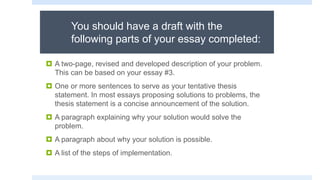
You should have a draft with the
following parts of your essay completed:
 A two-page, revised and developed description of your problem.
This can be based on your essay #3.
 One or more sentences to serve as your tentative thesis
statement. In most essays proposing solutions to problems, the
thesis statement is a concise announcement of the solution.
 A paragraph explaining why your solution would solve the
problem.
 A paragraph about why your solution is possible.
 A list of the steps of implementation.
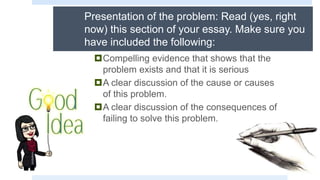
Presentation of the problem: Read (yes, right
now) this section of your essay. Make sure you
have included the following:
Compelling evidence that shows that the
problem exists and that it is serious
A clear discussion of the cause or causes
of this problem.
A clear discussion of the consequences of
failing to solve this problem.
Thesis Statement: Review
 You have probably written your thesis statement already. If so, refine
it, and make sure you have included it in your draft. If not, write it in
right now. Your thesis goes after a thorough explanation of the
problem.
 If you have not yet written it, write one or more sentences to serve
as your tentative thesis statement. In most essays proposing
solutions to problems, the thesis statement is a concise
announcement of the solution. Think about how emphatic you
should make the thesis and whether you should forecast your
reasons.
Description of the proposed solution
Read your working draft of your proposed
solution.
Have you explained how or why it would solve
the problem? If not, make notes here. If yes,
read and revise.
Have you explained how or why your solution
is possible. If not, make notes here. If yes,
read and revise.
We will address the steps of implementation next, so don’t
worry about that section quite yet.
List of steps for implementing the solution
 You should have written out these steps for your
homework. Read what you have, making sure you
have included each part.
 Now, put your steps into paragraph form. Make
sure to use transitions and connecting words so
the paragraph does not read like a list. Explain
exactly what you mean as you go through the
steps.
Anticipate Objections.
Remember, you write a counterargument that addresses objections readers might have to your solution.
Write a few sentences responding to the following objections you think are most likely. For homework,
you will further develop your ideas.
 We can’t afford your solution.
 Your solution would take too long to implement or to show results.
 People would not accept your solution, or they would not participate in it.
 Too few would benefit from your solution.
 You would benefit personally from your solution.
 We already tried your solution, with unsatisfactory results.
Consider Alternative Solutions
This requires thinking! Remember, ultimately,
you are going to show why your solution is better
than these alternatives!
Considering Alternative Solutions
List two or three alternative solutions. You may have
discovered these alternatives while you were looking for
a good solution. You may have found alternative
solutions when you did your research. You do not have
to list every solution that has been mentioned, but you
should include the most popular or serious alternatives.
If you include only obviously weak solutions in your
argument, your credibility will be harmed and you could
be accused of committing the straw man fallacy, which
involves directing your counterargument against an
alternative that nobody takes seriously anyway.
Developing your evaluation of alternative solutions
Write a paragraph for each alternative solution you think you should include in your
argument. Describe the alternative solution fairly, quoting supporters if possible.
Then work out the reasons you believe the alternative solution. You will further
develop your ideas for your homework.
 The alternative solution would not be feasible,
 The alternative solution would not solve the problem,
 The alternative solution would not be approved,
 The alternative solution would be hard to implement, or
 The alternative solution would be too costly, disruptive, or time-consuming to put
into effect.
Using Sources
Statistics can be helpful in establishing
that the problem exists and is serious. For
example, Patrick O’Malley cites
research to support his assertion that
students prefer frequent exams to
fewer high-stakes exams: “A Harvard
study notes students’ ‘strong preference
for frequent evaluation in a course’ ” (par.
4). But his argument would have been
stronger and possibly more convincing if
he had cited statistics to support the
study’s conclusion.
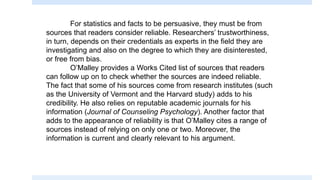
For statistics and facts to be persuasive, they must be from
sources that readers consider reliable. Researchers’ trustworthiness,
in turn, depends on their credentials as experts in the field they are
investigating and also on the degree to which they are disinterested,
or free from bias.
O’Malley provides a Works Cited list of sources that readers
can follow up on to check whether the sources are indeed reliable.
The fact that some of his sources come from research institutes (such
as the University of Vermont and the Harvard study) adds to his
credibility. He also relies on reputable academic journals for his
information (Journal of Counseling Psychology). Another factor that
adds to the appearance of reliability is that O’Malley cites a range of
sources instead of relying on only one or two. Moreover, the
information is current and clearly relevant to his argument.
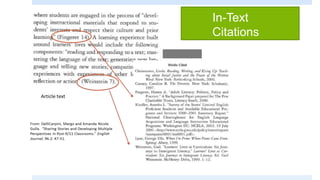
In-Text
Citations
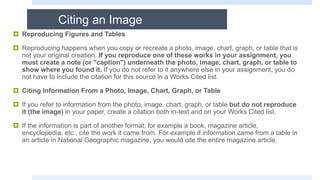
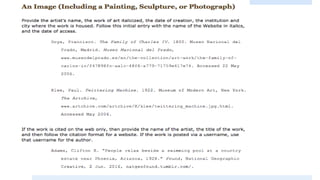
Citing an Image
 Reproducing Figures and Tables
 Reproducing happens when you copy or recreate a photo, image, chart, graph, or table that is
not your original creation. If you reproduce one of these works in your assignment, you
must create a note (or "caption") underneath the photo, image, chart, graph, or table to
show where you found it. If you do not refer to it anywhere else in your assignment, you do
not have to include the citation for this source in a Works Cited list.
 Citing Information From a Photo, Image, Chart, Graph, or Table
 If you refer to information from the photo, image, chart, graph, or table but do not reproduce
it (the image) in your paper, create a citation both in-text and on your Works Cited list.
 If the information is part of another format, for example a book, magazine article,
encyclopedia, etc., cite the work it came from. For example if information came from a table in
an article in National Geographic magazine, you would cite the entire magazine article.
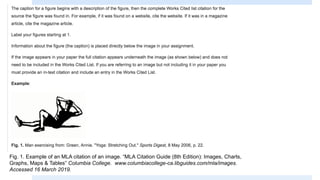
Fig. 1. Example of an MLA citation of an image. “MLA Citation Guide (8th Edition): Images, Charts,
Graphs, Maps & Tables” Columbia College. www.columbiacollege-ca.libguides.com/mla/images.
Accessed 16 March 2019.
Ask
Yourself:
Are my sources reliable?
Do they support my
assertions with facts,
statistics, or credible
opinions?
Do I need more support?
Where will I find it?
Review: Reference material for your
convenience:
Integrating Quotations, Citations, and Works
Cited
The next slides contain
information to help you
integrate and cite your
quotations and summary
correctly. Please use it to
minimize your errors.
In-Text Quotations
 At the Beginning
“Kitten season is overwhelming, crowded, and very hectic. I can be examining one cat and
there will be 10 or more waiting for me with more coming in one after the other on the other
side of the exam room door. It's never-ending and it affects the cats. They pick up on the
stress we feel," says Christa Raymond, a lead veterinary technician in the Animal Humane
Society (“Cats in Crisis”).
 In the Middle
In any given shelter, they are supposed to hold “strays up to only 5 days” according to
animal shelter specialist Stephanie Watson (6).
 At the End
According to Green Eco Services, “75% of Americans admit to littering within the past five
years.”
 Divided by Your Own Words
“We are always telling people about spay/neuter,” says Kit Belcher, the executive director
of Beltrami Humane Society, and “[t]he responsibility starts the day the animal is born, but
many don’t accept the responsibility” (“Spaying/Neutering” 14).
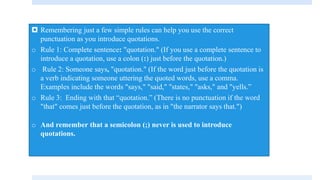
 Remembering just a few simple rules can help you use the correct
punctuation as you introduce quotations.
o Rule 1: Complete sentence: "quotation." (If you use a complete sentence to
introduce a quotation, use a colon (:) just before the quotation.)
o Rule 2: Someone says, "quotation." (If the word just before the quotation is
a verb indicating someone uttering the quoted words, use a comma.
Examples include the words "says," "said," "states," "asks," and "yells.”
o Rule 3: Ending with that “quotation.” (There is no punctuation if the word
"that" comes just before the quotation, as in "the narrator says that.")
o And remember that a semicolon (;) never is used to introduce
quotations.
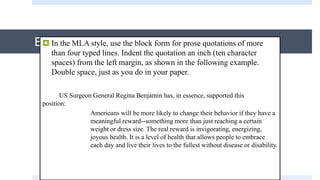
Block Quotations In the MLA style, use the block form for prose quotations of more
than four typed lines. Indent the quotation an inch (ten character
spaces) from the left margin, as shown in the following example.
Double space, just as you do in your paper.
US Surgeon General Regina Benjamin has, in essence, supported this
position:
Americans will be more likely to change their behavior if they have a
meaningful reward--something more than just reaching a certain
weight or dress size. The real reward is invigorating, energizing,
joyous health. It is a level of health that allows people to embrace
each day and live their lives to the fullest without disease or disability.
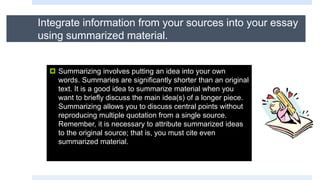
Integrate information from your sources into your essay
using summarized material.
 Summarizing involves putting an idea into your own
words. Summaries are significantly shorter than an original
text. It is a good idea to summarize material when you
want to briefly discuss the main idea(s) of a longer piece.
Summarizing allows you to discuss central points without
reproducing multiple quotation from a single source.
Remember, it is necessary to attribute summarized ideas
to the original source; that is, you must cite even
summarized material.
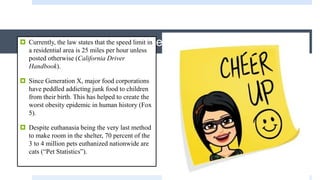
Citing Summarized Material Currently, the law states that the speed limit in
a residential area is 25 miles per hour unless
posted otherwise (California Driver
Handbook).
 Since Generation X, major food corporations
have peddled addicting junk food to children
from their birth. This has helped to create the
worst obesity epidemic in human history (Fox
5).
 Despite euthanasia being the very last method
to make room in the shelter, 70 percent of the
3 to 4 million pets euthanized nationwide are
cats (“Pet Statistics”).
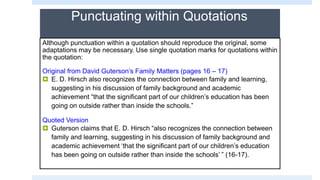
Punctuating within Quotations
Although punctuation within a quotation should reproduce the original, some
adaptations may be necessary. Use single quotation marks for quotations within
the quotation:
Original from David Guterson’s Family Matters (pages 16 – 17)
 E. D. Hirsch also recognizes the connection between family and learning,
suggesting in his discussion of family background and academic
achievement “that the significant part of our children’s education has been
going on outside rather than inside the schools.”
Quoted Version
 Guterson claims that E. D. Hirsch “also recognizes the connection between
family and learning, suggesting in his discussion of family background and
academic achievement ‘that the significant part of our children’s education
has been going on outside rather than inside the schools’ ” (16-17).
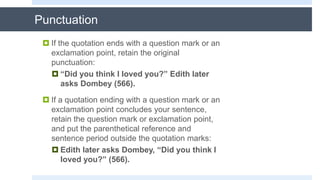
Punctuation
 If the quotation ends with a question mark or an
exclamation point, retain the original
punctuation:
 “Did you think I loved you?” Edith later
asks Dombey (566).
 If a quotation ending with a question mark or an
exclamation point concludes your sentence,
retain the question mark or exclamation point,
and put the parenthetical reference and
sentence period outside the quotation marks:
 Edith later asks Dombey, “Did you think I
loved you?” (566).
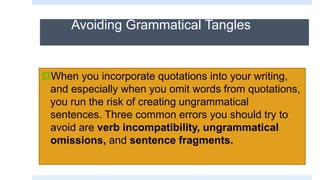
Avoiding Grammatical Tangles
When you incorporate quotations into your writing,
and especially when you omit words from quotations,
you run the risk of creating ungrammatical
sentences. Three common errors you should try to
avoid are verb incompatibility, ungrammatical
omissions, and sentence fragments.
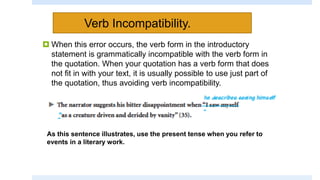
Verb Incompatibility.
 When this error occurs, the verb form in the introductory
statement is grammatically incompatible with the verb form in
the quotation. When your quotation has a verb form that does
not fit in with your text, it is usually possible to use just part of
the quotation, thus avoiding verb incompatibility.
As this sentence illustrates, use the present tense when you refer to
events in a literary work.
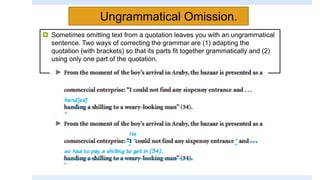
Ungrammatical Omission.
 Sometimes omitting text from a quotation leaves you with an ungrammatical
sentence. Two ways of correcting the grammar are (1) adapting the
quotation (with brackets) so that its parts fit together grammatically and (2)
using only one part of the quotation.
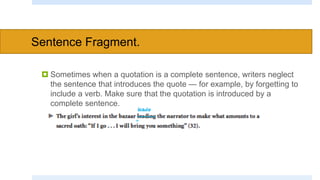
Sentence Fragment.
 Sometimes when a quotation is a complete sentence, writers neglect
the sentence that introduces the quote — for example, by forgetting to
include a verb. Make sure that the quotation is introduced by a
complete sentence.
Plan Follow-Up Research.
Make notes about the kinds of
information you think would help
make your counterargument
convincing for your readers and
where you think you can find this
information.
Homework
 HW Discussion #37: Post a paragraph addressing
at least one counterargument
 HW Discussion #38: Post a paragraph addressing
at least one alternative solutions
 Put all of the parts of your essay into the outline
we wrote today. Read your essay aloud to make
sure it is in a logical order. Integrate your research
into your essay. Begin your works cited page.
 Revision due Friday at Midnight

Class 34

  • 2.
    Agenda  Review: Essay#6:  The Problem  The Solution  New  The Counterargument  The Alternative Solutions Technical Help Sentence Strategies Integrating and Citing Sources
  • 3.
    Essay #6 Looking atthe parts of the essay
  • 4.
    You should havea draft with the following parts of your essay completed:  A two-page, revised and developed description of your problem. This can be based on your essay #3.  One or more sentences to serve as your tentative thesis statement. In most essays proposing solutions to problems, the thesis statement is a concise announcement of the solution.  A paragraph explaining why your solution would solve the problem.  A paragraph about why your solution is possible.  A list of the steps of implementation.
  • 5.
    Presentation of theproblem: Read (yes, right now) this section of your essay. Make sure you have included the following: Compelling evidence that shows that the problem exists and that it is serious A clear discussion of the cause or causes of this problem. A clear discussion of the consequences of failing to solve this problem.
  • 6.
    Thesis Statement: Review You have probably written your thesis statement already. If so, refine it, and make sure you have included it in your draft. If not, write it in right now. Your thesis goes after a thorough explanation of the problem.  If you have not yet written it, write one or more sentences to serve as your tentative thesis statement. In most essays proposing solutions to problems, the thesis statement is a concise announcement of the solution. Think about how emphatic you should make the thesis and whether you should forecast your reasons.
  • 7.
    Description of theproposed solution Read your working draft of your proposed solution. Have you explained how or why it would solve the problem? If not, make notes here. If yes, read and revise. Have you explained how or why your solution is possible. If not, make notes here. If yes, read and revise. We will address the steps of implementation next, so don’t worry about that section quite yet.
  • 8.
    List of stepsfor implementing the solution  You should have written out these steps for your homework. Read what you have, making sure you have included each part.  Now, put your steps into paragraph form. Make sure to use transitions and connecting words so the paragraph does not read like a list. Explain exactly what you mean as you go through the steps.
  • 10.
    Anticipate Objections. Remember, youwrite a counterargument that addresses objections readers might have to your solution. Write a few sentences responding to the following objections you think are most likely. For homework, you will further develop your ideas.  We can’t afford your solution.  Your solution would take too long to implement or to show results.  People would not accept your solution, or they would not participate in it.  Too few would benefit from your solution.  You would benefit personally from your solution.  We already tried your solution, with unsatisfactory results.
  • 11.
    Consider Alternative Solutions Thisrequires thinking! Remember, ultimately, you are going to show why your solution is better than these alternatives!
  • 12.
    Considering Alternative Solutions Listtwo or three alternative solutions. You may have discovered these alternatives while you were looking for a good solution. You may have found alternative solutions when you did your research. You do not have to list every solution that has been mentioned, but you should include the most popular or serious alternatives. If you include only obviously weak solutions in your argument, your credibility will be harmed and you could be accused of committing the straw man fallacy, which involves directing your counterargument against an alternative that nobody takes seriously anyway.
  • 13.
    Developing your evaluationof alternative solutions Write a paragraph for each alternative solution you think you should include in your argument. Describe the alternative solution fairly, quoting supporters if possible. Then work out the reasons you believe the alternative solution. You will further develop your ideas for your homework.  The alternative solution would not be feasible,  The alternative solution would not solve the problem,  The alternative solution would not be approved,  The alternative solution would be hard to implement, or  The alternative solution would be too costly, disruptive, or time-consuming to put into effect.
  • 14.
    Using Sources Statistics canbe helpful in establishing that the problem exists and is serious. For example, Patrick O’Malley cites research to support his assertion that students prefer frequent exams to fewer high-stakes exams: “A Harvard study notes students’ ‘strong preference for frequent evaluation in a course’ ” (par. 4). But his argument would have been stronger and possibly more convincing if he had cited statistics to support the study’s conclusion.
  • 15.
    For statistics andfacts to be persuasive, they must be from sources that readers consider reliable. Researchers’ trustworthiness, in turn, depends on their credentials as experts in the field they are investigating and also on the degree to which they are disinterested, or free from bias. O’Malley provides a Works Cited list of sources that readers can follow up on to check whether the sources are indeed reliable. The fact that some of his sources come from research institutes (such as the University of Vermont and the Harvard study) adds to his credibility. He also relies on reputable academic journals for his information (Journal of Counseling Psychology). Another factor that adds to the appearance of reliability is that O’Malley cites a range of sources instead of relying on only one or two. Moreover, the information is current and clearly relevant to his argument.
  • 16.
  • 17.
    Citing an Image Reproducing Figures and Tables  Reproducing happens when you copy or recreate a photo, image, chart, graph, or table that is not your original creation. If you reproduce one of these works in your assignment, you must create a note (or "caption") underneath the photo, image, chart, graph, or table to show where you found it. If you do not refer to it anywhere else in your assignment, you do not have to include the citation for this source in a Works Cited list.  Citing Information From a Photo, Image, Chart, Graph, or Table  If you refer to information from the photo, image, chart, graph, or table but do not reproduce it (the image) in your paper, create a citation both in-text and on your Works Cited list.  If the information is part of another format, for example a book, magazine article, encyclopedia, etc., cite the work it came from. For example if information came from a table in an article in National Geographic magazine, you would cite the entire magazine article.
  • 18.
    Fig. 1. Exampleof an MLA citation of an image. “MLA Citation Guide (8th Edition): Images, Charts, Graphs, Maps & Tables” Columbia College. www.columbiacollege-ca.libguides.com/mla/images. Accessed 16 March 2019.
  • 20.
    Ask Yourself: Are my sourcesreliable? Do they support my assertions with facts, statistics, or credible opinions? Do I need more support? Where will I find it?
  • 21.
    Review: Reference materialfor your convenience: Integrating Quotations, Citations, and Works Cited The next slides contain information to help you integrate and cite your quotations and summary correctly. Please use it to minimize your errors.
  • 22.
    In-Text Quotations  Atthe Beginning “Kitten season is overwhelming, crowded, and very hectic. I can be examining one cat and there will be 10 or more waiting for me with more coming in one after the other on the other side of the exam room door. It's never-ending and it affects the cats. They pick up on the stress we feel," says Christa Raymond, a lead veterinary technician in the Animal Humane Society (“Cats in Crisis”).  In the Middle In any given shelter, they are supposed to hold “strays up to only 5 days” according to animal shelter specialist Stephanie Watson (6).  At the End According to Green Eco Services, “75% of Americans admit to littering within the past five years.”  Divided by Your Own Words “We are always telling people about spay/neuter,” says Kit Belcher, the executive director of Beltrami Humane Society, and “[t]he responsibility starts the day the animal is born, but many don’t accept the responsibility” (“Spaying/Neutering” 14).
  • 23.
     Remembering justa few simple rules can help you use the correct punctuation as you introduce quotations. o Rule 1: Complete sentence: "quotation." (If you use a complete sentence to introduce a quotation, use a colon (:) just before the quotation.) o Rule 2: Someone says, "quotation." (If the word just before the quotation is a verb indicating someone uttering the quoted words, use a comma. Examples include the words "says," "said," "states," "asks," and "yells.” o Rule 3: Ending with that “quotation.” (There is no punctuation if the word "that" comes just before the quotation, as in "the narrator says that.") o And remember that a semicolon (;) never is used to introduce quotations.
  • 24.
    Block Quotations Inthe MLA style, use the block form for prose quotations of more than four typed lines. Indent the quotation an inch (ten character spaces) from the left margin, as shown in the following example. Double space, just as you do in your paper. US Surgeon General Regina Benjamin has, in essence, supported this position: Americans will be more likely to change their behavior if they have a meaningful reward--something more than just reaching a certain weight or dress size. The real reward is invigorating, energizing, joyous health. It is a level of health that allows people to embrace each day and live their lives to the fullest without disease or disability.
  • 25.
    Integrate information fromyour sources into your essay using summarized material.  Summarizing involves putting an idea into your own words. Summaries are significantly shorter than an original text. It is a good idea to summarize material when you want to briefly discuss the main idea(s) of a longer piece. Summarizing allows you to discuss central points without reproducing multiple quotation from a single source. Remember, it is necessary to attribute summarized ideas to the original source; that is, you must cite even summarized material.
  • 26.
    Citing Summarized MaterialCurrently, the law states that the speed limit in a residential area is 25 miles per hour unless posted otherwise (California Driver Handbook).  Since Generation X, major food corporations have peddled addicting junk food to children from their birth. This has helped to create the worst obesity epidemic in human history (Fox 5).  Despite euthanasia being the very last method to make room in the shelter, 70 percent of the 3 to 4 million pets euthanized nationwide are cats (“Pet Statistics”).
  • 27.
    Punctuating within Quotations Althoughpunctuation within a quotation should reproduce the original, some adaptations may be necessary. Use single quotation marks for quotations within the quotation: Original from David Guterson’s Family Matters (pages 16 – 17)  E. D. Hirsch also recognizes the connection between family and learning, suggesting in his discussion of family background and academic achievement “that the significant part of our children’s education has been going on outside rather than inside the schools.” Quoted Version  Guterson claims that E. D. Hirsch “also recognizes the connection between family and learning, suggesting in his discussion of family background and academic achievement ‘that the significant part of our children’s education has been going on outside rather than inside the schools’ ” (16-17).
  • 28.
    Punctuation  If thequotation ends with a question mark or an exclamation point, retain the original punctuation:  “Did you think I loved you?” Edith later asks Dombey (566).  If a quotation ending with a question mark or an exclamation point concludes your sentence, retain the question mark or exclamation point, and put the parenthetical reference and sentence period outside the quotation marks:  Edith later asks Dombey, “Did you think I loved you?” (566).
  • 29.
    Avoiding Grammatical Tangles Whenyou incorporate quotations into your writing, and especially when you omit words from quotations, you run the risk of creating ungrammatical sentences. Three common errors you should try to avoid are verb incompatibility, ungrammatical omissions, and sentence fragments.
  • 30.
    Verb Incompatibility.  Whenthis error occurs, the verb form in the introductory statement is grammatically incompatible with the verb form in the quotation. When your quotation has a verb form that does not fit in with your text, it is usually possible to use just part of the quotation, thus avoiding verb incompatibility. As this sentence illustrates, use the present tense when you refer to events in a literary work.
  • 31.
    Ungrammatical Omission.  Sometimesomitting text from a quotation leaves you with an ungrammatical sentence. Two ways of correcting the grammar are (1) adapting the quotation (with brackets) so that its parts fit together grammatically and (2) using only one part of the quotation.
  • 32.
    Sentence Fragment.  Sometimeswhen a quotation is a complete sentence, writers neglect the sentence that introduces the quote — for example, by forgetting to include a verb. Make sure that the quotation is introduced by a complete sentence.
  • 33.
    Plan Follow-Up Research. Makenotes about the kinds of information you think would help make your counterargument convincing for your readers and where you think you can find this information.
  • 34.
    Homework  HW Discussion#37: Post a paragraph addressing at least one counterargument  HW Discussion #38: Post a paragraph addressing at least one alternative solutions  Put all of the parts of your essay into the outline we wrote today. Read your essay aloud to make sure it is in a logical order. Integrate your research into your essay. Begin your works cited page.  Revision due Friday at Midnight