Generating Ideas
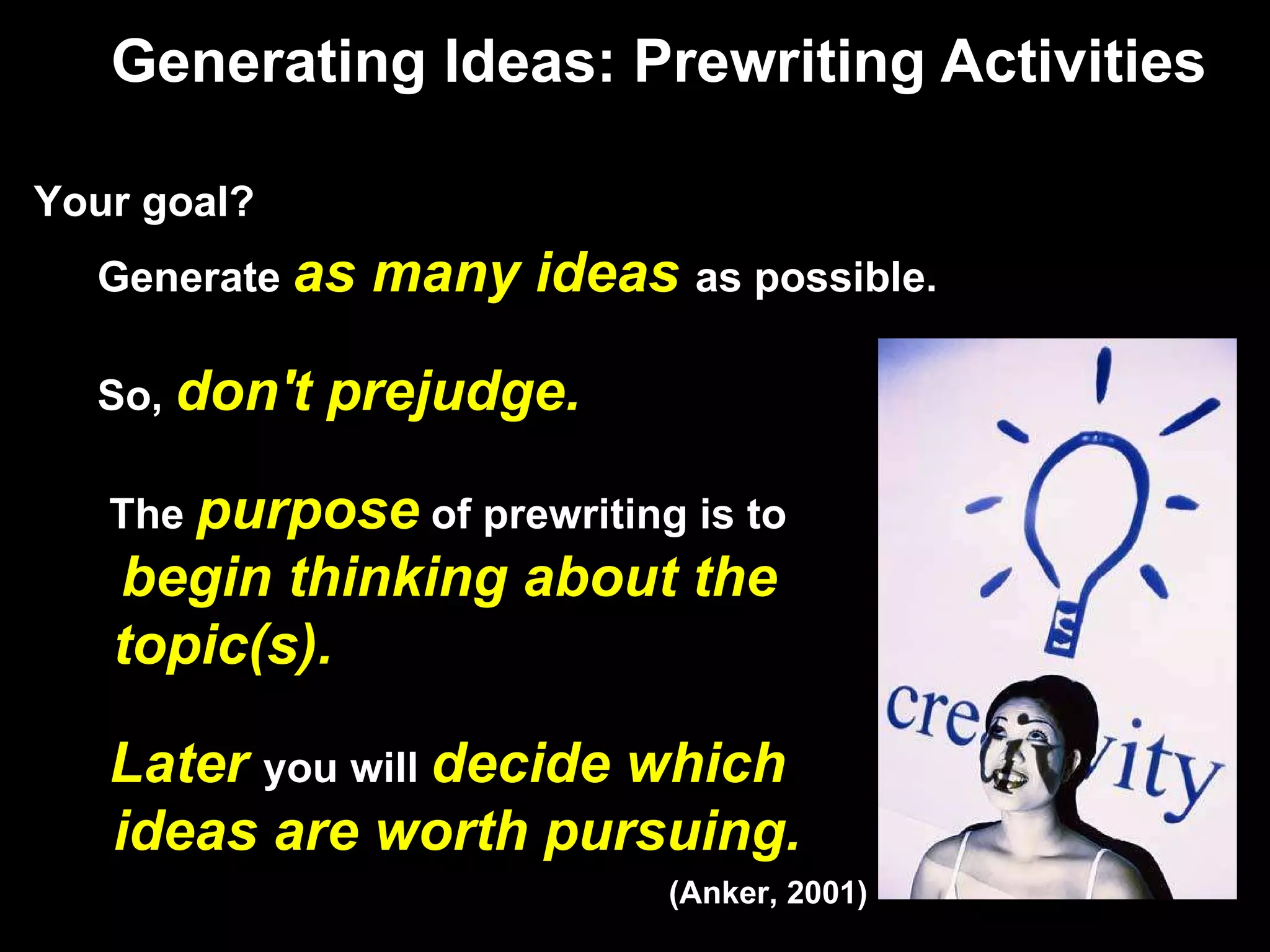
Generating Ideas: Prewriting Activities Your goal? Generate  as many ideas   as possible. So,  don't prejudge. The  purpose  of prewriting is to  begin thinking about the  topic(s).  Later  you will  decide which  ideas are worth pursuing. (Anker, 2001)
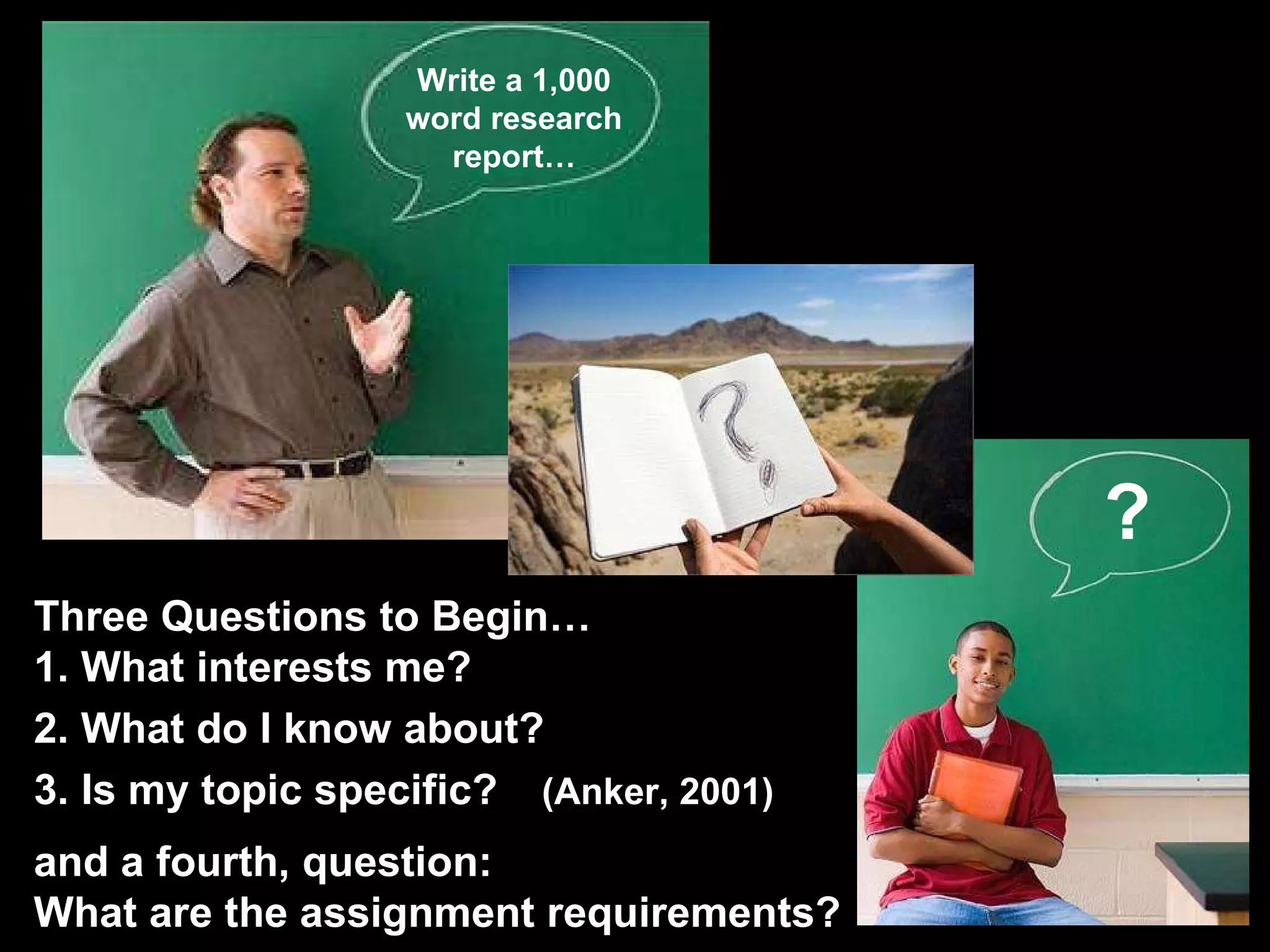
Th Write a 1,000 word research report… ? Three Questions to Begin… 1. What interests me? 2. What do I know about? 3. Is my topic specific?  (Anker, 2001) and a fourth, question: What are the assignment requirements?
A Topic Let's begin with a topic. Pick TWO of the following: Children [or Childhood] An issue [at the university] Leisure time Environmental problems Technology An important new discovery (Taken directly from Anker, 2001)
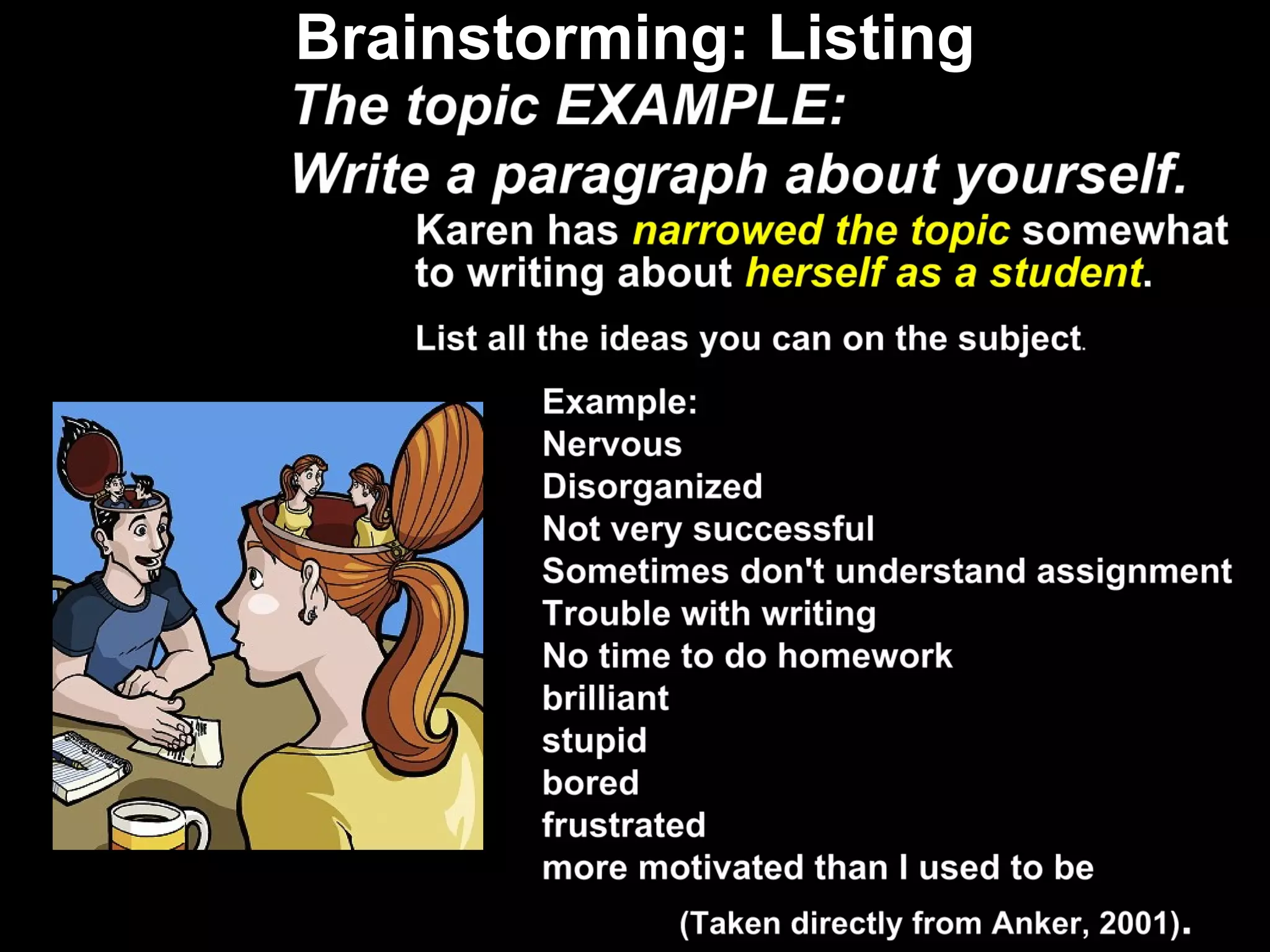
Brainstorming: Listing
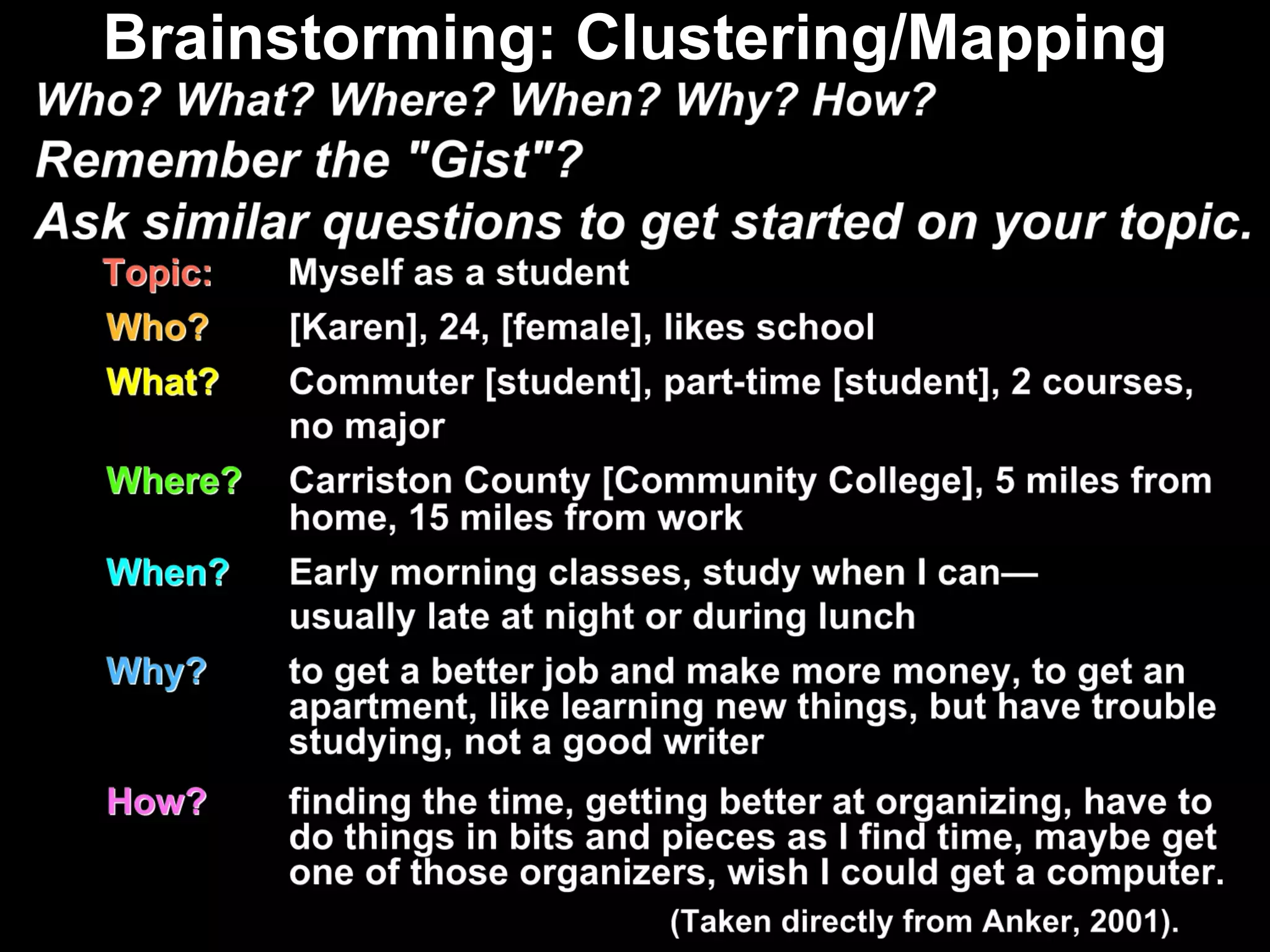
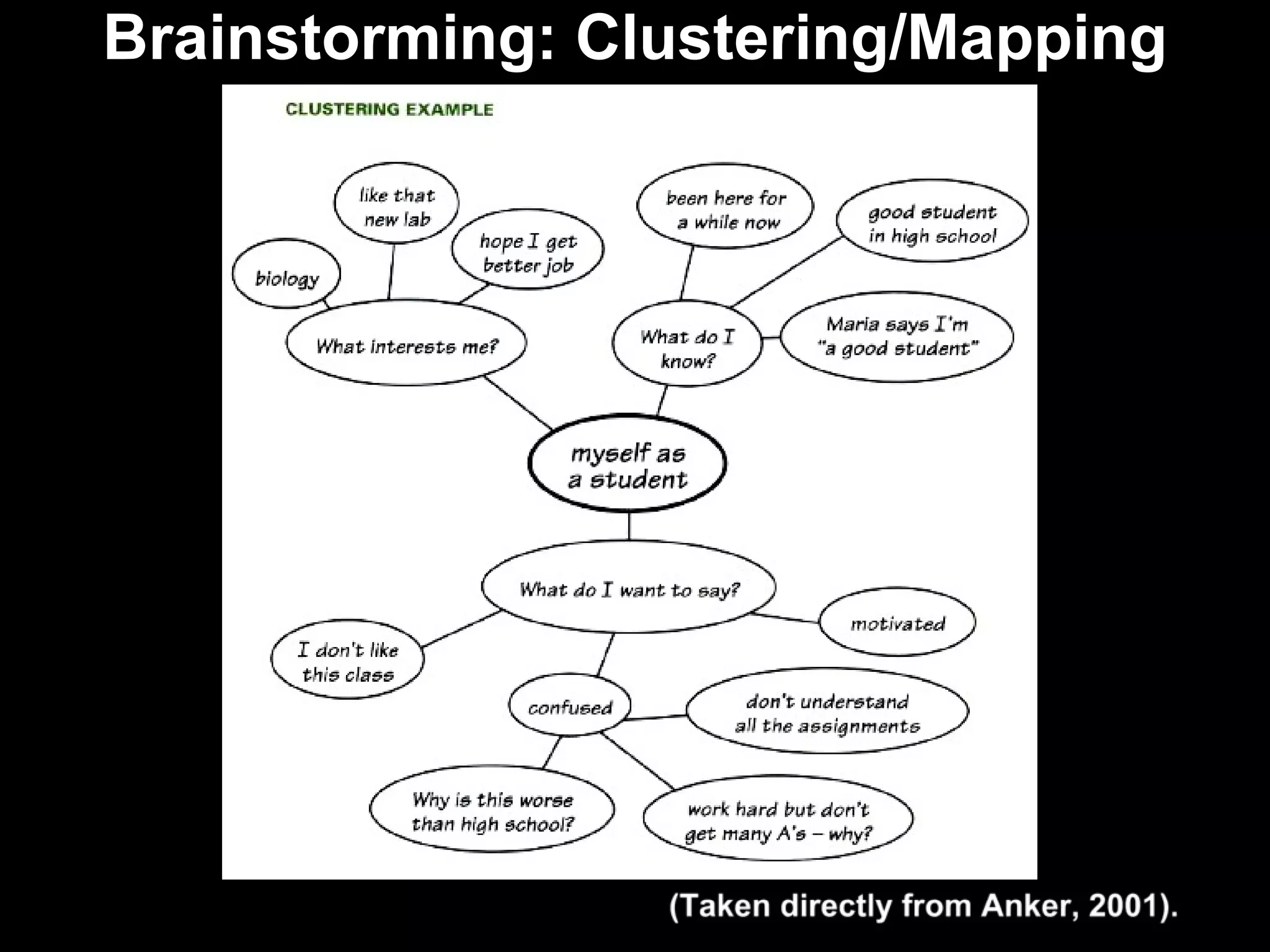
Brainstorming: Clustering/Mapping
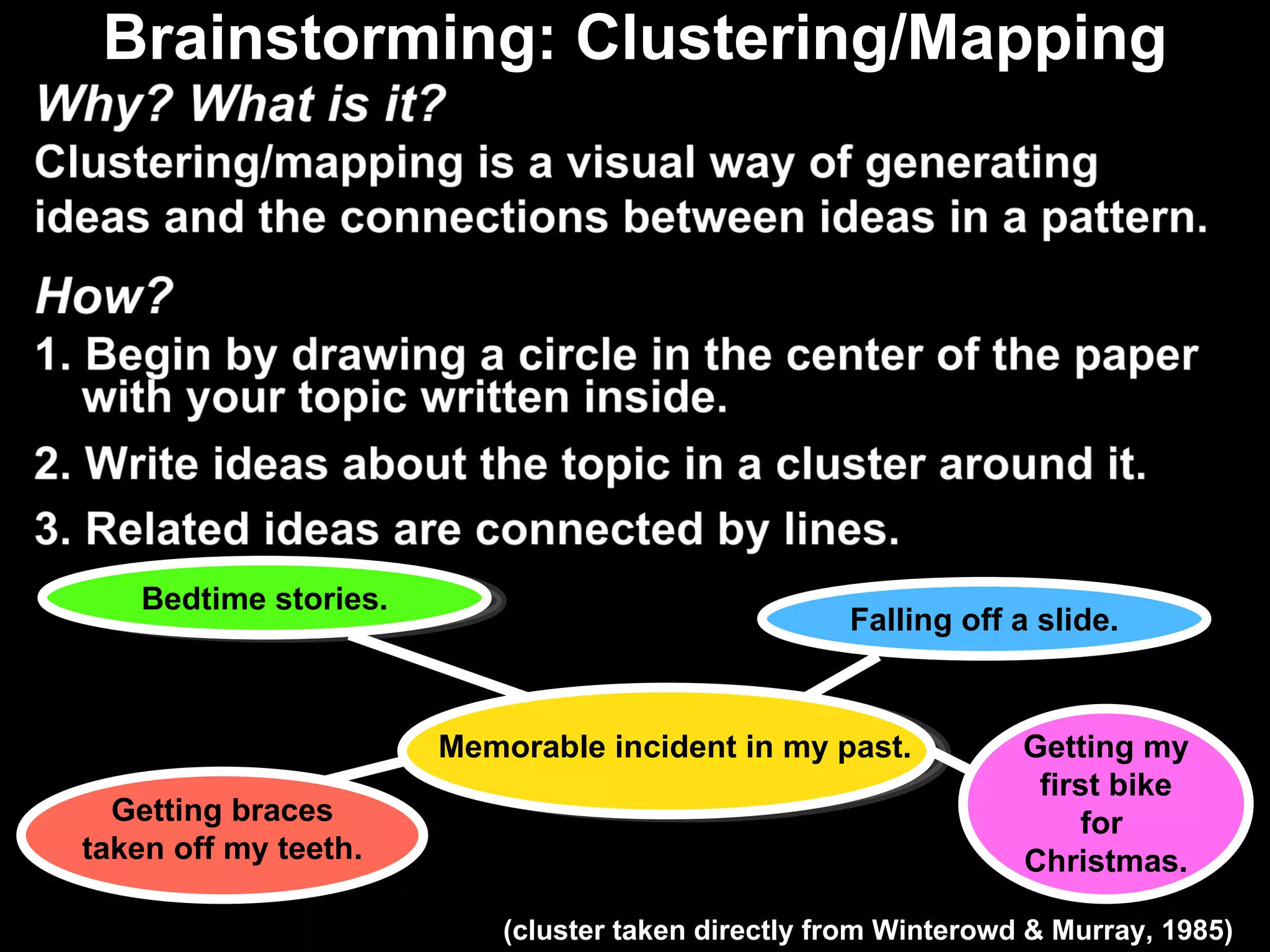
Brainstorming: Clustering/Mapping Memorable incident in my past. Bedtime stories. Falling off a slide. Getting braces taken off my teeth. Getting my first bike for  Christmas. (cluster taken directly from Winterowd & Murray, 1985)
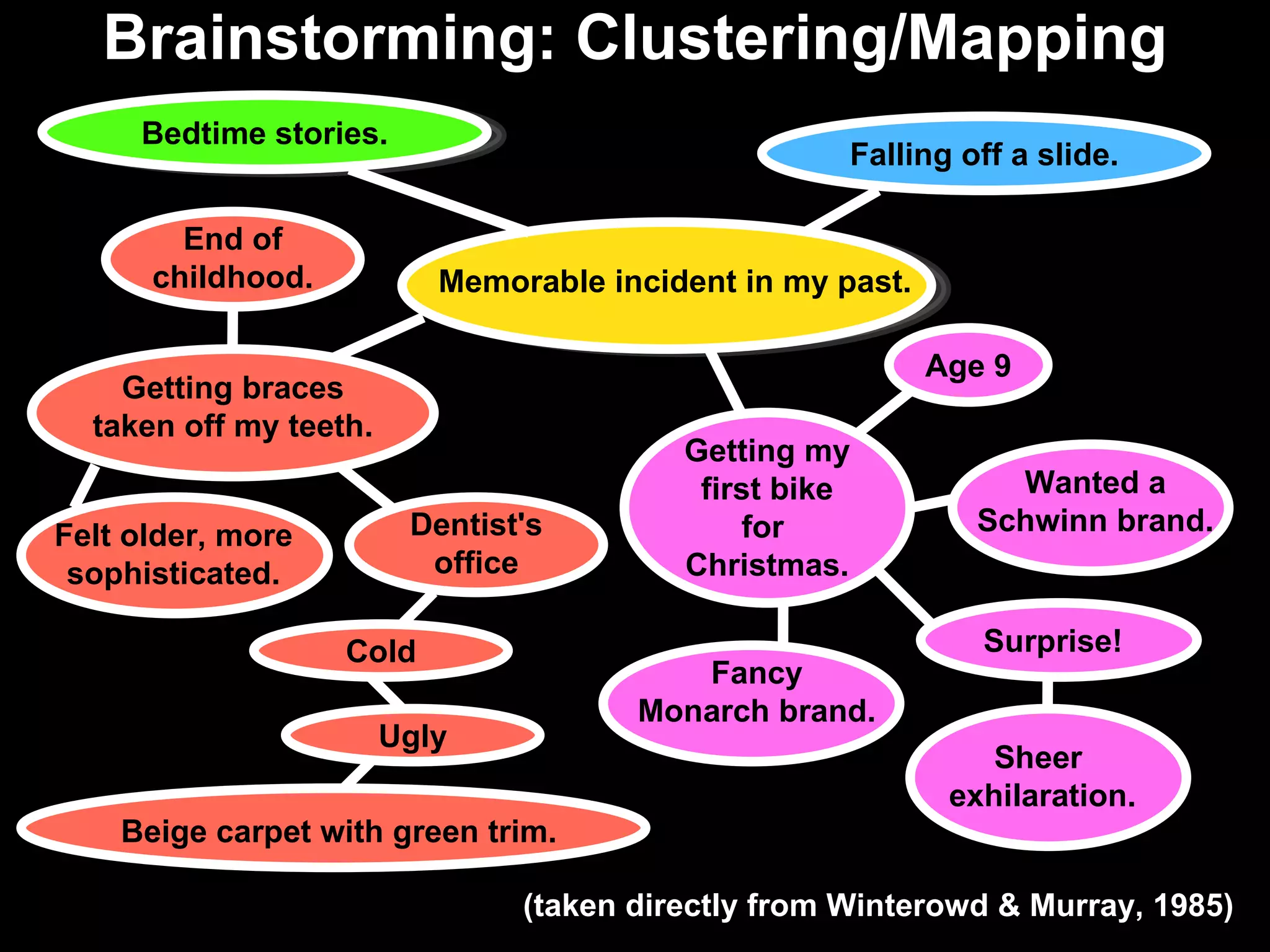
Brainstorming: Clustering/Mapping Memorable incident in my past. Bedtime stories. Falling off a slide. Getting braces taken off my teeth. Getting my first bike for  Christmas. Age 9 Wanted a Schwinn brand. Surprise! Sheer  exhilaration. Fancy Monarch brand. End of childhood. Felt older, more sophisticated. Dentist's office Cold Ugly Beige carpet with green trim. (taken directly from Winterowd & Murray, 1985)
Brainstorming: Clustering/Mapping
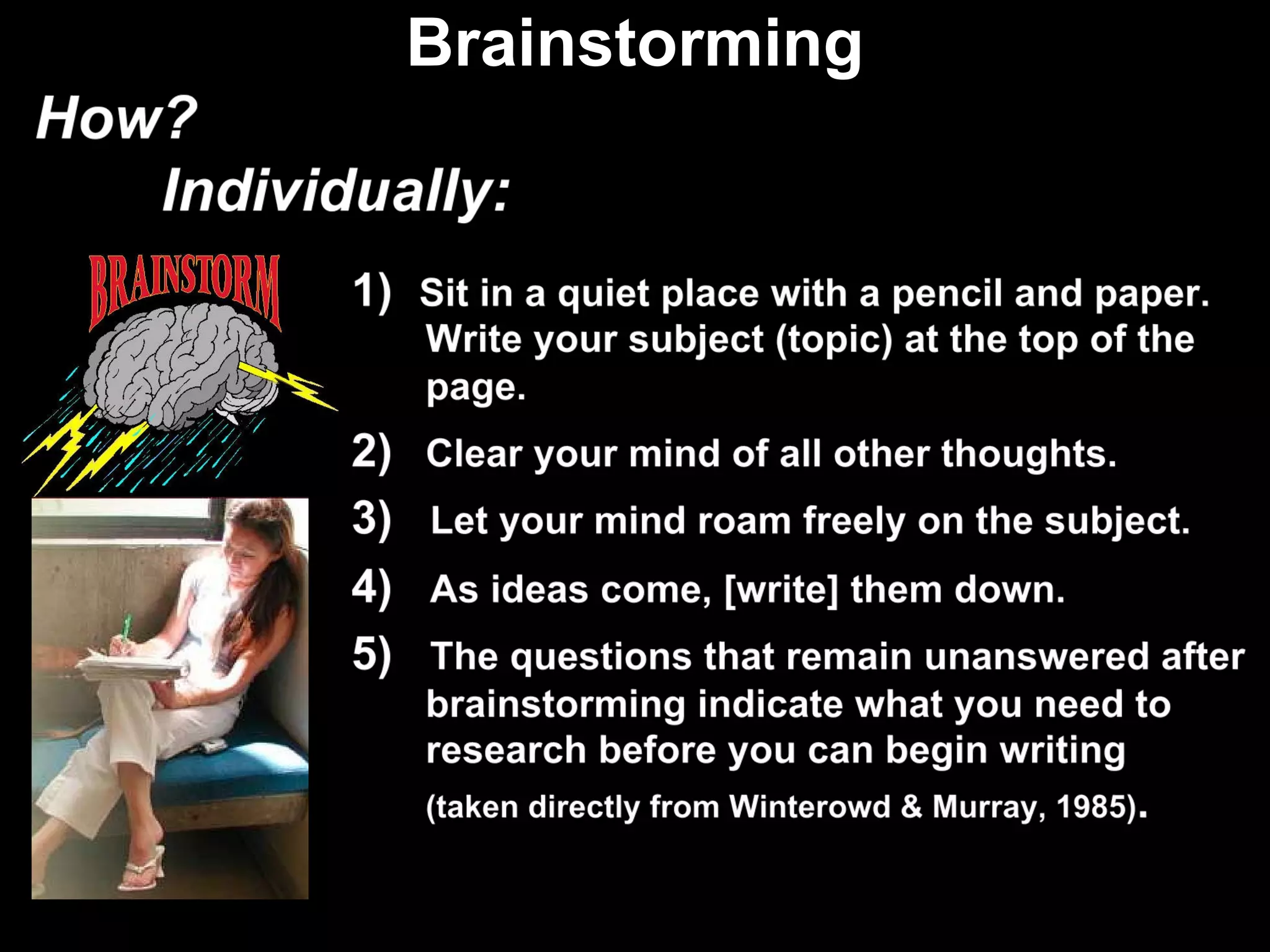
Brainstorming
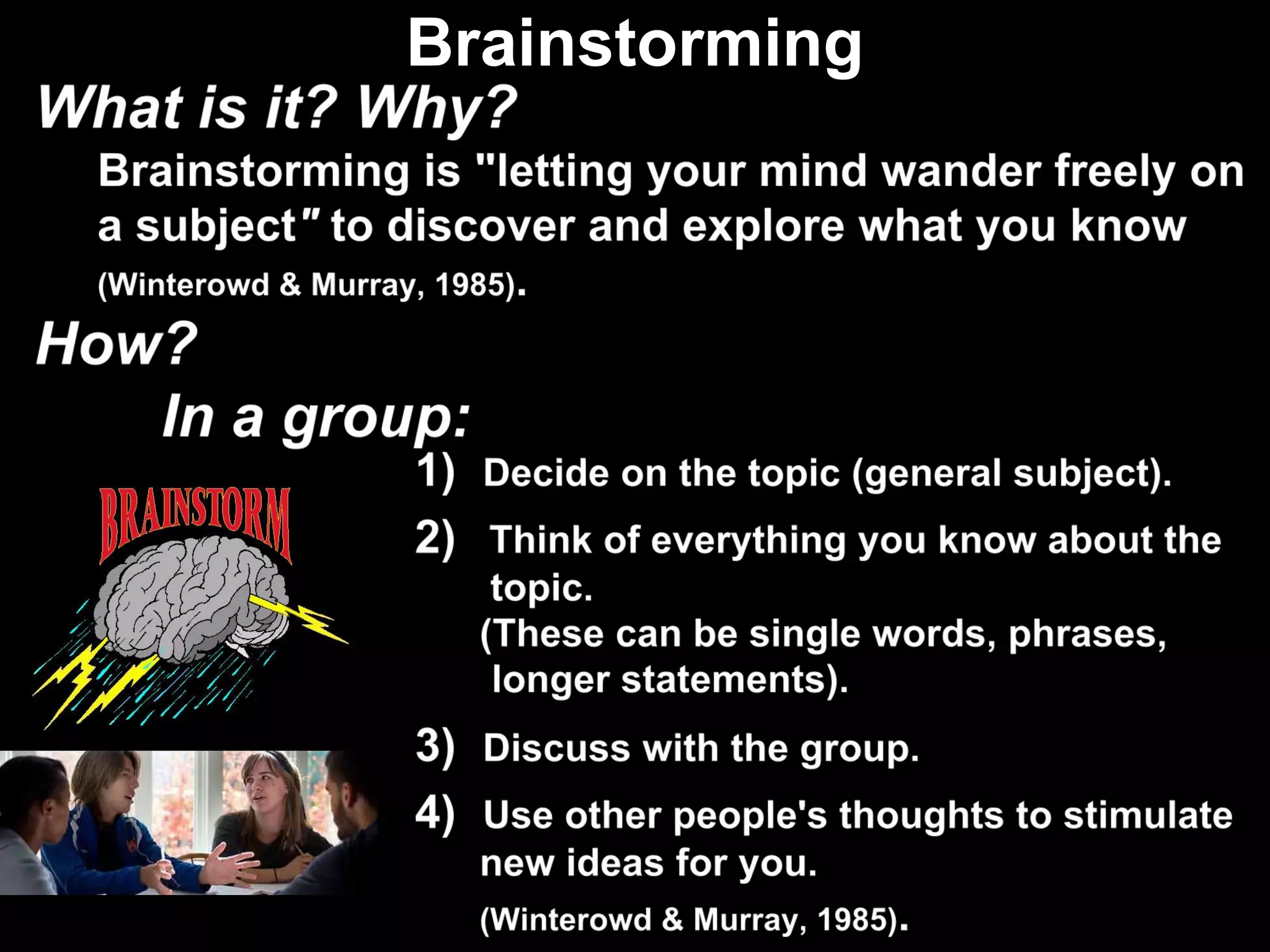
Brainstorming
Brainstorming
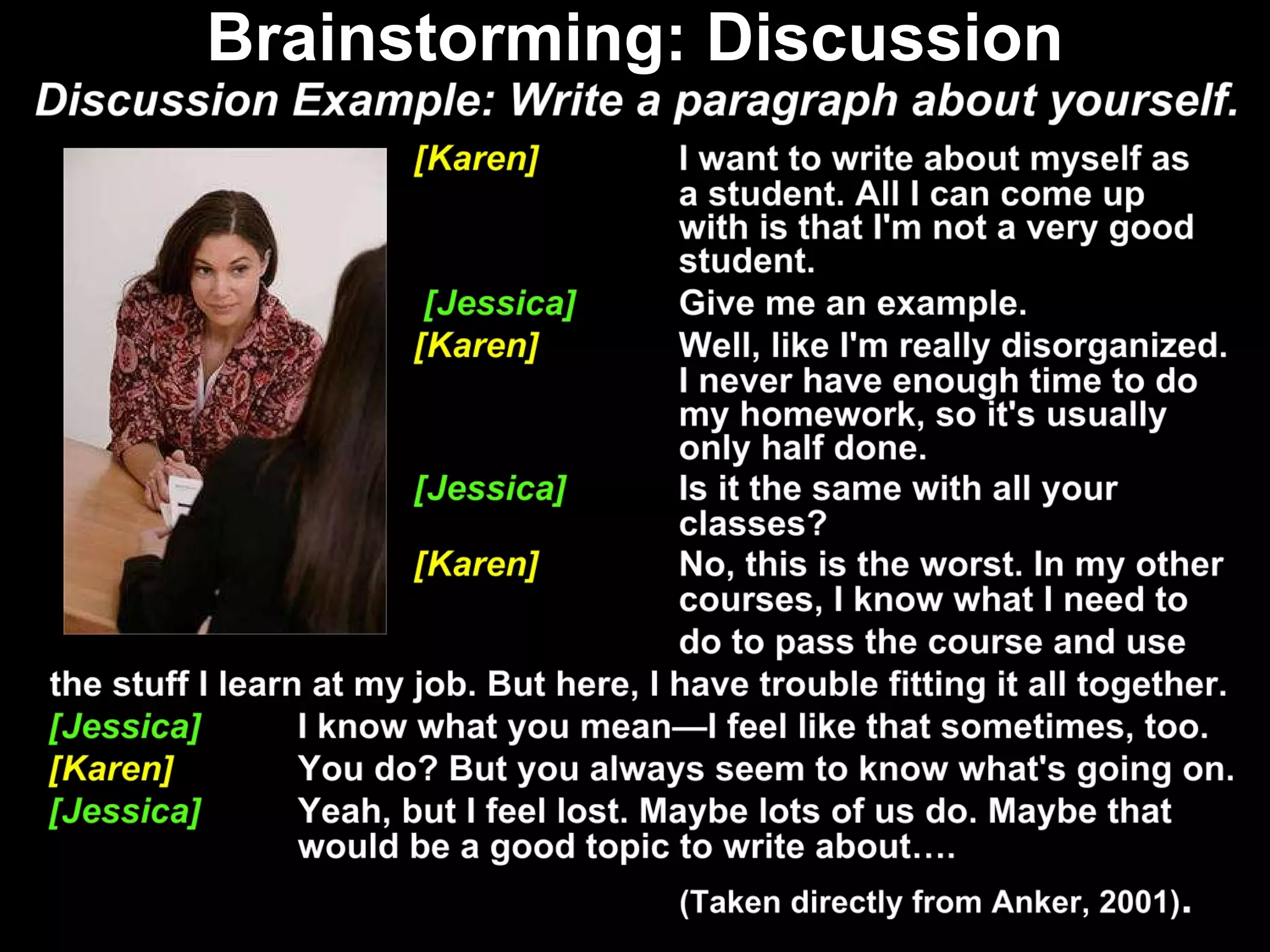
Brainstorming: Discussion
Pentad: Asking Questions to  Generate Ideas and Detail 1. What is the action? 2. Who are the actors? 3. What is the scene? 4. What is the method? 5. What is the purpose?
APA Format The following guidelines apply for an APA  style paper: Include a page  header on the  top of every page . The page header  is different on the  title page than on  the pages that  follow . The header should align with the left  Title page header: margin; the page  Running head: TITLE OF YOUR PAPER number should align with the right All other pages:  margin TITLE OF YOUR PAPER  (Angeli, et. al. 2010) Title page All other pages
APA Style For a sample APA-style paper with notes  on formatting go to Course Documents on  BlackBoard (BB).
APA Style Papers: Literature Review What is it? "A literature review is a summary of what the  scientific literature says about your specific topic or question" (Angeli, et. al., 2010) .     Why? When? The literature demonstrates your familiarity with prior  research into the topic. Before you begin writing your  professor may ask you to write a literature review for this  purpose (Angeli, et. al., 2010). Main Parts: title page introduction section list of references (possibly) abstract
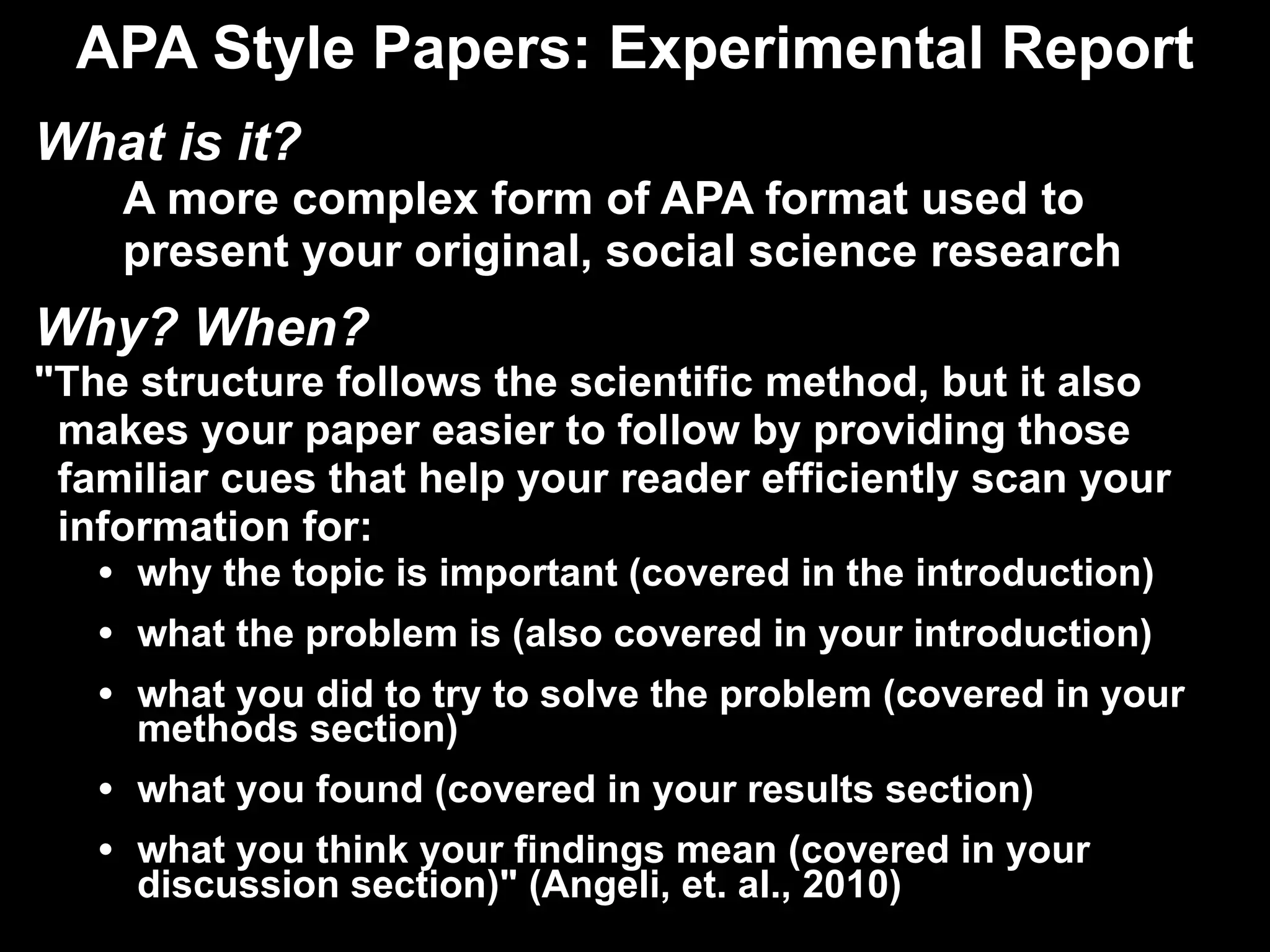
APA Style Papers: Experimental Report What is it? A more complex form of APA format used to present your original, social science research Why? When? "The structure follows the scientific method, but it also  makes your paper easier to follow by providing those  familiar cues that help your reader efficiently scan your  information for: why the topic is important (covered in the introduction) what the problem is (also covered in your introduction) what you did to try to solve the problem (covered in your methods section) what you found (covered in your results section) what you think your findings mean (covered in your discussion section)" (Angeli, et. al., 2010)
Abstract An abstract is a summary of the main points of your  research .  Abstract format/contents: include the header at the top of the page, first line, center the word "Abstract" (upper and lower case, plain text—no bold, italics, underlining, or quotation marks), In block style (no indenting) write the  abstract, which should be between 150-250  words At minimum the abstract includes: "research topic, research questions, participants, methods, results, data analysis, and conclusions" (this will differ for a literature review abstract) (Angeli, et. al.)
Properly Citing Sources Some “rules” always remain true: If you are  quoting a source directly , always:  - Use quotation marks  “ ” - Indicate in the sentence whom you are quoting If you are  paraphrasing someone else’s idea , always: - Acknowledge whose idea it is,  use indicator words  like  “According to…” , “As ...... says” ,  “As reported by .......” ,  “...... says that” - Although you are using your own words when when  paraphrasing ,  you still need to  cite the source of the information .
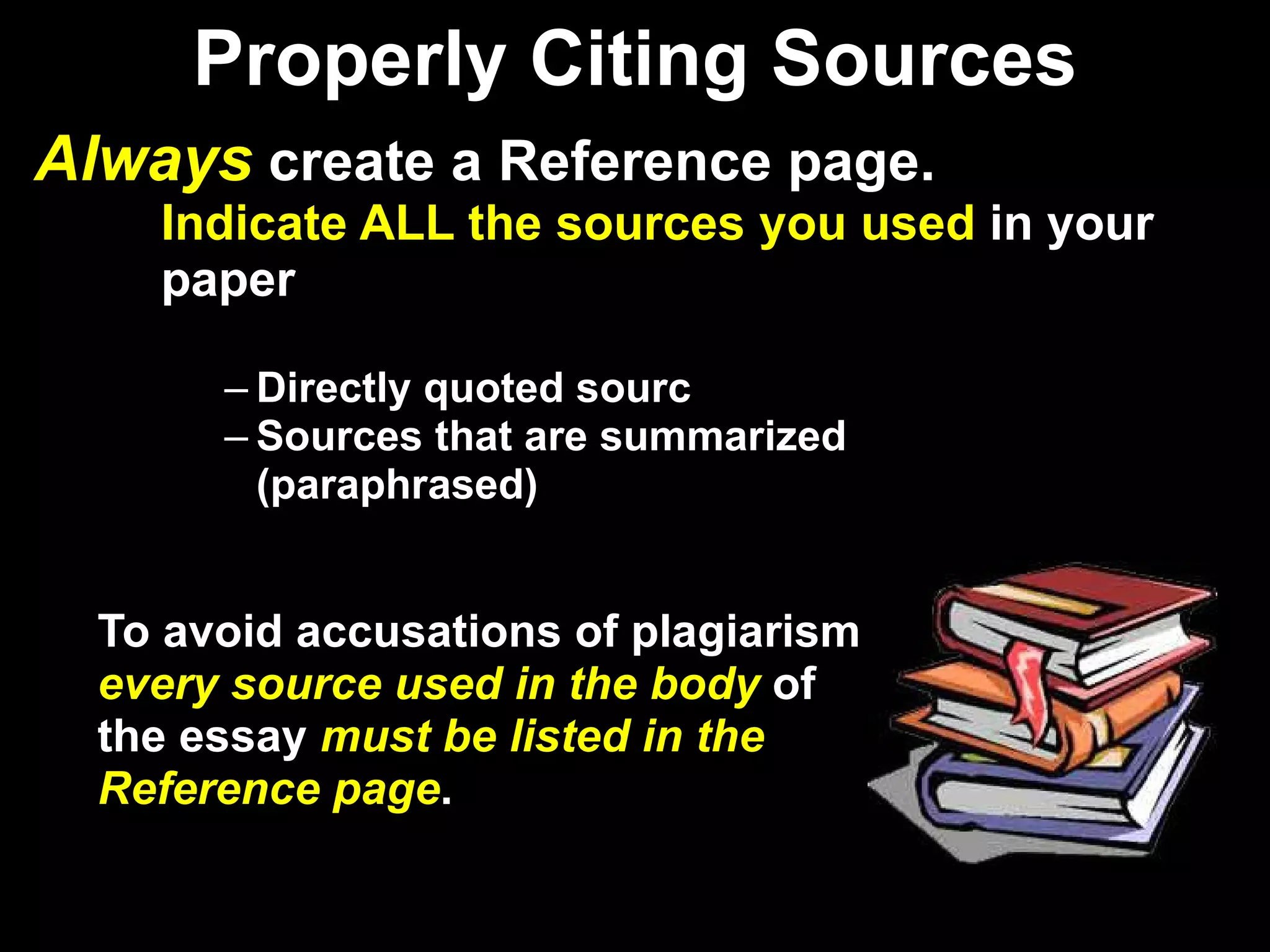
Properly Citing Sources Always   create a Reference page. Indicate ALL the sources you used  in your  paper  Directly quoted sourc Sources that are summarized (paraphrased) To avoid accusations of plagiarism every source used in the body  of the essay  must be listed in the Reference page .
In-text Citation: Ways to Cite Sources Author of a Quote Should be Acknowledged directly  before  or  after  the quoted  or referenced material Use words such as “ says ,” “ explains ,”  “ believes ,” “ thinks ,” “ argued ,” or “ demands .” The first time a source is mentioned, it is recommended to  use their  f u l l   n a m e  and an  indication of his or her  credibility . After the introduction use the  surname (family name). EXAMPLE: From this foundation,  Dr. Elliot  Smith  (2002) , an economist at  Milford University,   argued that  “humankind ought  to be left to  follow its inborn inclinations, which were to sustain life and to  acquire goods (p. 5).  [ title/given name  surname  date  signal word  credibility ]
Direct Quotations : Quotation Marks  and  Commas Smith   (1998)  says ,   “ What we require is a new method . ” “ What we require is a new method , ”   says  Smith . “ Thirty minutes later , ”   Edelman  said ,   “ subjects      responded negatively . ” Edelman said ,  “ Thirty minutes later subjects responded  negatively . ” “ Thirty minutes later subjects responded negatively , ”   said    Edelman .  [ surname  comma  quotation mark  quote  period ]
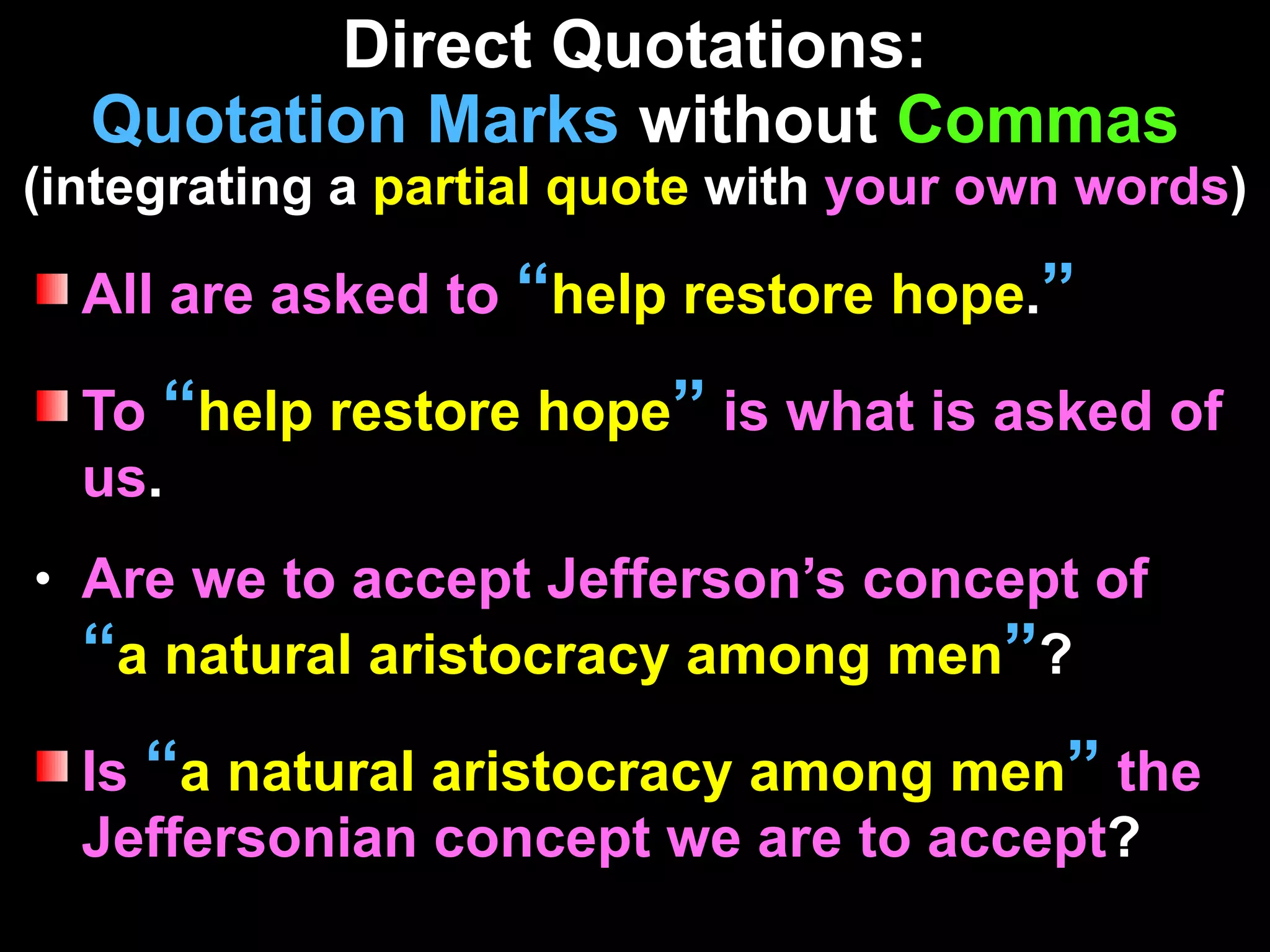
Direct Quotations: Quotation Marks  without  Commas (integrating a  partial quote  with  your own words ) All are asked to  “ help restore hope . ” To   “ help restore hope ”   is what is asked of us . Are we to accept Jefferson’s concept of  “ a natural aristocracy among men ” ? Is   “ a natural aristocracy among men ”   the Jeffersonian concept we are to accept ?
Ways to Cite Sources (Print) EXAMPLE (Author with signal phrase): According to  Jones   ( 1998 ) ,  “ Students often had difficulty using APA style, especially when it was their first time ”   (p. 199) .  EXAMPLE  (Author quote and writer's own material): Jones   ( 1998 )  found,  “ Students often had difficulty using APA style, especially when it was their first time ”   (p. 199) ;  what implications does this have for teachers? EXAMPLE (Author not named in signal phrase): She  stated ,  “ Students often had difficulty using APA style ”   ( Jones ,  1998 ,   p. 199 ), but she did not offer an explanation as to why .  [ surname  date   signal words  quotation mark  quote  page numbers ]
Summary or Paraphrase If you are  paraphrasing an idea  from another work,  you  only have to make reference to the author and  year of publication  in your in-text reference, but APA  guidelines  encourage you to also provide the page  number  (although it is not required). Examples: According to  Jones  ( 1998 ), APA style is a different citation format for first-time learners. APA style is a difficult citation format for first-time learners ( Jones ,  1998 ,  p. 199 ) [ surname  date   signal words  paraphrase  page numbers ]   (Angeli, et. al., 2010) Purdue OWL PDF p. 11.
Ways to Cite Sources (Print) FURTHER EXAMPLE: As noted by  Smith   (2010)  Americans have sympathy for the  belief that  “ public  services are never better performed than  when their reward comes only in consequence of their  being performed, and is proportioned to the diligence  employed in performing them ”  (pp. 678-679) .  [ surname  date   signal words  quotation mark  quote  page numbers ]
Ways to Cite Sources (Print) FURTHER EXAMPLE (When : This process,  Weigel   (1986)  rightly  describes , as an  outgrowth of the selling of scarcity that  “ has convinced  many Americans of the viability and moral necessity of  coerced, subsistence-wage labor through the workfare  and prison industries ”   ( p.  21) .  [ surname  date   signal words  quotation mark  quote  page numbers ]
Ways to Cite Sources (Webpage) Unlike print sources, Internet sources may not be divided into pages. Instead of using a page reference (p. or pp.)  you can refer to the paragraph where you found the  quotation using "para.", chapter number "chap. 2", or section  heading. EXAMPLE:   “ The Purdue University Writing lab and Purdue Online   Writing Lab (OWL) assist clients in their development as   writers—no matter what their skill level—with on-campus   consultations, online participation, and community   engagement ”  ( Purdue OWL,  2010 ,  "Mission" ,  para. 1 ) .  [ organization author  date   section  quotation mark  quote  paragraph number ]
Ways to Cite Sources (Webpage) EXAMPLE: Interval training encourages rotation between high-intensity spurts and  “ active recovery, which is typically a less-intense form of the original activity ”  ( Interval training ,  n.d. ,  chap. 2 ) .  [ title  date   section  quotation mark  quote  paragraph number ] n.d. = no date
Ways to Cite Sources  In-text Multiple Authors Two Authors: List the names  in the order they appear in the source .   Link the names with an   ampersand  ( & ); remember in the body of  your   essay you should always spell the word "and" ,  only use the  ampersand for citations . A group's cultural development enhances its chance for survival, providing both physical and psychological protection  ( Anderson  &   Ross ,   1998 ) .  [ authors  ampersand  date ] (Kennedy, Kennedy, & Muth, 2011)
Ways to Cite Sources  In-text Multiple Authors Three Authors or More: Three to Five Authors: Include  A L L   t h e   n a m e s   in your  FIRST reference .  In  later references  use  only the  first author   and  add  et al.   (et al.="and others"). Six or More Authors: For  all citations list the  first author  mentioned,  plus  et al. The field of conservation biology has developed in response to the accelerating rate at which species are being lost ( Purves ,  Orians ,  &   Heller ,  1999 ).  Purves   et al.  specifically explore the consequences of human activities in relation to this acceleration.  [ first author  additional authors  ampersand  date  et al. ] (Kennedy, Kennedy, & Muth, 2011)
Unknown Authors and  Corporate/Organization Authors Unknown Author: Use the TITLE  as  part of the signal phrase  or the  first one or two words  of the title that convey meaning in  parentheses .  Book and report titles  are  italicized   or  underlined . "Article" ,  "chapter" ,  "web page"  titles  are in  quotation marks ("") . A similar study was done of students learning to format research papers ( "Using APA , "   2001 ). According to the study  "Using APA: A Guide to College Usage"  ( 2001 ) a similar study was done of students learning to format research papers. Eastern mothers tend to teach their children social norms and actions when teaching language; whereas, Western mothers tend to focus on object names ( Culture and Language ,  2011 ,  pp. 48-49 ). [ article/chapter/web page title  book/report title  date  signal phrase  page(s) ]
Block Quotes Quotations  longer than three lines or  40 words  Should be indented Do not require quotation marks Should be double-spaced Followed by a citation Further information on in-text citation is available at Purdue University’s OWL Writing Lab “ In-Text Citations: The Basics” page at: http://owl.english.purdue.edu/owl/resource/560/02/
Block Quotes The second key tenet of post-structuralism concerns the very existence of the human subject.  Traditionally, individuals have been seen as coherent entities possessing qualities, such as initiative and will, as noted by Bush (1987):  The poststructuralist self is seen to be incoherent, disunified, and in effect  “ decentered,” so that…a human being is described as, for example, a mere  conveyor of unconscious mainstream ideologies, or as simply a “site” in which  various cultural constructs and “discursive formations” created & sustained by  the structures of power in a given social environment play themselves out.  (p.  4) The final characteristic of post-structuralism is an emphasis not on the writer  of texts but the reader. The traditional notion of a literary “work” that has some sort  I NDENT author/date page number/location on web page quotation over 40 words or three lines (indented as a block)
Quotes (Additions and Omissions) If you are  omitting something  from a quote  use ellipses ,  . . .  , to  mark the text that has been omitted.  Middle of the sentence  omission use three ellipses; end of the sentence omission use three  ellipses plus the period. Here is the entire quote: During the war Paris seems to have had a secondary role: a good warrior but inferior to his brother Hector and to the Greek leaders whom he faced.  Menelaus would have defeated Paris in single combat, but Aphrodite rescued him, and the war continued.  Near the end of the war, Paris shot the arrow that, by Apollo's help, caused the death of the hero Achilles. We want  to quote the green portions, but not the yellow portions. So, During the war Paris seems to have had a secondary role: a good warrior but inferior to his brother Hector and to the Greek leaders whom he faced.  . . .  Near the end of the war, Paris shot the arrow that, by Apollo's help, caused the death of the hero Achilles.
Quotes (Additions and Omissions) Sometimes when you  take a quote out of its context , the  sentences and paragraphs that surround it, you  need to  add additional words for clarity . If you add words to a quote  use brackets ,  [ ]  , to show the words you have added. EXAMPLE:   Peter Weiss (2003) observes that "examinations of bullet fragments  [linked]  the shootings" in the Washington, D.C., sniper case (23).  Here, the verb tense has changed from the original, "link",  which was a contemporary account of a crime. But by the  time of the essay this account is in the past. (Adapted from Price, n.d.)
Quotes (Additions and Omissions) If you add words to a quote  use brackets ,  [ ]  , to show the  words you have added.  EXAMPLE:   "In a most direct way, the Attorney General  [John Ashcroft]  had said that his critics were helping America's enemy; any questions the senators might have about his proposals had been preemptively labeled unpatriotic, even subversive" (Brooks, 2003, p. A5). Who is the Attorney General?  In the original source it is clear; taken out of context it is not.  The information is added with brackets for clarity. (Adapted from Price, n.d.)
References Key questions before you begin : To determine how to format the reference, ask: Who  wrote it? What type  of source is it?   (Kennedy, Kennedy & Muth, 2011). All references mentioned in your paper  (directly or in footnotes or endnotes) should be  included in your References page . The References should  begin on a new page  following the essay. Always include  the following information about your sources: Author Title Publisher Date Page numbers (location for Internet)
References In general the format of Reference page citations is as follows: 1 st  author 2 nd  date 3 rd  title of the book or article 4 th   if needed  title of magazine, newspaper, academic  journal, Internet site 4 th  or 5 th  publisher and location (books) / issue and volume  number (magazines and academic journals) / date  of retrieval and internet address (Internet sites) 6 th   if needed  pages (magazines and books)
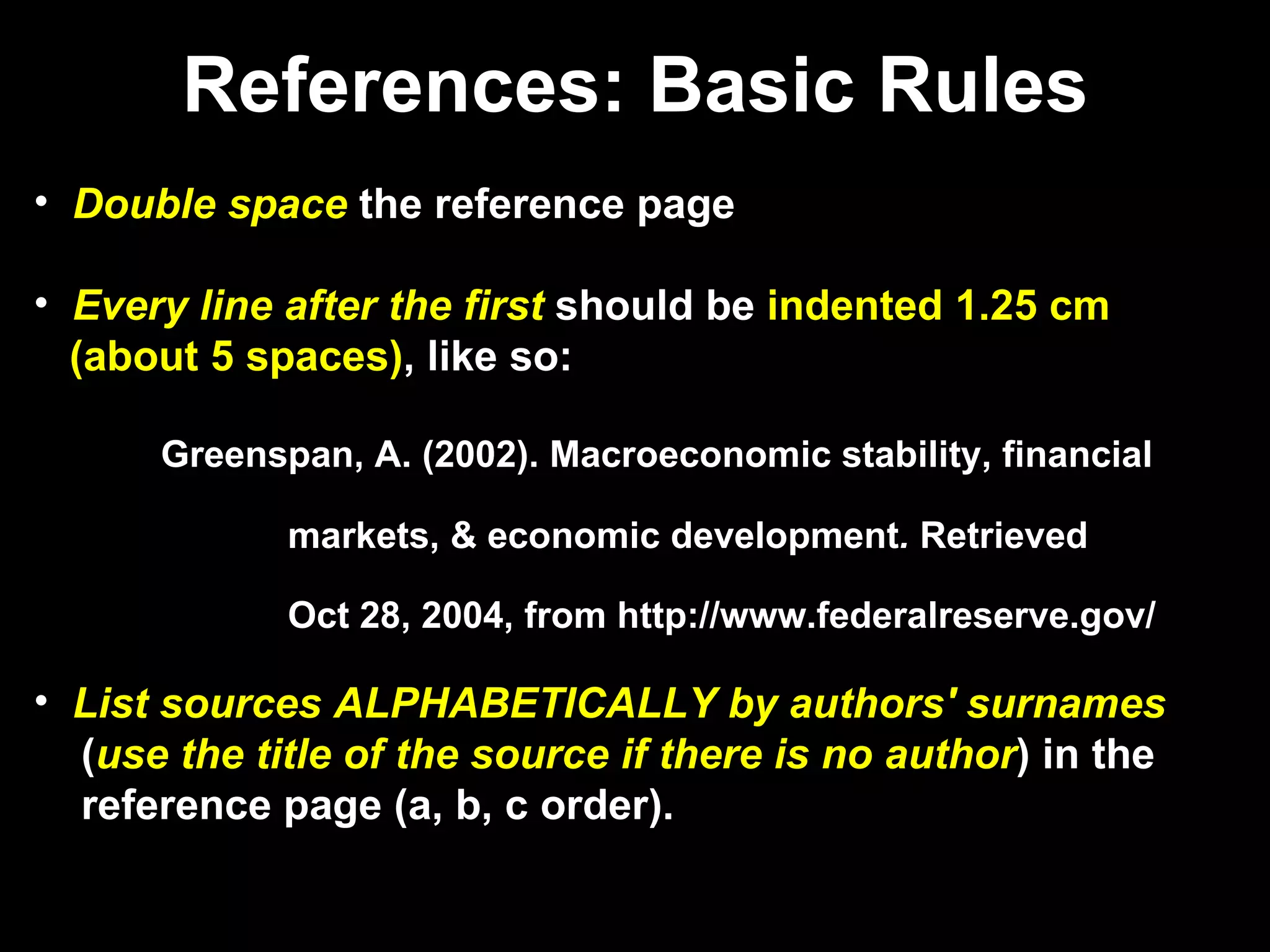
References: Basic Rules Double space  the reference page Every line after the first  should be  indented 1.25 cm  (about 5 spaces) , like so: Greenspan, A. (2002). Macroeconomic stability, financial  markets, & economic development .  Retrieved  Oct 28, 2004, from http://www.federalreserve.gov/ List sources ALPHABETICALLY by authors' surnames  ( use the title of the source if there is no author ) in the  reference page (a, b, c order).
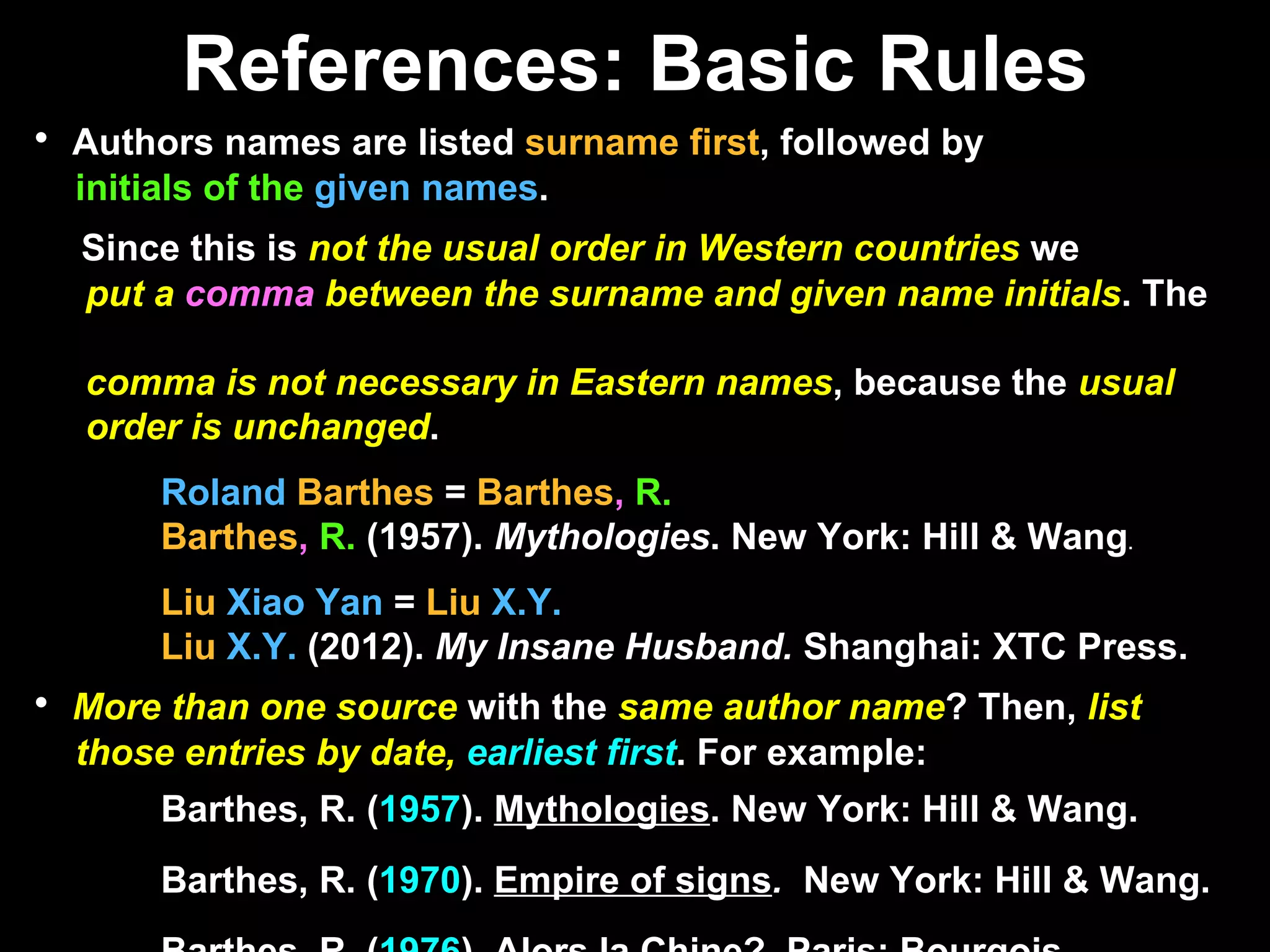
References: Basic Rules Authors names are listed  surname first , followed by  initials of the  given names . Since this is  not the usual order in Western countries  we  put a  comma  between the surname and given name initials . The  comma is not necessary in Eastern names , because the  usual  order is unchanged .  Roland   Barthes  =  Barthes ,   R. Barthes ,   R.  (1957).  Mythologies . New York: Hill & Wang .  Liu   Xiao Yan  =  Liu   X.Y. Liu   X.Y.  (2012).  My Insane Husband.  Shanghai: XTC Press. More than one source  with the  same author name ? Then,  list  those entries by date,   earliest first . For example: Barthes, R. ( 1957 ).  Mythologies . New York: Hill & Wang.  Barthes, R. ( 1970 ).  Empire of signs .   New York: Hill & Wang. Barthes, R. ( 1976 ).  Alors la Chine?   Paris: Bourgois. Purdue OWL PDF: Capitalization rules p. 14 APA Style Resource Compendium: APA Reference Page Check List p. 50, APA Sample Entries p. 47
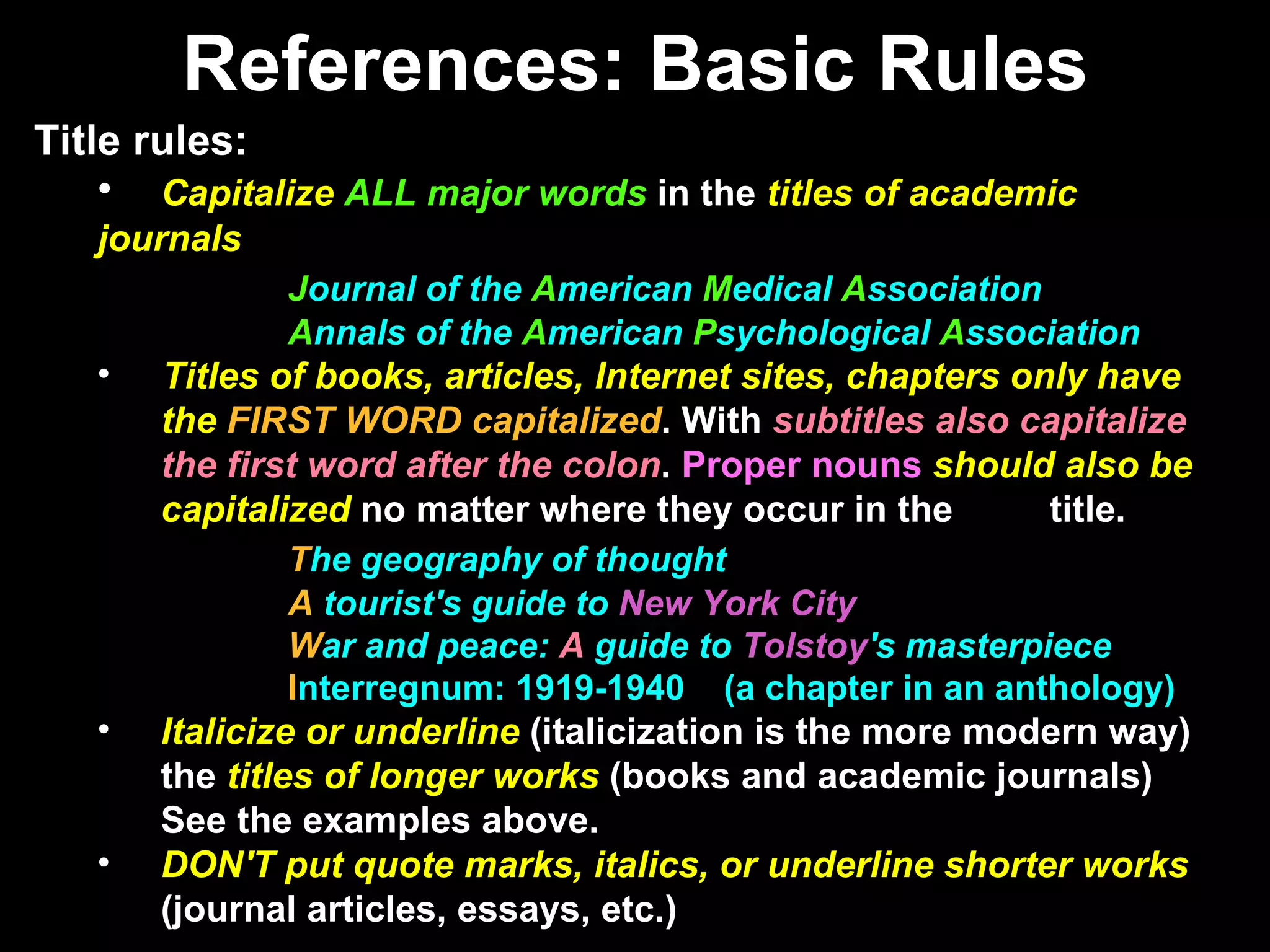
References: Basic Rules Title rules: Capitalize  ALL major words  in the  titles of academic  journals J ournal of the  A merican   M edical   A ssociation A nnals of the  A merican   P sychological   A ssociation Titles of books, articles, Internet sites, chapters only have  the  FIRST WORD capitalized . With  subtitles also capitalize  the first word after the colon .  Proper nouns   should also be  capitalized  no matter where they occur in the  title. T he geography of thought A  tourist's guide to  New York City W ar and peace:  A  guide to  Tolstoy 's masterpiece I nterregnum: 1919-1940  (a chapter in an anthology) Italicize or underline  (italicization is the more modern way)  the  titles of longer works  (books and academic journals)  See the examples above. DON'T put quote marks, italics, or underline shorter works  (journal articles, essays, etc.)
Anderson, J. (1996).  Communication theory: Epistemological foundations.  New York: Guilford. Barthes, R. (1957).  Mythologies . New York: Hill & Wang.  Barthes, R. (1970).  Empire of signs.   New York: Hill & Wang. Barthes, R. (1976).  Alors la Chine?  Paris: Bourgois. Brooks, P. & Schor, N. (2001). Roland Barthes: Twenty years after.  The Yale Journal of  Criticism ,  14 , 433-437. Bush, H. (1995). Post-structuralism as theory and practice in the English classroom.  ERIC Digest ,  ED387794 , 1-7. De Mente, B .L. (1997).  NTC’s Dictionary of Japan’s cultural code words: The complete guide to key words that express how the Japanese think, communicate, and  behave . Lincolnwood: NTC.  Goebel, R. (1993). Japan as western text: Roland Barthes, Richard Gordon Smith, and  Lafcadio Hearn.  Comparative Literature Studies ,  30 , 188-204. References
References: Newspapers, Magazines, Journals & the Internet Greenspan, A. (2002). Macroeconomic stability, financial  markets, & economic development .  Retrieved Oct 28,  2004,  from http://www.federalreserve.gov/boarddocs/ speeches.  Pfaff, W. (1995). A new colonialism?  Foreign Affairs, 81 ,   27-54 .  Farrell, C. (2004). Capitalism’s savior.  Business Week,   3878 , 20.
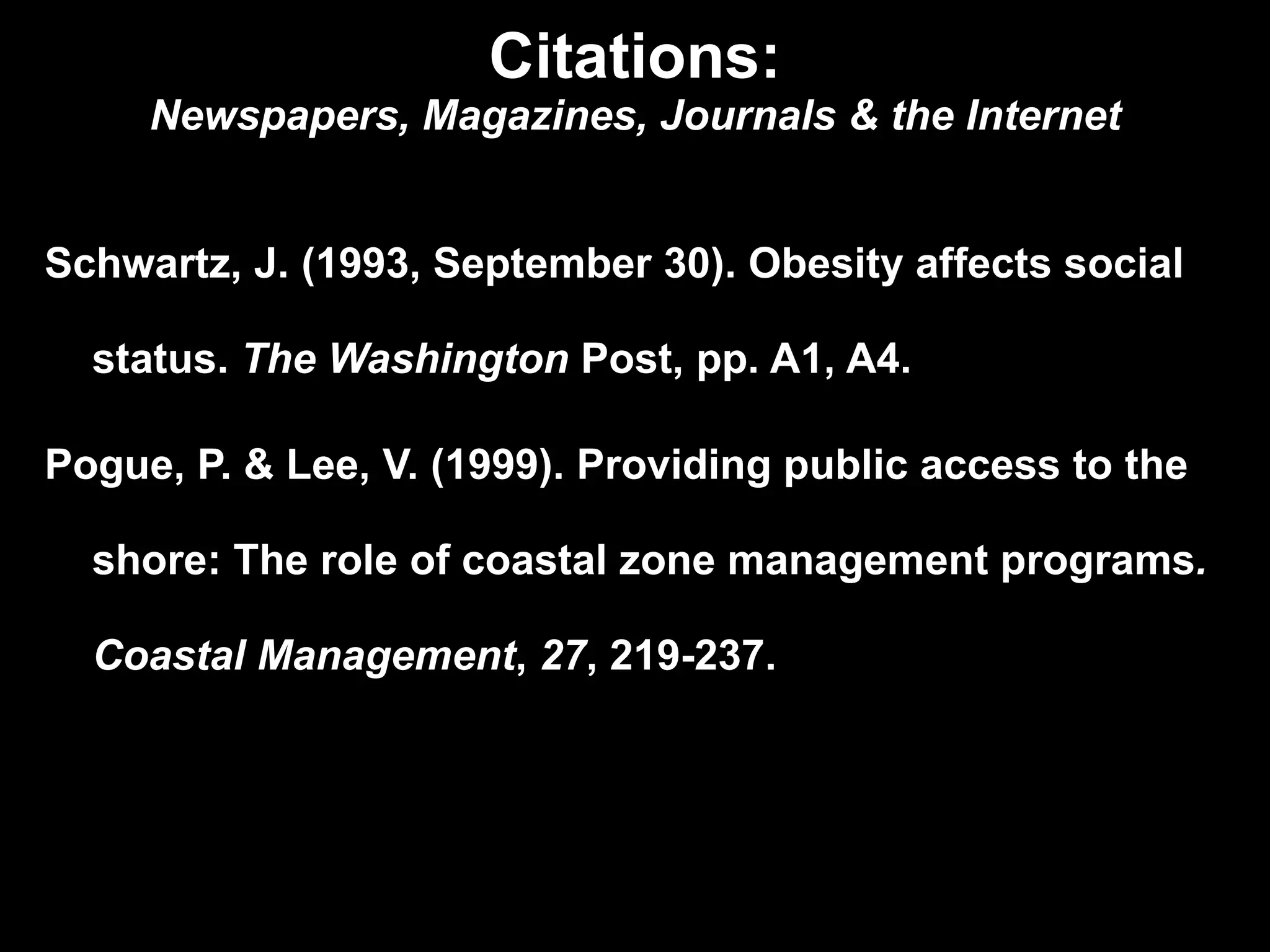
Citations: Newspapers, Magazines, Journals & the Internet Schwartz, J. (1993, September 30). Obesity affects social  status.  The Washington  Post, pp. A1, A4. Pogue, P. & Lee, V. (1999). Providing public access to the  shore: The role of coastal zone management programs .  Coastal Management ,  27 ,   219-237.
Citations with Missing Data: Newspapers, Magazines, Journals & the Internet Schools of business: The top schools. (2006).  U.S. News &  World Report ,  140 , 60. Roland Barthes (1915-1980) . (2002).   Retrieved June 13, 2003,  from  http://www.kirijasto.sci.fi/rabrtes.html .  Cycles and commitment. (2004) .   Economist ,  45 , 373 . Showcasing China’s book industry to the world. (2007, Autumn).  That’s Shanghai , 18 . Roland Barthes theories . Retrieved June 13, 2003,  from  h ttp:// www.bartheinstitute.org/ ~tuttle/theory.html .
References: Basic Rules Checklist for APA Style: Have you started each entry with the  appropriate  pattern for the author's name  [ surname first, then  initials ]?  Have you  left spaces between the initials  for each name? [MacTavish, J. B. ] Have you  used "&" not "and,"  to add the last  coauthor's  name ? [MacTavish, J. B. & Liu X.Y.] Have you  included the date  in each entry? Have you  followed the sample pattern  for the type of  source you have used? [ See the various APA style references for patterns on  how to format various types of sources ]. Checklist taken directly from Kennedy, Kennedy, & Muth, 2011
References: Basic Rules Checklist for APA Style: Have you  used capitals and italics correctly  for the  various  titles  in your entries?  Have you  included the conventional punctuation— periods, commas, colons, parentheses —in your entry? Have you  accurately recorded the name of the author  title, publisher, and so on ? Have you  checked the  accuracy of dates, pages, and other numbers ? [no misspellings or misinformation] Have you  correctly typed or pasted in the [website URL,  the digital object identifier (DOI) ] of an electronic source? Have you split a long URL before a period or another  punctuation mark or following a slash? Have you  ended  an entry without adding a final period  after [an URL or  DOI]? Checklist taken directly from Kennedy, Kennedy, & Muth, 2011
References: Basic Rules Checklist for APA Style: Have you arranged the entries in  alphabetical order  [and  date order]? Cameron, L. T. (1998).  At the gates.  Philadelphia: Renford. Cameron, L.T. (2002).  Milkshakes are free.  New York: Harper- Collins. Cameron, M. & Malik, T. The oeuvre of Lawrence Cameron.  Literary Theory, 50,  65-82.  Have you  checked your final list of references against  your text citations  so that  every source appears in both  places ? Checklist taken directly from Kennedy, Kennedy, & Muth, 2011
For Questions and More Information Always consult with your teacher if you have any questions. Reference a style guide  Chicago Manual of Style The Elements of Style Reference a Publication Manual MLA (Used for English classes at SUFE) Consult one of the numerous websites of universities and  other organizations:  OWL APA Formatting and Style Guide from Purdue University: http://owl.english.purdue.edu/owl/resource/560/01/
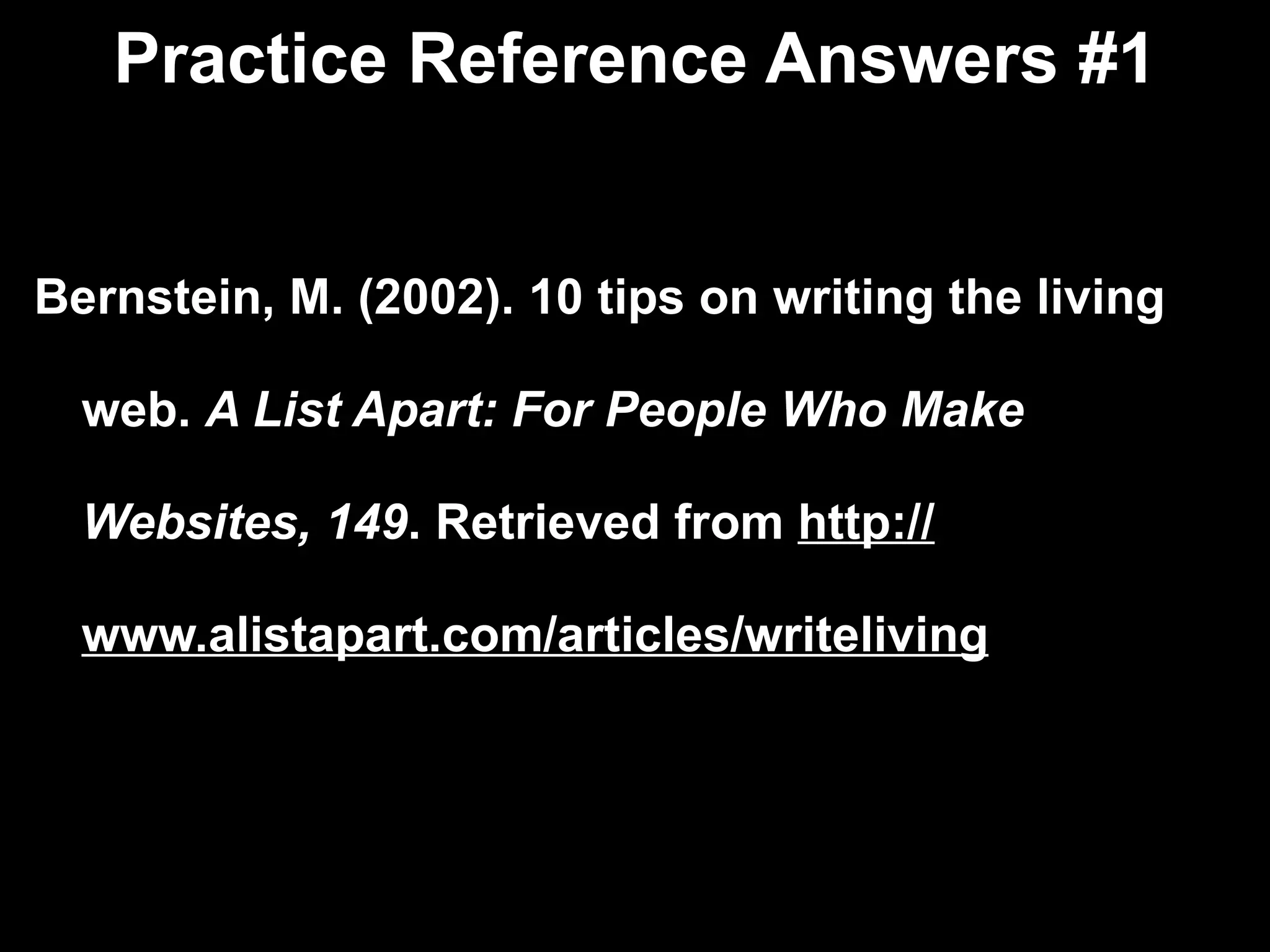
Practice Reference Answers #1 Bernstein, M. (2002). 10 tips on writing the living web.  A List Apart: For People Who Make  Websites, 149 . Retrieved from  http:// www.alistapart.com/articles/writeliving
Practice Reference Answers #2 Calfee, R. C., & Valencia, R. R. (1991).  APA guide to  preparing manuscripts for journal publication.  Washington, DC: American Psychological  Association.
Practice Reference Answers #3 Cummings, J. N., Butler, B., & Kraut, R. (2002). The  quality of online social relationships.  Communications of the ACM, 45  (7), 103-108 .
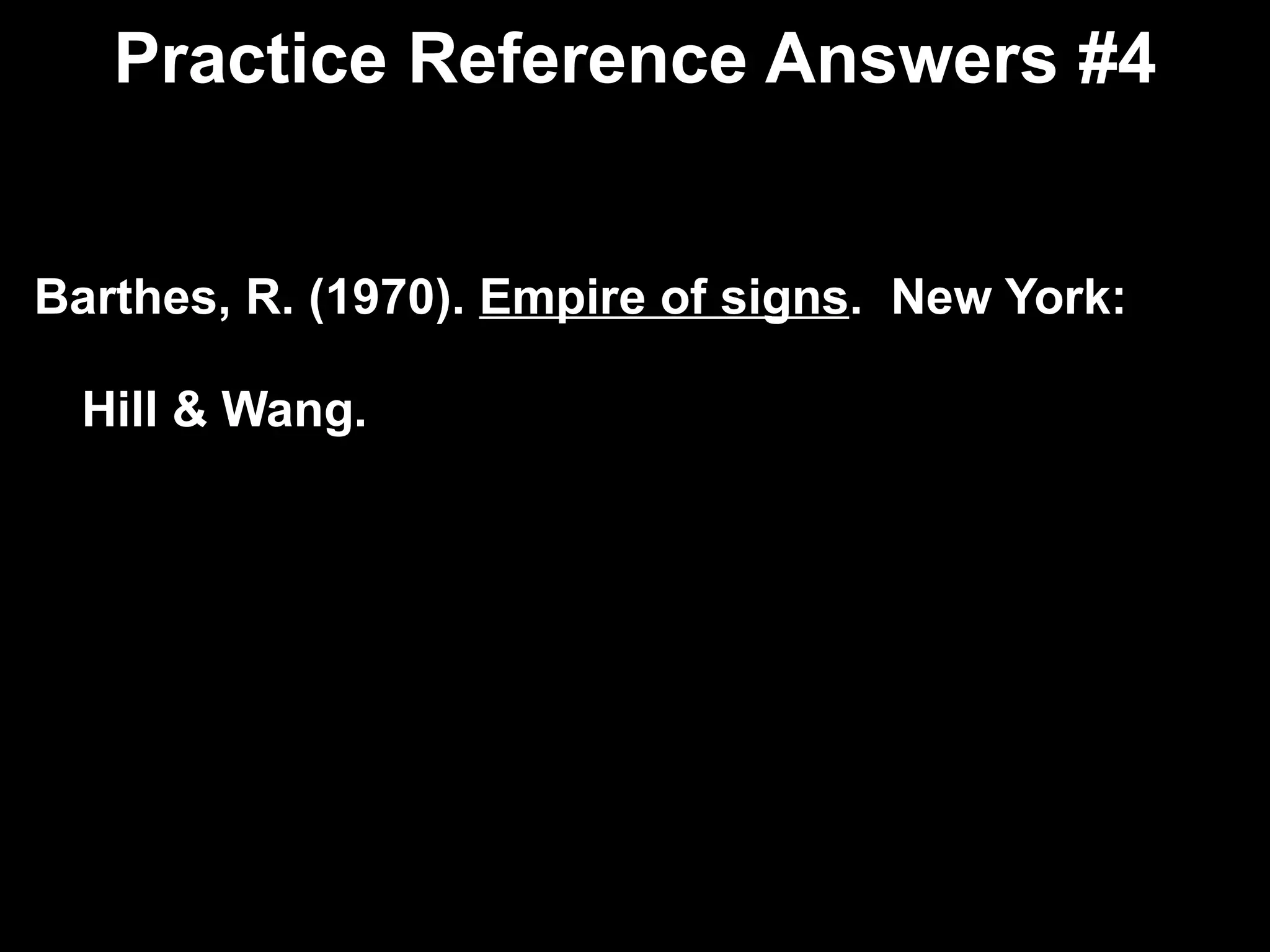
Practice Reference Answers #4 Barthes, R. (1970).  Empire of signs .  New York:  Hill & Wang.
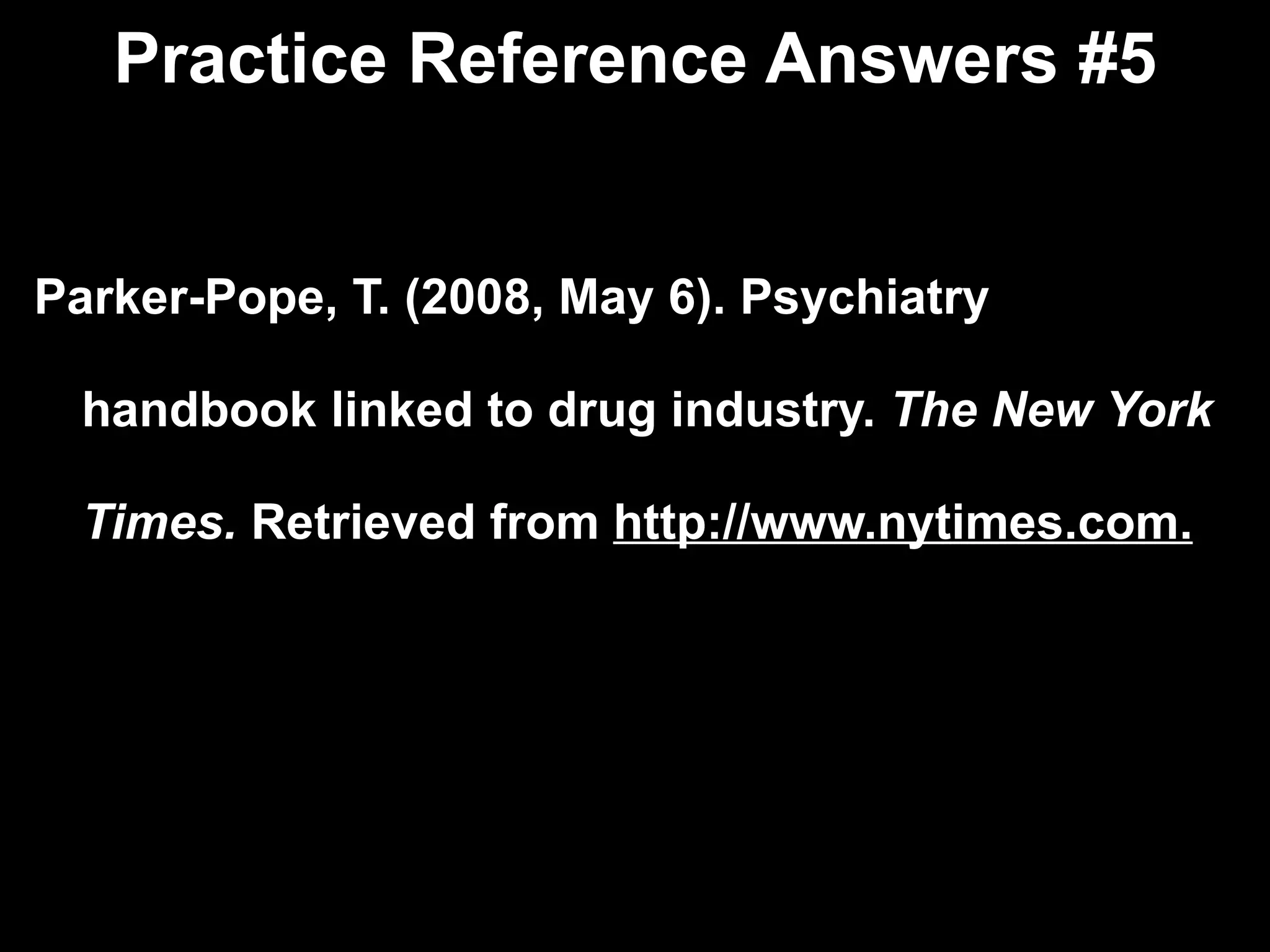
Practice Reference Answers #5 Parker-Pope, T. (2008, May 6). Psychiatry  handbook linked to drug industry.  The New York  Times.  Retrieved from  http://www.nytimes.com.
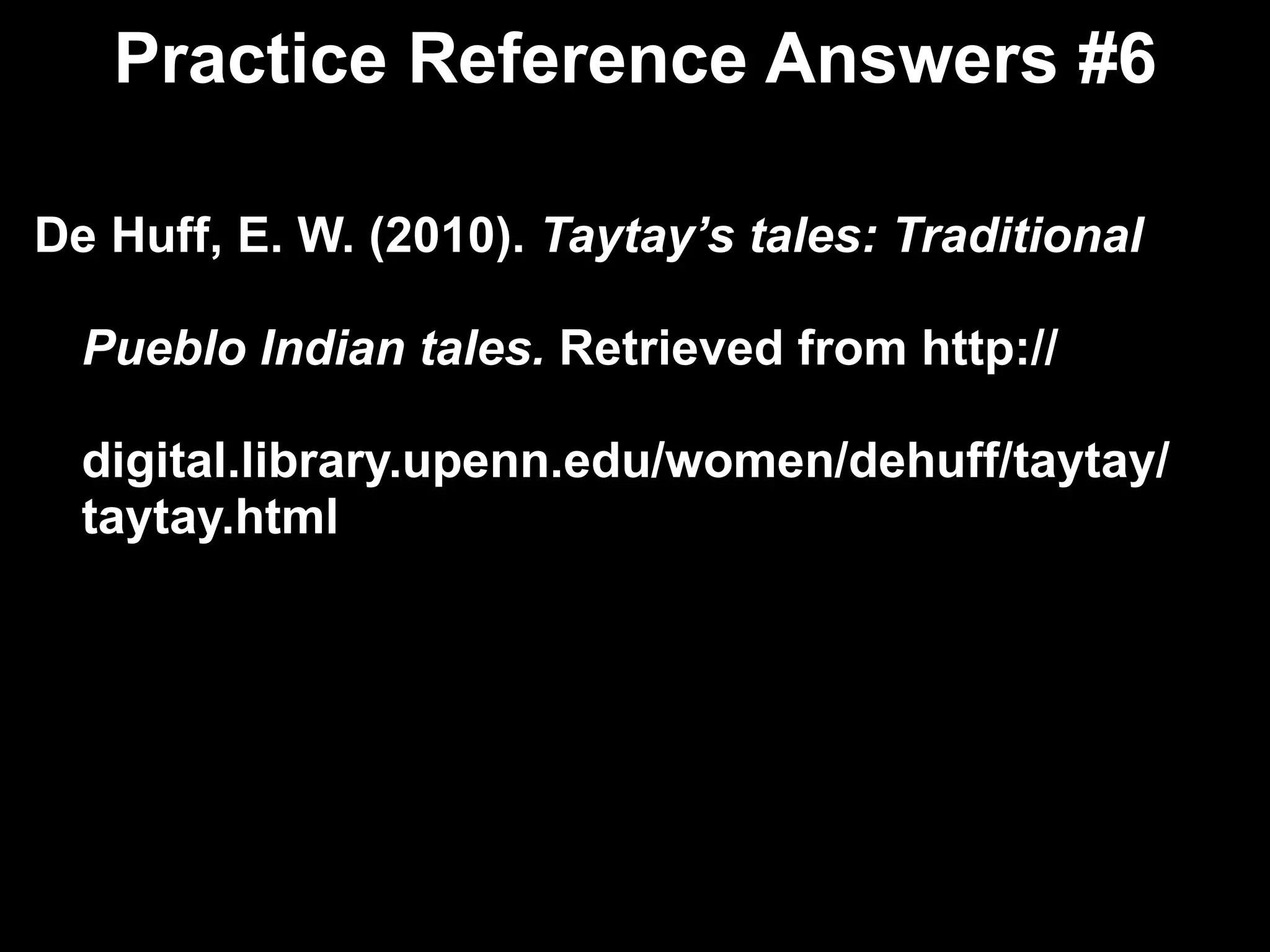
Practice Reference Answers #6 De Huff, E. W. (2010).  Taytay’s tales: Traditional  Pueblo Indian tales.  Retrieved from http:// digital.library.upenn.edu/women/dehuff/taytay/
 taytay.html
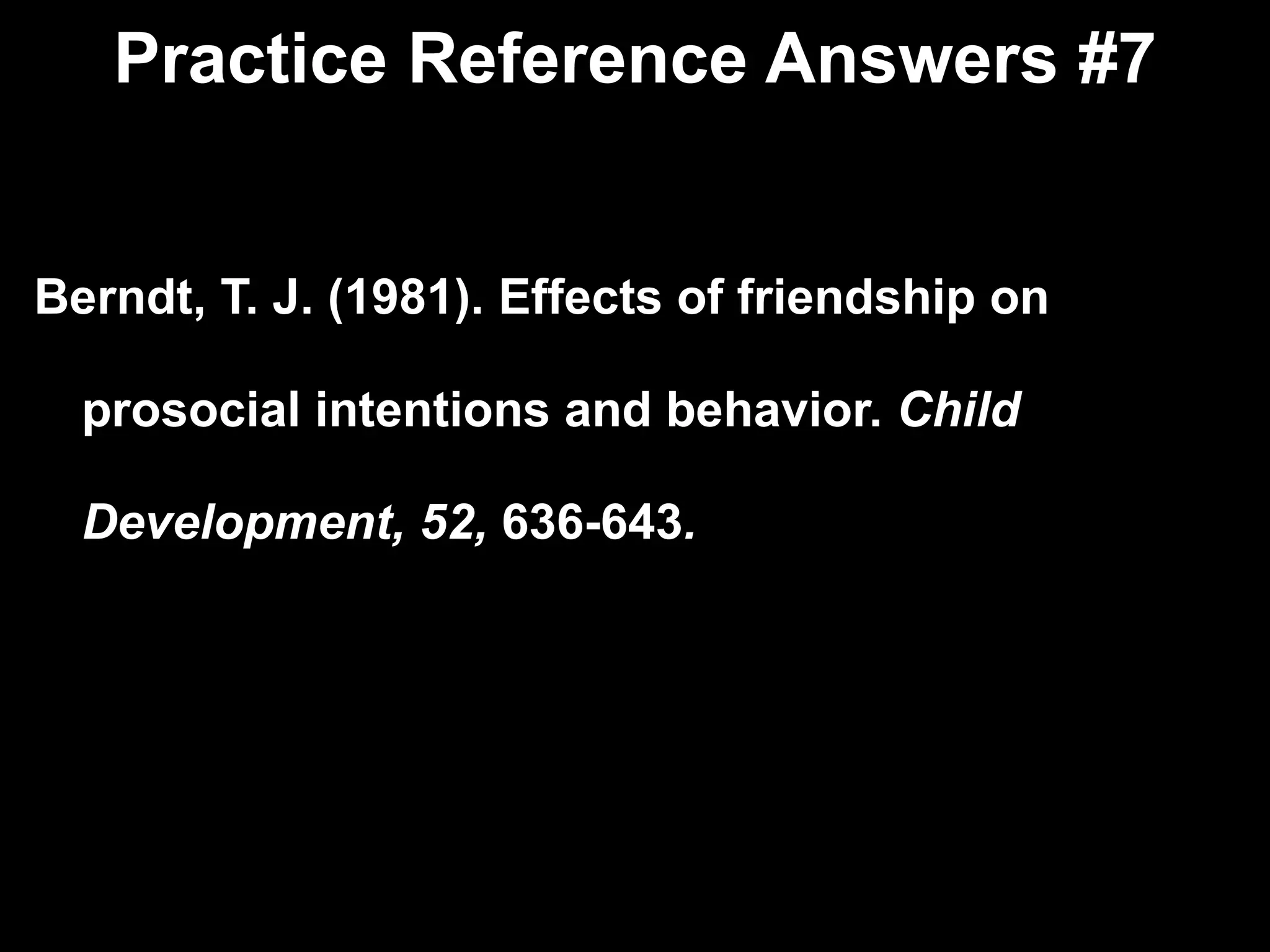
Practice Reference Answers #7 Berndt, T. J. (1981). Effects of friendship on  prosocial intentions and behavior.  Child  Development, 52,  636-643 .
Practice Reference Answers #8 Funk, R. & Kolln, M. (1998).  Understanding English   grammar . Needham, MA: Allyn and Bacon.
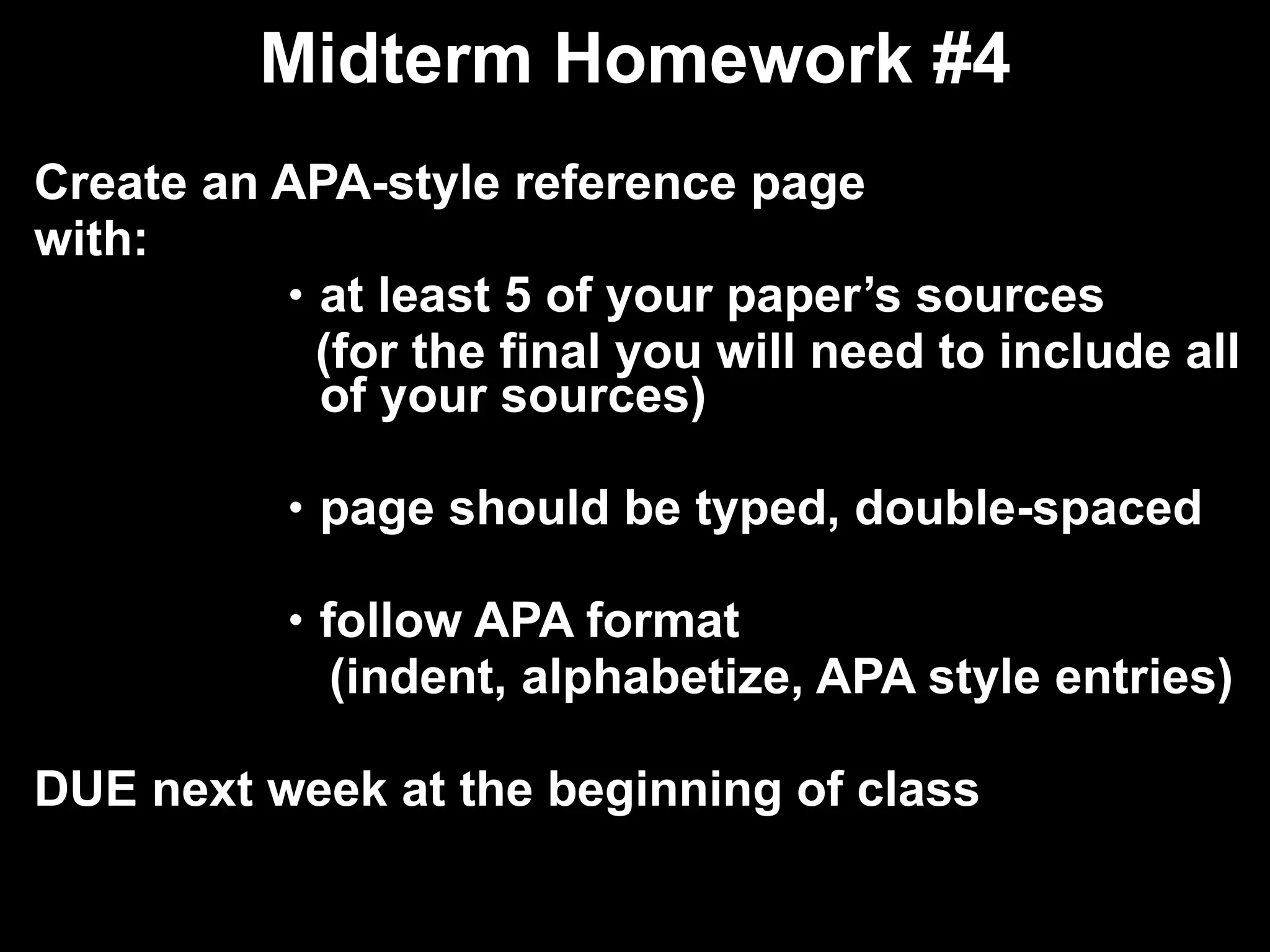
Midterm Homework #4 Create an APA-style reference page  with: at least 5 of your paper’s sources  (for the final you will need to include all of your sources) page should be typed, double-spaced follow APA format  (indent, alphabetize, APA style entries) DUE next week at the beginning of class
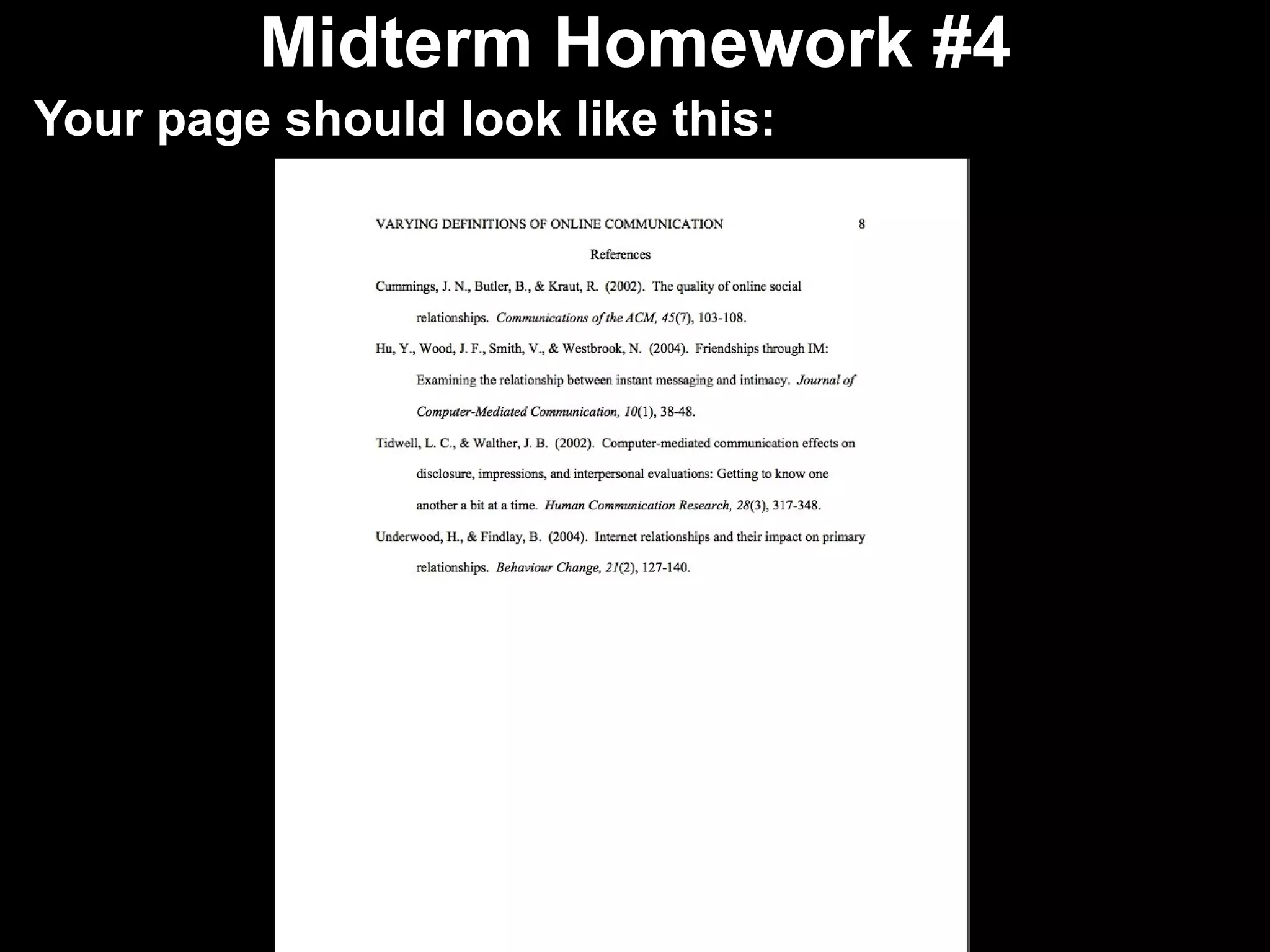
Midterm Homework #4 Your page should look like this:
Creating a Reference Page:  The Easy Way http://citationcenter.net/
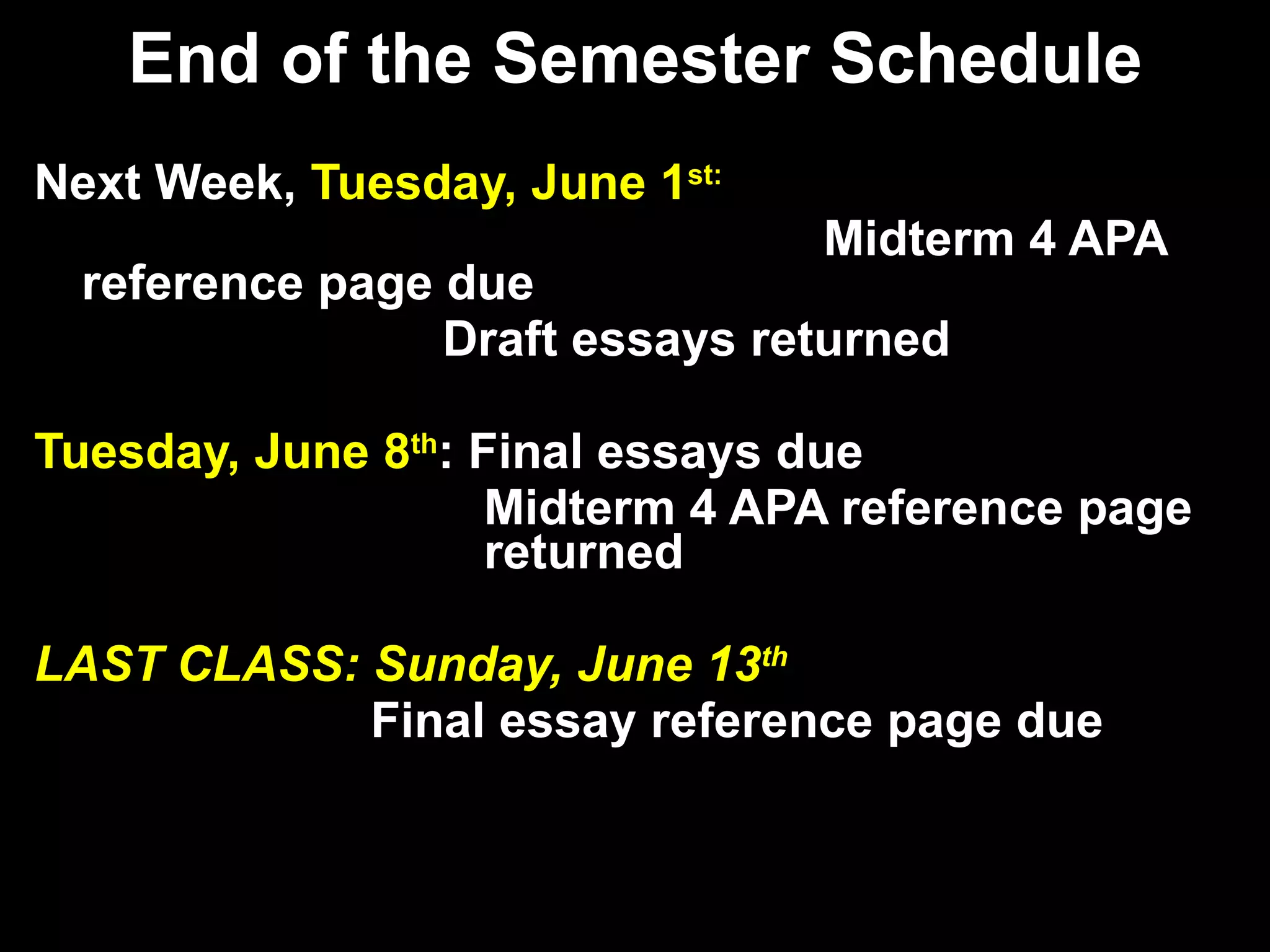
End of the Semester Schedule Next Week,  Tuesday, June 1 st:   Midterm 4 APA reference page due   Draft essays returned Tuesday, June 8 th : Final essays due   Midterm 4 APA reference page    returned LAST CLASS: Sunday, June 13 th   Final essay reference page due

Generating Ideas

  • 1.
  • 2.
    Generating Ideas: PrewritingActivities Your goal? Generate as many ideas as possible. So, don't prejudge. The purpose of prewriting is to begin thinking about the topic(s). Later you will decide which ideas are worth pursuing. (Anker, 2001)
  • 3.
    Th Write a1,000 word research report… ? Three Questions to Begin… 1. What interests me? 2. What do I know about? 3. Is my topic specific? (Anker, 2001) and a fourth, question: What are the assignment requirements?
  • 4.
    A Topic Let'sbegin with a topic. Pick TWO of the following: Children [or Childhood] An issue [at the university] Leisure time Environmental problems Technology An important new discovery (Taken directly from Anker, 2001)
  • 5.
  • 6.
  • 7.
    Brainstorming: Clustering/Mapping Memorableincident in my past. Bedtime stories. Falling off a slide. Getting braces taken off my teeth. Getting my first bike for Christmas. (cluster taken directly from Winterowd & Murray, 1985)
  • 8.
    Brainstorming: Clustering/Mapping Memorableincident in my past. Bedtime stories. Falling off a slide. Getting braces taken off my teeth. Getting my first bike for Christmas. Age 9 Wanted a Schwinn brand. Surprise! Sheer exhilaration. Fancy Monarch brand. End of childhood. Felt older, more sophisticated. Dentist's office Cold Ugly Beige carpet with green trim. (taken directly from Winterowd & Murray, 1985)
  • 9.
  • 10.
  • 11.
  • 12.
  • 13.
  • 14.
    Pentad: Asking Questionsto Generate Ideas and Detail 1. What is the action? 2. Who are the actors? 3. What is the scene? 4. What is the method? 5. What is the purpose?
  • 15.
    APA Format Thefollowing guidelines apply for an APA style paper: Include a page header on the top of every page . The page header is different on the title page than on the pages that follow . The header should align with the left Title page header: margin; the page Running head: TITLE OF YOUR PAPER number should align with the right All other pages: margin TITLE OF YOUR PAPER (Angeli, et. al. 2010) Title page All other pages
  • 16.
    APA Style Fora sample APA-style paper with notes on formatting go to Course Documents on BlackBoard (BB).
  • 17.
    APA Style Papers:Literature Review What is it? "A literature review is a summary of what the scientific literature says about your specific topic or question" (Angeli, et. al., 2010) . Why? When? The literature demonstrates your familiarity with prior research into the topic. Before you begin writing your professor may ask you to write a literature review for this purpose (Angeli, et. al., 2010). Main Parts: title page introduction section list of references (possibly) abstract
  • 18.
    APA Style Papers:Experimental Report What is it? A more complex form of APA format used to present your original, social science research Why? When? "The structure follows the scientific method, but it also makes your paper easier to follow by providing those familiar cues that help your reader efficiently scan your information for: why the topic is important (covered in the introduction) what the problem is (also covered in your introduction) what you did to try to solve the problem (covered in your methods section) what you found (covered in your results section) what you think your findings mean (covered in your discussion section)" (Angeli, et. al., 2010)
  • 19.
    Abstract An abstractis a summary of the main points of your research . Abstract format/contents: include the header at the top of the page, first line, center the word "Abstract" (upper and lower case, plain text—no bold, italics, underlining, or quotation marks), In block style (no indenting) write the abstract, which should be between 150-250 words At minimum the abstract includes: "research topic, research questions, participants, methods, results, data analysis, and conclusions" (this will differ for a literature review abstract) (Angeli, et. al.)
  • 20.
    Properly Citing SourcesSome “rules” always remain true: If you are quoting a source directly , always: - Use quotation marks “ ” - Indicate in the sentence whom you are quoting If you are paraphrasing someone else’s idea , always: - Acknowledge whose idea it is, use indicator words like “According to…” , “As ...... says” , “As reported by .......” , “...... says that” - Although you are using your own words when when paraphrasing , you still need to cite the source of the information .
  • 21.
    Properly Citing SourcesAlways create a Reference page. Indicate ALL the sources you used in your paper Directly quoted sourc Sources that are summarized (paraphrased) To avoid accusations of plagiarism every source used in the body of the essay must be listed in the Reference page .
  • 22.
    In-text Citation: Waysto Cite Sources Author of a Quote Should be Acknowledged directly before or after the quoted or referenced material Use words such as “ says ,” “ explains ,” “ believes ,” “ thinks ,” “ argued ,” or “ demands .” The first time a source is mentioned, it is recommended to use their f u l l n a m e and an indication of his or her credibility . After the introduction use the surname (family name). EXAMPLE: From this foundation, Dr. Elliot Smith (2002) , an economist at Milford University, argued that “humankind ought to be left to follow its inborn inclinations, which were to sustain life and to acquire goods (p. 5). [ title/given name surname date signal word credibility ]
  • 23.
    Direct Quotations :Quotation Marks and Commas Smith (1998) says , “ What we require is a new method . ” “ What we require is a new method , ” says Smith . “ Thirty minutes later , ” Edelman said , “ subjects responded negatively . ” Edelman said , “ Thirty minutes later subjects responded negatively . ” “ Thirty minutes later subjects responded negatively , ” said Edelman . [ surname comma quotation mark quote period ]
  • 24.
    Direct Quotations: QuotationMarks without Commas (integrating a partial quote with your own words ) All are asked to “ help restore hope . ” To “ help restore hope ” is what is asked of us . Are we to accept Jefferson’s concept of “ a natural aristocracy among men ” ? Is “ a natural aristocracy among men ” the Jeffersonian concept we are to accept ?
  • 25.
    Ways to CiteSources (Print) EXAMPLE (Author with signal phrase): According to Jones ( 1998 ) , “ Students often had difficulty using APA style, especially when it was their first time ” (p. 199) . EXAMPLE (Author quote and writer's own material): Jones ( 1998 ) found, “ Students often had difficulty using APA style, especially when it was their first time ” (p. 199) ; what implications does this have for teachers? EXAMPLE (Author not named in signal phrase): She stated , “ Students often had difficulty using APA style ” ( Jones , 1998 , p. 199 ), but she did not offer an explanation as to why . [ surname date signal words quotation mark quote page numbers ]
  • 26.
    Summary or ParaphraseIf you are paraphrasing an idea from another work, you only have to make reference to the author and year of publication in your in-text reference, but APA guidelines encourage you to also provide the page number (although it is not required). Examples: According to Jones ( 1998 ), APA style is a different citation format for first-time learners. APA style is a difficult citation format for first-time learners ( Jones , 1998 , p. 199 ) [ surname date signal words paraphrase page numbers ] (Angeli, et. al., 2010) Purdue OWL PDF p. 11.
  • 27.
    Ways to CiteSources (Print) FURTHER EXAMPLE: As noted by Smith (2010) Americans have sympathy for the belief that “ public services are never better performed than when their reward comes only in consequence of their being performed, and is proportioned to the diligence employed in performing them ” (pp. 678-679) . [ surname date signal words quotation mark quote page numbers ]
  • 28.
    Ways to CiteSources (Print) FURTHER EXAMPLE (When : This process, Weigel (1986) rightly describes , as an outgrowth of the selling of scarcity that “ has convinced many Americans of the viability and moral necessity of coerced, subsistence-wage labor through the workfare and prison industries ” ( p. 21) . [ surname date signal words quotation mark quote page numbers ]
  • 29.
    Ways to CiteSources (Webpage) Unlike print sources, Internet sources may not be divided into pages. Instead of using a page reference (p. or pp.) you can refer to the paragraph where you found the quotation using "para.", chapter number "chap. 2", or section heading. EXAMPLE: “ The Purdue University Writing lab and Purdue Online Writing Lab (OWL) assist clients in their development as writers—no matter what their skill level—with on-campus consultations, online participation, and community engagement ” ( Purdue OWL, 2010 , "Mission" , para. 1 ) . [ organization author date section quotation mark quote paragraph number ]
  • 30.
    Ways to CiteSources (Webpage) EXAMPLE: Interval training encourages rotation between high-intensity spurts and “ active recovery, which is typically a less-intense form of the original activity ” ( Interval training , n.d. , chap. 2 ) . [ title date section quotation mark quote paragraph number ] n.d. = no date
  • 31.
    Ways to CiteSources In-text Multiple Authors Two Authors: List the names in the order they appear in the source . Link the names with an ampersand ( & ); remember in the body of your essay you should always spell the word "and" , only use the ampersand for citations . A group's cultural development enhances its chance for survival, providing both physical and psychological protection ( Anderson & Ross , 1998 ) . [ authors ampersand date ] (Kennedy, Kennedy, & Muth, 2011)
  • 32.
    Ways to CiteSources In-text Multiple Authors Three Authors or More: Three to Five Authors: Include A L L t h e n a m e s in your FIRST reference . In later references use only the first author and add et al. (et al.="and others"). Six or More Authors: For all citations list the first author mentioned, plus et al. The field of conservation biology has developed in response to the accelerating rate at which species are being lost ( Purves , Orians , & Heller , 1999 ). Purves et al. specifically explore the consequences of human activities in relation to this acceleration. [ first author additional authors ampersand date et al. ] (Kennedy, Kennedy, & Muth, 2011)
  • 33.
    Unknown Authors and Corporate/Organization Authors Unknown Author: Use the TITLE as part of the signal phrase or the first one or two words of the title that convey meaning in parentheses . Book and report titles are italicized or underlined . "Article" , "chapter" , "web page" titles are in quotation marks ("") . A similar study was done of students learning to format research papers ( "Using APA , " 2001 ). According to the study "Using APA: A Guide to College Usage" ( 2001 ) a similar study was done of students learning to format research papers. Eastern mothers tend to teach their children social norms and actions when teaching language; whereas, Western mothers tend to focus on object names ( Culture and Language , 2011 , pp. 48-49 ). [ article/chapter/web page title book/report title date signal phrase page(s) ]
  • 34.
    Block Quotes Quotations longer than three lines or 40 words Should be indented Do not require quotation marks Should be double-spaced Followed by a citation Further information on in-text citation is available at Purdue University’s OWL Writing Lab “ In-Text Citations: The Basics” page at: http://owl.english.purdue.edu/owl/resource/560/02/
  • 35.
    Block Quotes Thesecond key tenet of post-structuralism concerns the very existence of the human subject. Traditionally, individuals have been seen as coherent entities possessing qualities, such as initiative and will, as noted by Bush (1987): The poststructuralist self is seen to be incoherent, disunified, and in effect “ decentered,” so that…a human being is described as, for example, a mere conveyor of unconscious mainstream ideologies, or as simply a “site” in which various cultural constructs and “discursive formations” created & sustained by the structures of power in a given social environment play themselves out. (p. 4) The final characteristic of post-structuralism is an emphasis not on the writer of texts but the reader. The traditional notion of a literary “work” that has some sort I NDENT author/date page number/location on web page quotation over 40 words or three lines (indented as a block)
  • 36.
    Quotes (Additions andOmissions) If you are omitting something from a quote use ellipses , . . . , to mark the text that has been omitted. Middle of the sentence omission use three ellipses; end of the sentence omission use three ellipses plus the period. Here is the entire quote: During the war Paris seems to have had a secondary role: a good warrior but inferior to his brother Hector and to the Greek leaders whom he faced. Menelaus would have defeated Paris in single combat, but Aphrodite rescued him, and the war continued. Near the end of the war, Paris shot the arrow that, by Apollo's help, caused the death of the hero Achilles. We want to quote the green portions, but not the yellow portions. So, During the war Paris seems to have had a secondary role: a good warrior but inferior to his brother Hector and to the Greek leaders whom he faced. . . . Near the end of the war, Paris shot the arrow that, by Apollo's help, caused the death of the hero Achilles.
  • 37.
    Quotes (Additions andOmissions) Sometimes when you take a quote out of its context , the sentences and paragraphs that surround it, you need to add additional words for clarity . If you add words to a quote use brackets , [ ] , to show the words you have added. EXAMPLE: Peter Weiss (2003) observes that "examinations of bullet fragments [linked] the shootings" in the Washington, D.C., sniper case (23). Here, the verb tense has changed from the original, "link", which was a contemporary account of a crime. But by the time of the essay this account is in the past. (Adapted from Price, n.d.)
  • 38.
    Quotes (Additions andOmissions) If you add words to a quote use brackets , [ ] , to show the words you have added. EXAMPLE: "In a most direct way, the Attorney General [John Ashcroft] had said that his critics were helping America's enemy; any questions the senators might have about his proposals had been preemptively labeled unpatriotic, even subversive" (Brooks, 2003, p. A5). Who is the Attorney General? In the original source it is clear; taken out of context it is not. The information is added with brackets for clarity. (Adapted from Price, n.d.)
  • 39.
    References Key questionsbefore you begin : To determine how to format the reference, ask: Who wrote it? What type of source is it? (Kennedy, Kennedy & Muth, 2011). All references mentioned in your paper (directly or in footnotes or endnotes) should be included in your References page . The References should begin on a new page following the essay. Always include the following information about your sources: Author Title Publisher Date Page numbers (location for Internet)
  • 40.
    References In generalthe format of Reference page citations is as follows: 1 st author 2 nd date 3 rd title of the book or article 4 th if needed title of magazine, newspaper, academic journal, Internet site 4 th or 5 th publisher and location (books) / issue and volume number (magazines and academic journals) / date of retrieval and internet address (Internet sites) 6 th if needed pages (magazines and books)
  • 41.
    References: Basic RulesDouble space the reference page Every line after the first should be indented 1.25 cm (about 5 spaces) , like so: Greenspan, A. (2002). Macroeconomic stability, financial markets, & economic development . Retrieved Oct 28, 2004, from http://www.federalreserve.gov/ List sources ALPHABETICALLY by authors' surnames ( use the title of the source if there is no author ) in the reference page (a, b, c order).
  • 42.
    References: Basic RulesAuthors names are listed surname first , followed by initials of the given names . Since this is not the usual order in Western countries we put a comma between the surname and given name initials . The comma is not necessary in Eastern names , because the usual order is unchanged . Roland Barthes = Barthes , R. Barthes , R. (1957). Mythologies . New York: Hill & Wang . Liu Xiao Yan = Liu X.Y. Liu X.Y. (2012). My Insane Husband. Shanghai: XTC Press. More than one source with the same author name ? Then, list those entries by date, earliest first . For example: Barthes, R. ( 1957 ). Mythologies . New York: Hill & Wang. Barthes, R. ( 1970 ). Empire of signs . New York: Hill & Wang. Barthes, R. ( 1976 ). Alors la Chine? Paris: Bourgois. Purdue OWL PDF: Capitalization rules p. 14 APA Style Resource Compendium: APA Reference Page Check List p. 50, APA Sample Entries p. 47
  • 43.
    References: Basic RulesTitle rules: Capitalize ALL major words in the titles of academic journals J ournal of the A merican M edical A ssociation A nnals of the A merican P sychological A ssociation Titles of books, articles, Internet sites, chapters only have the FIRST WORD capitalized . With subtitles also capitalize the first word after the colon . Proper nouns should also be capitalized no matter where they occur in the title. T he geography of thought A tourist's guide to New York City W ar and peace: A guide to Tolstoy 's masterpiece I nterregnum: 1919-1940 (a chapter in an anthology) Italicize or underline (italicization is the more modern way) the titles of longer works (books and academic journals) See the examples above. DON'T put quote marks, italics, or underline shorter works (journal articles, essays, etc.)
  • 44.
    Anderson, J. (1996). Communication theory: Epistemological foundations. New York: Guilford. Barthes, R. (1957). Mythologies . New York: Hill & Wang. Barthes, R. (1970). Empire of signs. New York: Hill & Wang. Barthes, R. (1976). Alors la Chine? Paris: Bourgois. Brooks, P. & Schor, N. (2001). Roland Barthes: Twenty years after. The Yale Journal of Criticism , 14 , 433-437. Bush, H. (1995). Post-structuralism as theory and practice in the English classroom. ERIC Digest , ED387794 , 1-7. De Mente, B .L. (1997). NTC’s Dictionary of Japan’s cultural code words: The complete guide to key words that express how the Japanese think, communicate, and behave . Lincolnwood: NTC. Goebel, R. (1993). Japan as western text: Roland Barthes, Richard Gordon Smith, and Lafcadio Hearn. Comparative Literature Studies , 30 , 188-204. References
  • 45.
    References: Newspapers, Magazines,Journals & the Internet Greenspan, A. (2002). Macroeconomic stability, financial markets, & economic development . Retrieved Oct 28, 2004, from http://www.federalreserve.gov/boarddocs/ speeches. Pfaff, W. (1995). A new colonialism? Foreign Affairs, 81 , 27-54 . Farrell, C. (2004). Capitalism’s savior. Business Week, 3878 , 20.
  • 46.
    Citations: Newspapers, Magazines,Journals & the Internet Schwartz, J. (1993, September 30). Obesity affects social status. The Washington Post, pp. A1, A4. Pogue, P. & Lee, V. (1999). Providing public access to the shore: The role of coastal zone management programs . Coastal Management , 27 , 219-237.
  • 47.
    Citations with MissingData: Newspapers, Magazines, Journals & the Internet Schools of business: The top schools. (2006). U.S. News & World Report , 140 , 60. Roland Barthes (1915-1980) . (2002). Retrieved June 13, 2003, from http://www.kirijasto.sci.fi/rabrtes.html . Cycles and commitment. (2004) . Economist , 45 , 373 . Showcasing China’s book industry to the world. (2007, Autumn). That’s Shanghai , 18 . Roland Barthes theories . Retrieved June 13, 2003, from h ttp:// www.bartheinstitute.org/ ~tuttle/theory.html .
  • 48.
    References: Basic RulesChecklist for APA Style: Have you started each entry with the appropriate pattern for the author's name [ surname first, then initials ]? Have you left spaces between the initials for each name? [MacTavish, J. B. ] Have you used "&" not "and," to add the last coauthor's name ? [MacTavish, J. B. & Liu X.Y.] Have you included the date in each entry? Have you followed the sample pattern for the type of source you have used? [ See the various APA style references for patterns on how to format various types of sources ]. Checklist taken directly from Kennedy, Kennedy, & Muth, 2011
  • 49.
    References: Basic RulesChecklist for APA Style: Have you used capitals and italics correctly for the various titles in your entries? Have you included the conventional punctuation— periods, commas, colons, parentheses —in your entry? Have you accurately recorded the name of the author title, publisher, and so on ? Have you checked the accuracy of dates, pages, and other numbers ? [no misspellings or misinformation] Have you correctly typed or pasted in the [website URL, the digital object identifier (DOI) ] of an electronic source? Have you split a long URL before a period or another punctuation mark or following a slash? Have you ended an entry without adding a final period after [an URL or DOI]? Checklist taken directly from Kennedy, Kennedy, & Muth, 2011
  • 50.
    References: Basic RulesChecklist for APA Style: Have you arranged the entries in alphabetical order [and date order]? Cameron, L. T. (1998). At the gates. Philadelphia: Renford. Cameron, L.T. (2002). Milkshakes are free. New York: Harper- Collins. Cameron, M. & Malik, T. The oeuvre of Lawrence Cameron. Literary Theory, 50, 65-82. Have you checked your final list of references against your text citations so that every source appears in both places ? Checklist taken directly from Kennedy, Kennedy, & Muth, 2011
  • 51.
    For Questions andMore Information Always consult with your teacher if you have any questions. Reference a style guide Chicago Manual of Style The Elements of Style Reference a Publication Manual MLA (Used for English classes at SUFE) Consult one of the numerous websites of universities and other organizations: OWL APA Formatting and Style Guide from Purdue University: http://owl.english.purdue.edu/owl/resource/560/01/
  • 52.
    Practice Reference Answers#1 Bernstein, M. (2002). 10 tips on writing the living web. A List Apart: For People Who Make Websites, 149 . Retrieved from http:// www.alistapart.com/articles/writeliving
  • 53.
    Practice Reference Answers#2 Calfee, R. C., & Valencia, R. R. (1991). APA guide to preparing manuscripts for journal publication. Washington, DC: American Psychological Association.
  • 54.
    Practice Reference Answers#3 Cummings, J. N., Butler, B., & Kraut, R. (2002). The quality of online social relationships. Communications of the ACM, 45 (7), 103-108 .
  • 55.
    Practice Reference Answers#4 Barthes, R. (1970). Empire of signs . New York: Hill & Wang.
  • 56.
    Practice Reference Answers#5 Parker-Pope, T. (2008, May 6). Psychiatry handbook linked to drug industry. The New York Times. Retrieved from http://www.nytimes.com.
  • 57.
    Practice Reference Answers#6 De Huff, E. W. (2010). Taytay’s tales: Traditional Pueblo Indian tales. Retrieved from http:// digital.library.upenn.edu/women/dehuff/taytay/
 taytay.html
  • 58.
    Practice Reference Answers#7 Berndt, T. J. (1981). Effects of friendship on prosocial intentions and behavior. Child Development, 52, 636-643 .
  • 59.
    Practice Reference Answers#8 Funk, R. & Kolln, M. (1998). Understanding English grammar . Needham, MA: Allyn and Bacon.
  • 60.
    Midterm Homework #4Create an APA-style reference page with: at least 5 of your paper’s sources (for the final you will need to include all of your sources) page should be typed, double-spaced follow APA format (indent, alphabetize, APA style entries) DUE next week at the beginning of class
  • 61.
    Midterm Homework #4Create an APA-style reference page with: at least 5 of your paper’s sources (for the final you will need to include all of your sources) page should be typed, double-spaced follow APA format (indent, alphabetize, APA style entries) DUE next week at the beginning of class
  • 62.
    Midterm Homework #4Your page should look like this:
  • 63.
    Creating a ReferencePage: The Easy Way http://citationcenter.net/
  • 64.
    End of theSemester Schedule Next Week, Tuesday, June 1 st: Midterm 4 APA reference page due Draft essays returned Tuesday, June 8 th : Final essays due Midterm 4 APA reference page returned LAST CLASS: Sunday, June 13 th Final essay reference page due

Editor's Notes

  • #3 Anker, S. (2001). Real writing with readings: Paragraphs and essays for college, work, and everyday life. (2nd ed.). Boston: Bedford/St.Martin's.
  • #4 Anker, S. (2001). Real writing with readings: Paragraphs and essays for college, work, and everyday life. (2nd ed.). Boston: Bedford/St.Martin's.
  • #5 Anker, S. (2001). Real writing with readings: Paragraphs and essays for college, work, and everyday life. (2nd ed.). Boston: Bedford/St.Martin's. Photo of comedian Will Durst by Pat Johnson from the Will Durst-America's Top Political Satirist—The Thinking Man's Comic (2011) website: http://willdurst.com/Media.html
  • #6 Anker, S. (2001). Real writing with readings: Paragraphs and essays for college, work, and everyday life. (2nd ed.). Boston: Bedford/St.Martin's. Illustration by Martin Whitmore from the cover of The Usual Error Book: Why We Don't Understand Each Other and 34 Ways to Make It Better (2008) by Pace and Kyeli at the website: http://usualerror.com/
  • #7 Anker, S. (2001). Real writing with readings: Paragraphs and essays for college, work, and everyday life. (2nd ed.). Boston: Bedford/St.Martin's.
  • #8 Anker, S. (2001). Real writing with readings: Paragraphs and essays for college, work, and everyday life. (2nd ed.). Boston: Bedford/St.Martin's.
  • #9 Winterowd, W. R. & Murray, P. Y. (1985). English: Writing and skills. San Diego: Coronado Publishers.
  • #10 Anker, S. (2001). Real writing with readings: Paragraphs and essays for college, work, and everyday life. (2nd ed.). Boston: Bedford/St.Martin's.
  • #11 Winterowd, W. R. & Murray, P. Y. (1985). English: Writing and skills. San Diego: Coronado Publishers. Anker, S. (2001). Real writing with readings: Paragraphs and essays for college, work, and everyday life. (2nd ed.). Boston: Bedford/St.Martin's.
  • #12 Winterowd, W. R. & Murray, P. Y. (1985). English: Writing and skills. San Diego: Coronado Publishers. Anker, S. (2001). Real writing with readings: Paragraphs and essays for college, work, and everyday life. (2nd ed.). Boston: Bedford/St.Martin's.
  • #13 Winterowd, W. R. & Murray, P. Y. (1985). English: Writing and skills. San Diego: Coronado Publishers. Anker, S. (2001). Real writing with readings: Paragraphs and essays for college, work, and everyday life. (2nd ed.). Boston: Bedford/St.Martin's.
  • #14 Winterowd, W. R. & Murray, P. Y. (1985). English: Writing and skills. San Diego: Coronado Publishers. Anker, S. (2001). Real writing with readings: Paragraphs and essays for college, work, and everyday life. (2nd ed.). Boston: Bedford/St.Martin's.
  • #15 Angeli, E., Wagner, J., Lawrick, E., Moore, K., Anderson, M., Soderlund, L. ., . . . Keck, R. (2010, April 19). General format. Retrieved from Purdue OWL: APA Formatting and Style Guide website: http://owl.english.purdue.edu/owl/resource/560/01/
  • #16 Angeli, E., Wagner, J., Lawrick, E., Moore, K., Anderson, M., Soderlund, L. ., . . . Keck, R. (2010, April 19). General format. Retrieved from Purdue OWL: APA Formatting and Style Guide website: http://owl.english.purdue.edu/owl/resource/560/01/
  • #17 Angeli, E. (n.d). Sample APA paper. Retrieved from Purdue OWL: APA Formatting and Style Guide website: http://owl.english.purdue.edu/owl/resource/560/18/
  • #18 Angeli, E., Wagner, J., Lawrick, E., Moore, K., Anderson, M., Soderlund, L. ., . . . Keck, R. (2010, April 21). Types of APA papers. Retrieved from Purdue OWL: APA Formatting and Style Guide website: http://owl.english.purdue.edu/owl/resource/560/12/
  • #19 Angeli, E., Wagner, J., Lawrick, E., Moore, K., Anderson, M., Soderlund, L. ., . . . Keck, R. (2010, April 21). Types of APA papers. Retrieved from Purdue OWL: APA Formatting and Style Guide website: http://owl.english.purdue.edu/owl/resource/560/12/
  • #20 Angeli, E., Wagner, J., Lawrick, E., Moore, K., Anderson, M., Soderlund, L. ., . . . Keck, R. (2010, April 19). General format. Retrieved from Purdue OWL: APA Formatting and Style Guide website: http://owl.english.purdue.edu/owl/resource/560/01/
  • #27 Angeli, E., Wagner, J., Lawrick, E., Moore, K., Anderson, M., Soderlund, L. ., . . . Keck, R. (2010, December 2). In-text citations: The basics. Retrieved from Purdue OWL: APA Formatting and Style Guide website: http://owl.english.purdue.edu/owl/resource/560/02/
  • #30 Angeli, E., Wagner, J., Lawrick, E., Moore, K., Anderson, M. Soderland, L, . . . Keck, R. (2010, June 6). APA Changes 6 th Edition. Retrieved from Purdue Online Writing Lab website: http://owl.english.purdue.edu/owl/resource/560/24/
  • #31 Kennedy, X. J., Kennedy, D. M., & Muth, M. F. (2011). The Bedford guide for college writers. Boston: Bedford/St. Martin's.
  • #32 Kennedy, X. J., Kennedy, D. M., & Muth, M. F. (2011). The Bedford guide for college writers. Boston: Bedford/St. Martin's.
  • #33 Kennedy, X. J., Kennedy, D. M., & Muth, M. F. (2011). The Bedford guide for college writers. Boston: Bedford/St. Martin's.
  • #34 Angeli, E., Wagner, J., Lawrick, E., Moore, K., Anderson, M. Soderland, L, . . . Keck, R. (2010, May 3). In-text citations: Author/authors. Retrieved from Purdue Online Writing Lab website: http://owl.english.purdue.edu/owl/resource/560/03/
  • #37 Paris. (2011). Encyclopædia Britannica. Ultimate Reference Suite. Chicago: Encyclopædia Britannica.
  • #38 Price, M. (n.d.) The St. Martin's Tutorial on Avoiding Plagiarism. Retrieved from http://bcs.bedfordstmartins.com/plagiarismtutorial/pages/bcs-main.asp?v=chapter&s=01000&n=00030&i=01030.01&o=|00040|00030|&ns=0.
  • #39 Price, M. (n.d.) The St. Martin's Tutorial on Avoiding Plagiarism. Retrieved from http://bcs.bedfordstmartins.com/plagiarismtutorial/pages/bcs-main.asp?v=chapter&s=01000&n=00030&i=01030.01&o=|00040|00030|&ns=0.
  • #40 Kennedy, X. J., Kennedy, D. M., & Muth, M. F. (2011). The Bedford guide for college writers. Boston: Bedford/St. Martin's.
  • #49 Kennedy, X. J., Kennedy, D. M., & Muth, M. F. (2011). The Bedford guide for college writers. Boston: Bedford/St. Martin's.
  • #50 Kennedy, X. J., Kennedy, D. M., & Muth, M. F. (2011). The Bedford guide for college writers. Boston: Bedford/St. Martin's.
  • #51 Kennedy, X. J., Kennedy, D. M., & Muth, M. F. (2011). The Bedford guide for college writers. Boston: Bedford/St. Martin's.