13. budget
Problemmanagementfoundation
Objectives
Budget
Financial
considerations
Cost categories
Cost of
downtime
Problemmanagementfoundation
Budget
• Many organizations have a budget to deal with operations
• In many cases the contingencies especially financial ones are not modelled or
understood
• Creating a budget for crisis management is a key element of business risk
management
• Presenting costs in terms of business impact is crucial to building a business case
• Technical support are IT related costs. Forensics, reputation, brand damage, lost
productivity and lost revenue are business costs.
• Assuming these costs are greater than the cost of investing in IT mitigation, the
business case for IT logically is one of prevention of losses or increasing revenues.
• According to IBM, business costs make up more than 75% of the financial
consequences of business continuity and IT security failures.
Problemmanagementfoundation
Financial
consideration
s
Reputational damage does not come with a price tag because it cannot be quantified –a
reputational event may require a higher allocation of financial resources for resolution
If the cost of averting a crisis exceeds the actual cost of the crisis, then the exercise is futile.
Each crisis has a cost, and each resolution has a price tag.
Understanding the cost implications of crisis management assists in determining where
resources are allocated.
Prioritisation of financial resources is required in order to manage risk.
In the real world there are limited budgets, limited resources and limited time.
In an ideal world there would be multiple instances of everything, as required in, order to
deal with a crisis.
Problemmanagementfoundation
Cost categories
• Understanding costs involved in a crisis indicates a mature level
of operational efficiency
• The following broad cost categories should assist in creating
transparency:
• Setup costs for the Crisis Management Operations Centre which
includes furniture, fit-out, connectivity, equipment, software, alternate
site charges, etc
• Repair cost – the cost most often budgeted by IT. This is the downtime;
multiplied by the pro rata cost of the resources used; equipment
replacement costs; insurance on the equipment; 3rd party services; costs
of contractual breaches
• Return to service cost – the cost to the business of the associated
unavailability. This is made up of the following costs:
• Downtime multiplied by population affected and normalised headcount
charge
• Downtime multiplied by missed revenue opportunity costs per hour
• Overtime and other direct costs associated with the major incident
• Soft costs such as customer perception and legal charges or penalties
• Engineering costs for remote site visits, etc
Problemmanagementfoundation
Cost of downtime (2 minutes)
Problemmanagementfoundation
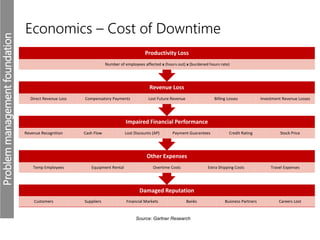
Economics – Cost of Downtime
Damaged Reputation
Customers Suppliers Financial Markets Banks Business Partners Careers Lost
Other Expenses
Temp Employees Equipment Rental Overtime Costs Extra Shipping Costs Travel Expenses
Impaired Financial Performance
Revenue Recognition Cash Flow Lost Discounts (AP) Payment Guarantees Credit Rating Stock Price
Revenue Loss
Direct Revenue Loss Compensatory Payments Lost Future Revenue Billing Losses Investment Revenue Losses
Productivity Loss
Number of employees affected x (hours out) x (burdened hours rate)
Source: Gartner Research
Problemmanagementfoundation
Allocation of funds
• When allocations are made consideration needs to include:
• People
• Process
• Technology
• Tools
• 3rd party system failures
• Cyber security breaches
• Internal and external communications
• Insurance
• Audits
• Forensics
• Compliance and regulatory fines
• Brand damage
• Real estate
• Legal costs
Problemmanagementfoundation
Influences from the cloud
Understand which costs are borne by which party should a crisis occur.
You cannot outsource a crisis, and even if you have outsourced, you are
accountable for managing the crisis
Problemmanagementfoundation
Review
It is important to know the costs
associated with a crisis as this is key to
allocation of resources – during a crisis
is too late to worry about where the
money is going to come from.

Problem management foundation Budget

  • 1.
  • 2.
  • 3.
    Problemmanagementfoundation Budget • Many organizationshave a budget to deal with operations • In many cases the contingencies especially financial ones are not modelled or understood • Creating a budget for crisis management is a key element of business risk management • Presenting costs in terms of business impact is crucial to building a business case • Technical support are IT related costs. Forensics, reputation, brand damage, lost productivity and lost revenue are business costs. • Assuming these costs are greater than the cost of investing in IT mitigation, the business case for IT logically is one of prevention of losses or increasing revenues. • According to IBM, business costs make up more than 75% of the financial consequences of business continuity and IT security failures.
  • 4.
    Problemmanagementfoundation Financial consideration s Reputational damage doesnot come with a price tag because it cannot be quantified –a reputational event may require a higher allocation of financial resources for resolution If the cost of averting a crisis exceeds the actual cost of the crisis, then the exercise is futile. Each crisis has a cost, and each resolution has a price tag. Understanding the cost implications of crisis management assists in determining where resources are allocated. Prioritisation of financial resources is required in order to manage risk. In the real world there are limited budgets, limited resources and limited time. In an ideal world there would be multiple instances of everything, as required in, order to deal with a crisis.
  • 5.
    Problemmanagementfoundation Cost categories • Understandingcosts involved in a crisis indicates a mature level of operational efficiency • The following broad cost categories should assist in creating transparency: • Setup costs for the Crisis Management Operations Centre which includes furniture, fit-out, connectivity, equipment, software, alternate site charges, etc • Repair cost – the cost most often budgeted by IT. This is the downtime; multiplied by the pro rata cost of the resources used; equipment replacement costs; insurance on the equipment; 3rd party services; costs of contractual breaches • Return to service cost – the cost to the business of the associated unavailability. This is made up of the following costs: • Downtime multiplied by population affected and normalised headcount charge • Downtime multiplied by missed revenue opportunity costs per hour • Overtime and other direct costs associated with the major incident • Soft costs such as customer perception and legal charges or penalties • Engineering costs for remote site visits, etc
  • 6.
  • 7.
    Problemmanagementfoundation Economics – Costof Downtime Damaged Reputation Customers Suppliers Financial Markets Banks Business Partners Careers Lost Other Expenses Temp Employees Equipment Rental Overtime Costs Extra Shipping Costs Travel Expenses Impaired Financial Performance Revenue Recognition Cash Flow Lost Discounts (AP) Payment Guarantees Credit Rating Stock Price Revenue Loss Direct Revenue Loss Compensatory Payments Lost Future Revenue Billing Losses Investment Revenue Losses Productivity Loss Number of employees affected x (hours out) x (burdened hours rate) Source: Gartner Research
  • 8.
    Problemmanagementfoundation Allocation of funds •When allocations are made consideration needs to include: • People • Process • Technology • Tools • 3rd party system failures • Cyber security breaches • Internal and external communications • Insurance • Audits • Forensics • Compliance and regulatory fines • Brand damage • Real estate • Legal costs
  • 9.
    Problemmanagementfoundation Influences from thecloud Understand which costs are borne by which party should a crisis occur. You cannot outsource a crisis, and even if you have outsourced, you are accountable for managing the crisis
  • 10.
    Problemmanagementfoundation Review It is importantto know the costs associated with a crisis as this is key to allocation of resources – during a crisis is too late to worry about where the money is going to come from.

Editor's Notes

  • #4 Requires notes
  • #5 Requires notes
  • #6 Cost categories
  • #7 Video reference: https://vimeo.com/83662045
  • #8 Requires notes
  • #9 Requires notes
  • #10 Influences from the cloud
  • #11 Review Requires notes