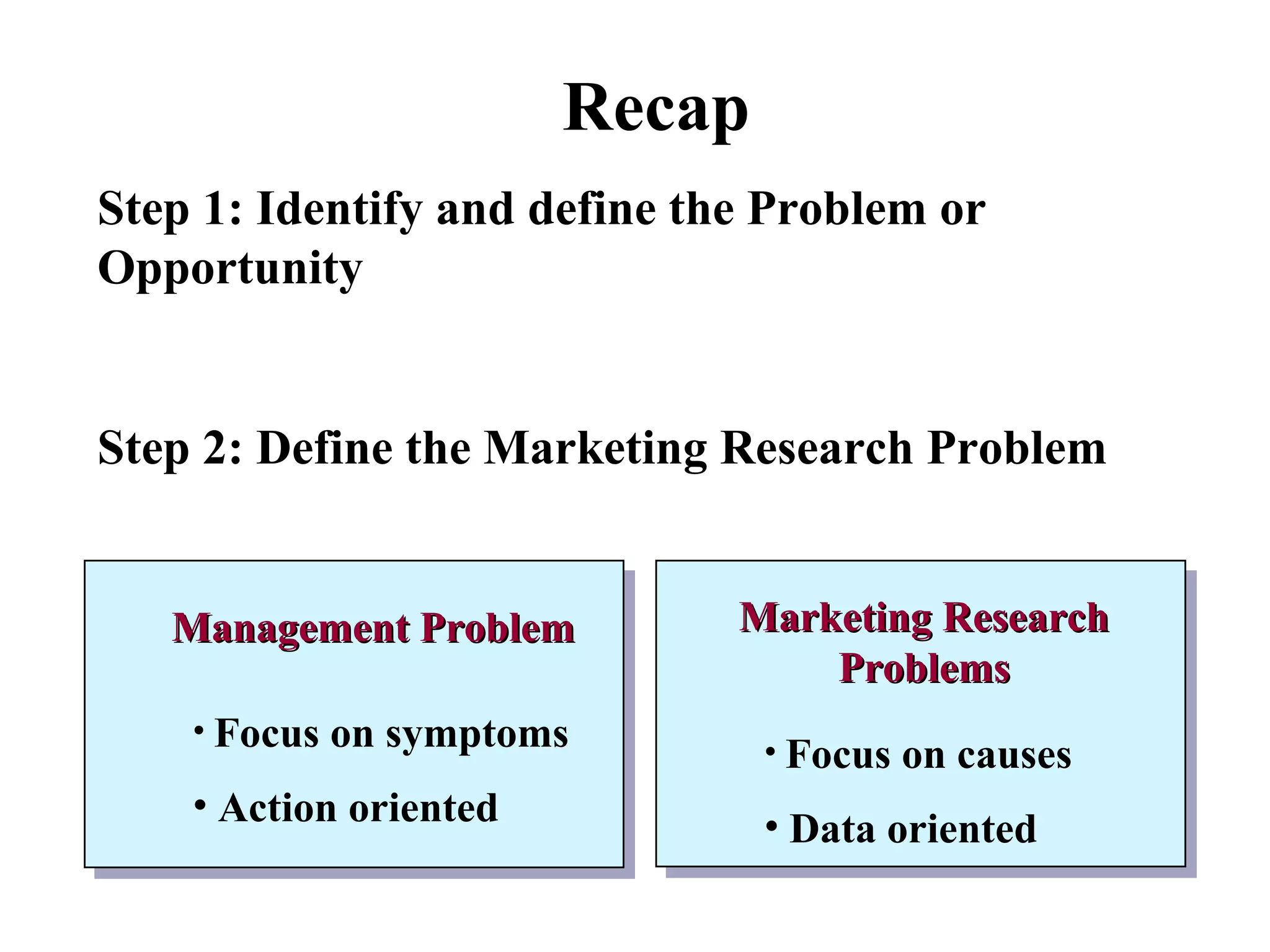


Recap 
Step 1: Identify and define the Problem or 
Opportunity 
Step 2: Define the Marketing Research Problem 
MMaannaaggeemmeenntt PPrroobblleemm MMaarrkkeettiinngg RReesseeaarrcchh 
PPrroobblleemmss 
• Focus on symptoms 
• Action oriented 
• Focus on causes 
• Data oriented
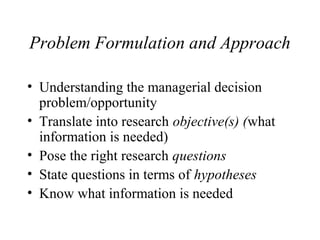
Problem Formulation and Approach 
• Understanding the managerial decision 
problem/opportunity 
• Translate into research objective(s) (what 
information is needed) 
• Pose the right research questions 
• State questions in terms of hypotheses 
• Know what information is needed
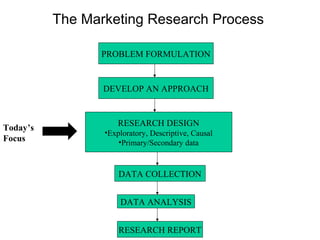
The Marketing Research Process 
PROBLEM FORMULATION 
RESEARCH DESIGN 
•Exploratory, Descriptive, Causal 
•Primary/Secondary data 
DATA COLLECTION 
DATA ANALYSIS 
RESEARCH REPORT 
Today’s 
Focus 
DEVELOP AN APPROACH
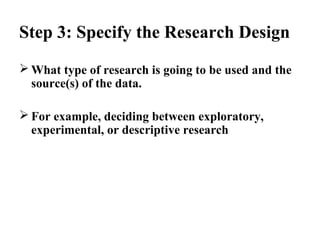
Step 3: Specify the Research Design 
What type of research is going to be used and the 
source(s) of the data. 
For example, deciding between exploratory, 
experimental, or descriptive research
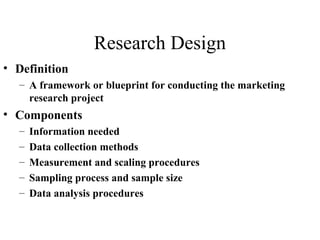
Research Design 
• Definition 
– A framework or blueprint for conducting the marketing 
research project 
• Components 
– Information needed 
– Data collection methods 
– Measurement and scaling procedures 
– Sampling process and sample size 
– Data analysis procedures
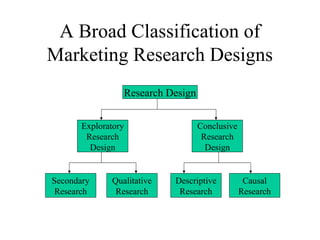
A Broad Classification of 
Marketing Research Designs 
Research Design 
Exploratory 
Research 
Design 
Secondary 
Research 
Qualitative 
Research 
Conclusive 
Research 
Design 
Descriptive 
Research 
Causal 
Research
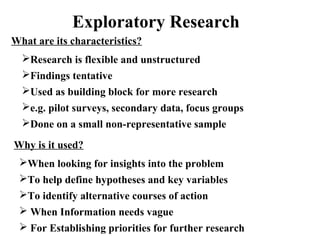
Exploratory Research 
What are its characteristics? 
Research is flexible and unstructured 
Findings tentative 
Used as building block for more research 
e.g. pilot surveys, secondary data, focus groups 
Done on a small non-representative sample 
Why is it used? 
When looking for insights into the problem 
To help define hypotheses and key variables 
To identify alternative courses of action 
 When Information needs vague 
 For Establishing priorities for further research
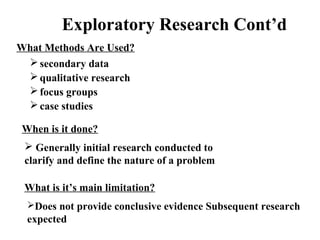
Exploratory Research Cont’d 
What Methods Are Used? 
secondary data 
qualitative research 
focus groups 
case studies 
When is it done? 
 Generally initial research conducted to 
clarify and define the nature of a problem 
What is it’s main limitation? 
Does not provide conclusive evidence Subsequent research 
expected
Conclusive Research 
Characteristics 
 inflexible, versatile 
 Results conclusive 
 Research formal and structured 
Used when information needs clearly defined 
Why is it Used? 
 to provide decision maker with the information needed to 
make sound decision 
 Testing hypotheses and insights and examining relationships
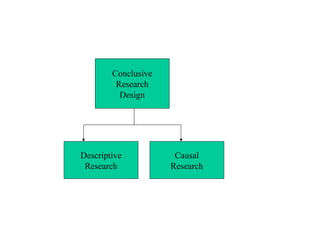
Conclusive 
Research 
Design 
Descriptive 
Research 
Causal 
Research
Descriptive Research 
What is the Objective? 
To describe something, e.g. Target market population 
characteristics 
What are its characteristics? 
 Problem well understood 
 Tests specific hypotheses 
 Formal and structured 
Large representative samples 
 Provides a snapshot of the market environment
Descriptive Research 
What Methods are Used? 
• Surveys (primary data) 
• panels 
• scanner data (secondary data) 
When Used? 
• Often a follow-up to exploratory research
Examples: 
 Market segmentation studies, i.e., describe characteristics 
of various groups, size of market, buying power of consumers. 
 Determining perceptions of company or product 
characteristics 
 Price and promotion elasticity studies 
 Product usage studies that describe consumption patterns 
 Sale potential studies for particular geographic region or 
population segment, 
Advertising studies that describe media consumption habits 
and audience profiles for specific television programs and 
magazines
Descriptive Research Designs 
• Two types of designs 
– Cross-sectional designs 
• Involves collection of information from sample of 
respondents only once 
• Could have a single cross-sectional design (only 
one sample) or multiple cross-sectional design 
(many samples of respondents) 
• Most popular design in marketing research 
• Example: Sample surveys
Descriptive Research Designs 
(contd.) 
• Longitudinal Designs 
– A fixed sample of the population is measured 
repeatedly, i.e., same respondents studied 
over time 
– Large amounts of data can be collected but 
can be expensive 
– Useful for tracking changes in consumer 
attitudes and behavior over time 
– Example: Diary panel data
Causal Research 
What is the objective of causal research? 
 To obtain information regarding cause and effect 
relationships 
Characteristics? 
Independent variable manipulated in a relatively 
controlled environment 
Main method is experiment 
Used to understand which variables are causes 
(independent variables), and which variables are the effects 
(dependent variables)
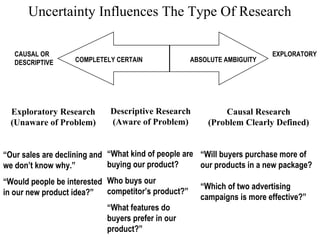
Uncertainty Influences The Type Of Research 
COMPLETELY CERTAIN ABSOLUTE AMBIGUITY 
Exploratory Research 
(Unaware of Problem) 
“Our sales are declining and 
we don’t know why.” 
“Would people be interested 
in our new product idea?” 
Descriptive Research 
(Aware of Problem) 
“What kind of people are 
buying our product? 
Who buys our 
competitor’s product?” 
“What features do 
buyers prefer in our 
product?” 
Causal Research 
(Problem Clearly Defined) 
“Will buyers purchase more of 
our products in a new package? 
“Which of two advertising 
campaigns is more effective?” 
CAUSAL OR 
DESCRIPTIVE 
EXPLORATORY
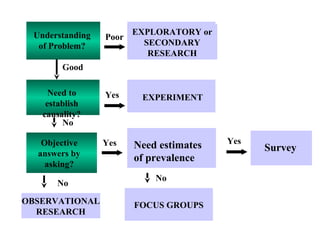
Understanding 
of Problem? 
Understanding 
of problem? 
Good 
Poor EXPLORATORY or 
SECONDARY 
RESEARCH 
Need to Yes EXPERIMENT 
establish 
causality? 
No 
Objective 
answers by 
asking? 
No 
OBSERVATIONAL 
RESEARCH 
Yes Need estimates Survey 
of prevalence? 
Yes Need estimates 
of prevalence 
No 
FOCUS GROUPS
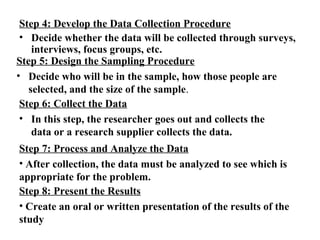
Step 4: Develop the Data Collection Procedure 
• Decide whether the data will be collected through surveys, 
interviews, focus groups, etc. 
Step 5: Design the Sampling Procedure 
• Decide who will be in the sample, how those people are 
selected, and the size of the sample. 
Step 6: Collect the Data 
• In this step, the researcher goes out and collects the 
data or a research supplier collects the data. 
Step 7: Process and Analyze the Data 
• After collection, the data must be analyzed to see which is 
appropriate for the problem. 
Step 8: Present the Results 
• Create an oral or written presentation of the results of the 
study
21 
I keep six honest 
serving men, (they 
taught me all I knew), 
their names are what 
and why, and when, and 
how, and where and 
who” --Rudyard 
Kipling
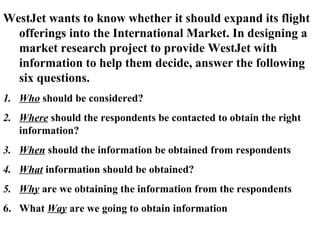
WestJet wants to know whether it should expand its flight 
offerings into the International Market. In designing a 
market research project to provide WestJet with 
information to help them decide, answer the following 
six questions. 
1. Who should be considered? 
2. Where should the respondents be contacted to obtain the right 
information? 
3. When should the information be obtained from respondents 
4. What information should be obtained? 
5. Why are we obtaining the information from the respondents 
6. What Way are we going to obtain information
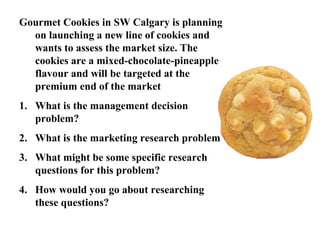
Gourmet Cookies in SW Calgary is planning 
on launching a new line of cookies and 
wants to assess the market size. The 
cookies are a mixed-chocolate-pineapple 
flavour and will be targeted at the 
premium end of the market 
1. What is the management decision 
problem? 
2. What is the marketing research problem 
3. What might be some specific research 
questions for this problem? 
4. How would you go about researching 
these questions?
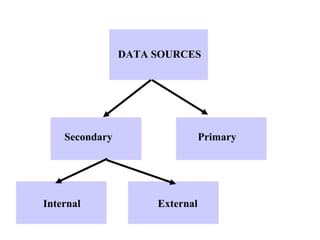
DATA SOURCES 
Secondary Primary 
Internal External
Secondary Data 
Data gathered and recorded by someone else prior to and 
for a purpose other than the current project. 
Is often: 
• Historical 
• Already assembled 
• Needs no access to subjects or respondents
Common Research Objectives 
for Secondary Data Research 
Fact Finding - Identifying consumption patterns 
- Tracking trends 
Model building - Estimating market potential 
- Forecasting sales 
- Selecting trade areas and sites 
Data Base - Development of Prospect Lists 
Marketing - Enhancement of Customer Lists
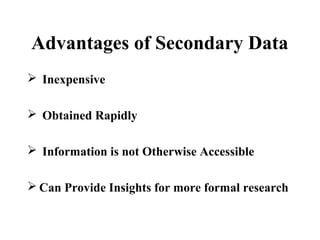
Advantages of Secondary Data 
 Inexpensive 
 Obtained Rapidly 
 Information is not Otherwise Accessible 
Can Provide Insights for more formal research
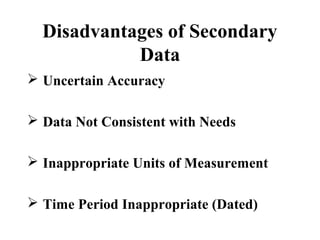
Disadvantages of Secondary 
Data 
 Uncertain Accuracy 
 Data Not Consistent with Needs 
 Inappropriate Units of Measurement 
 Time Period Inappropriate (Dated)
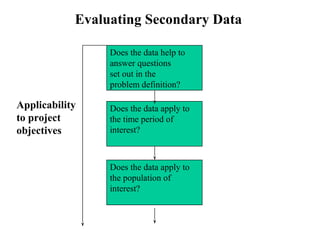
Evaluating Secondary Data 
Does the data help to 
answer questions 
set out in the 
problem definition? 
Does the data apply to 
the time period of 
interest? 
Does the data apply to 
the population of 
interest? 
Applicability 
to project 
objectives
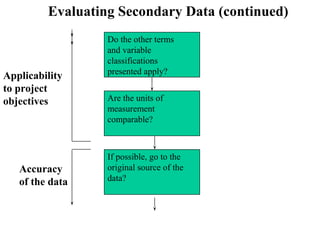
Evaluating Secondary Data (continued) 
Do the other terms 
and variable 
classifications 
presented apply? 
Are the units of 
measurement 
comparable? 
If possible, go to the 
original source of the 
data? 
Applicability 
to project 
objectives 
Accuracy 
of the data
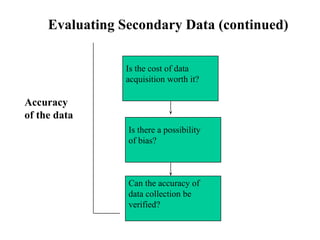
Evaluating Secondary Data (continued) 
Is the cost of data 
acquisition worth it? 
Accuracy 
of the data 
Is there a possibility 
of bias? 
Can the accuracy of 
data collection be 
verified?
Internal Data 
Accounting information 
Sales information 
Backorders 
Customer complaints
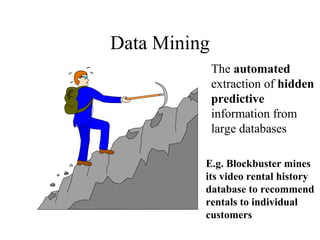
Data Mining 
The automated 
extraction of hidden 
predictive 
information from 
large databases 
E.g. Blockbuster mines 
its video rental history 
database to recommend 
rentals to individual 
customers
External Data 
Created, recorded, or generated by an 
entity other than the researcher’s 
organization.
Sources of External Data 
Libraries 
The Internet 
Vendors 
Producers 
Books and periodicals 
Government 
Trade associations 
Newspapers and journals
Commercial Sources 
 Attitude and public opinion research—syndicated 
services report the findings of opinion polls 
 Consumption and purchase behavior data 
 Advertising research—readership and audience 
data 
 Market share data companies like A.C. Nielsen 
provide information about sales volume and brand 
share over time
A Local health food store is interested in opening a branch 
near the SAIT campus. 
1. What is your management problem? 
2. What is the Research Problem? 
3. What information would be needed 
4. What Secondary sources of information are available to 
help you decide whether to open such a store 
5. Summarize the data that would bear on their decision 
on whether or not to open such a store.
You have decided to open a new retail store in Calgary that 
will sell personal computers and software. 
What information do you need to help you determine where 
to locate? 
What secondary data are available to help you decide where 
to locate the store?

Research design

  • 1.
    Recap Step 1:Identify and define the Problem or Opportunity Step 2: Define the Marketing Research Problem MMaannaaggeemmeenntt PPrroobblleemm MMaarrkkeettiinngg RReesseeaarrcchh PPrroobblleemmss • Focus on symptoms • Action oriented • Focus on causes • Data oriented
  • 2.
    Problem Formulation andApproach • Understanding the managerial decision problem/opportunity • Translate into research objective(s) (what information is needed) • Pose the right research questions • State questions in terms of hypotheses • Know what information is needed
  • 4.
    The Marketing ResearchProcess PROBLEM FORMULATION RESEARCH DESIGN •Exploratory, Descriptive, Causal •Primary/Secondary data DATA COLLECTION DATA ANALYSIS RESEARCH REPORT Today’s Focus DEVELOP AN APPROACH
  • 5.
    Step 3: Specifythe Research Design What type of research is going to be used and the source(s) of the data. For example, deciding between exploratory, experimental, or descriptive research
  • 6.
    Research Design •Definition – A framework or blueprint for conducting the marketing research project • Components – Information needed – Data collection methods – Measurement and scaling procedures – Sampling process and sample size – Data analysis procedures
  • 7.
    A Broad Classificationof Marketing Research Designs Research Design Exploratory Research Design Secondary Research Qualitative Research Conclusive Research Design Descriptive Research Causal Research
  • 8.
    Exploratory Research Whatare its characteristics? Research is flexible and unstructured Findings tentative Used as building block for more research e.g. pilot surveys, secondary data, focus groups Done on a small non-representative sample Why is it used? When looking for insights into the problem To help define hypotheses and key variables To identify alternative courses of action  When Information needs vague  For Establishing priorities for further research
  • 9.
    Exploratory Research Cont’d What Methods Are Used? secondary data qualitative research focus groups case studies When is it done?  Generally initial research conducted to clarify and define the nature of a problem What is it’s main limitation? Does not provide conclusive evidence Subsequent research expected
  • 10.
    Conclusive Research Characteristics  inflexible, versatile  Results conclusive  Research formal and structured Used when information needs clearly defined Why is it Used?  to provide decision maker with the information needed to make sound decision  Testing hypotheses and insights and examining relationships
  • 11.
    Conclusive Research Design Descriptive Research Causal Research
  • 12.
    Descriptive Research Whatis the Objective? To describe something, e.g. Target market population characteristics What are its characteristics?  Problem well understood  Tests specific hypotheses  Formal and structured Large representative samples  Provides a snapshot of the market environment
  • 13.
    Descriptive Research WhatMethods are Used? • Surveys (primary data) • panels • scanner data (secondary data) When Used? • Often a follow-up to exploratory research
  • 14.
    Examples:  Marketsegmentation studies, i.e., describe characteristics of various groups, size of market, buying power of consumers.  Determining perceptions of company or product characteristics  Price and promotion elasticity studies  Product usage studies that describe consumption patterns  Sale potential studies for particular geographic region or population segment, Advertising studies that describe media consumption habits and audience profiles for specific television programs and magazines
  • 15.
    Descriptive Research Designs • Two types of designs – Cross-sectional designs • Involves collection of information from sample of respondents only once • Could have a single cross-sectional design (only one sample) or multiple cross-sectional design (many samples of respondents) • Most popular design in marketing research • Example: Sample surveys
  • 16.
    Descriptive Research Designs (contd.) • Longitudinal Designs – A fixed sample of the population is measured repeatedly, i.e., same respondents studied over time – Large amounts of data can be collected but can be expensive – Useful for tracking changes in consumer attitudes and behavior over time – Example: Diary panel data
  • 17.
    Causal Research Whatis the objective of causal research?  To obtain information regarding cause and effect relationships Characteristics? Independent variable manipulated in a relatively controlled environment Main method is experiment Used to understand which variables are causes (independent variables), and which variables are the effects (dependent variables)
  • 18.
    Uncertainty Influences TheType Of Research COMPLETELY CERTAIN ABSOLUTE AMBIGUITY Exploratory Research (Unaware of Problem) “Our sales are declining and we don’t know why.” “Would people be interested in our new product idea?” Descriptive Research (Aware of Problem) “What kind of people are buying our product? Who buys our competitor’s product?” “What features do buyers prefer in our product?” Causal Research (Problem Clearly Defined) “Will buyers purchase more of our products in a new package? “Which of two advertising campaigns is more effective?” CAUSAL OR DESCRIPTIVE EXPLORATORY
  • 19.
    Understanding of Problem? Understanding of problem? Good Poor EXPLORATORY or SECONDARY RESEARCH Need to Yes EXPERIMENT establish causality? No Objective answers by asking? No OBSERVATIONAL RESEARCH Yes Need estimates Survey of prevalence? Yes Need estimates of prevalence No FOCUS GROUPS
  • 20.
    Step 4: Developthe Data Collection Procedure • Decide whether the data will be collected through surveys, interviews, focus groups, etc. Step 5: Design the Sampling Procedure • Decide who will be in the sample, how those people are selected, and the size of the sample. Step 6: Collect the Data • In this step, the researcher goes out and collects the data or a research supplier collects the data. Step 7: Process and Analyze the Data • After collection, the data must be analyzed to see which is appropriate for the problem. Step 8: Present the Results • Create an oral or written presentation of the results of the study
  • 21.
    21 I keepsix honest serving men, (they taught me all I knew), their names are what and why, and when, and how, and where and who” --Rudyard Kipling
  • 22.
    WestJet wants toknow whether it should expand its flight offerings into the International Market. In designing a market research project to provide WestJet with information to help them decide, answer the following six questions. 1. Who should be considered? 2. Where should the respondents be contacted to obtain the right information? 3. When should the information be obtained from respondents 4. What information should be obtained? 5. Why are we obtaining the information from the respondents 6. What Way are we going to obtain information
  • 23.
    Gourmet Cookies inSW Calgary is planning on launching a new line of cookies and wants to assess the market size. The cookies are a mixed-chocolate-pineapple flavour and will be targeted at the premium end of the market 1. What is the management decision problem? 2. What is the marketing research problem 3. What might be some specific research questions for this problem? 4. How would you go about researching these questions?
  • 24.
    DATA SOURCES SecondaryPrimary Internal External
  • 25.
    Secondary Data Datagathered and recorded by someone else prior to and for a purpose other than the current project. Is often: • Historical • Already assembled • Needs no access to subjects or respondents
  • 26.
    Common Research Objectives for Secondary Data Research Fact Finding - Identifying consumption patterns - Tracking trends Model building - Estimating market potential - Forecasting sales - Selecting trade areas and sites Data Base - Development of Prospect Lists Marketing - Enhancement of Customer Lists
  • 27.
    Advantages of SecondaryData  Inexpensive  Obtained Rapidly  Information is not Otherwise Accessible Can Provide Insights for more formal research
  • 28.
    Disadvantages of Secondary Data  Uncertain Accuracy  Data Not Consistent with Needs  Inappropriate Units of Measurement  Time Period Inappropriate (Dated)
  • 29.
    Evaluating Secondary Data Does the data help to answer questions set out in the problem definition? Does the data apply to the time period of interest? Does the data apply to the population of interest? Applicability to project objectives
  • 30.
    Evaluating Secondary Data(continued) Do the other terms and variable classifications presented apply? Are the units of measurement comparable? If possible, go to the original source of the data? Applicability to project objectives Accuracy of the data
  • 31.
    Evaluating Secondary Data(continued) Is the cost of data acquisition worth it? Accuracy of the data Is there a possibility of bias? Can the accuracy of data collection be verified?
  • 32.
    Internal Data Accountinginformation Sales information Backorders Customer complaints
  • 33.
    Data Mining Theautomated extraction of hidden predictive information from large databases E.g. Blockbuster mines its video rental history database to recommend rentals to individual customers
  • 35.
    External Data Created,recorded, or generated by an entity other than the researcher’s organization.
  • 36.
    Sources of ExternalData Libraries The Internet Vendors Producers Books and periodicals Government Trade associations Newspapers and journals
  • 37.
    Commercial Sources Attitude and public opinion research—syndicated services report the findings of opinion polls  Consumption and purchase behavior data  Advertising research—readership and audience data  Market share data companies like A.C. Nielsen provide information about sales volume and brand share over time
  • 38.
    A Local healthfood store is interested in opening a branch near the SAIT campus. 1. What is your management problem? 2. What is the Research Problem? 3. What information would be needed 4. What Secondary sources of information are available to help you decide whether to open such a store 5. Summarize the data that would bear on their decision on whether or not to open such a store.
  • 39.
    You have decidedto open a new retail store in Calgary that will sell personal computers and software. What information do you need to help you determine where to locate? What secondary data are available to help you decide where to locate the store?