B.TECH YEAR II
SEMESTER III
2014-2018
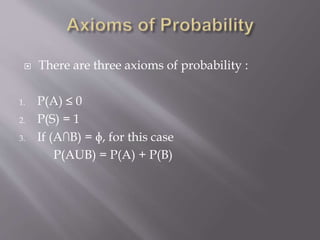
 There are three axioms of probability :
1. P(A) ≤ 0
2. P(S) = 1
3. If (A∩B) = ɸ, for this case
P(AUB) = P(A) + P(B)
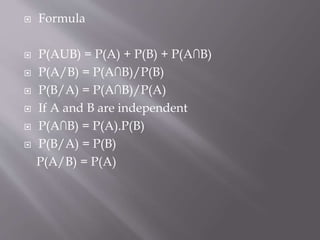
 Formula
 P(AUB) = P(A) + P(B) + P(A∩B)
 P(A/B) = P(A∩B)/P(B)
 P(B/A) = P(A∩B)/P(A)
 If A and B are independent
 P(A∩B) = P(A).P(B)
 P(B/A) = P(B)
P(A/B) = P(A)
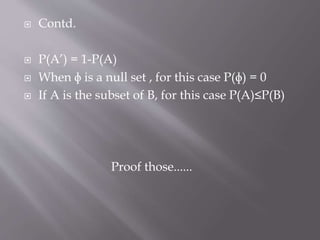
 Contd.
 P(A’) = 1-P(A)
 When ɸ is a null set , for this case P(ɸ) = 0
 If A is the subset of B, for this case P(A)≤P(B)
Proof those......
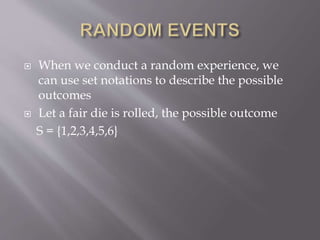
 When we conduct a random experience, we
can use set notations to describe the possible
outcomes
 Let a fair die is rolled, the possible outcome
S = {1,2,3,4,5,6}
 Random variable X(S) is a real valued function
of the underlying even space : s ϵ S
 A random variable be of two types
a. Discrete variable : Range finite [eg. {0,1,2}] or
infinite[eg. {0,1,2,3.....,n}]
b. Continues variable : range is uncountable[
eg.{0,1,2,..........n}]
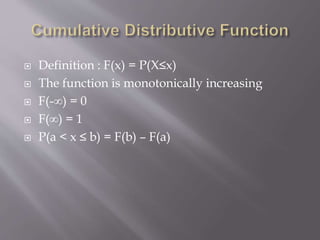
 Definition : F(x) = P(X≤x)
 The function is monotonically increasing
 F(-∞) = 0
 F(∞) = 1
 P(a < x ≤ b) = F(b) – F(a)
 Definition : P(x) = D[F(x)] here D = d/dx
 Properties :
a. P(x) ≥ 0
b. ∫ P(x)dx = 1 [limit -∞ to ∞]
c. P(a < x ≤ b) = ∫ P(x)dx [Limit a to b]
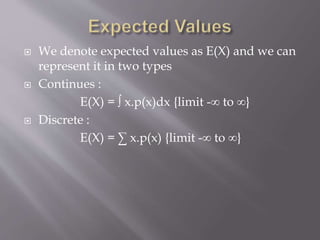
 We denote expected values as E(X) and we can
represent it in two types
 Continues :
E(X) = ∫ x.p(x)dx {limit -∞ to ∞}
 Discrete :
E(X) = ∑ x.p(x) {limit -∞ to ∞}
 Formula for variance is same for both
continues and discrete
Var(X) = E[X^2] – (E[X])^2
 Definition : p(x) = P(X = x)
 Properties :
p(x) ≥ 0
∑p(x) = 1 [for all values of x ]
P(a ≤ X ≤ b) = ∑p(x) [for all values of x=a to
x=b
 Let p(x) = 1-p [x=0]
= p [x=1]
For this case, we can say that
p(y) = nCy . p^y. (1-p)^(n-y)
Mean : np
Variance : np(1-p)
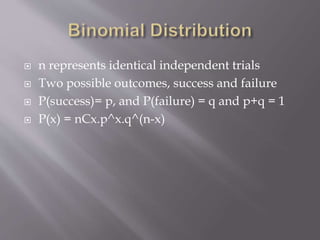
 n represents identical independent trials
 Two possible outcomes, success and failure
 P(success)= p, and P(failure) = q and p+q = 1
 P(x) = nCx.p^x.q^(n-x)
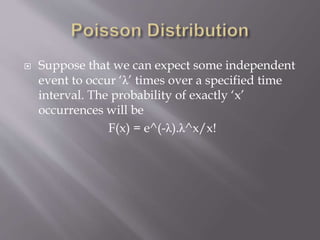
 Suppose that we can expect some independent
event to occur ‘λ’ times over a specified time
interval. The probability of exactly ‘x’
occurrences will be
F(x) = e^(-λ).λ^x/x!
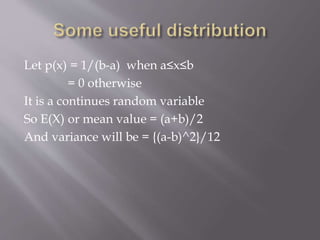
Let p(x) = 1/(b-a) when a≤x≤b
= 0 otherwise
It is a continues random variable
So E(X) or mean value = (a+b)/2
And variance will be = {(a-b)^2}/12
Thank You.....

Probability and Random Variables

  • 1.
  • 2.
     There arethree axioms of probability : 1. P(A) ≤ 0 2. P(S) = 1 3. If (A∩B) = ɸ, for this case P(AUB) = P(A) + P(B)
  • 3.
     Formula  P(AUB)= P(A) + P(B) + P(A∩B)  P(A/B) = P(A∩B)/P(B)  P(B/A) = P(A∩B)/P(A)  If A and B are independent  P(A∩B) = P(A).P(B)  P(B/A) = P(B) P(A/B) = P(A)
  • 4.
     Contd.  P(A’)= 1-P(A)  When ɸ is a null set , for this case P(ɸ) = 0  If A is the subset of B, for this case P(A)≤P(B) Proof those......
  • 5.
     When weconduct a random experience, we can use set notations to describe the possible outcomes  Let a fair die is rolled, the possible outcome S = {1,2,3,4,5,6}
  • 6.
     Random variableX(S) is a real valued function of the underlying even space : s ϵ S  A random variable be of two types a. Discrete variable : Range finite [eg. {0,1,2}] or infinite[eg. {0,1,2,3.....,n}] b. Continues variable : range is uncountable[ eg.{0,1,2,..........n}]
  • 7.
     Definition :F(x) = P(X≤x)  The function is monotonically increasing  F(-∞) = 0  F(∞) = 1  P(a < x ≤ b) = F(b) – F(a)
  • 8.
     Definition :P(x) = D[F(x)] here D = d/dx  Properties : a. P(x) ≥ 0 b. ∫ P(x)dx = 1 [limit -∞ to ∞] c. P(a < x ≤ b) = ∫ P(x)dx [Limit a to b]
  • 9.
     We denoteexpected values as E(X) and we can represent it in two types  Continues : E(X) = ∫ x.p(x)dx {limit -∞ to ∞}  Discrete : E(X) = ∑ x.p(x) {limit -∞ to ∞}
  • 10.
     Formula forvariance is same for both continues and discrete Var(X) = E[X^2] – (E[X])^2
  • 11.
     Definition :p(x) = P(X = x)  Properties : p(x) ≥ 0 ∑p(x) = 1 [for all values of x ] P(a ≤ X ≤ b) = ∑p(x) [for all values of x=a to x=b
  • 12.
     Let p(x)= 1-p [x=0] = p [x=1] For this case, we can say that p(y) = nCy . p^y. (1-p)^(n-y) Mean : np Variance : np(1-p)
  • 13.
     n representsidentical independent trials  Two possible outcomes, success and failure  P(success)= p, and P(failure) = q and p+q = 1  P(x) = nCx.p^x.q^(n-x)
  • 14.
     Suppose thatwe can expect some independent event to occur ‘λ’ times over a specified time interval. The probability of exactly ‘x’ occurrences will be F(x) = e^(-λ).λ^x/x!
  • 15.
    Let p(x) =1/(b-a) when a≤x≤b = 0 otherwise It is a continues random variable So E(X) or mean value = (a+b)/2 And variance will be = {(a-b)^2}/12
  • 16.

Editor's Notes

  • #10 Subhobrata Banerjee