Summarized by: Dr. Maribel R. Gaite
 The process of selecting a number of
individuals for a study in such a way
that the individuals represent the
larger group from which they were
selected
Sample
Sample…
…the representatives selected for a
study whose characteristics
exemplify the larger group from
which they were selected
Population
Population…
…the larger group from which
individuals are selected to participate
in a study
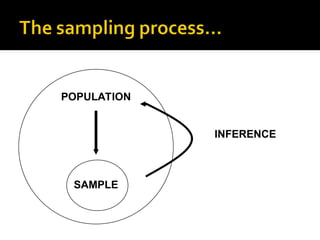
 To gather data about the population
in order to make an inference that
can be generalized to the population
POPULATION
SAMPLE
INFERENCE
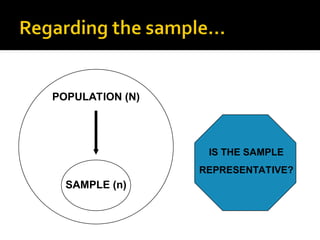
POPULATION (N)
SAMPLE (n)
IS THE SAMPLE
REPRESENTATIVE?
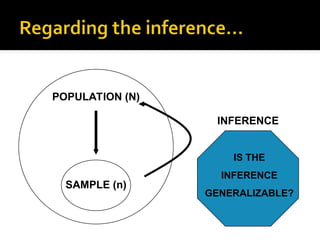
POPULATION (N)
SAMPLE (n)
INFERENCE
IS THE
INFERENCE
GENERALIZABLE?
2. Sampling bias
…which threaten to render a study’s
findings invalid
1. Sampling error
Sampling error
Sampling error…
…the chance and random variation in
variables that occurs when any sample
is selected from the population
…sampling error is to be expected
…to avoid sampling error, a census
census of
the entire population must be taken
…to control for sampling error,
researchers use various sampling
methods
Sampling bias
Sampling bias…
…nonrandom differences, generally the
fault of the researcher, where sample
over-represents individuals or groups
within the population and which lead to
invalid findings
…sources of sampling bias include the
use of volunteers and available groups
2. Determine sample size (n)
3. Control for bias and error
4. Select sample
1. Define population (N) to be sampled
 Identify the group of interest and
its characteristics to which the
findings of the study will be
generalized
…called the “target
target” population
(the ideal selection)
…oftentimes the “accessible
accessible” or
“available
available” population must be
used (the realistic selection)
 The size of the sample influences
both the representativeness of the
sample and the statistical analysis
of the data
…larger samples are more likely
to detect a difference between
different groups
…smaller samples are more likely
not to be representative
2. For smaller samples (N ‹ 100), there is
little point in sampling. Survey the
entire population.
1. The larger the population size, the
smaller the percentage of the
population required to get a
representative sample
 Be aware of the sources of sampling
bias and identify how to avoid it
Decide whether the bias is so severe
that the results of the study will be
seriously affected
In the final report, document
awareness of bias, rationale for
proceeding, and potential effects
 A process by which the researcher
attempts to ensure that the sample
is representative of the population
from which it is to be selected
…requires identifying the sampling
method that will be used
2. Nonrandom
Nonrandom (“nonprobability”): does
not have random sampling at any
state of the sample selection;
increases probability of sampling bias
1. Random
Random: allows a procedure
governed by chance to select the
sample; controls for sampling bias
2. Stratified sampling
3. Cluster sampling
4. Systematic sampling
1. Simple random sampling
Simple random sampling: the process
of selecting a sample that allows
individual in the defined population to
have an equal and independent
chance of being selected for the
sample
2. Determine the desired sample size.
3. List all members of the population.
4. Assign all individuals on the list a
consecutive number from zero to the
required number. Each individual
must have the same number of digits
as each other individual.
1. Identify and define the population.
6. For the selected number, look only at
the number of digits assigned to each
population member.
5. Select an arbitrary number in the table
of random numbers.
8. Go to the next number in the column
and repeat step #7 until the desired
number of individuals has been
selected for the sample.
7. If the number corresponds to the
number assigned to any of the
individuals in the population, then
that individual is included in the
sample.
advantages
advantages…
…easy to conduct
…strategy requires minimum knowledge
of the population to be sampled
disadvantages
disadvantages…
…need names of all population members
…may over- represent or under- estimate
sample members
…there is difficulty in reaching all selected
in the sample
2. Stratified sampling
Stratified sampling: the process of
selecting a sample that allows
identified subgroups in the defined
population to be represented in the
same proportion that they exist in the
population
2. Determine the desired sample size.
3. Identify the variable and subgroups
(strata) for which you want to
guarantee appropriate, equal
representation.
1. Identify and define the population.
5. Randomly select, using a table of
random numbers) an “appropriate”
number of individuals from each of
the subgroups, appropriate meaning
an equal number of individuals
4. Classify all members of the
population as members of one
identified subgroup.
advantages
advantages…
…more precise sample
…can be used for both proportions and
stratification sampling
…sample represents the desired strata
disadvantages
disadvantages…
…need names of all population members
…there is difficulty in reaching all selected
in the sample
…researcher must have names of all
populations
3. Cluster sampling
Cluster sampling: the process of
randomly selecting intact groups, not
individuals, within the defined
population sharing similar
characteristics
2. Determine the desired sample size.
3. Identify and define a logical cluster.
4. List all clusters (or obtain a list) that
make up the population of clusters.
1. Identify and define the population.
5. Estimate the average number of
population members per cluster.
7. Randomly select the needed number
of clusters by using a table of random
numbers.
6. Determine the number of clusters
needed by dividing the sample size by
the estimated size of a cluster.
8. Include in your study all population
members in each selected cluster.
advantages
advantages…
…efficient
…researcher doesn’t need names of all
population members
…reduces travel to site
…useful for educational research
disadvantages
disadvantages…
…fewer sampling points make it less like
that the sample is representative
4. Systematic sampling
Systematic sampling: the process of
selecting individuals within the
defined population from a list by
taking every K
Kth name.
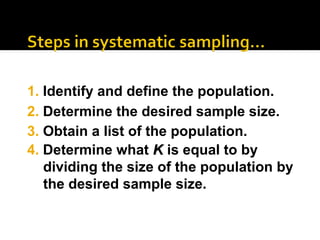
2. Determine the desired sample size.
3. Obtain a list of the population.
4. Determine what K
K is equal to by
dividing the size of the population by
the desired sample size.
1. Identify and define the population.
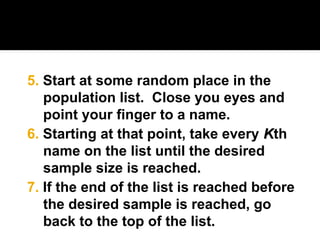
6. Starting at that point, take every K
Kth
name on the list until the desired
sample size is reached.
5. Start at some random place in the
population list. Close you eyes and
point your finger to a name.
7. If the end of the list is reached before
the desired sample is reached, go
back to the top of the list.
advantages
advantages…
…sample selection is simple
disadvantages
disadvantages…
…all members of the population do not
have an equal chance of being selected
…the K
Kth person may be related to a
periodical order in the population list,
producing unrepresentativeness in the
sample
2. Purposive sampling
3. Quota sampling
1. Convenience sampling
Convenience sampling: the process
of including whoever happens to be
available at the time
…called “accidental” or “haphazard”
sampling
disadvantages
disadvantages…
…difficulty in determining how much of
the effect (dependent variable) results
from the cause (independent variable)
2. Purposive sampling
Purposive sampling: the process
whereby the researcher selects a
sample based on experience or
knowledge of the group to be sampled
…called “judgment” sampling
disadvantages
disadvantages…
…potential for inaccuracy in the
researcher’s criteria and resulting
sample selections
3. Quota sampling
Quota sampling: the process whereby
a researcher gathers data from
individuals possessing identified
characteristics and quotas
disadvantages
disadvantages…
…people who are less accessible (more
difficult to contact, more reluctant to
participate) are under-represented
…qualitative research is characterized
by in-depth inquiry, immersion in a
setting, emphasis on context, concern
with participants’ perspectives, and
description of a single setting, not
generalization to many settings
…because samples need to be small
and many potential participants are
unwilling to undergo the demands of
participation, most qualitative
research samples are purposive
…representativeness is secondary to
the quality of the participants’ ability
to provide the desired information
about self and setting
2. Homogeneous sampling
Homogeneous sampling: selecting
participants who are very similar in
experience, perspective, or outlook
1. Intensity sampling
Intensity sampling: selecting
participants who permit study of
different levels of the research topic
4. Snowball sampling
Snowball sampling: selecting a few
individuals who can identify other
individuals who can identify still other
individuals who might be good
participants for a study
3. Criterion sampling
Criterion sampling: selecting all cases
that meet some pre-defined
characteristic
5. Random purposive sampling
Random purposive sampling: with a
small sample, selecting by random
means participants who were
purposively selected and are too
numerous to include all in the study
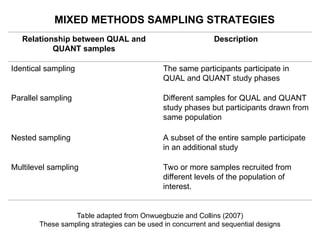
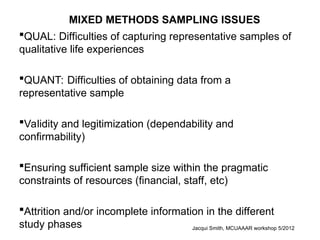
MIXED METHODS SAMPLING STRATEGIES
Relationship between QUAL and
QUANT samples
Description
Identical sampling The same participants participate in
QUAL and QUANT study phases
Parallel sampling Different samples for QUAL and QUANT
study phases but participants drawn from
same population
Nested sampling A subset of the entire sample participate
in an additional study
Multilevel sampling Two or more samples recruited from
different levels of the population of
interest.
Table adapted from Onwuegbuzie and Collins (2007)
These sampling strategies can be used in concurrent and sequential designs
QUAL: Difficulties of capturing representative samples of
qualitative life experiences
QUANT: Difficulties of obtaining data from a
representative sample
Validity and legitimization (dependability and
confirmability)
Ensuring sufficient sample size within the pragmatic
constraints of resources (financial, staff, etc)
Attrition and/or incomplete information in the different
study phases
MIXED METHODS SAMPLING ISSUES
Jacqui Smith, MCUAAAR workshop 5/2012
Jacobs, R. Educational Research: Sampling a
Population. Educational Research. n.d.
Reference:

Sampling Methods in Educational Research

  • 1.
    Summarized by: Dr.Maribel R. Gaite
  • 2.
     The processof selecting a number of individuals for a study in such a way that the individuals represent the larger group from which they were selected
  • 3.
    Sample Sample… …the representatives selectedfor a study whose characteristics exemplify the larger group from which they were selected
  • 4.
    Population Population… …the larger groupfrom which individuals are selected to participate in a study
  • 5.
     To gatherdata about the population in order to make an inference that can be generalized to the population
  • 6.
  • 7.
    POPULATION (N) SAMPLE (n) ISTHE SAMPLE REPRESENTATIVE?
  • 8.
    POPULATION (N) SAMPLE (n) INFERENCE ISTHE INFERENCE GENERALIZABLE?
  • 9.
    2. Sampling bias …whichthreaten to render a study’s findings invalid 1. Sampling error
  • 10.
    Sampling error Sampling error… …thechance and random variation in variables that occurs when any sample is selected from the population …sampling error is to be expected
  • 11.
    …to avoid samplingerror, a census census of the entire population must be taken …to control for sampling error, researchers use various sampling methods
  • 12.
    Sampling bias Sampling bias… …nonrandomdifferences, generally the fault of the researcher, where sample over-represents individuals or groups within the population and which lead to invalid findings …sources of sampling bias include the use of volunteers and available groups
  • 13.
    2. Determine samplesize (n) 3. Control for bias and error 4. Select sample 1. Define population (N) to be sampled
  • 14.
     Identify thegroup of interest and its characteristics to which the findings of the study will be generalized …called the “target target” population (the ideal selection) …oftentimes the “accessible accessible” or “available available” population must be used (the realistic selection)
  • 15.
     The sizeof the sample influences both the representativeness of the sample and the statistical analysis of the data …larger samples are more likely to detect a difference between different groups …smaller samples are more likely not to be representative
  • 16.
    2. For smallersamples (N ‹ 100), there is little point in sampling. Survey the entire population. 1. The larger the population size, the smaller the percentage of the population required to get a representative sample
  • 17.
     Be awareof the sources of sampling bias and identify how to avoid it Decide whether the bias is so severe that the results of the study will be seriously affected In the final report, document awareness of bias, rationale for proceeding, and potential effects
  • 18.
     A processby which the researcher attempts to ensure that the sample is representative of the population from which it is to be selected …requires identifying the sampling method that will be used
  • 19.
    2. Nonrandom Nonrandom (“nonprobability”):does not have random sampling at any state of the sample selection; increases probability of sampling bias 1. Random Random: allows a procedure governed by chance to select the sample; controls for sampling bias
  • 20.
    2. Stratified sampling 3.Cluster sampling 4. Systematic sampling 1. Simple random sampling
  • 21.
    1. Simple randomsampling Simple random sampling: the process of selecting a sample that allows individual in the defined population to have an equal and independent chance of being selected for the sample
  • 22.
    2. Determine thedesired sample size. 3. List all members of the population. 4. Assign all individuals on the list a consecutive number from zero to the required number. Each individual must have the same number of digits as each other individual. 1. Identify and define the population.
  • 23.
    6. For theselected number, look only at the number of digits assigned to each population member. 5. Select an arbitrary number in the table of random numbers.
  • 24.
    8. Go tothe next number in the column and repeat step #7 until the desired number of individuals has been selected for the sample. 7. If the number corresponds to the number assigned to any of the individuals in the population, then that individual is included in the sample.
  • 25.
    advantages advantages… …easy to conduct …strategyrequires minimum knowledge of the population to be sampled
  • 26.
    disadvantages disadvantages… …need names ofall population members …may over- represent or under- estimate sample members …there is difficulty in reaching all selected in the sample
  • 27.
    2. Stratified sampling Stratifiedsampling: the process of selecting a sample that allows identified subgroups in the defined population to be represented in the same proportion that they exist in the population
  • 28.
    2. Determine thedesired sample size. 3. Identify the variable and subgroups (strata) for which you want to guarantee appropriate, equal representation. 1. Identify and define the population.
  • 29.
    5. Randomly select,using a table of random numbers) an “appropriate” number of individuals from each of the subgroups, appropriate meaning an equal number of individuals 4. Classify all members of the population as members of one identified subgroup.
  • 30.
    advantages advantages… …more precise sample …canbe used for both proportions and stratification sampling …sample represents the desired strata
  • 31.
    disadvantages disadvantages… …need names ofall population members …there is difficulty in reaching all selected in the sample …researcher must have names of all populations
  • 32.
    3. Cluster sampling Clustersampling: the process of randomly selecting intact groups, not individuals, within the defined population sharing similar characteristics
  • 33.
    2. Determine thedesired sample size. 3. Identify and define a logical cluster. 4. List all clusters (or obtain a list) that make up the population of clusters. 1. Identify and define the population. 5. Estimate the average number of population members per cluster.
  • 34.
    7. Randomly selectthe needed number of clusters by using a table of random numbers. 6. Determine the number of clusters needed by dividing the sample size by the estimated size of a cluster. 8. Include in your study all population members in each selected cluster.
  • 35.
    advantages advantages… …efficient …researcher doesn’t neednames of all population members …reduces travel to site …useful for educational research
  • 36.
    disadvantages disadvantages… …fewer sampling pointsmake it less like that the sample is representative
  • 37.
    4. Systematic sampling Systematicsampling: the process of selecting individuals within the defined population from a list by taking every K Kth name.
  • 38.
    2. Determine thedesired sample size. 3. Obtain a list of the population. 4. Determine what K K is equal to by dividing the size of the population by the desired sample size. 1. Identify and define the population.
  • 39.
    6. Starting atthat point, take every K Kth name on the list until the desired sample size is reached. 5. Start at some random place in the population list. Close you eyes and point your finger to a name. 7. If the end of the list is reached before the desired sample is reached, go back to the top of the list.
  • 40.
  • 41.
    disadvantages disadvantages… …all members ofthe population do not have an equal chance of being selected …the K Kth person may be related to a periodical order in the population list, producing unrepresentativeness in the sample
  • 42.
    2. Purposive sampling 3.Quota sampling 1. Convenience sampling
  • 43.
    1. Convenience sampling Conveniencesampling: the process of including whoever happens to be available at the time …called “accidental” or “haphazard” sampling
  • 44.
    disadvantages disadvantages… …difficulty in determininghow much of the effect (dependent variable) results from the cause (independent variable)
  • 45.
    2. Purposive sampling Purposivesampling: the process whereby the researcher selects a sample based on experience or knowledge of the group to be sampled …called “judgment” sampling
  • 46.
    disadvantages disadvantages… …potential for inaccuracyin the researcher’s criteria and resulting sample selections
  • 47.
    3. Quota sampling Quotasampling: the process whereby a researcher gathers data from individuals possessing identified characteristics and quotas
  • 48.
    disadvantages disadvantages… …people who areless accessible (more difficult to contact, more reluctant to participate) are under-represented
  • 49.
    …qualitative research ischaracterized by in-depth inquiry, immersion in a setting, emphasis on context, concern with participants’ perspectives, and description of a single setting, not generalization to many settings
  • 50.
    …because samples needto be small and many potential participants are unwilling to undergo the demands of participation, most qualitative research samples are purposive
  • 51.
    …representativeness is secondaryto the quality of the participants’ ability to provide the desired information about self and setting
  • 52.
    2. Homogeneous sampling Homogeneoussampling: selecting participants who are very similar in experience, perspective, or outlook 1. Intensity sampling Intensity sampling: selecting participants who permit study of different levels of the research topic
  • 53.
    4. Snowball sampling Snowballsampling: selecting a few individuals who can identify other individuals who can identify still other individuals who might be good participants for a study 3. Criterion sampling Criterion sampling: selecting all cases that meet some pre-defined characteristic
  • 54.
    5. Random purposivesampling Random purposive sampling: with a small sample, selecting by random means participants who were purposively selected and are too numerous to include all in the study
  • 55.
    MIXED METHODS SAMPLINGSTRATEGIES Relationship between QUAL and QUANT samples Description Identical sampling The same participants participate in QUAL and QUANT study phases Parallel sampling Different samples for QUAL and QUANT study phases but participants drawn from same population Nested sampling A subset of the entire sample participate in an additional study Multilevel sampling Two or more samples recruited from different levels of the population of interest. Table adapted from Onwuegbuzie and Collins (2007) These sampling strategies can be used in concurrent and sequential designs
  • 56.
    QUAL: Difficulties ofcapturing representative samples of qualitative life experiences QUANT: Difficulties of obtaining data from a representative sample Validity and legitimization (dependability and confirmability) Ensuring sufficient sample size within the pragmatic constraints of resources (financial, staff, etc) Attrition and/or incomplete information in the different study phases MIXED METHODS SAMPLING ISSUES Jacqui Smith, MCUAAAR workshop 5/2012
  • 57.
    Jacobs, R. EducationalResearch: Sampling a Population. Educational Research. n.d. Reference: