DRUGPERMEABILITYENHANCEMENTUSING
CYCLODEXTRINS
Presented by:
Priyanka Gresess Anand
M.Pharm Pharmaceutics
Department of Pharmaceutics
Integral University 1
CONTENTS
• Introduction
• Structure of cyclodextrin
• Types of cyclodextrin
• Cyclodextrin derivatives of pharmaceutical interest
• Process for the manufacture of cyclodextrins
• Cyclodextrins as permeability enhancers
• Marketed products containing cyclodextrin
• Conclusion
• Case study
2
INTRODUCTION
CYCLODEXTRINS
• Cyclodextrins are cyclic oligosaccharides with a hydrophilic
outer surface and a somewhat lipophilic central cavity
• Cyclodextrins are able to form water-soluble inclusion
complexes with many lipophilic water-insoluble drugs
HISTORY
• Cyclodextrins, as they are known today, were called
"cellulosine"
• The CD era began in the late 19th century when beautiful
crystals were observed by the French scientist Villiers in alcohol
waste left after the production of dextrins from starch with an
impure bacterial culture*
• Schardinger, in the early 20th century isolated and named the
strain of bacteria, Bacillus macerans, responsible for CD
synthesis* 3
(*Kurkov S.V. and Loftsson T., 2013. Cyclodextrins. Int. J. of Pharm. 453, 167-180)
STRUCTUREOFCYCLODEXTRIN
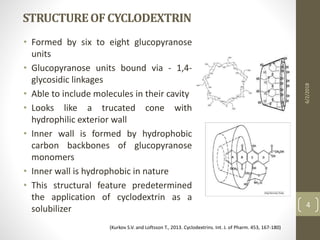
• Formed by six to eight glucopyranose
units
• Glucopyranose units bound via - 1,4-
glycosidic linkages
• Able to include molecules in their cavity
• Looks like a trucated cone with
hydrophilic exterior wall
• Inner wall is formed by hydrophobic
carbon backbones of glucopyranose
monomers
• Inner wall is hydrophobic in nature
• This structural feature predetermined
the application of cyclodextrin as a
solubilizer
6/2/2018
4
(Kurkov S.V. and Loftsson T., 2013. Cyclodextrins. Int. J. of Pharm. 453, 167-180)
TYPESOFCYLCODEXTRINS
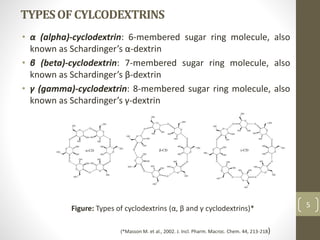
• α (alpha)-cyclodextrin: 6-membered sugar ring molecule, also
known as Schardinger’s α-dextrin
• β (beta)-cyclodextrin: 7-membered sugar ring molecule, also
known as Schardinger’s β-dextrin
• γ (gamma)-cyclodextrin: 8-membered sugar ring molecule, also
known as Schardinger’s γ-dextrin
5Figure: Types of cyclodextrins (α, β and γ cyclodextrins)*
(*Masson M. et al., 2002. J. Incl. Pharm. Macroc. Chem. 44, 213-218)
CYCLODEXTRINDERIVATIVESOFPHARMACEUTICAL
INTEREST
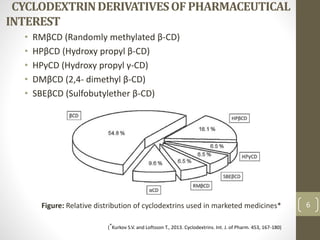
• RMβCD (Randomly methylated β-CD)
• HPβCD (Hydroxy propyl β-CD)
• HPγCD (Hydroxy propyl γ-CD)
• DMβCD (2,4- dimethyl β-CD)
• SBEβCD (Sulfobutylether β-CD)
6Figure: Relative distribution of cyclodextrins used in marketed medicines*
(*Kurkov S.V. and Loftsson T., 2013. Cyclodextrins. Int. J. of Pharm. 453, 167-180)
PROCESSFORTHEMANUFACTUREOF
CYCLODEXTRINS
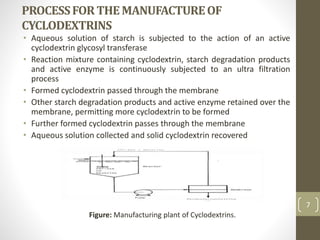
• Aqueous solution of starch is subjected to the action of an active
cyclodextrin glycosyl transferase
• Reaction mixture containing cyclodextrin, starch degradation products
and active enzyme is continuously subjected to an ultra filtration
process
• Formed cyclodextrin passed through the membrane
• Other starch degradation products and active enzyme retained over the
membrane, permitting more cyclodextrin to be formed
• Further formed cyclodextrin passes through the membrane
• Aqueous solution collected and solid cyclodextrin recovered
7
Figure: Manufacturing plant of Cyclodextrins.
METHODSOFPREPARATIONOFCYCLODEXTRIN
COMPLEXES
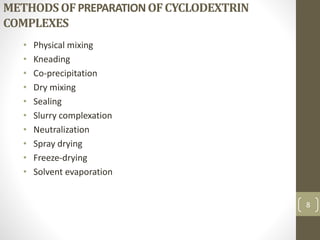
• Physical mixing
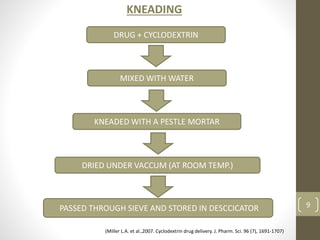
• Kneading
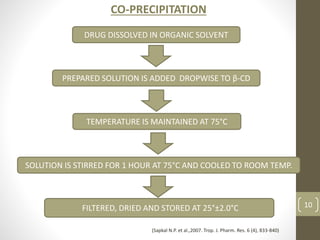
• Co-precipitation
• Dry mixing
• Sealing
• Slurry complexation
• Neutralization
• Spray drying
• Freeze-drying
• Solvent evaporation
8
9
KNEADING
DRUG + CYCLODEXTRIN
KNEADED WITH A PESTLE MORTAR
DRIED UNDER VACCUM (AT ROOM TEMP.)
PASSED THROUGH SIEVE AND STORED IN DESCCICATOR
MIXED WITH WATER
(Miller L.A. et al.,2007. Cyclodextrin drug delivery. J. Pharm. Sci. 96 (7), 1691-1707)
10
DRUG DISSOLVED IN ORGANIC SOLVENT
TEMPERATURE IS MAINTAINED AT 75°C
SOLUTION IS STIRRED FOR 1 HOUR AT 75°C AND COOLED TO ROOM TEMP.
FILTERED, DRIED AND STORED AT 25°±2.0°C
PREPARED SOLUTION IS ADDED DROPWISE TO β-CD
CO-PRECIPITATION
(Sapkal N.P. et al.,2007. Trop. J. Pharm. Res. 6 (4), 833-840)
CYCLODEXTRINSASPERMEABILITYENHANCERS
• Drug delivery through biological membranes
• Permeability enhancement of oral drugs
• Permeability enhancement of sublingual formulation
• Permeability enhancement of nasal formulations
• Permeability enhancement of pulmonary drugs
• Permeability enhancement of ophthalmic drugs
• Permeability enhancement of dermal drugs
11
DRUGDELIVERYTHROUGHBIOLOGICAL
MEMBRANES
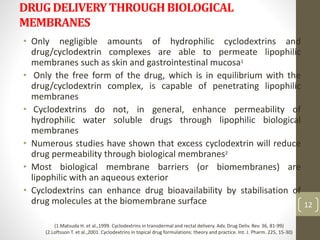
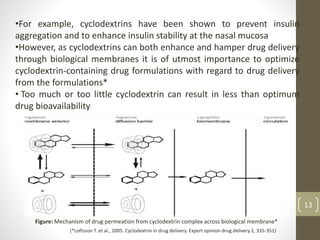
• Only negligible amounts of hydrophilic cyclodextrins and
drug/cyclodextrin complexes are able to permeate lipophilic
membranes such as skin and gastrointestinal mucosa1
• Only the free form of the drug, which is in equilibrium with the
drug/cyclodextrin complex, is capable of penetrating lipophilic
membranes
• Cyclodextrins do not, in general, enhance permeability of
hydrophilic water soluble drugs through lipophilic biological
membranes
• Numerous studies have shown that excess cyclodextrin will reduce
drug permeability through biological membranes2
• Most biological membrane barriers (or biomembranes) are
lipophilic with an aqueous exterior
• Cyclodextrins can enhance drug bioavailability by stabilisation of
drug molecules at the biomembrane surface 12
(1.Matsuda H. et al.,1999. Cyclodextrins in transdermal and rectal delivery. Adv. Drug Deliv. Rev. 36, 81-99)
(2.Loftsson T. et al.,2001. Cyclodextrins in topical drug formulations: theory and practice. Int. J. Pharm. 225, 15-30)
13
Figure: Mechanism of drug permeation from cyclodextrin complex across biological membrane*
(*Loftsson T. et al., 2005. Cyclodextrin in drug delivery. Expert opinion drug delivery 2, 335-351)
•For example, cyclodextrins have been shown to prevent insulin
aggregation and to enhance insulin stability at the nasal mucosa
•However, as cyclodextrins can both enhance and hamper drug delivery
through biological membranes it is of utmost importance to optimize
cyclodextrin-containing drug formulations with regard to drug delivery
from the formulations*
• Too much or too little cyclodextrin can result in less than optimum
drug bioavailability
PERMEABILITYENHANCEMENTOF ORALDRUGS
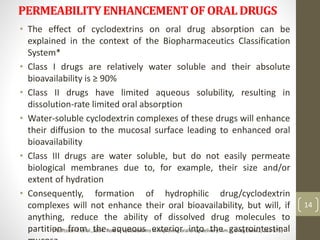
• The effect of cyclodextrins on oral drug absorption can be
explained in the context of the Biopharmaceutics Classification
System*
• Class I drugs are relatively water soluble and their absolute
bioavailability is ≥ 90%
• Class II drugs have limited aqueous solubility, resulting in
dissolution-rate limited oral absorption
• Water-soluble cyclodextrin complexes of these drugs will enhance
their diffusion to the mucosal surface leading to enhanced oral
bioavailability
• Class III drugs are water soluble, but do not easily permeate
biological membranes due to, for example, their size and/or
extent of hydration
• Consequently, formation of hydrophilic drug/cyclodextrin
complexes will not enhance their oral bioavailability, but will, if
anything, reduce the ability of dissolved drug molecules to
partition from the aqueous exterior into the gastrointestinal
14
(*Loftsson T. et al.,2004. Role of cyclodextrins in improving oral drug delivery. Am. J. Drug Deliv.2, 261-275)
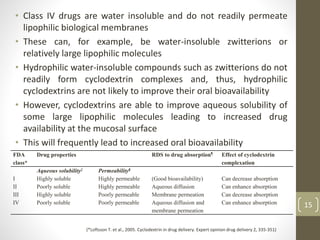
• Class IV drugs are water insoluble and do not readily permeate
lipophilic biological membranes
• These can, for example, be water-insoluble zwitterions or
relatively large lipophilic molecules
• Hydrophilic water-insoluble compounds such as zwitterions do not
readily form cyclodextrin complexes and, thus, hydrophilic
cyclodextrins are not likely to improve their oral bioavailability
• However, cyclodextrins are able to improve aqueous solubility of
some large lipophilic molecules leading to increased drug
availability at the mucosal surface
• This will frequently lead to increased oral bioavailability
15
FDA
class*
Drug properties RDS to drug absorption¶ Effect of cyclodextrin
complexation
Aqueous solubility‡ Permeability§
I Highly soluble Highly permeable (Good bioavailability) Can decrease absorption
II Poorly soluble Highly permeable Aqueous diffusion Can enhance absorption
III Highly soluble Poorly permeable Membrane permeation Can decrease absorption
IV Poorly soluble Poorly permeable Aqueous diffusion and
membrane permeation
Can enhance absorption
(*Loftsson T. et al., 2005. Cyclodextrin in drug delivery. Expert opinion drug delivery 2, 335-351)
PERMEABILITYENHANCEMENTOFSUBLINGUAL
FORMULATION
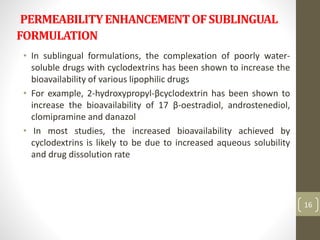
• In sublingual formulations, the complexation of poorly water-
soluble drugs with cyclodextrins has been shown to increase the
bioavailability of various lipophilic drugs
• For example, 2-hydroxypropyl-βcyclodextrin has been shown to
increase the bioavailability of 17 β-oestradiol, androstenediol,
clomipramine and danazol
• In most studies, the increased bioavailability achieved by
cyclodextrins is likely to be due to increased aqueous solubility
and drug dissolution rate
16
PERMEABILITYENHANCEMENTOFNASAL
FORMULATIONS
• In nasal formulations, cyclodextrins are normally used to increase
the aqueous solubility of lipophilic drugs
• Methylated cyclodextrins in particular are efficient absorption
enhancers and are the most commonly studied cyclodextrins in
nasal drug delivery*
• The first cyclodextrin-based nasal formulations contained
steroidal hormones and peptides.
• E.g. The bioavailability of progesterone is increased three fold
compared with suspension of the same compound, methylated
derivatives, as adjuvants used to improve the nasal absorption of
insulin despite its administration as a suspension form
• It has been suggested that cyclodextrin prevent insulin
aggregation and enhanced insulin bioavailability after nasal
administration and is partly due to this stabilising effect
17
(*Merkus F.W.H.M. et al.,1999. Cyclodextrin in nasal drug delivery. Adv. Drug Deliv. Rev. 36, 41-57)
PERMEABILITYENHANCEMENTOFPULMONARY
DRUGS
• Cyclodextrins can be of value in pulmonary delivery by
increasing the solubility, stability and dissolution rate of water-
insoluble and chemically unstable drugs
• Cyclodextrins are more readily absorbed from the lungs than
from the gastrointestinal tract and this limits the number of
cyclodextrins that can be included in pulmonary formulations
• The respirable fraction of salbutamol from Diskhaler®
(GlaxoSmithKline) has been increased by complexation with γ-
cyclodextrin and dimethyl-β cyclodextrin
• The respirable fraction of beclomethasone dipropionate from
Microhaler® has been increased by 2-hydroxypropyl-β-
cyclodextrin complexation*
18
(*Leite P.J.M.C. et al.,1999. Beclomethasone/cyclodextrin inclusion complex for dry powder inhalation. S.T.P.
Pharma. Sci. 9, 253-256)
PERMEABILITYENHANCEMENTOFOPHTHALMIC
DRUGS
• Through cyclodextrin solubilisation it is possible to increase
the dose-to-solubility ratio, making it possible to apply
drugs topically that previously could only be given by
systemic delivery
• For example, acetazolamide is a carbonic anhydrase
inhibitor that is used to treat glaucoma with oral daily dose
as high as 1000 mg
• The aqueous solubility of acetazolamide in pure water is 0.7
mg/ml, but in 20% (w/v) aqueous 2-hydroxypropyl-β-
cyclodextrin solution it is 7 mg/ml
• Thus, it is possible to obtain topically effective
acetazolamide eye drop solution through cyclodextrin
solubilisation of the drug*
19
(*Loftsson T. et al.,1994.Topically effective ocular hypotensive acetazolamide and ethoxyzolamide formulations in
rabbits. J. Pharm. Pharmacol. 46, 503-504)
PERMEABILITYENHANCEMENTOFDERMALDRUGS
• Cyclodextrins enhance drug delivery through aqueous diffusion
layers (i.e., aqueous diffusion barriers), but not through
lipophilic barriers such as the stratum corneum
• If the drug release is from an aqueous-based vehicle or if an
aqueous diffusion layer at the outer surface of the skin is a rate-
determining factor in dermal drug delivery, then cyclodextrins
can act as penetration enhancers
• However, if drug penetration through the lipophilic stratum
corneum is the main rate-determining factor then cyclodextrins
are unable to enhance the delivery
• It appears that cyclodextrins do enhance hydrocortisone
delivery from an unstirred aqueous donor phase through hair
less mouse skin, but have no effect on hydrocortisone delivery
from a well-stirred donor phase*
20
(*Shaker D.S. et al.,2003. Mechanistic studies of the effect of hydroxypropyl-βcyclodextrin on in vitro transdermal
permeation of corticosterone through hairless mouse skin. Int. J. Pharm. 253, 1-11)
21
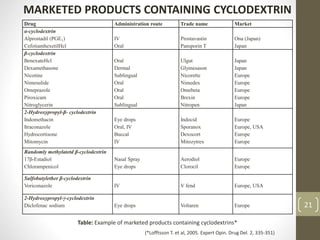
Drug Administration route Trade name Market
α-cyclodextrin
Alprostadil (PGE1)
CefotiamhexetilHcl
IV
Oral
Prostavastin
Pansporin T
Ona (Japan)
Japan
β-cyclodextrin
BenexateHcl
Dexamethasone
Nicotine
Nimesulide
Omeprazole
Piroxicam
Nitroglycerin
Oral
Dermal
Sublingual
Oral
Oral
Oral
Sublingual
Ulgut
Glymesason
Nicorette
Nimedex
Omebeta
Brexin
Nitropen
Japan
Japan
Europe
Europe
Europe
Europe
Japan
2-Hydroxypropyl-β- cyclodextrin
Indomethacin
Itraconazole
Hydrocortisone
Mitomycin
Eye drops
Oral, IV
Buccal
IV
Indocid
Sporanox
Dexocort
Mitozytrex
Europe
Europe, USA
Europe
Europe
Randomly methylatetd β-cyclodextrin
17β-Estadiol
Chlorampenicol
Nasal Spray
Eye drops
Aerodiol
Clorocil
Europe
Europe
Sulfobutylether β-cyclodextrin
Voriconazole IV V fend Europe, USA
2-Hydroxypropyl-γ-cyclodextrin
Diclofenac sodium Eye drops Voltaren Europe
MARKETED PRODUCTS CONTAINING CYCLODEXTRIN
Table: Example of marketed products containing cyclodextrins*
(*Lofftsson T. et al, 2005. Expert Opin. Drug Del. 2, 335-351)
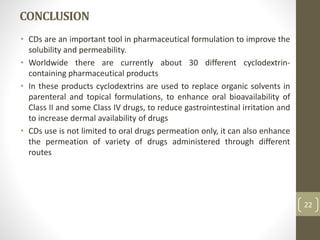
CONCLUSION
• CDs are an important tool in pharmaceutical formulation to improve the
solubility and permeability.
• Worldwide there are currently about 30 different cyclodextrin-
containing pharmaceutical products
• In these products cyclodextrins are used to replace organic solvents in
parenteral and topical formulations, to enhance oral bioavailability of
Class II and some Class IV drugs, to reduce gastrointestinal irritation and
to increase dermal availability of drugs
• CDs use is not limited to oral drugs permeation only, it can also enhance
the permeation of variety of drugs administered through different
routes
22
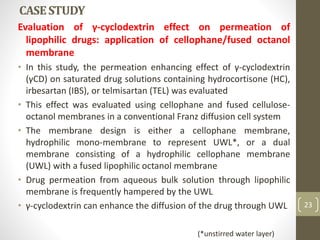
CASESTUDY
Evaluation of γ-cyclodextrin effect on permeation of
lipophilic drugs: application of cellophane/fused octanol
membrane
• In this study, the permeation enhancing effect of γ-cyclodextrin
(γCD) on saturated drug solutions containing hydrocortisone (HC),
irbesartan (IBS), or telmisartan (TEL) was evaluated
• This effect was evaluated using cellophane and fused cellulose-
octanol membranes in a conventional Franz diffusion cell system
• The membrane design is either a cellophane membrane,
hydrophilic mono-membrane to represent UWL*, or a dual
membrane consisting of a hydrophilic cellophane membrane
(UWL) with a fused lipophilic octanol membrane
• Drug permeation from aqueous bulk solution through lipophilic
membrane is frequently hampered by the UWL
• γ-cyclodextrin can enhance the diffusion of the drug through UWL 23
(*unstirred water layer)
METHOD
• Materials- Hydrocortisone, Irbesartan, telmisartan, γ-cyclodextrin,
diethyl ether, ethanol, n-octanol, mucin, nitrocellulose, cellophane
membrane with MWCO* 12000-14000, franz diffusion cells
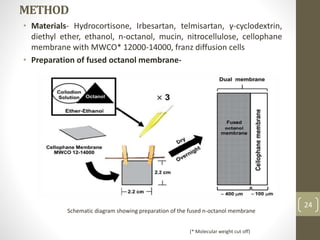
• Preparation of fused octanol membrane-
24
Schematic diagram showing preparation of the fused n-octanol membrane
(* Molecular weight cut off)
PERMEATIONSTUDY
• Drug permeabilty investigated from aqueous γ-cyclodextrin
solution using franz diffusion cell
• Phosphate buffer solution (pH 7.4) containing 2% w/v γ-
cyclodextrin for maintaining sink condition, used as receptor
phase
• Donor and receptor phases were separated by hydrophilic
cellophane membrane
• About 2ml of 20mM filtrate phosphate pH 7.4 buffer donor
solution, containing 0% or 10% (w/v) γCD saturated with the drug
to be tested was added to the donor chamber
• Samples of 150ul were withdrawn from receptor phase at 30, 60,
90, 120, and 180 and 240 min
• The drug content was quantified by HPLC
• The steady state flux (J) and the apparent permeation coefficient
(Papp) were calculated
25
RESULT
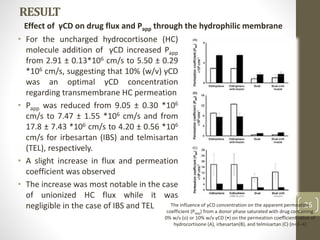
• For the uncharged hydrocortisone (HC)
molecule addition of γCD increased Papp
from 2.91 ± 0.13*106 cm/s to 5.50 ± 0.29
*106 cm/s, suggesting that 10% (w/v) γCD
was an optimal γCD concentration
regarding transmembrane HC permeation
• Papp was reduced from 9.05 ± 0.30 *106
cm/s to 7.47 ± 1.55 *106 cm/s and from
17.8 ± 7.43 *106 cm/s to 4.20 ± 0.56 *106
cm/s for irbesartan (IBS) and telmisartan
(TEL), respectively.
• A slight increase in flux and permeation
coefficient was observed
• The increase was most notable in the case
of unionized HC flux while it was
negligible in the case of IBS and TEL 26
Effect of γCD on drug flux and Papp through the hydrophilic membrane
The influence of γCD concentration on the apparent permeation
coefficient (Papp) from a donor phase saturated with drug containing
0% w/v (o) or 10% w/v γCD (•) on the permeation coefficient value of
hydrocortisone (A), irbesartan(B), and telmisartan (C) (n=3–4)
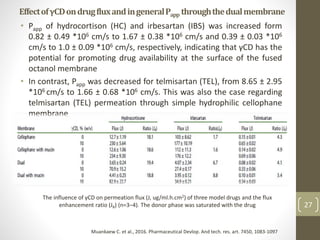
EffectofγCDondrugfluxandingeneralPapp throughthedualmembrane
• Papp of hydrocortison (HC) and irbesartan (IBS) was increased form
0.82 ± 0.49 *106 cm/s to 1.67 ± 0.38 *106 cm/s and 0.39 ± 0.03 *106
cm/s to 1.0 ± 0.09 *106 cm/s, respectively, indicating that γCD has the
potential for promoting drug availability at the surface of the fused
octanol membrane
• In contrast, Papp was decreased for telmisartan (TEL), from 8.65 ± 2.95
*106 cm/s to 1.66 ± 0.68 *106 cm/s. This was also the case regarding
telmisartan (TEL) permeation through simple hydrophilic cellophane
membrane
27
The influence of γCD on permeation flux (J, ug/ml.h.cm2) of three model drugs and the flux
enhancement ratio (JR) (n=3–4). The donor phase was saturated with the drug
Muankaew C. et al., 2016. Pharmaceutical Devlop. And tech. res. art. 7450, 1083-1097
CONCLUSION
• This study demonstrates the role of γCD on permeation behavior
of three lipophilic drugs at physiological pH
• The results reveal that, in general, addition of γCD to the
aqueous donor solution saturated with the drug increased the
drug flux
• γCD solubilizes the poorly soluble drug in the aqueous donor
solution and carries the drug molecules to the lipophilic
membrane surface
• The fused octanol membrane allowed estimation of how γCD in
formulation affected drug penetration through biological
membranes, whether γCD enhanced the drug permeation, had
no effect or decreased it
28

Priyanka

  • 1.
    DRUGPERMEABILITYENHANCEMENTUSING CYCLODEXTRINS Presented by: Priyanka GresessAnand M.Pharm Pharmaceutics Department of Pharmaceutics Integral University 1
  • 2.
    CONTENTS • Introduction • Structureof cyclodextrin • Types of cyclodextrin • Cyclodextrin derivatives of pharmaceutical interest • Process for the manufacture of cyclodextrins • Cyclodextrins as permeability enhancers • Marketed products containing cyclodextrin • Conclusion • Case study 2
  • 3.
    INTRODUCTION CYCLODEXTRINS • Cyclodextrins arecyclic oligosaccharides with a hydrophilic outer surface and a somewhat lipophilic central cavity • Cyclodextrins are able to form water-soluble inclusion complexes with many lipophilic water-insoluble drugs HISTORY • Cyclodextrins, as they are known today, were called "cellulosine" • The CD era began in the late 19th century when beautiful crystals were observed by the French scientist Villiers in alcohol waste left after the production of dextrins from starch with an impure bacterial culture* • Schardinger, in the early 20th century isolated and named the strain of bacteria, Bacillus macerans, responsible for CD synthesis* 3 (*Kurkov S.V. and Loftsson T., 2013. Cyclodextrins. Int. J. of Pharm. 453, 167-180)
  • 4.
    STRUCTUREOFCYCLODEXTRIN • Formed bysix to eight glucopyranose units • Glucopyranose units bound via - 1,4- glycosidic linkages • Able to include molecules in their cavity • Looks like a trucated cone with hydrophilic exterior wall • Inner wall is formed by hydrophobic carbon backbones of glucopyranose monomers • Inner wall is hydrophobic in nature • This structural feature predetermined the application of cyclodextrin as a solubilizer 6/2/2018 4 (Kurkov S.V. and Loftsson T., 2013. Cyclodextrins. Int. J. of Pharm. 453, 167-180)
  • 5.
    TYPESOFCYLCODEXTRINS • α (alpha)-cyclodextrin:6-membered sugar ring molecule, also known as Schardinger’s α-dextrin • β (beta)-cyclodextrin: 7-membered sugar ring molecule, also known as Schardinger’s β-dextrin • γ (gamma)-cyclodextrin: 8-membered sugar ring molecule, also known as Schardinger’s γ-dextrin 5Figure: Types of cyclodextrins (α, β and γ cyclodextrins)* (*Masson M. et al., 2002. J. Incl. Pharm. Macroc. Chem. 44, 213-218)
  • 6.
    CYCLODEXTRINDERIVATIVESOFPHARMACEUTICAL INTEREST • RMβCD (Randomlymethylated β-CD) • HPβCD (Hydroxy propyl β-CD) • HPγCD (Hydroxy propyl γ-CD) • DMβCD (2,4- dimethyl β-CD) • SBEβCD (Sulfobutylether β-CD) 6Figure: Relative distribution of cyclodextrins used in marketed medicines* (*Kurkov S.V. and Loftsson T., 2013. Cyclodextrins. Int. J. of Pharm. 453, 167-180)
  • 7.
    PROCESSFORTHEMANUFACTUREOF CYCLODEXTRINS • Aqueous solutionof starch is subjected to the action of an active cyclodextrin glycosyl transferase • Reaction mixture containing cyclodextrin, starch degradation products and active enzyme is continuously subjected to an ultra filtration process • Formed cyclodextrin passed through the membrane • Other starch degradation products and active enzyme retained over the membrane, permitting more cyclodextrin to be formed • Further formed cyclodextrin passes through the membrane • Aqueous solution collected and solid cyclodextrin recovered 7 Figure: Manufacturing plant of Cyclodextrins.
  • 8.
    METHODSOFPREPARATIONOFCYCLODEXTRIN COMPLEXES • Physical mixing •Kneading • Co-precipitation • Dry mixing • Sealing • Slurry complexation • Neutralization • Spray drying • Freeze-drying • Solvent evaporation 8
  • 9.
    9 KNEADING DRUG + CYCLODEXTRIN KNEADEDWITH A PESTLE MORTAR DRIED UNDER VACCUM (AT ROOM TEMP.) PASSED THROUGH SIEVE AND STORED IN DESCCICATOR MIXED WITH WATER (Miller L.A. et al.,2007. Cyclodextrin drug delivery. J. Pharm. Sci. 96 (7), 1691-1707)
  • 10.
    10 DRUG DISSOLVED INORGANIC SOLVENT TEMPERATURE IS MAINTAINED AT 75°C SOLUTION IS STIRRED FOR 1 HOUR AT 75°C AND COOLED TO ROOM TEMP. FILTERED, DRIED AND STORED AT 25°±2.0°C PREPARED SOLUTION IS ADDED DROPWISE TO β-CD CO-PRECIPITATION (Sapkal N.P. et al.,2007. Trop. J. Pharm. Res. 6 (4), 833-840)
  • 11.
    CYCLODEXTRINSASPERMEABILITYENHANCERS • Drug deliverythrough biological membranes • Permeability enhancement of oral drugs • Permeability enhancement of sublingual formulation • Permeability enhancement of nasal formulations • Permeability enhancement of pulmonary drugs • Permeability enhancement of ophthalmic drugs • Permeability enhancement of dermal drugs 11
  • 12.
    DRUGDELIVERYTHROUGHBIOLOGICAL MEMBRANES • Only negligibleamounts of hydrophilic cyclodextrins and drug/cyclodextrin complexes are able to permeate lipophilic membranes such as skin and gastrointestinal mucosa1 • Only the free form of the drug, which is in equilibrium with the drug/cyclodextrin complex, is capable of penetrating lipophilic membranes • Cyclodextrins do not, in general, enhance permeability of hydrophilic water soluble drugs through lipophilic biological membranes • Numerous studies have shown that excess cyclodextrin will reduce drug permeability through biological membranes2 • Most biological membrane barriers (or biomembranes) are lipophilic with an aqueous exterior • Cyclodextrins can enhance drug bioavailability by stabilisation of drug molecules at the biomembrane surface 12 (1.Matsuda H. et al.,1999. Cyclodextrins in transdermal and rectal delivery. Adv. Drug Deliv. Rev. 36, 81-99) (2.Loftsson T. et al.,2001. Cyclodextrins in topical drug formulations: theory and practice. Int. J. Pharm. 225, 15-30)
  • 13.
    13 Figure: Mechanism ofdrug permeation from cyclodextrin complex across biological membrane* (*Loftsson T. et al., 2005. Cyclodextrin in drug delivery. Expert opinion drug delivery 2, 335-351) •For example, cyclodextrins have been shown to prevent insulin aggregation and to enhance insulin stability at the nasal mucosa •However, as cyclodextrins can both enhance and hamper drug delivery through biological membranes it is of utmost importance to optimize cyclodextrin-containing drug formulations with regard to drug delivery from the formulations* • Too much or too little cyclodextrin can result in less than optimum drug bioavailability
  • 14.
    PERMEABILITYENHANCEMENTOF ORALDRUGS • Theeffect of cyclodextrins on oral drug absorption can be explained in the context of the Biopharmaceutics Classification System* • Class I drugs are relatively water soluble and their absolute bioavailability is ≥ 90% • Class II drugs have limited aqueous solubility, resulting in dissolution-rate limited oral absorption • Water-soluble cyclodextrin complexes of these drugs will enhance their diffusion to the mucosal surface leading to enhanced oral bioavailability • Class III drugs are water soluble, but do not easily permeate biological membranes due to, for example, their size and/or extent of hydration • Consequently, formation of hydrophilic drug/cyclodextrin complexes will not enhance their oral bioavailability, but will, if anything, reduce the ability of dissolved drug molecules to partition from the aqueous exterior into the gastrointestinal 14 (*Loftsson T. et al.,2004. Role of cyclodextrins in improving oral drug delivery. Am. J. Drug Deliv.2, 261-275)
  • 15.
    • Class IVdrugs are water insoluble and do not readily permeate lipophilic biological membranes • These can, for example, be water-insoluble zwitterions or relatively large lipophilic molecules • Hydrophilic water-insoluble compounds such as zwitterions do not readily form cyclodextrin complexes and, thus, hydrophilic cyclodextrins are not likely to improve their oral bioavailability • However, cyclodextrins are able to improve aqueous solubility of some large lipophilic molecules leading to increased drug availability at the mucosal surface • This will frequently lead to increased oral bioavailability 15 FDA class* Drug properties RDS to drug absorption¶ Effect of cyclodextrin complexation Aqueous solubility‡ Permeability§ I Highly soluble Highly permeable (Good bioavailability) Can decrease absorption II Poorly soluble Highly permeable Aqueous diffusion Can enhance absorption III Highly soluble Poorly permeable Membrane permeation Can decrease absorption IV Poorly soluble Poorly permeable Aqueous diffusion and membrane permeation Can enhance absorption (*Loftsson T. et al., 2005. Cyclodextrin in drug delivery. Expert opinion drug delivery 2, 335-351)
  • 16.
    PERMEABILITYENHANCEMENTOFSUBLINGUAL FORMULATION • In sublingualformulations, the complexation of poorly water- soluble drugs with cyclodextrins has been shown to increase the bioavailability of various lipophilic drugs • For example, 2-hydroxypropyl-βcyclodextrin has been shown to increase the bioavailability of 17 β-oestradiol, androstenediol, clomipramine and danazol • In most studies, the increased bioavailability achieved by cyclodextrins is likely to be due to increased aqueous solubility and drug dissolution rate 16
  • 17.
    PERMEABILITYENHANCEMENTOFNASAL FORMULATIONS • In nasalformulations, cyclodextrins are normally used to increase the aqueous solubility of lipophilic drugs • Methylated cyclodextrins in particular are efficient absorption enhancers and are the most commonly studied cyclodextrins in nasal drug delivery* • The first cyclodextrin-based nasal formulations contained steroidal hormones and peptides. • E.g. The bioavailability of progesterone is increased three fold compared with suspension of the same compound, methylated derivatives, as adjuvants used to improve the nasal absorption of insulin despite its administration as a suspension form • It has been suggested that cyclodextrin prevent insulin aggregation and enhanced insulin bioavailability after nasal administration and is partly due to this stabilising effect 17 (*Merkus F.W.H.M. et al.,1999. Cyclodextrin in nasal drug delivery. Adv. Drug Deliv. Rev. 36, 41-57)
  • 18.
    PERMEABILITYENHANCEMENTOFPULMONARY DRUGS • Cyclodextrins canbe of value in pulmonary delivery by increasing the solubility, stability and dissolution rate of water- insoluble and chemically unstable drugs • Cyclodextrins are more readily absorbed from the lungs than from the gastrointestinal tract and this limits the number of cyclodextrins that can be included in pulmonary formulations • The respirable fraction of salbutamol from Diskhaler® (GlaxoSmithKline) has been increased by complexation with γ- cyclodextrin and dimethyl-β cyclodextrin • The respirable fraction of beclomethasone dipropionate from Microhaler® has been increased by 2-hydroxypropyl-β- cyclodextrin complexation* 18 (*Leite P.J.M.C. et al.,1999. Beclomethasone/cyclodextrin inclusion complex for dry powder inhalation. S.T.P. Pharma. Sci. 9, 253-256)
  • 19.
    PERMEABILITYENHANCEMENTOFOPHTHALMIC DRUGS • Through cyclodextrinsolubilisation it is possible to increase the dose-to-solubility ratio, making it possible to apply drugs topically that previously could only be given by systemic delivery • For example, acetazolamide is a carbonic anhydrase inhibitor that is used to treat glaucoma with oral daily dose as high as 1000 mg • The aqueous solubility of acetazolamide in pure water is 0.7 mg/ml, but in 20% (w/v) aqueous 2-hydroxypropyl-β- cyclodextrin solution it is 7 mg/ml • Thus, it is possible to obtain topically effective acetazolamide eye drop solution through cyclodextrin solubilisation of the drug* 19 (*Loftsson T. et al.,1994.Topically effective ocular hypotensive acetazolamide and ethoxyzolamide formulations in rabbits. J. Pharm. Pharmacol. 46, 503-504)
  • 20.
    PERMEABILITYENHANCEMENTOFDERMALDRUGS • Cyclodextrins enhancedrug delivery through aqueous diffusion layers (i.e., aqueous diffusion barriers), but not through lipophilic barriers such as the stratum corneum • If the drug release is from an aqueous-based vehicle or if an aqueous diffusion layer at the outer surface of the skin is a rate- determining factor in dermal drug delivery, then cyclodextrins can act as penetration enhancers • However, if drug penetration through the lipophilic stratum corneum is the main rate-determining factor then cyclodextrins are unable to enhance the delivery • It appears that cyclodextrins do enhance hydrocortisone delivery from an unstirred aqueous donor phase through hair less mouse skin, but have no effect on hydrocortisone delivery from a well-stirred donor phase* 20 (*Shaker D.S. et al.,2003. Mechanistic studies of the effect of hydroxypropyl-βcyclodextrin on in vitro transdermal permeation of corticosterone through hairless mouse skin. Int. J. Pharm. 253, 1-11)
  • 21.
    21 Drug Administration routeTrade name Market α-cyclodextrin Alprostadil (PGE1) CefotiamhexetilHcl IV Oral Prostavastin Pansporin T Ona (Japan) Japan β-cyclodextrin BenexateHcl Dexamethasone Nicotine Nimesulide Omeprazole Piroxicam Nitroglycerin Oral Dermal Sublingual Oral Oral Oral Sublingual Ulgut Glymesason Nicorette Nimedex Omebeta Brexin Nitropen Japan Japan Europe Europe Europe Europe Japan 2-Hydroxypropyl-β- cyclodextrin Indomethacin Itraconazole Hydrocortisone Mitomycin Eye drops Oral, IV Buccal IV Indocid Sporanox Dexocort Mitozytrex Europe Europe, USA Europe Europe Randomly methylatetd β-cyclodextrin 17β-Estadiol Chlorampenicol Nasal Spray Eye drops Aerodiol Clorocil Europe Europe Sulfobutylether β-cyclodextrin Voriconazole IV V fend Europe, USA 2-Hydroxypropyl-γ-cyclodextrin Diclofenac sodium Eye drops Voltaren Europe MARKETED PRODUCTS CONTAINING CYCLODEXTRIN Table: Example of marketed products containing cyclodextrins* (*Lofftsson T. et al, 2005. Expert Opin. Drug Del. 2, 335-351)
  • 22.
    CONCLUSION • CDs arean important tool in pharmaceutical formulation to improve the solubility and permeability. • Worldwide there are currently about 30 different cyclodextrin- containing pharmaceutical products • In these products cyclodextrins are used to replace organic solvents in parenteral and topical formulations, to enhance oral bioavailability of Class II and some Class IV drugs, to reduce gastrointestinal irritation and to increase dermal availability of drugs • CDs use is not limited to oral drugs permeation only, it can also enhance the permeation of variety of drugs administered through different routes 22
  • 23.
    CASESTUDY Evaluation of γ-cyclodextrineffect on permeation of lipophilic drugs: application of cellophane/fused octanol membrane • In this study, the permeation enhancing effect of γ-cyclodextrin (γCD) on saturated drug solutions containing hydrocortisone (HC), irbesartan (IBS), or telmisartan (TEL) was evaluated • This effect was evaluated using cellophane and fused cellulose- octanol membranes in a conventional Franz diffusion cell system • The membrane design is either a cellophane membrane, hydrophilic mono-membrane to represent UWL*, or a dual membrane consisting of a hydrophilic cellophane membrane (UWL) with a fused lipophilic octanol membrane • Drug permeation from aqueous bulk solution through lipophilic membrane is frequently hampered by the UWL • γ-cyclodextrin can enhance the diffusion of the drug through UWL 23 (*unstirred water layer)
  • 24.
    METHOD • Materials- Hydrocortisone,Irbesartan, telmisartan, γ-cyclodextrin, diethyl ether, ethanol, n-octanol, mucin, nitrocellulose, cellophane membrane with MWCO* 12000-14000, franz diffusion cells • Preparation of fused octanol membrane- 24 Schematic diagram showing preparation of the fused n-octanol membrane (* Molecular weight cut off)
  • 25.
    PERMEATIONSTUDY • Drug permeabiltyinvestigated from aqueous γ-cyclodextrin solution using franz diffusion cell • Phosphate buffer solution (pH 7.4) containing 2% w/v γ- cyclodextrin for maintaining sink condition, used as receptor phase • Donor and receptor phases were separated by hydrophilic cellophane membrane • About 2ml of 20mM filtrate phosphate pH 7.4 buffer donor solution, containing 0% or 10% (w/v) γCD saturated with the drug to be tested was added to the donor chamber • Samples of 150ul were withdrawn from receptor phase at 30, 60, 90, 120, and 180 and 240 min • The drug content was quantified by HPLC • The steady state flux (J) and the apparent permeation coefficient (Papp) were calculated 25
  • 26.
    RESULT • For theuncharged hydrocortisone (HC) molecule addition of γCD increased Papp from 2.91 ± 0.13*106 cm/s to 5.50 ± 0.29 *106 cm/s, suggesting that 10% (w/v) γCD was an optimal γCD concentration regarding transmembrane HC permeation • Papp was reduced from 9.05 ± 0.30 *106 cm/s to 7.47 ± 1.55 *106 cm/s and from 17.8 ± 7.43 *106 cm/s to 4.20 ± 0.56 *106 cm/s for irbesartan (IBS) and telmisartan (TEL), respectively. • A slight increase in flux and permeation coefficient was observed • The increase was most notable in the case of unionized HC flux while it was negligible in the case of IBS and TEL 26 Effect of γCD on drug flux and Papp through the hydrophilic membrane The influence of γCD concentration on the apparent permeation coefficient (Papp) from a donor phase saturated with drug containing 0% w/v (o) or 10% w/v γCD (•) on the permeation coefficient value of hydrocortisone (A), irbesartan(B), and telmisartan (C) (n=3–4)
  • 27.
    EffectofγCDondrugfluxandingeneralPapp throughthedualmembrane • Pappof hydrocortison (HC) and irbesartan (IBS) was increased form 0.82 ± 0.49 *106 cm/s to 1.67 ± 0.38 *106 cm/s and 0.39 ± 0.03 *106 cm/s to 1.0 ± 0.09 *106 cm/s, respectively, indicating that γCD has the potential for promoting drug availability at the surface of the fused octanol membrane • In contrast, Papp was decreased for telmisartan (TEL), from 8.65 ± 2.95 *106 cm/s to 1.66 ± 0.68 *106 cm/s. This was also the case regarding telmisartan (TEL) permeation through simple hydrophilic cellophane membrane 27 The influence of γCD on permeation flux (J, ug/ml.h.cm2) of three model drugs and the flux enhancement ratio (JR) (n=3–4). The donor phase was saturated with the drug Muankaew C. et al., 2016. Pharmaceutical Devlop. And tech. res. art. 7450, 1083-1097
  • 28.
    CONCLUSION • This studydemonstrates the role of γCD on permeation behavior of three lipophilic drugs at physiological pH • The results reveal that, in general, addition of γCD to the aqueous donor solution saturated with the drug increased the drug flux • γCD solubilizes the poorly soluble drug in the aqueous donor solution and carries the drug molecules to the lipophilic membrane surface • The fused octanol membrane allowed estimation of how γCD in formulation affected drug penetration through biological membranes, whether γCD enhanced the drug permeation, had no effect or decreased it 28