July, 2021 © Haramaya University, CHMS,
Department of Emergency and Critical Care Nursing
Introduction to OR Technique
By:- Ame Mehadi (BSc, MSc)
PRINCIPLES OF STERILE FIELD
June, 2021 © Haramaya University, CHMS,
Department of Emergency and Critical Care Nursing
Basic First Aid and Emergency Care
By:- Ame Mehadi (BSc, MSc)
July, 2021 © Haramaya University, CHMS,
Department of Emergency and Critical Care Nursing
Introduction to OR Technique
By:- Ame Mehadi (BSc, MSc)
Principles of Sterile Field
Making & Maintaining Sterile Field
July, 2021 © Haramaya University, CHMS,
Department of Emergency and Critical Care Nursing
Introduction to OR Technique
By:- Ame Mehadi (BSc, MSc-EMCCN)
July, 2021 © Haramaya University, CHMS,
Department of Emergency and Critical Care Nursing
Objective
At the end of this Session, the learners will be able to:
►describe preparation of sterile field
►describe maintenance of sterile field
►identify necessary materials & supplies for preparation & maintenance
of the sterile field
►identify basic principles of sterile field
►prepare sterile field
►maintain sterile field
July, 2021 © Haramaya University, CHMS,
Department of Emergency and Critical Care Nursing
Introduction to OR Technique
By:- Ame Mehadi (BSc, MSc-EMCCN)
July, 2021 © Haramaya University, CHMS,
Department of Emergency and Critical Care Nursing
Principles of Sterile Field – Making & Keeping
Persons in sterile attire touch only sterile articles.
Persons in sterile attire preparing a sterile field or draping an un-sterile
surface always face the area being prepared.
Persons in sterile attire do not turn their backs to a sterile field.
July, 2021 © Haramaya University, CHMS,
Department of Emergency and Critical Care Nursing
Introduction to OR Technique
By:- Ame Mehadi (BSc, MSc-EMCCN)
July, 2021 © Haramaya University, CHMS,
Department of Emergency and Critical Care Nursing
Principles of Sterile Field – Making & Keeping
Gloved hands are protected while draping by making a cuff with the
drape.
Persons in sterile attire do not lean or reach over un-sterile surfaces.
Persons in non-sterile attire only touch non-sterile articles.
Persons in non-sterile attire avoid reaching over or touching the sterile
field when delivering sterile supplies to the sterile field.
July, 2021 © Haramaya University, CHMS,
Department of Emergency and Critical Care Nursing
Introduction to OR Technique
By:- Ame Mehadi (BSc, MSc-EMCCN)
July, 2021 © Haramaya University, CHMS,
Department of Emergency and Critical Care Nursing
Sterile Field …….
 Tables draped with sterile drapes are sterile only at table level.
 Scrub persons perform all work on the sterile surface of the table.
 Materials that hang over the edge of the sterile field are not considered sterile and are
discarded.
 Items that fall below the level of the sterile field are not brought back onto the sterile field.
 The gown is considered sterile from the level of the umbilicus to the axillary level in front.
 Sleeves are considered sterile to two inches above the elbow.
 The back of the gown is not considered sterile.
July, 2021 © Haramaya University, CHMS,
Department of Emergency and Critical Care Nursing
Introduction to OR Technique
By:- Ame Mehadi (BSc, MSc-EMCCN)
July, 2021 © Haramaya University, CHMS,
Department of Emergency and Critical Care Nursing
Sterile Field …….
 Areas of the gown outside the specified boundaries do not touch the sterile field or sterile
articles.
 Articles that drop below the umbilical level of the gown are discarded.
 Hands are not placed under the arms in the axillary region.
 The edges of containers enclosing sterile items are not considered sterile once the
container is opened.
 Non sterile persons maintain a safe distance from sterile areas.
 Corrective measures are to be instituted immediately if contamination occurs.
 If there is any doubt as to the sterility of an item or surface, it is considered contaminated.
July, 2021 © Haramaya University, CHMS,
Department of Emergency and Critical Care Nursing
Introduction to OR Technique
By:- Ame Mehadi (BSc, MSc-EMCCN)
July, 2021 © Haramaya University, CHMS,
Department of Emergency and Critical Care Nursing
Sterile Field …….
Sterile technique is the basis of modern surgery.
The patient is the center of the sterile field.
Strict adherence to the recommended practices of sterile technique
reflects the surgical conscience of the perioperative team and is
mandatory for the safety of the patient and personnel in the env’t.
July, 2021 © Haramaya University, CHMS,
Department of Emergency and Critical Care Nursing
Introduction to OR Technique
By:- Ame Mehadi (BSc, MSc-EMCCN)
July, 2021 © Haramaya University, CHMS,
Department of Emergency and Critical Care Nursing
Sterile Field …….
 The principles of sterile technique are applied under the following conditions:
►In preparation for an invasive procedure by
 sterilization of necessary materials & supplies.
►In preparation of the sterile team to handle sterile supplies and intimately contact the
surgical site by
 scrubbing, gowning, and gloving.
►In the creation and maintenance of the sterile field, including
 skin preparation and draping of the patient.
►In the maintenance of asepsis throughout the surgical procedure.
►In terminal sterilization and disinfection at the conclusion of the surgical procedure.
July, 2021 © Haramaya University, CHMS,
Department of Emergency and Critical Care Nursing
Introduction to OR Technique
By:- Ame Mehadi (BSc, MSc-EMCCN)
July, 2021 © Haramaya University, CHMS,
Department of Emergency and Critical Care Nursing
Sterile Field …….
 All materials that enter the sterile field must be sterile.
 Sterile team members must wear only sterile gowns & gloves and they keep well within the sterile field.
 Unsterile persons don’t reach over sterile surfaces.
 Talking during surgery is kept to a minimum
 Bacteria travel on airborne particles and will enter the sterile field with excessive air mov’t & currents.
 Therefore, movement is kept to a minimum during surgery.
► Sterile team members face each other.
► They face the sterile field.
► Sterile personnel handle only sterile equipment.
July, 2021 © Haramaya University, CHMS,
Department of Emergency and Critical Care Nursing
Introduction to OR Technique
By:- Ame Mehadi (BSc, MSc-EMCCN)
July, 2021 © Haramaya University, CHMS,
Department of Emergency and Critical Care Nursing
Sterile Field …….
 Unsterile personnel handle only unsterile equipment.
 Sterile tables are sterile only at table height.
 Gowns are sterile in front from the axillary line to the waist, and the sleeves to 2-3
inches above the elbow.
 The edges of anything that encloses sterile contents are considered unsterile.
 Moisture carries bacteria from a non sterile surface to a sterile surface.
 A wide margin of safety must be maintained b/n the sterile and unsterile field.
 Contaminated items should be removed immediately from the sterile field.
 The sterile field is created as close as possible to the time of use.
 Destruction of the integrity of microbial barriers results in contamination.
 Sterile persons keep contact with sterile areas/goods to a minimum.
 Some operative areas cannot be sterile.
July, 2021 © Haramaya University, CHMS,
Department of Emergency and Critical Care Nursing
Introduction to OR Technique
By:- Ame Mehadi (BSc, MSc-EMCCN)
Circulator Duties……
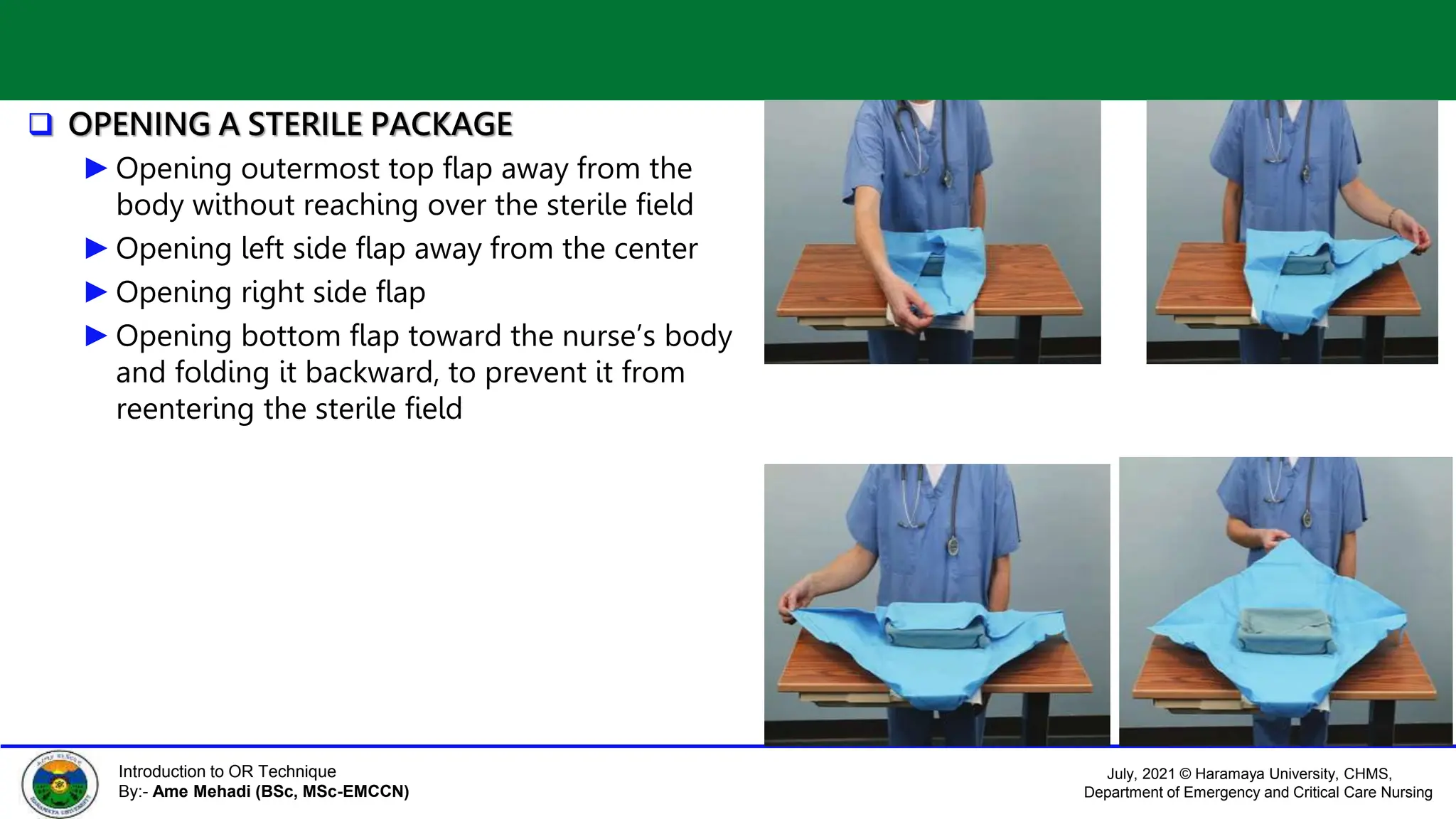
 OPENING A STERILE PACKAGE
►Opening outermost top flap away from the
body without reaching over the sterile field
►Opening left side flap away from the center
►Opening right side flap
►Opening bottom flap toward the nurse’s body
and folding it backward, to prevent it from
reentering the sterile field
July, 2021 © Haramaya University, CHMS,
Department of Emergency and Critical Care Nursing
Introduction to OR Technique
By:- Ame Mehadi (BSc, MSc-EMCCN)
Circulator Duties……
OPENING A STERILE PACKAGE
►Dropping sterile contents on the sterile
field, keeping at least 2 inches from the
edge of the sterile drape.
►Pouring sterile solution into sterile cup
without touching the sterile field and
without splashing.
July, 2021 © Haramaya University, CHMS,
Department of Emergency and Critical Care Nursing
Introduction to OR Technique
By:- Ame Mehadi (BSc, MSc-EMCCN)
July, 2021 © Haramaya University, CHMS,
Department of Emergency and Critical Care Nursing
July, 2021 © Haramaya University, CHMS,
Department of Emergency and Critical Care Nursing
Introduction to OR Technique
By:- Ame Mehadi (BSc, MSc-EMCCN)
July, 2021 © Haramaya University, CHMS,
Department of Emergency and Critical Care Nursing
Summary
Decontamination:
►Process that makes inanimate objects safer to be handled by staff before cleaning (i.e. inactivates
HBV, HCV and HIV, it reduces the number of other MOs but does not eliminate them).
Cleaning:
►Process that physically removes all visible dust, soil, blood or other body fluids from inanimate
objects as well as removing sufficient numbers of MOs to reduce risks for those who touch the
skin or handle the object.
►It consists of thoroughly washing with soap or detergent and water, rinsing with clean water and
drying.
HLD: Process that eliminates all MOs except some bacterial endospores from
inanimate objects by
►boiling,
►steaming or
►chemical disinfectants.
July, 2021 © Haramaya University, CHMS,
Department of Emergency and Critical Care Nursing
Introduction to OR Technique
By:- Ame Mehadi (BSc, MSc-EMCCN)
July, 2021 © Haramaya University, CHMS,
Department of Emergency and Critical Care Nursing
Summary……
Sterilization: Process that eliminates all MOs (bacteria, viruses, fungi
and parasites) including bacterial endospores from inanimate objects by
►high-pressure steam (autoclave),
►dry heat (oven),
►chemical sterilants or
►radiation.
Steam sterilization should be used for all items that will not be
damaged by heat, pressure, or moisture.
Biological monitoring of sterilization procedures should be performed
regularly, e. g. once a week.
Shelf-life and expiration dating-policies must be based on packaging
materials used and facilities for storage.
July, 2021 © Haramaya University, CHMS,
Department of Emergency and Critical Care Nursing
Introduction to OR Technique
By:- Ame Mehadi (BSc, MSc-EMCCN)
July, 2021 © Haramaya University, CHMS,
Department of Emergency and Critical Care Nursing
References
 Berry & Kohn: Introduction to Operating Room Techniques, 3rd Edition (The Blakiston Division,
McGraw-Hill Book Company, 1966)
 Abebaw Eredie: Operating Room Technique LECTURE NOTES For Nursing Students, Ethiopia
Public Health Training Initiative, USAID, 2008.
 A Guide to Operating Room Technique by Irene Gregory, June 1969.
 Introduction to the Operating Room U.S. Army Medical Department Center and School Fort Sam
Houston, Texas 78234-6100, 100th Edition.
 Emergency and Essential Surgical Care (EESC) programme www.who.int/surgery
 Internet sources

PRINCIPLES OF STERILE FIELD.pptx

  • 1.
    July, 2021 ©Haramaya University, CHMS, Department of Emergency and Critical Care Nursing Introduction to OR Technique By:- Ame Mehadi (BSc, MSc) PRINCIPLES OF STERILE FIELD
  • 2.
    June, 2021 ©Haramaya University, CHMS, Department of Emergency and Critical Care Nursing Basic First Aid and Emergency Care By:- Ame Mehadi (BSc, MSc) July, 2021 © Haramaya University, CHMS, Department of Emergency and Critical Care Nursing Introduction to OR Technique By:- Ame Mehadi (BSc, MSc) Principles of Sterile Field Making & Maintaining Sterile Field
  • 3.
    July, 2021 ©Haramaya University, CHMS, Department of Emergency and Critical Care Nursing Introduction to OR Technique By:- Ame Mehadi (BSc, MSc-EMCCN) July, 2021 © Haramaya University, CHMS, Department of Emergency and Critical Care Nursing Objective At the end of this Session, the learners will be able to: ►describe preparation of sterile field ►describe maintenance of sterile field ►identify necessary materials & supplies for preparation & maintenance of the sterile field ►identify basic principles of sterile field ►prepare sterile field ►maintain sterile field
  • 4.
    July, 2021 ©Haramaya University, CHMS, Department of Emergency and Critical Care Nursing Introduction to OR Technique By:- Ame Mehadi (BSc, MSc-EMCCN) July, 2021 © Haramaya University, CHMS, Department of Emergency and Critical Care Nursing Principles of Sterile Field – Making & Keeping Persons in sterile attire touch only sterile articles. Persons in sterile attire preparing a sterile field or draping an un-sterile surface always face the area being prepared. Persons in sterile attire do not turn their backs to a sterile field.
  • 5.
    July, 2021 ©Haramaya University, CHMS, Department of Emergency and Critical Care Nursing Introduction to OR Technique By:- Ame Mehadi (BSc, MSc-EMCCN) July, 2021 © Haramaya University, CHMS, Department of Emergency and Critical Care Nursing Principles of Sterile Field – Making & Keeping Gloved hands are protected while draping by making a cuff with the drape. Persons in sterile attire do not lean or reach over un-sterile surfaces. Persons in non-sterile attire only touch non-sterile articles. Persons in non-sterile attire avoid reaching over or touching the sterile field when delivering sterile supplies to the sterile field.
  • 6.
    July, 2021 ©Haramaya University, CHMS, Department of Emergency and Critical Care Nursing Introduction to OR Technique By:- Ame Mehadi (BSc, MSc-EMCCN) July, 2021 © Haramaya University, CHMS, Department of Emergency and Critical Care Nursing Sterile Field …….  Tables draped with sterile drapes are sterile only at table level.  Scrub persons perform all work on the sterile surface of the table.  Materials that hang over the edge of the sterile field are not considered sterile and are discarded.  Items that fall below the level of the sterile field are not brought back onto the sterile field.  The gown is considered sterile from the level of the umbilicus to the axillary level in front.  Sleeves are considered sterile to two inches above the elbow.  The back of the gown is not considered sterile.
  • 7.
    July, 2021 ©Haramaya University, CHMS, Department of Emergency and Critical Care Nursing Introduction to OR Technique By:- Ame Mehadi (BSc, MSc-EMCCN) July, 2021 © Haramaya University, CHMS, Department of Emergency and Critical Care Nursing Sterile Field …….  Areas of the gown outside the specified boundaries do not touch the sterile field or sterile articles.  Articles that drop below the umbilical level of the gown are discarded.  Hands are not placed under the arms in the axillary region.  The edges of containers enclosing sterile items are not considered sterile once the container is opened.  Non sterile persons maintain a safe distance from sterile areas.  Corrective measures are to be instituted immediately if contamination occurs.  If there is any doubt as to the sterility of an item or surface, it is considered contaminated.
  • 8.
    July, 2021 ©Haramaya University, CHMS, Department of Emergency and Critical Care Nursing Introduction to OR Technique By:- Ame Mehadi (BSc, MSc-EMCCN) July, 2021 © Haramaya University, CHMS, Department of Emergency and Critical Care Nursing Sterile Field ……. Sterile technique is the basis of modern surgery. The patient is the center of the sterile field. Strict adherence to the recommended practices of sterile technique reflects the surgical conscience of the perioperative team and is mandatory for the safety of the patient and personnel in the env’t.
  • 9.
    July, 2021 ©Haramaya University, CHMS, Department of Emergency and Critical Care Nursing Introduction to OR Technique By:- Ame Mehadi (BSc, MSc-EMCCN) July, 2021 © Haramaya University, CHMS, Department of Emergency and Critical Care Nursing Sterile Field …….  The principles of sterile technique are applied under the following conditions: ►In preparation for an invasive procedure by  sterilization of necessary materials & supplies. ►In preparation of the sterile team to handle sterile supplies and intimately contact the surgical site by  scrubbing, gowning, and gloving. ►In the creation and maintenance of the sterile field, including  skin preparation and draping of the patient. ►In the maintenance of asepsis throughout the surgical procedure. ►In terminal sterilization and disinfection at the conclusion of the surgical procedure.
  • 10.
    July, 2021 ©Haramaya University, CHMS, Department of Emergency and Critical Care Nursing Introduction to OR Technique By:- Ame Mehadi (BSc, MSc-EMCCN) July, 2021 © Haramaya University, CHMS, Department of Emergency and Critical Care Nursing Sterile Field …….  All materials that enter the sterile field must be sterile.  Sterile team members must wear only sterile gowns & gloves and they keep well within the sterile field.  Unsterile persons don’t reach over sterile surfaces.  Talking during surgery is kept to a minimum  Bacteria travel on airborne particles and will enter the sterile field with excessive air mov’t & currents.  Therefore, movement is kept to a minimum during surgery. ► Sterile team members face each other. ► They face the sterile field. ► Sterile personnel handle only sterile equipment.
  • 11.
    July, 2021 ©Haramaya University, CHMS, Department of Emergency and Critical Care Nursing Introduction to OR Technique By:- Ame Mehadi (BSc, MSc-EMCCN) July, 2021 © Haramaya University, CHMS, Department of Emergency and Critical Care Nursing Sterile Field …….  Unsterile personnel handle only unsterile equipment.  Sterile tables are sterile only at table height.  Gowns are sterile in front from the axillary line to the waist, and the sleeves to 2-3 inches above the elbow.  The edges of anything that encloses sterile contents are considered unsterile.  Moisture carries bacteria from a non sterile surface to a sterile surface.  A wide margin of safety must be maintained b/n the sterile and unsterile field.  Contaminated items should be removed immediately from the sterile field.  The sterile field is created as close as possible to the time of use.  Destruction of the integrity of microbial barriers results in contamination.  Sterile persons keep contact with sterile areas/goods to a minimum.  Some operative areas cannot be sterile.
  • 12.
    July, 2021 ©Haramaya University, CHMS, Department of Emergency and Critical Care Nursing Introduction to OR Technique By:- Ame Mehadi (BSc, MSc-EMCCN) Circulator Duties……  OPENING A STERILE PACKAGE ►Opening outermost top flap away from the body without reaching over the sterile field ►Opening left side flap away from the center ►Opening right side flap ►Opening bottom flap toward the nurse’s body and folding it backward, to prevent it from reentering the sterile field
  • 13.
    July, 2021 ©Haramaya University, CHMS, Department of Emergency and Critical Care Nursing Introduction to OR Technique By:- Ame Mehadi (BSc, MSc-EMCCN) Circulator Duties…… OPENING A STERILE PACKAGE ►Dropping sterile contents on the sterile field, keeping at least 2 inches from the edge of the sterile drape. ►Pouring sterile solution into sterile cup without touching the sterile field and without splashing.
  • 14.
    July, 2021 ©Haramaya University, CHMS, Department of Emergency and Critical Care Nursing Introduction to OR Technique By:- Ame Mehadi (BSc, MSc-EMCCN) July, 2021 © Haramaya University, CHMS, Department of Emergency and Critical Care Nursing
  • 15.
    July, 2021 ©Haramaya University, CHMS, Department of Emergency and Critical Care Nursing Introduction to OR Technique By:- Ame Mehadi (BSc, MSc-EMCCN) July, 2021 © Haramaya University, CHMS, Department of Emergency and Critical Care Nursing Summary Decontamination: ►Process that makes inanimate objects safer to be handled by staff before cleaning (i.e. inactivates HBV, HCV and HIV, it reduces the number of other MOs but does not eliminate them). Cleaning: ►Process that physically removes all visible dust, soil, blood or other body fluids from inanimate objects as well as removing sufficient numbers of MOs to reduce risks for those who touch the skin or handle the object. ►It consists of thoroughly washing with soap or detergent and water, rinsing with clean water and drying. HLD: Process that eliminates all MOs except some bacterial endospores from inanimate objects by ►boiling, ►steaming or ►chemical disinfectants.
  • 16.
    July, 2021 ©Haramaya University, CHMS, Department of Emergency and Critical Care Nursing Introduction to OR Technique By:- Ame Mehadi (BSc, MSc-EMCCN) July, 2021 © Haramaya University, CHMS, Department of Emergency and Critical Care Nursing Summary…… Sterilization: Process that eliminates all MOs (bacteria, viruses, fungi and parasites) including bacterial endospores from inanimate objects by ►high-pressure steam (autoclave), ►dry heat (oven), ►chemical sterilants or ►radiation. Steam sterilization should be used for all items that will not be damaged by heat, pressure, or moisture. Biological monitoring of sterilization procedures should be performed regularly, e. g. once a week. Shelf-life and expiration dating-policies must be based on packaging materials used and facilities for storage.
  • 17.
    July, 2021 ©Haramaya University, CHMS, Department of Emergency and Critical Care Nursing Introduction to OR Technique By:- Ame Mehadi (BSc, MSc-EMCCN) July, 2021 © Haramaya University, CHMS, Department of Emergency and Critical Care Nursing References  Berry & Kohn: Introduction to Operating Room Techniques, 3rd Edition (The Blakiston Division, McGraw-Hill Book Company, 1966)  Abebaw Eredie: Operating Room Technique LECTURE NOTES For Nursing Students, Ethiopia Public Health Training Initiative, USAID, 2008.  A Guide to Operating Room Technique by Irene Gregory, June 1969.  Introduction to the Operating Room U.S. Army Medical Department Center and School Fort Sam Houston, Texas 78234-6100, 100th Edition.  Emergency and Essential Surgical Care (EESC) programme www.who.int/surgery  Internet sources

Editor's Notes

  • #9 Aseptic technique evolved through the refinement of surgical technique, the use of a controlled env’t, precise housekeeping methods, and aseptic precautions to protect patients and personnel from infection. Need for Aseptic Technique Strict aseptic technique is needed at all times in an OR. Freshly cut living tissue can become infected easily. Sterile technique is the responsibility of everyone in the OR. He was the first to use a carbolic solution on dressings, which reduced the mortality of his patients to some degree. Lister believed that infections were airborne. In 1865, he started to use carbolic spray in the operating room (OR). He then used it in the wound, on articles in contact with the wound, and on the hands of the surgical team. The result was a notable decrease in mortality, but the carbolic solution caused wound
  • #10 Aseptic technique evolved through the refinement of surgical technique, the use of a controlled env’t, precise housekeeping methods, and aseptic precautions to protect patients and personnel from infection. Need for Aseptic Technique Strict aseptic technique is needed at all times in an OR. Freshly cut living tissue can become infected easily. Sterile technique is the responsibility of everyone in the OR. He was the first to use a carbolic solution on dressings, which reduced the mortality of his patients to some degree. Lister believed that infections were airborne. In 1865, he started to use carbolic spray in the operating room (OR). He then used it in the wound, on articles in contact with the wound, and on the hands of the surgical team. The result was a notable decrease in mortality, but the carbolic solution caused wound