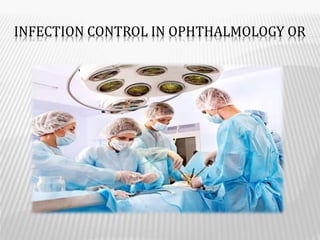
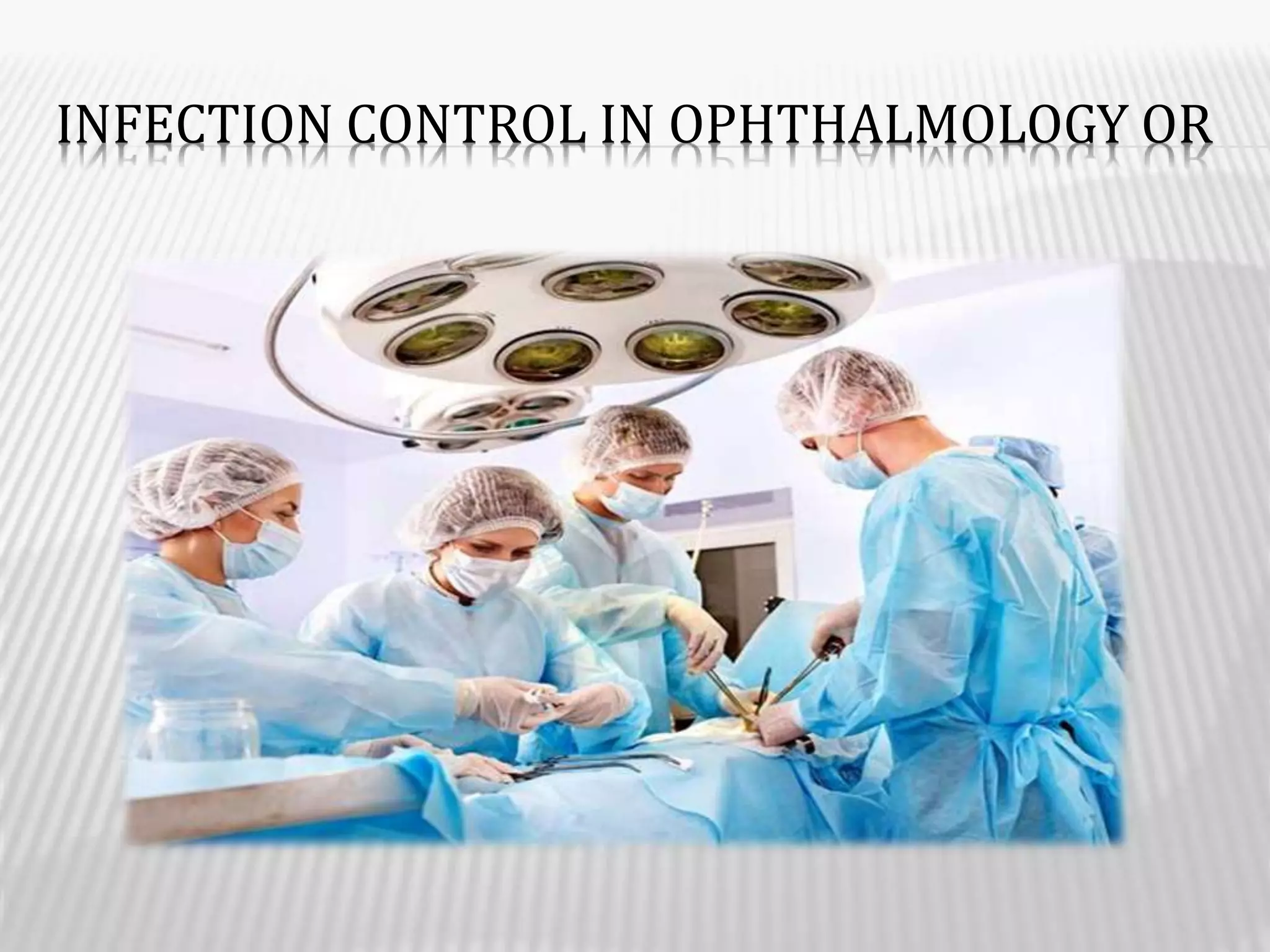
INFECTION CONTROL IN OPHTHALMOLOGY OR
1.Introduction
2.Possible infections in OR
3.What is wrong with our
practices .
4.OR etiquette .
5.Planning the OR complex .
6.Care of instruments .
7.Cleaning the OR .
8.Sterilization and disinfection
of the OR .
The operating room has become the most critical point of
any hospital set up , and the surgical procedures are the
most important event that happens to a patient.
Cleanliness of the hospital environment is the best starting
point to achieve the highest patient safety mandate.
There is a need to decrease the bio-burden present in the
environment in an operating room.
A systematic method of precautions taken by operating
team leads to a successful procedure.
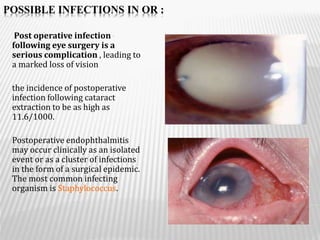
POSSIBLE INFECTIONS IN OR :
•Post operative infection
following eye surgery is a
serious complication , leading to
a marked loss of vision
the incidence of postoperative
infection following cataract
extraction to be as high as
11.6/1000.
Postoperative endophthalmitis
may occur clinically as an isolated
event or as a cluster of infections
in the form of a surgical epidemic.
The most common infecting
organism is Staphylococcus.
WHAT IS WRONG WITH OUR PRACTICES ?
.11. Improper or absence of
sterilisation of surgical
instruments or
environment .
.22. disinfectants used
indiscriminately .
.33. used unnecessirly .
.44. concentration not
adequate .
OR ETIQUETTE
1)Personnel entering the OR
complex should be strictly
controlled.
2)Anyone with overt infection should
be barred.
3)All persons entering the OR should
change into freshly laundered
clothing.
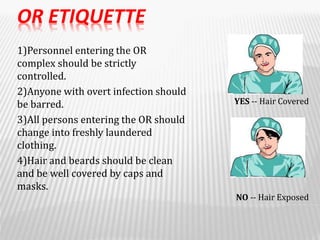
4)Hair and beards should be clean
and be well covered by caps and
masks.
YES -- Hair Covered

NO -- Hair Exposed
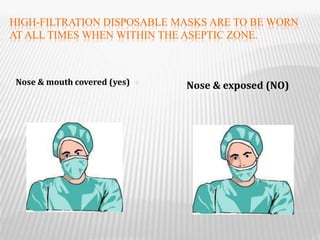
HIGH-FILTRATION DISPOSABLE MASKS ARE TO BE WORN
AT ALL TIMES WHEN WITHIN THE ASEPTIC ZONE.
Nose & mouth covered (yes) Nose & exposed (NO)
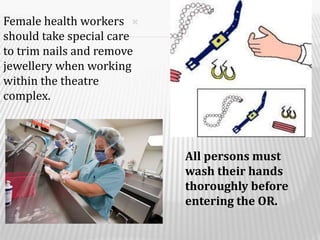
Female health workers
should take special care
to trim nails and remove
jewellery when working
within the theatre
complex.
All persons must
wash their hands
thoroughly before
entering the OR.
THERE IS A STRONG RELATIONSHIP BETWEEN THE DESIGN, EFFICIENCY AND THE
HUMAN ELEMENT. HENCE CONFIGURATION OF AN OR COMPLEX CAN INDIRECTLY
AFFECT THE INCIDENCE OF SURGICAL INFECTIONS.
A) LOCATION : OR COMPLEX SHOULD ALWAYS BE SEGREGATED FROM THE HIGH
TRAFFIC AREA OF THE HOSPITAL .
B)DESIGN : SEPARATING STERILE FROM NON_STERILE COMLEX NEED TO BE
DESIGNED THOUGHTFULY TO MAINTAIN ASEPSIS , FOR STRICT ASEPSIS : AN EYE OR
SHOULD NOT BE SHARED WITH ANY SURGICAL DISCIPLINE .
THERE ARE 4 MAJOR ZONES IN OR COMPLEX :
1.OUTER ZONE 2.CLEAN ZONE 3.ASEPTIC ZONE 4.DISPOSAL ZONE.
C)AIR HANDLING : IT SHOULD BE FILTERED AND VENTILATED .
Planning the OR complex
THE MAJOR ZONES OF OR COMLEX
a)The outer zone is a reception area and is accessible to all
persons and supplies.
b)The clean zone is the space for circulation of OR staff after
changing. It encompasses the (i)changing room located near the
entrance of the OR complex; and (ii)transfer zone which is the
space where patients are shifted from the transfer point to the
OR.
c)The aseptic zone is the sterile area within the OR complex
consisting of the scrub and gowning area, the preparation room and
the OR.
d)The disposal zone is the area where used equipment and supplies are
processed. Disposal of biohazardous waste is also done in this zone.
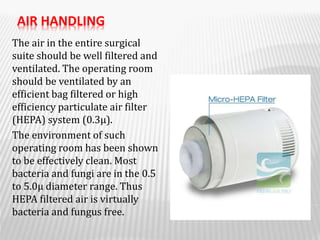
AIR HANDLING
The air in the entire surgical
suite should be well filtered and
ventilated. The operating room
should be ventilated by an
efficient bag filtered or high
efficiency particulate air filter
(HEPA) system (0.3μ).
The environment of such
operating room has been shown
to be effectively clean. Most
bacteria and fungi are in the 0.5
to 5.0μ diameter range. Thus
HEPA filtered air is virtually
bacteria and fungus free.
CARE OF INSTRUMENTS
a) Cleaning the instruments
prior to its sterilization Instruments should be
cleaned as soon as possible after their use.
Delicate and regular instruments should be
separated
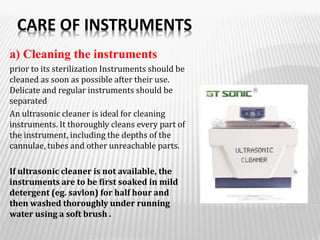
An ultrasonic cleaner is ideal for cleaning
instruments. It thoroughly cleans every part of
the instrument, including the depths of the
cannulae, tubes and other unreachable parts.
If ultrasonic cleaner is not available, the
instruments are to be first soaked in mild
detergent (eg. savlon) for half hour and
then washed thoroughly under running
water using a soft brush .
B) STERILISATION AND DISINFECTION
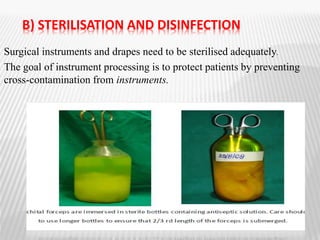
Surgical instruments and drapes need to be sterilised adequately.
The goal of instrument processing is to protect patients by preventing
cross-contamination from instruments.
C) STORAGE & INSTRUMENT SETS
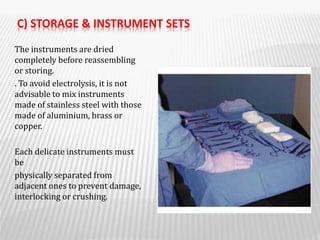
The instruments are dried
completely before reassembling
or storing.
. To avoid electrolysis, it is not
advisable to mix instruments
made of stainless steel with those
made of aluminium, brass or
copper.
Each delicate instruments must
be
physically separated from
adjacent ones to prevent damage,
interlocking or crushing.
ENVIRONMENTAL DECONTAMINATION
1) Cleaning the OR
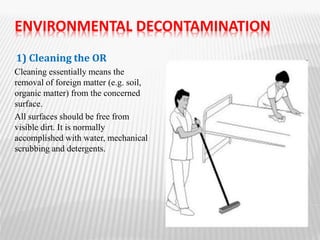
Cleaning essentially means the
removal of foreign matter (e.g. soil,
organic matter) from the concerned
surface.
All surfaces should be free from
visible dirt. It is normally
accomplished with water, mechanical
scrubbing and detergents.
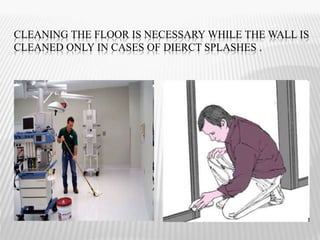
CLEANING THE FLOOR IS NECESSARY WHILE THE WALL IS
CLEANED ONLY IN CASES OF DIERCT SPLASHES .
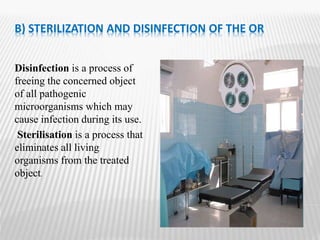
B) STERILIZATION AND DISINFECTION OF THE OR
Disinfection is a process of
freeing the concerned object
of all pathogenic
microorganisms which may
cause infection during its use.
Sterilisation is a process that
eliminates all living
organisms from the treated
object.
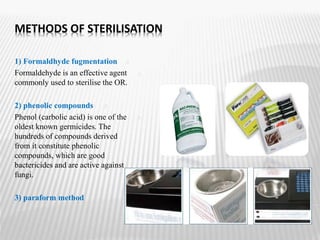
METHODS OF STERILISATION
.11) Formaldhyde fugmentation
.2Formaldehyde is an effective agent
commonly used to sterilise the OR.
.32) phenolic compounds
.4Phenol (carbolic acid) is one of the
oldest known germicides. The
hundreds of compounds derived
from it constitute phenolic
compounds, which are good
bactericides and are active against
fungi.
.53) paraform method
THANK YOU …

Infection control in ophthalmology or

  • 1.
    INFECTION CONTROL INOPHTHALMOLOGY OR
  • 2.
    1.Introduction 2.Possible infections inOR 3.What is wrong with our practices . 4.OR etiquette . 5.Planning the OR complex . 6.Care of instruments . 7.Cleaning the OR . 8.Sterilization and disinfection of the OR .
  • 3.
    The operating roomhas become the most critical point of any hospital set up , and the surgical procedures are the most important event that happens to a patient. Cleanliness of the hospital environment is the best starting point to achieve the highest patient safety mandate. There is a need to decrease the bio-burden present in the environment in an operating room. A systematic method of precautions taken by operating team leads to a successful procedure.
  • 4.
    POSSIBLE INFECTIONS INOR : •Post operative infection following eye surgery is a serious complication , leading to a marked loss of vision the incidence of postoperative infection following cataract extraction to be as high as 11.6/1000. Postoperative endophthalmitis may occur clinically as an isolated event or as a cluster of infections in the form of a surgical epidemic. The most common infecting organism is Staphylococcus.
  • 5.
    WHAT IS WRONGWITH OUR PRACTICES ? .11. Improper or absence of sterilisation of surgical instruments or environment . .22. disinfectants used indiscriminately . .33. used unnecessirly . .44. concentration not adequate .
  • 6.
    OR ETIQUETTE 1)Personnel enteringthe OR complex should be strictly controlled. 2)Anyone with overt infection should be barred. 3)All persons entering the OR should change into freshly laundered clothing. 4)Hair and beards should be clean and be well covered by caps and masks. YES -- Hair Covered  NO -- Hair Exposed
  • 7.
    HIGH-FILTRATION DISPOSABLE MASKSARE TO BE WORN AT ALL TIMES WHEN WITHIN THE ASEPTIC ZONE. Nose & mouth covered (yes) Nose & exposed (NO)
  • 8.
    Female health workers shouldtake special care to trim nails and remove jewellery when working within the theatre complex. All persons must wash their hands thoroughly before entering the OR.
  • 9.
    THERE IS ASTRONG RELATIONSHIP BETWEEN THE DESIGN, EFFICIENCY AND THE HUMAN ELEMENT. HENCE CONFIGURATION OF AN OR COMPLEX CAN INDIRECTLY AFFECT THE INCIDENCE OF SURGICAL INFECTIONS. A) LOCATION : OR COMPLEX SHOULD ALWAYS BE SEGREGATED FROM THE HIGH TRAFFIC AREA OF THE HOSPITAL . B)DESIGN : SEPARATING STERILE FROM NON_STERILE COMLEX NEED TO BE DESIGNED THOUGHTFULY TO MAINTAIN ASEPSIS , FOR STRICT ASEPSIS : AN EYE OR SHOULD NOT BE SHARED WITH ANY SURGICAL DISCIPLINE . THERE ARE 4 MAJOR ZONES IN OR COMPLEX : 1.OUTER ZONE 2.CLEAN ZONE 3.ASEPTIC ZONE 4.DISPOSAL ZONE. C)AIR HANDLING : IT SHOULD BE FILTERED AND VENTILATED . Planning the OR complex
  • 10.
    THE MAJOR ZONESOF OR COMLEX a)The outer zone is a reception area and is accessible to all persons and supplies. b)The clean zone is the space for circulation of OR staff after changing. It encompasses the (i)changing room located near the entrance of the OR complex; and (ii)transfer zone which is the space where patients are shifted from the transfer point to the OR. c)The aseptic zone is the sterile area within the OR complex consisting of the scrub and gowning area, the preparation room and the OR. d)The disposal zone is the area where used equipment and supplies are processed. Disposal of biohazardous waste is also done in this zone.
  • 11.
    AIR HANDLING The airin the entire surgical suite should be well filtered and ventilated. The operating room should be ventilated by an efficient bag filtered or high efficiency particulate air filter (HEPA) system (0.3μ). The environment of such operating room has been shown to be effectively clean. Most bacteria and fungi are in the 0.5 to 5.0μ diameter range. Thus HEPA filtered air is virtually bacteria and fungus free.
  • 12.
    CARE OF INSTRUMENTS a)Cleaning the instruments prior to its sterilization Instruments should be cleaned as soon as possible after their use. Delicate and regular instruments should be separated An ultrasonic cleaner is ideal for cleaning instruments. It thoroughly cleans every part of the instrument, including the depths of the cannulae, tubes and other unreachable parts. If ultrasonic cleaner is not available, the instruments are to be first soaked in mild detergent (eg. savlon) for half hour and then washed thoroughly under running water using a soft brush .
  • 13.
    B) STERILISATION ANDDISINFECTION Surgical instruments and drapes need to be sterilised adequately. The goal of instrument processing is to protect patients by preventing cross-contamination from instruments.
  • 14.
    C) STORAGE &INSTRUMENT SETS The instruments are dried completely before reassembling or storing. . To avoid electrolysis, it is not advisable to mix instruments made of stainless steel with those made of aluminium, brass or copper. Each delicate instruments must be physically separated from adjacent ones to prevent damage, interlocking or crushing.
  • 15.
    ENVIRONMENTAL DECONTAMINATION 1) Cleaningthe OR Cleaning essentially means the removal of foreign matter (e.g. soil, organic matter) from the concerned surface. All surfaces should be free from visible dirt. It is normally accomplished with water, mechanical scrubbing and detergents.
  • 16.
    CLEANING THE FLOORIS NECESSARY WHILE THE WALL IS CLEANED ONLY IN CASES OF DIERCT SPLASHES .
  • 17.
    B) STERILIZATION ANDDISINFECTION OF THE OR Disinfection is a process of freeing the concerned object of all pathogenic microorganisms which may cause infection during its use. Sterilisation is a process that eliminates all living organisms from the treated object.
  • 18.
    METHODS OF STERILISATION .11)Formaldhyde fugmentation .2Formaldehyde is an effective agent commonly used to sterilise the OR. .32) phenolic compounds .4Phenol (carbolic acid) is one of the oldest known germicides. The hundreds of compounds derived from it constitute phenolic compounds, which are good bactericides and are active against fungi. .53) paraform method
  • 19.