02/08/2025
by Abel.M
1
INFECTION PREVENTION IN OR
By Abel. M(Bsc, Msc in PCHN)
02/08/2025
by Abel.M
2
Objectives
 Explain the principles of IPP
 Describe the modes of transmission of microorganisms from the source to
the susceptible host.
 Elaborate how to break chain of infection
 Discuss Principles of Basic Aseptic Technique in the OR
02/08/2025
by Abel. M
3
Infection Prevention in OR
 The infection prevention (IP) practices are intended for use in all types
of health care facilities – from large urban hospitals to small rural clinics.
 IPC are directed at controlling or eliminating sources of infection in the
health care.
 The principles are based on the guidelines issued by Centers for Disease
Control and Prevention, CDC.
02/08/2025
by Abel.M
4
Cont…Principles…
 The recommended infection prevention practices are based on the
following principles:
 Every person is potentially infectious and susceptible to infection.
 Washing hands.
 Donning (wearing) gloves
 Using personal protective equipment (PPE)
02/08/2025
by Abel.M
5
Cont...
 Using antiseptic agents for cleansing the skin or mucous membrane
 Using safe work practices,
 Processing instruments
 Routinely cleaning and disinfecting equipment and furniture in patient care
areas.
 Disposing contaminated materials and contaminated waste properly.
02/08/2025
by Abel.M
6
Cont…
 Proper infection prevention practices (IPP) are fundamental to quality of
care, and essential to protect health care providers, patients, and
communities.
 Proper IPP break the disease transmission cycle (chain of infection).
 Chain of infection is a series of events that allow germs to spread from
person to person.
02/08/2025
by Abel.M
7
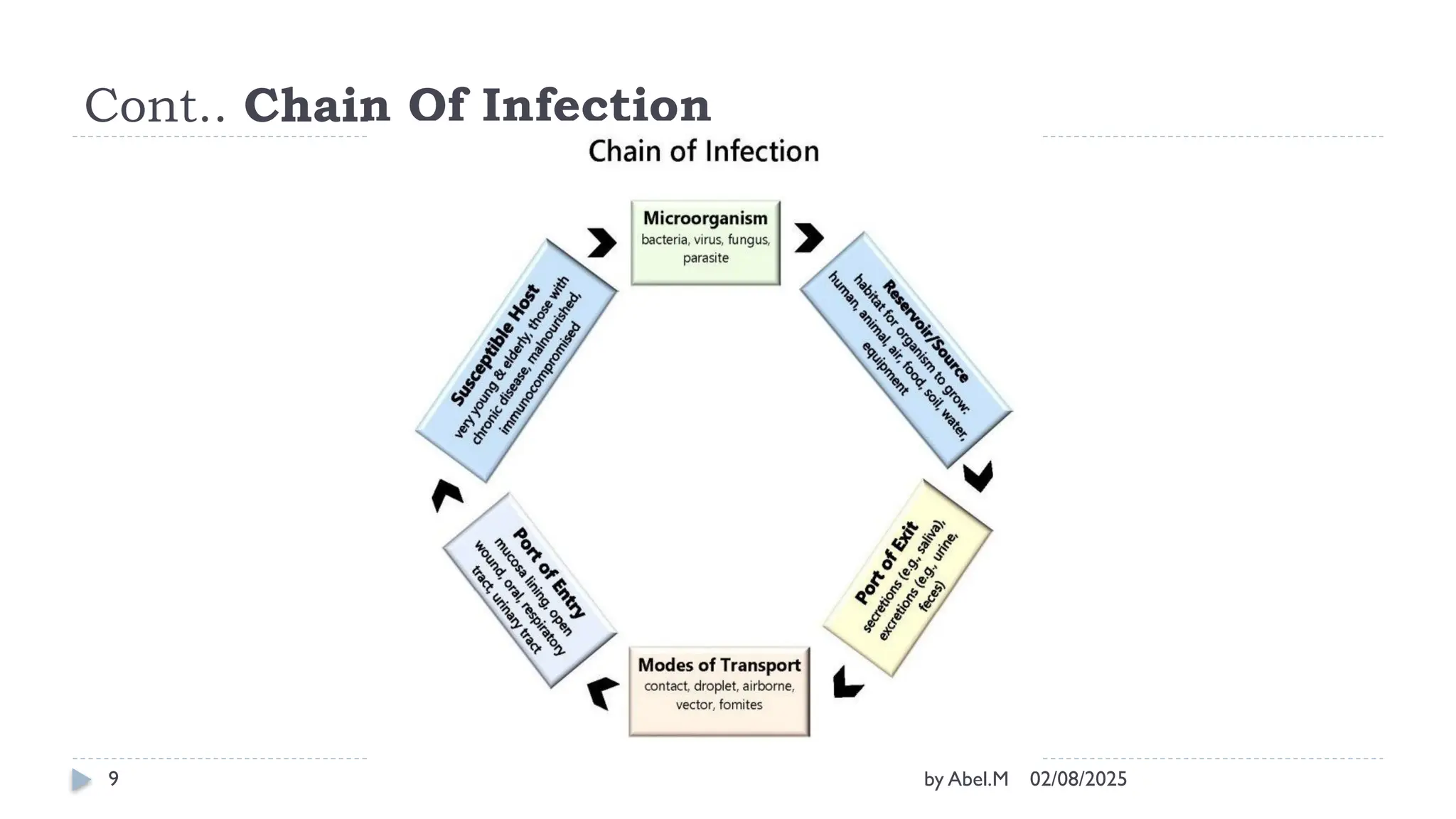
The chain of components has six sections:-
 Microorganisms: Disease producing, also called pathogens
 Virus, parasite, fungus, bacterium
 Reservoir/Source: Environment/habitat where a pathogen can live and multiply
 Environmental surfaces/equipment, body fluids (blood, saliva), urine/fecal material, food/water, soil, skin,
respiratory tract
 Portal of Exit: How the pathogen exits or leaves reservoir
 Skin to skin, skin to surface, blood, mucous membranes, oral cavity, fecal
 Other potentially infectious material: Seminal fluid, joint fluid, saliva, urine/fecal material, any body fluid
contaminated with blood.
02/08/2025
by Abel.M
8
Cont…
 Modes ofTransport: How a pathogen moves from reservoir to susceptible host
 DirectTransmission:Airborne, droplet, contact (e.g., skin), bite, needle stick or other
sharps injury
 IndirectTransmission: Fomites – contaminated equipment, vectors, food, water
 Portal of Entry: Opening where the pathogen may enter
 Body openings (e.g., mouth, eyes, urinary tract, respiratory tract), incisions, wounds
 Susceptible Host:The person at-risk: patient or healthcare worker
 Factors affecting susceptibility (e.g., age, health, co-morbidities, immune system,
nutrition, infective dose, medications)
02/08/2025
by Abel.M
9
Cont.. Chain Of Infection
02/08/2025
by Abel.M
10
Breaking the chain of Infection…
 This is achieved by:
 Reducing the number of infection causing microorganisms present (e.g., simple
hand washing, cleaning of instruments);
 Killing or inactivating infection causing micro-organisms (e.g., hand washing with
a waterless alcohol preparation, decontamination);
 Creating barriers to prevent infectious agents from spreading (e.g., wearing
gloves or PPE);
 Reducing or eliminating risky practices (e.g., using disposable gloves and syringes)
02/08/2025
by Abel.M
11
Hand Hygiene
 Proper hand hygiene and the use of protective gloves in the operating room is
a key component in minimizing the transmission of disease.
 Appropriate hand hygiene must be carried out:
 Before coming in direct contact with patients
 Before putting on gloves
 After any situation in which hands may be contaminated,
 After removing gloves.
02/08/2025
by Abel.M
12
Hand Hygiene Techniques
 Routine Hand washing
 Purpose: to mechanically remove soil and debris and reduce the number of transient
microorganisms.
 For appropriate hand-washing: Thoroughly wet hands
 Apply a hand washing agent
 Vigorously rub all areas of hands and fingers for 10-15 seconds, paying close attention to
fingernails, and areas between the fingers
 Rinse hands thoroughly with clean running water from a tap
 Dry hands.
02/08/2025
by Abel.M
13
Hand antisepsis
 Purpose: to remove soil and debris and reduce both transient and resident flora on the hands.
 The technique is similar to hand washing but, it involves use of soap containing an antimicrobial
agent.
 Hand antiseptic should be done before:
 Examining or caring for highly susceptible patients (e.g., premature infants, elderly patients or
those with advanced AIDS, etc.)
 Performing an invasive procedure such as placement of an intravascular device, and
 Leaving the room of patients on Contact Precaution (e.g., Hepatitis A or E), or who have drug
resistance infections.
02/08/2025
by Abel.M
14
Antiseptic Hand-rub
 Purpose: to inhibit or kill transient and resident flora.
 Use of a waterless, alcohol-based hand-rub product is more effective in killing transient
and resident flora.
 Antiseptic hand-rub is quicker and easier to perform, and gives a greater initial reduction
in hand flora.
 Use 5 ml for each application and continue rubbing the solution over the hands until it is
dry (15 to 30 seconds).
 To be effective an adequate amount (5 ml) of antiseptic handrub solution should be used.
02/08/2025
by Abel.M
15
Aseptic and sterile techniques
 Aseptic and sterile techniques are based on sound scientific principles
and are carried out primarily to prevent the transmission of
microorganisms that can cause infection.
 The term asepsis is used to describe the techniques of keeping the work
area and personnel as free from microorganisms as possible with the
intent of protecting the patient and the caregiver.
02/08/2025
by Abel.M
16
Cont…
 The four important steps for the practitioner are:
 1. Know what is clean, disinfected, or sterile.
 2. Know what is not clean, disinfected, or sterile.
 3. Keep clean, disinfected, and sterile items separate from contaminated items.
 4.Take immediate action if contamination occurs
02/08/2025
by Abel.M
17
Cont…
 Infections in the health care settings may occur in the post operative wound
or as a complication unrelated to the surgical site.
 A postoperative infection is a very serious, potentially fatal complication that
may result from a single break in sterile technique.
 Therefore the basis of prevention is the knowledge of causative agents and
their controls as well as the principles of aseptic and sterile techniques.
02/08/2025
by Abel.M
18
Cont…
 The methods by which microbial contamination is prevented in the
environment are referred to as aseptic techniques.
 Sterile technique refers to creating and working within the sterile field.
 The patient is at risk for infection any time tissues are interrupted or
instrumentation is introduced into the vascular system.
 Sterile items should be used to prevent the introduction of pathogens into the
patient’s body.
02/08/2025
by Abel.M
19
Cont…
 Although air is a vehicle for the transmission of microorganisms, direct person-to-
person contact is the most common route of transmission.
 Therefore, the risk of infection can be minimized by:
 1. Maximizing the patient’s normal defenses
 2.Avoiding external compromises
 3. Controlling or eliminating infectious agents by proper management of the
physical environment, including appropriate cleaning, disinfection or sterilization of
devices and instruments.
02/08/2025
by Abel.M
20
Sources of Contamination and Infection
 Members of the operating team,
 The patients
 All articles used in the wound and in the sterile setup
 Dust in the air
 Other personnel or visitors in the operating room
02/08/2025
by Abel.M
21
Cont…
 The incidence and type of infections that occur in surgical patients may be
the result of:
 A preexisting localized infectious process,
 A systemic communicable disease, or
 An acquired preoperative complication
02/08/2025
by Abel.M
22
Principles of Sterile Technique
 Sterile technique is the basis of modern surgery.
 The patient is the center of the sterile field, which includes the personnel
wearing sterile attire and the areas of the patient, operating bed, and furniture
that are covered with sterile drapes.
 Strict adherence to the recommended practices of sterile technique reflects
 the surgical conscience of the perioperative team and is mandatory for the safety of
the patient and personnel in the environment.
02/08/2025
by Abel.M
23
The principles of sterile technique are applied under the following
conditions:
 In preparation for an invasive procedure by sterilization of necessary materials
and supplies,
 In preparation of the sterile team to handle sterile supplies and intimately
contact the surgical site by scrubbing, gowning, and gloving
02/08/2025
by Abel.M
24
 In the creation and maintenance of the sterile field, including skin preparation
and draping of the patient
 In the maintenance of asepsis throughout the surgical procedure
 In terminal sterilization and disinfection at the conclusion of the surgical
procedure.
02/08/2025
by Abel.M
25
Basic Rules of Asepsis
 The outcome of a patient’s surgical experience is influenced by the knowledge
and application of aseptic technique by the perioperative staff.
 This is best achieved by maintaining asepsis and limiting the risk of
contamination.
 To prevent infections, aseptic technique is practiced in the OR.
02/08/2025
by Abel.M
26
 This is implemented through the creation and maintenance of a sterile field.
 The center of the sterile field is the site of the surgical incision.
 Inanimate items in the sterile field include surgical items and equipment that
have been sterilized by appropriate sterilization methods.
02/08/2025
by Abel.M
27
Principles of Basic Aseptic Technique in the OR
 All materials that enter the sterile field must be sterile.
 Sterile team members must wear only sterile gowns and gloves and they keep
well within the sterile field.
 Unsterile persons don’t reach over sterile surfaces.
 Talking during surgery is kept to a minimum
02/08/2025
by Abel.M
28
 Movement is kept to a minimum during surgery.
 Sterile team members face each other.
 They face the sterile field.
 Sterile personnel handle only sterile equipment.
 Unsterile personnel handle only unsterile equipment.
02/08/2025
by Abel.M
29
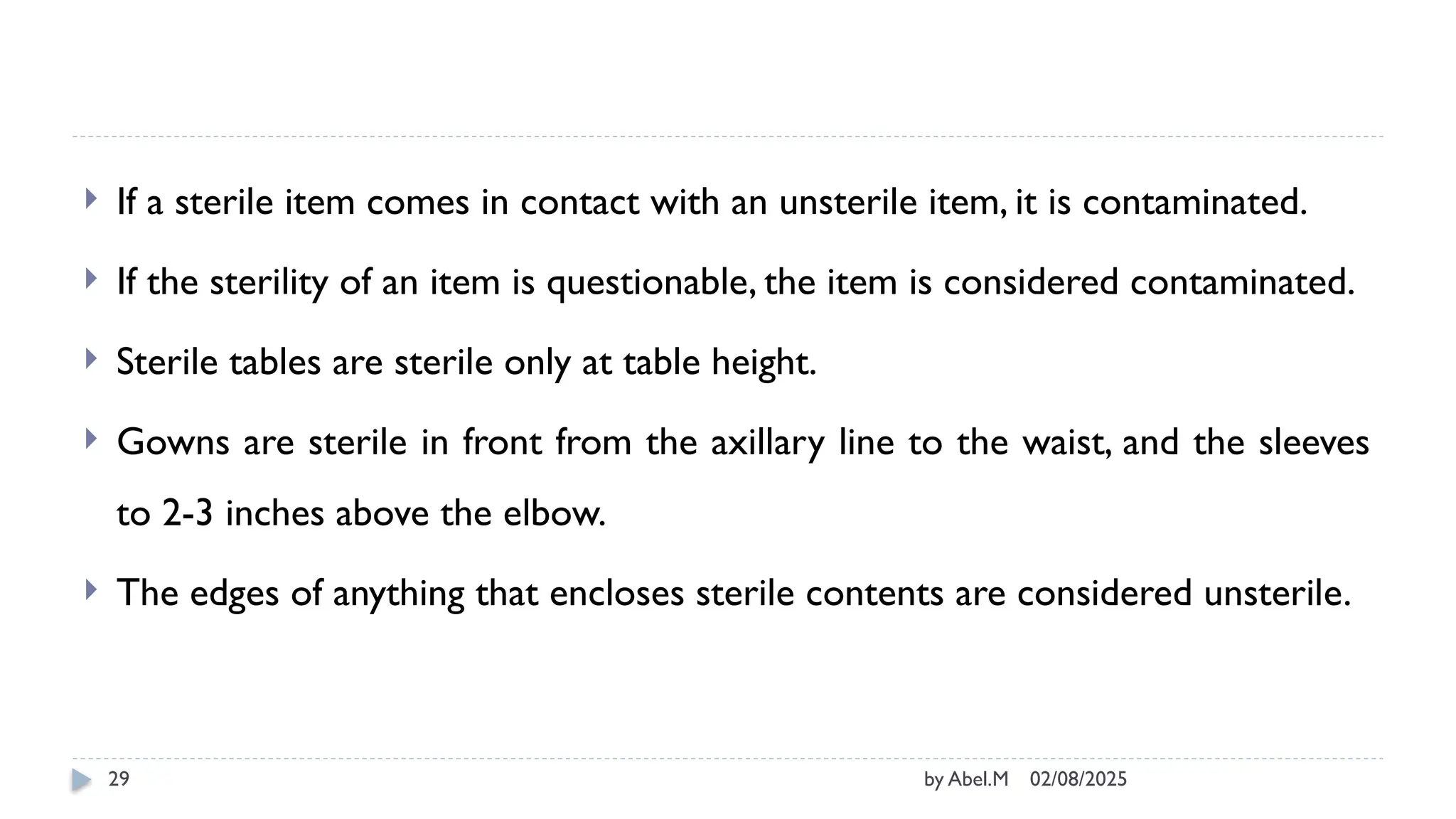
 If a sterile item comes in contact with an unsterile item, it is contaminated.
 If the sterility of an item is questionable, the item is considered contaminated.
 Sterile tables are sterile only at table height.
 Gowns are sterile in front from the axillary line to the waist, and the sleeves
to 2-3 inches above the elbow.
 The edges of anything that encloses sterile contents are considered unsterile.
02/08/2025
by Abel.M
30
 Moisture carries bacteria from a non sterile surface to a sterile surface.
 A wide margin of safety must be maintained between the sterile and unsterile
field.
 Contaminated items should be removed immediately from the sterile field.
 The sterile field is created as close as possible to the time of use.
02/08/2025
by Abel.M
31
 Destruction of the integrity of microbial barriers results in contamination.
 Sterile persons keep contact with sterile areas/goods to a minimum.
 Some operative areas cannot be sterile.
 Steps are taken to keep contamination to a minimum.
 No compromise of sterility.
02/08/2025
by Abel.M
32
Standard Precautions
 Standard precautions include considerations for the following:
 All body fluids
 Hand washing
 Barrier clothing
 Handling of used patient care equipment and linen
 Occupational exposure to blood-borne pathogens
 Patient placement
02/08/2025
by Abel.M
33
Cont…
 The CDC-identified routes of transmission include, airborne, droplet, and
contact precautions.
 The potential for becoming infected through skin exposure depends on:
 Localization
 Duration of contact
 The presence of skin lesions on the hands, and
 Immune status of the host
02/08/2025
by Abel.M
34
 Standard precautions supplement other recommended practices for
environmental control and are the minimum precautions for all invasive
procedures.
 An invasive procedure involves any entry into body tissues or cavities in any
procedural environment.
 Standard precautions are in effect for any procedure during which bleeding
occurs or for which the potential for bleeding or exposure to body substances
exists.
02/08/2025
by Abel.M
35
Application of Sterile Technique
 Intact skin and mucous membranes are the body’s first line of defense against
infection, but a portal for microorganisms is created if the integrity of the skin
is interrupted.
 Freshly incised or traumatized tissue can become infected easily, regardless of
the area of the body.
02/08/2025
by Abel.M
36
 Surgical procedures are performed under sterile conditions; contamination
with microorganisms is prevented to maintain sterility throughout the
procedure.
 A sterile field is created around the site of incision into tissues or the site of
introduction of sterile instruments into a body orifice.
02/08/2025
by Abel.M
37
 Conversely, all material and equipment used during a surgical procedure are
terminally decontaminated and sterilized after use with the assumption that
every patient is a potential source of infection for other persons.
 It is essential that all operating room team members know the common
sources and mechanisms of contamination by microorganisms in the
Perioperative environment.
02/08/2025
by Abel.M
38
 Sterile technique is the particular responsibility of everyone caring for the
patient in the OR.
 All members of the OR team must be vigilant in safeguarding the sterility of
the sterile field.
 Any contamination must be remedied immediately.
02/08/2025
by Abel.M
39
Thank You

Infection prevention is controlling or break the chain of transmission

  • 1.
    02/08/2025 by Abel.M 1 INFECTION PREVENTIONIN OR By Abel. M(Bsc, Msc in PCHN)
  • 2.
    02/08/2025 by Abel.M 2 Objectives  Explainthe principles of IPP  Describe the modes of transmission of microorganisms from the source to the susceptible host.  Elaborate how to break chain of infection  Discuss Principles of Basic Aseptic Technique in the OR
  • 3.
    02/08/2025 by Abel. M 3 InfectionPrevention in OR  The infection prevention (IP) practices are intended for use in all types of health care facilities – from large urban hospitals to small rural clinics.  IPC are directed at controlling or eliminating sources of infection in the health care.  The principles are based on the guidelines issued by Centers for Disease Control and Prevention, CDC.
  • 4.
    02/08/2025 by Abel.M 4 Cont…Principles…  Therecommended infection prevention practices are based on the following principles:  Every person is potentially infectious and susceptible to infection.  Washing hands.  Donning (wearing) gloves  Using personal protective equipment (PPE)
  • 5.
    02/08/2025 by Abel.M 5 Cont...  Usingantiseptic agents for cleansing the skin or mucous membrane  Using safe work practices,  Processing instruments  Routinely cleaning and disinfecting equipment and furniture in patient care areas.  Disposing contaminated materials and contaminated waste properly.
  • 6.
    02/08/2025 by Abel.M 6 Cont…  Properinfection prevention practices (IPP) are fundamental to quality of care, and essential to protect health care providers, patients, and communities.  Proper IPP break the disease transmission cycle (chain of infection).  Chain of infection is a series of events that allow germs to spread from person to person.
  • 7.
    02/08/2025 by Abel.M 7 The chainof components has six sections:-  Microorganisms: Disease producing, also called pathogens  Virus, parasite, fungus, bacterium  Reservoir/Source: Environment/habitat where a pathogen can live and multiply  Environmental surfaces/equipment, body fluids (blood, saliva), urine/fecal material, food/water, soil, skin, respiratory tract  Portal of Exit: How the pathogen exits or leaves reservoir  Skin to skin, skin to surface, blood, mucous membranes, oral cavity, fecal  Other potentially infectious material: Seminal fluid, joint fluid, saliva, urine/fecal material, any body fluid contaminated with blood.
  • 8.
    02/08/2025 by Abel.M 8 Cont…  ModesofTransport: How a pathogen moves from reservoir to susceptible host  DirectTransmission:Airborne, droplet, contact (e.g., skin), bite, needle stick or other sharps injury  IndirectTransmission: Fomites – contaminated equipment, vectors, food, water  Portal of Entry: Opening where the pathogen may enter  Body openings (e.g., mouth, eyes, urinary tract, respiratory tract), incisions, wounds  Susceptible Host:The person at-risk: patient or healthcare worker  Factors affecting susceptibility (e.g., age, health, co-morbidities, immune system, nutrition, infective dose, medications)
  • 9.
  • 10.
    02/08/2025 by Abel.M 10 Breaking thechain of Infection…  This is achieved by:  Reducing the number of infection causing microorganisms present (e.g., simple hand washing, cleaning of instruments);  Killing or inactivating infection causing micro-organisms (e.g., hand washing with a waterless alcohol preparation, decontamination);  Creating barriers to prevent infectious agents from spreading (e.g., wearing gloves or PPE);  Reducing or eliminating risky practices (e.g., using disposable gloves and syringes)
  • 11.
    02/08/2025 by Abel.M 11 Hand Hygiene Proper hand hygiene and the use of protective gloves in the operating room is a key component in minimizing the transmission of disease.  Appropriate hand hygiene must be carried out:  Before coming in direct contact with patients  Before putting on gloves  After any situation in which hands may be contaminated,  After removing gloves.
  • 12.
    02/08/2025 by Abel.M 12 Hand HygieneTechniques  Routine Hand washing  Purpose: to mechanically remove soil and debris and reduce the number of transient microorganisms.  For appropriate hand-washing: Thoroughly wet hands  Apply a hand washing agent  Vigorously rub all areas of hands and fingers for 10-15 seconds, paying close attention to fingernails, and areas between the fingers  Rinse hands thoroughly with clean running water from a tap  Dry hands.
  • 13.
    02/08/2025 by Abel.M 13 Hand antisepsis Purpose: to remove soil and debris and reduce both transient and resident flora on the hands.  The technique is similar to hand washing but, it involves use of soap containing an antimicrobial agent.  Hand antiseptic should be done before:  Examining or caring for highly susceptible patients (e.g., premature infants, elderly patients or those with advanced AIDS, etc.)  Performing an invasive procedure such as placement of an intravascular device, and  Leaving the room of patients on Contact Precaution (e.g., Hepatitis A or E), or who have drug resistance infections.
  • 14.
    02/08/2025 by Abel.M 14 Antiseptic Hand-rub Purpose: to inhibit or kill transient and resident flora.  Use of a waterless, alcohol-based hand-rub product is more effective in killing transient and resident flora.  Antiseptic hand-rub is quicker and easier to perform, and gives a greater initial reduction in hand flora.  Use 5 ml for each application and continue rubbing the solution over the hands until it is dry (15 to 30 seconds).  To be effective an adequate amount (5 ml) of antiseptic handrub solution should be used.
  • 15.
    02/08/2025 by Abel.M 15 Aseptic andsterile techniques  Aseptic and sterile techniques are based on sound scientific principles and are carried out primarily to prevent the transmission of microorganisms that can cause infection.  The term asepsis is used to describe the techniques of keeping the work area and personnel as free from microorganisms as possible with the intent of protecting the patient and the caregiver.
  • 16.
    02/08/2025 by Abel.M 16 Cont…  Thefour important steps for the practitioner are:  1. Know what is clean, disinfected, or sterile.  2. Know what is not clean, disinfected, or sterile.  3. Keep clean, disinfected, and sterile items separate from contaminated items.  4.Take immediate action if contamination occurs
  • 17.
    02/08/2025 by Abel.M 17 Cont…  Infectionsin the health care settings may occur in the post operative wound or as a complication unrelated to the surgical site.  A postoperative infection is a very serious, potentially fatal complication that may result from a single break in sterile technique.  Therefore the basis of prevention is the knowledge of causative agents and their controls as well as the principles of aseptic and sterile techniques.
  • 18.
    02/08/2025 by Abel.M 18 Cont…  Themethods by which microbial contamination is prevented in the environment are referred to as aseptic techniques.  Sterile technique refers to creating and working within the sterile field.  The patient is at risk for infection any time tissues are interrupted or instrumentation is introduced into the vascular system.  Sterile items should be used to prevent the introduction of pathogens into the patient’s body.
  • 19.
    02/08/2025 by Abel.M 19 Cont…  Althoughair is a vehicle for the transmission of microorganisms, direct person-to- person contact is the most common route of transmission.  Therefore, the risk of infection can be minimized by:  1. Maximizing the patient’s normal defenses  2.Avoiding external compromises  3. Controlling or eliminating infectious agents by proper management of the physical environment, including appropriate cleaning, disinfection or sterilization of devices and instruments.
  • 20.
    02/08/2025 by Abel.M 20 Sources ofContamination and Infection  Members of the operating team,  The patients  All articles used in the wound and in the sterile setup  Dust in the air  Other personnel or visitors in the operating room
  • 21.
    02/08/2025 by Abel.M 21 Cont…  Theincidence and type of infections that occur in surgical patients may be the result of:  A preexisting localized infectious process,  A systemic communicable disease, or  An acquired preoperative complication
  • 22.
    02/08/2025 by Abel.M 22 Principles ofSterile Technique  Sterile technique is the basis of modern surgery.  The patient is the center of the sterile field, which includes the personnel wearing sterile attire and the areas of the patient, operating bed, and furniture that are covered with sterile drapes.  Strict adherence to the recommended practices of sterile technique reflects  the surgical conscience of the perioperative team and is mandatory for the safety of the patient and personnel in the environment.
  • 23.
    02/08/2025 by Abel.M 23 The principlesof sterile technique are applied under the following conditions:  In preparation for an invasive procedure by sterilization of necessary materials and supplies,  In preparation of the sterile team to handle sterile supplies and intimately contact the surgical site by scrubbing, gowning, and gloving
  • 24.
    02/08/2025 by Abel.M 24  Inthe creation and maintenance of the sterile field, including skin preparation and draping of the patient  In the maintenance of asepsis throughout the surgical procedure  In terminal sterilization and disinfection at the conclusion of the surgical procedure.
  • 25.
    02/08/2025 by Abel.M 25 Basic Rulesof Asepsis  The outcome of a patient’s surgical experience is influenced by the knowledge and application of aseptic technique by the perioperative staff.  This is best achieved by maintaining asepsis and limiting the risk of contamination.  To prevent infections, aseptic technique is practiced in the OR.
  • 26.
    02/08/2025 by Abel.M 26  Thisis implemented through the creation and maintenance of a sterile field.  The center of the sterile field is the site of the surgical incision.  Inanimate items in the sterile field include surgical items and equipment that have been sterilized by appropriate sterilization methods.
  • 27.
    02/08/2025 by Abel.M 27 Principles ofBasic Aseptic Technique in the OR  All materials that enter the sterile field must be sterile.  Sterile team members must wear only sterile gowns and gloves and they keep well within the sterile field.  Unsterile persons don’t reach over sterile surfaces.  Talking during surgery is kept to a minimum
  • 28.
    02/08/2025 by Abel.M 28  Movementis kept to a minimum during surgery.  Sterile team members face each other.  They face the sterile field.  Sterile personnel handle only sterile equipment.  Unsterile personnel handle only unsterile equipment.
  • 29.
    02/08/2025 by Abel.M 29  Ifa sterile item comes in contact with an unsterile item, it is contaminated.  If the sterility of an item is questionable, the item is considered contaminated.  Sterile tables are sterile only at table height.  Gowns are sterile in front from the axillary line to the waist, and the sleeves to 2-3 inches above the elbow.  The edges of anything that encloses sterile contents are considered unsterile.
  • 30.
    02/08/2025 by Abel.M 30  Moisturecarries bacteria from a non sterile surface to a sterile surface.  A wide margin of safety must be maintained between the sterile and unsterile field.  Contaminated items should be removed immediately from the sterile field.  The sterile field is created as close as possible to the time of use.
  • 31.
    02/08/2025 by Abel.M 31  Destructionof the integrity of microbial barriers results in contamination.  Sterile persons keep contact with sterile areas/goods to a minimum.  Some operative areas cannot be sterile.  Steps are taken to keep contamination to a minimum.  No compromise of sterility.
  • 32.
    02/08/2025 by Abel.M 32 Standard Precautions Standard precautions include considerations for the following:  All body fluids  Hand washing  Barrier clothing  Handling of used patient care equipment and linen  Occupational exposure to blood-borne pathogens  Patient placement
  • 33.
    02/08/2025 by Abel.M 33 Cont…  TheCDC-identified routes of transmission include, airborne, droplet, and contact precautions.  The potential for becoming infected through skin exposure depends on:  Localization  Duration of contact  The presence of skin lesions on the hands, and  Immune status of the host
  • 34.
    02/08/2025 by Abel.M 34  Standardprecautions supplement other recommended practices for environmental control and are the minimum precautions for all invasive procedures.  An invasive procedure involves any entry into body tissues or cavities in any procedural environment.  Standard precautions are in effect for any procedure during which bleeding occurs or for which the potential for bleeding or exposure to body substances exists.
  • 35.

    02/08/2025 by Abel.M 35 Application ofSterile Technique  Intact skin and mucous membranes are the body’s first line of defense against infection, but a portal for microorganisms is created if the integrity of the skin is interrupted.  Freshly incised or traumatized tissue can become infected easily, regardless of the area of the body.
  • 36.
    02/08/2025 by Abel.M 36  Surgicalprocedures are performed under sterile conditions; contamination with microorganisms is prevented to maintain sterility throughout the procedure.  A sterile field is created around the site of incision into tissues or the site of introduction of sterile instruments into a body orifice.
  • 37.
    02/08/2025 by Abel.M 37  Conversely,all material and equipment used during a surgical procedure are terminally decontaminated and sterilized after use with the assumption that every patient is a potential source of infection for other persons.  It is essential that all operating room team members know the common sources and mechanisms of contamination by microorganisms in the Perioperative environment.
  • 38.
    02/08/2025 by Abel.M 38  Steriletechnique is the particular responsibility of everyone caring for the patient in the OR.  All members of the OR team must be vigilant in safeguarding the sterility of the sterile field.  Any contamination must be remedied immediately.
  • 39.