Basic Movements
& Mechanical
Physics of forceps
Dr. Firas Kassab
2Dr. Firas Kassab
Dr. Firas Kassab 3
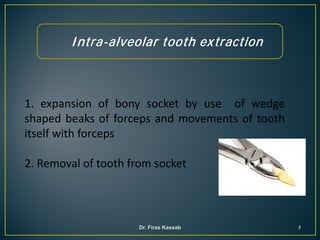
Intra-alveolar tooth extraction
1. expansion of bony socket by use of wedge
shaped beaks of forceps and movements of tooth
itself with forceps
2. Removal of tooth from socket
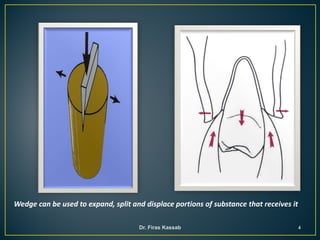
Wedge can be used to expand, split and displace portions of substance that receives it
4Dr. Firas Kassab
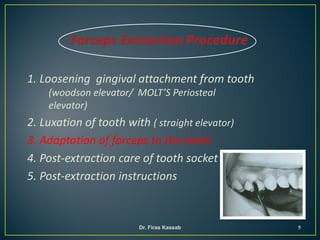
1. Loosening gingival attachment from tooth
(woodson elevator/ MOLT’S Periosteal
elevator)
2. Luxation of tooth with ( straight elevator)
3. Adaptation of forceps to the tooth
4. Post-extraction care of tooth socket
5. Post-extraction instructions
5Dr. Firas Kassab
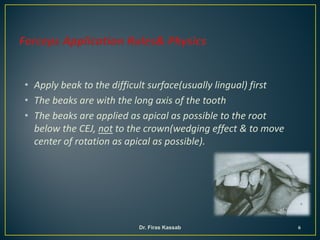
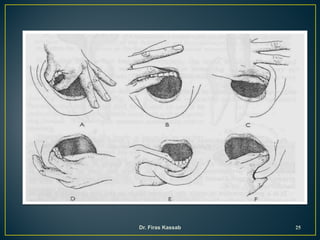
• Apply beak to the difficult surface(usually lingual) first
• The beaks are with the long axis of the tooth
• The beaks are applied as apical as possible to the root
below the CEJ, not to the crown(wedging effect & to move
center of rotation as apical as possible).
6Dr. Firas Kassab
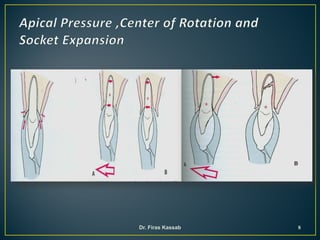
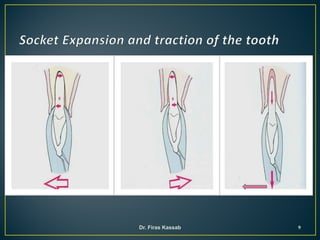
Result in
1. Apical pressure
• Bony expansion
• Apical displacement for the center of rotation
2. Buccal force
3. Lingual/palatal force
4. Rotation
5. Traction force
7Dr. Firas Kassab
8Dr. Firas Kassab
9Dr. Firas Kassab
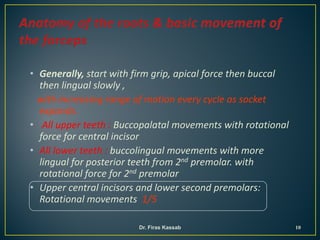
• Generally, start with firm grip, apical force then buccal
then lingual slowly ,
with increasing range of motion every cycle as socket
expands.
• All upper teeth : Buccopalatal movements with rotational
force for central incisor
• All lower teeth : buccolingual movements with more
lingual for posterior teeth from 2nd premolar. with
rotational force for 2nd premolar
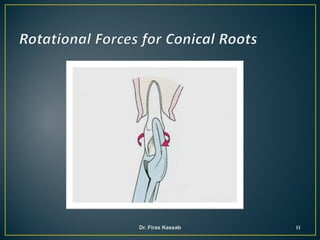
• Upper central incisors and lower second premolars:
Rotational movements 1/5
10Dr. Firas Kassab
11Dr. Firas Kassab
Specific techniques for removal
of each tooth
12Dr. Firas Kassab
13Dr. Firas Kassab
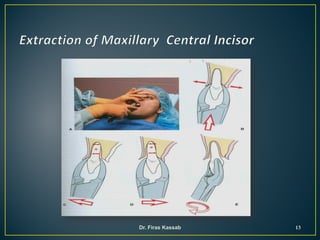
• Root: single ,straight , conical
• Labial alveolar bone is thinner than palatal alveolar
bone
• Relation: nasal floor
• rotational movements
14Dr. Firas Kassab
• Root: single ,slightly longer , and more slender
• More likely to have distal curvature on apical one
third
• Labial bone is thicker than in central incisor
• Relation: nasal floor
• Labio-palatal movement
• Avoid rotational movement
15Dr. Firas Kassab
16Dr. Firas Kassab
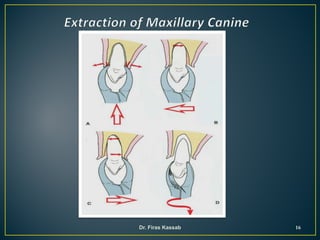
• Root: single ,longest ,strongest-----difficult extraction.
• Thin labial alveolar bone ( because of canine
eminence
• Relation: neutral between nasal cavity and maxillary
sinus
• Labio-palatal movement.
17Dr. Firas Kassab
18Dr. Firas Kassab
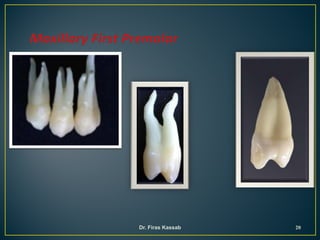
• Root:
- a single- rooted tooth in its first two thirds, with a
bifurcation usually occurring in the apical one third to one
half.
- >50% have two roots
- Extremely thin and are subject to fracture
(king of fracture)
• Thin buccal plate
• Relation :maxillary sinus
• Bucco-palatal movement, Avoid rotational
palatal movements are made with relatively small
amounts of force to prevent fracture of the palatal root tip
19Dr. Firas Kassab
20Dr. Firas Kassab
• Root: mostly single
• Thin buccal plate
• Relation: maxillary sinus
• Bucco-palatal movement.
21Dr. Firas Kassab
22Dr. Firas Kassab
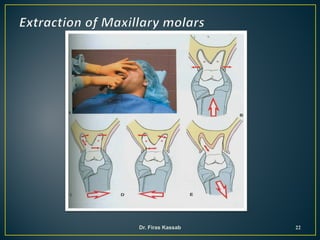
• Roots: two buccal ,one palatal , straight , divergent (more
in the first molar) .
• Thin buccal plate
• Relation : maxillary sinus esp. palatal root of first molar.
• Bucco-palatal movement.
• The second molar is similar to first except that roots are
shorter and less divergent, with the buccal roots more
commonly fused --------- (easier extraction than first)
23Dr. Firas Kassab
• frequently conical fused roots BUT can show wide
anatomical variation
• Bayonet forceps
• relation : maxillary sinus & maxillary tuberosity
24Dr. Firas Kassab
25Dr. Firas Kassab

Principles of simple extractions 2

  • 1.
    Basic Movements & Mechanical Physicsof forceps Dr. Firas Kassab
  • 2.
  • 3.
    Dr. Firas Kassab3 Intra-alveolar tooth extraction 1. expansion of bony socket by use of wedge shaped beaks of forceps and movements of tooth itself with forceps 2. Removal of tooth from socket
  • 4.
    Wedge can beused to expand, split and displace portions of substance that receives it 4Dr. Firas Kassab
  • 5.
    1. Loosening gingivalattachment from tooth (woodson elevator/ MOLT’S Periosteal elevator) 2. Luxation of tooth with ( straight elevator) 3. Adaptation of forceps to the tooth 4. Post-extraction care of tooth socket 5. Post-extraction instructions 5Dr. Firas Kassab
  • 6.
    • Apply beakto the difficult surface(usually lingual) first • The beaks are with the long axis of the tooth • The beaks are applied as apical as possible to the root below the CEJ, not to the crown(wedging effect & to move center of rotation as apical as possible). 6Dr. Firas Kassab
  • 7.
    Result in 1. Apicalpressure • Bony expansion • Apical displacement for the center of rotation 2. Buccal force 3. Lingual/palatal force 4. Rotation 5. Traction force 7Dr. Firas Kassab
  • 8.
  • 9.
  • 10.
    • Generally, startwith firm grip, apical force then buccal then lingual slowly , with increasing range of motion every cycle as socket expands. • All upper teeth : Buccopalatal movements with rotational force for central incisor • All lower teeth : buccolingual movements with more lingual for posterior teeth from 2nd premolar. with rotational force for 2nd premolar • Upper central incisors and lower second premolars: Rotational movements 1/5 10Dr. Firas Kassab
  • 11.
  • 12.
    Specific techniques forremoval of each tooth 12Dr. Firas Kassab
  • 13.
  • 14.
    • Root: single,straight , conical • Labial alveolar bone is thinner than palatal alveolar bone • Relation: nasal floor • rotational movements 14Dr. Firas Kassab
  • 15.
    • Root: single,slightly longer , and more slender • More likely to have distal curvature on apical one third • Labial bone is thicker than in central incisor • Relation: nasal floor • Labio-palatal movement • Avoid rotational movement 15Dr. Firas Kassab
  • 16.
  • 17.
    • Root: single,longest ,strongest-----difficult extraction. • Thin labial alveolar bone ( because of canine eminence • Relation: neutral between nasal cavity and maxillary sinus • Labio-palatal movement. 17Dr. Firas Kassab
  • 18.
  • 19.
    • Root: - asingle- rooted tooth in its first two thirds, with a bifurcation usually occurring in the apical one third to one half. - >50% have two roots - Extremely thin and are subject to fracture (king of fracture) • Thin buccal plate • Relation :maxillary sinus • Bucco-palatal movement, Avoid rotational palatal movements are made with relatively small amounts of force to prevent fracture of the palatal root tip 19Dr. Firas Kassab
  • 20.
  • 21.
    • Root: mostlysingle • Thin buccal plate • Relation: maxillary sinus • Bucco-palatal movement. 21Dr. Firas Kassab
  • 22.
  • 23.
    • Roots: twobuccal ,one palatal , straight , divergent (more in the first molar) . • Thin buccal plate • Relation : maxillary sinus esp. palatal root of first molar. • Bucco-palatal movement. • The second molar is similar to first except that roots are shorter and less divergent, with the buccal roots more commonly fused --------- (easier extraction than first) 23Dr. Firas Kassab
  • 24.
    • frequently conicalfused roots BUT can show wide anatomical variation • Bayonet forceps • relation : maxillary sinus & maxillary tuberosity 24Dr. Firas Kassab
  • 25.