By
Kampa.mini alekya
Group 4
International school of medicine
Submitted To
Dr.ilshat Yuldashev
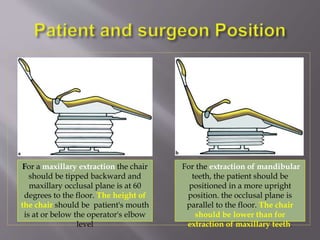
For the extraction of mandibular
teeth, the patient should be
positioned in a more upright
position. the occlusal plane is
parallel to the floor. The chair
should be lower than for
extraction of maxillary teeth.
For a maxillary extraction the chair
should be tipped backward and
maxillary occlusal plane is at 60
degrees to the floor. The height of
the chair should be patient's mouth
is at or below the operator's elbow
level
 For all maxillary teeth and anterior
mandibular teeth, the dentist is to the
front and right (and to the left, for
left-handed dentists) of the patient.
 For the posterior mandibular teeth
the dentist is positioned in front of or
behind and to the right (or to the left,
for left-handed dentists) of the patient
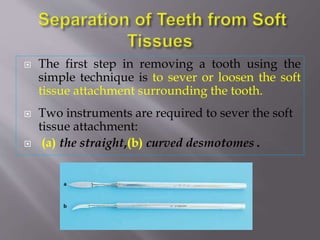
 The first step in removing a tooth using the
simple technique is to sever or loosen the soft
tissue attachment surrounding the tooth.
 Two instruments are required to sever the soft
tissue attachment:
 (a) the straight,(b) curved desmotomes .
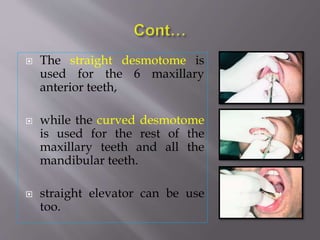
 The straight desmotome is
used for the 6 maxillary
anterior teeth,
 while the curved desmotome
is used for the rest of the
maxillary teeth and all the
mandibular teeth.
 straight elevator can be use
too.
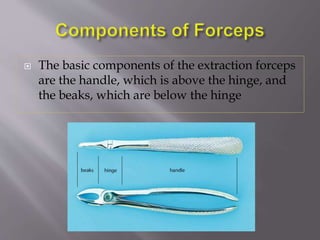
 The basic components of the extraction forceps
are the handle, which is above the hinge, and
the beaks, which are below the hinge
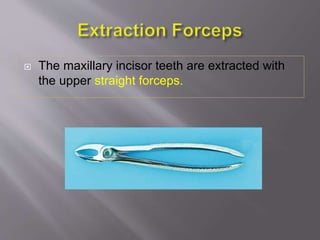
 The maxillary incisor teeth are extracted with
the upper straight forceps.
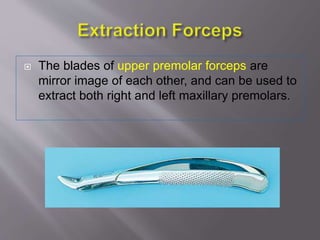
 The blades of upper premolar forceps are
mirror image of each other, and can be used to
extract both right and left maxillary premolars.
 The buccal beak of each forceps has a pointed
design, which fits into the buccal bifurcation of
the two buccal roots.
Maxillary left molar forceps Maxillary right molar forceps
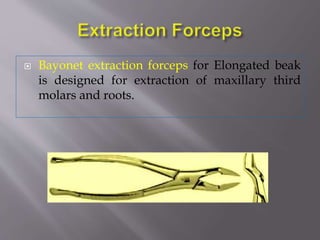
 Bayonet extraction forceps for Elongated beak
is designed for extraction of maxillary third
molars and roots.
 Lower root forceps with fine blades are used to
extract lower incisors,premolars, and roots.
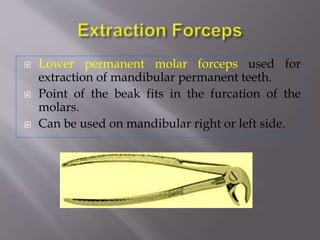
 Lower permanent molar forceps used for
extraction of mandibular permanent teeth.
 Point of the beak fits in the furcation of the
molars.
 Can be used on mandibular right or left side.
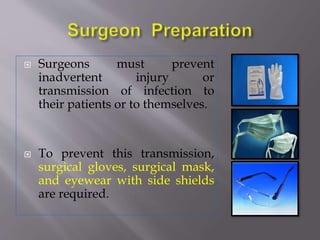
 Surgeons must prevent
inadvertent injury or
transmission of infection to
their patients or to themselves.
 To prevent this transmission,
surgical gloves, surgical mask,
and eyewear with side shields
are required.
 For patient:
1. A sterile disposable towel
drape should be put across
the patient's chest .
2. proper oral hygiene is very
important before extraction.
1. Satisfactory access and visualization of the
field of surgery.
2. An un-obstructed pathway for the removal
of the tooth.
3. The use of controlled force to luxate and
remove the tooth
1. Expansion of the bony socket.
2. The use of fulcrum or lever.
3. Insertion of wedge or wedges.
4. Wheel and axel.
 Expansion of the bony socket
by use of the wedge-shaped
beaks of the forceps .
 The forceps should be seated
with strong apical pressure
to expand crestal bones and
to displace center of rotation
as apically as possible .
 If center of rotation is not far
enough apicaliy, it is too far
occlusally, which results in
excess movement of tooth apex.
 Excess motion of root apex
caused by high center of rotation
results in fracture of root apex.
 Buccal or labial pressure applied
to tooth will expand the buccal
cortical plate toward the crestal
bone with some lingual expansion
at apical end of the root.
• Lingual or palatal pressure will
expand lingual cortical plate at
crestal area and slightly expand
buccal bone at apical area.
 The initial linguo-buccal movement for
extraction of lower second mandibular molar.
• Initial rotational forces It is
useful for removal of teeth
with conical roots; such as
maxillary central.
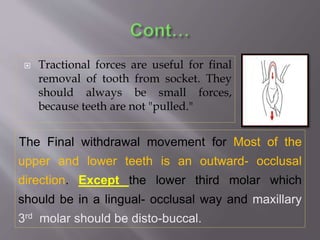
 Tractional forces are useful for final
removal of tooth from socket. They
should always be small forces,
because teeth are not "pulled."
The Final withdrawal movement for Most of the
upper and lower teeth is an outward- occlusal
direction. Except the lower third molar which
should be in a lingual- occlusal way and maxillary
3rd molar should be disto-buccal.
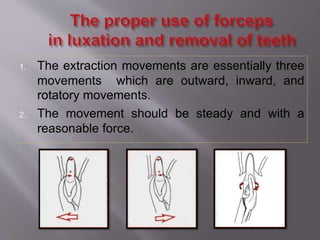
1. The extraction movements are essentially three
movements which are outward, inward, and
rotatory movements.
2. The movement should be steady and with a
reasonable force.
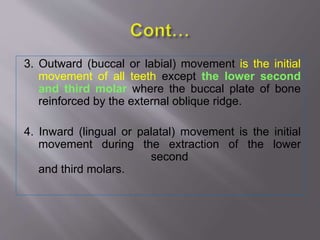
3. Outward (buccal or labial) movement is the initial
movement of all teeth except the lower second
and third molar where the buccal plate of bone
reinforced by the external oblique ridge.
4. Inward (lingual or palatal) movement is the initial
movement during the extraction of the lower
second
and third molars.
5. Primary Rotatory movement is the initial movement
used in upper central incisor and lower second
premolar.
6. If a resistance is felt in primary rotation, a bucco-
lingual movement should be started.
7. If rotatory movement continued, a spiral fractured
of the tooth root may occur.
7. The force should be held for several seconds to
allow the bone time to expand.
8. Once the alveolar bone has expanded
sufficiently and the tooth has been luxated, a
slight traction force, usually directed buccally,
can be used.
9. Final movement is the movement by which the
tooth is removed from its bony socket. It should
be always directed outward and occlusally to
avoid traumatizing the opposing tooth,
10. The extraction forceps
blade should be applied to
the carious side first, and
the first movement made
toward the caries.
 A lever is a mechanism for transmitting a
modest force with the mechanical advantages
of a long lever arm and a short resistance arm
into a small movement against great
resistance.
 When an elevator is used for
tooth extraction, an acquired
contact point can be made
on the root surface and a
liter can be applied by the
handle of the elevator to
elevate the tooth or a tooth
root from the socket.
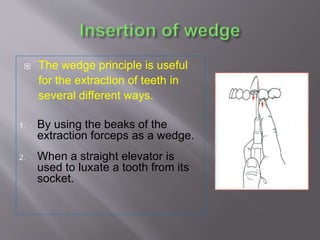
 The wedge principle is useful
for the extraction of teeth in
several different ways.
1. By using the beaks of the
extraction forceps as a wedge.
2. When a straight elevator is
used to luxate a tooth from its
socket.
 When one root of a multiple-rooted
tooth is let in the alveolar process,
the pennant-shaped elevator is
positioned in the socket and
turned
 The handle then serves as the
axle and the tip of the triangular
elevator acts as a wheel and
engages and elevates the tooth
root from the socket
Triangular
elevator
 The opposite hand plays an important role in
supporting and stabilizing the lower jaw when
mandibular teeth are being extracted.
 The opposite hand supports the alveolar process
and provides tactile information to the operator
concerning the expansion of the alveolar process
during the luxation period.
 Peterson, L. J. Contemporary Oral and Maxillofacial
Surgery, 4th ed. Amsterdam Elsevier Science. 2002. ch.7
 Sweedan, O. A. Textbook of Oral and Maxillofacial v, 1st ed.,
2009.
 Fragiskos D. Fragiskos Oral Surger. 2007
 Carmen Scheller BASIC GUIDE TO DENTAL
INSTRUMENTS
Simpleextraction

Simpleextraction

  • 1.
    By Kampa.mini alekya Group 4 Internationalschool of medicine Submitted To Dr.ilshat Yuldashev
  • 2.
    For the extractionof mandibular teeth, the patient should be positioned in a more upright position. the occlusal plane is parallel to the floor. The chair should be lower than for extraction of maxillary teeth. For a maxillary extraction the chair should be tipped backward and maxillary occlusal plane is at 60 degrees to the floor. The height of the chair should be patient's mouth is at or below the operator's elbow level
  • 3.
     For allmaxillary teeth and anterior mandibular teeth, the dentist is to the front and right (and to the left, for left-handed dentists) of the patient.  For the posterior mandibular teeth the dentist is positioned in front of or behind and to the right (or to the left, for left-handed dentists) of the patient
  • 4.
     The firststep in removing a tooth using the simple technique is to sever or loosen the soft tissue attachment surrounding the tooth.  Two instruments are required to sever the soft tissue attachment:  (a) the straight,(b) curved desmotomes .
  • 5.
     The straightdesmotome is used for the 6 maxillary anterior teeth,  while the curved desmotome is used for the rest of the maxillary teeth and all the mandibular teeth.  straight elevator can be use too.
  • 6.
     The basiccomponents of the extraction forceps are the handle, which is above the hinge, and the beaks, which are below the hinge
  • 7.
     The maxillaryincisor teeth are extracted with the upper straight forceps.
  • 8.
     The bladesof upper premolar forceps are mirror image of each other, and can be used to extract both right and left maxillary premolars.
  • 9.
     The buccalbeak of each forceps has a pointed design, which fits into the buccal bifurcation of the two buccal roots. Maxillary left molar forceps Maxillary right molar forceps
  • 10.
     Bayonet extractionforceps for Elongated beak is designed for extraction of maxillary third molars and roots.
  • 11.
     Lower rootforceps with fine blades are used to extract lower incisors,premolars, and roots.
  • 12.
     Lower permanentmolar forceps used for extraction of mandibular permanent teeth.  Point of the beak fits in the furcation of the molars.  Can be used on mandibular right or left side.
  • 13.
     Surgeons mustprevent inadvertent injury or transmission of infection to their patients or to themselves.  To prevent this transmission, surgical gloves, surgical mask, and eyewear with side shields are required.
  • 14.
     For patient: 1.A sterile disposable towel drape should be put across the patient's chest . 2. proper oral hygiene is very important before extraction.
  • 15.
    1. Satisfactory accessand visualization of the field of surgery. 2. An un-obstructed pathway for the removal of the tooth. 3. The use of controlled force to luxate and remove the tooth
  • 16.
    1. Expansion ofthe bony socket. 2. The use of fulcrum or lever. 3. Insertion of wedge or wedges. 4. Wheel and axel.
  • 17.
     Expansion ofthe bony socket by use of the wedge-shaped beaks of the forceps .  The forceps should be seated with strong apical pressure to expand crestal bones and to displace center of rotation as apically as possible .
  • 18.
     If centerof rotation is not far enough apicaliy, it is too far occlusally, which results in excess movement of tooth apex.  Excess motion of root apex caused by high center of rotation results in fracture of root apex.
  • 19.
     Buccal orlabial pressure applied to tooth will expand the buccal cortical plate toward the crestal bone with some lingual expansion at apical end of the root. • Lingual or palatal pressure will expand lingual cortical plate at crestal area and slightly expand buccal bone at apical area.
  • 20.
     The initiallinguo-buccal movement for extraction of lower second mandibular molar. • Initial rotational forces It is useful for removal of teeth with conical roots; such as maxillary central.
  • 21.
     Tractional forcesare useful for final removal of tooth from socket. They should always be small forces, because teeth are not "pulled." The Final withdrawal movement for Most of the upper and lower teeth is an outward- occlusal direction. Except the lower third molar which should be in a lingual- occlusal way and maxillary 3rd molar should be disto-buccal.
  • 22.
    1. The extractionmovements are essentially three movements which are outward, inward, and rotatory movements. 2. The movement should be steady and with a reasonable force.
  • 23.
    3. Outward (buccalor labial) movement is the initial movement of all teeth except the lower second and third molar where the buccal plate of bone reinforced by the external oblique ridge. 4. Inward (lingual or palatal) movement is the initial movement during the extraction of the lower second and third molars.
  • 24.
    5. Primary Rotatorymovement is the initial movement used in upper central incisor and lower second premolar. 6. If a resistance is felt in primary rotation, a bucco- lingual movement should be started. 7. If rotatory movement continued, a spiral fractured of the tooth root may occur.
  • 25.
    7. The forceshould be held for several seconds to allow the bone time to expand. 8. Once the alveolar bone has expanded sufficiently and the tooth has been luxated, a slight traction force, usually directed buccally, can be used. 9. Final movement is the movement by which the tooth is removed from its bony socket. It should be always directed outward and occlusally to avoid traumatizing the opposing tooth,
  • 26.
    10. The extractionforceps blade should be applied to the carious side first, and the first movement made toward the caries.
  • 27.
     A leveris a mechanism for transmitting a modest force with the mechanical advantages of a long lever arm and a short resistance arm into a small movement against great resistance.
  • 28.
     When anelevator is used for tooth extraction, an acquired contact point can be made on the root surface and a liter can be applied by the handle of the elevator to elevate the tooth or a tooth root from the socket.
  • 29.
     The wedgeprinciple is useful for the extraction of teeth in several different ways. 1. By using the beaks of the extraction forceps as a wedge. 2. When a straight elevator is used to luxate a tooth from its socket.
  • 30.
     When oneroot of a multiple-rooted tooth is let in the alveolar process, the pennant-shaped elevator is positioned in the socket and turned  The handle then serves as the axle and the tip of the triangular elevator acts as a wheel and engages and elevates the tooth root from the socket Triangular elevator
  • 31.
     The oppositehand plays an important role in supporting and stabilizing the lower jaw when mandibular teeth are being extracted.  The opposite hand supports the alveolar process and provides tactile information to the operator concerning the expansion of the alveolar process during the luxation period.
  • 33.
     Peterson, L.J. Contemporary Oral and Maxillofacial Surgery, 4th ed. Amsterdam Elsevier Science. 2002. ch.7  Sweedan, O. A. Textbook of Oral and Maxillofacial v, 1st ed., 2009.  Fragiskos D. Fragiskos Oral Surger. 2007  Carmen Scheller BASIC GUIDE TO DENTAL INSTRUMENTS