Dr. Firas Kassab
• Maxilla is 35 times more edentulous than
mandible
• Maxillary sinus continues pneumatization
throughout life.
• The available bone is lost from the inferior
expansion of the sinus after tooth loss,
involving the residual ridge region
• The bone density in this region is also
decreases rapidly an on average is the least
dense of any oral region
Dr. Firas Kassab
Blood supply is mainly derived from nose
• Sphenopalatine artery
• Anterior & posterior nasal artery
• Infraorbital artery
• Posterior & middle superior alveolar artery
• Facial artery
• Palatine artery
Dr. Firas Kassab
Venous drainage
• Anterior facial vein
• Pterygoid veinous plexus
Lymphatic drainage
• Submandibular lymphnode
Nerve supply
• Maxillary division of trigeminal nerve (V2)
Dr. Firas Kassab
• Pyramidal shape
• Roof : floor of orbit
• Floor : alveolar bone and
palatine process
• Anterior wall : facial surface
of maxilla
• Posterior wall : infratemporal
surface
• Medial wall : lateral wall of
nasal cavity
Dr. Firas Kassab
• Schneiderian membrane
• Mucoperiosteum cansists 3 layers
• 1.Epithelium lining : pseudostratified columnar ciliated
epithelium
• 2.Lamina propria can stripped easily from
• 3.periosteum underlying bone
• There are numerous goblet cell
• Most of the serous and mucous glands found in
the lining are located near the maxillary ostium
Dr. Firas Kassab
Dr. Firas Kassab
• The maxillary ostium opening
in the medial wall
and near the superior
aspect of the sinus
• The cilia beat toward the
ostium at 15 cycles/minute
• Adequate manipulation of
the membrane and placement
of graft material are
possible without impeding
the drainage of the sinus
Dr. Firas Kassab
Dr. Firas Kassab
• The SA-2 to SA-4 surgical procedures the
sinus should be free of infection
• In addition, a thorough history and clinical
evaluation of the maxillary sinus are
conducted.
• Potential infection in the region of the sinuses
may result in extremely severe complication
Dr. Firas Kassab
• Physical examination
• Radiography
• Conventional :OPG, water’s view
• CT
• MRI
• CT is currently the modality of choice
• Any sign of acute sinusitis, root tips, cysts or
tumors complicate the procedure and mandate
further evaluation
• Known diseases of the antrum should be
treated before sinus grafts
Dr. Firas Kassab
Dr. Firas Kassab
• Patient sedation, local anesthesia, and
preparation of an aseptic environment
• Antiseptic mouth rinse : Chlorhexidine scrub
and rinse may be used
• Iodophor compounds ( Betadine ) are a most
effective antiseptic, but inhibit the
osteoinduction of demineralized bone
Dr. Firas Kassab
Regional anesthesia
• Blocking maxillary nerve (v2 ) : 1.8 ml
• Hemimaxilla, side of nose, cheek, lip, sinus area
• Long-acting anesthetic : Bupivacaine 0.5 % or
Etidocaine 1.5 % with EPI 1:200,000
Local infiltration
• Labial mucosa and palatal region
• Complete hemostasis
• Lidocaine 2 % with EPI 1:100,000
Dr. Firas Kassab
• 1. dense compact (D-1) bone
• 2. dense to thick porous compact and coarse trabecular
(D-2) bone
• 3. porous compact and fine trabecular (D-3) bone
• 4. fine trabecular (D-4) bone
Dr. Firas Kassab
Dr. Firas Kassab
• Height > 12 mm.
• An improved compressive thread design
implant (4 mm. diameter) implants may
accommodate
• 11 mm. of bone height in D2,
• 12 mm. in D3,
• 13 mm. in D4
• In division A, root form implants are placed
for prosthetic support
• Division B bone, osteoplasty or augmentation
to increase the width to Division A
Dr. Firas Kassab
• Then reevaluated to determine the proper treatment
plan classification
• Endosteal implantation in the SA-1 category are left
to heal in a nonfunctional environment for
approximately 4 to 8 months before the abutment
posts are added for prosthodontic reconstruction
Dr. Firas Kassab
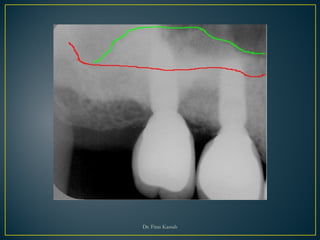
• Height 10 – 12 mm.
• When the available bone is 10 to 12 mm.
Insufficient in length for ideal implant length
Incision and Reflection
• A full thickness incision is made on the crest of
the ridge from the tuberosity to the distal of the
canine region and vertical incision 5 mm.
Dr. Firas Kassab
Osteotomy and Sinus lift ( SA-2 )
• The depth of the osteotomy is approximately
1 to 2 mm. short of the floor of the antrum
• Reduced speed of the hand piece ( slower
than 1000 rpm ) enhances the tactile sense
and feel the cortical plate of the antral floor
Dr. Firas Kassab
• The osteotome is inserted and tapped firmly
into final position up to 2 mm.
• The apical portion of the implant engages the
cortical floor, with bone over the apex, and an
intact sinus membrane
Dr. Firas Kassab
Dr. Firas Kassab
• The patient’s prosthodontic treatment is
similar to that in the SA-1 category
• The implant body should not have an apical
hole, which also may fill with mucous and be a
source of further sinus infections
Dr. Firas Kassab
• Height 5 – 10 mm.
Incision line and reflection
• Awareness of the greater palatal artery, in
the severe atrophic maxilla
• A relief incision enhance access and vision
• Aggressive reflection of the flap may cause
damage to infraorbital nerve
Dr. Firas Kassab
Access window
• #6 round diamond bur
• Copious sterile saline
• The outline is scored on the
bone with a rotary
instrument
Dr. Firas Kassab
• The corners of the access window are
usually round
• paintbrush stroke approach until a bluish
hue or hemorrhage from the site is
observed
• A flat-ended metal punch or mirror handle
and mallet are used to gently separate the
lateral window from the surrounding bone,
while still attached to the thin sinus
membrane
Dr. Firas Kassab
• A soft tissue curette is introduced along the
margin of the window
• The curette is never blindly placed into the
access window
• The periosteal elevators and curettes further
reflect the membrane off, to a height of at
least 16 mm from the crest of the ridge
Dr. Firas Kassab
Dr. Firas Kassab
Dr. Firas Kassab
Dr. Firas Kassab
Several graft materials have been studied
• Autogenous bone : any debris from implant
osteotomies, the tuberosity region, exostoses,
cores from the symphysis or ramus region
• Demineralized freeze-dried bone (DFDB)
• Beta tricalcium phosphate
• Xenograft hydroxyapatite
• Combinations
Dr. Firas Kassab
• 1. dense HA + antibiotic
• 2. cacium phosphate (usually
xenograft microporous HA such
as Osteograft N-300 or Bio-
Oss) + DFDB + PRP from whole blood
+ antibiotic
• 3. autogenous bone
Dr. Firas Kassab
• Graft materials not mixed with blood or anesthetic
solution
• The toxic byproducts of blood catabolism and the
acidic pH of anesthetic both may decrease bone
formation
• A resorbable membrane may be placed over the
lateral access window
Dr. Firas Kassab
• The 5 to 8 mm of initial bone height may
stabilize the implant and permit its rigid
fixation
• An endosteal implant may be inserted at this
appointment
Dr. Firas Kassab
• Several advantages tend toward the decision
to delay implant placement for approximately
4 months
• Disadvantage of delaying the implant
placement is the need for an additional
surgery
• The implant may be inserted after 2 months
yet reducing considerably the risk of infection
Dr. Firas Kassab
• Primary closure using interrupted horizontal
mattress or a continuous suture
• Sinus incision line opening may contribute to
infection, contamination, or loss of graft
materials
Dr. Firas Kassab
Healing for implants placed into sinus grafts
The main variables appear to be the time
healing
• The volume of the subantral graft
• The distance from the lateral to medial wall
• The amount of autologous bone
• The health status of the patient : Diabetics,
postmenopausal women
All of which relate to the amount of new bone
formation
Dr. Firas Kassab
• Autogenous bone (4-6 months)
• Autogenous bone + porous HA + DFDB (6-10
months)
• Alloplasts only as tricalcium phosphate (24
months)
Dr. Firas Kassab
• Height < 5 mm
• There for the fewer bony walls, less favorable
vascular bed, minimal local autologous bone,
and larger graft volume
• Sinus graft is performed as in the previous
SA-3 procedure
Dr. Firas Kassab
• Additional bone harvest site is usually
required : ascending ramus of mandible
• The implant does offer an advantage if coated
with HA
• The time interval for rigid osseous fixation is
dependent on the density of bone
Dr. Firas Kassab
• Do not
• blow your nose
• Tobacco use
• Drinking with straw
• lift or pull on lip to look at sutures
• Sneezing with closed mouth
• Take your medication as directed
• Aware of small granules in your mouth
Dr. Firas Kassab
Notify the office if :
• You feel granules in your nose
• Your medications do not relieve your discomfort
Dr. Firas Kassab
Window
• Bleeding – bone wax, electrocautery
• Septum – make two windows seperated by septum
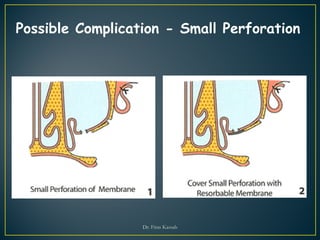
• Perforation – repair after membrane elevation
Dr. Firas Kassab
Membrane
• Perforation – repair
Small – collagen membrane (Collatape)
Large – slow resorbable membrane (Biomend)
• Thick
Polyp – curette out
Mucocele – drain
• Delay sinus graft
Dr. Firas Kassab
Dr. Firas Kassab
Possible Complication - Small Perforation
Dr. Firas Kassab
Possible Complication - Large Perforation
Dr. Firas Kassab
• Incision line opening – assess need to restore
• Bleeding (from nose) – do not blow nose, do
not lower head
• Graft – escape through perforation, assess
amount swelling/infection
• Antibiotic – oral, IV
• Drain, remove graft
• Assess progression – culture and sensitivity test
anaerobes/aerobes
• Reassess antibiotic choice
• Refer
Dr. Firas Kassab
• Amoxicillin 2 g stat, 500 mg qid
+ Metronidazole 500 mg stat, 250 mg tid
or
Clindamycin 300 mg stat, 150 mg qid
Dr. Firas Kassab

Maxilary sinus augmentation

  • 1.
  • 2.
    • Maxilla is35 times more edentulous than mandible • Maxillary sinus continues pneumatization throughout life. • The available bone is lost from the inferior expansion of the sinus after tooth loss, involving the residual ridge region • The bone density in this region is also decreases rapidly an on average is the least dense of any oral region Dr. Firas Kassab
  • 3.
    Blood supply ismainly derived from nose • Sphenopalatine artery • Anterior & posterior nasal artery • Infraorbital artery • Posterior & middle superior alveolar artery • Facial artery • Palatine artery Dr. Firas Kassab
  • 4.
    Venous drainage • Anteriorfacial vein • Pterygoid veinous plexus Lymphatic drainage • Submandibular lymphnode Nerve supply • Maxillary division of trigeminal nerve (V2) Dr. Firas Kassab
  • 5.
    • Pyramidal shape •Roof : floor of orbit • Floor : alveolar bone and palatine process • Anterior wall : facial surface of maxilla • Posterior wall : infratemporal surface • Medial wall : lateral wall of nasal cavity Dr. Firas Kassab
  • 6.
    • Schneiderian membrane •Mucoperiosteum cansists 3 layers • 1.Epithelium lining : pseudostratified columnar ciliated epithelium • 2.Lamina propria can stripped easily from • 3.periosteum underlying bone • There are numerous goblet cell • Most of the serous and mucous glands found in the lining are located near the maxillary ostium Dr. Firas Kassab
  • 7.
  • 8.
    • The maxillaryostium opening in the medial wall and near the superior aspect of the sinus • The cilia beat toward the ostium at 15 cycles/minute • Adequate manipulation of the membrane and placement of graft material are possible without impeding the drainage of the sinus Dr. Firas Kassab
  • 9.
  • 10.
    • The SA-2to SA-4 surgical procedures the sinus should be free of infection • In addition, a thorough history and clinical evaluation of the maxillary sinus are conducted. • Potential infection in the region of the sinuses may result in extremely severe complication Dr. Firas Kassab
  • 11.
    • Physical examination •Radiography • Conventional :OPG, water’s view • CT • MRI • CT is currently the modality of choice • Any sign of acute sinusitis, root tips, cysts or tumors complicate the procedure and mandate further evaluation • Known diseases of the antrum should be treated before sinus grafts Dr. Firas Kassab
  • 12.
  • 13.
    • Patient sedation,local anesthesia, and preparation of an aseptic environment • Antiseptic mouth rinse : Chlorhexidine scrub and rinse may be used • Iodophor compounds ( Betadine ) are a most effective antiseptic, but inhibit the osteoinduction of demineralized bone Dr. Firas Kassab
  • 14.
    Regional anesthesia • Blockingmaxillary nerve (v2 ) : 1.8 ml • Hemimaxilla, side of nose, cheek, lip, sinus area • Long-acting anesthetic : Bupivacaine 0.5 % or Etidocaine 1.5 % with EPI 1:200,000 Local infiltration • Labial mucosa and palatal region • Complete hemostasis • Lidocaine 2 % with EPI 1:100,000 Dr. Firas Kassab
  • 15.
    • 1. densecompact (D-1) bone • 2. dense to thick porous compact and coarse trabecular (D-2) bone • 3. porous compact and fine trabecular (D-3) bone • 4. fine trabecular (D-4) bone Dr. Firas Kassab
  • 16.
  • 17.
    • Height >12 mm. • An improved compressive thread design implant (4 mm. diameter) implants may accommodate • 11 mm. of bone height in D2, • 12 mm. in D3, • 13 mm. in D4 • In division A, root form implants are placed for prosthetic support • Division B bone, osteoplasty or augmentation to increase the width to Division A Dr. Firas Kassab
  • 18.
    • Then reevaluatedto determine the proper treatment plan classification • Endosteal implantation in the SA-1 category are left to heal in a nonfunctional environment for approximately 4 to 8 months before the abutment posts are added for prosthodontic reconstruction Dr. Firas Kassab
  • 19.
    • Height 10– 12 mm. • When the available bone is 10 to 12 mm. Insufficient in length for ideal implant length Incision and Reflection • A full thickness incision is made on the crest of the ridge from the tuberosity to the distal of the canine region and vertical incision 5 mm. Dr. Firas Kassab
  • 20.
    Osteotomy and Sinuslift ( SA-2 ) • The depth of the osteotomy is approximately 1 to 2 mm. short of the floor of the antrum • Reduced speed of the hand piece ( slower than 1000 rpm ) enhances the tactile sense and feel the cortical plate of the antral floor Dr. Firas Kassab
  • 21.
    • The osteotomeis inserted and tapped firmly into final position up to 2 mm. • The apical portion of the implant engages the cortical floor, with bone over the apex, and an intact sinus membrane Dr. Firas Kassab
  • 22.
  • 23.
    • The patient’sprosthodontic treatment is similar to that in the SA-1 category • The implant body should not have an apical hole, which also may fill with mucous and be a source of further sinus infections Dr. Firas Kassab
  • 24.
    • Height 5– 10 mm. Incision line and reflection • Awareness of the greater palatal artery, in the severe atrophic maxilla • A relief incision enhance access and vision • Aggressive reflection of the flap may cause damage to infraorbital nerve Dr. Firas Kassab
  • 25.
    Access window • #6round diamond bur • Copious sterile saline • The outline is scored on the bone with a rotary instrument Dr. Firas Kassab
  • 26.
    • The cornersof the access window are usually round • paintbrush stroke approach until a bluish hue or hemorrhage from the site is observed • A flat-ended metal punch or mirror handle and mallet are used to gently separate the lateral window from the surrounding bone, while still attached to the thin sinus membrane Dr. Firas Kassab
  • 27.
    • A softtissue curette is introduced along the margin of the window • The curette is never blindly placed into the access window • The periosteal elevators and curettes further reflect the membrane off, to a height of at least 16 mm from the crest of the ridge Dr. Firas Kassab
  • 28.
  • 29.
  • 30.
  • 31.
    Several graft materialshave been studied • Autogenous bone : any debris from implant osteotomies, the tuberosity region, exostoses, cores from the symphysis or ramus region • Demineralized freeze-dried bone (DFDB) • Beta tricalcium phosphate • Xenograft hydroxyapatite • Combinations Dr. Firas Kassab
  • 32.
    • 1. denseHA + antibiotic • 2. cacium phosphate (usually xenograft microporous HA such as Osteograft N-300 or Bio- Oss) + DFDB + PRP from whole blood + antibiotic • 3. autogenous bone Dr. Firas Kassab
  • 33.
    • Graft materialsnot mixed with blood or anesthetic solution • The toxic byproducts of blood catabolism and the acidic pH of anesthetic both may decrease bone formation • A resorbable membrane may be placed over the lateral access window Dr. Firas Kassab
  • 34.
    • The 5to 8 mm of initial bone height may stabilize the implant and permit its rigid fixation • An endosteal implant may be inserted at this appointment Dr. Firas Kassab
  • 35.
    • Several advantagestend toward the decision to delay implant placement for approximately 4 months • Disadvantage of delaying the implant placement is the need for an additional surgery • The implant may be inserted after 2 months yet reducing considerably the risk of infection Dr. Firas Kassab
  • 36.
    • Primary closureusing interrupted horizontal mattress or a continuous suture • Sinus incision line opening may contribute to infection, contamination, or loss of graft materials Dr. Firas Kassab
  • 37.
    Healing for implantsplaced into sinus grafts The main variables appear to be the time healing • The volume of the subantral graft • The distance from the lateral to medial wall • The amount of autologous bone • The health status of the patient : Diabetics, postmenopausal women All of which relate to the amount of new bone formation Dr. Firas Kassab
  • 38.
    • Autogenous bone(4-6 months) • Autogenous bone + porous HA + DFDB (6-10 months) • Alloplasts only as tricalcium phosphate (24 months) Dr. Firas Kassab
  • 39.
    • Height <5 mm • There for the fewer bony walls, less favorable vascular bed, minimal local autologous bone, and larger graft volume • Sinus graft is performed as in the previous SA-3 procedure Dr. Firas Kassab
  • 40.
    • Additional boneharvest site is usually required : ascending ramus of mandible • The implant does offer an advantage if coated with HA • The time interval for rigid osseous fixation is dependent on the density of bone Dr. Firas Kassab
  • 41.
    • Do not •blow your nose • Tobacco use • Drinking with straw • lift or pull on lip to look at sutures • Sneezing with closed mouth • Take your medication as directed • Aware of small granules in your mouth Dr. Firas Kassab
  • 42.
    Notify the officeif : • You feel granules in your nose • Your medications do not relieve your discomfort Dr. Firas Kassab
  • 43.
    Window • Bleeding –bone wax, electrocautery • Septum – make two windows seperated by septum • Perforation – repair after membrane elevation Dr. Firas Kassab
  • 44.
    Membrane • Perforation –repair Small – collagen membrane (Collatape) Large – slow resorbable membrane (Biomend) • Thick Polyp – curette out Mucocele – drain • Delay sinus graft Dr. Firas Kassab
  • 45.
    Dr. Firas Kassab PossibleComplication - Small Perforation
  • 46.
    Dr. Firas Kassab PossibleComplication - Large Perforation
  • 47.
  • 48.
    • Incision lineopening – assess need to restore • Bleeding (from nose) – do not blow nose, do not lower head • Graft – escape through perforation, assess amount swelling/infection • Antibiotic – oral, IV • Drain, remove graft • Assess progression – culture and sensitivity test anaerobes/aerobes • Reassess antibiotic choice • Refer Dr. Firas Kassab
  • 49.
    • Amoxicillin 2g stat, 500 mg qid + Metronidazole 500 mg stat, 250 mg tid or Clindamycin 300 mg stat, 150 mg qid Dr. Firas Kassab