Dr. Firas Kassab
What is graft ?
What is grafting?
What are bone grafts ?
History of bone grafting
Objectives and rationale of bone grafting
Biological concept of using bone grafts
techniques
Dr. Firas Kassab 2
• A viable tissue that after removal from a donor site is implanted
with in a reciepient tissue is then restored repaired and
regenerated.
what is grafting ?
• Grafting is a procedure used to replace/ restore missing tissue.
Dr. Firas Kassab 3
what are bone grafts ?
• bone grafts are the materials used for replacement or
augmentation of bone.
Dr. Firas Kassab 4
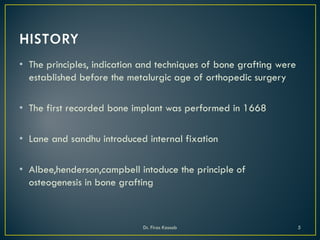
• The principles, indication and techniques of bone grafting were
established before the metalurgic age of orthopedic surgery
• The first recorded bone implant was performed in 1668
• Lane and sandhu introduced internal fixation
• Albee,henderson,campbell intoduce the principle of
osteogenesis in bone grafting
Dr. Firas Kassab 5
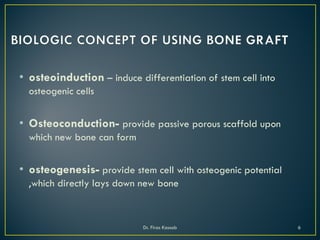
• osteoinduction – induce differentiation of stem cell into
osteogenic cells
• Osteoconduction- provide passive porous scaffold upon
which new bone can form
• osteogenesis- provide stem cell with osteogenic potential
,which directly lays down new bone
Dr. Firas Kassab 6
• Increase in clinical bone defect fill.
• To preserve and augment bone for future bone grafting when
required.
Dr. Firas Kassab 7
Fill cavities or defects resulting from cysts or tumors
Bridge joint and provide arthrodesis
Bridge major defects or establish continuity of long bone
Dr. Firas Kassab 8
Provide bone block to limit joint motion(arthroereisis)
Establish union in a pseudarthrosis
Promote union or fill defects in delayed union , malunion , fresh
fracture or osteotomies
Dr. Firas Kassab 9
• Bone is transferred from one site to other in the same individual
• Ideal as bone graft posses all characteristic necessary for new
bone growth i.e
osteoconductivity, osteoinductivity
osteogenicity
• includes-
cortical bone grafts
cancellous
vascularised bone grafts
autologus bone marrow grafts
Dr. Firas Kassab 10
• ADVANTAGE
no immune reaction
all three properties present
Dr. Firas Kassab 11
• DISADVANTAGE
• additional surgery
• donor site morbidity
-inflamation ,infection, chronic
pain and cosmetic
• limited quantities of bone graft
Dr. Firas Kassab 12
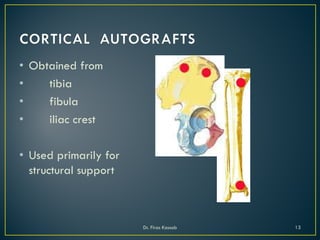
• Obtained from
• tibia
• fibula
• iliac crest
• Used primarily for
structural support
Dr. Firas Kassab 13
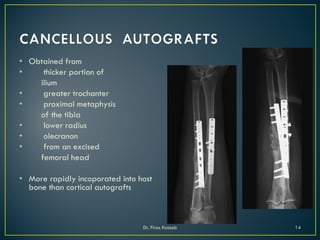
• Obtained from
• thicker portion of
ilium
• greater trochanter
• proximal metaphysis
of the tibia
• lower radius
• olecranon
• from an excised
femoral head
• More rapidly incoporated into host
bone than cortical autografts
Dr. Firas Kassab 14
Uses of cancellous bone graft
- excellent choice for non unions with
<5 to 6 cm of bone loss and that do
not required structural integrity
- used to fill bone cyst or bone voids
after reduction of depressed articular
surface such as in tibial plateu fracture
Stable internal or external fixation is required for graft
consolidation and fracture healing
Dr. Firas Kassab 15
PRIMARY PHASE
- haemorrhage
- inflamation
- accumulation of haematopoietis cells
including neutrophills, macrophages, and
osteoclasts
- removal of necrotic tissue
Dr. Firas Kassab 16
- osteoconductive factors released from graft
during resorption and cytokines released
during inflamation
- recruitment and stimulation of
mesenchymal stem cells to osteogenic cells
- active bone formation
Dr. Firas Kassab 17
- Osteoblasts lines dead trabecule lay down
osteoid
- haemopoitic marrow cells forms new bone
in transplanted bone
- remodeling i.e woven bone slowly being
transformed into lameler bone by
cordinated activities of osteoblasts and
osteoclasts
- incorporation of graft
Dr. Firas Kassab 18
- In cortical bone graft first osteoclastic resorption than
osteoblastic activity
- In cancellous bone graft bone formation and resorption occurs
simultaneously called
creeping substitution
-Therefore cancellous bone graft incorporate quickly
-But doesnot provide immediate structural support
Dr. Firas Kassab 19
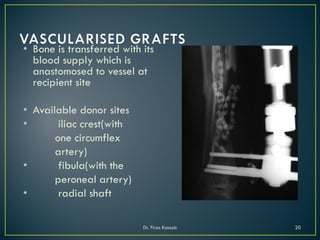
• Bone is transferred with its
blood supply which is
anastomosed to vessel at
recipient site
• Available donor sites
• iliac crest(with
one circumflex
artery)
• fibula(with the
peroneal artery)
• radial shaft
Dr. Firas Kassab 20
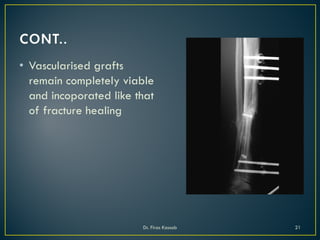
• Vascularised grafts
remain completely viable
and incoporated like that
of fracture healing
Dr. Firas Kassab 21
Graft is obtained from an individual other than the patient
• used in small children where sufficient
graft is not available from donor site
 in adults where large defects have to be
filled like-
 periprosthetic long bone fracture
 revision total joint surgery
 reconstruction after tumor excision
Dr. Firas Kassab 22
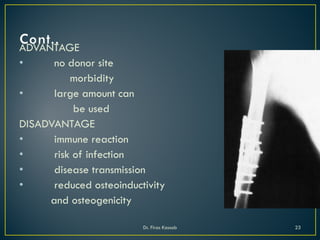
ADVANTAGE
• no donor site
morbidity
• large amount can
be used
DISADVANTAGE
• immune reaction
• risk of infection
• disease transmission
• reduced osteoinductivity
and osteogenicity
Dr. Firas Kassab 23
• Graft must be harvested under sterile condition and doner must
be cleared for malignancy , syphilis, cmv and hiv
• Antigenicity can be reduced by freezing (at 70 deg c) , freeze
drying or by ionizing radiation
• Demineralization also reduces antigenicity and enhances
osteoconductive property
Dr. Firas Kassab 24
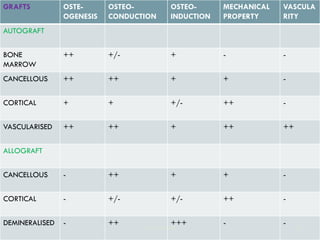
GRAFTS OSTE-
OGENESIS
OSTEO-
CONDUCTION
OSTEO-
INDUCTION
MECHANICAL
PROPERTY
VASCULA
RITY
AUTOGRAFT
BONE
MARROW
++ +/- + - -
CANCELLOUS ++ ++ + + -
CORTICAL + + +/- ++ -
VASCULARISED ++ ++ + ++ ++
ALLOGRAFT
CANCELLOUS - ++ + + -
CORTICAL - +/- +/- ++ -
DEMINERALISED - ++ +++ - -Dr. Firas Kassab 25
• Donor must be screened for
bacterial ,viral(HIV,hepatitis) and fungal infection ,
malignancy ,
collagen vascular disease ,
metabolic bone disease ,
and presence of toxins.
Dr. Firas Kassab 26
• bone is harvested in a clean , nonsterile environment
•
• sterilized by irradiation , strong acid or ethylene oxide
• Freeze dried for storage
Dr. Firas Kassab 27
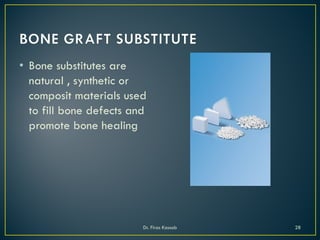
• Bone substitutes are
natural , synthetic or
composit materials used
to fill bone defects and
promote bone healing
Dr. Firas Kassab 28
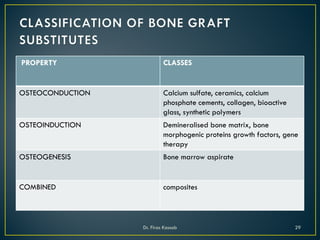
PROPERTY CLASSES
OSTEOCONDUCTION Calcium sulfate, ceramics, calcium
phosphate cements, collagen, bioactive
glass, synthetic polymers
OSTEOINDUCTION Demineralised bone matrix, bone
morphogenic proteins growth factors, gene
therapy
OSTEOGENESIS Bone marrow aspirate
COMBINED composites
Dr. Firas Kassab 29
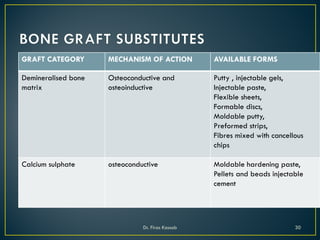
GRAFT CATEGORY MECHANISM OF ACTION AVAILABLE FORMS
Demineralised bone
matrix
Osteoconductive and
osteoinductive
Putty , injectable gels,
Injectable paste,
Flexible sheets,
Formable discs,
Moldable putty,
Preformed strips,
Fibres mixed with cancellous
chips
Calcium sulphate osteoconductive Moldable hardening paste,
Pellets and beads injectable
cement
Dr. Firas Kassab 30
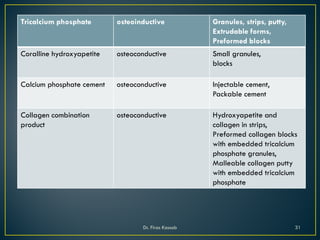
Tricalcium phosphate osteoinductive Granules, strips, putty,
Extrudable forms,
Preformed blocks
Coralline hydroxyapetite osteoconductive Small granules,
blocks
Calcium phosphate cement osteoconductive Injectable cement,
Packable cement
Collagen combination
product
osteoconductive Hydroxyapetite and
collagen in strips,
Preformed collagen blocks
with embedded tricalcium
phosphate granules,
Malleable collagen putty
with embedded tricalcium
phosphate
Dr. Firas Kassab 31
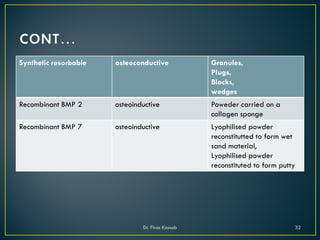
Synthetic resorbable osteoconductive Granules,
Plugs,
Blocks,
wedges
Recombinant BMP 2 osteoinductive Poweder carried on a
collagen sponge
Recombinant BMP 7 osteoinductive Lyophilised powder
reconstitutted to form wet
sand material,
Lyophilised powder
reconstituted to form putty
Dr. Firas Kassab 32
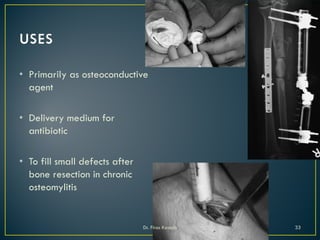
• Primarily as osteoconductive
agent
• Delivery medium for
antibiotic
• To fill small defects after
bone resection in chronic
osteomylitis
Dr. Firas Kassab 33
• Contains stem cells and osteoprogenitor cells , which are able to
transform into osteoblasts
• Multiple small volume aspirate is obtained from iliac crest(four
1ml aspirates from separate site puncture)
• Centrifugation of aspirate in order to concentrate the cellular
contents has provided encouraging results in animal experiment
Dr. Firas Kassab 34
• BMPs are osteoconductive
• BMP-2 and BMP-7 are manufactured using recombinant
technique
• Used in treatment of non-union and open tibial fracture
• Used with a carrier which may be allograft, DMB, collagen or
bioactive bone cement
Dr. Firas Kassab 35
ONLAY CORTICAL GRAFT
• graft is placed subperiosteally across the fragments without
mobilizing the fragments .
• Cortical graft was suplemented with cancellous bone for
osteogenesis.
• Advantages-
- simple to do
- blood suply of the fragments and the
normal impacting forces of fracture is not
disturbed
Dr. Firas Kassab 36
• Uses-
- malunited , nonunited fracture of shaft of
long bone
- bridging joints to produce arthrodesis
• Fixation is achived by internal or external metalic device
Dr. Firas Kassab 37
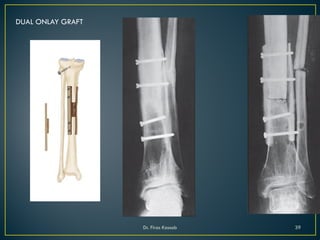
DUAL ONLAY GRAFT
• Two cortical onlay grafts are placed opposite each other on the
host bone across the nonunion and are fixed with the same set
of screws
• They grip the fragments like a vise
• Uses-
to fix nonunited short osteoporotic
fracture near a joint
Dr. Firas Kassab 38
DUAL ONLAY GRAFT
Dr. Firas Kassab 39
ADVANTAGE
• Mechanichal fixation is better than fixation by a single onlay
bone graft
• two grafts add strength and stability
• Grafts form a trough into which cancellous bone may be
packed
• during healing the dual graft prevent contracting fibrous
tissue from compromising transplanted cancellous bone
Dr. Firas Kassab 40
DISADVANTAGE
-same as single cortical grafts
• not as strong as metalic fixator devices
• Extremity usualy must serve as a donor site if autogenous graft
are used
• Not as osteogenic as autogenous iliac grafts
• The surgery necessary to obtain them has more risk
Dr. Firas Kassab 41
• A slot or rectangular defect is created in the cortex of host
bone then a graft of the same size or slighty smaller is fitted in
to the defect
• Ocaisonaly used in arthrodesis, particularly at the ankle
Dr. Firas Kassab 42
• Usefull for-
filling defects or cavities resulting from cysts, tumor
for establishing bone blocks
and for wedging in osteotomies
• Cancellous grafts are usefull for arthrodesis of spine because
osteogenesis is prime concern
Dr. Firas Kassab 43
• Harvested from
- anterior iliac crest using an acetabula
reamer,
- femoral canal using a reamer-irrigator-
aspirator(large volume cancellous bone
graft can be harvested)
Dr. Firas Kassab 44
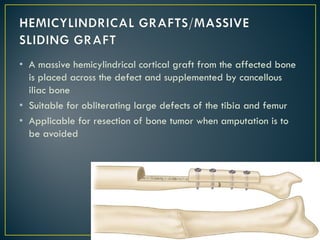
• A massive hemicylindrical cortical graft from the affected bone
is placed across the defect and supplemented by cancellous
iliac bone
• Suitable for obliterating large defects of the tibia and femur
• Applicable for resection of bone tumor when amputation is to
be avoided
Dr. Firas Kassab 45
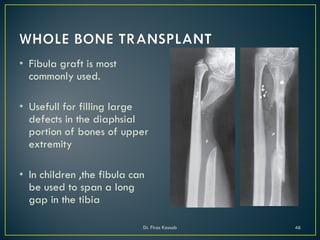
• Fibula graft is most
commonly used.
• Usefull for filling large
defects in the diaphsial
portion of bones of upper
extremity
• In children ,the fibula can
be used to span a long
gap in the tibia
Dr. Firas Kassab 46
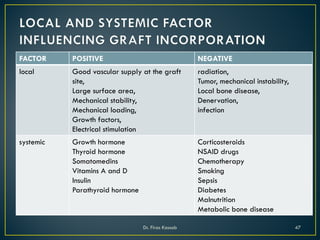
FACTOR POSITIVE NEGATIVE
local Good vascular supply at the graft
site,
Large surface area,
Mechanical stability,
Mechanical loading,
Growth factors,
Electrical stimulation
radiation,
Tumor, mechanical instability,
Local bone disease,
Denervation,
infection
systemic Growth hormone
Thyroid hormone
Somatomedins
Vitamins A and D
Insulin
Parathyroid hormone
Corticosteroids
NSAID drugs
Chemotherapy
Smoking
Sepsis
Diabetes
Malnutrition
Metabolic bone disease
Dr. Firas Kassab 47
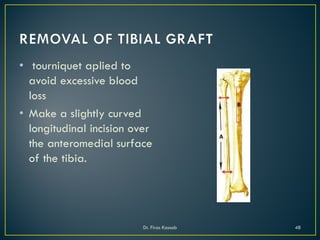
• tourniquet aplied to
avoid excessive blood
loss
• Make a slightly curved
longitudinal incision over
the anteromedial surface
of the tibia.
Dr. Firas Kassab 48
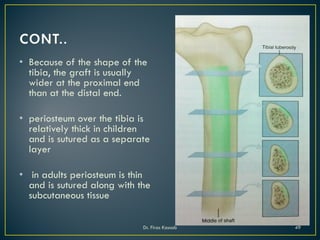
• Because of the shape of the
tibia, the graft is usually
wider at the proximal end
than at the distal end.
• periosteum over the tibia is
relatively thick in children
and is sutured as a separate
layer
• in adults periosteum is thin
and is sutured along with the
subcutaneous tissue
Dr. Firas Kassab 49
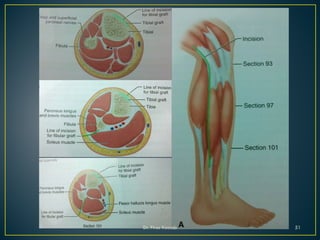
PRECAUTION
• the peroneal nerve must not be damaged
• the distal fourth of the bone must be left
to maintain a stable ankle
• the peroneal muscles should not be cut
• Disect along the anterior surface of the septum between the
peroneus longus and soleus muscle.
Dr. Firas Kassab 50
Dr. Firas Kassab 51
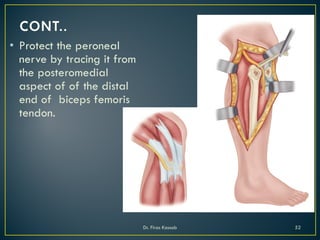
• Protect the peroneal
nerve by tracing it from
the posteromedial
aspect of of the distal
end of biceps femoris
tendon.
Dr. Firas Kassab 52
• Protect the anterior tibial vessel that pass between the neck of
fibula and the tibia by subperiosteal dissection
• After the resection is complete, suture the biceps tendon and the
fibular collateral ligament to the adjacent soft tissues
Dr. Firas Kassab 53
iliac crest is an ideal source of bone graft because –
• it is relatively subcutaneous
• has ample cancellous bone
• has cortical bone of varying thickness
• Removal of the bone carries minimal
risk
• usually there is no significant residual
disability
Dr. Firas Kassab 54
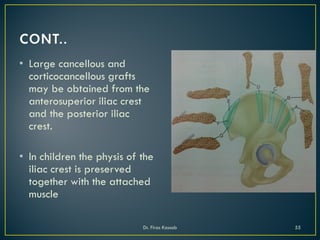
• Large cancellous and
corticocancellous grafts
may be obtained from the
anterosuperior iliac crest
and the posterior iliac
crest.
• In children the physis of the
iliac crest is preserved
together with the attached
muscle
Dr. Firas Kassab 55
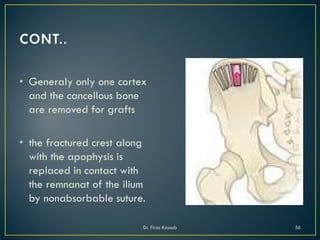
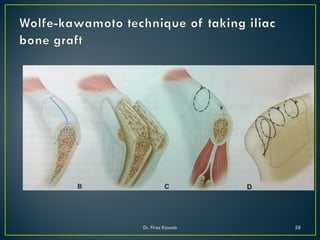
• Generaly only one cortex
and the cancellous bone
are removed for grafts
• the fractured crest along
with the apophysis is
replaced in contact with
the remnanat of the ilium
by nonabsorbable suture.
Dr. Firas Kassab 56
• INCISION
along the subcutaneous border of the iliac crest at the
point of contact of the periosteum with the origins of the gluteal
and trunk muscles
• When the crest of the ilium is not required as part of the graft,
split off the lateral side or both sides of the crest in continuity
with the periosteum
Dr. Firas Kassab 57
Dr. Firas Kassab 58
Dr. Firas Kassab 59
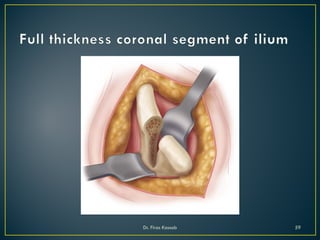
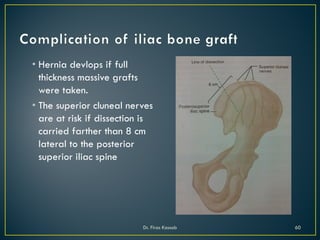
• Hernia devlops if full
thickness massive grafts
were taken.
• The superior cluneal nerves
are at risk if dissection is
carried farther than 8 cm
lateral to the posterior
superior iliac spine
Dr. Firas Kassab 60
• superior gluteal vessels can be damaged by retraction against
the roof of the sciatic notch
• Removal of large full-thickness grafts from the anterior ilium can
result in significant cosmetic deformity
• Arteriovenous fistula,
• pseudoaneurysm,
• ureteral injury,
• anterior superior iliac spine avulsion,
• and pelvic instability
Dr. Firas Kassab 61
Dr. Firas Kassab 62

Bone graft

  • 1.
  • 2.
    What is graft? What is grafting? What are bone grafts ? History of bone grafting Objectives and rationale of bone grafting Biological concept of using bone grafts techniques Dr. Firas Kassab 2
  • 3.
    • A viabletissue that after removal from a donor site is implanted with in a reciepient tissue is then restored repaired and regenerated. what is grafting ? • Grafting is a procedure used to replace/ restore missing tissue. Dr. Firas Kassab 3
  • 4.
    what are bonegrafts ? • bone grafts are the materials used for replacement or augmentation of bone. Dr. Firas Kassab 4
  • 5.
    • The principles,indication and techniques of bone grafting were established before the metalurgic age of orthopedic surgery • The first recorded bone implant was performed in 1668 • Lane and sandhu introduced internal fixation • Albee,henderson,campbell intoduce the principle of osteogenesis in bone grafting Dr. Firas Kassab 5
  • 6.
    • osteoinduction –induce differentiation of stem cell into osteogenic cells • Osteoconduction- provide passive porous scaffold upon which new bone can form • osteogenesis- provide stem cell with osteogenic potential ,which directly lays down new bone Dr. Firas Kassab 6
  • 7.
    • Increase inclinical bone defect fill. • To preserve and augment bone for future bone grafting when required. Dr. Firas Kassab 7
  • 8.
    Fill cavities ordefects resulting from cysts or tumors Bridge joint and provide arthrodesis Bridge major defects or establish continuity of long bone Dr. Firas Kassab 8
  • 9.
    Provide bone blockto limit joint motion(arthroereisis) Establish union in a pseudarthrosis Promote union or fill defects in delayed union , malunion , fresh fracture or osteotomies Dr. Firas Kassab 9
  • 10.
    • Bone istransferred from one site to other in the same individual • Ideal as bone graft posses all characteristic necessary for new bone growth i.e osteoconductivity, osteoinductivity osteogenicity • includes- cortical bone grafts cancellous vascularised bone grafts autologus bone marrow grafts Dr. Firas Kassab 10
  • 11.
    • ADVANTAGE no immunereaction all three properties present Dr. Firas Kassab 11
  • 12.
    • DISADVANTAGE • additionalsurgery • donor site morbidity -inflamation ,infection, chronic pain and cosmetic • limited quantities of bone graft Dr. Firas Kassab 12
  • 13.
    • Obtained from •tibia • fibula • iliac crest • Used primarily for structural support Dr. Firas Kassab 13
  • 14.
    • Obtained from •thicker portion of ilium • greater trochanter • proximal metaphysis of the tibia • lower radius • olecranon • from an excised femoral head • More rapidly incoporated into host bone than cortical autografts Dr. Firas Kassab 14
  • 15.
    Uses of cancellousbone graft - excellent choice for non unions with <5 to 6 cm of bone loss and that do not required structural integrity - used to fill bone cyst or bone voids after reduction of depressed articular surface such as in tibial plateu fracture Stable internal or external fixation is required for graft consolidation and fracture healing Dr. Firas Kassab 15
  • 16.
    PRIMARY PHASE - haemorrhage -inflamation - accumulation of haematopoietis cells including neutrophills, macrophages, and osteoclasts - removal of necrotic tissue Dr. Firas Kassab 16
  • 17.
    - osteoconductive factorsreleased from graft during resorption and cytokines released during inflamation - recruitment and stimulation of mesenchymal stem cells to osteogenic cells - active bone formation Dr. Firas Kassab 17
  • 18.
    - Osteoblasts linesdead trabecule lay down osteoid - haemopoitic marrow cells forms new bone in transplanted bone - remodeling i.e woven bone slowly being transformed into lameler bone by cordinated activities of osteoblasts and osteoclasts - incorporation of graft Dr. Firas Kassab 18
  • 19.
    - In corticalbone graft first osteoclastic resorption than osteoblastic activity - In cancellous bone graft bone formation and resorption occurs simultaneously called creeping substitution -Therefore cancellous bone graft incorporate quickly -But doesnot provide immediate structural support Dr. Firas Kassab 19
  • 20.
    • Bone istransferred with its blood supply which is anastomosed to vessel at recipient site • Available donor sites • iliac crest(with one circumflex artery) • fibula(with the peroneal artery) • radial shaft Dr. Firas Kassab 20
  • 21.
    • Vascularised grafts remaincompletely viable and incoporated like that of fracture healing Dr. Firas Kassab 21
  • 22.
    Graft is obtainedfrom an individual other than the patient • used in small children where sufficient graft is not available from donor site  in adults where large defects have to be filled like-  periprosthetic long bone fracture  revision total joint surgery  reconstruction after tumor excision Dr. Firas Kassab 22
  • 23.
    ADVANTAGE • no donorsite morbidity • large amount can be used DISADVANTAGE • immune reaction • risk of infection • disease transmission • reduced osteoinductivity and osteogenicity Dr. Firas Kassab 23
  • 24.
    • Graft mustbe harvested under sterile condition and doner must be cleared for malignancy , syphilis, cmv and hiv • Antigenicity can be reduced by freezing (at 70 deg c) , freeze drying or by ionizing radiation • Demineralization also reduces antigenicity and enhances osteoconductive property Dr. Firas Kassab 24
  • 25.
    GRAFTS OSTE- OGENESIS OSTEO- CONDUCTION OSTEO- INDUCTION MECHANICAL PROPERTY VASCULA RITY AUTOGRAFT BONE MARROW ++ +/-+ - - CANCELLOUS ++ ++ + + - CORTICAL + + +/- ++ - VASCULARISED ++ ++ + ++ ++ ALLOGRAFT CANCELLOUS - ++ + + - CORTICAL - +/- +/- ++ - DEMINERALISED - ++ +++ - -Dr. Firas Kassab 25
  • 26.
    • Donor mustbe screened for bacterial ,viral(HIV,hepatitis) and fungal infection , malignancy , collagen vascular disease , metabolic bone disease , and presence of toxins. Dr. Firas Kassab 26
  • 27.
    • bone isharvested in a clean , nonsterile environment • • sterilized by irradiation , strong acid or ethylene oxide • Freeze dried for storage Dr. Firas Kassab 27
  • 28.
    • Bone substitutesare natural , synthetic or composit materials used to fill bone defects and promote bone healing Dr. Firas Kassab 28
  • 29.
    PROPERTY CLASSES OSTEOCONDUCTION Calciumsulfate, ceramics, calcium phosphate cements, collagen, bioactive glass, synthetic polymers OSTEOINDUCTION Demineralised bone matrix, bone morphogenic proteins growth factors, gene therapy OSTEOGENESIS Bone marrow aspirate COMBINED composites Dr. Firas Kassab 29
  • 30.
    GRAFT CATEGORY MECHANISMOF ACTION AVAILABLE FORMS Demineralised bone matrix Osteoconductive and osteoinductive Putty , injectable gels, Injectable paste, Flexible sheets, Formable discs, Moldable putty, Preformed strips, Fibres mixed with cancellous chips Calcium sulphate osteoconductive Moldable hardening paste, Pellets and beads injectable cement Dr. Firas Kassab 30
  • 31.
    Tricalcium phosphate osteoinductiveGranules, strips, putty, Extrudable forms, Preformed blocks Coralline hydroxyapetite osteoconductive Small granules, blocks Calcium phosphate cement osteoconductive Injectable cement, Packable cement Collagen combination product osteoconductive Hydroxyapetite and collagen in strips, Preformed collagen blocks with embedded tricalcium phosphate granules, Malleable collagen putty with embedded tricalcium phosphate Dr. Firas Kassab 31
  • 32.
    Synthetic resorbable osteoconductiveGranules, Plugs, Blocks, wedges Recombinant BMP 2 osteoinductive Poweder carried on a collagen sponge Recombinant BMP 7 osteoinductive Lyophilised powder reconstitutted to form wet sand material, Lyophilised powder reconstituted to form putty Dr. Firas Kassab 32
  • 33.
    • Primarily asosteoconductive agent • Delivery medium for antibiotic • To fill small defects after bone resection in chronic osteomylitis Dr. Firas Kassab 33
  • 34.
    • Contains stemcells and osteoprogenitor cells , which are able to transform into osteoblasts • Multiple small volume aspirate is obtained from iliac crest(four 1ml aspirates from separate site puncture) • Centrifugation of aspirate in order to concentrate the cellular contents has provided encouraging results in animal experiment Dr. Firas Kassab 34
  • 35.
    • BMPs areosteoconductive • BMP-2 and BMP-7 are manufactured using recombinant technique • Used in treatment of non-union and open tibial fracture • Used with a carrier which may be allograft, DMB, collagen or bioactive bone cement Dr. Firas Kassab 35
  • 36.
    ONLAY CORTICAL GRAFT •graft is placed subperiosteally across the fragments without mobilizing the fragments . • Cortical graft was suplemented with cancellous bone for osteogenesis. • Advantages- - simple to do - blood suply of the fragments and the normal impacting forces of fracture is not disturbed Dr. Firas Kassab 36
  • 37.
    • Uses- - malunited, nonunited fracture of shaft of long bone - bridging joints to produce arthrodesis • Fixation is achived by internal or external metalic device Dr. Firas Kassab 37
  • 38.
    DUAL ONLAY GRAFT •Two cortical onlay grafts are placed opposite each other on the host bone across the nonunion and are fixed with the same set of screws • They grip the fragments like a vise • Uses- to fix nonunited short osteoporotic fracture near a joint Dr. Firas Kassab 38
  • 39.
    DUAL ONLAY GRAFT Dr.Firas Kassab 39
  • 40.
    ADVANTAGE • Mechanichal fixationis better than fixation by a single onlay bone graft • two grafts add strength and stability • Grafts form a trough into which cancellous bone may be packed • during healing the dual graft prevent contracting fibrous tissue from compromising transplanted cancellous bone Dr. Firas Kassab 40
  • 41.
    DISADVANTAGE -same as singlecortical grafts • not as strong as metalic fixator devices • Extremity usualy must serve as a donor site if autogenous graft are used • Not as osteogenic as autogenous iliac grafts • The surgery necessary to obtain them has more risk Dr. Firas Kassab 41
  • 42.
    • A slotor rectangular defect is created in the cortex of host bone then a graft of the same size or slighty smaller is fitted in to the defect • Ocaisonaly used in arthrodesis, particularly at the ankle Dr. Firas Kassab 42
  • 43.
    • Usefull for- fillingdefects or cavities resulting from cysts, tumor for establishing bone blocks and for wedging in osteotomies • Cancellous grafts are usefull for arthrodesis of spine because osteogenesis is prime concern Dr. Firas Kassab 43
  • 44.
    • Harvested from -anterior iliac crest using an acetabula reamer, - femoral canal using a reamer-irrigator- aspirator(large volume cancellous bone graft can be harvested) Dr. Firas Kassab 44
  • 45.
    • A massivehemicylindrical cortical graft from the affected bone is placed across the defect and supplemented by cancellous iliac bone • Suitable for obliterating large defects of the tibia and femur • Applicable for resection of bone tumor when amputation is to be avoided Dr. Firas Kassab 45
  • 46.
    • Fibula graftis most commonly used. • Usefull for filling large defects in the diaphsial portion of bones of upper extremity • In children ,the fibula can be used to span a long gap in the tibia Dr. Firas Kassab 46
  • 47.
    FACTOR POSITIVE NEGATIVE localGood vascular supply at the graft site, Large surface area, Mechanical stability, Mechanical loading, Growth factors, Electrical stimulation radiation, Tumor, mechanical instability, Local bone disease, Denervation, infection systemic Growth hormone Thyroid hormone Somatomedins Vitamins A and D Insulin Parathyroid hormone Corticosteroids NSAID drugs Chemotherapy Smoking Sepsis Diabetes Malnutrition Metabolic bone disease Dr. Firas Kassab 47
  • 48.
    • tourniquet apliedto avoid excessive blood loss • Make a slightly curved longitudinal incision over the anteromedial surface of the tibia. Dr. Firas Kassab 48
  • 49.
    • Because ofthe shape of the tibia, the graft is usually wider at the proximal end than at the distal end. • periosteum over the tibia is relatively thick in children and is sutured as a separate layer • in adults periosteum is thin and is sutured along with the subcutaneous tissue Dr. Firas Kassab 49
  • 50.
    PRECAUTION • the peronealnerve must not be damaged • the distal fourth of the bone must be left to maintain a stable ankle • the peroneal muscles should not be cut • Disect along the anterior surface of the septum between the peroneus longus and soleus muscle. Dr. Firas Kassab 50
  • 51.
  • 52.
    • Protect theperoneal nerve by tracing it from the posteromedial aspect of of the distal end of biceps femoris tendon. Dr. Firas Kassab 52
  • 53.
    • Protect theanterior tibial vessel that pass between the neck of fibula and the tibia by subperiosteal dissection • After the resection is complete, suture the biceps tendon and the fibular collateral ligament to the adjacent soft tissues Dr. Firas Kassab 53
  • 54.
    iliac crest isan ideal source of bone graft because – • it is relatively subcutaneous • has ample cancellous bone • has cortical bone of varying thickness • Removal of the bone carries minimal risk • usually there is no significant residual disability Dr. Firas Kassab 54
  • 55.
    • Large cancellousand corticocancellous grafts may be obtained from the anterosuperior iliac crest and the posterior iliac crest. • In children the physis of the iliac crest is preserved together with the attached muscle Dr. Firas Kassab 55
  • 56.
    • Generaly onlyone cortex and the cancellous bone are removed for grafts • the fractured crest along with the apophysis is replaced in contact with the remnanat of the ilium by nonabsorbable suture. Dr. Firas Kassab 56
  • 57.
    • INCISION along thesubcutaneous border of the iliac crest at the point of contact of the periosteum with the origins of the gluteal and trunk muscles • When the crest of the ilium is not required as part of the graft, split off the lateral side or both sides of the crest in continuity with the periosteum Dr. Firas Kassab 57
  • 58.
  • 59.
  • 60.
    • Hernia devlopsif full thickness massive grafts were taken. • The superior cluneal nerves are at risk if dissection is carried farther than 8 cm lateral to the posterior superior iliac spine Dr. Firas Kassab 60
  • 61.
    • superior glutealvessels can be damaged by retraction against the roof of the sciatic notch • Removal of large full-thickness grafts from the anterior ilium can result in significant cosmetic deformity • Arteriovenous fistula, • pseudoaneurysm, • ureteral injury, • anterior superior iliac spine avulsion, • and pelvic instability Dr. Firas Kassab 61
  • 62.