PRINCIPLES OF PROGRAMMING LANGUAGES
GENERAL COMPARISON
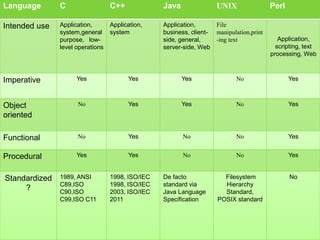
Language C C++ Java UNIX Perl
Intended use Application,
system,general
purpose, low-
level operations
Application,
system
Application,
business, client-
side, general,
server-side, Web
File
manipulation,print
-ing text Application,
scripting, text
processing, Web
Imperative Yes Yes Yes No Yes
Object
oriented
No Yes Yes No Yes
Functional No Yes No No Yes
Procedural Yes Yes No No Yes
Standardized
?
1989, ANSI
C89,ISO
C90,ISO
C99,ISO C11
1998, ISO/IEC
1998, ISO/IEC
2003, ISO/IEC
2011
De facto
standard via
Java Language
Specification
Filesystem
Hierarchy
Standard,
POSIX standard
No
EVOLUTION
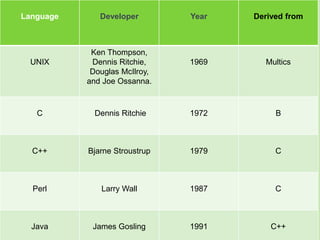
Language Developer Year Derived from
UNIX
Ken Thompson,
Dennis Ritchie,
Douglas McIlroy,
and Joe Ossanna.
1969 Multics
C Dennis Ritchie 1972 B
C++ Bjarne Stroustrup 1979 C
Perl Larry Wall 1987 C
Java James Gosling 1991 C++
LANGUAGE EVALUATION
CRITERIA
READABILITY
Language
Characteristic
SIMPLICITY
Illustration
C Feature multiplicity x++;
++x;
x = x+1;
x += 1;
C++ Feature multiplicity
Operator overloading
operator+
(addition & string
concatenation)
Java Feature multiplicity
x++;
++x;
x = x+1;
x += 1;Perl Feature multiplicity
UNIX feature multiplicity
No operator overloading
$x++;
$(++x)
x = $x+1
$x += 1
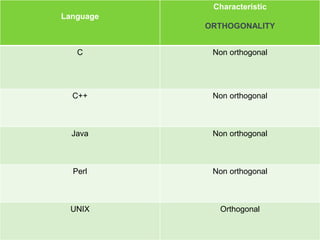
Language
Characteristic
ORTHOGONALITY
C Non orthogonal
C++ Non orthogonal
Java Non orthogonal
Perl Non orthogonal
UNIX Orthogonal
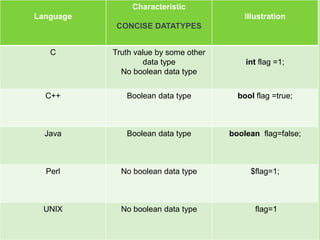
Language
Characteristic
CONCISE DATATYPES
Illustration
C Truth value by some other
data type
No boolean data type
int flag =1;
C++ Boolean data type bool flag =true;
Java Boolean data type boolean flag=false;
Perl No boolean data type $flag=1;
UNIX No boolean data type flag=1
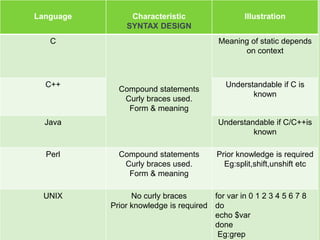
Language Characteristic
SYNTAX DESIGN
Illustration
C
Compound statements
Curly braces used.
Form & meaning
Meaning of static depends
on context
C++ Understandable if C is
known
Java Understandable if C/C++is
known
Perl Compound statements
Curly braces used.
Form & meaning
Prior knowledge is required
Eg:split,shift,unshift etc
UNIX No curly braces
Prior knowledge is required
for var in 0 1 2 3 4 5 6 7 8
do
echo $var
done
Eg:grep
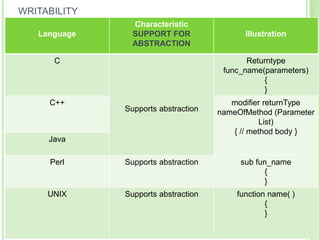
WRITABILITY
Language
Characteristic
SUPPORT FOR
ABSTRACTION
Illustration
C
Supports abstraction
Returntype
func_name(parameters)
{
}
C++ modifier returnType
nameOfMethod (Parameter
List)
{ // method body }
Java
Perl Supports abstraction sub fun_name
{
}
UNIX Supports abstraction function name( )
{
}
Language
Characteristic
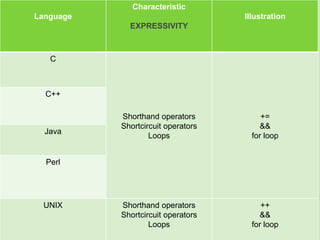
EXPRESSIVITY
Illustration
C
Shorthand operators
Shortcircuit operators
Loops
+=
&&
for loop
C++
Java
Perl
UNIX Shorthand operators
Shortcircuit operators
Loops
++
&&
for loop
RELIABILITY
Language
Characteristic
TYPE CHECKING
Illustration
C Strongly typed int a=5;
C++ Strongly typed int a=5;
Java Strongly typed int a=5;
Perl Loosely typed
Runtime
$a=5;
$a=“hii”;
UNIX Loosely typed
Runtime
a=5;
Language Characteristic
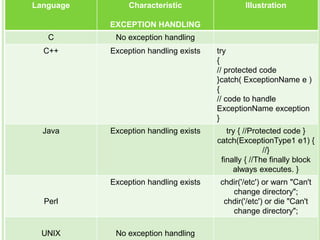
EXCEPTION HANDLING
Illustration
C No exception handling
C++ Exception handling exists try
{
// protected code
}catch( ExceptionName e )
{
// code to handle
ExceptionName exception
}
Java Exception handling exists try { //Protected code }
catch(ExceptionType1 e1) {
//}
finally { //The finally block
always executes. }
Perl
Exception handling exists chdir('/etc') or warn "Can't
change directory";
chdir('/etc') or die "Can't
change directory";
UNIX No exception handling
Language
Characteristic
ALIASING
Illustration
C Aliasing using pointers int A[10];
int *p= A;
C++ Aliasing using reference
variables
float total=100;
float &sum=total;
Java
Aliasing using object
references
Square box1 = new Square
(0, 0, 100, 200);
Square box2 = box1;
Perl Aliasing using reference
variables
$r=@arr;
UNIX Giving a name for a
command
alias dir=ls
BINDING
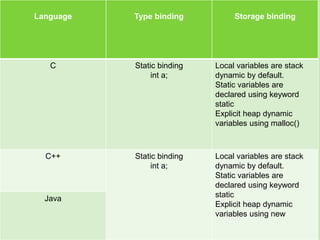
Language Type binding Storage binding
C Static binding
int a;
Local variables are stack
dynamic by default.
Static variables are
declared using keyword
static
Explicit heap dynamic
variables using malloc()
C++ Static binding
int a;
Local variables are stack
dynamic by default.
Static variables are
declared using keyword
static
Explicit heap dynamic
variables using new
Java
language Type binding Storage Binding
Perl Dynamic binding
$a=5;
implicit declarations and
explicit declarations with
static scoping, lots of heap
bindings (for strings, arrays,
etc.), run-time memory
manager does garbage
collection, implicit allocation
and de-allocation
UNIX Dynamic binding
a=5
Local variables are stack
dynamic by default.
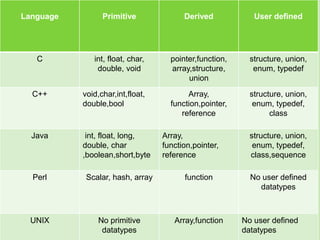
DATA TYPES
Language Primitive Derived User defined
C int, float, char,
double, void
pointer,function,
array,structure,
union
structure, union,
enum, typedef
C++ void,char,int,float,
double,bool
Array,
function,pointer,
reference
structure, union,
enum, typedef,
class
Java int, float, long,
double, char
,boolean,short,byte
Array,
function,pointer,
reference
structure, union,
enum, typedef,
class,sequence
Perl Scalar, hash, array function No user defined
datatypes
UNIX No primitive
datatypes
Array,function No user defined
datatypes
VARIABLES & CONSTANTS
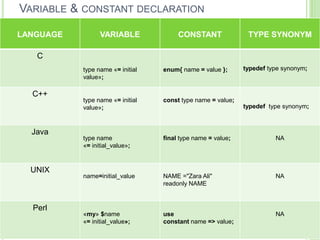
VARIABLE & CONSTANT DECLARATION
LANGUAGE VARIABLE CONSTANT TYPE SYNONYM
C
type name «= initial
value»;
enum{ name = value }; typedef type synonym;
C++
type name «= initial
value»;
const type name = value;
typedef type synonym;
Java
type name
«= initial_value»;
final type name = value; NA
UNIX
name=initial_value NAME ="Zara Ali"
readonly NAME
NA
Perl
«my» $name
«= initial_value»;
use
constant name => value;
NA
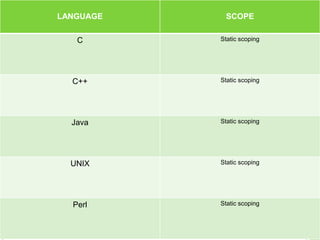
SCOPE
LANGUAGE SCOPE
C Static scoping
C++ Static scoping
Java Static scoping
UNIX Static scoping
Perl Static scoping
ASSIGNMENT STATEMENTS
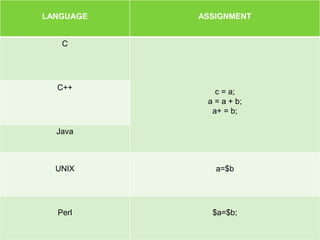
LANGUAGE ASSIGNMENT
C
c = a;
a = a + b;
a+ = b;
C++
Java
UNIX a=$b
Perl $a=$b;
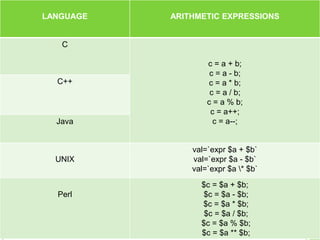
ARITHMETIC EXPRESSIONS
LANGUAGE ARITHMETIC EXPRESSIONS
C
c = a + b;
c = a - b;
c = a * b;
c = a / b;
c = a % b;
c = a++;
c = a--;
C++
Java
UNIX
val=`expr $a + $b`
val=`expr $a - $b`
val=`expr $a * $b`
Perl
$c = $a + $b;
$c = $a - $b;
$c = $a * $b;
$c = $a / $b;
$c = $a % $b;
$c = $a ** $b;
CONTROL FLOW
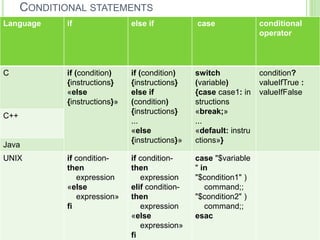
CONDITIONAL STATEMENTS
Language if else if case conditional
operator
C if (condition)
{instructions}
«else
{instructions}»
if (condition)
{instructions}
else if
(condition)
{instructions}
...
«else
{instructions}»
switch
(variable)
{case case1: in
structions
«break;»
...
«default: instru
ctions»}
condition?
valueIfTrue :
valueIfFalse
C++
Java
UNIX if condition-
then
expression
«else
expression»
fi
if condition-
then
expression
elif condition-
then
expression
«else
expression»
fi
case "$variable
" in
"$condition1" )
command;;
"$condition2" )
command;;
esac
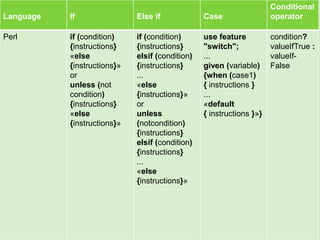
Language If Else if Case
Conditional
operator
Perl if (condition)
{instructions}
«else
{instructions}»
or
unless (not
condition)
{instructions}
«else
{instructions}»
if (condition)
{instructions}
elsif (condition)
{instructions}
...
«else
{instructions}»
or
unless
(notcondition)
{instructions}
elsif (condition)
{instructions}
...
«else
{instructions}»
use feature
"switch";
...
given (variable)
{when (case1)
{ instructions }
...
«default
{ instructions }»}
condition?
valueIfTrue :
valueIf-
False
LOOP STATEMENTS
Language while Do while For foreach
C
while
(condition) {instructi
ons }
do { instructions }
while (condition)
for («type»
i = first; i <= last;
++i) { instructions }
NA
C++ «std::»
for_each(start,end,f
unction)
Java for (type item : set)
{instructions }
UNIX while [condition
] do
Instructions
done
or
until [notconditi
on] do
Instructions
done
NA for
((i = first; i <= last;
++i))
do
Instructions
done
for item in set
do
Instructions
done
Language While Do while For foreach
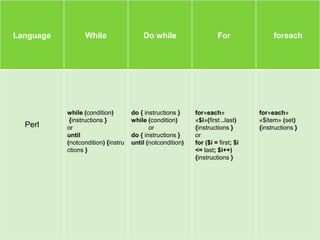
Perl
while (condition)
{instructions }
or
until
(notcondition) {instru
ctions }
do { instructions }
while (condition)
or
do { instructions }
until (notcondition)
for«each»
«$i»(first ..last)
{instructions }
or
for ($i = first; $i
<= last; $i++)
{instructions }
for«each»
«$item» (set)
{instructions }
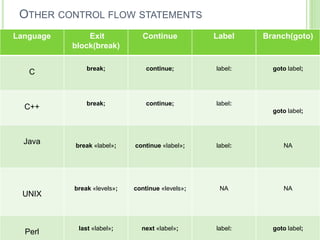
OTHER CONTROL FLOW STATEMENTS
Language Exit
block(break)
Continue Label Branch(goto)
C break; continue; label: goto label;
C++ break; continue; label:
goto label;
Java break «label»; continue «label»; label: NA
UNIX
break «levels»; continue «levels»; NA NA
Perl last «label»; next «label»; label: goto label;

principles of programming languages

  • 1.
  • 2.
  • 3.
    Language C C++Java UNIX Perl Intended use Application, system,general purpose, low- level operations Application, system Application, business, client- side, general, server-side, Web File manipulation,print -ing text Application, scripting, text processing, Web Imperative Yes Yes Yes No Yes Object oriented No Yes Yes No Yes Functional No Yes No No Yes Procedural Yes Yes No No Yes Standardized ? 1989, ANSI C89,ISO C90,ISO C99,ISO C11 1998, ISO/IEC 1998, ISO/IEC 2003, ISO/IEC 2011 De facto standard via Java Language Specification Filesystem Hierarchy Standard, POSIX standard No
  • 4.
  • 5.
    Language Developer YearDerived from UNIX Ken Thompson, Dennis Ritchie, Douglas McIlroy, and Joe Ossanna. 1969 Multics C Dennis Ritchie 1972 B C++ Bjarne Stroustrup 1979 C Perl Larry Wall 1987 C Java James Gosling 1991 C++
  • 6.
  • 7.
    READABILITY Language Characteristic SIMPLICITY Illustration C Feature multiplicityx++; ++x; x = x+1; x += 1; C++ Feature multiplicity Operator overloading operator+ (addition & string concatenation) Java Feature multiplicity x++; ++x; x = x+1; x += 1;Perl Feature multiplicity UNIX feature multiplicity No operator overloading $x++; $(++x) x = $x+1 $x += 1
  • 8.
    Language Characteristic ORTHOGONALITY C Non orthogonal C++Non orthogonal Java Non orthogonal Perl Non orthogonal UNIX Orthogonal
  • 9.
    Language Characteristic CONCISE DATATYPES Illustration C Truthvalue by some other data type No boolean data type int flag =1; C++ Boolean data type bool flag =true; Java Boolean data type boolean flag=false; Perl No boolean data type $flag=1; UNIX No boolean data type flag=1
  • 10.
    Language Characteristic SYNTAX DESIGN Illustration C Compoundstatements Curly braces used. Form & meaning Meaning of static depends on context C++ Understandable if C is known Java Understandable if C/C++is known Perl Compound statements Curly braces used. Form & meaning Prior knowledge is required Eg:split,shift,unshift etc UNIX No curly braces Prior knowledge is required for var in 0 1 2 3 4 5 6 7 8 do echo $var done Eg:grep
  • 11.
    WRITABILITY Language Characteristic SUPPORT FOR ABSTRACTION Illustration C Supports abstraction Returntype func_name(parameters) { } C++modifier returnType nameOfMethod (Parameter List) { // method body } Java Perl Supports abstraction sub fun_name { } UNIX Supports abstraction function name( ) { }
  • 12.
    Language Characteristic EXPRESSIVITY Illustration C Shorthand operators Shortcircuit operators Loops += && forloop C++ Java Perl UNIX Shorthand operators Shortcircuit operators Loops ++ && for loop
  • 13.
    RELIABILITY Language Characteristic TYPE CHECKING Illustration C Stronglytyped int a=5; C++ Strongly typed int a=5; Java Strongly typed int a=5; Perl Loosely typed Runtime $a=5; $a=“hii”; UNIX Loosely typed Runtime a=5;
  • 14.
    Language Characteristic EXCEPTION HANDLING Illustration CNo exception handling C++ Exception handling exists try { // protected code }catch( ExceptionName e ) { // code to handle ExceptionName exception } Java Exception handling exists try { //Protected code } catch(ExceptionType1 e1) { //} finally { //The finally block always executes. } Perl Exception handling exists chdir('/etc') or warn "Can't change directory"; chdir('/etc') or die "Can't change directory"; UNIX No exception handling
  • 15.
    Language Characteristic ALIASING Illustration C Aliasing usingpointers int A[10]; int *p= A; C++ Aliasing using reference variables float total=100; float &sum=total; Java Aliasing using object references Square box1 = new Square (0, 0, 100, 200); Square box2 = box1; Perl Aliasing using reference variables $r=@arr; UNIX Giving a name for a command alias dir=ls
  • 16.
  • 17.
    Language Type bindingStorage binding C Static binding int a; Local variables are stack dynamic by default. Static variables are declared using keyword static Explicit heap dynamic variables using malloc() C++ Static binding int a; Local variables are stack dynamic by default. Static variables are declared using keyword static Explicit heap dynamic variables using new Java
  • 18.
    language Type bindingStorage Binding Perl Dynamic binding $a=5; implicit declarations and explicit declarations with static scoping, lots of heap bindings (for strings, arrays, etc.), run-time memory manager does garbage collection, implicit allocation and de-allocation UNIX Dynamic binding a=5 Local variables are stack dynamic by default.
  • 19.
  • 20.
    Language Primitive DerivedUser defined C int, float, char, double, void pointer,function, array,structure, union structure, union, enum, typedef C++ void,char,int,float, double,bool Array, function,pointer, reference structure, union, enum, typedef, class Java int, float, long, double, char ,boolean,short,byte Array, function,pointer, reference structure, union, enum, typedef, class,sequence Perl Scalar, hash, array function No user defined datatypes UNIX No primitive datatypes Array,function No user defined datatypes
  • 21.
  • 22.
    VARIABLE & CONSTANTDECLARATION LANGUAGE VARIABLE CONSTANT TYPE SYNONYM C type name «= initial value»; enum{ name = value }; typedef type synonym; C++ type name «= initial value»; const type name = value; typedef type synonym; Java type name «= initial_value»; final type name = value; NA UNIX name=initial_value NAME ="Zara Ali" readonly NAME NA Perl «my» $name «= initial_value»; use constant name => value; NA
  • 23.
  • 24.
    LANGUAGE SCOPE C Staticscoping C++ Static scoping Java Static scoping UNIX Static scoping Perl Static scoping
  • 25.
  • 26.
    LANGUAGE ASSIGNMENT C c =a; a = a + b; a+ = b; C++ Java UNIX a=$b Perl $a=$b;
  • 27.
  • 28.
    LANGUAGE ARITHMETIC EXPRESSIONS C c= a + b; c = a - b; c = a * b; c = a / b; c = a % b; c = a++; c = a--; C++ Java UNIX val=`expr $a + $b` val=`expr $a - $b` val=`expr $a * $b` Perl $c = $a + $b; $c = $a - $b; $c = $a * $b; $c = $a / $b; $c = $a % $b; $c = $a ** $b;
  • 29.
  • 30.
    CONDITIONAL STATEMENTS Language ifelse if case conditional operator C if (condition) {instructions} «else {instructions}» if (condition) {instructions} else if (condition) {instructions} ... «else {instructions}» switch (variable) {case case1: in structions «break;» ... «default: instru ctions»} condition? valueIfTrue : valueIfFalse C++ Java UNIX if condition- then expression «else expression» fi if condition- then expression elif condition- then expression «else expression» fi case "$variable " in "$condition1" ) command;; "$condition2" ) command;; esac
  • 31.
    Language If Elseif Case Conditional operator Perl if (condition) {instructions} «else {instructions}» or unless (not condition) {instructions} «else {instructions}» if (condition) {instructions} elsif (condition) {instructions} ... «else {instructions}» or unless (notcondition) {instructions} elsif (condition) {instructions} ... «else {instructions}» use feature "switch"; ... given (variable) {when (case1) { instructions } ... «default { instructions }»} condition? valueIfTrue : valueIf- False
  • 32.
    LOOP STATEMENTS Language whileDo while For foreach C while (condition) {instructi ons } do { instructions } while (condition) for («type» i = first; i <= last; ++i) { instructions } NA C++ «std::» for_each(start,end,f unction) Java for (type item : set) {instructions } UNIX while [condition ] do Instructions done or until [notconditi on] do Instructions done NA for ((i = first; i <= last; ++i)) do Instructions done for item in set do Instructions done
  • 33.
    Language While Dowhile For foreach Perl while (condition) {instructions } or until (notcondition) {instru ctions } do { instructions } while (condition) or do { instructions } until (notcondition) for«each» «$i»(first ..last) {instructions } or for ($i = first; $i <= last; $i++) {instructions } for«each» «$item» (set) {instructions }
  • 34.
    OTHER CONTROL FLOWSTATEMENTS Language Exit block(break) Continue Label Branch(goto) C break; continue; label: goto label; C++ break; continue; label: goto label; Java break «label»; continue «label»; label: NA UNIX break «levels»; continue «levels»; NA NA Perl last «label»; next «label»; label: goto label;