Extending Python
Francisco Fernández Castaño!
July 2014!
EuroPython, Berlin!
@fcofdezc
Roadmap
• Motivation
• Guidelines
• Native Extensions
• Ctypes
• CFFI
• Conclusions
Caution
Huge topic
Useless examples
Unix ^ CPython centric
Motivation
Why write in C?
Motivation
Speed
Using legacy code
Integration
Guidelines
C artifacts
Static libraries
Shared libraries
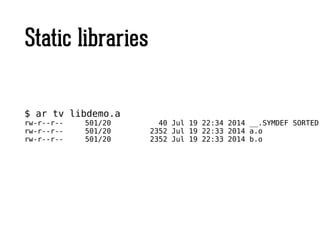
Static libraries
$ ar tv libdemo.a
rw-r--r-- 501/20 40 Jul 19 22:34 2014 __.SYMDEF SORTED
rw-r--r-- 501/20 2352 Jul 19 22:33 2014 a.o
rw-r--r-- 501/20 2352 Jul 19 22:33 2014 b.o
Shared libraries
Single copy in memory
Runtime load
Native extensions
C API
Native extensions
Hello world
Native extensions
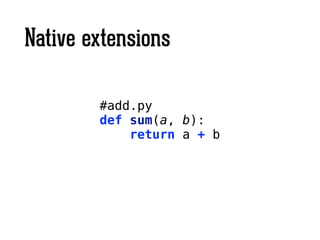
#add.py
def sum(a, b):
return a + b
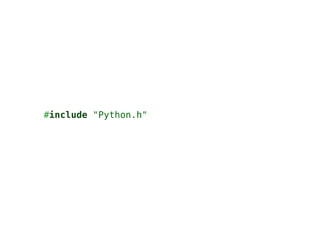
#include "Python.h"
// sum function.
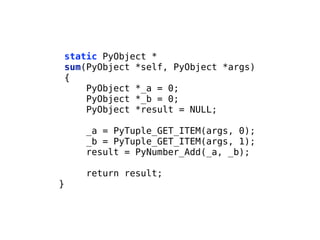
static PyObject *
sum(PyObject *self, PyObject *args)
{
PyObject *_a = 0;
PyObject *_b = 0;
PyObject *result = NULL;
!
_a = PyTuple_GET_ITEM(args, 0);
_b = PyTuple_GET_ITEM(args, 1);
result = PyNumber_Add(_a, _b);
!
return result;
}
// Module functions table.
static PyMethodDef
module_functions[] = {
{ "sum", sum, METH_VARARGS, "Sum docstring." },
{ NULL }
};
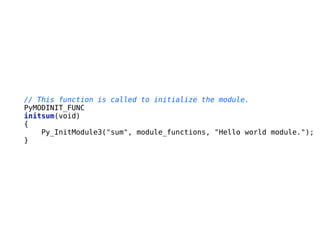
// This function is called to initialize the module.
PyMODINIT_FUNC
initsum(void)
{
Py_InitModule3("sum", module_functions, "Hello world module.");
}
#include "Python.h"
static PyObject *
sum(PyObject *self, PyObject *args)
{
PyObject *_a = 0;
PyObject *_b = 0;
PyObject *result = NULL;
!
_a = PyTuple_GET_ITEM(args, 0);
_b = PyTuple_GET_ITEM(args, 1);
result = PyNumber_Add(_a, _b);
!
return result;
}
// Module functions table.
static PyMethodDef
module_functions[] = {
{ "sum", sum, METH_VARARGS, "Sum docstring." },
{ NULL }
};
// This function is called to initialize the module.
PyMODINIT_FUNC
initsum(void)
{
Py_InitModule3("sum", module_functions, "Hello world module.");
}
from distutils.core import setup, Extension
setup(name='sum',
version=‘1.0',
ext_modules=[Extension('sum', ['sum.c'])])
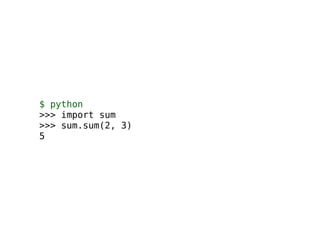
$ python
>>> import sum
>>> sum.sum(2, 3)
5
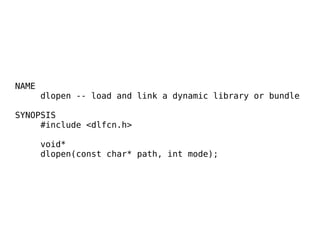
NAME
dlopen -- load and link a dynamic library or bundle
!
SYNOPSIS
#include <dlfcn.h>
!
void*
dlopen(const char* path, int mode);
// Python/dynload_shlib.c
.
.
handle = dlopen(pathname, dlopenflags);
!
if (handle == NULL) {
const char *error = dlerror();
if (error == NULL)
error = "unknown dlopen() error";
PyErr_SetString(PyExc_ImportError, error);
return NULL;
}
if (fp != NULL && nhandles < 128)
handles[nhandles++].handle = handle;
p = (dl_funcptr) dlsym(handle, funcname);
return p;
.
.
.
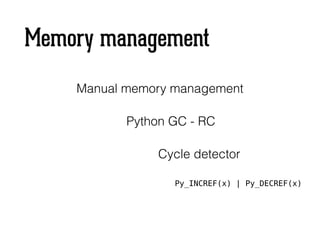
Memory management
Manual memory management
Python GC - RC
Py_INCREF(x) | Py_DECREF(x)
Cycle detector
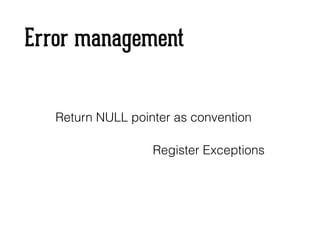
Error management
Return NULL pointer as convention
Register Exceptions
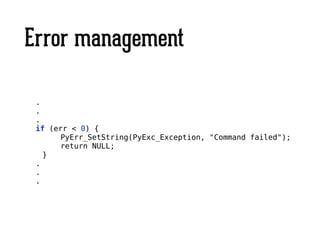
Error management
.
.
.
if (err < 0) {
PyErr_SetString(PyExc_Exception, "Command failed");
return NULL;
}
.
.
.
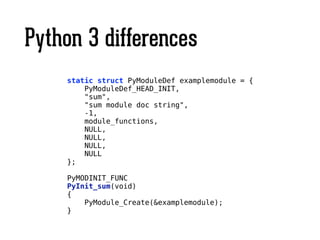
Python 3 differences
!
static struct PyModuleDef examplemodule = {
PyModuleDef_HEAD_INIT,
"sum",
"sum module doc string",
-1,
module_functions,
NULL,
NULL,
NULL,
NULL
};
!
PyMODINIT_FUNC
PyInit_sum(void)
{
PyModule_Create(&examplemodule);
}
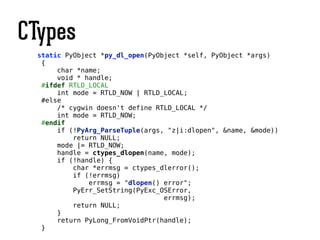
CTypes
Advanced FFI for Python
Allows call functions from Shared libs
Create, access, manipulate C data types
CTypes
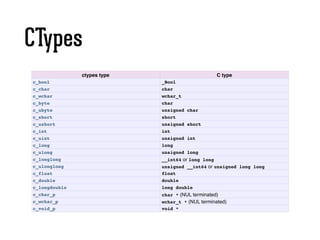
ctypes type C type
c_bool _Bool
c_char char
c_wchar wchar_t
c_byte char
c_ubyte unsigned char
c_short short
c_ushort unsigned short
c_int int
c_uint unsigned int
c_long long
c_ulong unsigned long
c_longlong __int64 or long long
c_ulonglong unsigned __int64 or unsigned long long
c_float float
c_double double
c_longdouble long double
c_char_p char * (NUL terminated)
c_wchar_p wchar_t * (NUL terminated)
c_void_p void *
CTypes - structs
from ctypes import *
class POINT(Structure):
_fields_ = [("x", c_int),
("y", c_int)]
!
class RECT(Structure):
_fields_ = [("upperleft", POINT),
("lowerright", POINT)]
CTypes - example
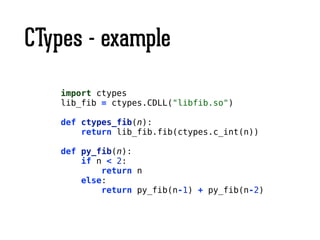
Implemented fibonacci as c function
Map as Python code
Measure differences between Python and C
CTypes - example
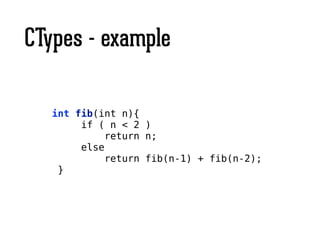
int fib(int n){
if ( n < 2 )
return n;
else
return fib(n-1) + fib(n-2);
}
CTypes - example
import ctypes
lib_fib = ctypes.CDLL("libfib.so")
!
def ctypes_fib(n):
return lib_fib.fib(ctypes.c_int(n))
!
def py_fib(n):
if n < 2:
return n
else:
return py_fib(n-1) + py_fib(n-2)
CTypes - times
In [3]: %timeit fib.ctypes_fib(20)
10000 loops, best of 3: 63.8 µs per loop
!
In [4]: %timeit fib.py_fib(20)
100 loops, best of 3: 3.62 ms per loop
CTypes - Fortran example
Use of existing fortran code
Take random code at github
https://github.com/astrofrog/fortranlib
Wrap using ctypes
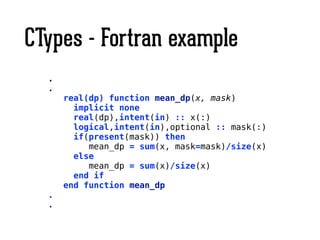
CTypes - Fortran example
.
.
real(dp) function mean_dp(x, mask)
implicit none
real(dp),intent(in) :: x(:)
logical,intent(in),optional :: mask(:)
if(present(mask)) then
mean_dp = sum(x, mask=mask)/size(x)
else
mean_dp = sum(x)/size(x)
end if
end function mean_dp
.
.
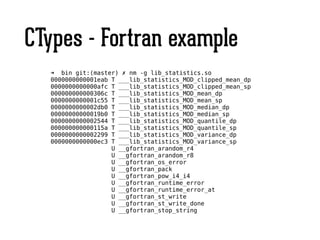
CTypes - Fortran example
➜ bin git:(master) ✗ nm -g lib_statistics.so
0000000000001eab T ___lib_statistics_MOD_clipped_mean_dp
0000000000000afc T ___lib_statistics_MOD_clipped_mean_sp
000000000000306c T ___lib_statistics_MOD_mean_dp
0000000000001c55 T ___lib_statistics_MOD_mean_sp
0000000000002db0 T ___lib_statistics_MOD_median_dp
00000000000019b0 T ___lib_statistics_MOD_median_sp
0000000000002544 T ___lib_statistics_MOD_quantile_dp
000000000000115a T ___lib_statistics_MOD_quantile_sp
0000000000002299 T ___lib_statistics_MOD_variance_dp
0000000000000ec3 T ___lib_statistics_MOD_variance_sp
U __gfortran_arandom_r4
U __gfortran_arandom_r8
U __gfortran_os_error
U __gfortran_pack
U __gfortran_pow_i4_i4
U __gfortran_runtime_error
U __gfortran_runtime_error_at
U __gfortran_st_write
U __gfortran_st_write_done
U __gfortran_stop_string
CTypes - Fortran example
from ctypes import *
!
# Statistics fortran lib
st_lib = CDLL(“lib_statistics.so")
!
mean = st_lib.__lib_statistics_MOD_mean_dp
mean.argtypes = [POINTER(c_float*2)]
mean.restype = c_float
!
vals = (c_float*2)(2.0, 3.0)
!
print mean(vals)
CTypes
static PyObject *py_dl_open(PyObject *self, PyObject *args)
{
char *name;
void * handle;
#ifdef RTLD_LOCAL
int mode = RTLD_NOW | RTLD_LOCAL;
#else
/* cygwin doesn't define RTLD_LOCAL */
int mode = RTLD_NOW;
#endif
if (!PyArg_ParseTuple(args, "z|i:dlopen", &name, &mode))
return NULL;
mode |= RTLD_NOW;
handle = ctypes_dlopen(name, mode);
if (!handle) {
char *errmsg = ctypes_dlerror();
if (!errmsg)
errmsg = "dlopen() error";
PyErr_SetString(PyExc_OSError,
errmsg);
return NULL;
}
return PyLong_FromVoidPtr(handle);
}
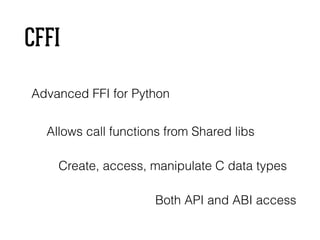
CFFI
Advanced FFI for Python
Allows call functions from Shared libs
Create, access, manipulate C data types
Both API and ABI access
CFFI
Mostly the same as CTypes
CFFI
Recommended way to extend PyPy
CFFI - ABI
from cffi import FFI
ffi = FFI()
ffi.cdef("""
int printf(const char *format, …);""")
C = ffi.dlopen(None)
arg = ffi.new("char[]", "world")
C.printf("hi there, %s!n", arg)
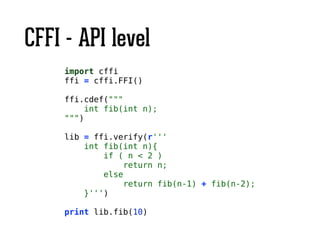
CFFI - API level
import cffi
ffi = cffi.FFI()
!
ffi.cdef("""
int fib(int n);
""")
!
lib = ffi.verify(r'''
int fib(int n){
if ( n < 2 )
return n;
else
return fib(n-1) + fib(n-2);
}''')
!
print lib.fib(10)
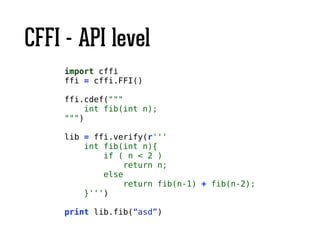
CFFI - API level
import cffi
ffi = cffi.FFI()
!
ffi.cdef("""
int fib(int n);
""")
!
lib = ffi.verify(r'''
int fib(int n){
if ( n < 2 )
return n;
else
return fib(n-1) + fib(n-2);
}''')
!
print lib.fib(“asd”)
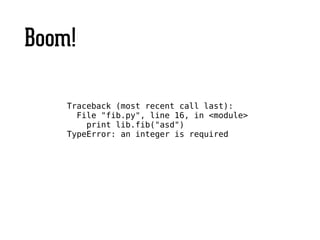
Boom!
Traceback (most recent call last):
File "fib.py", line 16, in <module>
print lib.fib("asd")
TypeError: an integer is required
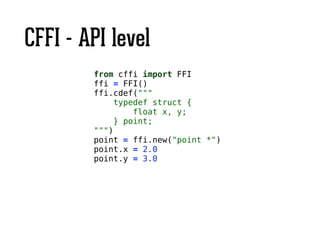
CFFI - API level
from cffi import FFI
ffi = FFI()
ffi.cdef("""
typedef struct {
float x, y;
} point;
""")
point = ffi.new("point *")
point.x = 2.0
point.y = 3.0
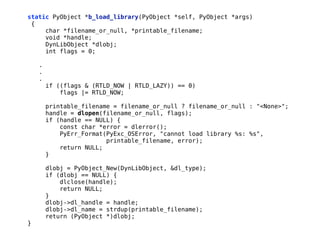
static PyObject *b_load_library(PyObject *self, PyObject *args)
{
char *filename_or_null, *printable_filename;
void *handle;
DynLibObject *dlobj;
int flags = 0;
!
.
.
.
if ((flags & (RTLD_NOW | RTLD_LAZY)) == 0)
flags |= RTLD_NOW;
!
printable_filename = filename_or_null ? filename_or_null : "<None>";
handle = dlopen(filename_or_null, flags);
if (handle == NULL) {
const char *error = dlerror();
PyErr_Format(PyExc_OSError, "cannot load library %s: %s",
printable_filename, error);
return NULL;
}
!
dlobj = PyObject_New(DynLibObject, &dl_type);
if (dlobj == NULL) {
dlclose(handle);
return NULL;
}
dlobj->dl_handle = handle;
dlobj->dl_name = strdup(printable_filename);
return (PyObject *)dlobj;
}
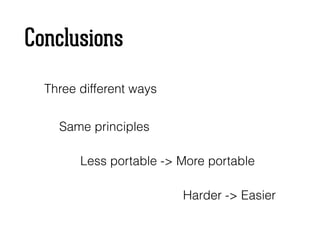
Conclusions
Three different ways
Same principles
Less portable -> More portable
Harder -> Easier
Questions?
Danke!

Extending Python - EuroPython 2014

  • 1.
    Extending Python Francisco FernándezCastaño! July 2014! EuroPython, Berlin! @fcofdezc
  • 2.
    Roadmap • Motivation • Guidelines •Native Extensions • Ctypes • CFFI • Conclusions
  • 3.
  • 4.
  • 5.
  • 6.
  • 7.
    Static libraries $ artv libdemo.a rw-r--r-- 501/20 40 Jul 19 22:34 2014 __.SYMDEF SORTED rw-r--r-- 501/20 2352 Jul 19 22:33 2014 a.o rw-r--r-- 501/20 2352 Jul 19 22:33 2014 b.o
  • 8.
    Shared libraries Single copyin memory Runtime load
  • 9.
  • 10.
  • 11.
  • 12.
    #include "Python.h" // sumfunction. static PyObject * sum(PyObject *self, PyObject *args) { PyObject *_a = 0; PyObject *_b = 0; PyObject *result = NULL; ! _a = PyTuple_GET_ITEM(args, 0); _b = PyTuple_GET_ITEM(args, 1); result = PyNumber_Add(_a, _b); ! return result; } // Module functions table. static PyMethodDef module_functions[] = { { "sum", sum, METH_VARARGS, "Sum docstring." }, { NULL } }; // This function is called to initialize the module. PyMODINIT_FUNC initsum(void) { Py_InitModule3("sum", module_functions, "Hello world module."); }
  • 13.
  • 14.
    static PyObject * sum(PyObject*self, PyObject *args) { PyObject *_a = 0; PyObject *_b = 0; PyObject *result = NULL; ! _a = PyTuple_GET_ITEM(args, 0); _b = PyTuple_GET_ITEM(args, 1); result = PyNumber_Add(_a, _b); ! return result; }
  • 15.
    // Module functionstable. static PyMethodDef module_functions[] = { { "sum", sum, METH_VARARGS, "Sum docstring." }, { NULL } };
  • 16.
    // This functionis called to initialize the module. PyMODINIT_FUNC initsum(void) { Py_InitModule3("sum", module_functions, "Hello world module."); }
  • 17.
    from distutils.core importsetup, Extension setup(name='sum', version=‘1.0', ext_modules=[Extension('sum', ['sum.c'])])
  • 18.
    $ python >>> importsum >>> sum.sum(2, 3) 5
  • 19.
    NAME dlopen -- loadand link a dynamic library or bundle ! SYNOPSIS #include <dlfcn.h> ! void* dlopen(const char* path, int mode);
  • 20.
    // Python/dynload_shlib.c . . handle =dlopen(pathname, dlopenflags); ! if (handle == NULL) { const char *error = dlerror(); if (error == NULL) error = "unknown dlopen() error"; PyErr_SetString(PyExc_ImportError, error); return NULL; } if (fp != NULL && nhandles < 128) handles[nhandles++].handle = handle; p = (dl_funcptr) dlsym(handle, funcname); return p; . . .
  • 21.
    Memory management Manual memorymanagement Python GC - RC Py_INCREF(x) | Py_DECREF(x) Cycle detector
  • 22.
    Error management Return NULLpointer as convention Register Exceptions
  • 23.
    Error management . . . if (err< 0) { PyErr_SetString(PyExc_Exception, "Command failed"); return NULL; } . . .
  • 24.
    Python 3 differences ! staticstruct PyModuleDef examplemodule = { PyModuleDef_HEAD_INIT, "sum", "sum module doc string", -1, module_functions, NULL, NULL, NULL, NULL }; ! PyMODINIT_FUNC PyInit_sum(void) { PyModule_Create(&examplemodule); }
  • 25.
    CTypes Advanced FFI forPython Allows call functions from Shared libs Create, access, manipulate C data types
  • 26.
    CTypes ctypes type Ctype c_bool _Bool c_char char c_wchar wchar_t c_byte char c_ubyte unsigned char c_short short c_ushort unsigned short c_int int c_uint unsigned int c_long long c_ulong unsigned long c_longlong __int64 or long long c_ulonglong unsigned __int64 or unsigned long long c_float float c_double double c_longdouble long double c_char_p char * (NUL terminated) c_wchar_p wchar_t * (NUL terminated) c_void_p void *
  • 27.
    CTypes - structs fromctypes import * class POINT(Structure): _fields_ = [("x", c_int), ("y", c_int)] ! class RECT(Structure): _fields_ = [("upperleft", POINT), ("lowerright", POINT)]
  • 28.
    CTypes - example Implementedfibonacci as c function Map as Python code Measure differences between Python and C
  • 29.
    CTypes - example intfib(int n){ if ( n < 2 ) return n; else return fib(n-1) + fib(n-2); }
  • 30.
    CTypes - example importctypes lib_fib = ctypes.CDLL("libfib.so") ! def ctypes_fib(n): return lib_fib.fib(ctypes.c_int(n)) ! def py_fib(n): if n < 2: return n else: return py_fib(n-1) + py_fib(n-2)
  • 31.
    CTypes - times In[3]: %timeit fib.ctypes_fib(20) 10000 loops, best of 3: 63.8 µs per loop ! In [4]: %timeit fib.py_fib(20) 100 loops, best of 3: 3.62 ms per loop
  • 32.
    CTypes - Fortranexample Use of existing fortran code Take random code at github https://github.com/astrofrog/fortranlib Wrap using ctypes
  • 33.
    CTypes - Fortranexample . . real(dp) function mean_dp(x, mask) implicit none real(dp),intent(in) :: x(:) logical,intent(in),optional :: mask(:) if(present(mask)) then mean_dp = sum(x, mask=mask)/size(x) else mean_dp = sum(x)/size(x) end if end function mean_dp . .
  • 34.
    CTypes - Fortranexample ➜ bin git:(master) ✗ nm -g lib_statistics.so 0000000000001eab T ___lib_statistics_MOD_clipped_mean_dp 0000000000000afc T ___lib_statistics_MOD_clipped_mean_sp 000000000000306c T ___lib_statistics_MOD_mean_dp 0000000000001c55 T ___lib_statistics_MOD_mean_sp 0000000000002db0 T ___lib_statistics_MOD_median_dp 00000000000019b0 T ___lib_statistics_MOD_median_sp 0000000000002544 T ___lib_statistics_MOD_quantile_dp 000000000000115a T ___lib_statistics_MOD_quantile_sp 0000000000002299 T ___lib_statistics_MOD_variance_dp 0000000000000ec3 T ___lib_statistics_MOD_variance_sp U __gfortran_arandom_r4 U __gfortran_arandom_r8 U __gfortran_os_error U __gfortran_pack U __gfortran_pow_i4_i4 U __gfortran_runtime_error U __gfortran_runtime_error_at U __gfortran_st_write U __gfortran_st_write_done U __gfortran_stop_string
  • 35.
    CTypes - Fortranexample from ctypes import * ! # Statistics fortran lib st_lib = CDLL(“lib_statistics.so") ! mean = st_lib.__lib_statistics_MOD_mean_dp mean.argtypes = [POINTER(c_float*2)] mean.restype = c_float ! vals = (c_float*2)(2.0, 3.0) ! print mean(vals)
  • 36.
    CTypes static PyObject *py_dl_open(PyObject*self, PyObject *args) { char *name; void * handle; #ifdef RTLD_LOCAL int mode = RTLD_NOW | RTLD_LOCAL; #else /* cygwin doesn't define RTLD_LOCAL */ int mode = RTLD_NOW; #endif if (!PyArg_ParseTuple(args, "z|i:dlopen", &name, &mode)) return NULL; mode |= RTLD_NOW; handle = ctypes_dlopen(name, mode); if (!handle) { char *errmsg = ctypes_dlerror(); if (!errmsg) errmsg = "dlopen() error"; PyErr_SetString(PyExc_OSError, errmsg); return NULL; } return PyLong_FromVoidPtr(handle); }
  • 37.
    CFFI Advanced FFI forPython Allows call functions from Shared libs Create, access, manipulate C data types Both API and ABI access
  • 38.
  • 39.
  • 40.
    CFFI - ABI fromcffi import FFI ffi = FFI() ffi.cdef(""" int printf(const char *format, …);""") C = ffi.dlopen(None) arg = ffi.new("char[]", "world") C.printf("hi there, %s!n", arg)
  • 41.
    CFFI - APIlevel import cffi ffi = cffi.FFI() ! ffi.cdef(""" int fib(int n); """) ! lib = ffi.verify(r''' int fib(int n){ if ( n < 2 ) return n; else return fib(n-1) + fib(n-2); }''') ! print lib.fib(10)
  • 42.
    CFFI - APIlevel import cffi ffi = cffi.FFI() ! ffi.cdef(""" int fib(int n); """) ! lib = ffi.verify(r''' int fib(int n){ if ( n < 2 ) return n; else return fib(n-1) + fib(n-2); }''') ! print lib.fib(“asd”)
  • 43.
    Boom! Traceback (most recentcall last): File "fib.py", line 16, in <module> print lib.fib("asd") TypeError: an integer is required
  • 44.
    CFFI - APIlevel from cffi import FFI ffi = FFI() ffi.cdef(""" typedef struct { float x, y; } point; """) point = ffi.new("point *") point.x = 2.0 point.y = 3.0
  • 45.
    static PyObject *b_load_library(PyObject*self, PyObject *args) { char *filename_or_null, *printable_filename; void *handle; DynLibObject *dlobj; int flags = 0; ! . . . if ((flags & (RTLD_NOW | RTLD_LAZY)) == 0) flags |= RTLD_NOW; ! printable_filename = filename_or_null ? filename_or_null : "<None>"; handle = dlopen(filename_or_null, flags); if (handle == NULL) { const char *error = dlerror(); PyErr_Format(PyExc_OSError, "cannot load library %s: %s", printable_filename, error); return NULL; } ! dlobj = PyObject_New(DynLibObject, &dl_type); if (dlobj == NULL) { dlclose(handle); return NULL; } dlobj->dl_handle = handle; dlobj->dl_name = strdup(printable_filename); return (PyObject *)dlobj; }
  • 46.
    Conclusions Three different ways Sameprinciples Less portable -> More portable Harder -> Easier
  • 47.
  • 48.