NITESH KUMAR PANDEY
STORAGE CLASS

 The storage class determines the part of the memory
  where the variable would be stored.
 The storage class also determines the initial value of
  the variable.
 and it used to define the scope and lifetime of
  variable.
 There are two storage location in computer :
   CPU Registers and Memory
CPU REGISTER AND MEMORY

 A value stored in a CPU register can always be
 accessed faster then the one that is stored in
 memory.
TYPES OF STORAGE CLASSES

There are four types of storage classes in C:
i.   Automatic storage class
ii.   Register storage class
iii.  Static storage class
iv.   External storage class
Automatic Storage Class

 Keywords                : auto.
 Storage                  : memory.
 Default initial value     : garbage value.
 Scope                     : local to the block in
                                which the variable is
                                defined.
 Life                     : till the control remains
                                within the block in which
                                the variable is defined.
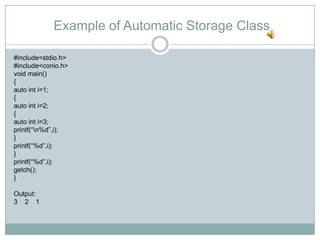
Example of Automatic Storage Class

#include<stdio.h>
#include<conio.h>
void main()
{
auto int i=1;
{
auto int i=2;
{
auto int i=3;
printf(“n%d”,i);
}
printf(“%d”,i);
}
printf(“%d”,i);
getch();
}

Output:
3 2 1
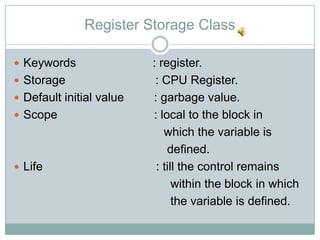
Register Storage Class

 Keywords                : register.
 Storage                  : CPU Register.
 Default initial value   : garbage value.
 Scope                   : local to the block in
                             which the variable is
                              defined.
 Life                     : till the control remains
                                within the block in which
                                the variable is defined.
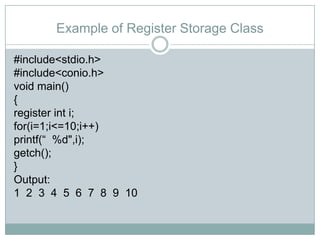
Example of Register Storage Class

#include<stdio.h>
#include<conio.h>
void main()
{
register int i;
for(i=1;i<=10;i++)
printf(“ %d",i);
getch();
}
Output:
1 2 3 4 5 6 7 8 9 10
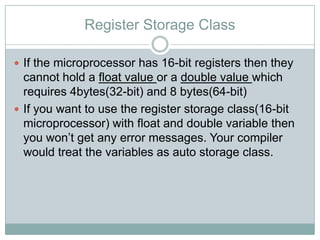
Register Storage Class

 If the microprocessor has 16-bit registers then they
  cannot hold a float value or a double value which
  requires 4bytes(32-bit) and 8 bytes(64-bit)
 If you want to use the register storage class(16-bit
  microprocessor) with float and double variable then
  you won‟t get any error messages. Your compiler
  would treat the variables as auto storage class.
Static Storage Class

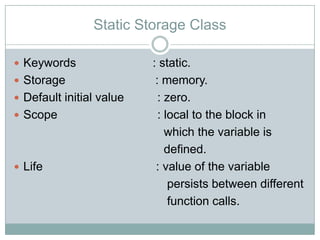
 Keywords                : static.
 Storage                  : memory.
 Default initial value     : zero.
 Scope                     : local to the block in
                              which the variable is
                              defined.
 Life                     : value of the variable
                               persists between different
                               function calls.
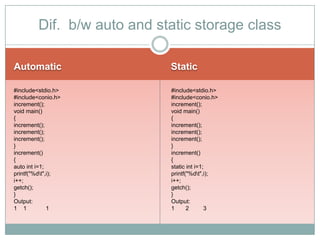
Dif. b/w auto and static storage class

Automatic                   Static

#include<stdio.h>           #include<stdio.h>
#include<conio.h>           #include<conio.h>
increment();                increment();
void main()                 void main()
{                           {
increment();                increment();
}                           }
increment()                 increment()
{                           {
auto int i=1;               static int i=1;
printf("%dt",i);           printf("%dt",i);
i++;                        i++;
getch();                    getch();
}                           }
Output:                     Output:
1 1           1             1      2       3
External Storage Class

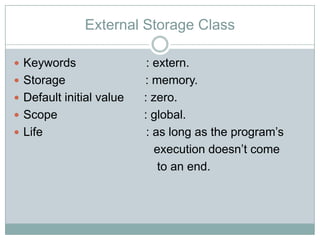
 Keywords                 : extern.
 Storage                 : memory.
 Default initial value   : zero.
 Scope                   : global.
 Life                     : as long as the program‟s
                             execution doesn‟t come
                              to an end.
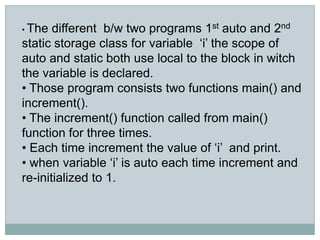
• The  different b/w two programs 1st auto and 2nd
static storage class for variable „i‟ the scope of
auto and static both use local to the block in witch
the variable is declared.
• Those program consists two functions main() and
increment().
• The increment() function called from main()
function for three times.
• Each time increment the value of „i‟ and print.
• when variable „i‟ is auto each time increment and
re-initialized to 1.
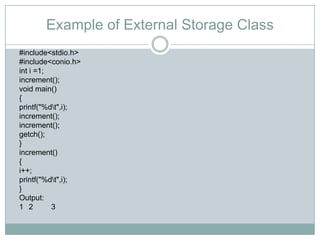
Example of External Storage Class
#include<stdio.h>
#include<conio.h>
int i =1;
increment();
void main()
{
printf("%dt",i);
increment();
increment();
getch();
}
increment()
{
i++;
printf("%dt",i);
}
Output:
1 2       3
Storage class in C Language

Storage class in C Language

  • 1.
  • 2.
    STORAGE CLASS  Thestorage class determines the part of the memory where the variable would be stored.  The storage class also determines the initial value of the variable.  and it used to define the scope and lifetime of variable.  There are two storage location in computer : CPU Registers and Memory
  • 3.
    CPU REGISTER ANDMEMORY  A value stored in a CPU register can always be accessed faster then the one that is stored in memory.
  • 4.
    TYPES OF STORAGECLASSES There are four types of storage classes in C: i. Automatic storage class ii. Register storage class iii. Static storage class iv. External storage class
  • 5.
    Automatic Storage Class Keywords : auto.  Storage : memory.  Default initial value : garbage value.  Scope : local to the block in which the variable is defined.  Life : till the control remains within the block in which the variable is defined.
  • 6.
    Example of AutomaticStorage Class #include<stdio.h> #include<conio.h> void main() { auto int i=1; { auto int i=2; { auto int i=3; printf(“n%d”,i); } printf(“%d”,i); } printf(“%d”,i); getch(); } Output: 3 2 1
  • 7.
    Register Storage Class Keywords : register.  Storage : CPU Register.  Default initial value : garbage value.  Scope : local to the block in which the variable is defined.  Life : till the control remains within the block in which the variable is defined.
  • 8.
    Example of RegisterStorage Class #include<stdio.h> #include<conio.h> void main() { register int i; for(i=1;i<=10;i++) printf(“ %d",i); getch(); } Output: 1 2 3 4 5 6 7 8 9 10
  • 9.
    Register Storage Class If the microprocessor has 16-bit registers then they cannot hold a float value or a double value which requires 4bytes(32-bit) and 8 bytes(64-bit)  If you want to use the register storage class(16-bit microprocessor) with float and double variable then you won‟t get any error messages. Your compiler would treat the variables as auto storage class.
  • 10.
    Static Storage Class Keywords : static.  Storage : memory.  Default initial value : zero.  Scope : local to the block in which the variable is defined.  Life : value of the variable persists between different function calls.
  • 11.
    Dif. b/w autoand static storage class Automatic Static #include<stdio.h> #include<stdio.h> #include<conio.h> #include<conio.h> increment(); increment(); void main() void main() { { increment(); increment(); increment(); increment(); increment(); increment(); } } increment() increment() { { auto int i=1; static int i=1; printf("%dt",i); printf("%dt",i); i++; i++; getch(); getch(); } } Output: Output: 1 1 1 1 2 3
  • 12.
    External Storage Class Keywords : extern.  Storage : memory.  Default initial value : zero.  Scope : global.  Life : as long as the program‟s execution doesn‟t come to an end.
  • 13.
    • The different b/w two programs 1st auto and 2nd static storage class for variable „i‟ the scope of auto and static both use local to the block in witch the variable is declared. • Those program consists two functions main() and increment(). • The increment() function called from main() function for three times. • Each time increment the value of „i‟ and print. • when variable „i‟ is auto each time increment and re-initialized to 1.
  • 14.
    Example of ExternalStorage Class #include<stdio.h> #include<conio.h> int i =1; increment(); void main() { printf("%dt",i); increment(); increment(); getch(); } increment() { i++; printf("%dt",i); } Output: 1 2 3