Marketing Process
The Marketing Process
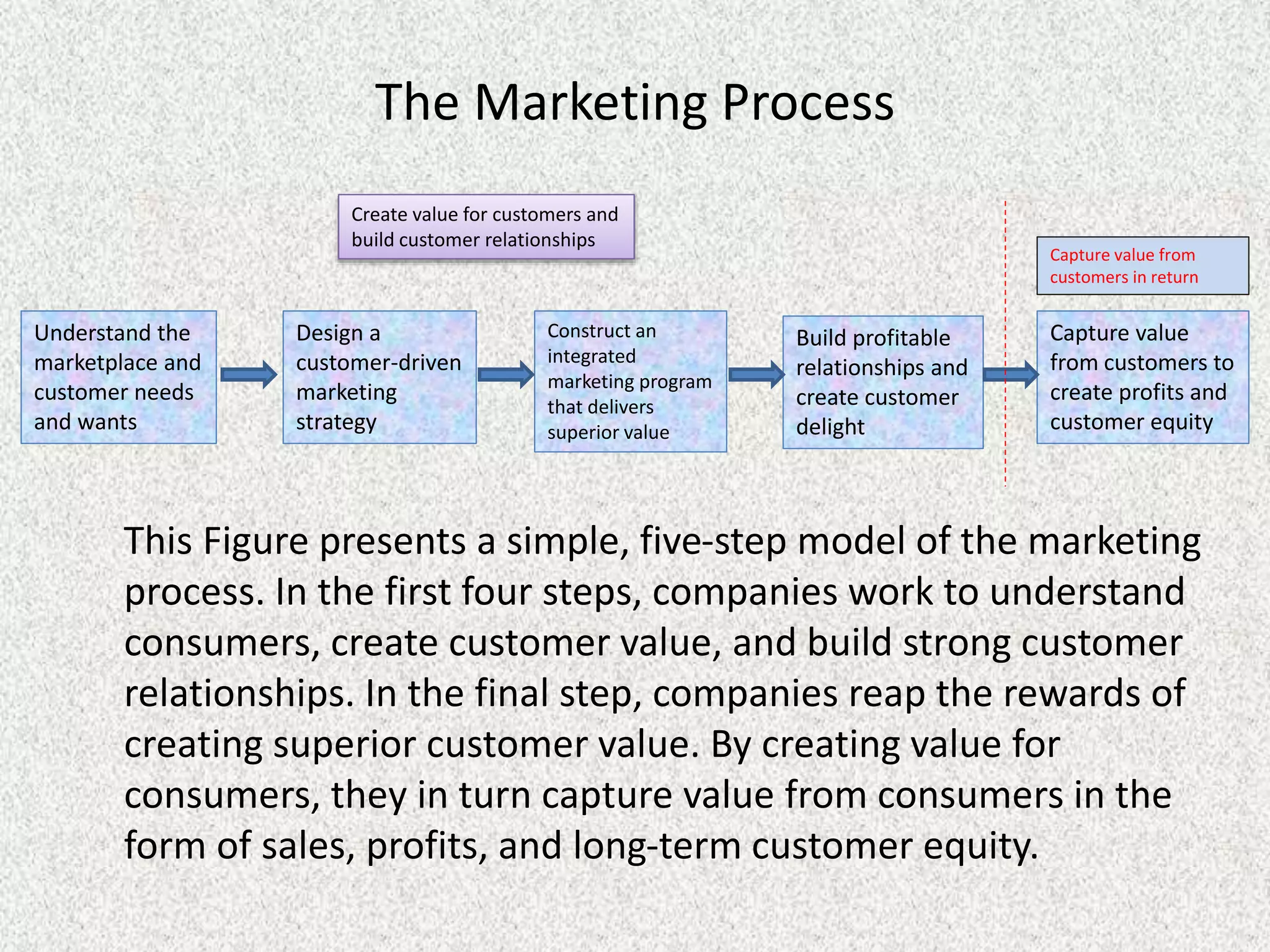
This Figure presents a simple, five-step model of the marketing
process. In the first four steps, companies work to understand
consumers, create customer value, and build strong customer
relationships. In the final step, companies reap the rewards of
creating superior customer value. By creating value for
consumers, they in turn capture value from consumers in the
form of sales, profits, and long-term customer equity.
Understand the
marketplace and
customer needs
and wants
Design a
customer-driven
marketing
strategy
Construct an
integrated
marketing program
that delivers
superior value
Build profitable
relationships and
create customer
delight
Capture value
from customers to
create profits and
customer equity
Capture value from
customers in return
Create value for customers and
build customer relationships
Understanding the Marketplace and Customer
Needs
As a first step, marketers need to understand
customer needs and wants and the marketplace in
which they operate. We examine five core customer
and marketplace concepts:
(1) needs, wants, and demands;
(2) market offerings (products, services, and experiences);
(3) value and satisfaction;
(4) exchanges and relationships; and
(5) markets.
1. Needs, Wants, and Demands
Need: State of felt deprivation including physical,
social, and individual needs.
• Physical needs: Food, clothing, shelter, safety
• Social needs: Belonging, affection
• Individual needs: Learning, knowledge, self-
expression
Want: Form that a human need takes, as
shaped by culture and individual
personality.
• Wants + Buying Power = Demand
2. Market Offering
Needs & wants are fulfilled through a Marketing Offering:
• Products:
– Persons, places, organizations, information, ideas.
• Services:
– Activity or benefit offered for sale that is essentially intangible and
does not result in ownership.
• Experiences:
– Consumers live the offering.
3. Value and Satisfaction
Value = Benefits/Cost
Where, Benefits = (Functional + Emotional) benefits
And, Costs = (Monetary + Time + Energy + Psychic) costs
Customer satisfaction Dependent on the product’s perceived
performance relative to a buyer’s expectations.
Care must be taken when setting expectations:
• If performance is lower than expectations, satisfaction is low.
• If performance is higher than expectations, satisfaction is high.
Customer satisfaction often leads to consumer loyalty.
Some firms seek to DELIGHT customers by exceeding expectations.
Factors That Affect Customer
Satisfaction
Overall
Customer
Satisfaction
Courteous Employees
Knowledgeable Employees
Friendly Employees
Helpful Employees
Accuracy of Billing
Quick Service
Courteous Employees
Billing Clarity Billing Timeliness
Good Value Competitive Pricing
4. Exchanges and Relationships
Marketing occurs when people decide to satisfy needs and wants
through exchange relationships. Exchange is the act of obtaining a
desired object from someone by offering something in return. In
the broadest sense, the marketer tries to bring about a response to
some market offering. The response may be more than simply
buying or trading products and services. A political candidate, for
instance, wants votes, a church wants membership, an orchestra
wants an audience, and a social action group wants idea
acceptance.
Marketing consists of actions taken to build and maintain desirable
exchange relationships with target audiences involving a product,
service, idea, or other object. Beyond simply attracting new
customers and creating transactions, companies want to retain
customers and grow their businesses. Marketers want to build
strong relationships by consistently delivering superior customer
value. We will expand on the important concept of managing
customer relationships later in the chapter.
5. Markets
• The concepts of exchange and relationships lead to the
concept of a market. A market is the set of actual and
potential buyers of a product or service. These buyers
share a particular need or want that can be satisfied
through exchange relationships.
• Marketing means managing markets to bring about
profitable customer relationships. However, creating
these relationships takes work. Sellers must search for
buyers, identify their needs, design good market
offerings, set prices for them, promote them, and store
and deliver them. Activities such as consumer research,
product development, communication, distribution,
pricing, and service are core marketing activities.
A Simple Marketing System
Marketing Concept:
 Marketing management wants to design strategies that will
build profitable relationships with target consumers. There
are five alternative concepts under which organizations design
and carry out their marketing strategies:
1. The production concept,
2. The product concept,
3. The selling concept,
4. The marketing concept,
5. The societal marketing concepts.
1. The Production Concept
•The production concept holds that
consumers will favor products that are
available and highly affordable.
•Therefore, management should focus on
improving production and distribution
efficiency.
•This concept is one of the oldest
orientations that guides sellers.
2. The Product Concept
• The product concept holds that consumers
will favor products that offer the most in
quality, performance, and innovative features.
• Under this concept, marketing strategy
focuses on making continuous product
improvements.
• Product quality and improvement are
important parts of most marketing strategies.
3. The Selling Concept
• Many companies follow the selling concept,
which holds that consumers will not buy enough
of the firm’s products unless it undertakes a
large-scale selling and promotion effort.
• The selling concept is typically practiced with
unsought goods—those that buyers do not
normally think of buying, such as insurance or
blood donations.
• These industries must be good at tracking down
prospects and selling them on a product’s
benefits.
• The marketing concept holds that achieving organizational
goals depends on knowing the needs and wants of target
markets and delivering the desired satisfactions better than
competitors do.
• Under the marketing concept, customer focus and value are
the paths to sales and profits.
• Implementing the marketing concept often means more than
simply responding to customers’ stated desires and obvious
needs.
• Customer-driven companies research current customers
deeply to learn about their desires, gather new product and
service ideas, and test proposed product improvements.
• Such customer-driven marketing usually works well when a
clear need exists and when customers know what they want
4. The Marketing Concept
Md.Ahsan Habib, Lecture, Dept. of TM,
BUTex
The selling concept takes an
inside-out view that focuses
on existing products and
heavy selling. The aim is to
sell what the company makes
rather than making what the
customer wants.
The marketing concept takes an
outside-in view that focuses on
satisfying customer needs as a
path to profits. As Southwest
Airlines’ colorful founder puts it,
“We don’t have a marketing
department, we have a
customer department.
• The societal marketing concept questions whether the
pure marketing concept overlooks possible conflicts
between consumer short-run wants and consumer
long-run welfare.
• The societal marketing concept holds that marketing
strategy should deliver value to customers in a way
that maintains or improves both the consumer’s and
society’s well-being.
• It calls for sustainable marketing, socially and
environmentally responsible marketing that meets the
present needs of consumers and businesses while also
preserving or enhancing the ability of future
generations to meet their needs.
5. The Societal Marketing Concept
Societal
marketing
concept
Consumers
Want satisfaction)
Company
(Profits)
Society
(Human welfare)
Thanks For your attention

Marketing Process

  • 1.
  • 3.
    The Marketing Process ThisFigure presents a simple, five-step model of the marketing process. In the first four steps, companies work to understand consumers, create customer value, and build strong customer relationships. In the final step, companies reap the rewards of creating superior customer value. By creating value for consumers, they in turn capture value from consumers in the form of sales, profits, and long-term customer equity. Understand the marketplace and customer needs and wants Design a customer-driven marketing strategy Construct an integrated marketing program that delivers superior value Build profitable relationships and create customer delight Capture value from customers to create profits and customer equity Capture value from customers in return Create value for customers and build customer relationships
  • 4.
    Understanding the Marketplaceand Customer Needs As a first step, marketers need to understand customer needs and wants and the marketplace in which they operate. We examine five core customer and marketplace concepts: (1) needs, wants, and demands; (2) market offerings (products, services, and experiences); (3) value and satisfaction; (4) exchanges and relationships; and (5) markets.
  • 5.
    1. Needs, Wants,and Demands Need: State of felt deprivation including physical, social, and individual needs. • Physical needs: Food, clothing, shelter, safety • Social needs: Belonging, affection • Individual needs: Learning, knowledge, self- expression Want: Form that a human need takes, as shaped by culture and individual personality. • Wants + Buying Power = Demand
  • 6.
    2. Market Offering Needs& wants are fulfilled through a Marketing Offering: • Products: – Persons, places, organizations, information, ideas. • Services: – Activity or benefit offered for sale that is essentially intangible and does not result in ownership. • Experiences: – Consumers live the offering.
  • 7.
    3. Value andSatisfaction Value = Benefits/Cost Where, Benefits = (Functional + Emotional) benefits And, Costs = (Monetary + Time + Energy + Psychic) costs Customer satisfaction Dependent on the product’s perceived performance relative to a buyer’s expectations. Care must be taken when setting expectations: • If performance is lower than expectations, satisfaction is low. • If performance is higher than expectations, satisfaction is high. Customer satisfaction often leads to consumer loyalty. Some firms seek to DELIGHT customers by exceeding expectations.
  • 8.
    Factors That AffectCustomer Satisfaction Overall Customer Satisfaction Courteous Employees Knowledgeable Employees Friendly Employees Helpful Employees Accuracy of Billing Quick Service Courteous Employees Billing Clarity Billing Timeliness Good Value Competitive Pricing
  • 9.
    4. Exchanges andRelationships Marketing occurs when people decide to satisfy needs and wants through exchange relationships. Exchange is the act of obtaining a desired object from someone by offering something in return. In the broadest sense, the marketer tries to bring about a response to some market offering. The response may be more than simply buying or trading products and services. A political candidate, for instance, wants votes, a church wants membership, an orchestra wants an audience, and a social action group wants idea acceptance. Marketing consists of actions taken to build and maintain desirable exchange relationships with target audiences involving a product, service, idea, or other object. Beyond simply attracting new customers and creating transactions, companies want to retain customers and grow their businesses. Marketers want to build strong relationships by consistently delivering superior customer value. We will expand on the important concept of managing customer relationships later in the chapter.
  • 10.
    5. Markets • Theconcepts of exchange and relationships lead to the concept of a market. A market is the set of actual and potential buyers of a product or service. These buyers share a particular need or want that can be satisfied through exchange relationships. • Marketing means managing markets to bring about profitable customer relationships. However, creating these relationships takes work. Sellers must search for buyers, identify their needs, design good market offerings, set prices for them, promote them, and store and deliver them. Activities such as consumer research, product development, communication, distribution, pricing, and service are core marketing activities.
  • 11.
  • 12.
    Marketing Concept:  Marketingmanagement wants to design strategies that will build profitable relationships with target consumers. There are five alternative concepts under which organizations design and carry out their marketing strategies: 1. The production concept, 2. The product concept, 3. The selling concept, 4. The marketing concept, 5. The societal marketing concepts.
  • 13.
    1. The ProductionConcept •The production concept holds that consumers will favor products that are available and highly affordable. •Therefore, management should focus on improving production and distribution efficiency. •This concept is one of the oldest orientations that guides sellers.
  • 14.
    2. The ProductConcept • The product concept holds that consumers will favor products that offer the most in quality, performance, and innovative features. • Under this concept, marketing strategy focuses on making continuous product improvements. • Product quality and improvement are important parts of most marketing strategies.
  • 15.
    3. The SellingConcept • Many companies follow the selling concept, which holds that consumers will not buy enough of the firm’s products unless it undertakes a large-scale selling and promotion effort. • The selling concept is typically practiced with unsought goods—those that buyers do not normally think of buying, such as insurance or blood donations. • These industries must be good at tracking down prospects and selling them on a product’s benefits.
  • 16.
    • The marketingconcept holds that achieving organizational goals depends on knowing the needs and wants of target markets and delivering the desired satisfactions better than competitors do. • Under the marketing concept, customer focus and value are the paths to sales and profits. • Implementing the marketing concept often means more than simply responding to customers’ stated desires and obvious needs. • Customer-driven companies research current customers deeply to learn about their desires, gather new product and service ideas, and test proposed product improvements. • Such customer-driven marketing usually works well when a clear need exists and when customers know what they want 4. The Marketing Concept Md.Ahsan Habib, Lecture, Dept. of TM, BUTex
  • 17.
    The selling concepttakes an inside-out view that focuses on existing products and heavy selling. The aim is to sell what the company makes rather than making what the customer wants. The marketing concept takes an outside-in view that focuses on satisfying customer needs as a path to profits. As Southwest Airlines’ colorful founder puts it, “We don’t have a marketing department, we have a customer department.
  • 18.
    • The societalmarketing concept questions whether the pure marketing concept overlooks possible conflicts between consumer short-run wants and consumer long-run welfare. • The societal marketing concept holds that marketing strategy should deliver value to customers in a way that maintains or improves both the consumer’s and society’s well-being. • It calls for sustainable marketing, socially and environmentally responsible marketing that meets the present needs of consumers and businesses while also preserving or enhancing the ability of future generations to meet their needs. 5. The Societal Marketing Concept
  • 19.
  • 20.
    Thanks For yourattention