MARKET OPPORTUNITY AND
CONSUMER ANALYSIS
Marikriz M. Paulino, MBA
MARKETING
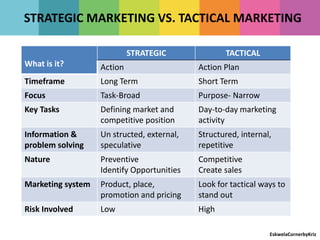
STRATEGIC MARKETING VS. TACTICAL MARKETING
What is it?
STRATEGIC TACTICAL
Action Action Plan
Timeframe Long Term Short Term
Focus Task-Broad Purpose- Narrow
Key Tasks Defining market and
competitive position
Day-to-day marketing
activity
Information &
problem solving
Un structed, external,
speculative
Structured, internal,
repetitive
Nature Preventive
Identify Opportunities
Competitive
Create sales
Marketing system Product, place,
promotion and pricing
Look for tactical ways to
stand out
Risk Involved Low High
EskwelaCornerbyKriz
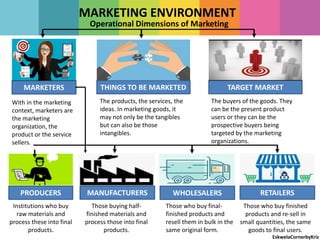
MARKETERS
PRODUCERS MANUFACTURERS WHOLESALERS RETAILERS
THINGS TO BE MARKETED TARGET MARKET
With in the marketing
context, marketers are
the marketing
organization, the
product or the service
sellers.
Institutions who buy
raw materials and
process these into final
products.
Those buying half-
finished materials and
process those into final
products.
Those who buy final-
finished products and
resell them in bulk in the
same original form.
Those who buy finished
products and re-sell in
small quantities, the same
goods to final users.
The products, the services, the
ideas. In marketing goods, it
may not only be the tangibles
but can also be those
intangibles.
The buyers of the goods. They
can be the present product
users or they can be the
prospective buyers being
targeted by the marketing
organizations.
Operational Dimensions of Marketing
MARKETING ENVIRONMENT
EskwelaCornerbyKriz
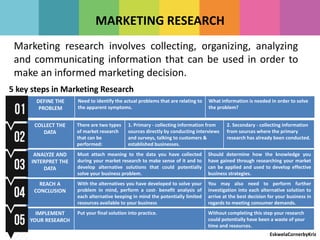
MARKETING RESEARCH
Marketing research involves collecting, organizing, analyzing
and communicating information that can be used in order to
make an informed marketing decision.
EskwelaCornerbyKriz
5 key steps in Marketing Research
COLLECT THE
DATA
There are two types
of market research
that can be
performed:
1. Primary - collecting information from
sources directly by conducting interviews
and surveys, talking to customers &
established businesses.
2. Secondary - collecting information
from sources where the primary
research has already been conducted.
ANALYZE AND
INTERPRET THE
DATA
Must attach meaning to the data you have collected
during your market research to make sense of it and to
develop alternative solutions that could potentially
solve your business problem.
Should determine how the knowledge you
have gained through researching your market
can be applied and used to develop effective
business strategies.
REACH A
CONCLUSION
With the alternatives you have developed to solve your
problem in mind, perform a cost- benefit analysis of
each alternative keeping in mind the potentially limited
resources available to your business
You may also need to perform further
investigation into each alternative solution to
arrive at the best decision for your business in
regards to meeting consumer demands.
DEFINE THE
PROBLEM
Need to identify the actual problems that are relating to
the apparent symptoms.
What information is needed in order to solve
the problem?
IMPLEMENT
YOUR RESEARCH
Put your final solution into practice. Without completing this step your research
could potentially have been a waste of your
time and resources.
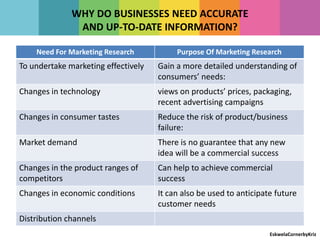
WHY DO BUSINESSES NEED ACCURATE
AND UP-TO-DATE INFORMATION?
Need For Marketing Research Purpose Of Marketing Research
To undertake marketing effectively Gain a more detailed understanding of
consumers’ needs:
Changes in technology views on products’ prices, packaging,
recent advertising campaigns
Changes in consumer tastes Reduce the risk of product/business
failure:
Market demand There is no guarantee that any new
idea will be a commercial success
Changes in the product ranges of
competitors
Can help to achieve commercial
success
Changes in economic conditions It can also be used to anticipate future
customer needs
Distribution channels
EskwelaCornerbyKriz
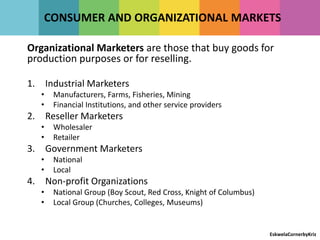
Organizational Marketers are those that buy goods for
production purposes or for reselling.
1. Industrial Marketers
• Manufacturers, Farms, Fisheries, Mining
• Financial Institutions, and other service providers
2. Reseller Marketers
• Wholesaler
• Retailer
3. Government Marketers
• National
• Local
4. Non-profit Organizations
• National Group (Boy Scout, Red Cross, Knight of Columbus)
• Local Group (Churches, Colleges, Museums)
CONSUMER AND ORGANIZATIONAL MARKETS
EskwelaCornerbyKriz
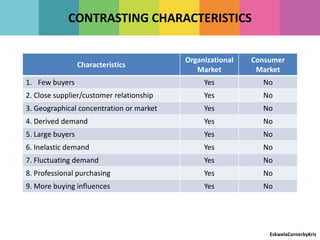
Characteristics
Organizational
Market
Consumer
Market
1. Few buyers Yes No
2. Close supplier/customer relationship Yes No
3. Geographical concentration or market Yes No
4. Derived demand Yes No
5. Large buyers Yes No
6. Inelastic demand Yes No
7. Fluctuating demand Yes No
8. Professional purchasing Yes No
9. More buying influences Yes No
CONTRASTING CHARACTERISTICS
EskwelaCornerbyKriz
EskwelaCornerbyKriz
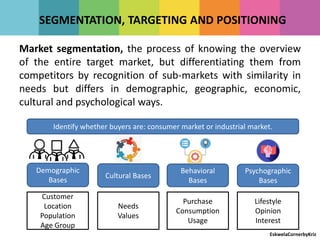
Market segmentation, the process of knowing the overview
of the entire target market, but differentiating them from
competitors by recognition of sub-markets with similarity in
needs but differs in demographic, geographic, economic,
cultural and psychological ways.
SEGMENTATION, TARGETING AND POSITIONING
EskwelaCornerbyKriz
Psychographic
Bases
Demographic
Bases
Cultural Bases
Behavioral
Bases
Identify whether buyers are: consumer market or industrial market.
Customer
Location
Population
Age Group
Needs
Values
Purchase
Consumption
Usage
Lifestyle
Opinion
Interest
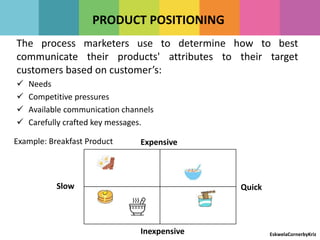
The process marketers use to determine how to best
communicate their products' attributes to their target
customers based on customer’s:
 Needs
 Competitive pressures
 Available communication channels
 Carefully crafted key messages.
Slow Quick
Expensive
Inexpensive
Example: Breakfast Product
EskwelaCornerbyKriz
PRODUCT POSITIONING
References:
 Raw pictures by Google Image
 Wikipedia
 Series of presentation in marketing
END OF THE SLIDE
EskwelaCornerbyKriz

Market opportunity and consumer analysis

  • 1.
    MARKET OPPORTUNITY AND CONSUMERANALYSIS Marikriz M. Paulino, MBA MARKETING
  • 2.
    STRATEGIC MARKETING VS.TACTICAL MARKETING What is it? STRATEGIC TACTICAL Action Action Plan Timeframe Long Term Short Term Focus Task-Broad Purpose- Narrow Key Tasks Defining market and competitive position Day-to-day marketing activity Information & problem solving Un structed, external, speculative Structured, internal, repetitive Nature Preventive Identify Opportunities Competitive Create sales Marketing system Product, place, promotion and pricing Look for tactical ways to stand out Risk Involved Low High EskwelaCornerbyKriz
  • 3.
    MARKETERS PRODUCERS MANUFACTURERS WHOLESALERSRETAILERS THINGS TO BE MARKETED TARGET MARKET With in the marketing context, marketers are the marketing organization, the product or the service sellers. Institutions who buy raw materials and process these into final products. Those buying half- finished materials and process those into final products. Those who buy final- finished products and resell them in bulk in the same original form. Those who buy finished products and re-sell in small quantities, the same goods to final users. The products, the services, the ideas. In marketing goods, it may not only be the tangibles but can also be those intangibles. The buyers of the goods. They can be the present product users or they can be the prospective buyers being targeted by the marketing organizations. Operational Dimensions of Marketing MARKETING ENVIRONMENT EskwelaCornerbyKriz
  • 4.
    MARKETING RESEARCH Marketing researchinvolves collecting, organizing, analyzing and communicating information that can be used in order to make an informed marketing decision. EskwelaCornerbyKriz 5 key steps in Marketing Research COLLECT THE DATA There are two types of market research that can be performed: 1. Primary - collecting information from sources directly by conducting interviews and surveys, talking to customers & established businesses. 2. Secondary - collecting information from sources where the primary research has already been conducted. ANALYZE AND INTERPRET THE DATA Must attach meaning to the data you have collected during your market research to make sense of it and to develop alternative solutions that could potentially solve your business problem. Should determine how the knowledge you have gained through researching your market can be applied and used to develop effective business strategies. REACH A CONCLUSION With the alternatives you have developed to solve your problem in mind, perform a cost- benefit analysis of each alternative keeping in mind the potentially limited resources available to your business You may also need to perform further investigation into each alternative solution to arrive at the best decision for your business in regards to meeting consumer demands. DEFINE THE PROBLEM Need to identify the actual problems that are relating to the apparent symptoms. What information is needed in order to solve the problem? IMPLEMENT YOUR RESEARCH Put your final solution into practice. Without completing this step your research could potentially have been a waste of your time and resources.
  • 5.
    WHY DO BUSINESSESNEED ACCURATE AND UP-TO-DATE INFORMATION? Need For Marketing Research Purpose Of Marketing Research To undertake marketing effectively Gain a more detailed understanding of consumers’ needs: Changes in technology views on products’ prices, packaging, recent advertising campaigns Changes in consumer tastes Reduce the risk of product/business failure: Market demand There is no guarantee that any new idea will be a commercial success Changes in the product ranges of competitors Can help to achieve commercial success Changes in economic conditions It can also be used to anticipate future customer needs Distribution channels EskwelaCornerbyKriz
  • 6.
    Organizational Marketers arethose that buy goods for production purposes or for reselling. 1. Industrial Marketers • Manufacturers, Farms, Fisheries, Mining • Financial Institutions, and other service providers 2. Reseller Marketers • Wholesaler • Retailer 3. Government Marketers • National • Local 4. Non-profit Organizations • National Group (Boy Scout, Red Cross, Knight of Columbus) • Local Group (Churches, Colleges, Museums) CONSUMER AND ORGANIZATIONAL MARKETS EskwelaCornerbyKriz
  • 7.
    Characteristics Organizational Market Consumer Market 1. Few buyersYes No 2. Close supplier/customer relationship Yes No 3. Geographical concentration or market Yes No 4. Derived demand Yes No 5. Large buyers Yes No 6. Inelastic demand Yes No 7. Fluctuating demand Yes No 8. Professional purchasing Yes No 9. More buying influences Yes No CONTRASTING CHARACTERISTICS EskwelaCornerbyKriz
  • 8.
  • 9.
    Market segmentation, theprocess of knowing the overview of the entire target market, but differentiating them from competitors by recognition of sub-markets with similarity in needs but differs in demographic, geographic, economic, cultural and psychological ways. SEGMENTATION, TARGETING AND POSITIONING EskwelaCornerbyKriz Psychographic Bases Demographic Bases Cultural Bases Behavioral Bases Identify whether buyers are: consumer market or industrial market. Customer Location Population Age Group Needs Values Purchase Consumption Usage Lifestyle Opinion Interest
  • 10.
    The process marketersuse to determine how to best communicate their products' attributes to their target customers based on customer’s:  Needs  Competitive pressures  Available communication channels  Carefully crafted key messages. Slow Quick Expensive Inexpensive Example: Breakfast Product EskwelaCornerbyKriz PRODUCT POSITIONING
  • 11.
    References:  Raw picturesby Google Image  Wikipedia  Series of presentation in marketing END OF THE SLIDE EskwelaCornerbyKriz