6–1
Decision-Making Biases and Errors
• Heuristics
– Using “rules of thumb” to simplify decision making.
• Overconfidence Bias
– Holding unrealistically positive views of one’s self and
one’s performance.
• Immediate Gratification Bias
– Choosing alternatives that offer immediate rewards
and that to avoid immediate costs.
6–2
Decision-Making Biases and Errors
(cont’d)
• Anchoring Effect
– Fixating on initial information and ignoring
subsequent information.
• Selective Perception Bias
– Selecting organizing and interpreting events
based on the decision maker’s biased
perceptions.
6–3
Decision-Making Biases and Errors
(cont’d)
• Framing Bias
– Selecting and highlighting certain aspects of a
situation while ignoring other aspects.
• Availability Bias
– Losing decision-making objectivity by focusing on
the most recent events.
6–4
Decision Making for Today’s World
• Guidelines for making effective decisions:
– Understand cultural differences.
– Know when it’s time to call it quits.
– Use an effective decision-making process.
6–5
Characteristics of an Effective
Decision-Making Process
• It focuses on what is important.
• It is logical and consistent.
• It acknowledges both subjective and objective thinking and
blends analytical with intuitive thinking.
• It requires only as much information and analysis as is
necessary to resolve a particular dilemma.
• It encourages and guides the gathering of relevant
information and informed opinion.
• It is straightforward, reliable, easy to use, and flexible.
FOM 4.6
Decision-making and Technology
• Information technology can help support
decision-making
• Types of software include
– Expert systems
– Neural networks
– Groupware
FOM 4.7
Analytical
BehaviouralDirective
Conceptual
Decision-Making Styles
Rational Intuitive
Way of Thinking
Low
Tolerancefor
Ambiguity
6–8
Decision-Making Styles (cont’d)
• Types of Decision Makers
– Directive
• Use minimal information and consider few alternatives.
– Analytic
• Make careful decisions in unique situations.
– Conceptual
• Maintain a broad outlook and consider many alternatives in
making decisions.
– Behavioral
• Avoid conflict by working well with others and being
receptive to suggestions.
FOM 4.9
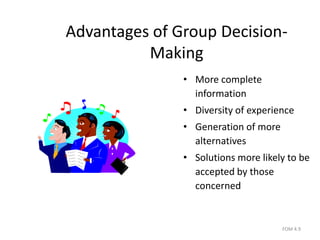
Advantages of Group Decision-
Making
• More complete
information
• Diversity of experience
• Generation of more
alternatives
• Solutions more likely to be
accepted by those
concerned
FOM 4.10
Disadvantages of Group Decision-
Making
• Time-consuming
• Domination by a few
• Pressure to conform
FOM 4.11
When are Groups More Effective
• When accuracy is important
• When creativity is important
• When buy-in is important
• When size of group is 5-7 people
FOM 4.12
Decision-Making and National Culture
• Differs from one country to another
• Need to recognize what is acceptable
• Managers can expect high payoff if they can
accommodate the diversity

Decsion making

  • 1.
    6–1 Decision-Making Biases andErrors • Heuristics – Using “rules of thumb” to simplify decision making. • Overconfidence Bias – Holding unrealistically positive views of one’s self and one’s performance. • Immediate Gratification Bias – Choosing alternatives that offer immediate rewards and that to avoid immediate costs.
  • 2.
    6–2 Decision-Making Biases andErrors (cont’d) • Anchoring Effect – Fixating on initial information and ignoring subsequent information. • Selective Perception Bias – Selecting organizing and interpreting events based on the decision maker’s biased perceptions.
  • 3.
    6–3 Decision-Making Biases andErrors (cont’d) • Framing Bias – Selecting and highlighting certain aspects of a situation while ignoring other aspects. • Availability Bias – Losing decision-making objectivity by focusing on the most recent events.
  • 4.
    6–4 Decision Making forToday’s World • Guidelines for making effective decisions: – Understand cultural differences. – Know when it’s time to call it quits. – Use an effective decision-making process.
  • 5.
    6–5 Characteristics of anEffective Decision-Making Process • It focuses on what is important. • It is logical and consistent. • It acknowledges both subjective and objective thinking and blends analytical with intuitive thinking. • It requires only as much information and analysis as is necessary to resolve a particular dilemma. • It encourages and guides the gathering of relevant information and informed opinion. • It is straightforward, reliable, easy to use, and flexible.
  • 6.
    FOM 4.6 Decision-making andTechnology • Information technology can help support decision-making • Types of software include – Expert systems – Neural networks – Groupware
  • 7.
  • 8.
    6–8 Decision-Making Styles (cont’d) •Types of Decision Makers – Directive • Use minimal information and consider few alternatives. – Analytic • Make careful decisions in unique situations. – Conceptual • Maintain a broad outlook and consider many alternatives in making decisions. – Behavioral • Avoid conflict by working well with others and being receptive to suggestions.
  • 9.
    FOM 4.9 Advantages ofGroup Decision- Making • More complete information • Diversity of experience • Generation of more alternatives • Solutions more likely to be accepted by those concerned
  • 10.
    FOM 4.10 Disadvantages ofGroup Decision- Making • Time-consuming • Domination by a few • Pressure to conform
  • 11.
    FOM 4.11 When areGroups More Effective • When accuracy is important • When creativity is important • When buy-in is important • When size of group is 5-7 people
  • 12.
    FOM 4.12 Decision-Making andNational Culture • Differs from one country to another • Need to recognize what is acceptable • Managers can expect high payoff if they can accommodate the diversity