What does effective technology integration look like?
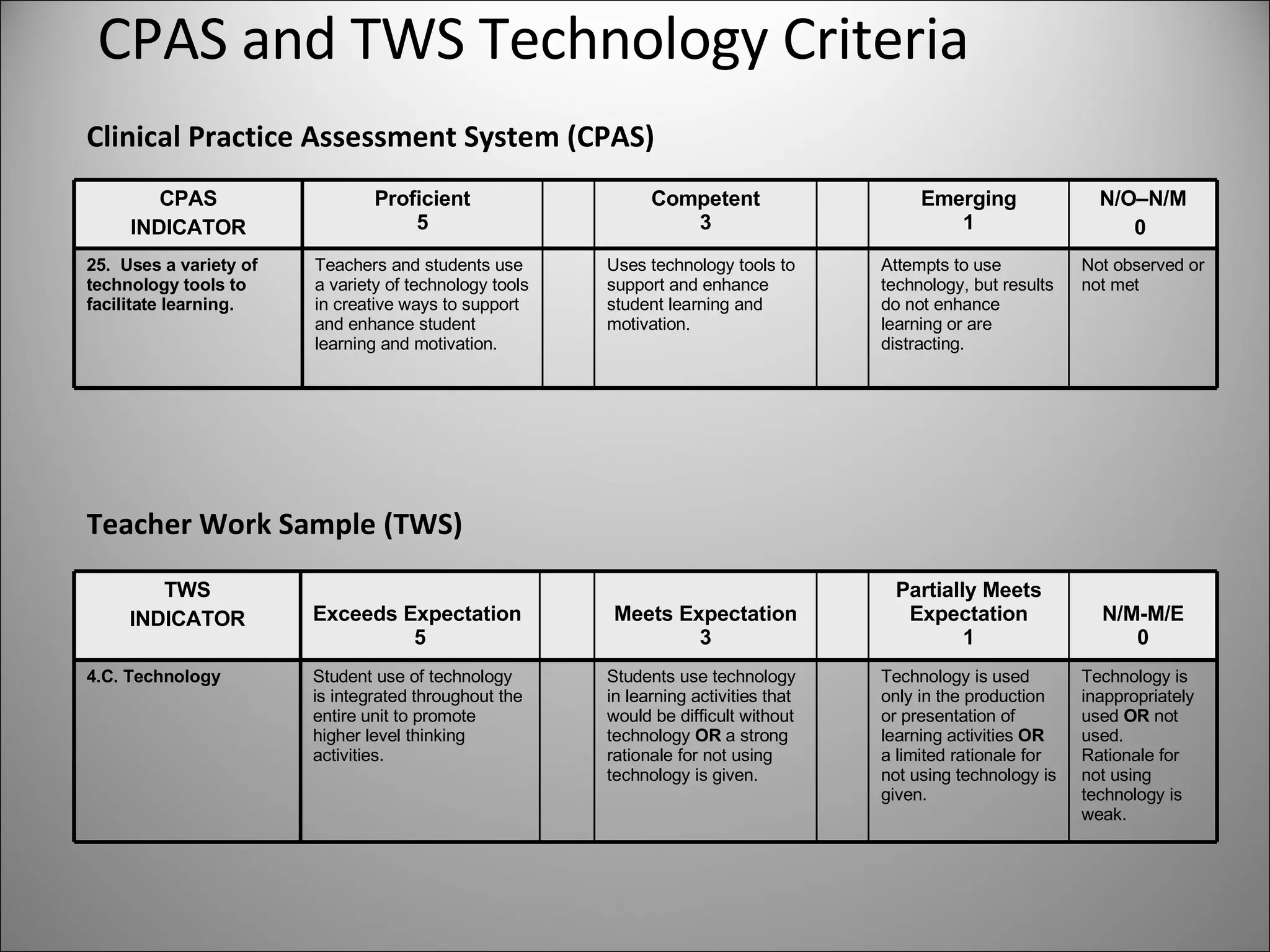
CPAS and TWS Technology Criteria Clinical Practice Assessment System (CPAS) Teacher Work Sample (TWS) CPAS INDICATOR Proficient 5 Competent 3 Emerging 1 N/O–N/M 0   25.  Uses a variety of technology tools to facilitate learning. Teachers and students use a variety of technology tools in creative ways to support and enhance student learning and motivation. Uses technology tools to support and enhance student learning and motivation. Attempts to use technology, but results do not enhance learning or are distracting.  Not observed or not met TWS INDICATOR Exceeds Expectation  5 Meets Expectation 3 Partially Meets Expectation 1 N/M-M/E 0 4.C. Technology Student use of technology is integrated throughout the entire unit to promote higher level thinking activities.  Students use technology in learning activities that would be difficult without technology  OR  a strong rationale for not using technology is given. Technology is used only in the production or presentation of learning activities  OR  a limited rationale for not using technology is given. Technology is inappropriately used  OR  not used.  Rationale for not using technology is weak.
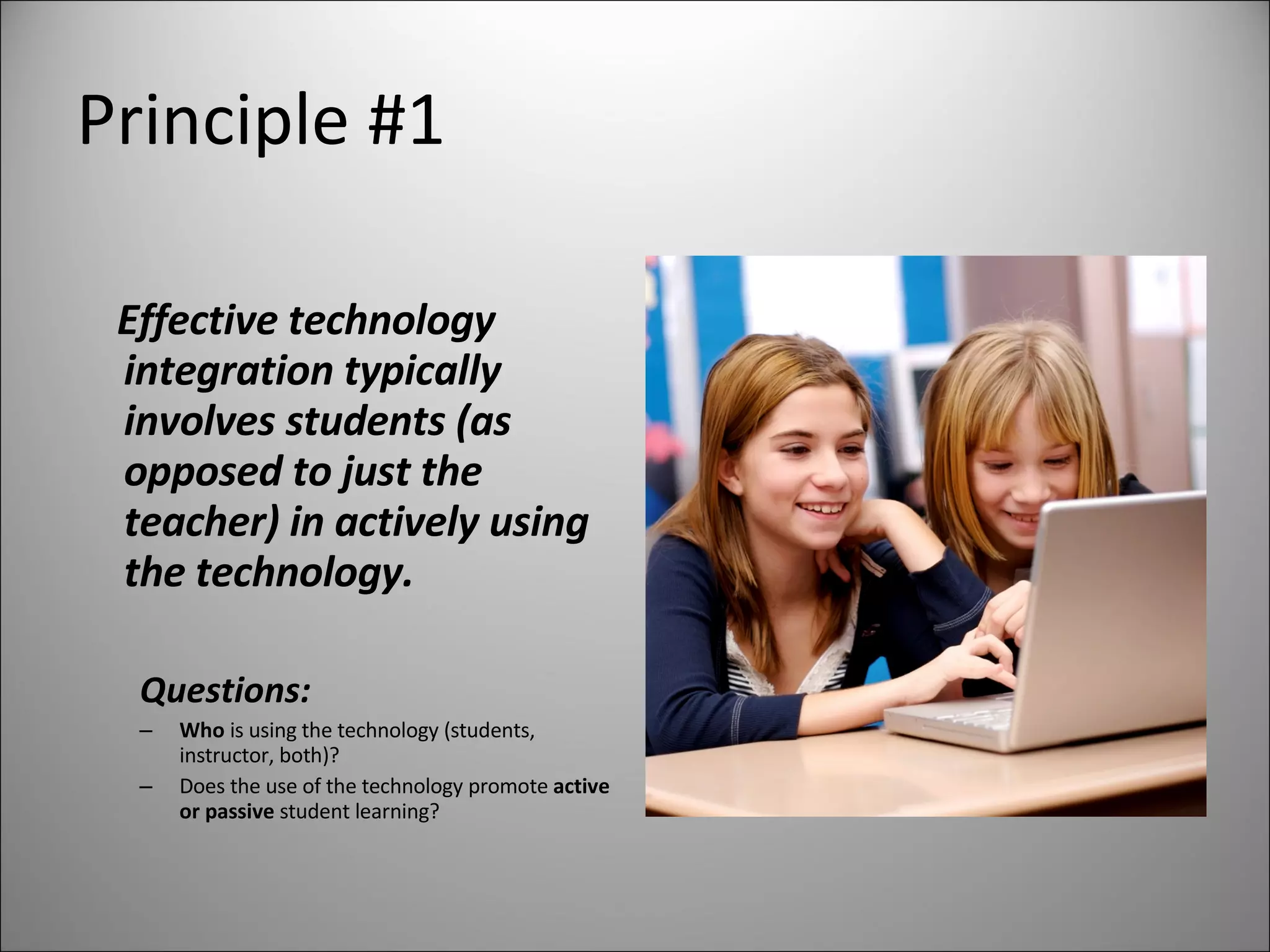
Principle #1 Effective technology integration typically involves students (as opposed to just the teacher) in actively using the technology. Questions: Who  is using the technology (students, instructor, both)? Does the use of the technology promote  active or passive  student learning?
Principle #2 Effective technology integration is essential not peripheral to the learning activity. Questions: Is technology an  add-on  to the real learning activity? Is technology added as a  convenience or  solely as a  motivational  factor? How does technology  impact  classroom management?
Principle #3 Effective technology integration focuses on the learning task and not the technology. Questions: Is the technology  the focus  or learning in the subject area the focus? Is technology being used  as a tool  to help achieve the learning task? How much  time will it take for the students to learn  to use the technology as compared to the benefit from using the technology tool?
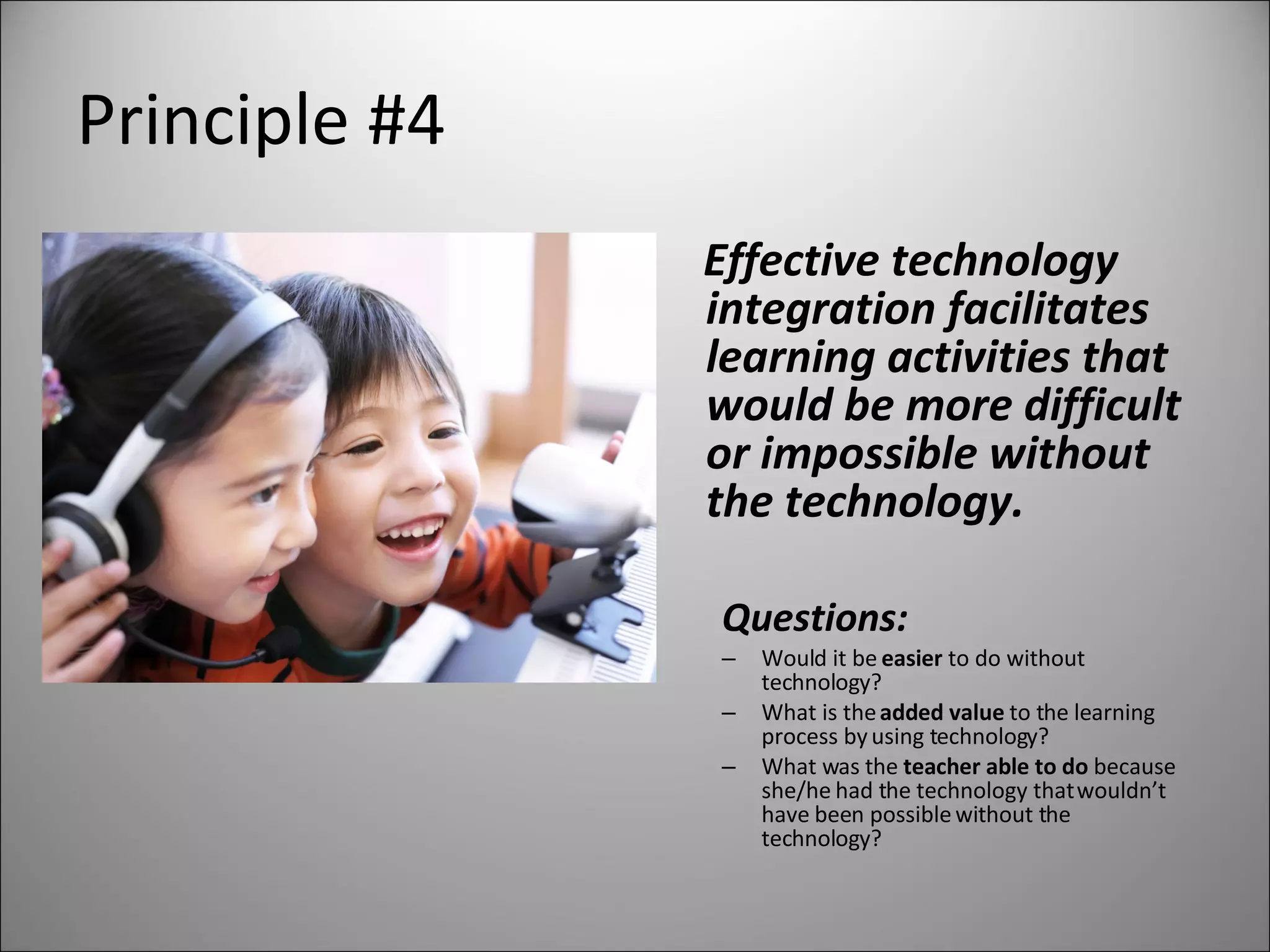
Principle #4 Effective technology integration facilitates learning activities that would be more difficult or impossible without the technology. Questions: Would it be  easier  to do without technology? What is the  added value  to the learning process by using technology? What was the  teacher able to do  because she/he had the technology that wouldn’t have been possible without the technology?
Effective use of PowerPoint? Recommended  Viewing:  Taking your Slide Deck to the Next Level Death by PowerPoint  PowerPoint for Teachers
This Week Look at examples of classroom technology use Critique them according to the principles shared in this presentation
Credits The principles shared here were originally developed by Dr. Charles Graham at Brigham Young University. All images are clipart available through Microsoft Office.

Principles of Effective Technology Integration

  • 1.
    What does effectivetechnology integration look like?
  • 2.
    CPAS and TWSTechnology Criteria Clinical Practice Assessment System (CPAS) Teacher Work Sample (TWS) CPAS INDICATOR Proficient 5 Competent 3 Emerging 1 N/O–N/M 0 25. Uses a variety of technology tools to facilitate learning. Teachers and students use a variety of technology tools in creative ways to support and enhance student learning and motivation. Uses technology tools to support and enhance student learning and motivation. Attempts to use technology, but results do not enhance learning or are distracting. Not observed or not met TWS INDICATOR Exceeds Expectation 5 Meets Expectation 3 Partially Meets Expectation 1 N/M-M/E 0 4.C. Technology Student use of technology is integrated throughout the entire unit to promote higher level thinking activities. Students use technology in learning activities that would be difficult without technology OR a strong rationale for not using technology is given. Technology is used only in the production or presentation of learning activities OR a limited rationale for not using technology is given. Technology is inappropriately used OR not used.  Rationale for not using technology is weak.
  • 3.
    Principle #1 Effectivetechnology integration typically involves students (as opposed to just the teacher) in actively using the technology. Questions: Who is using the technology (students, instructor, both)? Does the use of the technology promote active or passive student learning?
  • 4.
    Principle #2 Effectivetechnology integration is essential not peripheral to the learning activity. Questions: Is technology an add-on to the real learning activity? Is technology added as a convenience or solely as a motivational factor? How does technology impact classroom management?
  • 5.
    Principle #3 Effectivetechnology integration focuses on the learning task and not the technology. Questions: Is the technology the focus or learning in the subject area the focus? Is technology being used as a tool to help achieve the learning task? How much time will it take for the students to learn to use the technology as compared to the benefit from using the technology tool?
  • 6.
    Principle #4 Effectivetechnology integration facilitates learning activities that would be more difficult or impossible without the technology. Questions: Would it be easier to do without technology? What is the added value to the learning process by using technology? What was the teacher able to do because she/he had the technology that wouldn’t have been possible without the technology?
  • 7.
    Effective use ofPowerPoint? Recommended Viewing: Taking your Slide Deck to the Next Level Death by PowerPoint PowerPoint for Teachers
  • 8.
    This Week Lookat examples of classroom technology use Critique them according to the principles shared in this presentation
  • 9.
    Credits The principlesshared here were originally developed by Dr. Charles Graham at Brigham Young University. All images are clipart available through Microsoft Office.