Technology Integration..
is NOT the use of managed instructional software, where a
computer delivers content and tracks students’ progress.
is NOT having students go to a computer lab to learn technical skills
while the classroom teacher stays behind to plan or grade papers.

is NOT using the Internet to access games sponsored by
toy manufacturers or popular television shows.
is NOT using specialty software for drill and practice day after day.

Integration does NOT replace a teacher with a computer.
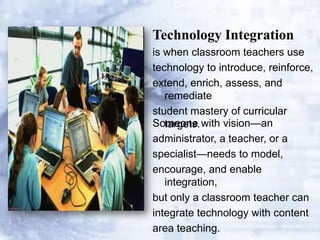
Technology Integration
is when classroom teachers use
technology to introduce, reinforce,
extend, enrich, assess, and
remediate
student mastery of curricular
Someone with vision—an
targets.
administrator, a teacher, or a
specialist—needs to model,
encourage, and enable
integration,
but only a classroom teacher can
integrate technology with content
area teaching.
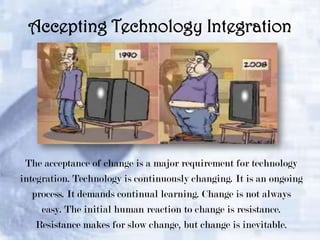
Accepting Technology Integration

The acceptance of change is a major requirement for technology
integration. Technology is continuously changing. It is an ongoing
process. It demands continual learning. Change is not always
easy. The initial human reaction to change is resistance.
Resistance makes for slow change, but change is inevitable.
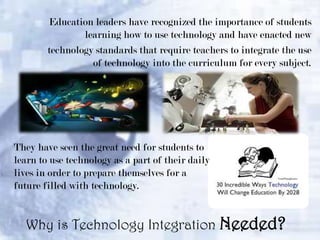
Education leaders have recognized the importance of students
learning how to use technology and have enacted new
technology standards that require teachers to integrate the use
of technology into the curriculum for every subject.

They have seen the great need for students to
learn to use technology as a part of their daily
lives in order to prepare themselves for a
future filled with technology.

Why is Technology Integration Needed?
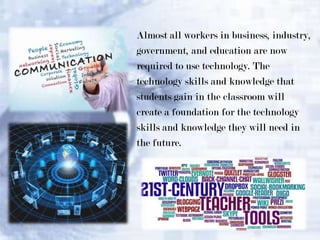
Almost all workers in business, industry,
government, and education are now
required to use technology. The
technology skills and knowledge that
students gain in the classroom will
create a foundation for the technology
skills and knowledge they will need in
the future.
Rationale for Using Technology in Education
1. Technology provides motivation for students by:
– Gaining learner attention
– Engaging the learner through production work
– Increasing perceptions of control

2. Technology offers unique instructional capabilities, such as:
–
–
–
–

Linking learners to information and educational resources
Helping learners visualize problems and solutions
Tracking learner progress
Linking learners to learning tools
3.

Technology gives
approaches, such as:

support

for

new

instructional

– Cooperative learning
– Shared intelligence
– Problem solving and higher level skills

4. Technology skills are required for an information age:
– Technology literacy
– Information literacy
– Visual literacy
5. Technology increased teacher productivity by:
- Freeing time to work with students by helping with
production and record-keeping tasks
- Providing more accurate information more quickly
- Allowing teachers to produce better looking, more
“student-friendly” materials more quickly
http://www.stratfordk12.org/Content/Technolo
gy_Integration_Defined.asp

Technology Integration

  • 2.
    Technology Integration.. is NOTthe use of managed instructional software, where a computer delivers content and tracks students’ progress. is NOT having students go to a computer lab to learn technical skills while the classroom teacher stays behind to plan or grade papers. is NOT using the Internet to access games sponsored by toy manufacturers or popular television shows. is NOT using specialty software for drill and practice day after day. Integration does NOT replace a teacher with a computer.
  • 3.
    Technology Integration is whenclassroom teachers use technology to introduce, reinforce, extend, enrich, assess, and remediate student mastery of curricular Someone with vision—an targets. administrator, a teacher, or a specialist—needs to model, encourage, and enable integration, but only a classroom teacher can integrate technology with content area teaching.
  • 4.
    Accepting Technology Integration Theacceptance of change is a major requirement for technology integration. Technology is continuously changing. It is an ongoing process. It demands continual learning. Change is not always easy. The initial human reaction to change is resistance. Resistance makes for slow change, but change is inevitable.
  • 5.
    Education leaders haverecognized the importance of students learning how to use technology and have enacted new technology standards that require teachers to integrate the use of technology into the curriculum for every subject. They have seen the great need for students to learn to use technology as a part of their daily lives in order to prepare themselves for a future filled with technology. Why is Technology Integration Needed?
  • 6.
    Almost all workersin business, industry, government, and education are now required to use technology. The technology skills and knowledge that students gain in the classroom will create a foundation for the technology skills and knowledge they will need in the future.
  • 7.
    Rationale for UsingTechnology in Education 1. Technology provides motivation for students by: – Gaining learner attention – Engaging the learner through production work – Increasing perceptions of control 2. Technology offers unique instructional capabilities, such as: – – – – Linking learners to information and educational resources Helping learners visualize problems and solutions Tracking learner progress Linking learners to learning tools
  • 8.
    3. Technology gives approaches, suchas: support for new instructional – Cooperative learning – Shared intelligence – Problem solving and higher level skills 4. Technology skills are required for an information age: – Technology literacy – Information literacy – Visual literacy
  • 9.
    5. Technology increasedteacher productivity by: - Freeing time to work with students by helping with production and record-keeping tasks - Providing more accurate information more quickly - Allowing teachers to produce better looking, more “student-friendly” materials more quickly
  • 10.