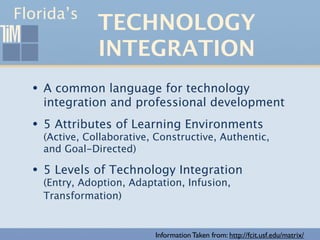
Florida’s
             TECHNOLOGY
             INTEGRATION
                   MATRIX
  •   A common language for technology
      integration and professional development
  • 5 Attributes of Learning Environments
      (Active, Collaborative, Constructive, Authentic,
      and Goal-Directed)

  • 5 Levels of Technology Integration
      (Entry, Adoption, Adaptation, Infusion,
      Transformation)


                             Information Taken from: http://fcit.usf.edu/matrix/
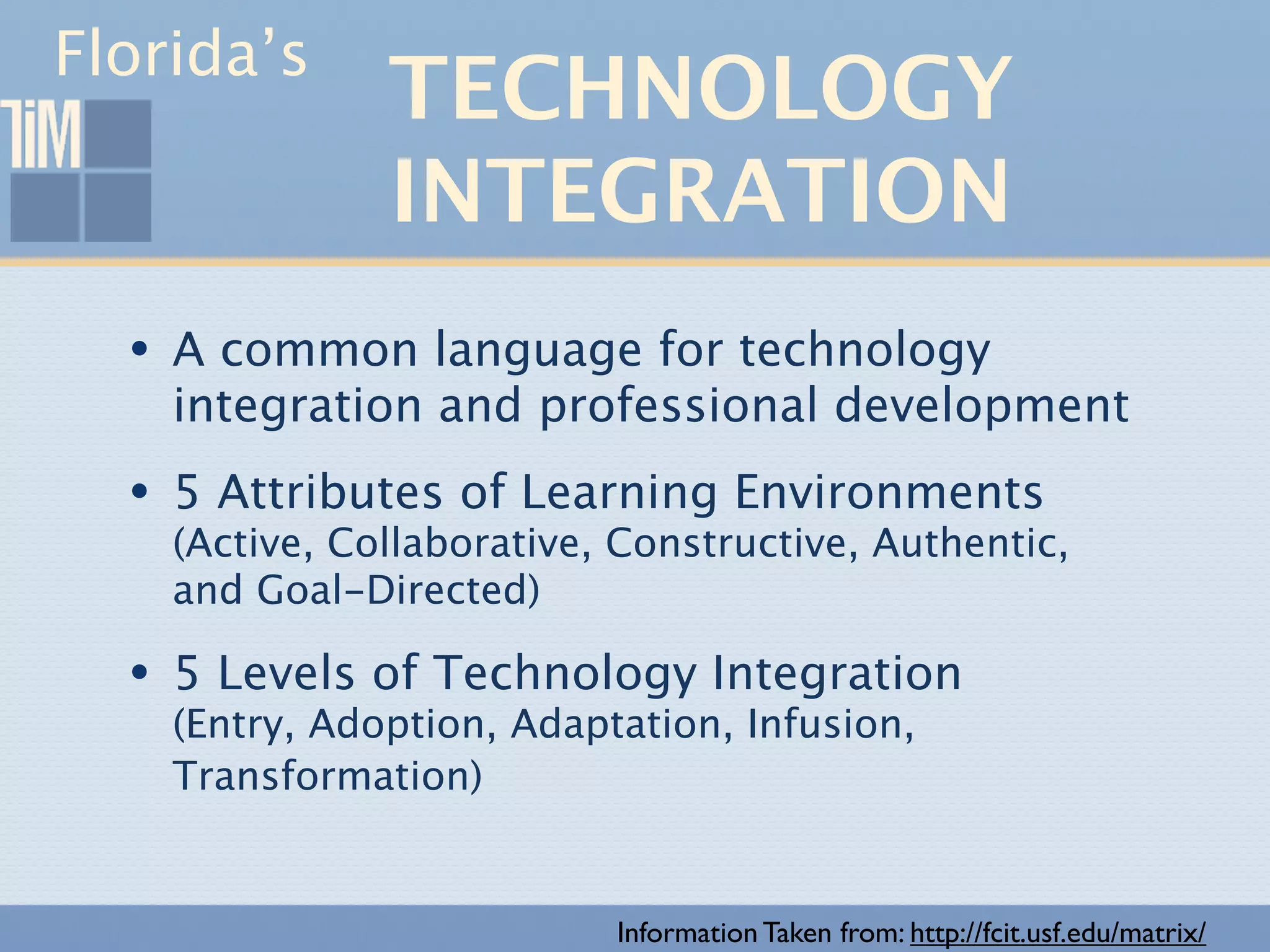
Setting Up the
          Activity
                          Entry
             Levels of
            Technology
            Integration
          Adoption        Adaptation


          Infusion        Transformation


After reading the description, rewrite
   it in student friendly language.
LEVELS OF TECHNOLOGY
   INTEGRATION (LOTI)
• Entry
• Adoption
• Adaptation
• Infusion
• Transformation
ENTRY
At the Entry level, typically the teacher uses technology to
deliver curriculum content to students. Entry level activities
may include listening to or watching content delivered
through technology or working on activities designed to
build fluency with basic facts or skills, such as drill-and-
practice exercises. In a lesson that includes technology use
at the Entry level, the students may not have direct access to
the technology. Decisions about how and when to use
technology tools as well as which tools to use are made by
the teacher.
ENTRY

Teacher is in control of the
    technology in the
       classroom.
ADOPTION
At the Adoption level, technology tools are used in
conventional ways. The teacher makes decisions about
which technology tool to use and when and how to use it.
Students exposure to individual technology tools may be
limited to single types of tasks that involve a procedural
understanding.
ADOPTION
 Teachers make decisions
  of the technology tools,
    but the students are
      involved with the
technology at a basic level.
ADAPTATION
At the Adaptation level, the teacher incorporates technology
tools as an integral part of the lesson. While the teacher
makes most decisions about technology use, the teacher
guides the students in the independent use of technology
tools. Students have a greater familiarity with the use of
technology tools and have a more conceptual understanding
of the tools than students at the Adoption level. They are
able to work without direct procedural instruction from the
teacher and begin to explore different ways of using the
technology tools.
ADAPTATION
 The teacher still facilitates the
 technology used, but students
    are able to use the tools
  independently. Students also
begin to explore different ways
to use the technology that they
       know how to use.
INFUSION
At the Infusion level, a range of different technology tools
are integrated flexibly and seamlessly into the classroom.
Technology is available in sufficient quantities to meet the
needs of all students. Students are able to make informed
decisions about when and how to use different tools. The
instructional focus is on student learning and not on the
technology tools themselves. For this reason, Infusion level
work typically occurs after teachers and students have
experience with a particular technology tool. The teacher
guides students to make decisions about when and how to
use technology.
INFUSION
A wide variety of technology tools
are available for student use. The
student is focused on the content
     rather than learning a new
technology tool. Students are able
  to make decisions on their own
      about which tools to use.
TRANSFORMATION
At the Transformation level, students use technology tools
flexibly to achieve specific learning outcomes. The students
have a conceptual understanding of the tools coupled with
extensive practical knowledge about their use. Students
apply that understanding and knowledge, and students may
extend the use of technology tools. They are encouraged to
use technology tools in unconventional ways and are self-
directed in combining the use of various tools. The teacher
serves as a guide, mentor, and model in the use of
technology. At this level, technology tools are often used to
facilitate higher order learning activities that would not
otherwise have been possible, or would have been difficult
to accomplish without the use of technology.
TRANSFORMATION
 Students are independent when
  using technology and use the
   tools to further extend the
learning. Technology use as this
 level is focused on higher level
           thinking skills.

Technology Integration Matrix Introduction

  • 1.
    Florida’s TECHNOLOGY INTEGRATION MATRIX • A common language for technology integration and professional development • 5 Attributes of Learning Environments (Active, Collaborative, Constructive, Authentic, and Goal-Directed) • 5 Levels of Technology Integration (Entry, Adoption, Adaptation, Infusion, Transformation) Information Taken from: http://fcit.usf.edu/matrix/
  • 2.
    Setting Up the Activity Entry Levels of Technology Integration Adoption Adaptation Infusion Transformation After reading the description, rewrite it in student friendly language.
  • 3.
    LEVELS OF TECHNOLOGY INTEGRATION (LOTI) • Entry • Adoption • Adaptation • Infusion • Transformation
  • 4.
    ENTRY At the Entrylevel, typically the teacher uses technology to deliver curriculum content to students. Entry level activities may include listening to or watching content delivered through technology or working on activities designed to build fluency with basic facts or skills, such as drill-and- practice exercises. In a lesson that includes technology use at the Entry level, the students may not have direct access to the technology. Decisions about how and when to use technology tools as well as which tools to use are made by the teacher.
  • 5.
    ENTRY Teacher is incontrol of the technology in the classroom.
  • 6.
    ADOPTION At the Adoptionlevel, technology tools are used in conventional ways. The teacher makes decisions about which technology tool to use and when and how to use it. Students exposure to individual technology tools may be limited to single types of tasks that involve a procedural understanding.
  • 7.
    ADOPTION Teachers makedecisions of the technology tools, but the students are involved with the technology at a basic level.
  • 8.
    ADAPTATION At the Adaptationlevel, the teacher incorporates technology tools as an integral part of the lesson. While the teacher makes most decisions about technology use, the teacher guides the students in the independent use of technology tools. Students have a greater familiarity with the use of technology tools and have a more conceptual understanding of the tools than students at the Adoption level. They are able to work without direct procedural instruction from the teacher and begin to explore different ways of using the technology tools.
  • 9.
    ADAPTATION The teacherstill facilitates the technology used, but students are able to use the tools independently. Students also begin to explore different ways to use the technology that they know how to use.
  • 10.
    INFUSION At the Infusionlevel, a range of different technology tools are integrated flexibly and seamlessly into the classroom. Technology is available in sufficient quantities to meet the needs of all students. Students are able to make informed decisions about when and how to use different tools. The instructional focus is on student learning and not on the technology tools themselves. For this reason, Infusion level work typically occurs after teachers and students have experience with a particular technology tool. The teacher guides students to make decisions about when and how to use technology.
  • 11.
    INFUSION A wide varietyof technology tools are available for student use. The student is focused on the content rather than learning a new technology tool. Students are able to make decisions on their own about which tools to use.
  • 12.
    TRANSFORMATION At the Transformationlevel, students use technology tools flexibly to achieve specific learning outcomes. The students have a conceptual understanding of the tools coupled with extensive practical knowledge about their use. Students apply that understanding and knowledge, and students may extend the use of technology tools. They are encouraged to use technology tools in unconventional ways and are self- directed in combining the use of various tools. The teacher serves as a guide, mentor, and model in the use of technology. At this level, technology tools are often used to facilitate higher order learning activities that would not otherwise have been possible, or would have been difficult to accomplish without the use of technology.
  • 13.
    TRANSFORMATION Students areindependent when using technology and use the tools to further extend the learning. Technology use as this level is focused on higher level thinking skills.

Editor's Notes