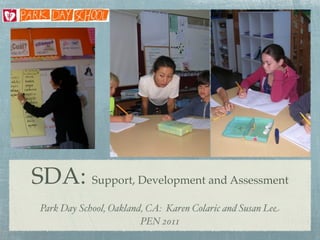





SDA: Support, Development and Assessment
 Park Day School, Oakland, CA: Karen Colaric and Susan Lee
                         PEN 2011
Teacher Assessment


What do you think of when
you hear the word “teacher
assessment”?
Background
Assessment committee
focused on admin jobs

Annual Parent Program
Survey

Annual Goal Setting meeting

Lesson Study Partnerships

Employee Handbook: trial
and established teachers
Problem Statement

 Park Day School has some systems in place for the support, professional
 development and assessment of teachers, such as goal setting, mentoring,
 advising and an annual parent survey. We also have established classifications for
 teachers (trial employee, established employee and employee under review).
 However, criteria for successful and effective teaching has not been established,
 nor is there a process for periodic, comprehensive assessment of teachers at the
 various stages of their career. A plan is needed that is a match for us
 philosophically in our work with students, manageable and responsive to the
 needs of individual teachers.
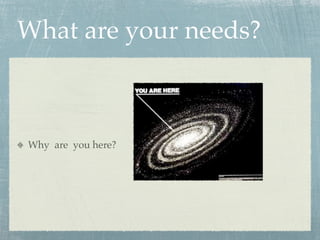
What are your needs?


Why are you here?
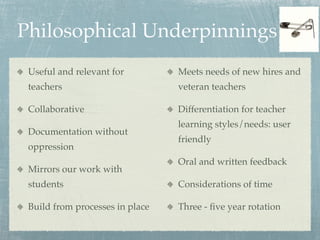
Philosophical Underpinnings
 Useful and relevant for         Meets needs of new hires and
 teachers                        veteran teachers

 Collaborative                   Differentiation for teacher
                                 learning styles/needs: user
 Documentation without
                                 friendly
 oppression
                                 Oral and written feedback
 Mirrors our work with
 students                        Considerations of time

 Build from processes in place   Three - five year rotation
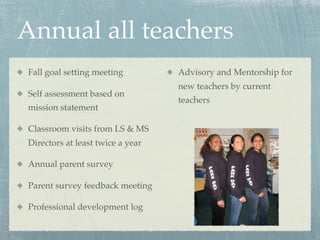
Annual all teachers
Fall goal setting meeting         Advisory and Mentorship for
                                  new teachers by current
Self assessment based on
                                  teachers
mission statement

Classroom visits from LS & MS
Directors at least twice a year

Annual parent survey

Parent survey feedback meeting

Professional development log
Annual Goal Setting
Meet with Head of School    Time given at annual retreat
and LS or MS Director
                            Shared with a colleague
Three professional goals
                            Time to reflect in spring
selected by teacher

One institutional goal
related to theme for year

Achievable and relevant

Action plan & timeline
Action plan for goals
Goal

Action Plan

Resources

Support

Allies/Obstacles

Reflection

Self-assessment
Considerations
             Teachers participate in selection
             of teacher team members

             Cross grade & disciplines

             Scheduling and time

             Specialist teachers need process
             to begin later in year

             Guinea pigs

             Dual role or experience first
Trial Teachers
Any new hire @ PDS        Personnel Committee de-
                          brief in December with
Orientation on
                          teacher
progressive education &
reading                   Consultation with advisor

Advisor and mentor if     Personnel committee
requested                 February follow up:
                          discuss status for next
Personnel Committee
                          year
formed
                          March status decision to
                          teacher
Established Teacher Options
 Critical Reflection Process

 Research/Project Option

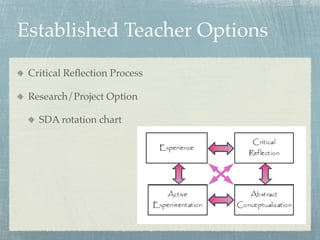
   SDA rotation chart
Critical
    Reflection
     Process
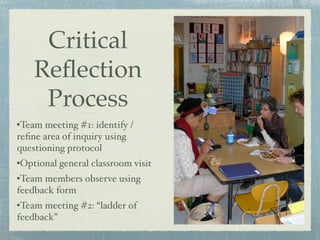
•Team meeting #1: identify /
refine area of inquiry using
questioning protocol
•Optional general classroom visit
•Team members observe using
feedback form
•Team meeting #2: “ladder of
feedback”
Questioning Protocol
Teacher begins process in annual goal
setting meeting

Teacher meets with team to refine
question of inquiry:

   Why is this question personally and
   professionally important to you?

   What direct connections to student
   learning can we identify?

   What needs clarifying? What
   assumptions are present?

   How will you go about answering
   this question? How can we help?
Sample Inquiries
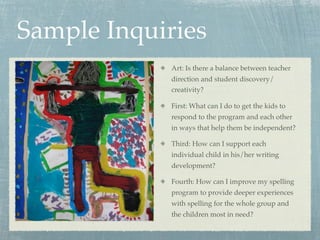
             Art: Is there a balance between teacher
             direction and student discovery/
             creativity?

             First: What can I do to get the kids to
             respond to the program and each other
             in ways that help them be independent?

             Third: How can I support each
             individual child in his/her writing
             development?

             Fourth: How can I improve my spelling
             program to provide deeper experiences
             with spelling for the whole group and
             the children most in need?
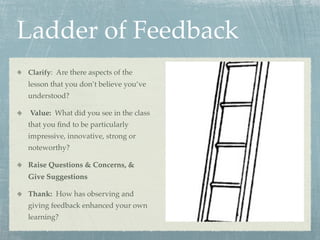
Ladder of Feedback
Clarify: Are there aspects of the
lesson that you don’t believe you’ve
understood?

 Value: What did you see in the class
that you find to be particularly
impressive, innovative, strong or
noteworthy?

Raise Questions & Concerns, &
Give Suggestions

Thank: How has observing and
giving feedback enhanced your own
learning?
Critical
  Reflection
 Process, cont.
•Second observation by team
members
•Second ladder of feedback
•Reflection on process/goals/
inquiry
•Final meeting with Head of
School & LS or MS Director
What makes
  a teacher
successful at
your school?
   Brainstorm
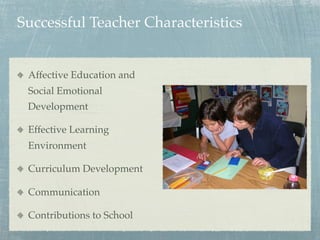
Successful Teacher Characteristics


 Affective Education and
 Social Emotional
 Development

 Effective Learning
 Environment

 Curriculum Development

 Communication

 Contributions to School
Sample Characteristics
Promotes community building in       Creates curriculum that
the classroom and encourages         emphasizes process over
the development of empathy,          product.
compassion and conflict
                                     Maintain communication with
resolution skills in each student.
                                     support staff for individual
Clearly outlines, maintains and      children both inside and outside
promotes student investment in       the school community.
classroom procedures, routines,
                                     Regularly attends and
systems and expectations
                                     participates actively as a member
                                     of at least one governance
                                     committee.
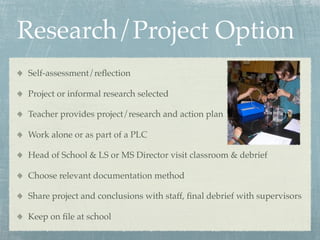
Research/Project Option
Self-assessment/reflection

Project or informal research selected

Teacher provides project/research and action plan

Work alone or as part of a PLC

Head of School & LS or MS Director visit classroom & debrief

Choose relevant documentation method

Share project and conclusions with staff, final debrief with supervisors

Keep on file at school
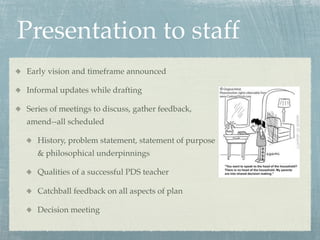
Presentation to staff
Early vision and timeframe announced

Informal updates while drafting

Series of meetings to discuss, gather feedback,
amend--all scheduled

   History, problem statement, statement of purpose
   & philosophical underpinnings

   Qualities of a successful PDS teacher

   Catchball feedback on all aspects of plan

   Decision meeting
Sample SDA Projects
Julie, fifth grade teacher

 How can I more effectively          Also introduced Connection,
 implement TfU in the                Appreciation, Suggestion routine
                                     during writer’s workshop
 process aspect of my
                                     session
 writing program?
                                     Crucial for them to learn to give
 Modified See, Think, Wonder
                                     more effective critical feedback.
 thinking routine to: I read/hear,
 I connect, I think, I would
 change.
Julie’s Outcomes
Helped me tap into    Allowed them to be
individual kids in    more verbal and gave
terms of learning     them license to be
styles.               creative

Helped new kids who   Saw improvement as a
were not as strong    result of the
writers.              processing we did
                      together and group
                      feedback
Sample SDA Projects
Amida, kindergarten teacher
 How can I better prepare          Two philosophical bases:
 students for their experience
                                     Sense of place to reduce
 in the Create with Nature
                                     anxiety and be
 Zone?
                                     meaningfully connected to
 To inspire students to look at      nature
 nature in a certain way--to see
                                     Experience non-
 the building blocks nature
                                     permanence and work
 provides and use them
                                     communally, share
 artistically, and to connect to
 the natural world emotionally.    Reduce weaponizing/violence
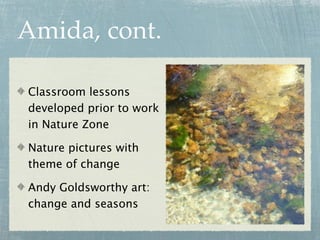
Amida, cont.

Classroom lessons
developed prior to work
in Nature Zone

Nature pictures with
theme of change

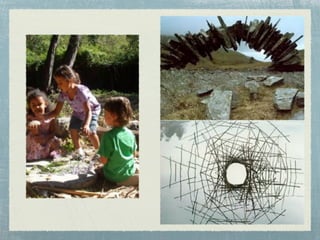
Andy Goldsworthy art:
change and seasons
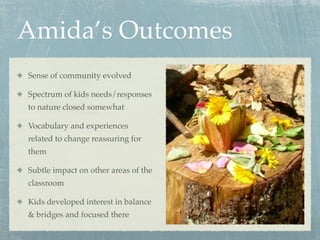
Amida’s Outcomes
Sense of community evolved

Spectrum of kids needs/responses
to nature closed somewhat

Vocabulary and experiences
related to change reassuring for
them

Subtle impact on other areas of the
classroom

Kids developed interest in balance
& bridges and focused there
Sample SDA Projects
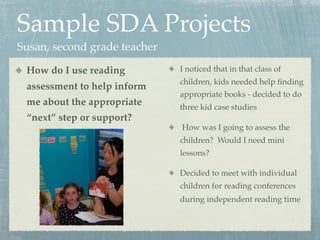
Susan, second grade teacher

 How do I use reading         I noticed that in that class of
                              children, kids needed help finding
 assessment to help inform
                              appropriate books - decided to do
 me about the appropriate     three kid case studies
 “next” step or support?
                              How was I going to assess the
                              children? Would I need mini
                              lessons?

                              Decided to meet with individual
                              children for reading conferences
                              during independent reading time
Susan’s Outcomes
Helped me tailor     Provided me an
reading materials    invaluable opportunity
provided for each    to meet/brainstorm
child during their   ideas with other
animal research      teachers
projects
                     Allowed me to think
                     deeply about my
                     teaching practice -
                     why and what
Participant feedback
Kris, 4th: “Picked            Susan, 1st: “A safe,
challenging topic, rewards    supportive process; a
felt next year with program   wonderful time-out, pause
changes.”                     to reflect on one’s own
                              teaching.”
Jenny, art: “Appreciated
formality of process; never   Bob, 4th: “Impressed with
felt intimidated . . .        process & work of
supportive and helpful.”      committee. Fraught with
                              peril but worked well.”
Participant feedback
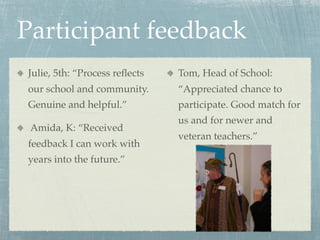
Julie, 5th: “Process reflects   Tom, Head of School:
our school and community.      “Appreciated chance to
Genuine and helpful.”          participate. Good match for
                               us and for newer and
 Amida, K: “Received
                               veteran teachers.”
feedback I can work with
years into the future.”
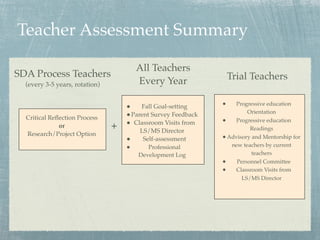
Teacher Assessment Summary

                                        All Teachers
SDA Process Teachers                                               Trial Teachers
  (every 3-5 years, rotation)           Every Year

                                    • Fall Goal-setting        •   Progressive education
                                                                        Orientation
  Critical Reflection Process        • Parent Survey Feedback
                                    • Classroom Visits from    • Progressive education
              or                +       LS/MS Director                   Readings
  Research/Project Option
                                    •    Self-assessment       • Advisory and Mentorship for
                                                                  new teachers by current
                                    •      Professional
                                        Development Log                   teachers
                                                               • Personnel Committee
                                                               • Classroom Visits from
                                                                      LS/MS Director
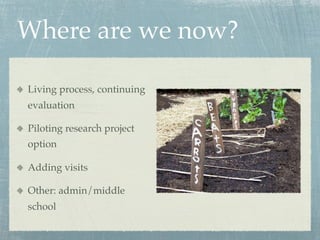
Where are we now?

Living process, continuing
evaluation

Piloting research project
option

Adding visits

Other: admin/middle
school
Q & A / Discussion

Sda for pen

  • 1.
    SDA: Support, Developmentand Assessment Park Day School, Oakland, CA: Karen Colaric and Susan Lee PEN 2011
  • 2.
    Teacher Assessment What doyou think of when you hear the word “teacher assessment”?
  • 3.
    Background Assessment committee focused onadmin jobs Annual Parent Program Survey Annual Goal Setting meeting Lesson Study Partnerships Employee Handbook: trial and established teachers
  • 4.
    Problem Statement ParkDay School has some systems in place for the support, professional development and assessment of teachers, such as goal setting, mentoring, advising and an annual parent survey. We also have established classifications for teachers (trial employee, established employee and employee under review). However, criteria for successful and effective teaching has not been established, nor is there a process for periodic, comprehensive assessment of teachers at the various stages of their career. A plan is needed that is a match for us philosophically in our work with students, manageable and responsive to the needs of individual teachers.
  • 5.
    What are yourneeds? Why are you here?
  • 6.
    Philosophical Underpinnings Usefuland relevant for Meets needs of new hires and teachers veteran teachers Collaborative Differentiation for teacher learning styles/needs: user Documentation without friendly oppression Oral and written feedback Mirrors our work with students Considerations of time Build from processes in place Three - five year rotation
  • 7.
    Annual all teachers Fallgoal setting meeting Advisory and Mentorship for new teachers by current Self assessment based on teachers mission statement Classroom visits from LS & MS Directors at least twice a year Annual parent survey Parent survey feedback meeting Professional development log
  • 8.
    Annual Goal Setting Meetwith Head of School Time given at annual retreat and LS or MS Director Shared with a colleague Three professional goals Time to reflect in spring selected by teacher One institutional goal related to theme for year Achievable and relevant Action plan & timeline
  • 9.
    Action plan forgoals Goal Action Plan Resources Support Allies/Obstacles Reflection Self-assessment
  • 10.
    Considerations Teachers participate in selection of teacher team members Cross grade & disciplines Scheduling and time Specialist teachers need process to begin later in year Guinea pigs Dual role or experience first
  • 11.
    Trial Teachers Any newhire @ PDS Personnel Committee de- brief in December with Orientation on teacher progressive education & reading Consultation with advisor Advisor and mentor if Personnel committee requested February follow up: discuss status for next Personnel Committee year formed March status decision to teacher
  • 12.
    Established Teacher Options Critical Reflection Process Research/Project Option SDA rotation chart
  • 13.
    Critical Reflection Process •Team meeting #1: identify / refine area of inquiry using questioning protocol •Optional general classroom visit •Team members observe using feedback form •Team meeting #2: “ladder of feedback”
  • 14.
    Questioning Protocol Teacher beginsprocess in annual goal setting meeting Teacher meets with team to refine question of inquiry: Why is this question personally and professionally important to you? What direct connections to student learning can we identify? What needs clarifying? What assumptions are present? How will you go about answering this question? How can we help?
  • 15.
    Sample Inquiries Art: Is there a balance between teacher direction and student discovery/ creativity? First: What can I do to get the kids to respond to the program and each other in ways that help them be independent? Third: How can I support each individual child in his/her writing development? Fourth: How can I improve my spelling program to provide deeper experiences with spelling for the whole group and the children most in need?
  • 16.
    Ladder of Feedback Clarify:Are there aspects of the lesson that you don’t believe you’ve understood? Value: What did you see in the class that you find to be particularly impressive, innovative, strong or noteworthy? Raise Questions & Concerns, & Give Suggestions Thank: How has observing and giving feedback enhanced your own learning?
  • 17.
    Critical Reflection Process, cont. •Second observation by team members •Second ladder of feedback •Reflection on process/goals/ inquiry •Final meeting with Head of School & LS or MS Director
  • 18.
    What makes a teacher successful at your school? Brainstorm
  • 19.
    Successful Teacher Characteristics Affective Education and Social Emotional Development Effective Learning Environment Curriculum Development Communication Contributions to School
  • 20.
    Sample Characteristics Promotes communitybuilding in Creates curriculum that the classroom and encourages emphasizes process over the development of empathy, product. compassion and conflict Maintain communication with resolution skills in each student. support staff for individual Clearly outlines, maintains and children both inside and outside promotes student investment in the school community. classroom procedures, routines, Regularly attends and systems and expectations participates actively as a member of at least one governance committee.
  • 21.
    Research/Project Option Self-assessment/reflection Project orinformal research selected Teacher provides project/research and action plan Work alone or as part of a PLC Head of School & LS or MS Director visit classroom & debrief Choose relevant documentation method Share project and conclusions with staff, final debrief with supervisors Keep on file at school
  • 22.
    Presentation to staff Earlyvision and timeframe announced Informal updates while drafting Series of meetings to discuss, gather feedback, amend--all scheduled History, problem statement, statement of purpose & philosophical underpinnings Qualities of a successful PDS teacher Catchball feedback on all aspects of plan Decision meeting
  • 23.
    Sample SDA Projects Julie,fifth grade teacher How can I more effectively Also introduced Connection, implement TfU in the Appreciation, Suggestion routine during writer’s workshop process aspect of my session writing program? Crucial for them to learn to give Modified See, Think, Wonder more effective critical feedback. thinking routine to: I read/hear, I connect, I think, I would change.
  • 24.
    Julie’s Outcomes Helped metap into Allowed them to be individual kids in more verbal and gave terms of learning them license to be styles. creative Helped new kids who Saw improvement as a were not as strong result of the writers. processing we did together and group feedback
  • 25.
    Sample SDA Projects Amida,kindergarten teacher How can I better prepare Two philosophical bases: students for their experience Sense of place to reduce in the Create with Nature anxiety and be Zone? meaningfully connected to To inspire students to look at nature nature in a certain way--to see Experience non- the building blocks nature permanence and work provides and use them communally, share artistically, and to connect to the natural world emotionally. Reduce weaponizing/violence
  • 26.
    Amida, cont. Classroom lessons developedprior to work in Nature Zone Nature pictures with theme of change Andy Goldsworthy art: change and seasons
  • 28.
    Amida’s Outcomes Sense ofcommunity evolved Spectrum of kids needs/responses to nature closed somewhat Vocabulary and experiences related to change reassuring for them Subtle impact on other areas of the classroom Kids developed interest in balance & bridges and focused there
  • 29.
    Sample SDA Projects Susan,second grade teacher How do I use reading I noticed that in that class of children, kids needed help finding assessment to help inform appropriate books - decided to do me about the appropriate three kid case studies “next” step or support? How was I going to assess the children? Would I need mini lessons? Decided to meet with individual children for reading conferences during independent reading time
  • 30.
    Susan’s Outcomes Helped metailor Provided me an reading materials invaluable opportunity provided for each to meet/brainstorm child during their ideas with other animal research teachers projects Allowed me to think deeply about my teaching practice - why and what
  • 31.
    Participant feedback Kris, 4th:“Picked Susan, 1st: “A safe, challenging topic, rewards supportive process; a felt next year with program wonderful time-out, pause changes.” to reflect on one’s own teaching.” Jenny, art: “Appreciated formality of process; never Bob, 4th: “Impressed with felt intimidated . . . process & work of supportive and helpful.” committee. Fraught with peril but worked well.”
  • 32.
    Participant feedback Julie, 5th:“Process reflects Tom, Head of School: our school and community. “Appreciated chance to Genuine and helpful.” participate. Good match for us and for newer and Amida, K: “Received veteran teachers.” feedback I can work with years into the future.”
  • 33.
    Teacher Assessment Summary All Teachers SDA Process Teachers Trial Teachers (every 3-5 years, rotation) Every Year • Fall Goal-setting • Progressive education Orientation Critical Reflection Process • Parent Survey Feedback • Classroom Visits from • Progressive education or + LS/MS Director Readings Research/Project Option • Self-assessment • Advisory and Mentorship for new teachers by current • Professional Development Log teachers • Personnel Committee • Classroom Visits from LS/MS Director
  • 34.
    Where are wenow? Living process, continuing evaluation Piloting research project option Adding visits Other: admin/middle school
  • 35.
    Q & A/ Discussion