Improving Project Performanceby Creating and Re-Using KnowledgeNiclas RinmanShea Wilson2011-02-09
The ability to sustain significant improvements in development over long periods of time rests on the capability to learn from experience.- Steven C. Wheelwright and Kim B. Clark Almost all defective projects result from not having the right knowledge in the right place at the right time.- Allen C. Ward| Introduction | Background | Project | Findings | Framework | Summary |
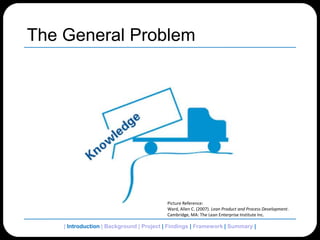
The General ProblemPicture Reference:Ward, Allen C. (2007). LeanProduct and Process Development.  Cambridge, MA: The Lean Enterprise Institute Inc.  | Introduction | Background | Project | Findings | Framework | Summary |
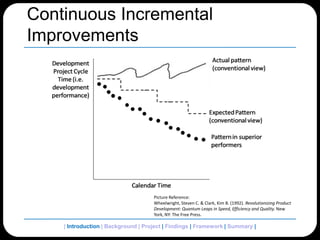
Continuous Incremental ImprovementsPicture Reference:Wheelwright, Steven C. & Clark, Kim B. (1992). Revolutionizing Product Development: Quantum Leaps in Speed, Efficiency and Quality. New York, NY: The Free Press.| Introduction | Background | Project | Findings | Framework | Summary |
AgendaBackgroundProjectFindingsFrameworkSummary| Introduction | Background | Project | Findings | Framework | Summary |
ScopeLearning in a Project-based OrganizationProvide knowledge and experiences to future project teams in order to enhance their problem solving ability.Continuously improve organizational structures, processes, tools and routines based on knowledge from previous projects.| Introduction | Background | Project | Findings | Framework | Summary |
Conventional SolutionsProcess Based Methodse.g. project reviews and auditsDocument Based Methodse.g. final project reports, databases| Introduction | Background | Project | Findings | Framework | Summary |
BarriersEliciting Knowledge and ExperiencesTime PressureMotivationSkill…Re-Using Knowledge and ExperiencesFormal BarriersInformal BarriersLearning from development projects is one of the most difficult things that an organization can do.- Steven C. Wheelwright and Kim B. Clark | Introduction | Background | Project | Findings | Framework | Summary |
The ProjectBackgroundBetter process for capturing and sharing lessons learned highly neededObjectiveCreate a platform (framework) for lessons learned at the case company| Introduction | Background | Project | Findings | Framework | Summary |
Case CompanyProject-based organization using a defined stage-gate development processMatrix structure with cross-functional project teamsUses project reports for documenting lessons learnedAutomotive IndustryGlobal presence and about 5000 employees| Introduction | Background | Project| Findings | Framework | Summary |
MethodologyInterviewsAbout 35 semi-structured interviewsCross-site and cross-functionalResearchLiterature studyFormal documentationObservations and hallway conversations| Introduction | Background | Project | Findings | Framework | Summary |
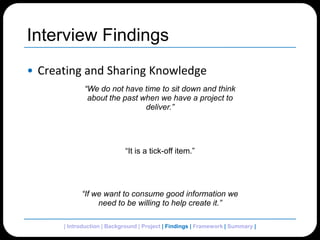
Interview FindingsCreating and Sharing Knowledge“We do not have time to sit down and think about the past when we have a project to deliver.”“It is a tick-off item.”“If we want to consume good information we need to be willing to help create it.”| Introduction | Background | Project | Findings | Framework | Summary |
Interview FindingsLittle useable knowledge created and made available by projects.| Introduction | Background | Project | Findings | Framework | Summary |
Interview FindingsLittle useable knowledge created and made available by projects.There is a trade off in projects between documenting knowledge and delivering the product.The creation of the final project report is seen as a tick-off item done before passing a gate.Knowledge is lost by writing the project report at the end of projects.| Introduction | Background | Project | Findings | Framework | Summary |
Interview FindingsAccessing and Retrieving Information“People read project reports, but don’t understand them.”“The project reports sound useful, but I don’t know where to find them.” “Which one do I need to read? If I have to use the tool, make it useable and valuable and easy to reference and understand.”| Introduction | Background | Project | Findings | Framework | Summary |
Interview FindingsKnowledge is not documented and stored in a good way.| Introduction | Background | Project | Findings | Framework | Summary |
Interview FindingsKnowledge is not documented and stored in a good way.It is hard to find, search, and access information in the project reports.The information is of varying usefulness and levels of detail.Outspoken need to have knowledge made available in a simple and understandable way.| Introduction | Background | Project | Findings | Framework | Summary |
Interview FindingsCreating Action and Change“All projects have problems, and the same kind of problems re-appear, and they are repeatedly documented in the project reports.”“Why document mistakes if we are not going to change anything?”| Introduction | Background | Project | Findings | Framework | Summary |
Interview FindingsKnowledge is not re-used throughout the organization.| Introduction | Background | Project | Findings | Framework | Summary |
Interview FindingsKnowledge is not re-used throughout the organization.The use of project reports in projects is limited to reading some of them in the early phases.There is no structured, visible, process for making changes based on information in the project reports.There is a desire from the functional organization to get feedback from projects in order to make changes.| Introduction | Background | Project | Findings | Framework | Summary |
Interview ConclusionsTick-off item. Trade-off in time.Not available and not useful. No visible changes. Feedback missing.| Introduction | Background | Project | Findings | Framework | Summary |
Interview ConclusionsTick-off item. Trade-off in time.Not available and not useful. No visible changes. Feedback missing.Consequences:Re-inventing the wheelRepeating mistakesFailed projectsWasteFrustration| Introduction | Background | Project | Findings | Framework | Summary |
Goal – A Better WaySustainably increase project performance…| Introduction | Background | Project | Findings | Framework | Summary |
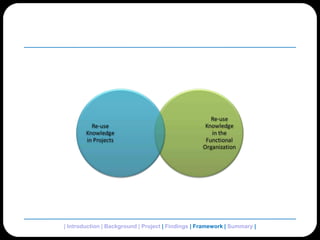
Goal – A Better WaySustainably increase project performance... by using a resource that is currently being wasted.Re-use knowledge in future project teams to improve performance, e.g. lead time, project cost.Re-use knowledge in the functional organization to improve, e.g. processes, tools, methods.| Introduction | Background | Project | Findings | Framework| Summary |
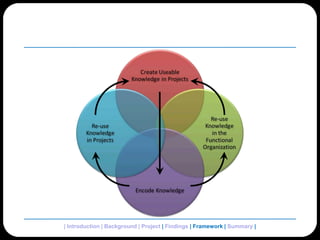
Creating the FrameworkGoal: Increase project performance through knowledge re-use.Provide knowledge to future project teamsUse knowledge to improve the organization| Introduction | Background | Project | Findings | Framework| Summary |
| Introduction | Background | Project | Findings | Framework | Summary |
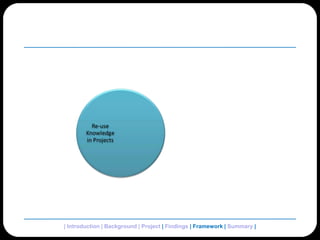
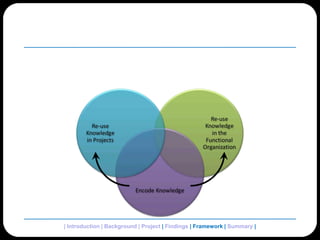
Creating the FrameworkRe-using knowledge in projectsIncreased problem solving capability and frontloading of problem solving.Improved risk management with earlier identification of risks.Needed: Useful knowledge| Introduction | Background | Project | Findings | Framework | Summary |
| Introduction | Background | Project | Findings | Framework | Summary |
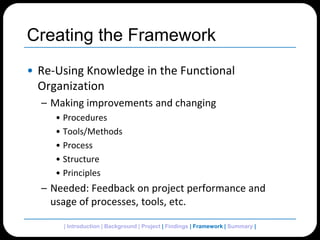
Creating the FrameworkRe-Using Knowledge in the Functional OrganizationMaking improvements and changingProceduresTools/MethodsProcessStructurePrinciplesNeeded: Feedback on project performance and usage of processes, tools, etc.| Introduction | Background | Project | Findings | Framework | Summary |
| Introduction | Background | Project | Findings | Framework | Summary |
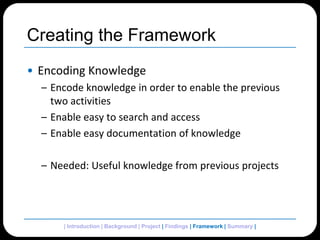
Creating the FrameworkEncoding KnowledgeEncode knowledge in order to enable the previous two activitiesEnable easy to search and accessEnable easy documentation of knowledgeNeeded: Useful knowledge from previous projects| Introduction | Background | Project | Findings | Framework | Summary |
| Introduction | Background | Project | Findings | Framework | Summary |
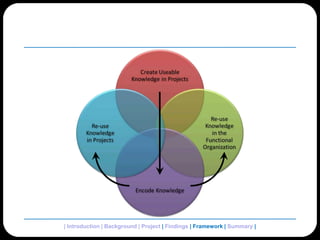
Creating the FrameworkCreating Knowledge in ProjectsCreate and deliver useful knowledgeNeeded: Motivation for spending time on knowledge creating activities | Introduction | Background | Project | Findings | Framework| Summary |
| Introduction | Background | Project | Findings | Framework| Summary |
Broken CycleA broken cycleFor the cycle to work, you need all the connections.Focusing on just one of these does not work. | Introduction | Background | Project | Findings | Framework | Summary |
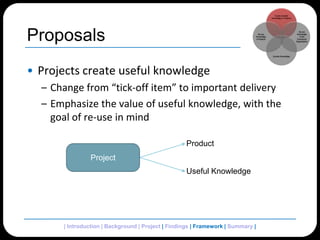
ProposalsProjects create useful knowledgeChange from “tick-off item” to important deliveryEmphasize the value of useful knowledge, with the goal of re-use in mindProductProjectUseful Knowledge| Introduction | Background | Project | Findings | Framework| Summary |
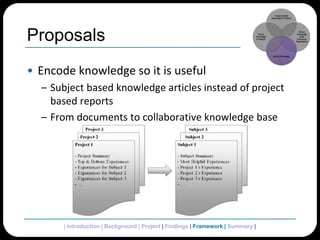
ProposalsEncode knowledge so it is usefulSubject based knowledge articles instead of project based reportsFrom documents to collaborative knowledge base| Introduction | Background | Project | Findings | Framework| Summary |
ProposalsIncrease project performance by re-using knowledgeFrom passive reading to active use throughProblem SolvingRisk ManagementAccess knowledge articles to find solutions and possible risks| Introduction | Background | Project | Findings | Framework | Summary |
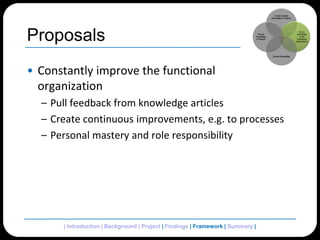
ProposalsConstantly improve the functional organizationPull feedback from knowledge articlesCreate continuous improvements, e.g. to processesPersonal mastery and role responsibility| Introduction | Background | Project | Findings | Framework| Summary |
SummaryFour areas you need to supportCreate Knowledge in ProjectsEncode KnowledgeRe-Use Knowledge in Projects Re-Use Knowledge in the Functional Organization| Introduction | Background | Project | Findings | Framework | Summary|
SummaryFour areas you need to supportCreate a pull system. Pull knowledge from projects based on the desired re-use.| Introduction | Background | Project | Findings | Framework | Summary|
SummaryFour areas you need to supportCreate a pull system. Pull knowledge from projects based on the desired re-use.Learning from experience is one of the most difficult, but also one of the most important things that an organization can do.| Introduction | Background | Project | Findings | Framework | Summary|
Thank You!

Wilson.shea

  • 1.
    Improving Project PerformancebyCreating and Re-Using KnowledgeNiclas RinmanShea Wilson2011-02-09
  • 2.
    The ability tosustain significant improvements in development over long periods of time rests on the capability to learn from experience.- Steven C. Wheelwright and Kim B. Clark Almost all defective projects result from not having the right knowledge in the right place at the right time.- Allen C. Ward| Introduction | Background | Project | Findings | Framework | Summary |
  • 3.
    The General ProblemPictureReference:Ward, Allen C. (2007). LeanProduct and Process Development. Cambridge, MA: The Lean Enterprise Institute Inc. | Introduction | Background | Project | Findings | Framework | Summary |
  • 4.
    Continuous Incremental ImprovementsPictureReference:Wheelwright, Steven C. & Clark, Kim B. (1992). Revolutionizing Product Development: Quantum Leaps in Speed, Efficiency and Quality. New York, NY: The Free Press.| Introduction | Background | Project | Findings | Framework | Summary |
  • 5.
    AgendaBackgroundProjectFindingsFrameworkSummary| Introduction |Background | Project | Findings | Framework | Summary |
  • 6.
    ScopeLearning in aProject-based OrganizationProvide knowledge and experiences to future project teams in order to enhance their problem solving ability.Continuously improve organizational structures, processes, tools and routines based on knowledge from previous projects.| Introduction | Background | Project | Findings | Framework | Summary |
  • 7.
    Conventional SolutionsProcess BasedMethodse.g. project reviews and auditsDocument Based Methodse.g. final project reports, databases| Introduction | Background | Project | Findings | Framework | Summary |
  • 8.
    BarriersEliciting Knowledge andExperiencesTime PressureMotivationSkill…Re-Using Knowledge and ExperiencesFormal BarriersInformal BarriersLearning from development projects is one of the most difficult things that an organization can do.- Steven C. Wheelwright and Kim B. Clark | Introduction | Background | Project | Findings | Framework | Summary |
  • 9.
    The ProjectBackgroundBetter processfor capturing and sharing lessons learned highly neededObjectiveCreate a platform (framework) for lessons learned at the case company| Introduction | Background | Project | Findings | Framework | Summary |
  • 10.
    Case CompanyProject-based organizationusing a defined stage-gate development processMatrix structure with cross-functional project teamsUses project reports for documenting lessons learnedAutomotive IndustryGlobal presence and about 5000 employees| Introduction | Background | Project| Findings | Framework | Summary |
  • 11.
    MethodologyInterviewsAbout 35 semi-structuredinterviewsCross-site and cross-functionalResearchLiterature studyFormal documentationObservations and hallway conversations| Introduction | Background | Project | Findings | Framework | Summary |
  • 12.
    Interview FindingsCreating andSharing Knowledge“We do not have time to sit down and think about the past when we have a project to deliver.”“It is a tick-off item.”“If we want to consume good information we need to be willing to help create it.”| Introduction | Background | Project | Findings | Framework | Summary |
  • 13.
    Interview FindingsLittle useableknowledge created and made available by projects.| Introduction | Background | Project | Findings | Framework | Summary |
  • 14.
    Interview FindingsLittle useableknowledge created and made available by projects.There is a trade off in projects between documenting knowledge and delivering the product.The creation of the final project report is seen as a tick-off item done before passing a gate.Knowledge is lost by writing the project report at the end of projects.| Introduction | Background | Project | Findings | Framework | Summary |
  • 15.
    Interview FindingsAccessing andRetrieving Information“People read project reports, but don’t understand them.”“The project reports sound useful, but I don’t know where to find them.” “Which one do I need to read? If I have to use the tool, make it useable and valuable and easy to reference and understand.”| Introduction | Background | Project | Findings | Framework | Summary |
  • 16.
    Interview FindingsKnowledge isnot documented and stored in a good way.| Introduction | Background | Project | Findings | Framework | Summary |
  • 17.
    Interview FindingsKnowledge isnot documented and stored in a good way.It is hard to find, search, and access information in the project reports.The information is of varying usefulness and levels of detail.Outspoken need to have knowledge made available in a simple and understandable way.| Introduction | Background | Project | Findings | Framework | Summary |
  • 18.
    Interview FindingsCreating Actionand Change“All projects have problems, and the same kind of problems re-appear, and they are repeatedly documented in the project reports.”“Why document mistakes if we are not going to change anything?”| Introduction | Background | Project | Findings | Framework | Summary |
  • 19.
    Interview FindingsKnowledge isnot re-used throughout the organization.| Introduction | Background | Project | Findings | Framework | Summary |
  • 20.
    Interview FindingsKnowledge isnot re-used throughout the organization.The use of project reports in projects is limited to reading some of them in the early phases.There is no structured, visible, process for making changes based on information in the project reports.There is a desire from the functional organization to get feedback from projects in order to make changes.| Introduction | Background | Project | Findings | Framework | Summary |
  • 21.
    Interview ConclusionsTick-off item.Trade-off in time.Not available and not useful. No visible changes. Feedback missing.| Introduction | Background | Project | Findings | Framework | Summary |
  • 22.
    Interview ConclusionsTick-off item.Trade-off in time.Not available and not useful. No visible changes. Feedback missing.Consequences:Re-inventing the wheelRepeating mistakesFailed projectsWasteFrustration| Introduction | Background | Project | Findings | Framework | Summary |
  • 23.
    Goal – ABetter WaySustainably increase project performance…| Introduction | Background | Project | Findings | Framework | Summary |
  • 24.
    Goal – ABetter WaySustainably increase project performance... by using a resource that is currently being wasted.Re-use knowledge in future project teams to improve performance, e.g. lead time, project cost.Re-use knowledge in the functional organization to improve, e.g. processes, tools, methods.| Introduction | Background | Project | Findings | Framework| Summary |
  • 25.
    Creating the FrameworkGoal:Increase project performance through knowledge re-use.Provide knowledge to future project teamsUse knowledge to improve the organization| Introduction | Background | Project | Findings | Framework| Summary |
  • 26.
    | Introduction |Background | Project | Findings | Framework | Summary |
  • 27.
    Creating the FrameworkRe-usingknowledge in projectsIncreased problem solving capability and frontloading of problem solving.Improved risk management with earlier identification of risks.Needed: Useful knowledge| Introduction | Background | Project | Findings | Framework | Summary |
  • 28.
    | Introduction |Background | Project | Findings | Framework | Summary |
  • 29.
    Creating the FrameworkRe-UsingKnowledge in the Functional OrganizationMaking improvements and changingProceduresTools/MethodsProcessStructurePrinciplesNeeded: Feedback on project performance and usage of processes, tools, etc.| Introduction | Background | Project | Findings | Framework | Summary |
  • 30.
    | Introduction |Background | Project | Findings | Framework | Summary |
  • 31.
    Creating the FrameworkEncodingKnowledgeEncode knowledge in order to enable the previous two activitiesEnable easy to search and accessEnable easy documentation of knowledgeNeeded: Useful knowledge from previous projects| Introduction | Background | Project | Findings | Framework | Summary |
  • 32.
    | Introduction |Background | Project | Findings | Framework | Summary |
  • 33.
    Creating the FrameworkCreatingKnowledge in ProjectsCreate and deliver useful knowledgeNeeded: Motivation for spending time on knowledge creating activities | Introduction | Background | Project | Findings | Framework| Summary |
  • 34.
    | Introduction |Background | Project | Findings | Framework| Summary |
  • 35.
    Broken CycleA brokencycleFor the cycle to work, you need all the connections.Focusing on just one of these does not work. | Introduction | Background | Project | Findings | Framework | Summary |
  • 36.
    ProposalsProjects create usefulknowledgeChange from “tick-off item” to important deliveryEmphasize the value of useful knowledge, with the goal of re-use in mindProductProjectUseful Knowledge| Introduction | Background | Project | Findings | Framework| Summary |
  • 37.
    ProposalsEncode knowledge soit is usefulSubject based knowledge articles instead of project based reportsFrom documents to collaborative knowledge base| Introduction | Background | Project | Findings | Framework| Summary |
  • 38.
    ProposalsIncrease project performanceby re-using knowledgeFrom passive reading to active use throughProblem SolvingRisk ManagementAccess knowledge articles to find solutions and possible risks| Introduction | Background | Project | Findings | Framework | Summary |
  • 39.
    ProposalsConstantly improve thefunctional organizationPull feedback from knowledge articlesCreate continuous improvements, e.g. to processesPersonal mastery and role responsibility| Introduction | Background | Project | Findings | Framework| Summary |
  • 40.
    SummaryFour areas youneed to supportCreate Knowledge in ProjectsEncode KnowledgeRe-Use Knowledge in Projects Re-Use Knowledge in the Functional Organization| Introduction | Background | Project | Findings | Framework | Summary|
  • 41.
    SummaryFour areas youneed to supportCreate a pull system. Pull knowledge from projects based on the desired re-use.| Introduction | Background | Project | Findings | Framework | Summary|
  • 42.
    SummaryFour areas youneed to supportCreate a pull system. Pull knowledge from projects based on the desired re-use.Learning from experience is one of the most difficult, but also one of the most important things that an organization can do.| Introduction | Background | Project | Findings | Framework | Summary|
  • 43.