Immunit
y
Guided by:
Dr Archana Nikam
Presented by:
23009
23012
23013
23014
23015
Acquired/adaptive Immunity
Acquired immunity is defined as the resistance
against the infecting foreign substance that an
individual acquires or adapts during the course of
his life
Components of Acquired Immunity
Mediators: T cells and B cells are the prime mediators and
regulate the immunity via : Cell-mediated and Antibody-
mediated responses respectively
Other mediators : 1) Complement Pathway (Classical)
2) Antigen Presenting Cells
3) Cytokines mainly IL-2,IL-4,and IL-5
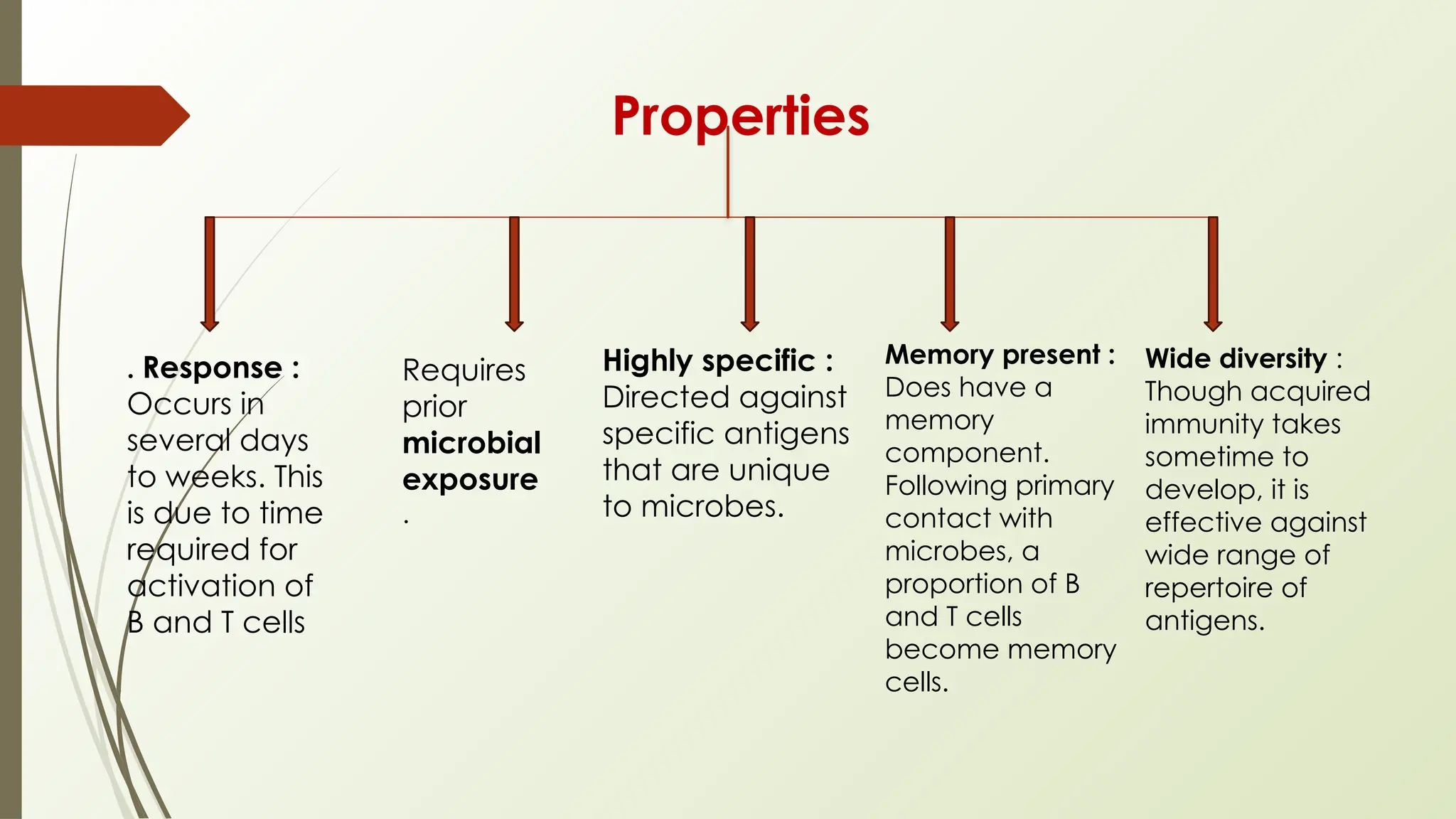
Properties
. Response :
Occurs in
several days
to weeks. This
is due to time
required for
activation of
B and T cells
Requires
prior
microbial
exposure
.
Highly specific :
Directed against
specific antigens
that are unique
to microbes.
Memory present :
Does have a
memory
component.
Following primary
contact with
microbes, a
proportion of B
and T cells
become memory
cells.
Wide diversity :
Though acquired
immunity takes
sometime to
develop, it is
effective against
wide range of
repertoire of
antigens.
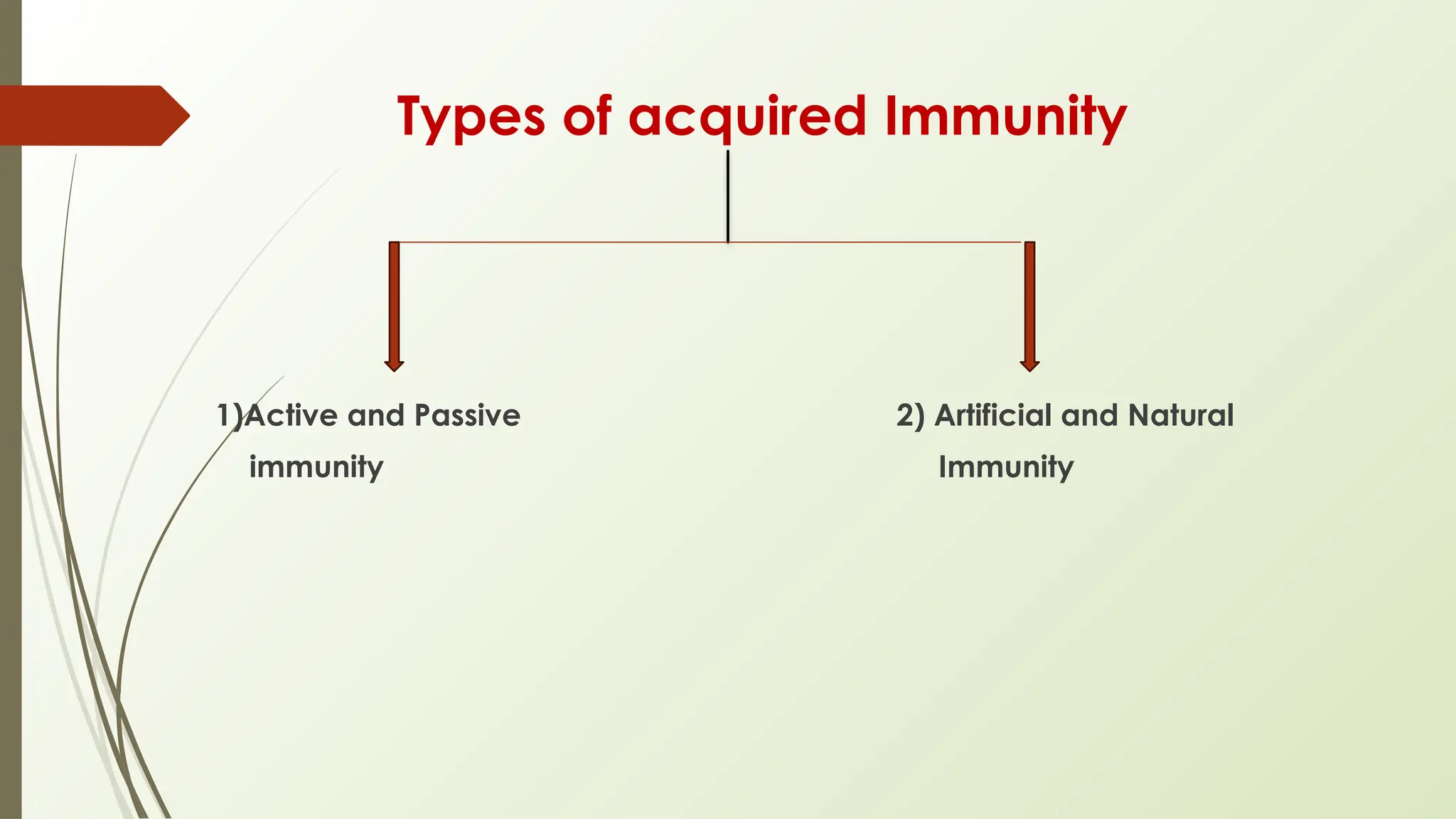
Types of acquired Immunity
1)Active and Passive 2) Artificial and Natural
immunity Immunity
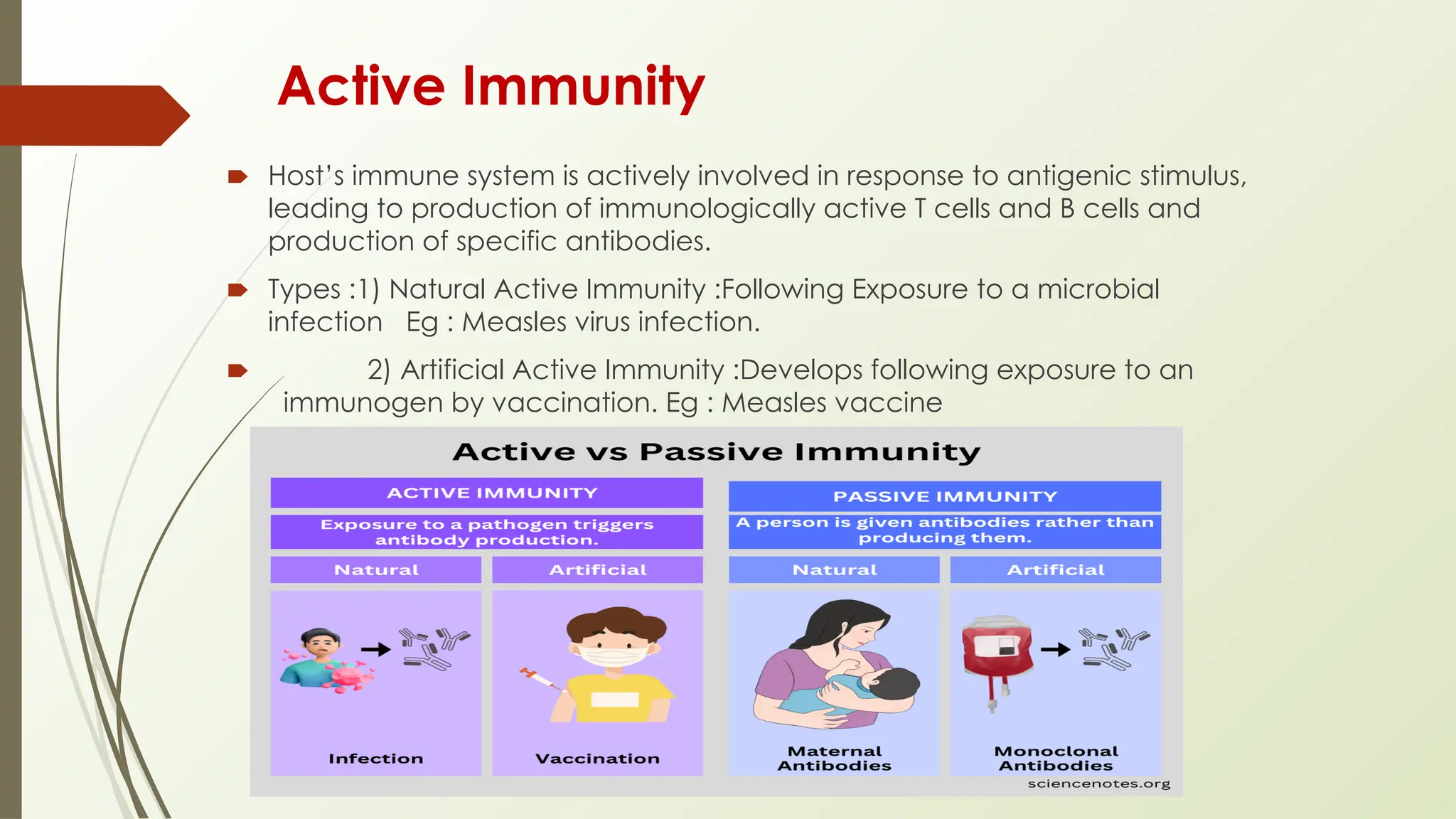
Active Immunity
🠶 Host’s immune system is actively involved in response to antigenic stimulus,
leading to production of immunologically active T cells and B cells and
production of specific antibodies.
🠶 Types :1) Natural Active Immunity :Following Exposure to a microbial
infection Eg : Measles virus infection.
🠶 2) Artificial Active Immunity :Develops following exposure to an
immunogen by vaccination. Eg : Measles vaccine
Properties:
🠶 1)Fails to develop when the host becomes
immunocompromised.
🠶 2)Long lasting.
🠶 3)Lasts for short duration in Influenza virus infection.
🠶 4)Life long in viral infections such as chicken pox,
measles, mumps, rubella, etc.
🠶 5)Lasts for as long as microbial infection persists in body.
Hence called Pre-munition or concomitant immunity
Types of Immune responses in the
Active immunity
🠶 1) Primary Immune Response : When the antigenic exposure
occurs for the first time, the following events take place
Latent or lag period:
Active immunity develops only after a latent period following
the antigenic exposure, Time required for the host’s immune
apparatus to become active
Effector cells:
Majority of activated T and B cells against the antigenic stimulus
become effector T and B cells
Effector T cells helper T cells and cytotoxic T cells
Effector B cells include plasma cells
Memory cells:
A minor proportion of stimulated T and B cells become
memory cells, which are the key cells for secondary immune
response.
◦Antibody surge:
Effector B cells produce antibodies (mainly IgM type).
Antibodies appear in the serum in slow and sluggish manner;
reach peak, maintain the level for a while and then fall down.
Finally, a low titer of baseline antibodies may be maintained in
the serum
Secondary Immune Response
🠶 Same Antigenic exposure occurs subsequently ,the events which
takes place are:
◦Latent period:
• Either absent or of short duration.
• This is because memory cells become active soon after the
antigenic exposure.
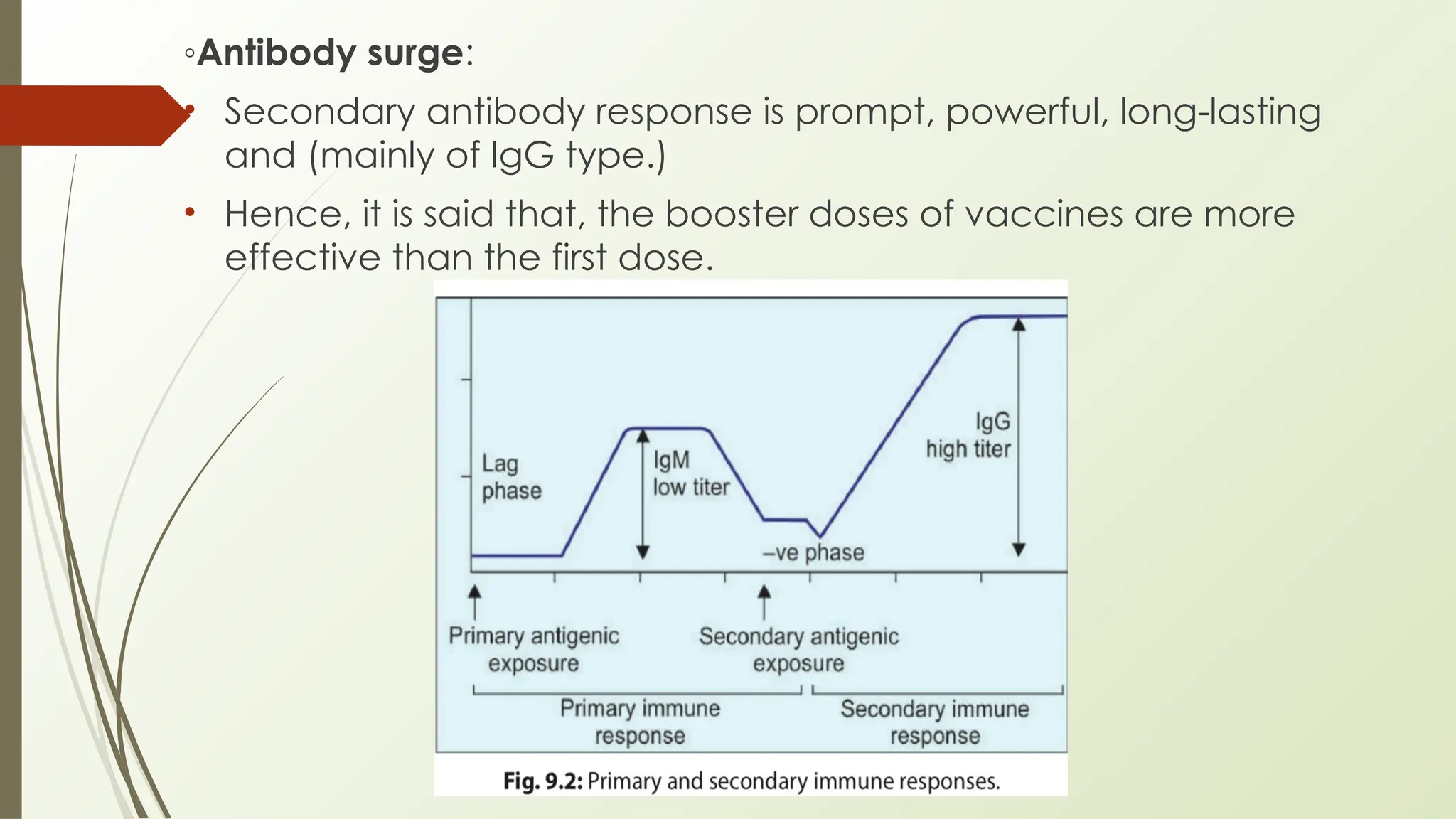
◦Negative phase:
• At the onset of secondary immune response.Antibody level may
become lower than it was before the antigenic stimulus.
• This is because the exposed antigen combines with the pre-
existing antibody and thus the antibody level in serum fall down.
◦Antibody surge:
• Secondary antibody response is prompt, powerful, long-lasting
and (mainly of IgG type.)
• Hence, it is said that, the booster doses of vaccines are more
effective than the first dose.
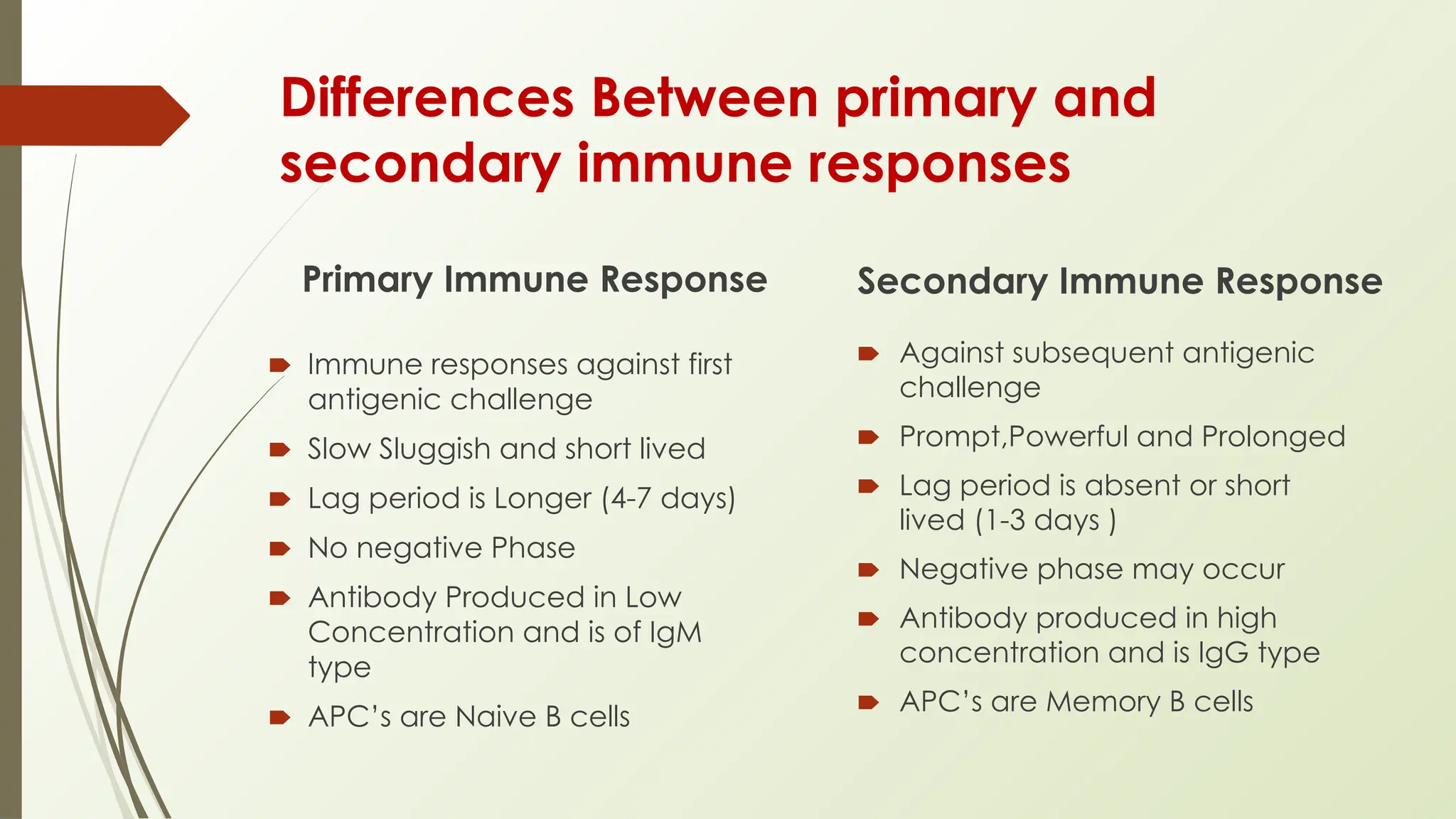
Differences Between primary and
secondary immune responses
Primary Immune Response
🠶 Immune responses against first
antigenic challenge
🠶 Slow Sluggish and short lived
🠶 Lag period is Longer (4-7 days)
🠶 No negative Phase
🠶 Antibody Produced in Low
Concentration and is of IgM
type
🠶 APC’s are Naive B cells
Secondary Immune Response
🠶 Against subsequent antigenic
challenge
🠶 Prompt,Powerful and Prolonged
🠶 Lag period is absent or short
lived (1-3 days )
🠶 Negative phase may occur
🠶 Antibody produced in high
concentration and is IgG type
🠶 APC’s are Memory B cells
active immunity short summarized pptx presentation

active immunity short summarized pptx presentation

  • 1.
    Immunit y Guided by: Dr ArchanaNikam Presented by: 23009 23012 23013 23014 23015
  • 2.
    Acquired/adaptive Immunity Acquired immunityis defined as the resistance against the infecting foreign substance that an individual acquires or adapts during the course of his life
  • 3.
    Components of AcquiredImmunity Mediators: T cells and B cells are the prime mediators and regulate the immunity via : Cell-mediated and Antibody- mediated responses respectively Other mediators : 1) Complement Pathway (Classical) 2) Antigen Presenting Cells 3) Cytokines mainly IL-2,IL-4,and IL-5
  • 4.
    Properties . Response : Occursin several days to weeks. This is due to time required for activation of B and T cells Requires prior microbial exposure . Highly specific : Directed against specific antigens that are unique to microbes. Memory present : Does have a memory component. Following primary contact with microbes, a proportion of B and T cells become memory cells. Wide diversity : Though acquired immunity takes sometime to develop, it is effective against wide range of repertoire of antigens.
  • 5.
    Types of acquiredImmunity 1)Active and Passive 2) Artificial and Natural immunity Immunity
  • 6.
    Active Immunity 🠶 Host’simmune system is actively involved in response to antigenic stimulus, leading to production of immunologically active T cells and B cells and production of specific antibodies. 🠶 Types :1) Natural Active Immunity :Following Exposure to a microbial infection Eg : Measles virus infection. 🠶 2) Artificial Active Immunity :Develops following exposure to an immunogen by vaccination. Eg : Measles vaccine
  • 7.
    Properties: 🠶 1)Fails todevelop when the host becomes immunocompromised. 🠶 2)Long lasting. 🠶 3)Lasts for short duration in Influenza virus infection. 🠶 4)Life long in viral infections such as chicken pox, measles, mumps, rubella, etc. 🠶 5)Lasts for as long as microbial infection persists in body. Hence called Pre-munition or concomitant immunity
  • 8.
    Types of Immuneresponses in the Active immunity 🠶 1) Primary Immune Response : When the antigenic exposure occurs for the first time, the following events take place Latent or lag period: Active immunity develops only after a latent period following the antigenic exposure, Time required for the host’s immune apparatus to become active Effector cells: Majority of activated T and B cells against the antigenic stimulus become effector T and B cells Effector T cells helper T cells and cytotoxic T cells Effector B cells include plasma cells
  • 9.
    Memory cells: A minorproportion of stimulated T and B cells become memory cells, which are the key cells for secondary immune response. ◦Antibody surge: Effector B cells produce antibodies (mainly IgM type). Antibodies appear in the serum in slow and sluggish manner; reach peak, maintain the level for a while and then fall down. Finally, a low titer of baseline antibodies may be maintained in the serum
  • 10.
    Secondary Immune Response 🠶Same Antigenic exposure occurs subsequently ,the events which takes place are: ◦Latent period: • Either absent or of short duration. • This is because memory cells become active soon after the antigenic exposure. ◦Negative phase: • At the onset of secondary immune response.Antibody level may become lower than it was before the antigenic stimulus. • This is because the exposed antigen combines with the pre- existing antibody and thus the antibody level in serum fall down.
  • 11.
    ◦Antibody surge: • Secondaryantibody response is prompt, powerful, long-lasting and (mainly of IgG type.) • Hence, it is said that, the booster doses of vaccines are more effective than the first dose.
  • 12.
    Differences Between primaryand secondary immune responses Primary Immune Response 🠶 Immune responses against first antigenic challenge 🠶 Slow Sluggish and short lived 🠶 Lag period is Longer (4-7 days) 🠶 No negative Phase 🠶 Antibody Produced in Low Concentration and is of IgM type 🠶 APC’s are Naive B cells Secondary Immune Response 🠶 Against subsequent antigenic challenge 🠶 Prompt,Powerful and Prolonged 🠶 Lag period is absent or short lived (1-3 days ) 🠶 Negative phase may occur 🠶 Antibody produced in high concentration and is IgG type 🠶 APC’s are Memory B cells