ADAPTIVE IMMUNITY
Oleh:
Muh Dzulfikar Lingga QM
Pembimbing:
dr. Deshinta Putri Mulya, Sp.PD-KAI
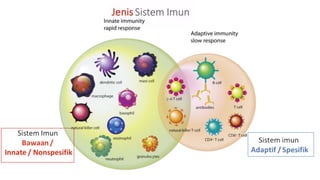
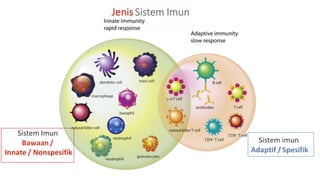
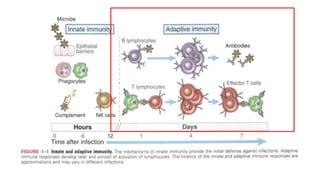
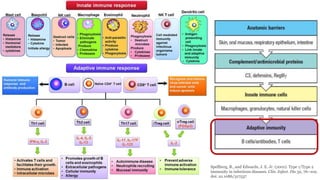
Innate Immunity
• Innate immunity (natural/naive immunity): early line of defense
against microbes.
• It consists of cellular and biochemical defense mechanisms that are in
place even before infection and are poised to respond rapidly to
infections.
• These mechanisms react only to microbes (and to the products of
injured cells), and they respond in essentially the same way to
repeated infections.
Adaptive Immunity
• Adaptive/acquired/specific immunity: stimulated by exposure to
infectious agents and increase in magnitude and defensive
capabilities with each successive exposure to a particular microbe
• It is able to recognize and react to a large number of microbial and
nonmicrobial substances.
• It has an extraordinary capacity to distinguish between different, even
closely related, microbes and molecules
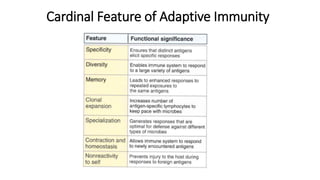
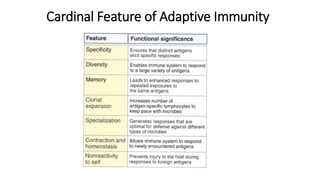
Cardinal Feature of Adaptive Immunity
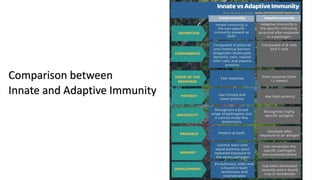
Comparison between
Innate and Adaptive Immunity
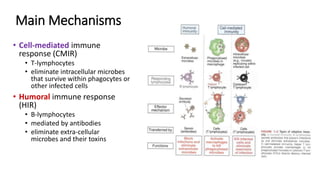
Main Mechanisms
• Cell-mediated immune
response (CMIR)
• T-lymphocytes
• eliminate intracellular microbes
that survive within phagocytes or
other infected cells
• Humoral immune response
(HIR)
• B-lymphocytes
• mediated by antibodies
• eliminate extra-cellular
microbes and their toxins
Adaptive Immunity
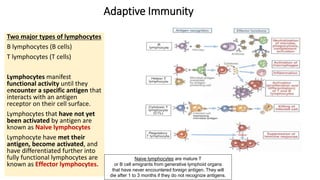
Two major types of lymphocytes
B lymphocytes (B cells)
T lymphocytes (T cells)
Lymphocytes manifest
functional activity until they
encounter a specific antigen that
interacts with an antigen
receptor on their cell surface.
Lymphocytes that have not yet
been activated by antigen are
known as Naive lymphocytes
Lymphocyte have met their
antigen, become activated, and
have differentiated further into
fully functional lymphocytes are
known as Effector lymphocytes.
Naive lymphocytes are mature T
or B cell emigrants from generative lymphoid organs
that have never encountered foreign antigen. They will
die after 1 to 3 months if they do not recognize antigens.
Adaptive Immunity
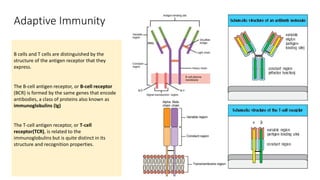
B cells and T cells are distinguished by the
structure of the antigen receptor that they
express.
The B-cell antigen receptor, or B-cell receptor
(BCR) is formed by the same genes that encode
antibodies, a class of proteins also known as
immunoglobulins (Ig)
The T-cell antigen receptor, or T-cell
receptor(TCR), is related to the
immunoglobulins but is quite distinct in its
structure and recognition properties.
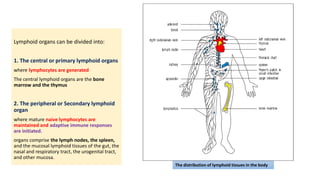
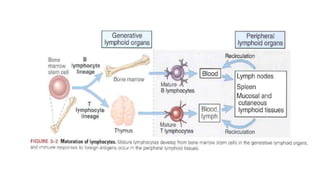
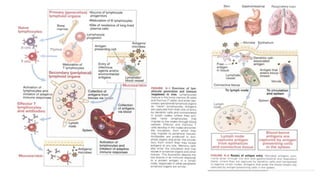
Lymphoid organs can be divided into:
1. The central or primary lymphoid organs
where lymphocytes are generated
The central lymphoid organs are the bone
marrow and the thymus
2. The peripheral or Secondary lymphoid
organ
where mature naive lymphocytes are
maintained and adaptive immune responses
are initiated.
organs comprise the lymph nodes, the spleen,
and the mucosal lymphoid tissues of the gut, the
nasal and respiratory tract, the urogenital tract,
and other mucosa.
The distribution of lymphoid tissues in the body
CELL MEDIATED
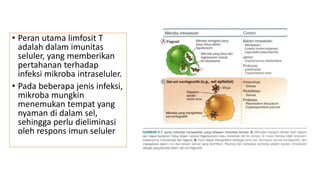
• Peran utama limfosit T
adalah dalam imunitas
seluler, yang memberikan
pertahanan terhadap
infeksi mikroba intraseluler.
• Pada beberapa jenis infeksi,
mikroba mungkin
menemukan tempat yang
nyaman di dalam sel,
sehingga perlu dieliminasi
oleh respons imun seluler
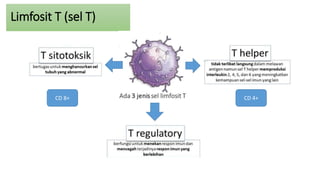
Limfosit T (sel T)
CD 8+ CD 4+
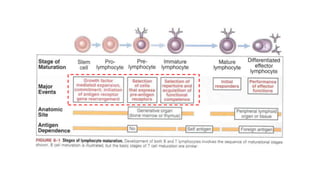
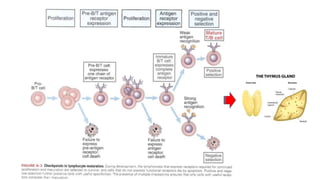
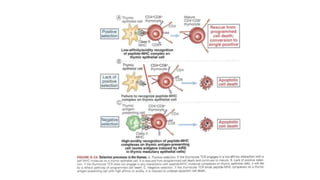
Proses Maturasi Sel T
Cell Mediated Immunity
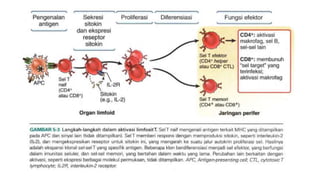
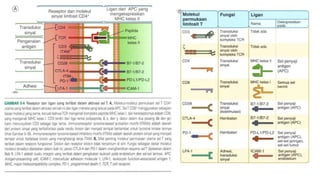
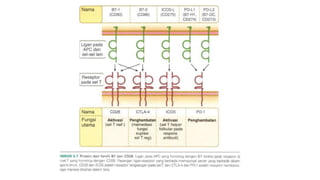
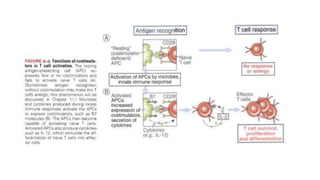
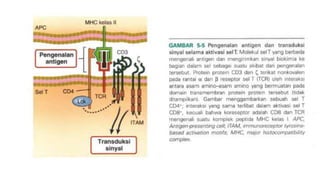
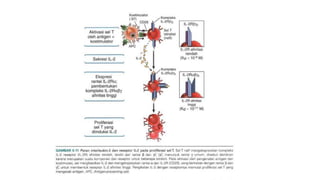
Aktivasi Sel T
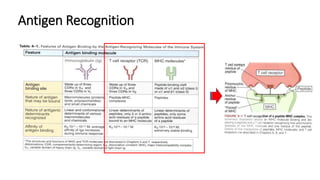
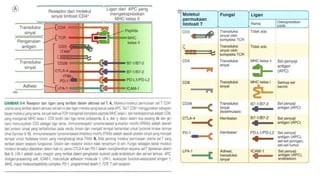
Antigen Recognition
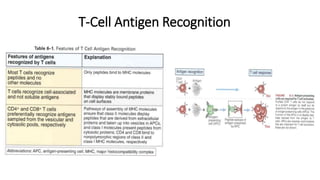
T-Cell Antigen Recognition
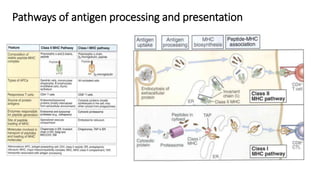
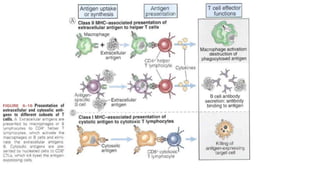
Pathways of antigen processing and presentation
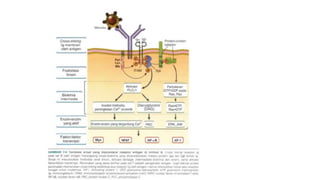
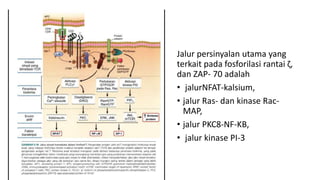
Jalur persinyalan utama yang
terkait pada fosforilasi rantai ζ,
dan ZAP- 70 adalah
• jalurNFAT-kalsium,
• jalur Ras- dan kinase Rac-
MAP,
• jalur PKC8-NF-KB,
• jalur kinase PI-3
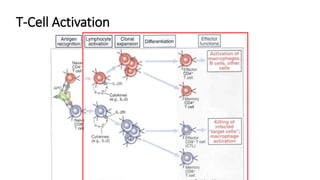
T-Cell Activation
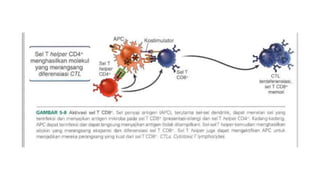
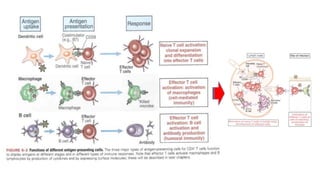
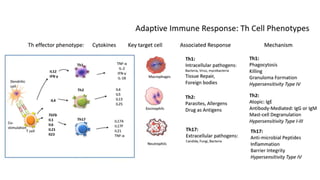
Sel T CD4 efektor
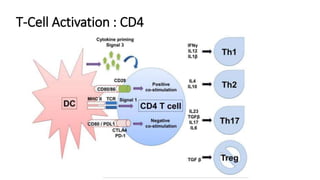
T-Cell Activation : CD4
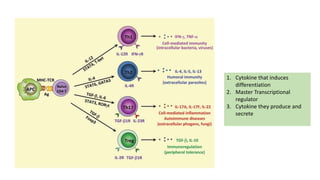
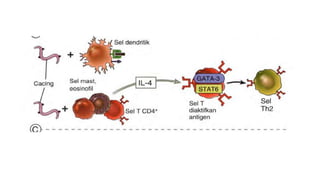
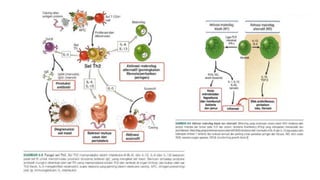
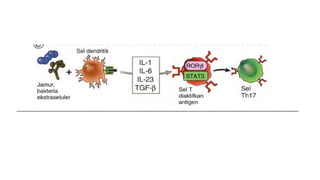
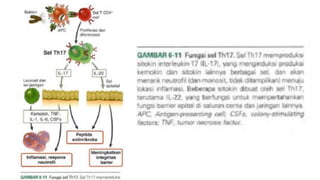
1. Cytokine that induces
differentiation
2. Master Transcriptional
regulator
3. Cytokine they produce and
secrete
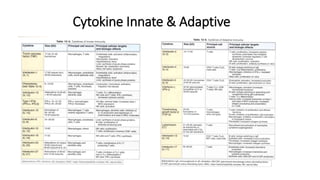
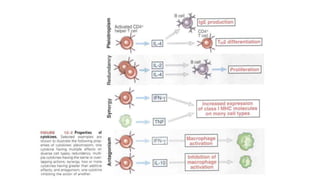
Cytokine Innate & Adaptive
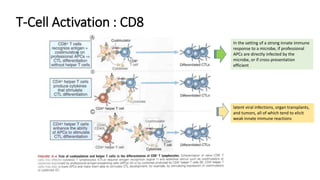
T-Cell Activation : CD8
latent viral infections, organ transplants,
and tumors, all of which tend to elicit
weak innate immune reactions
In the setting of a strong innate immune
response to a microbe, if professional
APCs are directly infected by the
microbe, or if cross-presentation
efficient
HUMORAL
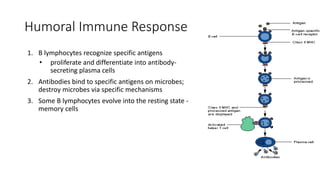
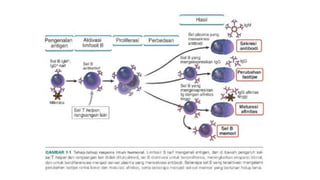
Humoral Immune Response
1. B lymphocytes recognize specific antigens
• proliferate and differentiate into antibody-
secreting plasma cells
2. Antibodies bind to specific antigens on microbes;
destroy microbes via specific mechanisms
3. Some B lymphocytes evolve into the resting state -
memory cells
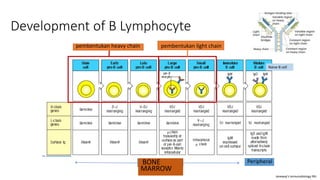
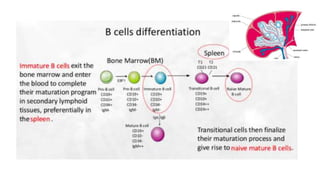
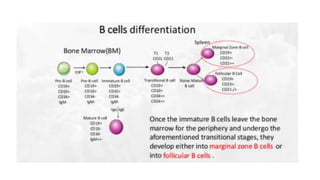
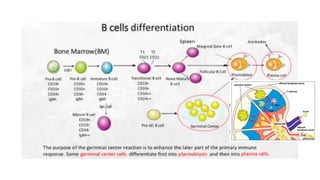
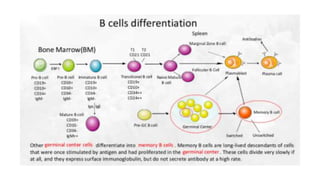
Development of B Lymphocyte
BONE
MARROW
Peripheral
Janeway's immunobiology 9th
pembentukan heavy chain pembentukan light chain
Naive B cell
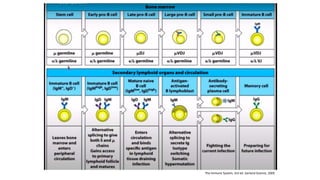
The Immune System, 3rd ed. Garland Science, 2009
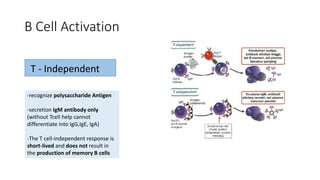
B Cell Activation
-recognize polysaccharide Antigen
-secretion IgM antibody only
(without Tcell help cannot
differentiate into IgG,IgE, IgA)
-The T cell-independent response is
short-lived and does not result in
the production of memory B cells
T - Independent
B Cell Activation
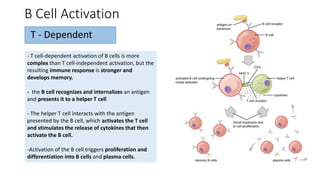
- T cell-dependent activation of B cells is more
complex than T cell-independent activation, but the
resulting immune response is stronger and
develops memory.
- the B cell recognizes and internalizes an antigen
and presents it to a helper T cell
- The helper T cell interacts with the antigen
presented by the B cell, which activates the T cell
and stimulates the release of cytokines that then
activate the B cell.
-Activation of the B cell triggers proliferation and
differentiation into B cells and plasma cells.
T - Dependent
B Cell Activation
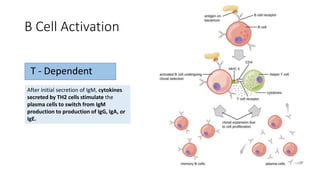
T - Dependent
After initial secretion of IgM, cytokines
secreted by TH2 cells stimulate the
plasma cells to switch from IgM
production to production of IgG, IgA, or
IgE.
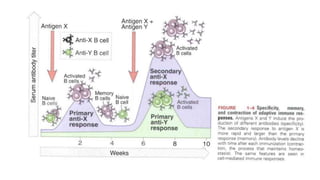
Primary and Secondary Response
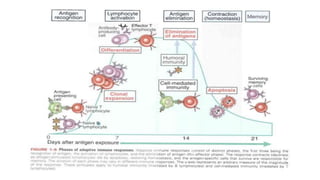
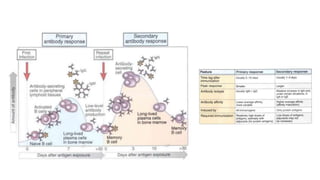
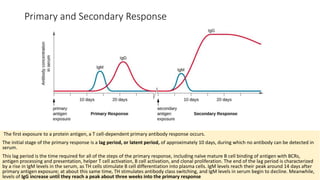
The first exposure to a protein antigen, a T cell-dependent primary antibody response occurs.
The initial stage of the primary response is a lag period, or latent period, of approximately 10 days, during which no antibody can be detected in
serum.
This lag period is the time required for all of the steps of the primary response, including naïve mature B cell binding of antigen with BCRs,
antigen processing and presentation, helper T cell activation, B cell activation, and clonal proliferation. The end of the lag period is characterized
by a rise in IgM levels in the serum, as TH cells stimulate B cell differentiation into plasma cells. IgM levels reach their peak around 14 days after
primary antigen exposure; at about this same time, TH stimulates antibody class switching, and IgM levels in serum begin to decline. Meanwhile,
levels of IgG increase until they reach a peak about three weeks into the primary response
Primary and Secondary Response
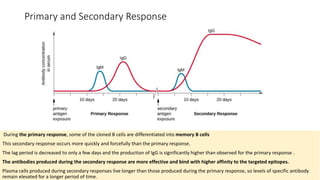
During the primary response, some of the cloned B cells are differentiated into memory B cells
This secondary response occurs more quickly and forcefully than the primary response.
The lag period is decreased to only a few days and the production of IgG is significantly higher than observed for the primary response .
The antibodies produced during the secondary response are more effective and bind with higher affinity to the targeted epitopes.
Plasma cells produced during secondary responses live longer than those produced during the primary response, so levels of specific antibody
remain elevated for a longer period of time.
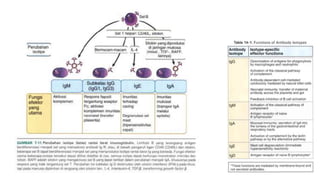
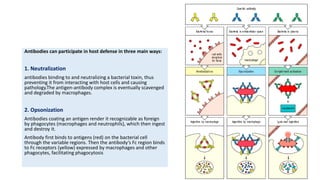
Antibodies can participate in host defense in three main ways:
1. Neutralization
antibodies binding to and neutralizing a bacterial toxin, thus
preventing it from interacting with host cells and causing
pathology.The antigen-antibody complex is eventually scavenged
and degraded by macrophages.
2. Opsonization
Antibodies coating an antigen render it recognizable as foreign
by phagocytes (macrophages and neutrophils), which then ingest
and destroy it.
Antibody first binds to antigens (red) on the bacterial cell
through the variable regions. Then the antibody’s Fc region binds
to Fc receptors (yellow) expressed by macrophages and other
phagocytes, facilitating phagocytosis
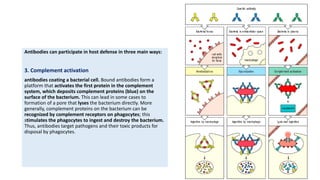
Antibodies can participate in host defense in three main ways:
3. Complement activation
antibodies coating a bacterial cell. Bound antibodies form a
platform that activates the first protein in the complement
system, which deposits complement proteins (blue) on the
surface of the bacterium. This can lead in some cases to
formation of a pore that lyses the bacterium directly. More
generally, complement proteins on the bacterium can be
recognized by complement receptors on phagocytes; this
stimulates the phagocytes to ingest and destroy the bacterium.
Thus, antibodies target pathogens and their toxic products for
disposal by phagocytes.
TERIMA KASIH
Mohon Arahannya
Spellberg, B., and Edwards, J. E. Jr. (2001). Type 1/Type 2
immunity in infectious diseases. Clin. Infect. Dis 32, 76–102.
doi: 10.1086/317537
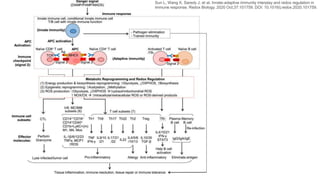
Sun L, Wang X, Saredy J, et al. Innate-adaptive immunity interplay and redox regulation in
immune response. Redox Biology. 2020 Oct;37:101759. DOI: 10.1016/j.redox.2020.101759.
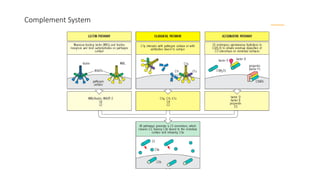
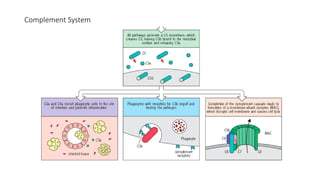
Complement System
Complement System
Lingga Adaptive Imun.pptx

Lingga Adaptive Imun.pptx

  • 1.
    ADAPTIVE IMMUNITY Oleh: Muh DzulfikarLingga QM Pembimbing: dr. Deshinta Putri Mulya, Sp.PD-KAI
  • 3.
    Innate Immunity • Innateimmunity (natural/naive immunity): early line of defense against microbes. • It consists of cellular and biochemical defense mechanisms that are in place even before infection and are poised to respond rapidly to infections. • These mechanisms react only to microbes (and to the products of injured cells), and they respond in essentially the same way to repeated infections.
  • 5.
    Adaptive Immunity • Adaptive/acquired/specificimmunity: stimulated by exposure to infectious agents and increase in magnitude and defensive capabilities with each successive exposure to a particular microbe • It is able to recognize and react to a large number of microbial and nonmicrobial substances. • It has an extraordinary capacity to distinguish between different, even closely related, microbes and molecules
  • 7.
    Cardinal Feature ofAdaptive Immunity
  • 9.
    Cardinal Feature ofAdaptive Immunity
  • 10.
  • 11.
    Main Mechanisms • Cell-mediatedimmune response (CMIR) • T-lymphocytes • eliminate intracellular microbes that survive within phagocytes or other infected cells • Humoral immune response (HIR) • B-lymphocytes • mediated by antibodies • eliminate extra-cellular microbes and their toxins
  • 13.
    Adaptive Immunity Two majortypes of lymphocytes B lymphocytes (B cells) T lymphocytes (T cells) Lymphocytes manifest functional activity until they encounter a specific antigen that interacts with an antigen receptor on their cell surface. Lymphocytes that have not yet been activated by antigen are known as Naive lymphocytes Lymphocyte have met their antigen, become activated, and have differentiated further into fully functional lymphocytes are known as Effector lymphocytes. Naive lymphocytes are mature T or B cell emigrants from generative lymphoid organs that have never encountered foreign antigen. They will die after 1 to 3 months if they do not recognize antigens.
  • 14.
    Adaptive Immunity B cellsand T cells are distinguished by the structure of the antigen receptor that they express. The B-cell antigen receptor, or B-cell receptor (BCR) is formed by the same genes that encode antibodies, a class of proteins also known as immunoglobulins (Ig) The T-cell antigen receptor, or T-cell receptor(TCR), is related to the immunoglobulins but is quite distinct in its structure and recognition properties.
  • 15.
    Lymphoid organs canbe divided into: 1. The central or primary lymphoid organs where lymphocytes are generated The central lymphoid organs are the bone marrow and the thymus 2. The peripheral or Secondary lymphoid organ where mature naive lymphocytes are maintained and adaptive immune responses are initiated. organs comprise the lymph nodes, the spleen, and the mucosal lymphoid tissues of the gut, the nasal and respiratory tract, the urogenital tract, and other mucosa. The distribution of lymphoid tissues in the body
  • 18.
  • 19.
    • Peran utamalimfosit T adalah dalam imunitas seluler, yang memberikan pertahanan terhadap infeksi mikroba intraseluler. • Pada beberapa jenis infeksi, mikroba mungkin menemukan tempat yang nyaman di dalam sel, sehingga perlu dieliminasi oleh respons imun seluler
  • 20.
    Limfosit T (selT) CD 8+ CD 4+
  • 21.
    Proses Maturasi SelT Cell Mediated Immunity
  • 25.
  • 27.
  • 29.
  • 30.
    Pathways of antigenprocessing and presentation
  • 36.
    Jalur persinyalan utamayang terkait pada fosforilasi rantai ζ, dan ZAP- 70 adalah • jalurNFAT-kalsium, • jalur Ras- dan kinase Rac- MAP, • jalur PKC8-NF-KB, • jalur kinase PI-3
  • 38.
  • 40.
    Sel T CD4efektor
  • 42.
  • 43.
    1. Cytokine thatinduces differentiation 2. Master Transcriptional regulator 3. Cytokine they produce and secrete
  • 51.
  • 52.
    T-Cell Activation :CD8 latent viral infections, organ transplants, and tumors, all of which tend to elicit weak innate immune reactions In the setting of a strong innate immune response to a microbe, if professional APCs are directly infected by the microbe, or if cross-presentation efficient
  • 54.
  • 55.
    Humoral Immune Response 1.B lymphocytes recognize specific antigens • proliferate and differentiate into antibody- secreting plasma cells 2. Antibodies bind to specific antigens on microbes; destroy microbes via specific mechanisms 3. Some B lymphocytes evolve into the resting state - memory cells
  • 56.
    Development of BLymphocyte BONE MARROW Peripheral Janeway's immunobiology 9th pembentukan heavy chain pembentukan light chain Naive B cell
  • 57.
    The Immune System,3rd ed. Garland Science, 2009
  • 58.
    B Cell Activation -recognizepolysaccharide Antigen -secretion IgM antibody only (without Tcell help cannot differentiate into IgG,IgE, IgA) -The T cell-independent response is short-lived and does not result in the production of memory B cells T - Independent
  • 59.
    B Cell Activation -T cell-dependent activation of B cells is more complex than T cell-independent activation, but the resulting immune response is stronger and develops memory. - the B cell recognizes and internalizes an antigen and presents it to a helper T cell - The helper T cell interacts with the antigen presented by the B cell, which activates the T cell and stimulates the release of cytokines that then activate the B cell. -Activation of the B cell triggers proliferation and differentiation into B cells and plasma cells. T - Dependent
  • 60.
    B Cell Activation T- Dependent After initial secretion of IgM, cytokines secreted by TH2 cells stimulate the plasma cells to switch from IgM production to production of IgG, IgA, or IgE.
  • 65.
    Primary and SecondaryResponse The first exposure to a protein antigen, a T cell-dependent primary antibody response occurs. The initial stage of the primary response is a lag period, or latent period, of approximately 10 days, during which no antibody can be detected in serum. This lag period is the time required for all of the steps of the primary response, including naïve mature B cell binding of antigen with BCRs, antigen processing and presentation, helper T cell activation, B cell activation, and clonal proliferation. The end of the lag period is characterized by a rise in IgM levels in the serum, as TH cells stimulate B cell differentiation into plasma cells. IgM levels reach their peak around 14 days after primary antigen exposure; at about this same time, TH stimulates antibody class switching, and IgM levels in serum begin to decline. Meanwhile, levels of IgG increase until they reach a peak about three weeks into the primary response
  • 66.
    Primary and SecondaryResponse During the primary response, some of the cloned B cells are differentiated into memory B cells This secondary response occurs more quickly and forcefully than the primary response. The lag period is decreased to only a few days and the production of IgG is significantly higher than observed for the primary response . The antibodies produced during the secondary response are more effective and bind with higher affinity to the targeted epitopes. Plasma cells produced during secondary responses live longer than those produced during the primary response, so levels of specific antibody remain elevated for a longer period of time.
  • 67.
    Antibodies can participatein host defense in three main ways: 1. Neutralization antibodies binding to and neutralizing a bacterial toxin, thus preventing it from interacting with host cells and causing pathology.The antigen-antibody complex is eventually scavenged and degraded by macrophages. 2. Opsonization Antibodies coating an antigen render it recognizable as foreign by phagocytes (macrophages and neutrophils), which then ingest and destroy it. Antibody first binds to antigens (red) on the bacterial cell through the variable regions. Then the antibody’s Fc region binds to Fc receptors (yellow) expressed by macrophages and other phagocytes, facilitating phagocytosis
  • 68.
    Antibodies can participatein host defense in three main ways: 3. Complement activation antibodies coating a bacterial cell. Bound antibodies form a platform that activates the first protein in the complement system, which deposits complement proteins (blue) on the surface of the bacterium. This can lead in some cases to formation of a pore that lyses the bacterium directly. More generally, complement proteins on the bacterium can be recognized by complement receptors on phagocytes; this stimulates the phagocytes to ingest and destroy the bacterium. Thus, antibodies target pathogens and their toxic products for disposal by phagocytes.
  • 69.
  • 73.
    Spellberg, B., andEdwards, J. E. Jr. (2001). Type 1/Type 2 immunity in infectious diseases. Clin. Infect. Dis 32, 76–102. doi: 10.1086/317537
  • 74.
    Sun L, WangX, Saredy J, et al. Innate-adaptive immunity interplay and redox regulation in immune response. Redox Biology. 2020 Oct;37:101759. DOI: 10.1016/j.redox.2020.101759.
  • 75.
  • 76.

Editor's Notes

  • #4 Mekanisme pertahanan inang terdiri dari imunitas alami, yang memberikan perlindungan segera terhadap infeksi, dan imunitas adaptif, yang berkembang lebih lambat namun memberikan perlindungan yang lebih spesialistik terhadap infeksi
  • #6 Mekanisme pertahanan inang terdiri dari imunitas alami, yang memberikan perlindungan segera terhadap infeksi, dan imunitas adaptif, yang berkembang lebih lambat namun memberikan perlindungan yang lebih spesialistik terhadap infeksi
  • #8 Imunitas alami Uuga disebut natural immunity dan native immunity) selalu ada pada invidu-individu sehat, dan disiapkan untuk menghambat masuknya mikroba dan untuk mengeliminasi mikroba yang berhasil memasuki jaringan inang (host) secara cepat. Imunitas adaptif (disebut juga imunitas spesifik atau imunitas didapat) memerlukan ekspansi dan diferensiasi limfosit sebagai respons terhadap mikroba sebelum mem- berikan pertahanan yang efektif; imunitas im beradaptasi terhadap adanya invasi mikroba. Imunitas alami secara filogenetis lebih tua , sedangkan imunitas adaptif yang lebih terspesialisasi dan lebih kuat, barn berkembang kemudian
  • #14 Respons imun adaptif terutama penting untuk pertahanan terhadap mikroba infeksius yang bersifat patogenik terhadap manusia (yaitu dapat menyebabkan penyakit) dan mampu melawan imunitas alarrti. Sementara mekanisme imunitas alami mengenali struktur-struktur yang sama-sama dirrtiliki oleh berbagai kelas rrtikroba, sel-sel imunitas adaptif (limfosit), mengekspresikan reseptor yang secara spesifik mengenali berbagai molekul yang diproduksi oleh mikroba serta molekul- molekul non-infeksius. Setiap bahan yang secara spesifik dapat dikenali oleh limfosit dan antibodi disebut antigen.