The National Strategies  Primary
                         Assessing Pupils’ Progress in primary science

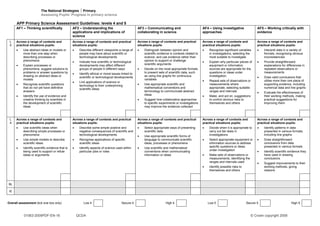
      APP Primary Science Assessment Guidelines: levels 4 and 5
      AF1 – Thinking scientifically               AF2 – Understanding the                           AF3 – Communicating and                              AF4 – Using investigative               AF5 – Working critically with
                                                  applications and implications of                  collaborating in science                             approaches                              evidence
                                                  science
 L    Across a range of contexts and              Across a range of contexts and practical          Across a range of contexts and practical             Across a range of contexts and          Across a range of contexts and
 5    practical situations pupils:                situations pupils:                                situations pupils:                                   practical situations pupils:            practical situations pupils:
          Use abstract ideas or models or            Describe different viewpoints a range of            Distinguish between opinion and                 Recognise significant variables        Interpret data in a variety of
           more than one step when                     people may have about scientific or                  scientific evidence in contexts related to       in investigations, selecting the        formats, recognising obvious
           describing processes or                     technological developments                           science, and use evidence rather than            most suitable to investigate            inconsistencies
           phenomena                                  Indicate how scientific or technological             opinion to support or challenge                 Explain why particular pieces of       Provide straightforward
          Explain processes or                        developments may affect different                    scientific arguments                             equipment or information                explanations for differences in
           phenomena, suggest solutions to             groups of people in different ways                  Decide on the most appropriate formats           sources are appropriate for the         repeated observations or
           problems or answer questions by            Identify ethical or moral issues linked to           to present sets of scientific data, such         questions or ideas under                measurements
           drawing on abstract ideas or                scientific or technological developments             as using line graphs for continuous              investigation                          Draw valid conclusions that
           models                                                                                           variables                                       Repeat sets of observations or          utilise more than one piece of
                                                      Link applications of science or
          Recognise scientific questions              technology to their underpinning                    Use appropriate scientific and                   measurements where                      supporting evidence, including
           that do not yet have definitive             scientific ideas                                     mathematical conventions and                     appropriate, selecting suitable         numerical data and line graphs
           answers                                                                                          terminology to communicate abstract              ranges and intervals                   Evaluate the effectiveness of
          Identify the use of evidence and                                                                 ideas                                           Make, and act on, suggestions           their working methods, making
           creative thinking by scientists in                                                              Suggest how collaborative approaches             to control obvious risks to             practical suggestions for
           the development of scientific                                                                    to specific experiments or investigations        themselves and others                   improving them
           ideas                                                                                            may improve the evidence collected


 L    Across a range of contexts and              Across a range of contexts and practical          Across a range of contexts and practical             Across a range of contexts and          Across a range of contexts and
 4    practical situations pupils:                situations pupils:                                situations pupils:                                   practical situations pupils:            practical situations pupils:
          Use scientific ideas when                  Describe some simple positive and                   Select appropriate ways of presenting           Decide when it is appropriate to       Identify patterns in data
           describing simple processes or              negative consequences of scientific and              scientific data                                  carry out fair tests in                 presented in various formats,
           phenomena                                   technological developments                          Use appropriate scientific forms of              investigations                          including line graphs
          Use simple models to describe              Recognise applications of specific                   language to communicate scientific              Select appropriate equipment or        Draw straightforward
           scientific ideas                            scientific ideas                                     ideas, processes or phenomena                    information sources to address          conclusions from data
          Identify scientific evidence that is       Identify aspects of science used within             Use scientific and mathematical                  specific questions or ideas             presented in various formats
           being used to support or refute             particular jobs or roles                             conventions when communicating                   under investigation                    Identify scientific evidence they
           ideas or arguments                                                                               information or ideas                            Make sets of observations or            have used in drawing
                                                                                                                                                             measurements, identifying the           conclusions
                                                                                                                                                             ranges and intervals used              Suggest improvements to their
                                                                                                                                                            Identify possible risks to              working methods, giving
                                                                                                                                                             themselves and others                   reasons


BL

 IE


Overall assessment (tick one box only)                    Low 4                         Secure 4                           High 4                           Low 5                        Secure 5                        High 5


           01063-2009PDF-EN-16                        QCDA                                                                                                                                   © Crown copyright 2009

Pri app sci_assess_gl_l4_5

  • 1.
    The National Strategies Primary Assessing Pupils’ Progress in primary science APP Primary Science Assessment Guidelines: levels 4 and 5 AF1 – Thinking scientifically AF2 – Understanding the AF3 – Communicating and AF4 – Using investigative AF5 – Working critically with applications and implications of collaborating in science approaches evidence science L Across a range of contexts and Across a range of contexts and practical Across a range of contexts and practical Across a range of contexts and Across a range of contexts and 5 practical situations pupils: situations pupils: situations pupils: practical situations pupils: practical situations pupils:  Use abstract ideas or models or  Describe different viewpoints a range of  Distinguish between opinion and  Recognise significant variables  Interpret data in a variety of more than one step when people may have about scientific or scientific evidence in contexts related to in investigations, selecting the formats, recognising obvious describing processes or technological developments science, and use evidence rather than most suitable to investigate inconsistencies phenomena  Indicate how scientific or technological opinion to support or challenge  Explain why particular pieces of  Provide straightforward  Explain processes or developments may affect different scientific arguments equipment or information explanations for differences in phenomena, suggest solutions to groups of people in different ways  Decide on the most appropriate formats sources are appropriate for the repeated observations or problems or answer questions by  Identify ethical or moral issues linked to to present sets of scientific data, such questions or ideas under measurements drawing on abstract ideas or scientific or technological developments as using line graphs for continuous investigation  Draw valid conclusions that models variables  Repeat sets of observations or utilise more than one piece of  Link applications of science or  Recognise scientific questions technology to their underpinning  Use appropriate scientific and measurements where supporting evidence, including that do not yet have definitive scientific ideas mathematical conventions and appropriate, selecting suitable numerical data and line graphs answers terminology to communicate abstract ranges and intervals  Evaluate the effectiveness of  Identify the use of evidence and ideas  Make, and act on, suggestions their working methods, making creative thinking by scientists in  Suggest how collaborative approaches to control obvious risks to practical suggestions for the development of scientific to specific experiments or investigations themselves and others improving them ideas may improve the evidence collected L Across a range of contexts and Across a range of contexts and practical Across a range of contexts and practical Across a range of contexts and Across a range of contexts and 4 practical situations pupils: situations pupils: situations pupils: practical situations pupils: practical situations pupils:  Use scientific ideas when  Describe some simple positive and  Select appropriate ways of presenting  Decide when it is appropriate to  Identify patterns in data describing simple processes or negative consequences of scientific and scientific data carry out fair tests in presented in various formats, phenomena technological developments  Use appropriate scientific forms of investigations including line graphs  Use simple models to describe  Recognise applications of specific language to communicate scientific  Select appropriate equipment or  Draw straightforward scientific ideas scientific ideas ideas, processes or phenomena information sources to address conclusions from data  Identify scientific evidence that is  Identify aspects of science used within  Use scientific and mathematical specific questions or ideas presented in various formats being used to support or refute particular jobs or roles conventions when communicating under investigation  Identify scientific evidence they ideas or arguments information or ideas  Make sets of observations or have used in drawing measurements, identifying the conclusions ranges and intervals used  Suggest improvements to their  Identify possible risks to working methods, giving themselves and others reasons BL IE Overall assessment (tick one box only) Low 4 Secure 4  High 4 Low 5 Secure 5 High 5 01063-2009PDF-EN-16 QCDA © Crown copyright 2009