BUILDING THEORIES
FROM CASE STUDY
RESEARCH
Kathleen M. Eisenhardt,
The Academy of Management Review
Introduction
 In this paper the author Kathleen M. Eisenhardt attempts to make two
contributions to theory building from case study research.
 The first is to create a road map for building theories from case study
research
 The second is to position theory building from case studies into the
larger context of social science research.
 The road map proposed in this paper synthesizes the work of (Glaser
and Strauss, 1967) on grounded theory building, (Miles and
Huberman, 1984) on qualitative methods and (Yin, 1981 &1984) on
design of case study research and extends that work in areas such as
a priori specification of constructs, triangulation of multiple
investigators, within case and cross case analyses, and the role of
existing literature..
Introduction
 The motivation for this research paper is that the author identified that
there is confusion regarding the distinctions among qualitative data,
inductive logic and case study research
 The author also found that there is lack of clarity regarding the
process of actually building theory from cases, especially regarding
the central inductive process and the role of literature.
 Additionally, there is a gap in studies regarding when theory building
research is likely to be useful and the strengths and weaknesses of
using case studies for theory building.
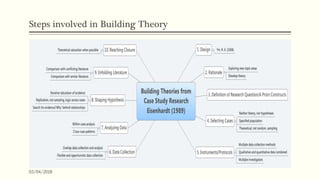
Steps involved in Building Theory
03/04/2018
Getting started
“ Defining research questions ”
 Without a research focus, it is easy to become overwhelmed by the
volume of data. Thus it is important to define a research question
within a broad topic which helps in identification of types of samples,
and, also the kind of data to be gathered.
 A priori specification of constructs can also help to shape the initial
design of theory building research. If these constructs prove
important as the study progresses, then researchers have a firmer
empirical grounding for the emergent theory.
 Research theory questions should be tentative as they are bound to
change during research.
03/04/2018
Selecting Cases
 Selection of cases is an important aspect of building theory from case
studies.
 As in hypothesis testing research, the concept of a population is
crucial, because the population defines the set of entities from which
the research sample is to be drawn.
 Also, selection of an appropriate population controls extraneous
variation and helps to define the limits for generalizing the findings.
The Cases are chosen for theoretical, not statistical, reasons.
 The cases may be chosen to replicate previous cases or extend
emergent theory, or they may be chosen to fill theoretical categories
and provide examples of polar types.
03/04/2018
Crafting Instruments and Protocols
 Theory-building researchers typically combine multiple data collection
methods.
 While interviews, observations, and archival sources are particularly
common, inductive researchers are not confined to these choices.
 The terms qualitative and case study are often used interchangeably.
 Case study research can involve qualitative data only, quantitative
only, or both (Yin, 1984).
 Strengthens grounding of theory by triangulation of evidence. Fosters
divergent perspectives and strengthens grounding by use of multiple
investigators.
03/04/2018
Entering the field
 An important feature of building theory from case studies is the frequent overlap of
data analysis with data collection. Preparing field notes is an important means to
achieve this overlap. Preparing field notes involve both observation and analysis.
 One key to preparing useful field notes is to write down whatever impressions that
occur to the researcher and react on it rather than filtering out what is important.
Another key is to use the information in these notes is to check what one is learning
and how this case in hand differs from the others.
 Overlapping the steps of data analysis with data collection provides the researcher
with a head start in analysis and more than that flexible data collection.
 A key feature of theory-building case research is the freedom to make adjustments
during data collection process.
03/04/2018
Analyzing Data
 According to the author, analyzing data is the most important part of building theory
from case studies. It is also the difficult and least codified part of the process.
 Most often published studies do not give importance to discussion and analysis and
establish how the final conclusions were arrived from the data collected.
 One important step in this phase is conducting within case analysis. Within case
analysis can help researchers to cope with huge volume of data.
 This typically involves preparing detailed case study write ups for each chosen case.
They are detailed descriptions of the site but helps in generating insight and to
become intimately familiar with each case as a stand-alone entity.
 This process allows unique patterns of each case to emerge before generalizing
patterns across cases.
03/04/2018
Analyzing Data (Continued)
 Generally people are poor processors of information while analyzing data.
Often researchers leap to conclusions based on limited data , they are
overly influenced by the vividness or by more elite respondents, they ignore
basic statistical properties, or they sometimes inadvertently drop
disconfirming evidence.
 They may reach premature or even false conclusions as a result of
information processing biases. The key to good cross-case comparison is
counteracting these tendencies by looking at the data in many divergent
ways.
 One tactic is to select categories or dimensions, and then to look for within-
group similarities coupled with intergroup differences.
03/04/2018
Analyzing Data (Continued)
 Another tactic is to select pairs of cases and then to list the
similarities and differences between each pair. This tactic forces
researchers to look for the subtle similarities and differences between
cases.
 A third tactic is to divide the data by data source. For example, one
researcher looks at observational data, another reviews interviews,
and still another works with questionnaire evidence. A variation of this
tactic is to split the data into groups of cases, focusing on one group
of cases initially, while later focusing on the remaining cases.
03/04/2018
Analyzing Data (Continued)
 The idea behind these cross-case searching tactics is to force
investigators to go beyond initial impressions, especially through he
use of structured and diverse lenses on the data. These tactics help
in improving the likelihood of accurate and reliable theory, that is, a
theory with a close fit with the data.
 Also, cross-case searching tactics enhance the probability that the
researchers will capture the novel findings which may exist in the
data.
03/04/2018
Shaping Hypothesis
 According to the author, from the within-site analysis plus various
cross-site tactics and overall impressions, tentative themes, concepts, and
possibly even relationships between variables begin to emerge.
 The next step of this highly iterative process is to compare systematically
the emergent frame with the evidence from each case in order to
assess how well or poorly it fits with case data.
 The key idea is that researchers constantly compare theory and
data-iterating toward a theory which closely fits the data. A close fit is
important to building good theory because it takes advantage of
the new insights possible from the data and yields an empirically
valid theory.
03/04/2018
Shaping Hypothesis (Contd)
 One step in shaping hypotheses is the sharpening of constructs. This is a two-part
process involving (1) refining the definition of the construct and (2) building
evidence which measures the construct in each case. .
 This occurs through constant comparison between data and constructs so
that accumulating evidence from diverse sources converges on a single,
well defined construct.
 The reasons for defining and building evidence for a construct apply in theory-
building research just as they do in traditional, hypothesis-testing work. That is,
careful construction of construct definitions and evidence produces the
sharply defined, measurable constructs which are necessary for strong theory
03/04/2018
Shaping Hypothesis (Contd)
 A second step in shaping hypotheses is verifying that the
emergent relationships between constructs fit with the
evidence in each case. Sometimes a relationship is confirmed by
the case evidence, while other times it is revised disconfirmed, or
rejected for insufficient evidence.
 The underlying logic here is replication, that is, the logic of treating
a series of cases as a series of experiments with each case
serving to confirm or disconfirm the hypotheses. Each case is
analogous to an experiment, and multiple cases are analogous to
multiple experiments.
 In replication logic, cases which confirm emergent relationships
enhance confidence in the validity of the relationships. Cases
which disconfirm the relationships often can provide an
opportunity to refine and extend the theory.
03/04/2018
Shaping Hypothesis (Contd)
 At this point, the qualitative data are particularly useful for understanding
why or why not emergent relationships hold. When a relationship is
supported, the qualitative data often provide a good understanding of the
dynamics underlying the relationship, that is, the “why” of what is happening.
This is crucial to the establishment of internal validity.
 Overall, shaping hypotheses in theory building research involves
measuring constructs and verifying relationships. These processes are
similar to traditional hypothesis- testing research.
 However, these processes are more judgmental in theory-building research
because researchers cannot apply statistical tests such as an F statistic.
The researchers judge the strength and consistency of relationships within
and across cases and also fully display the evidence and procedures when
the findings are published, so that readers may apply their own standards.
03/04/2018
Enfolding Literature
 An essential feature of theory building is comparison of the emergent concepts,
theory, or hypotheses with the extant literature. This involve asking what is this
similar to, what does it contradict, and why.
 A key to this process is to consider a broad range of literature. Examining literature
which conflicts with the emergent theory is important for two reasons.
 First, if researchers ignore conflicting findings, then confidence in the findings is
reduced. For example, readers may assume that the results are incorrect (a
challenge to internal validity), or if correct, are idiosyncratic to the specific cases of
the study (a challenge to generalizability).
 Second and perhaps more importantly, conflicting literature represents an
opportunity. The juxtaposition of conflicting results forces researchers into a
more creative, framebreaking mode of thinking than they might otherwise be
able to achieve.
03/04/2018
Enfolding Literature (Contd)
 The result can be deeper insight into both the emergent theory and the conflicting
literature, as well as sharpening of the limits to generalizability of the focal
research.
 Literature discussing similar findings is important as well because it ties together
underlying similarities in phenomena normally not associated with each other.
The result is often a theory with stronger internal validity, wider generalizability, and
higher conceptual level.
 Overall, tying the emergent theory to existing literature enhances the of theory
building from case stuinternal validity, generalizability, and theoretical level dy
research.
 While linking results to the literature is important in most research, it is
particularly crucial in theory building research because the findings often
rest on a very limited number of cases. In this situation, any further03/04/2018
Reaching Closure
 Two issues are important in reaching closure: when to stop adding cases, and
when to stop iterating between theory and data.
 In the first, ideally, researchers should stop adding cases when is reached.
Theoretical saturation is the point at which incremental learning is minimal
because the researchers are observing phenomena seen before.
 In practice, theoretical saturation often combines with pragmatic considerations
such as time and money to dictate when case collection ends. In fact, it is
not uncommon for researchers to plan the number of cases in advance.
 In the second closure issue, when to stop iterating between theory and data,
again, saturation is the key idea. That is, the iteration process stops when the
incremental improvement to theory is minimal
03/04/2018
Reaching Closure (Contd)
 The final product of building theory from case studies may be concepts, a
conceptual framework, or propositions or possibly midrange theory.
 On the downside, the final product may be disappointing. The research may
simply replicate prior theory, or there may be no clear patterns within the data.
The process of building theory from case study research is a strikingly iterative
one.
 One strength of theory building from cases is its likelihood of generating novel
theory. A second strength is that the emergent theory is likely to be testable
with constructs that can be readily measured and hypotheses that can be
proven false. A third strength is that the resultant theory is likely to be
empirically valid.
 The likelihood of valid theory is high because the theory-building process is so
intimately tied with evidence that it is very likely that the resultant theory
will be consistent with empirical observation.
03/04/2018
Summary
03/04/2018
THANK YOU!

Building theory from case study

  • 1.
    BUILDING THEORIES FROM CASESTUDY RESEARCH Kathleen M. Eisenhardt, The Academy of Management Review
  • 2.
    Introduction  In thispaper the author Kathleen M. Eisenhardt attempts to make two contributions to theory building from case study research.  The first is to create a road map for building theories from case study research  The second is to position theory building from case studies into the larger context of social science research.  The road map proposed in this paper synthesizes the work of (Glaser and Strauss, 1967) on grounded theory building, (Miles and Huberman, 1984) on qualitative methods and (Yin, 1981 &1984) on design of case study research and extends that work in areas such as a priori specification of constructs, triangulation of multiple investigators, within case and cross case analyses, and the role of existing literature..
  • 3.
    Introduction  The motivationfor this research paper is that the author identified that there is confusion regarding the distinctions among qualitative data, inductive logic and case study research  The author also found that there is lack of clarity regarding the process of actually building theory from cases, especially regarding the central inductive process and the role of literature.  Additionally, there is a gap in studies regarding when theory building research is likely to be useful and the strengths and weaknesses of using case studies for theory building.
  • 4.
    Steps involved inBuilding Theory 03/04/2018
  • 5.
    Getting started “ Definingresearch questions ”  Without a research focus, it is easy to become overwhelmed by the volume of data. Thus it is important to define a research question within a broad topic which helps in identification of types of samples, and, also the kind of data to be gathered.  A priori specification of constructs can also help to shape the initial design of theory building research. If these constructs prove important as the study progresses, then researchers have a firmer empirical grounding for the emergent theory.  Research theory questions should be tentative as they are bound to change during research. 03/04/2018
  • 6.
    Selecting Cases  Selectionof cases is an important aspect of building theory from case studies.  As in hypothesis testing research, the concept of a population is crucial, because the population defines the set of entities from which the research sample is to be drawn.  Also, selection of an appropriate population controls extraneous variation and helps to define the limits for generalizing the findings. The Cases are chosen for theoretical, not statistical, reasons.  The cases may be chosen to replicate previous cases or extend emergent theory, or they may be chosen to fill theoretical categories and provide examples of polar types. 03/04/2018
  • 7.
    Crafting Instruments andProtocols  Theory-building researchers typically combine multiple data collection methods.  While interviews, observations, and archival sources are particularly common, inductive researchers are not confined to these choices.  The terms qualitative and case study are often used interchangeably.  Case study research can involve qualitative data only, quantitative only, or both (Yin, 1984).  Strengthens grounding of theory by triangulation of evidence. Fosters divergent perspectives and strengthens grounding by use of multiple investigators. 03/04/2018
  • 8.
    Entering the field An important feature of building theory from case studies is the frequent overlap of data analysis with data collection. Preparing field notes is an important means to achieve this overlap. Preparing field notes involve both observation and analysis.  One key to preparing useful field notes is to write down whatever impressions that occur to the researcher and react on it rather than filtering out what is important. Another key is to use the information in these notes is to check what one is learning and how this case in hand differs from the others.  Overlapping the steps of data analysis with data collection provides the researcher with a head start in analysis and more than that flexible data collection.  A key feature of theory-building case research is the freedom to make adjustments during data collection process. 03/04/2018
  • 9.
    Analyzing Data  Accordingto the author, analyzing data is the most important part of building theory from case studies. It is also the difficult and least codified part of the process.  Most often published studies do not give importance to discussion and analysis and establish how the final conclusions were arrived from the data collected.  One important step in this phase is conducting within case analysis. Within case analysis can help researchers to cope with huge volume of data.  This typically involves preparing detailed case study write ups for each chosen case. They are detailed descriptions of the site but helps in generating insight and to become intimately familiar with each case as a stand-alone entity.  This process allows unique patterns of each case to emerge before generalizing patterns across cases. 03/04/2018
  • 10.
    Analyzing Data (Continued) Generally people are poor processors of information while analyzing data. Often researchers leap to conclusions based on limited data , they are overly influenced by the vividness or by more elite respondents, they ignore basic statistical properties, or they sometimes inadvertently drop disconfirming evidence.  They may reach premature or even false conclusions as a result of information processing biases. The key to good cross-case comparison is counteracting these tendencies by looking at the data in many divergent ways.  One tactic is to select categories or dimensions, and then to look for within- group similarities coupled with intergroup differences. 03/04/2018
  • 11.
    Analyzing Data (Continued) Another tactic is to select pairs of cases and then to list the similarities and differences between each pair. This tactic forces researchers to look for the subtle similarities and differences between cases.  A third tactic is to divide the data by data source. For example, one researcher looks at observational data, another reviews interviews, and still another works with questionnaire evidence. A variation of this tactic is to split the data into groups of cases, focusing on one group of cases initially, while later focusing on the remaining cases. 03/04/2018
  • 12.
    Analyzing Data (Continued) The idea behind these cross-case searching tactics is to force investigators to go beyond initial impressions, especially through he use of structured and diverse lenses on the data. These tactics help in improving the likelihood of accurate and reliable theory, that is, a theory with a close fit with the data.  Also, cross-case searching tactics enhance the probability that the researchers will capture the novel findings which may exist in the data. 03/04/2018
  • 13.
    Shaping Hypothesis  Accordingto the author, from the within-site analysis plus various cross-site tactics and overall impressions, tentative themes, concepts, and possibly even relationships between variables begin to emerge.  The next step of this highly iterative process is to compare systematically the emergent frame with the evidence from each case in order to assess how well or poorly it fits with case data.  The key idea is that researchers constantly compare theory and data-iterating toward a theory which closely fits the data. A close fit is important to building good theory because it takes advantage of the new insights possible from the data and yields an empirically valid theory. 03/04/2018
  • 14.
    Shaping Hypothesis (Contd) One step in shaping hypotheses is the sharpening of constructs. This is a two-part process involving (1) refining the definition of the construct and (2) building evidence which measures the construct in each case. .  This occurs through constant comparison between data and constructs so that accumulating evidence from diverse sources converges on a single, well defined construct.  The reasons for defining and building evidence for a construct apply in theory- building research just as they do in traditional, hypothesis-testing work. That is, careful construction of construct definitions and evidence produces the sharply defined, measurable constructs which are necessary for strong theory 03/04/2018
  • 15.
    Shaping Hypothesis (Contd) A second step in shaping hypotheses is verifying that the emergent relationships between constructs fit with the evidence in each case. Sometimes a relationship is confirmed by the case evidence, while other times it is revised disconfirmed, or rejected for insufficient evidence.  The underlying logic here is replication, that is, the logic of treating a series of cases as a series of experiments with each case serving to confirm or disconfirm the hypotheses. Each case is analogous to an experiment, and multiple cases are analogous to multiple experiments.  In replication logic, cases which confirm emergent relationships enhance confidence in the validity of the relationships. Cases which disconfirm the relationships often can provide an opportunity to refine and extend the theory. 03/04/2018
  • 16.
    Shaping Hypothesis (Contd) At this point, the qualitative data are particularly useful for understanding why or why not emergent relationships hold. When a relationship is supported, the qualitative data often provide a good understanding of the dynamics underlying the relationship, that is, the “why” of what is happening. This is crucial to the establishment of internal validity.  Overall, shaping hypotheses in theory building research involves measuring constructs and verifying relationships. These processes are similar to traditional hypothesis- testing research.  However, these processes are more judgmental in theory-building research because researchers cannot apply statistical tests such as an F statistic. The researchers judge the strength and consistency of relationships within and across cases and also fully display the evidence and procedures when the findings are published, so that readers may apply their own standards. 03/04/2018
  • 17.
    Enfolding Literature  Anessential feature of theory building is comparison of the emergent concepts, theory, or hypotheses with the extant literature. This involve asking what is this similar to, what does it contradict, and why.  A key to this process is to consider a broad range of literature. Examining literature which conflicts with the emergent theory is important for two reasons.  First, if researchers ignore conflicting findings, then confidence in the findings is reduced. For example, readers may assume that the results are incorrect (a challenge to internal validity), or if correct, are idiosyncratic to the specific cases of the study (a challenge to generalizability).  Second and perhaps more importantly, conflicting literature represents an opportunity. The juxtaposition of conflicting results forces researchers into a more creative, framebreaking mode of thinking than they might otherwise be able to achieve. 03/04/2018
  • 18.
    Enfolding Literature (Contd) The result can be deeper insight into both the emergent theory and the conflicting literature, as well as sharpening of the limits to generalizability of the focal research.  Literature discussing similar findings is important as well because it ties together underlying similarities in phenomena normally not associated with each other. The result is often a theory with stronger internal validity, wider generalizability, and higher conceptual level.  Overall, tying the emergent theory to existing literature enhances the of theory building from case stuinternal validity, generalizability, and theoretical level dy research.  While linking results to the literature is important in most research, it is particularly crucial in theory building research because the findings often rest on a very limited number of cases. In this situation, any further03/04/2018
  • 19.
    Reaching Closure  Twoissues are important in reaching closure: when to stop adding cases, and when to stop iterating between theory and data.  In the first, ideally, researchers should stop adding cases when is reached. Theoretical saturation is the point at which incremental learning is minimal because the researchers are observing phenomena seen before.  In practice, theoretical saturation often combines with pragmatic considerations such as time and money to dictate when case collection ends. In fact, it is not uncommon for researchers to plan the number of cases in advance.  In the second closure issue, when to stop iterating between theory and data, again, saturation is the key idea. That is, the iteration process stops when the incremental improvement to theory is minimal 03/04/2018
  • 20.
    Reaching Closure (Contd) The final product of building theory from case studies may be concepts, a conceptual framework, or propositions or possibly midrange theory.  On the downside, the final product may be disappointing. The research may simply replicate prior theory, or there may be no clear patterns within the data. The process of building theory from case study research is a strikingly iterative one.  One strength of theory building from cases is its likelihood of generating novel theory. A second strength is that the emergent theory is likely to be testable with constructs that can be readily measured and hypotheses that can be proven false. A third strength is that the resultant theory is likely to be empirically valid.  The likelihood of valid theory is high because the theory-building process is so intimately tied with evidence that it is very likely that the resultant theory will be consistent with empirical observation. 03/04/2018
  • 21.
  • 22.