Assessing Pupils’ Progress:
                                                                                                                  Science assessment criteria
Name: …………………………………….

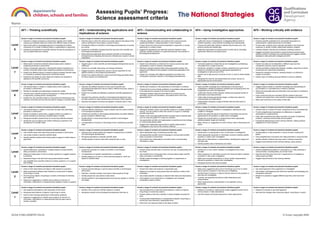
        AF1 – Thinking scientifically                                                     AF2 – Understanding the applications and                                        AF3 – Communicating and collaborating in                                       AF4 – Using investigative approaches                                             AF5 – Working critically with evidence
                                                                                          implications of science                                                         science
        Across a range of contexts and practical situations pupils:                       Across a range of contexts and practical situations pupils:                     Across a range of contexts and practical situations pupils:                    Across a range of contexts and practical situations pupils:                      Across a range of contexts and practical situations pupils:
         Describe or explain processes or phenomena, logically and in detail,             Describe ways in which the values of a society influence the nature of the     Critically evaluate information and evidence from various sources,            Justify their choice of strategies for investigating different kinds of         Propose scientific explanations for unexpected observations or
          making use of abstract ideas and models from different areas of science           science developed in that society or period of history                          explaining limitations, misrepresentation or lack of balance                   scientific questions, using scientific knowledge and understanding               measurements, making allowances for anomalies
Level    Select and justify an appropriate approach to evaluating the relative            Evaluate the effects of scientific or technological developments on society    Present robust and well structured explanations, arguments or counter         Choose and justify data collection methods that minimise error, and             Process data, including using multi-step calculations and compound
          importance of a number of different factors in explanations or arguments          as a whole                                                                      arguments in a variety of ways                                                 produce precise and reliable data                                                measures, to identify complex relationships between variables
 8       Analyse the development of scientific theories through the emergence of          Explain the unintended consequences that may arise from scientific and         Suggest the specialisms and skills that would be needed to solve              Adapt their approaches to practical work to control risk by consulting          Critically interpret, evaluate and synthesise conflicting evidence
          new, accepted ideas and evidence                                                  technological developments                                                      particular scientific problems or to generate particular new scientific or     appropriate resources and expert advice                                         Suggest and justify improvements to experimental procedures using
                                                                                           Make balanced judgements about particular scientific or technological           technological developments                                                                                                                                      detailed scientific knowledge and understanding and suggest coherent
                                                                                            developments by evaluating the economic, ethical/moral, social or cultural                                                                                                                                                                      strategies to take particular investigations further
                                                                                            implications

        Across a range of contexts and practical situations pupils:                       Across a range of contexts and practical situations pupils:                     Across a range of contexts and practical situations pupils:                    Across a range of contexts and practical situations pupils:                      Across a range of contexts and practical situations pupils:
         Make explicit connections between abstract ideas and/or models in                Suggest ways in which scientific and technological developments may be         Explain how information or evidence from various sources may been             Formulate questions or ideas that can be investigated by synthesising           Explain how data can be interpreted in different ways and how
          explaining processes or phenomena                                                 influenced                                                                      manipulated in order to influence interpretation                               information from a range of sources                                              unexpected outcomes could be significant
Level    Employ a systematic approach in deciding the relative importance of a            Explain how scientific discoveries can change worldviews                       Effectively represent abstract ideas using appropriate symbols, flow          Identify key variables in complex contexts, explaining why some cannot          Identify quantitative relationships between variables, using them to inform
          number of scientific factors when explaining processes or phenomena              Suggest economic, ethical/moral, social or cultural arguments for and           diagrams and different kinds of graphs in presenting explanations and          readily be controlled and planning appropriate approaches to                     conclusions and make further predictions
 7       Explain how different pieces of evidence support accepted scientific ideas        against scientific or technological developments                                arguments                                                                      investigations to take account of this                                          Assess the strength of evidence, deciding whether it is sufficient to
          or contribute to questions that science cannot fully answer                      Explain how creative thinking in science and technology generates ideas        Explain how scientists with different specialisms and skills have             Explain how to take account of sources of error in order to collect reliable     support a conclusion
         Explain the processes by which ideas and evidence are accepted or                 for future research and development                                             contributed to particular scientific or technological developments             data                                                                            Explain ways of modifying working methods to improve reliability
          rejected by the scientific community                                                                                                                                                                                                            Recognise the need for risk assessments and consult, and act on,
                                                                                                                                                                                                                                                           appropriate sources of information

        Across a range of contexts and practical situations pupils:                       Across a range of contexts and practical situations pupils:                     Across a range of contexts and practical situations pupils:                    Across a range of contexts and practical situations pupils:                      Across a range of contexts and practical situations pupils:
         Use abstract ideas or models or multiple factors when explaining                 Describe how different decisions on the uses of scientific and                 Identify lack of balance in the presentation of information or evidence       Apply scientific knowledge and understanding in the planning of                 Suggest reasons based on scientific knowledge and understanding for
          processes or phenomena                                                            technological developments may be made in different economic, social or        Choose forms to communicate qualitative or quantitative data appropriate       investigations, identifying significant variables and recognising which are      any limitations or inconsistencies in evidence collected
Level    Identify the strengths and weaknesses of particular models                        cultural contexts                                                               to the data and the purpose of the communication                               independent and which are dependent                                             Select and manipulate data and information and use them to contribute to
         Describe some scientific evidence that supports or refutes particular ideas      Explain how societies are affected by particular scientific applications or    Distinguish between data and information from primary sources,                Justify their choices of data collection method and proposed number of           conclusions
 6        or arguments, including those in development                                      ideas                                                                           secondary sources and simulations, and present them in the most                observations and measurements                                                   Draw conclusions that are consistent with the evidence they have
         Explain how new scientific evidence is discussed and interpreted by the          Describe how particular scientific or technological developments have           appropriate form                                                              Collect data choosing appropriate ranges, numbers and values for                 collected and explain them using scientific knowledge and understanding
          scientific community and how this may lead to changes in scientific ideas         provided evidence to help scientists pose and answer further questions                                                                                         measurements and observations                                                   Make valid comments on the quality of their data
                                                                                           Describe how aspects of science are applied in particular jobs or roles                                                                                       Independently recognise a range of familiar risks and take action to
                                                                                                                                                                                                                                                           control them

        Across a range of contexts and practical situations pupils:                       Across a range of contexts and practical situations pupils:                     Across a range of contexts and practical situations pupils:                    Across a range of contexts and practical situations pupils:                      Across a range of contexts and practical situations pupils:
         Use abstract ideas or models or more than one step when describing               Describe different viewpoints a range of people may have about scientific      Distinguish between opinion and scientific evidence in contexts related to    Recognise significant variables in investigations, selecting the most           Interpret data in a variety of formats, recognising obvious inconsistencies
          processes or phenomena                                                            or technological developments                                                   science, and use evidence rather than opinion to support or challenge          suitable to investigate                                                         Provide straightforward explanations for differences in repeated
Level    Explain processes or phenomena, suggest solutions to problems or                 Indicate how scientific or technological developments may affect different      scientific arguments                                                          Explain why particular pieces of equipment or information sources are            observations or measurements
          answer questions by drawing on abstract ideas or models                           groups of people in different ways                                             Decide on the most appropriate formats to present sets of scientific data,     appropriate for the questions or ideas under investigation                      Draw valid conclusions that utilise more than one piece of supporting
 5       Recognise scientific questions that do not yet have definitive answers           Identify ethical or moral issues linked to scientific or technological          such as using line graphs for continuous variables                            Repeat sets of observations or measurements where appropriate,                   evidence, including numerical data and line graphs
         Identify the use of evidence and creative thinking by scientists in the           developments                                                                   Use appropriate scientific and mathematical conventions and terminology        selecting suitable ranges and intervals                                         Evaluate the effectiveness of their working methods, making practical
          development of scientific ideas                                                  Link applications of science or technology to their underpinning scientific     to communicate abstract ideas                                                 Make, and act on, suggestions to control obvious risks to themselves and         suggestions for improving them
                                                                                            ideas                                                                          Suggest how collaborative approaches to specific experiments or                others
                                                                                                                                                                            investigations may improve the evidence collected

        Across a range of contexts and practical situations pupils:                       Across a range of contexts and practical situations pupils:                     Across a range of contexts and practical situations pupils:                    Across a range of contexts and practical situations pupils:                      Across a range of contexts and practical situations pupils:
         Use scientific ideas when describing simple processes or phenomena               Describe some simple positive and negative consequences of scientific          Select appropriate ways of presenting scientific data                         Decide when it is appropriate to carry out fair tests in investigations         Identify patterns in data presented in various formats, including line
Level    Use simple models to describe scientific ideas                                    and technological developments                                                 Use appropriate scientific forms of language to communicate scientific        Select appropriate equipment or information sources to address specific          graphs
         Identify scientific evidence that is being used to support or refute ideas or    Recognise applications of specific scientific ideas                             ideas, processes or phenomena                                                  questions or ideas under investigation                                          Draw straightforward conclusions from data presented in various formats
 4        arguments                                                                        Identify aspects of science used within particular jobs or roles               Use scientific and mathematical conventions when communicating                Make sets of observations or measurements, identifying the ranges and           Identify scientific evidence they have used in drawing conclusions
                                                                                                                                                                            information or ideas                                                           intervals used                                                                  Suggest improvements to their working methods, giving reasons
                                                                                                                                                                                                                                                          Identify possible risks to themselves and others

        Across a range of contexts and practical situations pupils:                       Across a range of contexts and practical situations pupils:                     Across a range of contexts and practical situations pupils:                    Across a range of contexts and practical situations pupils:                      Across a range of contexts and practical situations pupils:
         Identify differences, similarities or changes related to simple scientific       Explain the purposes of a variety of scientific or technological               Present simple scientific data in more than one way, including tables and     Identify one or more control variables in investigations from those             Identify straightforward patterns in observations or in data presented in
Level     ideas, processes or phenomena                                                     developments                                                                    bar charts                                                                     provided                                                                         various formats, including tables, pie and bar charts
         Respond to ideas given to them to answer questions or suggest solutions          Link applications to specific characteristics or properties                    Use scientific forms of language when communicating simple scientific         Select equipment or information sources from those provided to address          Describe what they have found out in experiments or investigations,
 3        to problems                                                                      Identify aspects of our lives, or of the work that people do, which are         ideas, processes or phenomena                                                  a question or idea under investigation                                           linking cause and effect
         Represent things in the real world using simple physical models                   based on scientific ideas                                                      Identify simple advantages of working together on experiments or              Make some accurate observations or whole number measurements                    Suggest improvements to their working methods
         Use straightforward scientific evidence to answer questions, or to support                                                                                        investigations                                                                 relevant to questions or ideas under investigation
          their findings                                                                                                                                                                                                                                  Recognise obvious risks when prompted

        Across a range of contexts and practical situations pupils:                       Across a range of contexts and practical situations pupils:                     Across a range of contexts and practical situations pupils:                    Across a range of contexts and practical situations pupils:                      Across a range of contexts and practical situations pupils:
         Draw on their observations and ideas to offer answers to questions               Express personal feelings or opinions about scientific or technological        Present their ideas and evidence in appropriate ways                          Make some suggestions about how to find things out or how to collect            Say what happened in their experiment or investigation
         Make comparisons between basic features or components of objects,                 phenomena                                                                      Respond to prompts by using simple texts and electronic media to find          data to answer a question or idea they are investigating                        Say whether what happened was what they expected, acknowledging any
Level     living things or events                                                          Describe, in familiar contexts, how science helps people do things              information                                                                   Identify things to measure or observe that are relevant to the question or       unexpected outcomes
         Sort and group objects, living things or events on the basis of what they        Identify people who use science to help others                                 Use simple scientific vocabulary to describe their ideas and observations      idea they are investigating                                                     Respond to prompts to suggest different ways they could have done
 2        have observed                                                                                                                                                                                                                                   Correctly use equipment provided to make observations and                        things
                                                                                           Identify scientific or technological phenomena and say whether or not they     Work together on an experiment or investigation and recognise
         Respond to suggestions to identify some evidence (in the form of                  are helpful                                                                     contributions made by others                                                   measurements
          information, observations or measurements) needed to answer a question                                                                                                                                                                          Make measurements, using standard or non-standard units as
                                                                                                                                                                                                                                                           appropriate

        Across a range of contexts and practical situations pupils:                       Across a range of contexts and practical situations pupils:                     Across a range of contexts and practical situations pupils:                    Across a range of contexts and practical situations pupils:                      Across a range of contexts and practical situations pupils:
         Ask questions stimulated by their exploration of their world                     Identify a link to science in familiar objects or contexts                     Use everyday terms to describe simple features or actions of objects,         Respond to prompts by making some simple suggestions about how to               Respond to prompts to say what happened
         Recognise basic features of objects, living things or events                     Recognise scientific and technological developments that help us                living things or events they observe                                           find an answer or make observations                                             Say what has changed when observing objects, living things or events
Level
         Draw on their everyday experience to help answer questions                                                                                                       Present evidence they have collected in simple templates provided for         Use their senses and simple equipment to make observations
                                                                                                                                                                            them
 1       Respond to suggestions to identify some evidence (in the form of
                                                                                                                                                                           Communicate simple features or components of objects, living things or
          information, observations or measurements) that has been used to
          answer a question                                                                                                                                                 events they have observed in appropriate forms
                                                                                                                                                                           Share their own ideas and listen to the ideas of others


QCDA 01063-2009PDF-EN-02                                                                                                                                                                                                                                                                                                                                                            © Crown copyright 2009

Pri app sci_assess_crit

  • 1.
    Assessing Pupils’ Progress: Science assessment criteria Name: ……………………………………. AF1 – Thinking scientifically AF2 – Understanding the applications and AF3 – Communicating and collaborating in AF4 – Using investigative approaches AF5 – Working critically with evidence implications of science science Across a range of contexts and practical situations pupils: Across a range of contexts and practical situations pupils: Across a range of contexts and practical situations pupils: Across a range of contexts and practical situations pupils: Across a range of contexts and practical situations pupils:  Describe or explain processes or phenomena, logically and in detail,  Describe ways in which the values of a society influence the nature of the  Critically evaluate information and evidence from various sources,  Justify their choice of strategies for investigating different kinds of  Propose scientific explanations for unexpected observations or making use of abstract ideas and models from different areas of science science developed in that society or period of history explaining limitations, misrepresentation or lack of balance scientific questions, using scientific knowledge and understanding measurements, making allowances for anomalies Level  Select and justify an appropriate approach to evaluating the relative  Evaluate the effects of scientific or technological developments on society  Present robust and well structured explanations, arguments or counter  Choose and justify data collection methods that minimise error, and  Process data, including using multi-step calculations and compound importance of a number of different factors in explanations or arguments as a whole arguments in a variety of ways produce precise and reliable data measures, to identify complex relationships between variables 8  Analyse the development of scientific theories through the emergence of  Explain the unintended consequences that may arise from scientific and  Suggest the specialisms and skills that would be needed to solve  Adapt their approaches to practical work to control risk by consulting  Critically interpret, evaluate and synthesise conflicting evidence new, accepted ideas and evidence technological developments particular scientific problems or to generate particular new scientific or appropriate resources and expert advice  Suggest and justify improvements to experimental procedures using  Make balanced judgements about particular scientific or technological technological developments detailed scientific knowledge and understanding and suggest coherent developments by evaluating the economic, ethical/moral, social or cultural strategies to take particular investigations further implications Across a range of contexts and practical situations pupils: Across a range of contexts and practical situations pupils: Across a range of contexts and practical situations pupils: Across a range of contexts and practical situations pupils: Across a range of contexts and practical situations pupils:  Make explicit connections between abstract ideas and/or models in  Suggest ways in which scientific and technological developments may be  Explain how information or evidence from various sources may been  Formulate questions or ideas that can be investigated by synthesising  Explain how data can be interpreted in different ways and how explaining processes or phenomena influenced manipulated in order to influence interpretation information from a range of sources unexpected outcomes could be significant Level  Employ a systematic approach in deciding the relative importance of a  Explain how scientific discoveries can change worldviews  Effectively represent abstract ideas using appropriate symbols, flow  Identify key variables in complex contexts, explaining why some cannot  Identify quantitative relationships between variables, using them to inform number of scientific factors when explaining processes or phenomena  Suggest economic, ethical/moral, social or cultural arguments for and diagrams and different kinds of graphs in presenting explanations and readily be controlled and planning appropriate approaches to conclusions and make further predictions 7  Explain how different pieces of evidence support accepted scientific ideas against scientific or technological developments arguments investigations to take account of this  Assess the strength of evidence, deciding whether it is sufficient to or contribute to questions that science cannot fully answer  Explain how creative thinking in science and technology generates ideas  Explain how scientists with different specialisms and skills have  Explain how to take account of sources of error in order to collect reliable support a conclusion  Explain the processes by which ideas and evidence are accepted or for future research and development contributed to particular scientific or technological developments data  Explain ways of modifying working methods to improve reliability rejected by the scientific community  Recognise the need for risk assessments and consult, and act on, appropriate sources of information Across a range of contexts and practical situations pupils: Across a range of contexts and practical situations pupils: Across a range of contexts and practical situations pupils: Across a range of contexts and practical situations pupils: Across a range of contexts and practical situations pupils:  Use abstract ideas or models or multiple factors when explaining  Describe how different decisions on the uses of scientific and  Identify lack of balance in the presentation of information or evidence  Apply scientific knowledge and understanding in the planning of  Suggest reasons based on scientific knowledge and understanding for processes or phenomena technological developments may be made in different economic, social or  Choose forms to communicate qualitative or quantitative data appropriate investigations, identifying significant variables and recognising which are any limitations or inconsistencies in evidence collected Level  Identify the strengths and weaknesses of particular models cultural contexts to the data and the purpose of the communication independent and which are dependent  Select and manipulate data and information and use them to contribute to  Describe some scientific evidence that supports or refutes particular ideas  Explain how societies are affected by particular scientific applications or  Distinguish between data and information from primary sources,  Justify their choices of data collection method and proposed number of conclusions 6 or arguments, including those in development ideas secondary sources and simulations, and present them in the most observations and measurements  Draw conclusions that are consistent with the evidence they have  Explain how new scientific evidence is discussed and interpreted by the  Describe how particular scientific or technological developments have appropriate form  Collect data choosing appropriate ranges, numbers and values for collected and explain them using scientific knowledge and understanding scientific community and how this may lead to changes in scientific ideas provided evidence to help scientists pose and answer further questions measurements and observations  Make valid comments on the quality of their data  Describe how aspects of science are applied in particular jobs or roles  Independently recognise a range of familiar risks and take action to control them Across a range of contexts and practical situations pupils: Across a range of contexts and practical situations pupils: Across a range of contexts and practical situations pupils: Across a range of contexts and practical situations pupils: Across a range of contexts and practical situations pupils:  Use abstract ideas or models or more than one step when describing  Describe different viewpoints a range of people may have about scientific  Distinguish between opinion and scientific evidence in contexts related to  Recognise significant variables in investigations, selecting the most  Interpret data in a variety of formats, recognising obvious inconsistencies processes or phenomena or technological developments science, and use evidence rather than opinion to support or challenge suitable to investigate  Provide straightforward explanations for differences in repeated Level  Explain processes or phenomena, suggest solutions to problems or  Indicate how scientific or technological developments may affect different scientific arguments  Explain why particular pieces of equipment or information sources are observations or measurements answer questions by drawing on abstract ideas or models groups of people in different ways  Decide on the most appropriate formats to present sets of scientific data, appropriate for the questions or ideas under investigation  Draw valid conclusions that utilise more than one piece of supporting 5  Recognise scientific questions that do not yet have definitive answers  Identify ethical or moral issues linked to scientific or technological such as using line graphs for continuous variables  Repeat sets of observations or measurements where appropriate, evidence, including numerical data and line graphs  Identify the use of evidence and creative thinking by scientists in the developments  Use appropriate scientific and mathematical conventions and terminology selecting suitable ranges and intervals  Evaluate the effectiveness of their working methods, making practical development of scientific ideas  Link applications of science or technology to their underpinning scientific to communicate abstract ideas  Make, and act on, suggestions to control obvious risks to themselves and suggestions for improving them ideas  Suggest how collaborative approaches to specific experiments or others investigations may improve the evidence collected Across a range of contexts and practical situations pupils: Across a range of contexts and practical situations pupils: Across a range of contexts and practical situations pupils: Across a range of contexts and practical situations pupils: Across a range of contexts and practical situations pupils:  Use scientific ideas when describing simple processes or phenomena  Describe some simple positive and negative consequences of scientific  Select appropriate ways of presenting scientific data  Decide when it is appropriate to carry out fair tests in investigations  Identify patterns in data presented in various formats, including line Level  Use simple models to describe scientific ideas and technological developments  Use appropriate scientific forms of language to communicate scientific  Select appropriate equipment or information sources to address specific graphs  Identify scientific evidence that is being used to support or refute ideas or  Recognise applications of specific scientific ideas ideas, processes or phenomena questions or ideas under investigation  Draw straightforward conclusions from data presented in various formats 4 arguments  Identify aspects of science used within particular jobs or roles  Use scientific and mathematical conventions when communicating  Make sets of observations or measurements, identifying the ranges and  Identify scientific evidence they have used in drawing conclusions information or ideas intervals used  Suggest improvements to their working methods, giving reasons  Identify possible risks to themselves and others Across a range of contexts and practical situations pupils: Across a range of contexts and practical situations pupils: Across a range of contexts and practical situations pupils: Across a range of contexts and practical situations pupils: Across a range of contexts and practical situations pupils:  Identify differences, similarities or changes related to simple scientific  Explain the purposes of a variety of scientific or technological  Present simple scientific data in more than one way, including tables and  Identify one or more control variables in investigations from those  Identify straightforward patterns in observations or in data presented in Level ideas, processes or phenomena developments bar charts provided various formats, including tables, pie and bar charts  Respond to ideas given to them to answer questions or suggest solutions  Link applications to specific characteristics or properties  Use scientific forms of language when communicating simple scientific  Select equipment or information sources from those provided to address  Describe what they have found out in experiments or investigations, 3 to problems  Identify aspects of our lives, or of the work that people do, which are ideas, processes or phenomena a question or idea under investigation linking cause and effect  Represent things in the real world using simple physical models based on scientific ideas  Identify simple advantages of working together on experiments or  Make some accurate observations or whole number measurements  Suggest improvements to their working methods  Use straightforward scientific evidence to answer questions, or to support investigations relevant to questions or ideas under investigation their findings  Recognise obvious risks when prompted Across a range of contexts and practical situations pupils: Across a range of contexts and practical situations pupils: Across a range of contexts and practical situations pupils: Across a range of contexts and practical situations pupils: Across a range of contexts and practical situations pupils:  Draw on their observations and ideas to offer answers to questions  Express personal feelings or opinions about scientific or technological  Present their ideas and evidence in appropriate ways  Make some suggestions about how to find things out or how to collect  Say what happened in their experiment or investigation  Make comparisons between basic features or components of objects, phenomena  Respond to prompts by using simple texts and electronic media to find data to answer a question or idea they are investigating  Say whether what happened was what they expected, acknowledging any Level living things or events  Describe, in familiar contexts, how science helps people do things information  Identify things to measure or observe that are relevant to the question or unexpected outcomes  Sort and group objects, living things or events on the basis of what they  Identify people who use science to help others  Use simple scientific vocabulary to describe their ideas and observations idea they are investigating  Respond to prompts to suggest different ways they could have done 2 have observed  Correctly use equipment provided to make observations and things  Identify scientific or technological phenomena and say whether or not they  Work together on an experiment or investigation and recognise  Respond to suggestions to identify some evidence (in the form of are helpful contributions made by others measurements information, observations or measurements) needed to answer a question  Make measurements, using standard or non-standard units as appropriate Across a range of contexts and practical situations pupils: Across a range of contexts and practical situations pupils: Across a range of contexts and practical situations pupils: Across a range of contexts and practical situations pupils: Across a range of contexts and practical situations pupils:  Ask questions stimulated by their exploration of their world  Identify a link to science in familiar objects or contexts  Use everyday terms to describe simple features or actions of objects,  Respond to prompts by making some simple suggestions about how to  Respond to prompts to say what happened  Recognise basic features of objects, living things or events  Recognise scientific and technological developments that help us living things or events they observe find an answer or make observations  Say what has changed when observing objects, living things or events Level  Draw on their everyday experience to help answer questions  Present evidence they have collected in simple templates provided for  Use their senses and simple equipment to make observations them 1  Respond to suggestions to identify some evidence (in the form of  Communicate simple features or components of objects, living things or information, observations or measurements) that has been used to answer a question events they have observed in appropriate forms  Share their own ideas and listen to the ideas of others QCDA 01063-2009PDF-EN-02 © Crown copyright 2009