SECONDARY EDUCATION CURRICULUM
                                                               (SCIENCE)

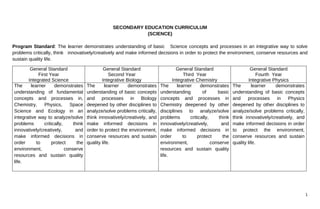
Program Standard: The learner demonstrates understanding of basic Science concepts and processes in an integrative way to solve
problems critically, think innovatively/creatively and make informed decisions in order to protect the environment, conserve resources and
sustain quality life.

        General Standard                         General Standard                    General Standard                          General Standard
             First Year                             Second Year                          Third Year                                Fourth Year
       Integrated Science                       Integrative Biology                Integrative Chemistry                      Integrative Physics
The      learner      demonstrates      The       learner    demonstrates    The      learner      demonstrates      The        learner    demonstrates
understanding of fundamental            understanding of basic concepts      understanding          of      basic    understanding of basic concepts
concepts and processes in,              and processes in Biology             concepts and processes in               and     processes      in   Physics
Chemistry,      Physics,      Space     deepened by other disciplines to     Chemistry deepened by other             deepened by other disciplines to
Science and Ecology in an               analyze/solve problems critically,   disciplines to analyze/solve            analyze/solve problems critically,
integrative way to analyze/solve        think innovatively/creatively, and   problems        critically,     think   think innovatively/creatively, and
problems        critically,     think   make informed decisions in           innovatively/creatively,         and    make informed decisions in order
innovatively/creatively,         and    order to protect the environment,    make informed decisions in              to protect the environment,
make informed decisions in              conserve resources and sustain       order       to      protect       the   conserve resources and sustain
order       to      protect       the   quality life.                        environment,                conserve    quality life.
environment,                conserve                                         resources and sustain quality
resources and sustain quality                                                life.
life.


                                                                                                                                                           1
General Standard: The learner demonstrates understanding of fundamental concepts and processes in Chemistry, Physics, Space Science and Ecology in an integrative way to
analyze/solve problems critically, think innovatively/creatively, and make informed decisions in order to protect the environment, conserve resources and sustain quality life.

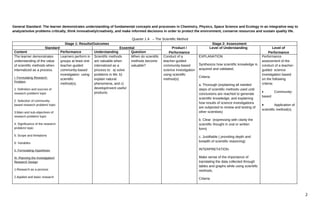
                                                                                  Quarter 1 A – The Scientific Method
                                      Stage 1: Results/Outcomes                                                                        Stage 2: Assessment
                         Standard                                           Essential                       Product /                 Level of Understanding                      Level of
 Content                            Performance           Understanding           Question                 Performance                                                         Performance
 The learner demonstrates           Learners perform in   Scientific methods      When do scientific   Conduct of a            EXPLANATION                                Performance
 understanding of the value         groups at least one   are valuable when       methods become       teacher-guided                                                     assessment of the
 of scientific methods when         teacher-guided        internalized as a       valuable?            community-based         Synthesize how scientific knowledge is     conduct of a teacher-
 internalized as a process.         community-based       process to: a) solve                         science investigation   acquired and validated.                    guided science
                                    investigation using   problems in life; b)                         using scientific                                                   investigation based
 I. Formulating Research                                                                                                       Criteria
                                    scientific            explain natural                              method(s)                                                          on the following
 Problem
                                    method(s).            phenomena, and c)                                                    a. Thorough (explaining all needed         criteria:
 1. Definition and sources of                             develop/invent useful                                                steps of scientific methods used until
 research problem/ topic                                  products.                                                                                                       •     Community-
                                                                                                                               conclusions are reached to generate
                                                                                                                                                                          based
                                                                                                                               scientific knowledge; and explaining
 2. Selection of community-
                                                                                                                               how results of science investigations
 based research problem/ topic                                                                                                                                            •         Application of
                                                                                                                               are subjected to review and testing of
                                                                                                                                                                          scientific method(s)
 3.Main and sub-objectives of                                                                                                  other scientists)
 research problem/ topic
                                                                                                                               b. Clear (expressing with clarity the
 4. Significance of the research                                                                                               scientific thought in oral or written
 problem/ topic                                                                                                                form)
 5. Scope and limitations                                                                                                      c. Justifiable ( providing depth and
 6. Variables
                                                                                                                               breadth of scientific reasoning)

 II. Formulating Hypothesis                                                                                                    INTERPRETATION

 III. Planning the Investigation/                                                                                              Make sense of the importance of
 Research Design                                                                                                               translating the data collected through
                                                                                                                               tables and graphs while using scientific
 1.Research as a process                                                                                                       methods.
 2.Applied and basic research
                                                                                                                               Criteria


                                                                                                                                                                                                     2
Stage 1: Results/Outcomes                                            Stage 2: Assessment
                        Standard                                   Essential         Product /           Level of Understanding               Level of
Content                            Performance       Understanding       Question   Performance                                             Performance
3. Experimental/Investigation                                                                     a. Meaningful ( giving brief yet
design                                                                                            substantial discussion on the
                                                                                                  importance of graphing/ tabulating data
4. Time Table
                                                                                                  while using scientific methods)
5. Materials and methods
                                                                                                  b.Illustrative (using given graphed or
IV. Conducting Actual                                                                             tabulated data to show relationships or
Experiment/ Investigation                                                                         connections between organizing or
                                                                                                  transforming raw data and the
1.Use of
                                                                                                  provision of a more compact and
laboratory apparatus                                                                              organized way based on specific
                                                                                                  purposes; how relationships or
2.Precision and accuracy                                                                          connections can be used in
                                                                                                  determining pattern and trend)
3.Proper handling and disposal
procedures                                                                                        APPLICATION
4.Notetaking and data
                                                                                                  Use scientific methods in solving
collection (using qualitative
                                                                                                  problem at home/community (eg.
and quantitative observations)
                                                                                                  increase of insect pests) considering
V. Detecting Patterns and                                                                         either economic, social, cultural or
Trends                                                                                            other factors.

1. Classification of data                                                                         Criteria

2.Use of graphs and tables                                                                        a. Appropriate (illustrating how
                                                                                                  scientific method(s) can be used/
3.Describing data                                                                                 adapted/ customized in solving
                                                                                                  problems at home or community)
4. Testing of hypothesis
                                                                                                  b.Practical (discussing how scientific
VI. Making Conclusions and
                                                                                                  methods can be done easily to solve a
Recommendations
                                                                                                  problem at home or in the community)

                                                                                                  c.Efficient (expounding how time and


                                                                                                                                                          3
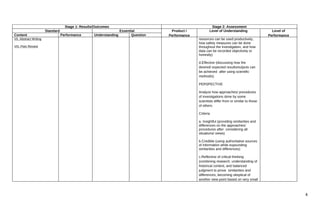
Stage 1: Results/Outcomes                                            Stage 2: Assessment
                        Standard                                   Essential         Product /           Level of Understanding                  Level of
Content                            Performance       Understanding       Question   Performance                                                Performance
VII. Abstract Writing                                                                             resources can be used productively,
                                                                                                  how safety measures can be done
VIII. Peer Review                                                                                 throughout the investigation, and how
                                                                                                  data can be recorded objectively or
                                                                                                  honestly)

                                                                                                  d.Effective (discussing how the
                                                                                                  desired/ expected results/outputs can
                                                                                                  be achieved after using scientific
                                                                                                  method/s)

                                                                                                  PERSPECTIVE

                                                                                                  Analyze how approaches/ procedures
                                                                                                  of investigations done by some
                                                                                                  scientists differ from or similar to those
                                                                                                  of others.

                                                                                                  Criteria

                                                                                                  a. Insightful (providing similarities and
                                                                                                  differences on the approaches/
                                                                                                  procedures after considering all
                                                                                                  situations/ views)

                                                                                                  b.Credible (using authoritative sources
                                                                                                  of information while expounding
                                                                                                  similarities and differences)

                                                                                                  c.Reflective of critical thinking
                                                                                                  (combining research, understanding of
                                                                                                  historical context, and balanced
                                                                                                  judgment to prove similarities and
                                                                                                  differences; becoming skeptical of
                                                                                                  another view point based on very small


                                                                                                                                                             4
Stage 1: Results/Outcomes                                            Stage 2: Assessment
          Standard                                   Essential         Product /           Level of Understanding                 Level of
Content              Performance       Understanding       Question   Performance                                               Performance
                                                                                    sample of data; distinguishing between
                                                                                    irrelevant and relevant or inaccurate
                                                                                    and accurate information, and
                                                                                    appropriate and inappropriate
                                                                                    analogies)

                                                                                    EMPATHY

                                                                                    Assume the role of a scientist.

                                                                                    Be open to emulate scientists the way
                                                                                    they develop their attitudes and values
                                                                                    while using scientific method/s.

                                                                                    Criteria

                                                                                    a. Perceptive (recognizing scientific
                                                                                    attitudes and values developed by
                                                                                    scientists while doing scientific
                                                                                    method/s)

                                                                                    b. Receptive (accepting readily/
                                                                                    willingly that these scientific attitudes
                                                                                    and values must be developed by
                                                                                    scientists and oneself)

                                                                                    c. Responsive (exhibiting how
                                                                                    scientists develop scientific attitudes
                                                                                    and values while using scientific
                                                                                    methods)


                                                                                                                                              5
Stage 1: Results/Outcomes                                            Stage 2: Assessment
          Standard                                   Essential         Product /           Level of Understanding                Level of
Content              Performance       Understanding       Question   Performance                                              Performance


                                                                                    SELF-KNOWLEDGE

                                                                                    Recognize one’s best contribution to
                                                                                    community using scientific method.

                                                                                    Criteria

                                                                                    a. Reflective(becoming aware of one’s
                                                                                    limitations in applying scientific
                                                                                    methods, and of how one’s thought is
                                                                                    influenced/ shaped by these)

                                                                                    b.Responsive (reacting positively as a
                                                                                    result of change in one’s view from
                                                                                    using scientific method/s; reacting
                                                                                    positively showing how the learner can
                                                                                    use scientific methods beneficial to the
                                                                                    community)


                                                                                                                                             6
Quarter IB - Matter

                                         Stage 1: Results/Outcomes                                                                           Stage 2: Assessment
                            Standard                                               Essential                       Product /                Level of Understanding                   Level of
Content                           Performance                    Understanding           Question                Performance                                                       Performance
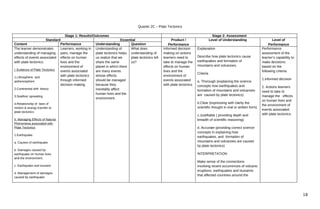
The learner demonstrates          Learners, working in           Understanding of        How does            Manifestation of       EXPLANATION                               Performance
understanding of changes in groups, manifest                     changes in properties understanding of      understanding of                                                 assessment of the
properties of matter and their understanding of changes          of matter is important changes in           changes in             Prove that matter undergoes physical      manifestation of
benefits to one’s health and      in properties of matter and    when manifested in      properties of       properties of matter   or chemical change or both.               understanding of
the environment.                  their benefits to one’s health creating products that matter become        through creation of                                              changes in properties
                                                                                                                                    Criteria:
                                  and the environment            are significantly       beneficial?         innovative,                                                      of matter through
I .Properties and Phases of       through creating innovative, beneficial to one’s                           marketable,                                                      creation of product(s)
Matter                                                                                                                              a. Thorough ( discussing completely
                                  marketable, replicable and     health and the                              replicable and cost-   why matter undergoes physical or          based on the
1.Properties of matter (physical: cost-effective products.       environment.                                effective products     chemical change or both)                  following criteria:
extensive or intensive;                                                                                      that are beneficial
chemical)                                                                                                    to one’s health and    b.Justifiable ( providing depth and       • Innovativeness/
                                                                                                             the environment.       breadth of scientific reasoning)            creativity
2. Phases of matter (solid,                                                                                                                                                     - originality
liquid, gas and plasma)                                                                                                             c.Clear (expressing with clarity
                                                                                                                                                                                - critical thinking in
                                                                                                                                    scientific thoughts in written or oral
II. Classification of Matter                                                                                                                                                    finding ways/means
                                                                                                                                    form)
                                                                                                                                                                                to produce the
I. Substances (elements :
                                                                                                                                    INTERPRETATION                              product
metals, non-metals and
metalloids; compounds:
                                                                                                                                    Make sense of the data gathered from      • Marketability
inorganic & organic, acids,
                                                                                                                                    investigations that indicate changes in   - quality
bases and salts)
                                                                                                                                    properties of matter.
                                                                                                                                                                              - aesthetic value
2. Mixtures (homogeneous/
heterogeneous; types of                                                                                                             Criteria:
                                                                                                                                                                              - usability
mixtures (solutions,
suspensions and colloids), their                                                                                                    a. Meaningful (drawing inference or
                                                                                                                                    making justification on the data          • Replicability of the
characteristics and uses)
                                                                                                                                    presented)                                  production
III. Beneficial effects of Physical
                                                                                                                                                                                processes
                                                                                                                                    b. Illustrative (discussing accurately    - easy/simple
and Chemical Changes on
Health and the Environment                                                                                                          and comprehensively the details of        production process


                                                                                                                                                                                                       7
Stage 1: Results/Outcomes                                                  Stage 2: Assessment
          Standard                                       Essential         Product /           Level of Understanding                      Level of
Content        Performance                 Understanding       Question   Performance                                                    Performance
                                                                                        information)                                  - availability of
                                                                                                                                     materials
                                                                                        APPLICATION
                                                                                                                                     • Cost- effectiveness
                                                                                        Propose ways on how understanding              - quality product at
                                                                                        of changes in properties of matter can         low cost
                                                                                        be used in life.
                                                                                                                                      - availability of
                                                                                        Criteria                                     materials

                                                                                        a. Appropriate (proposing ways or            •   Manifestation of
                                                                                        approaches in regard to how the
                                                                                                                                         changes in
                                                                                        understanding of changes in properties
                                                                                        of matter can be used/adapted/                   properties of
                                                                                        customized in relation to one’s life)            matter

                                                                                        b.Practical (suggesting how these            •   Benefits to one’s
                                                                                        ways or approaches can be done                   health and the
                                                                                        easily)                                          environment

                                                                                        c.Efficient (expounding how the              - usability
                                                                                        proposed ways or approaches will
                                                                                        employ the productive use of time and        - practicality
                                                                                        resources)
                                                                                                                                     - safety in using the
                                                                                        d.Effective (achieving the desired           product
                                                                                        result in using the understanding of
                                                                                        changes in properties of matter)

                                                                                        PERSPECTIVE

                                                                                        Argue on the use of some
                                                                                        commercially        available     products
                                                                                        (fertilizers, detergents, instant noodles,
                                                                                        toothpaste, shampoos, automobiles,
                                                                                        toys with high content of lead, milk and


                                                                                                                                                             8
Stage 1: Results/Outcomes                                                  Stage 2: Assessment
          Standard                                       Essential         Product /           Level of Understanding                Level of
Content        Performance                 Understanding       Question   Performance                                              Performance
                                                                                        other dairy products with melamine
                                                                                        content, refrigerators , etc..) showing
                                                                                        changes in properties of matter that
                                                                                        affect health and the environment.

                                                                                        Criteria

                                                                                        a. Insightful (developing one’s
                                                                                        argument after considering all effects
                                                                                        of some commercially-available
                                                                                        products on health and the
                                                                                        environment)

                                                                                        b.Credible (citing authoritative sources
                                                                                        of information while arguing or
                                                                                        defending a point of view)

                                                                                        c.Reflective    of  critical thinking
                                                                                        (combining research, understanding of
                                                                                        historical context, and balanced
                                                                                        judgment to choose the most
                                                                                        reasonable view based on objectivity
                                                                                        and discretion to disregard personal
                                                                                        biases/ prejudices)

                                                                                        EMPATHY

                                                                                        Role play a worker’s feeling (that of a
                                                                                        farmer, fisherman, etc – depending on
                                                                                        the context of learner’s community)
                                                                                        when there is less production due to
                                                                                        some changes in properties of matter
                                                                                        that evolved in long term conduct of
                                                                                        activities (use of pesticides, rampant


                                                                                                                                                 9
Stage 1: Results/Outcomes                                                   Stage 2: Assessment
          Standard                                       Essential         Product /            Level of Understanding                 Level of
Content        Performance                 Understanding       Question   Performance                                                Performance
                                                                                        use of illegal fishing activities, etc).

                                                                                        Criteria

                                                                                        a. Perceptive (recognizing the
                                                                                        problem a worker faces)

                                                                                        b. Receptive (accepting readily/
                                                                                        willingly a worker’s feeling about the
                                                                                        less yield of products due to some
                                                                                        changes (changes in properties of the
                                                                                        soil, long term use of pesticides,
                                                                                        rampant use of illegal fishing activities,
                                                                                        etc…)

                                                                                        c.Sensitive (demonstrating how a
                                                                                        worker reacts to this situation)

                                                                                        SELF-KNOWLEDGE

                                                                                        Realize how understanding of changes
                                                                                        in properties of matter affects one’s
                                                                                        view on health and the environment.

                                                                                        Criteria

                                                                                        a. Reflective (becoming aware how
                                                                                        one’s view on health and the
                                                                                        environment is affected by the
                                                                                        understanding of changes in properties
                                                                                        of matter)

                                                                                        b.Responsive (reacting positively as a
                                                                                        result of redirecting/ changing one’s
                                                                                        thought or view)


                                                                                                                                                   10
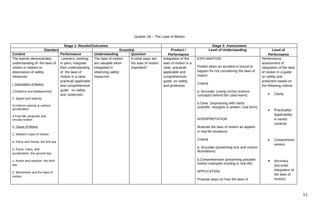
Quarter 2A – The Laws of Motion

                                        Stage 1: Results/Outcomes                                                                            Stage 2: Assessment
                           Standard                                            Essential                       Product /                   Level of Understanding                     Level of
Content                               Performance             Understanding          Question                Performance                                                           Performance
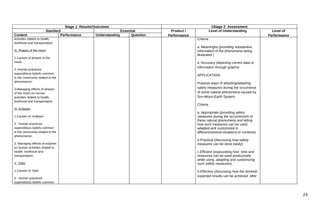
The learner demonstrates               Learners, working      The laws of motion     In what ways are     Integration of the    EXPLANATION                                   Performance
understanding of the laws of          in pairs, integrate     are valuable when      the laws of motion   laws of motion in a                                                 assessment of
motion in relation to                 their understanding     integrated in          important?           clear, practical/     Predict when an accident is bound to          integration of the laws
observance of safety                  of the laws of          observing safety                            applicable and        happen for not considering the laws of        of motion in a guide
measures.                             motion in a clear,      measures.                                   comprehensive         motion.                                       on safety and
                                      practical/ applicable                                               guide on safety                                                     protection based on
I. Description of Motion                                                                                                        Criteria
                                      and comprehensive                                                   and protection                                                      the following criteria:
1.Distance and displacement           guide on safety                                                                           a. Accurate (using correct science
                                      and protection.                                                                           concept/s behind the cited event)                 •   Clarity
2. Speed and velocity
                                                                                                                                b.Clear (expressing with clarity
3.Uniform velocity & uniform
                                                                                                                                scientific thoughts in written / oral form)
acceleration                                                                                                                                                                      •   Practicality/
4.Free fall, projectile and                                                                                                                                                           Applicability
circular motion                                                                                                                 INTERPRETATION                                        in varied
                                                                                                                                                                                      contexts
II. Cause of Motion                                                                                                             Illustrate the laws of motion as applied
                                                                                                                                in real life situations.
1. Newton’s laws of motion
                                                                                                                                Criteria                                          •   Comprehensi
a. Force and Inertia: the first law
                                                                                                                                                                                      veness
                                                                                                                                a. Accurate (presenting true and correct
b. Force, mass, and
                                                                                                                                illustrations)
acceleration: the second law

c. Action and reaction: the third                                                                                               b.Comprehensive (presenting possible              •   Accuracy
law                                                                                                                             motion examples existing in real life)
                                                                                                                                                                                      (accurate
                                                                                                                                APPLICATION                                           integration of
2. Momentum and the laws of
                                                                                                                                                                                      the laws of
motion
                                                                                                                                Propose ways on how the laws of                       motion)


                                                                                                                                                                                                        11
Stage 1: Results/Outcomes                                                   Stage 2: Assessment
                       Standard                                   Essential         Product /                Level of Understanding              Level of
Content                           Performance       Understanding       Question   Performance                                                 Performance
3. Law of universal gravitation                                                                   motion can be used in life.

III. Forces and the Laws of                                                                       Criteria
Motion
                                                                                                  a. Appropriate (citing the laws of motion
1. Mass, weight and gravity                                                                       that fits the situation / event)
2. Friction                                                                                       b. Effective (achieving the desired
                                                                                                  result)
3.Equilibrium

IV. Implications of the Laws of
                                                                                                  PERSPECTIVE
Motion on safety and protection
                                                                                                  Analyze the significance of the laws of
                                                                                                  motion in designing safety gadgets or
                                                                                                  protective devices/ gears

                                                                                                  Criteria

                                                                                                  a. Credible (citing authoritative source/s
                                                                                                  of information while arguing for or
                                                                                                  against a point of view)

                                                                                                  b.Insightful (creating one’s own view
                                                                                                  after considering all the situations)

                                                                                                  EMPATHY

                                                                                                  Assume the role of a victim of an
                                                                                                  accident due to inability to apply the
                                                                                                  laws of motion.

                                                                                                  Criteria

                                                                                                 a. Receptive (becoming ready / willing to
                                                                                                  accept that humans fail to remember to


                                                                                                                                                             12
Stage 1: Results/Outcomes                                                   Stage 2: Assessment
          Standard                                   Essential         Product /                Level of Understanding            Level of
Content              Performance       Understanding       Question   Performance                                               Performance
                                                                                    take precautions either due to
                                                                                    negligence or lack of knowledge)

                                                                                    b.Perceptive ( recognizing emotions of
                                                                                     others)

                                                                                    c.Responsive (exhibiting other’s feelings
                                                                                     and reciprocate it in some ways)


                                                                                     SELF-KNOWLEDGE

                                                                                     Self-assess how the laws of motion help
                                                                                     one become safety conscious

                                                                                     Criteria

                                                                                     a. Reflective (becoming aware of how
                                                                                     one’s thoughts are influenced by certain
                                                                                     factors like accidents which happen
                                                                                     because some people neglect to
                                                                                     consider the laws of motions)

                                                                                     b.Responsive (reacting positively from
                                                                                     one’s understanding of the laws of
                                                                                     motion)


                                                                                                                                              13
Quarter 2B – Efficient Energy Transfer

                                   Stage 1: Results/Outcomes                                                                           Stage 2: Assessment
                      Standard                                           Essential                        Product /                  Level of Understanding                  Level of
Content                          Performance            Understanding          Question                 Performance                                                       Performance
The learner demonstrates         Learners, working      Advocating efficient   Why should we        Conduct of            EXPLANATION                                Performance
understanding of the             in groups, advocate    energy transfer is a   advocate for         advocacy for                                                     assessment of the
importance of advocating         efficient use of       means of using         efficient energy     efficient use of      Describe how energy is transferred         conduct of advocacy
efficient energy transfer.       energy and its         energy resources       transfer?            energy and its        efficiently in the homes, school and       activity for wise use
                                 alternative sources    wisely and its                              alternative sources   workplace                                  of energy and its
I. Energy Transfer               in the community       alternative sources in                      through a                                                        alternative sources in
                                                                                                                          Criteria
                                 through a              the community.                              cooperatively                                                    the community based
1. Energy – operational
                                 cooperatively                                                      planned, relevant,    a. Accurate (giving correct data /         on the following
definition, spontaneous and
                                 planned, relevant,                                                 comprehensive,          information)                             criteria:
non-spontaneous/ deliberate
                                 comprehensive,                                                     and creative or
energy transfer                                                                                                           b.Clear (expressing with clarity the       I. Cooperation
                                 accurate and                                                       innovative activity
                                 creative or                                                                                scientific thought)
2. Law of conservation of                                                                                                                                            • Teamwork
energy                           innovative activity.
                                                                                                                          c.Thorough (giving complete                  (members work
                                                                                                    .                       explanation in terms of how energy is      together; each
3. Kinetic and potential                                                                                                    transferred efficiently in two or more     member performs a
energy                                                                                                                      ways)                                      specific task)

4. Heat transfer –                                                                                                        d.Justifiable (providing depth and         • Communication
conduction, convection and                                                                                                  breadth of scientific reasoning)          (members
radiation                                                                                                                                                            communicate thought
                                                                                                                                                                     processes and
5. Work                                                                                                                   INTERPRETATION
                                                                                                                                                                     strategies by asking
                                                                                                                          Evaluate why there are different power     questions, discussing
6. Power
                                                                                                                          ratings of electrical appliances and       ideas, offering
7. Efficiency of machines                                                                                                 relate these to the efficient use of       constructive
                                                                                                                          energy                                     criticisms, and
8. Power rating of electrical                                                                                                                                        summarizing
appliances                                                                                                                Criteria                                   discoveries as a


                                                                                                                                                                                              14
Stage 1: Results/Outcomes                                                  Stage 2: Assessment
                      Standard                                   Essential         Product /               Level of Understanding                    Level of
Content                          Performance       Understanding       Question   Performance                                                     Performance
9. Energy use and sources in                                                                    a. Illustrative (discussing in details how   result of the group’s
the community, country and                                                                        power ratings vary)                        effort to come up with
the world                                                                                                                                    an advocacy)
                                                                                                b.Meaningful (showing the importance
II. Human Activities that                                                                         of having different power ratings by       2. Relevance/
                                                                                                  relating these to conserving energy)
Impact on the Thermal                                                                                                                        suitability in the
Environment                                                                                     c.Accuracy (computing energy use of          context of one’s
                                                                                                  appliance/s of different power ratings)    community

                                                                                                APPLICATION                                  3.
III. Conserving Energy and                                                                                                                   Comprehensiveness
Energy Resources (energy                                                                        Propose ways to efficiently use energy
use and sources)                                                                                and its alternative sources.                 4. Innovativeness/
                                                                                                                                             Creativity in the
                                                                                                Criteria                                     design and/or
                                                                                                                                             implementation of the
                                                                                                a. Appropriate (expressing varied ways       activity
                                                                                                  how energy consumption can be
                                                                                                  minimized within one’s context or          5. With a focus on the
                                                                                                  experience)                                wise use of energy
                                                                                                                                             and its alternative
                                                                                                b.Practical (illustrating how such ways
                                                                                                  can be done easily)                        sources in the
                                                                                                                                             community
                                                                                                c.Efficient (expounding how these
                                                                                                  proposed ways can be done using
                                                                                                  time and resources productively)

                                                                                                d.Effective (presenting documents
                                                                                                showing that desired results are
                                                                                                achieved)

                                                                                                PERSPECTIVE

                                                                                                Infer how proposed ways to minimize


                                                                                                                                                                      15
Stage 1: Results/Outcomes                                                  Stage 2: Assessment
          Standard                                   Essential         Product /               Level of Understanding              Level of
Content              Performance       Understanding       Question   Performance                                                Performance
                                                                                    energy consumption contribute to global
                                                                                    campaign on the efficient use of energy.

                                                                                    Criteria

                                                                                    a. Credible(citing authoritative source of
                                                                                      information / data while arguing
                                                                                      for/against a view)

                                                                                    b. Reflective of critical thinking
                                                                                      (reaching the view impartially and
                                                                                      without bias by combining research,
                                                                                      understanding of historical context,
                                                                                      and having a balanced judgment)

                                                                                    c.Insightful ( creating one’s own view
                                                                                      after considering all the situations /
                                                                                      views)

                                                                                    EMPATHY

                                                                                    Assume the role of a policy maker who
                                                                                    develops measures for the efficient use
                                                                                    of alternative sources and standard
                                                                                    energy-compliant appliances/vehicles

                                                                                    Criteria

                                                                                    a. Perceptive (recognizing emotions /
                                                                                      world view of others)

                                                                                    b. Responsive (exhibiting other’s
                                                                                      feelings or worldview and able to
                                                                                      reciprocate it)


                                                                                                                                               16
Stage 1: Results/Outcomes                                                  Stage 2: Assessment
          Standard                                   Essential         Product /               Level of Understanding           Level of
Content              Performance       Understanding       Question   Performance                                             Performance
                                                                                    SELF-KNOWLEDGE

                                                                                    Identify one’s habits which do not
                                                                                    contribute towards efficient energy
                                                                                    transfer and be able to do concrete
                                                                                    steps to correct these.

                                                                                    Criteria

                                                                                    a. Reflective (becoming aware of how
                                                                                    one’s habits)

                                                                                    b. Responsive (reacting positively from
                                                                                    one’s understanding of efficient energy
                                                                                    transfer)


                                                                                                                                            17
Quarter 2C – Plate Tectonics

                                    Stage 1: Results/Outcomes                                                                            Stage 2: Assessment
                        Standard                                        Essential                          Product /                   Level of Understanding                    Level of
Content                         Performance           Understanding           Question                   Performance                                                           Performance
The learner demonstrates        Learners, working in Understanding of         What does              Informed decision      Explanation                                   Performance
understanding of managing pairs, manage the           plate tectonics helps understanding of         making on actions                                                    assessment of the
effects of events associated effects on human         us realize that we      plate tectonics tell   learners need to       Describe how plate tectonics cause            learner’s capability to
with plate tectonics.           lives and the         share the same          us?                    take to manage the     earthquakes and formation of                  make decisions
                                environment of        planet in which there                          effects on human       mountains and volcanoes.                      based on the
I. Evidence of Plate Tectonics  events associated     are many events                                lives and the                                                        following criteria:
                                                                                                                            Criteria
1.Lithosphere and
                                with plate tectonics  whose effects                                  environment of
                                through informed      should be managed                              events associated                                                    1.informed decision
asthenosphere                                                                                                               a. Thorough (explaining the science
                                decision making.      because they                                   with plate tectonics   concepts how earthquakes and                  2. Actions learners
2.Continental drift theory                            inevitably affect                                                     formation of mountains and volcanoes          need to take to
                                                      human lives and the                                                   are caused by plate tectonics)
3.Seafloor spreading                                                                                                                                                      manage the effects
                                                      environment.
                                                                                                                                                                          on human lives and
4.Relationship of laws of                                                                                                   b.Clear (expressing with clarity the
                                                                                                                                                                          the environment of
motion & energy transfer to                                                                                                 scientific thought in oral or written form)
                                                                                                                                                                          events associated
plate tectonics
                                                                                                                            c.Justifiable ( providing depth and           with plate tectonics.
II. Managing Effects of Natural                                                                                             breadth of scientific reasoning)
Phenomena associated with
Plate Tectonics                                                                                                             d. Accurate (providing correct science
                                                                                                                            concepts in explaining how
1.Earthquake
                                                                                                                            earthquakes, and formation of
a. Causes of earthquake                                                                                                     mountains and volcanoes are caused
                                                                                                                            by plate tectonics)
b. Damages caused by
earthquake on human lives                                                                                                   INTERPRETATION
and the environment.
                                                                                                                            Make sense of the connections
c. Earthquake and tsunami                                                                                                   involving recent occurrences of volcanic
                                                                                                                            eruptions, earthquakes and tsunamis
d. Management of damages
                                                                                                                            that affected countries around the
caused by earthquake


                                                                                                                                                                                                    18
Stage 1: Results/Outcomes                                                   Stage 2: Assessment
                        Standard                                  Essential         Product /               Level of Understanding            Level of
Content                         Performance         Understanding       Question   Performance                                              Performance
                                                                                                 world.

2.Mountain formation                                                                             Criteria
a. Plate tectonics and                                                                           a. Meaningful (seeing the connections
formation of types of mountain                                                                   within the immediate context of the
                                                                                                 learner)
3.Volcanoes
                                                                                                 b.Illustrative (discussing in detail the
a. Types of volcanoes
                                                                                                 connections involving recent
b.Volcanic activities                                                                            occurrences of volcanic eruptions,
                                                                                                 earthquakes and tsunamis among
c.Effects of volcanic eruptions                                                                  countries)
on humans and the
environment                                                                                      APPLICATION
d.Making predictions for the                                                                     Propose implementation of safety
country in regard to volcanic
                                                                                                 measures before, during, and after the
activities
                                                                                                 occurrence of earthquakes, tsunamis
e.Monitoring and safeguards                                                                      and volcanic eruptions.
for volcanic activities
                                                                                                 Criteria

                                                                                                 a. Appropriate (providing safety
                                                                                                 measures before, during, and after the
                                                                                                 occurrence/s of these natural
                                                                                                 phenomena and telling how such
                                                                                                 measures can be used, adapted and
                                                                                                 customized in different/several
                                                                                                 situations or contexts)

                                                                                                 b.Practical (discussing how safety
                                                                                                 measures can be done easily)

                                                                                                 c.Efficient (expounding how time and
                                                                                                 resources can be used productively


                                                                                                                                                          19
Stage 1: Results/Outcomes                                                   Stage 2: Assessment
          Standard                                  Essential         Product /               Level of Understanding            Level of
Content           Performance         Understanding       Question   Performance                                              Performance
                                                                                   while using, adapting and customizing
                                                                                   such safety measures )

                                                                                   d.Effective(discussing how the desired/
                                                                                   expected results can be achieved after
                                                                                   using safety measures)

                                                                                   PERSPECTIVE

                                                                                   Analyze government efforts
                                                                                   (international, national and local) in
                                                                                   reducing damages of earthquakes,
                                                                                   tsunamis and volcanic eruptions
                                                                                   reasonable based on cost
                                                                                   effectiveness.

                                                                                   Criteria

                                                                                   a. Insightful (developing one’s view
                                                                                   after considering all government efforts
                                                                                   in reducing damages of earthquakes
                                                                                   and volcanic eruptions)

                                                                                   b.Credible (citing authoritative/primary
                                                                                   sources of information while arguing for
                                                                                   the reasonability of government efforts
                                                                                   in reducing damages of earthquakes
                                                                                   and volcanic eruptions based on the
                                                                                   cost effectiveness analysis)

                                                                                   c.Reflective of critical thinking
                                                                                   (combining research, understanding of
                                                                                   historical context, and balanced
                                                                                   judgment to prove the reasonable or
                                                                                   unreasonable government efforts in


                                                                                                                                            20
Stage 1: Results/Outcomes                                                   Stage 2: Assessment
          Standard                                  Essential         Product /               Level of Understanding           Level of
Content           Performance         Understanding       Question   Performance                                             Performance
                                                                                   reducing damages of earthquakes and
                                                                                   volcanic eruptions based on cost
                                                                                   effectiveness analysis)

                                                                                   EMPATHY

                                                                                   Imagine what other people feel and how
                                                                                   they adjust while living in areas
                                                                                   frequented by earthquakes, tsunamis or
                                                                                   volcanic eruptions.

                                                                                   Criteria

                                                                                   a. Perceptive (recognizing the effects
                                                                                   on people living in areas frequented by
                                                                                   earthquakes and volcanic eruptions)

                                                                                   c.Sensitive (exhibiting what these
                                                                                   people feel and how they adjust as a
                                                                                   result of experiencing effects of these
                                                                                   natural phenomena)

                                                                                   SELF-KNOWLEDGE

                                                                                   Self-assesses how the understanding of
                                                                                   reducing damages of earthquakes,
                                                                                   tsunamis and volcanic eruptions
                                                                                   shapes/influences one’s beliefs and
                                                                                   values on volunteerism.

                                                                                   a. Reflective (becoming aware of how
                                                                                   one’s beliefs and values on
                                                                                   volunteerism are influenced/ shaped by
                                                                                   understanding of reducing damages
                                                                                   brought about by earthquakes and


                                                                                                                                           21
Stage 1: Results/Outcomes                                               Stage 2: Assessment
          Standard                                  Essential         Product /           Level of Understanding             Level of
Content           Performance         Understanding       Question   Performance                                           Performance
                                                                                   volcanic eruptions)

                                                                                   b.Responsive (reacting positively/how
                                                                                   one must behave as a result of
                                                                                   changing one’s beliefs and values on
                                                                                   volunteerism)


                                                                                                                                         22
Quarter 3A – Sun-Moon-Earth System

                                   Stage 1: Results/Outcomes                                                                          1Stage 2: Assessment
                       Standard                                        Essential                         Product /                   Level of Understanding                    Level of
Content                        Performance           Understanding           Question                 Performance                                                            Performance
The learner demonstrates        Learners, working    Understanding of        In what way is the   Informed decision       EXPLANATION                                   Performance
understanding of effects of    individually or in    the Sun-Moon-Earth understanding of          making on actions                                                     assessment of the
Sun-Moon-Earth System          groups, make          System is valuable      the Sun-Moon-        learners need to        Demonstrate how the Sun-Moon-Earth            learner’s capability to
and how these are              informed decision to when used making         Earth System         take to manage the      System causes different natural               make decisions
managed.                       manage the effects    informed decision to valuable?               effects of the Sun-     phenomena.                                    based on the
                               of the Sun-Moon-      manage its effects                           Moon-Earth                                                            following criteria:
I. Day and Night Cycle                                                                                                    Criteria
                               Earth System on       on activities                                System on
                               activities related to involving livelihood,                        activities related to                                                 1.informed decision
1.Causes of day and night                                                                                                 a. Thorough (explaining science
cycle                          livelihood, health    health and                                   livelihood, health      concepts behind each natural                  2. Actions learners
                               and transportation.   transportation.                              and transportation.     phenomenon caused by Sun-Moon-                need to take to
2. Human practices/
                                                                                                                          Earth System)                                 manage the effects
superstitious beliefs common
in the community related to the                                                                                                                                         of the Sun-Moon-
                                                                                                                          b.Clear (expressing with clarity the
phenomenon                                                                                                                                                              Earth System on
                                                                                                                          scientific thought in oral or written form)
                                                                                                                                                                        activities related to
3.Managing effects of day and                                                                                                                                           livelihood, health and
                                                                                                                          c.Justifiable ( providing depth and
night cycle on human activities
                                                                                                                          breadth of scientific reasoning)              transportation.
related to health, livelihood
and transportation
                                                                                                                          d. Accurate (providing correct science
                                                                                                                          concepts in explaining how each
                                                                                                                          phenomenon is caused by Sun-Moon-
II. Seasonal Patterns                                                                                                     Earth System)
1.Causes of seasonal patterns
                                                                                                                          INTERPRETATION
2. Human practices/
                                                                                                                          Illustrate through graphs the
superstitious beliefs common
in the community related to the
                                                                                                                          phenomena caused by the Sun-Moon-
phenomenon                                                                                                                Earth System

3. Managing effects of
seasonal patterns on human


                                                                                                                                                                                                  23
Stage 1: Results/Outcomes                                                  1Stage 2: Assessment
                       Standard                                  Essential         Product /               Level of Understanding             Level of
Content                        Performance         Understanding       Question   Performance                                               Performance
activities related to health,                                                                   Criteria
livelihood and transportation
                                                                                                a. Meaningful (providing substantive
III. Phases of the moon                                                                         information of the phenomena being
                                                                                                illustrated )
1.Causes of phases of the
moon                                                                                            b. Accuracy (depicting correct data or
                                                                                                information through graphs)
2. Human practices/
superstitious beliefs common
                                                                                                APPLICATION
in the community related to the
phenomenon                                                                                      Propose ways of adopting/adapting
3.Managing effects of phases                                                                    safety measures during the occurrence
of the moon on human                                                                            of some natural phenomena caused by
activities related to health,                                                                   Sun-Moon-Earth System.
livelihood and transportation
                                                                                                Criteria
IV. Eclipses
                                                                                                a. Appropriate (providing safety
1.Causes of eclipses                                                                            measures during the occurrence/s of
                                                                                                these natural phenomena and telling
2. Human practices/                                                                             how such measures can be used,
superstitious beliefs common                                                                    adapted and customized in
in the community related to the                                                                 different/several situations or contexts)
phenomenon
                                                                                                b.Practical (discussing how safety
3. Managing effects of eclipses                                                                 measures can be done easily)
on human activities related to
health, livelihood and                                                                          c.Efficient (expounding how time and
transportation                                                                                  resources can be used productively
                                                                                                while using, adapting and customizing
V. Tides                                                                                        such safety measures)

1.Causes of tides                                                                               d.Effective (discussing how the desired/
                                                                                                expected results can be achieved after
2. Human practices/
superstitious beliefs common


                                                                                                                                                          24
Stage 1: Results/Outcomes                                                  1Stage 2: Assessment
                       Standard                                  Essential         Product /               Level of Understanding             Level of
Content                        Performance         Understanding       Question   Performance                                               Performance
in the community related to the                                                                 using safety measures)
phenomenon
                                                                                                PERSPECTIVE
3. Managing effects of tides on
human activities related to                                                                     Infer on the adequacy and/or
health, livelihood and                                                                          insufficiency of evidence of
transportation                                                                                  superstitious beliefs and community
                                                                                                practices related to natural phenomena
                                                                                                caused by the Sun-Moon-Earth System.

                                                                                                Criteria

                                                                                                a. Insightful (developing one’s view
                                                                                                after considering all superstitious
                                                                                                beliefs and community practices related
                                                                                                to natural phenomena caused by the
                                                                                                Sun-Moon-Earth System)

                                                                                                b.Credible ( citing authoritative/primary
                                                                                                sources of information while arguing for
                                                                                                limited or adequate evidences of
                                                                                                superstitious beliefs and community
                                                                                                practices)

                                                                                                c.Reflective of critical thinking
                                                                                                (combining research, understanding of
                                                                                                historical context, and balanced
                                                                                                judgment to prove the limitations or
                                                                                                adequacy of evidences for superstitious
                                                                                                beliefs and community practices;
                                                                                                becoming skeptical of arguments based
                                                                                                on small samples of data, biased
                                                                                                samples or samples for which there was
                                                                                                no control sample; distinguishing
                                                                                                between irrelevant and relevant or


                                                                                                                                                          25
Stage 1: Results/Outcomes                                                  1Stage 2: Assessment
          Standard                                  Essential         Product /               Level of Understanding            Level of
Content           Performance         Understanding       Question   Performance                                              Performance
                                                                                   inaccurate and accurate information,
                                                                                   illogical and logical conclusions, and
                                                                                   appropriate and inappropriate
                                                                                   analogies)

                                                                                   EMPATHY

                                                                                   Relate how people living in different
                                                                                   topographical locations (highland,
                                                                                   lowland, coastal areas, riverbanks, etc)
                                                                                   might feel about being affected by the
                                                                                   Sun-Moon-Earth System.

                                                                                   Criteria

                                                                                   a. Perceptive (recognizing the effects
                                                                                   of the Sun-Moon-System methods to
                                                                                   people living in different topographical
                                                                                   locations)

                                                                                   c.Sensitive (exhibiting what these
                                                                                   people feel and how they adapt as a
                                                                                   result of the effects of the Sun-Moon-
                                                                                   Earth System they have been
                                                                                   experiencing)

                                                                                   SELF-KNOWLEDGE

                                                                                   Reflect on how the understanding of the
                                                                                   Sun-Moon-Earth System influences
                                                                                   one’s beliefs, behavior, practices and
                                                                                   way of life.

                                                                                   a. Reflective (becoming aware of how
                                                                                   one’s beliefs, behavior, practices and


                                                                                                                                            26
Stage 1: Results/Outcomes                                              1Stage 2: Assessment
          Standard                                  Essential         Product /           Level of Understanding             Level of
Content           Performance         Understanding       Question   Performance                                           Performance
                                                                                   way of life are influenced/ shaped by
                                                                                   the understanding of Sun-Moon-Earth
                                                                                   System)

                                                                                   b.Responsive (reacting positively/how
                                                                                   one must behave as a result of
                                                                                   changing one’s view)


                                                                                                                                         27
Quarter 3B – Earth and Space Explorations

                                                                                                                                        Stage 2: Assessment
                                  Stage 1: Results/Outcomes
                      Standard                                         Essential                        Product /                   Level of Understanding              Level of Performance
Content                        Performance            Understanding          Question                 Performance
The learner demonstrates       Learners, working in   Earth and space        To what extent are   Conduct of an          EXPLANATION                                   Performance assessment
understanding of advocating groups, advocate          explorations lead to   earth and space      activity clearly                                                     of an advocacy activity
the use of breakthroughs /     the use of             breakthroughs/         explorations         advocating the use     Describe in your own words the                based on the following
discoveries and technologies technologies and         discoveries and        useful? Explain.     of technologies and    significance of advances in earth and         criteria:
resulting from earth and       recent discoveries/    develop                                     recent discoveries     space explorations.
space explorations.            breakthroughs          technologies, the                           or breakthroughs                                                        •   Clear advocacy on
                                                                                                                         Criteria
                               resulting from earth   use of which should                         resulting from earth                                                        the use of
I. Space-based Observations of and space              be advocated for the                        and space                                                                   technologies and
the Earth (historical                                                                                                    a. Thorough (explaining completely the
                               explorations for the   benefit of society.                         explorations for the   significance of advances in earth and                recent discoveries
development, types and uses of
                               benefit of society.                                                benefit of society     space explorations )                                 and breakthroughs
satellites in exploring mineral
                                                                                                                                                                              resulting from
deposits, weather events,
topography, etc)                                                                                                         b.Clear (expressing with clarity the                 earth and space
                                                                                                                         scientific thought in oral or written form)          explorations
II. Explorations of Earth’s
Waters (Earth as the water                                                                                               c.Justifiable (providing depth and breadth       •   Beneficial to
planet, freshwater resources,                                                                                            of scientific reasoning)                             society
ocean systems and ocean
environments)                                                                                                            INTERPRETATION

III. Earth-based and Space-                                                                                              Evaluate the advances made through
based Observations of Space                                                                                              earth and space explorations.
(historical development of
astronomy from ancient to                                                                                                Criteria
modern, technologies or tools
used to explore the space:                                                                                               a. Meaningful (giving substantial insights
telescopes, spacecrafts,                                                                                                 about earth and space explorations)
orbiters, landers, probes and
flyby; space flights and                                                                                                 b. Illustrative (discussing in detail these
challenges encountered by                                                                                                insights using varied examples; becoming
astronauts/ cosmonauts,                                                                                                  aware that there may be more than one
explorations within the Solar
                                                                                                                         way to interpret data on space


                                                                                                                                                                                               28
Stage 2: Assessment
                                     Stage 1: Results/Outcomes
                        Standard                                      Essential         Product /               Level of Understanding          Level of Performance
Content                             Performance       Understanding         Question   Performance
System, explorations outside of                                                                      explorations)
the Solar System)
                                                                                                     APPLICATION
IV. Recent Discoveries or
Breakthroughs in Earth and                                                                           Use practically the information gained
Space Explorations (latest                                                                           from space-based observations of the
information/ discoveries about                                                                       Earth.
earth and space, latest theories
developed on earth, space/                                                                           Criteria
universe, benefits of the society
from spin-offs of technologies                                                                       a. Appropriate (discussing how the
used in earth and space                                                                              information gained from spaced-based
explorations)                                                                                        observations of the earth can be used,
                                                                                                     adapted and customized daily in one’s
                                                                                                     context)

                                                                                                     b. Practical (illustrating how the use,
                                                                                                     adaptation and customization of these
                                                                                                     information can be done easily)

                                                                                                     c.Efficient (expounding how the use of
                                                                                                     these information employs the productive
                                                                                                     utilization of time and resources)

                                                                                                     d.Effective (discussing how the desired/
                                                                                                     expected results can be achieved after
                                                                                                     using the information from space-based
                                                                                                     observations of the earth)


                                                                                                     PERSPECTIVE


                                                                                                                                                                       29
Stage 2: Assessment
                      Stage 1: Results/Outcomes
          Standard                                     Essential         Product /               Level of Understanding              Level of Performance
Content              Performance       Understanding         Question   Performance
                                                                                      Infer on the risks and cost effectiveness of
                                                                                      efforts done in earth and space
                                                                                      explorations.

                                                                                      Criteria

                                                                                      a. Insightful (developing one’s view after
                                                                                      considering all efforts in earth and space
                                                                                      explorations)

                                                                                      b. Credible (citing authoritative/primary
                                                                                      sources of information while arguing for
                                                                                      the reasonability of efforts in earth and
                                                                                      space explorations based on the cost
                                                                                      effectiveness analysis)

                                                                                      c.Reflective of critical thinking (combining
                                                                                      research, understanding of historical
                                                                                      context, and balanced judgment to prove
                                                                                      the reasonable or unreasonable efforts in
                                                                                      earth and space explorations based on
                                                                                      cost effectiveness analysis)

                                                                                      EMPATHY

                                                                                      Role play how oceanographers or
                                                                                      astronauts/ cosmonauts might
                                                                                      respectively feel about adjusting to
                                                                                      problems in earth or space explorations.

                                                                                      a. Perceptive (recognizing problems
                                                                                      faced by astronauts/ cosmonauts or
                                                                                      oceanographers during earth or space
                                                                                      explorations)


                                                                                                                                                            30
Stage 2: Assessment
                      Stage 1: Results/Outcomes
          Standard                                     Essential         Product /               Level of Understanding            Level of Performance
Content              Performance       Understanding         Question   Performance

                                                                                      b. Receptive (accepting readily/ willingly
                                                                                      the feeling of astronauts/ cosmonauts
                                                                                      about adjusting to problems encountered
                                                                                      during earth or space explorations)

                                                                                      c. Responsive (exhibiting how
                                                                                      cosmonauts/ astronauts or
                                                                                      oceanographers feel and adjust to
                                                                                      problems encountered during earth or
                                                                                      space explorations)

                                                                                      SELF-KNOWLEDGE

                                                                                      Be aware on how information from earth
                                                                                      and space explorations help one become
                                                                                      more objective and appreciative of the
                                                                                      wonders of nature.

                                                                                      Criteria

                                                                                      a. Reflective (becoming aware that
                                                                                      information from earth and space
                                                                                      explorations make one objective and
                                                                                      appreciative of wonders of nature)

                                                                                      b.Responsive (reacting positively as a
                                                                                      result of having information from earth
                                                                                      and space explorations changed one’s
                                                                                      view)


                                                                                                                                                          31
Quarter 4 – Humans as Stewards of Our Finite Earth

                                        Stage 1: Results/Outcomes                                                                              Stage 2: Assessment
                           Standard                                             Essential                   Product /                     Level of Understanding                Level of Performance
Content                               Performance             Understanding           Question             Performance
The learner demonstrates              Learners, working in    Humans, as               Why are humans                          EXPLANATION                                   Performance assessment of
understanding of humans as            groups, contribute to   stewards of our finite stewards of our    Conserving                                                           a conduct of an
stewards of our finite earth.         conservation of         earth, are tasked to    finite earth?     resources and/or       Describe how our finite earth should be       environmental activity based
                                      resources and/or        contribute to (a)                         solving an             taken cared of.                               on the following criteria:
I. Basics of Ecology                  solution of an          conservation of                           ecological problem
                                                                                                                               Criteria                                          1. Cooperation
                                      ecological problem      resources and (b)                         existing in the
1.Basic units of ecology
(organism to biosphere                existing in the         solution of                               immediate              a. Thorough (discussing completely
                                                                                                        community through                                                    • Teamwork ( members
                                      immediate               ecological problems                                              how the earth should be taken cared of)         work together; each
2.Components of ecosystem             community through       through cooperative                       the cooperative
                                                                                                                                                                               member performs a
(ecological communities,              the cooperative         conduct of                                conduct of an          b.Justifiable ( providing depth and             specific task)
ecological habitats, ecological       conduct of an           environmental                             innovative/ creative   breadth of scientific reasoning)              • Communication
niches)                                                                                                 environmental
                                      innovative/ creative    activities or projects.                                                                                         (members communicate
                                      environmental                                                     activity or project    c.Clear (expressing with clarity scientific   thought processes and
3.Functions of ecosystem (self-
                                      activity or project.                                              (either clean-up       thoughts in written or oral form)             strategies by asking
regulating: carrying capacity,
maximum sustainable yield,                                                                              drive, eco-fun run,                                                  questions, discussing ideas,
                                                                                                        tree planting, rip-    INTERPRETATION
waste assimilative capacity,                                                                                                                                                 offering constructive
natural enemies; self-                                                                                  rapping, IGP for an                                                  criticisms, and summarizing
                                                                                                                               Evaluate how understanding of
perpetuating)                                                                                           environmental                                                        discoveries as a result of the
                                                                                                                               stewardship of the earth benefits
                                                                                                        cause, etc.)                                                         group’s involvement in an
II.Human Impact on Ecosystems                                                                                                  humans.
                                                                                                                                                                             environmental activity)
1.Altering biotic and abiotic                                                                                                  Criteria
factors
                                                                                                                               a. Meaningful (giving the importance of
2.Human contributions to                                                                                                       this understanding using one’s                    2. Innovativeness/
pollution and its impact on                                                                                                    immediate context)                                   Creativity
ecosystems (impact on the
quality of air and water, global                                                                                               b.Illustrative (discussing vividly how this       •   Active learning
warming and climate change)                                                                                                    understanding is valuable to humans)                  (group members
                                                                                                                                                                                     explore new ways or
III. Seven (7) Environmental
                                                                                                                                                                                     approaches to
Principles (nature knows best,
                                                                                                                                                                                     address an


                                                                                                                                                                                                         32
Stage 1: Results/Outcomes                                                     Stage 2: Assessment
                      Standard                                   Essential         Product /               Level of Understanding           Level of Performance
Content                          Performance       Understanding       Question   Performance
all life forms are important,                                                                   APPLICATION                                     ecological problem
everything is connected to
everything else, everything                                                                     Design how resources can be                 3. Contribution to
changes, everything must go                                                                     sustained.                                      conservation of
somewhere, ours is a finite                                                                                                                     resources and/or
earth, and humans are stewards                                                                  Criteria                                        solution of an
of nature)
                                                                                                                                                ecological problem
                                                                                                a. Appropriate (discussing specific
                                                                                                resources to be sustained)                      existing in the
                                                                                                                                                immediate
                                                                                                b.Practical (illustrating how the design        community
                                                                                                can be done easily)

                                                                                                c.Efficient (expounding how the use of
                                                                                                these key concepts will result to
                                                                                                utilizing time and needed materials/
                                                                                                equipment productively)

                                                                                                d.Effective (discussing how the desired/
                                                                                                expected results-eg.sustaining
                                                                                                resources, can be achieved after using
                                                                                                important concepts of ecology)

                                                                                                PERSPECTIVE

                                                                                                Argue on “thinking globally and acting
                                                                                                locally” to protect ecosystems.

                                                                                                Criteria

                                                                                                a. Insightful ( developing one’s own
                                                                                                view after exhausting all views about
                                                                                                “thinking globally and acting locally”)

                                                                                                b.Credible ( citing authoritative sources
                                                                                                of information while arguing or


                                                                                                                                                                     33
Stage 1: Results/Outcomes                                                     Stage 2: Assessment
          Standard                                   Essential         Product /               Level of Understanding            Level of Performance
Content              Performance       Understanding       Question   Performance
                                                                                    defending one’s view)

                                                                                    c.Reflective of critical thinking
                                                                                    (combining research, understanding of
                                                                                    historical context, and balanced
                                                                                    judgment to choose the most
                                                                                    reasonable view; distinguishing
                                                                                    between irrelevant and relevant or
                                                                                    inaccurate and accurate information,
                                                                                    logical and illogical conclusions, and
                                                                                    appropriate and inappropriate
                                                                                    analogies)

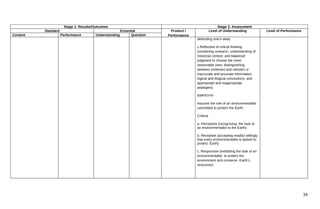
                                                                                    EMPATHY

                                                                                    Assume the role of an environmentalist
                                                                                    committed to protect the Earth.

                                                                                    Criteria

                                                                                    a. Perceptive (recognizing the task of
                                                                                    an environmentalist to the Earth)

                                                                                    b. Receptive (accepting readily/ willingly
                                                                                    that every environmentalist is tasked to
                                                                                    protect Earth)

                                                                                    c. Responsive (exhibiting the task of an
                                                                                    environmentalist to protect the
                                                                                    environment and conserve Earth’s
                                                                                    resources)


                                                                                                                                                        34
Stage 1: Results/Outcomes                                                     Stage 2: Assessment
          Standard                                   Essential         Product /               Level of Understanding          Level of Performance
Content              Performance       Understanding       Question   Performance
                                                                                    SELF-KNOWLEDGE

                                                                                    Realize one’s contribution to
                                                                                    environmental protection and
                                                                                    conservation of resources.

                                                                                    Criteria

                                                                                    a. Reflective (becoming aware of one’s
                                                                                    contribution to environmental protection
                                                                                    and conservation)

                                                                                    b.Responsive (reacting positively as a
                                                                                    result of redirecting/ changing one’s
                                                                                    thought or view)


                                                                                                                                                      35

Science Curriculum Guide

  • 1.
    SECONDARY EDUCATION CURRICULUM (SCIENCE) Program Standard: The learner demonstrates understanding of basic Science concepts and processes in an integrative way to solve problems critically, think innovatively/creatively and make informed decisions in order to protect the environment, conserve resources and sustain quality life. General Standard General Standard General Standard General Standard First Year Second Year Third Year Fourth Year Integrated Science Integrative Biology Integrative Chemistry Integrative Physics The learner demonstrates The learner demonstrates The learner demonstrates The learner demonstrates understanding of fundamental understanding of basic concepts understanding of basic understanding of basic concepts concepts and processes in, and processes in Biology concepts and processes in and processes in Physics Chemistry, Physics, Space deepened by other disciplines to Chemistry deepened by other deepened by other disciplines to Science and Ecology in an analyze/solve problems critically, disciplines to analyze/solve analyze/solve problems critically, integrative way to analyze/solve think innovatively/creatively, and problems critically, think think innovatively/creatively, and problems critically, think make informed decisions in innovatively/creatively, and make informed decisions in order innovatively/creatively, and order to protect the environment, make informed decisions in to protect the environment, make informed decisions in conserve resources and sustain order to protect the conserve resources and sustain order to protect the quality life. environment, conserve quality life. environment, conserve resources and sustain quality resources and sustain quality life. life. 1
  • 2.
    General Standard: Thelearner demonstrates understanding of fundamental concepts and processes in Chemistry, Physics, Space Science and Ecology in an integrative way to analyze/solve problems critically, think innovatively/creatively, and make informed decisions in order to protect the environment, conserve resources and sustain quality life. Quarter 1 A – The Scientific Method Stage 1: Results/Outcomes Stage 2: Assessment Standard Essential Product / Level of Understanding Level of Content Performance Understanding Question Performance Performance The learner demonstrates Learners perform in Scientific methods When do scientific Conduct of a EXPLANATION Performance understanding of the value groups at least one are valuable when methods become teacher-guided assessment of the of scientific methods when teacher-guided internalized as a valuable? community-based Synthesize how scientific knowledge is conduct of a teacher- internalized as a process. community-based process to: a) solve science investigation acquired and validated. guided science investigation using problems in life; b) using scientific investigation based I. Formulating Research Criteria scientific explain natural method(s) on the following Problem method(s). phenomena, and c) a. Thorough (explaining all needed criteria: 1. Definition and sources of develop/invent useful steps of scientific methods used until research problem/ topic products. • Community- conclusions are reached to generate based scientific knowledge; and explaining 2. Selection of community- how results of science investigations based research problem/ topic • Application of are subjected to review and testing of scientific method(s) 3.Main and sub-objectives of other scientists) research problem/ topic b. Clear (expressing with clarity the 4. Significance of the research scientific thought in oral or written problem/ topic form) 5. Scope and limitations c. Justifiable ( providing depth and 6. Variables breadth of scientific reasoning) II. Formulating Hypothesis INTERPRETATION III. Planning the Investigation/ Make sense of the importance of Research Design translating the data collected through tables and graphs while using scientific 1.Research as a process methods. 2.Applied and basic research Criteria 2
  • 3.
    Stage 1: Results/Outcomes Stage 2: Assessment Standard Essential Product / Level of Understanding Level of Content Performance Understanding Question Performance Performance 3. Experimental/Investigation a. Meaningful ( giving brief yet design substantial discussion on the importance of graphing/ tabulating data 4. Time Table while using scientific methods) 5. Materials and methods b.Illustrative (using given graphed or IV. Conducting Actual tabulated data to show relationships or Experiment/ Investigation connections between organizing or transforming raw data and the 1.Use of provision of a more compact and laboratory apparatus organized way based on specific purposes; how relationships or 2.Precision and accuracy connections can be used in determining pattern and trend) 3.Proper handling and disposal procedures APPLICATION 4.Notetaking and data Use scientific methods in solving collection (using qualitative problem at home/community (eg. and quantitative observations) increase of insect pests) considering V. Detecting Patterns and either economic, social, cultural or Trends other factors. 1. Classification of data Criteria 2.Use of graphs and tables a. Appropriate (illustrating how scientific method(s) can be used/ 3.Describing data adapted/ customized in solving problems at home or community) 4. Testing of hypothesis b.Practical (discussing how scientific VI. Making Conclusions and methods can be done easily to solve a Recommendations problem at home or in the community) c.Efficient (expounding how time and 3
  • 4.
    Stage 1: Results/Outcomes Stage 2: Assessment Standard Essential Product / Level of Understanding Level of Content Performance Understanding Question Performance Performance VII. Abstract Writing resources can be used productively, how safety measures can be done VIII. Peer Review throughout the investigation, and how data can be recorded objectively or honestly) d.Effective (discussing how the desired/ expected results/outputs can be achieved after using scientific method/s) PERSPECTIVE Analyze how approaches/ procedures of investigations done by some scientists differ from or similar to those of others. Criteria a. Insightful (providing similarities and differences on the approaches/ procedures after considering all situations/ views) b.Credible (using authoritative sources of information while expounding similarities and differences) c.Reflective of critical thinking (combining research, understanding of historical context, and balanced judgment to prove similarities and differences; becoming skeptical of another view point based on very small 4
  • 5.
    Stage 1: Results/Outcomes Stage 2: Assessment Standard Essential Product / Level of Understanding Level of Content Performance Understanding Question Performance Performance sample of data; distinguishing between irrelevant and relevant or inaccurate and accurate information, and appropriate and inappropriate analogies) EMPATHY Assume the role of a scientist. Be open to emulate scientists the way they develop their attitudes and values while using scientific method/s. Criteria a. Perceptive (recognizing scientific attitudes and values developed by scientists while doing scientific method/s) b. Receptive (accepting readily/ willingly that these scientific attitudes and values must be developed by scientists and oneself) c. Responsive (exhibiting how scientists develop scientific attitudes and values while using scientific methods) 5
  • 6.
    Stage 1: Results/Outcomes Stage 2: Assessment Standard Essential Product / Level of Understanding Level of Content Performance Understanding Question Performance Performance SELF-KNOWLEDGE Recognize one’s best contribution to community using scientific method. Criteria a. Reflective(becoming aware of one’s limitations in applying scientific methods, and of how one’s thought is influenced/ shaped by these) b.Responsive (reacting positively as a result of change in one’s view from using scientific method/s; reacting positively showing how the learner can use scientific methods beneficial to the community) 6
  • 7.
    Quarter IB -Matter Stage 1: Results/Outcomes Stage 2: Assessment Standard Essential Product / Level of Understanding Level of Content Performance Understanding Question Performance Performance The learner demonstrates Learners, working in Understanding of How does Manifestation of EXPLANATION Performance understanding of changes in groups, manifest changes in properties understanding of understanding of assessment of the properties of matter and their understanding of changes of matter is important changes in changes in Prove that matter undergoes physical manifestation of benefits to one’s health and in properties of matter and when manifested in properties of properties of matter or chemical change or both. understanding of the environment. their benefits to one’s health creating products that matter become through creation of changes in properties Criteria: and the environment are significantly beneficial? innovative, of matter through I .Properties and Phases of through creating innovative, beneficial to one’s marketable, creation of product(s) Matter a. Thorough ( discussing completely marketable, replicable and health and the replicable and cost- why matter undergoes physical or based on the 1.Properties of matter (physical: cost-effective products. environment. effective products chemical change or both) following criteria: extensive or intensive; that are beneficial chemical) to one’s health and b.Justifiable ( providing depth and • Innovativeness/ the environment. breadth of scientific reasoning) creativity 2. Phases of matter (solid, - originality liquid, gas and plasma) c.Clear (expressing with clarity - critical thinking in scientific thoughts in written or oral II. Classification of Matter finding ways/means form) to produce the I. Substances (elements : INTERPRETATION product metals, non-metals and metalloids; compounds: Make sense of the data gathered from • Marketability inorganic & organic, acids, investigations that indicate changes in - quality bases and salts) properties of matter. - aesthetic value 2. Mixtures (homogeneous/ heterogeneous; types of Criteria: - usability mixtures (solutions, suspensions and colloids), their a. Meaningful (drawing inference or making justification on the data • Replicability of the characteristics and uses) presented) production III. Beneficial effects of Physical processes b. Illustrative (discussing accurately - easy/simple and Chemical Changes on Health and the Environment and comprehensively the details of production process 7
  • 8.
    Stage 1: Results/Outcomes Stage 2: Assessment Standard Essential Product / Level of Understanding Level of Content Performance Understanding Question Performance Performance information) - availability of materials APPLICATION • Cost- effectiveness Propose ways on how understanding - quality product at of changes in properties of matter can low cost be used in life. - availability of Criteria materials a. Appropriate (proposing ways or • Manifestation of approaches in regard to how the changes in understanding of changes in properties of matter can be used/adapted/ properties of customized in relation to one’s life) matter b.Practical (suggesting how these • Benefits to one’s ways or approaches can be done health and the easily) environment c.Efficient (expounding how the - usability proposed ways or approaches will employ the productive use of time and - practicality resources) - safety in using the d.Effective (achieving the desired product result in using the understanding of changes in properties of matter) PERSPECTIVE Argue on the use of some commercially available products (fertilizers, detergents, instant noodles, toothpaste, shampoos, automobiles, toys with high content of lead, milk and 8
  • 9.
    Stage 1: Results/Outcomes Stage 2: Assessment Standard Essential Product / Level of Understanding Level of Content Performance Understanding Question Performance Performance other dairy products with melamine content, refrigerators , etc..) showing changes in properties of matter that affect health and the environment. Criteria a. Insightful (developing one’s argument after considering all effects of some commercially-available products on health and the environment) b.Credible (citing authoritative sources of information while arguing or defending a point of view) c.Reflective of critical thinking (combining research, understanding of historical context, and balanced judgment to choose the most reasonable view based on objectivity and discretion to disregard personal biases/ prejudices) EMPATHY Role play a worker’s feeling (that of a farmer, fisherman, etc – depending on the context of learner’s community) when there is less production due to some changes in properties of matter that evolved in long term conduct of activities (use of pesticides, rampant 9
  • 10.
    Stage 1: Results/Outcomes Stage 2: Assessment Standard Essential Product / Level of Understanding Level of Content Performance Understanding Question Performance Performance use of illegal fishing activities, etc). Criteria a. Perceptive (recognizing the problem a worker faces) b. Receptive (accepting readily/ willingly a worker’s feeling about the less yield of products due to some changes (changes in properties of the soil, long term use of pesticides, rampant use of illegal fishing activities, etc…) c.Sensitive (demonstrating how a worker reacts to this situation) SELF-KNOWLEDGE Realize how understanding of changes in properties of matter affects one’s view on health and the environment. Criteria a. Reflective (becoming aware how one’s view on health and the environment is affected by the understanding of changes in properties of matter) b.Responsive (reacting positively as a result of redirecting/ changing one’s thought or view) 10
  • 11.
    Quarter 2A –The Laws of Motion Stage 1: Results/Outcomes Stage 2: Assessment Standard Essential Product / Level of Understanding Level of Content Performance Understanding Question Performance Performance The learner demonstrates Learners, working The laws of motion In what ways are Integration of the EXPLANATION Performance understanding of the laws of in pairs, integrate are valuable when the laws of motion laws of motion in a assessment of motion in relation to their understanding integrated in important? clear, practical/ Predict when an accident is bound to integration of the laws observance of safety of the laws of observing safety applicable and happen for not considering the laws of of motion in a guide measures. motion in a clear, measures. comprehensive motion. on safety and practical/ applicable guide on safety protection based on I. Description of Motion Criteria and comprehensive and protection the following criteria: 1.Distance and displacement guide on safety a. Accurate (using correct science and protection. concept/s behind the cited event) • Clarity 2. Speed and velocity b.Clear (expressing with clarity 3.Uniform velocity & uniform scientific thoughts in written / oral form) acceleration • Practicality/ 4.Free fall, projectile and Applicability circular motion INTERPRETATION in varied contexts II. Cause of Motion Illustrate the laws of motion as applied in real life situations. 1. Newton’s laws of motion Criteria • Comprehensi a. Force and Inertia: the first law veness a. Accurate (presenting true and correct b. Force, mass, and illustrations) acceleration: the second law c. Action and reaction: the third b.Comprehensive (presenting possible • Accuracy law motion examples existing in real life) (accurate APPLICATION integration of 2. Momentum and the laws of the laws of motion Propose ways on how the laws of motion) 11
  • 12.
    Stage 1: Results/Outcomes Stage 2: Assessment Standard Essential Product / Level of Understanding Level of Content Performance Understanding Question Performance Performance 3. Law of universal gravitation motion can be used in life. III. Forces and the Laws of Criteria Motion a. Appropriate (citing the laws of motion 1. Mass, weight and gravity that fits the situation / event) 2. Friction b. Effective (achieving the desired result) 3.Equilibrium IV. Implications of the Laws of PERSPECTIVE Motion on safety and protection Analyze the significance of the laws of motion in designing safety gadgets or protective devices/ gears Criteria a. Credible (citing authoritative source/s of information while arguing for or against a point of view) b.Insightful (creating one’s own view after considering all the situations) EMPATHY Assume the role of a victim of an accident due to inability to apply the laws of motion. Criteria a. Receptive (becoming ready / willing to accept that humans fail to remember to 12
  • 13.
    Stage 1: Results/Outcomes Stage 2: Assessment Standard Essential Product / Level of Understanding Level of Content Performance Understanding Question Performance Performance take precautions either due to negligence or lack of knowledge) b.Perceptive ( recognizing emotions of others) c.Responsive (exhibiting other’s feelings and reciprocate it in some ways) SELF-KNOWLEDGE Self-assess how the laws of motion help one become safety conscious Criteria a. Reflective (becoming aware of how one’s thoughts are influenced by certain factors like accidents which happen because some people neglect to consider the laws of motions) b.Responsive (reacting positively from one’s understanding of the laws of motion) 13
  • 14.
    Quarter 2B –Efficient Energy Transfer Stage 1: Results/Outcomes Stage 2: Assessment Standard Essential Product / Level of Understanding Level of Content Performance Understanding Question Performance Performance The learner demonstrates Learners, working Advocating efficient Why should we Conduct of EXPLANATION Performance understanding of the in groups, advocate energy transfer is a advocate for advocacy for assessment of the importance of advocating efficient use of means of using efficient energy efficient use of Describe how energy is transferred conduct of advocacy efficient energy transfer. energy and its energy resources transfer? energy and its efficiently in the homes, school and activity for wise use alternative sources wisely and its alternative sources workplace of energy and its I. Energy Transfer in the community alternative sources in through a alternative sources in Criteria through a the community. cooperatively the community based 1. Energy – operational cooperatively planned, relevant, a. Accurate (giving correct data / on the following definition, spontaneous and planned, relevant, comprehensive, information) criteria: non-spontaneous/ deliberate comprehensive, and creative or energy transfer b.Clear (expressing with clarity the I. Cooperation accurate and innovative activity creative or scientific thought) 2. Law of conservation of • Teamwork energy innovative activity. c.Thorough (giving complete (members work . explanation in terms of how energy is together; each 3. Kinetic and potential transferred efficiently in two or more member performs a energy ways) specific task) 4. Heat transfer – d.Justifiable (providing depth and • Communication conduction, convection and breadth of scientific reasoning) (members radiation communicate thought processes and 5. Work INTERPRETATION strategies by asking Evaluate why there are different power questions, discussing 6. Power ratings of electrical appliances and ideas, offering 7. Efficiency of machines relate these to the efficient use of constructive energy criticisms, and 8. Power rating of electrical summarizing appliances Criteria discoveries as a 14
  • 15.
    Stage 1: Results/Outcomes Stage 2: Assessment Standard Essential Product / Level of Understanding Level of Content Performance Understanding Question Performance Performance 9. Energy use and sources in a. Illustrative (discussing in details how result of the group’s the community, country and power ratings vary) effort to come up with the world an advocacy) b.Meaningful (showing the importance II. Human Activities that of having different power ratings by 2. Relevance/ relating these to conserving energy) Impact on the Thermal suitability in the Environment c.Accuracy (computing energy use of context of one’s appliance/s of different power ratings) community APPLICATION 3. III. Conserving Energy and Comprehensiveness Energy Resources (energy Propose ways to efficiently use energy use and sources) and its alternative sources. 4. Innovativeness/ Creativity in the Criteria design and/or implementation of the a. Appropriate (expressing varied ways activity how energy consumption can be minimized within one’s context or 5. With a focus on the experience) wise use of energy and its alternative b.Practical (illustrating how such ways can be done easily) sources in the community c.Efficient (expounding how these proposed ways can be done using time and resources productively) d.Effective (presenting documents showing that desired results are achieved) PERSPECTIVE Infer how proposed ways to minimize 15
  • 16.
    Stage 1: Results/Outcomes Stage 2: Assessment Standard Essential Product / Level of Understanding Level of Content Performance Understanding Question Performance Performance energy consumption contribute to global campaign on the efficient use of energy. Criteria a. Credible(citing authoritative source of information / data while arguing for/against a view) b. Reflective of critical thinking (reaching the view impartially and without bias by combining research, understanding of historical context, and having a balanced judgment) c.Insightful ( creating one’s own view after considering all the situations / views) EMPATHY Assume the role of a policy maker who develops measures for the efficient use of alternative sources and standard energy-compliant appliances/vehicles Criteria a. Perceptive (recognizing emotions / world view of others) b. Responsive (exhibiting other’s feelings or worldview and able to reciprocate it) 16
  • 17.
    Stage 1: Results/Outcomes Stage 2: Assessment Standard Essential Product / Level of Understanding Level of Content Performance Understanding Question Performance Performance SELF-KNOWLEDGE Identify one’s habits which do not contribute towards efficient energy transfer and be able to do concrete steps to correct these. Criteria a. Reflective (becoming aware of how one’s habits) b. Responsive (reacting positively from one’s understanding of efficient energy transfer) 17
  • 18.
    Quarter 2C –Plate Tectonics Stage 1: Results/Outcomes Stage 2: Assessment Standard Essential Product / Level of Understanding Level of Content Performance Understanding Question Performance Performance The learner demonstrates Learners, working in Understanding of What does Informed decision Explanation Performance understanding of managing pairs, manage the plate tectonics helps understanding of making on actions assessment of the effects of events associated effects on human us realize that we plate tectonics tell learners need to Describe how plate tectonics cause learner’s capability to with plate tectonics. lives and the share the same us? take to manage the earthquakes and formation of make decisions environment of planet in which there effects on human mountains and volcanoes. based on the I. Evidence of Plate Tectonics events associated are many events lives and the following criteria: Criteria 1.Lithosphere and with plate tectonics whose effects environment of through informed should be managed events associated 1.informed decision asthenosphere a. Thorough (explaining the science decision making. because they with plate tectonics concepts how earthquakes and 2. Actions learners 2.Continental drift theory inevitably affect formation of mountains and volcanoes need to take to human lives and the are caused by plate tectonics) 3.Seafloor spreading manage the effects environment. on human lives and 4.Relationship of laws of b.Clear (expressing with clarity the the environment of motion & energy transfer to scientific thought in oral or written form) events associated plate tectonics c.Justifiable ( providing depth and with plate tectonics. II. Managing Effects of Natural breadth of scientific reasoning) Phenomena associated with Plate Tectonics d. Accurate (providing correct science concepts in explaining how 1.Earthquake earthquakes, and formation of a. Causes of earthquake mountains and volcanoes are caused by plate tectonics) b. Damages caused by earthquake on human lives INTERPRETATION and the environment. Make sense of the connections c. Earthquake and tsunami involving recent occurrences of volcanic eruptions, earthquakes and tsunamis d. Management of damages that affected countries around the caused by earthquake 18
  • 19.
    Stage 1: Results/Outcomes Stage 2: Assessment Standard Essential Product / Level of Understanding Level of Content Performance Understanding Question Performance Performance world. 2.Mountain formation Criteria a. Plate tectonics and a. Meaningful (seeing the connections formation of types of mountain within the immediate context of the learner) 3.Volcanoes b.Illustrative (discussing in detail the a. Types of volcanoes connections involving recent b.Volcanic activities occurrences of volcanic eruptions, earthquakes and tsunamis among c.Effects of volcanic eruptions countries) on humans and the environment APPLICATION d.Making predictions for the Propose implementation of safety country in regard to volcanic measures before, during, and after the activities occurrence of earthquakes, tsunamis e.Monitoring and safeguards and volcanic eruptions. for volcanic activities Criteria a. Appropriate (providing safety measures before, during, and after the occurrence/s of these natural phenomena and telling how such measures can be used, adapted and customized in different/several situations or contexts) b.Practical (discussing how safety measures can be done easily) c.Efficient (expounding how time and resources can be used productively 19
  • 20.
    Stage 1: Results/Outcomes Stage 2: Assessment Standard Essential Product / Level of Understanding Level of Content Performance Understanding Question Performance Performance while using, adapting and customizing such safety measures ) d.Effective(discussing how the desired/ expected results can be achieved after using safety measures) PERSPECTIVE Analyze government efforts (international, national and local) in reducing damages of earthquakes, tsunamis and volcanic eruptions reasonable based on cost effectiveness. Criteria a. Insightful (developing one’s view after considering all government efforts in reducing damages of earthquakes and volcanic eruptions) b.Credible (citing authoritative/primary sources of information while arguing for the reasonability of government efforts in reducing damages of earthquakes and volcanic eruptions based on the cost effectiveness analysis) c.Reflective of critical thinking (combining research, understanding of historical context, and balanced judgment to prove the reasonable or unreasonable government efforts in 20
  • 21.
    Stage 1: Results/Outcomes Stage 2: Assessment Standard Essential Product / Level of Understanding Level of Content Performance Understanding Question Performance Performance reducing damages of earthquakes and volcanic eruptions based on cost effectiveness analysis) EMPATHY Imagine what other people feel and how they adjust while living in areas frequented by earthquakes, tsunamis or volcanic eruptions. Criteria a. Perceptive (recognizing the effects on people living in areas frequented by earthquakes and volcanic eruptions) c.Sensitive (exhibiting what these people feel and how they adjust as a result of experiencing effects of these natural phenomena) SELF-KNOWLEDGE Self-assesses how the understanding of reducing damages of earthquakes, tsunamis and volcanic eruptions shapes/influences one’s beliefs and values on volunteerism. a. Reflective (becoming aware of how one’s beliefs and values on volunteerism are influenced/ shaped by understanding of reducing damages brought about by earthquakes and 21
  • 22.
    Stage 1: Results/Outcomes Stage 2: Assessment Standard Essential Product / Level of Understanding Level of Content Performance Understanding Question Performance Performance volcanic eruptions) b.Responsive (reacting positively/how one must behave as a result of changing one’s beliefs and values on volunteerism) 22
  • 23.
    Quarter 3A –Sun-Moon-Earth System Stage 1: Results/Outcomes 1Stage 2: Assessment Standard Essential Product / Level of Understanding Level of Content Performance Understanding Question Performance Performance The learner demonstrates Learners, working Understanding of In what way is the Informed decision EXPLANATION Performance understanding of effects of individually or in the Sun-Moon-Earth understanding of making on actions assessment of the Sun-Moon-Earth System groups, make System is valuable the Sun-Moon- learners need to Demonstrate how the Sun-Moon-Earth learner’s capability to and how these are informed decision to when used making Earth System take to manage the System causes different natural make decisions managed. manage the effects informed decision to valuable? effects of the Sun- phenomena. based on the of the Sun-Moon- manage its effects Moon-Earth following criteria: I. Day and Night Cycle Criteria Earth System on on activities System on activities related to involving livelihood, activities related to 1.informed decision 1.Causes of day and night a. Thorough (explaining science cycle livelihood, health health and livelihood, health concepts behind each natural 2. Actions learners and transportation. transportation. and transportation. phenomenon caused by Sun-Moon- need to take to 2. Human practices/ Earth System) manage the effects superstitious beliefs common in the community related to the of the Sun-Moon- b.Clear (expressing with clarity the phenomenon Earth System on scientific thought in oral or written form) activities related to 3.Managing effects of day and livelihood, health and c.Justifiable ( providing depth and night cycle on human activities breadth of scientific reasoning) transportation. related to health, livelihood and transportation d. Accurate (providing correct science concepts in explaining how each phenomenon is caused by Sun-Moon- II. Seasonal Patterns Earth System) 1.Causes of seasonal patterns INTERPRETATION 2. Human practices/ Illustrate through graphs the superstitious beliefs common in the community related to the phenomena caused by the Sun-Moon- phenomenon Earth System 3. Managing effects of seasonal patterns on human 23
  • 24.
    Stage 1: Results/Outcomes 1Stage 2: Assessment Standard Essential Product / Level of Understanding Level of Content Performance Understanding Question Performance Performance activities related to health, Criteria livelihood and transportation a. Meaningful (providing substantive III. Phases of the moon information of the phenomena being illustrated ) 1.Causes of phases of the moon b. Accuracy (depicting correct data or information through graphs) 2. Human practices/ superstitious beliefs common APPLICATION in the community related to the phenomenon Propose ways of adopting/adapting 3.Managing effects of phases safety measures during the occurrence of the moon on human of some natural phenomena caused by activities related to health, Sun-Moon-Earth System. livelihood and transportation Criteria IV. Eclipses a. Appropriate (providing safety 1.Causes of eclipses measures during the occurrence/s of these natural phenomena and telling 2. Human practices/ how such measures can be used, superstitious beliefs common adapted and customized in in the community related to the different/several situations or contexts) phenomenon b.Practical (discussing how safety 3. Managing effects of eclipses measures can be done easily) on human activities related to health, livelihood and c.Efficient (expounding how time and transportation resources can be used productively while using, adapting and customizing V. Tides such safety measures) 1.Causes of tides d.Effective (discussing how the desired/ expected results can be achieved after 2. Human practices/ superstitious beliefs common 24
  • 25.
    Stage 1: Results/Outcomes 1Stage 2: Assessment Standard Essential Product / Level of Understanding Level of Content Performance Understanding Question Performance Performance in the community related to the using safety measures) phenomenon PERSPECTIVE 3. Managing effects of tides on human activities related to Infer on the adequacy and/or health, livelihood and insufficiency of evidence of transportation superstitious beliefs and community practices related to natural phenomena caused by the Sun-Moon-Earth System. Criteria a. Insightful (developing one’s view after considering all superstitious beliefs and community practices related to natural phenomena caused by the Sun-Moon-Earth System) b.Credible ( citing authoritative/primary sources of information while arguing for limited or adequate evidences of superstitious beliefs and community practices) c.Reflective of critical thinking (combining research, understanding of historical context, and balanced judgment to prove the limitations or adequacy of evidences for superstitious beliefs and community practices; becoming skeptical of arguments based on small samples of data, biased samples or samples for which there was no control sample; distinguishing between irrelevant and relevant or 25
  • 26.
    Stage 1: Results/Outcomes 1Stage 2: Assessment Standard Essential Product / Level of Understanding Level of Content Performance Understanding Question Performance Performance inaccurate and accurate information, illogical and logical conclusions, and appropriate and inappropriate analogies) EMPATHY Relate how people living in different topographical locations (highland, lowland, coastal areas, riverbanks, etc) might feel about being affected by the Sun-Moon-Earth System. Criteria a. Perceptive (recognizing the effects of the Sun-Moon-System methods to people living in different topographical locations) c.Sensitive (exhibiting what these people feel and how they adapt as a result of the effects of the Sun-Moon- Earth System they have been experiencing) SELF-KNOWLEDGE Reflect on how the understanding of the Sun-Moon-Earth System influences one’s beliefs, behavior, practices and way of life. a. Reflective (becoming aware of how one’s beliefs, behavior, practices and 26
  • 27.
    Stage 1: Results/Outcomes 1Stage 2: Assessment Standard Essential Product / Level of Understanding Level of Content Performance Understanding Question Performance Performance way of life are influenced/ shaped by the understanding of Sun-Moon-Earth System) b.Responsive (reacting positively/how one must behave as a result of changing one’s view) 27
  • 28.
    Quarter 3B –Earth and Space Explorations Stage 2: Assessment Stage 1: Results/Outcomes Standard Essential Product / Level of Understanding Level of Performance Content Performance Understanding Question Performance The learner demonstrates Learners, working in Earth and space To what extent are Conduct of an EXPLANATION Performance assessment understanding of advocating groups, advocate explorations lead to earth and space activity clearly of an advocacy activity the use of breakthroughs / the use of breakthroughs/ explorations advocating the use Describe in your own words the based on the following discoveries and technologies technologies and discoveries and useful? Explain. of technologies and significance of advances in earth and criteria: resulting from earth and recent discoveries/ develop recent discoveries space explorations. space explorations. breakthroughs technologies, the or breakthroughs • Clear advocacy on Criteria resulting from earth use of which should resulting from earth the use of I. Space-based Observations of and space be advocated for the and space technologies and the Earth (historical a. Thorough (explaining completely the explorations for the benefit of society. explorations for the significance of advances in earth and recent discoveries development, types and uses of benefit of society. benefit of society space explorations ) and breakthroughs satellites in exploring mineral resulting from deposits, weather events, topography, etc) b.Clear (expressing with clarity the earth and space scientific thought in oral or written form) explorations II. Explorations of Earth’s Waters (Earth as the water c.Justifiable (providing depth and breadth • Beneficial to planet, freshwater resources, of scientific reasoning) society ocean systems and ocean environments) INTERPRETATION III. Earth-based and Space- Evaluate the advances made through based Observations of Space earth and space explorations. (historical development of astronomy from ancient to Criteria modern, technologies or tools used to explore the space: a. Meaningful (giving substantial insights telescopes, spacecrafts, about earth and space explorations) orbiters, landers, probes and flyby; space flights and b. Illustrative (discussing in detail these challenges encountered by insights using varied examples; becoming astronauts/ cosmonauts, aware that there may be more than one explorations within the Solar way to interpret data on space 28
  • 29.
    Stage 2: Assessment Stage 1: Results/Outcomes Standard Essential Product / Level of Understanding Level of Performance Content Performance Understanding Question Performance System, explorations outside of explorations) the Solar System) APPLICATION IV. Recent Discoveries or Breakthroughs in Earth and Use practically the information gained Space Explorations (latest from space-based observations of the information/ discoveries about Earth. earth and space, latest theories developed on earth, space/ Criteria universe, benefits of the society from spin-offs of technologies a. Appropriate (discussing how the used in earth and space information gained from spaced-based explorations) observations of the earth can be used, adapted and customized daily in one’s context) b. Practical (illustrating how the use, adaptation and customization of these information can be done easily) c.Efficient (expounding how the use of these information employs the productive utilization of time and resources) d.Effective (discussing how the desired/ expected results can be achieved after using the information from space-based observations of the earth) PERSPECTIVE 29
  • 30.
    Stage 2: Assessment Stage 1: Results/Outcomes Standard Essential Product / Level of Understanding Level of Performance Content Performance Understanding Question Performance Infer on the risks and cost effectiveness of efforts done in earth and space explorations. Criteria a. Insightful (developing one’s view after considering all efforts in earth and space explorations) b. Credible (citing authoritative/primary sources of information while arguing for the reasonability of efforts in earth and space explorations based on the cost effectiveness analysis) c.Reflective of critical thinking (combining research, understanding of historical context, and balanced judgment to prove the reasonable or unreasonable efforts in earth and space explorations based on cost effectiveness analysis) EMPATHY Role play how oceanographers or astronauts/ cosmonauts might respectively feel about adjusting to problems in earth or space explorations. a. Perceptive (recognizing problems faced by astronauts/ cosmonauts or oceanographers during earth or space explorations) 30
  • 31.
    Stage 2: Assessment Stage 1: Results/Outcomes Standard Essential Product / Level of Understanding Level of Performance Content Performance Understanding Question Performance b. Receptive (accepting readily/ willingly the feeling of astronauts/ cosmonauts about adjusting to problems encountered during earth or space explorations) c. Responsive (exhibiting how cosmonauts/ astronauts or oceanographers feel and adjust to problems encountered during earth or space explorations) SELF-KNOWLEDGE Be aware on how information from earth and space explorations help one become more objective and appreciative of the wonders of nature. Criteria a. Reflective (becoming aware that information from earth and space explorations make one objective and appreciative of wonders of nature) b.Responsive (reacting positively as a result of having information from earth and space explorations changed one’s view) 31
  • 32.
    Quarter 4 –Humans as Stewards of Our Finite Earth Stage 1: Results/Outcomes Stage 2: Assessment Standard Essential Product / Level of Understanding Level of Performance Content Performance Understanding Question Performance The learner demonstrates Learners, working in Humans, as Why are humans EXPLANATION Performance assessment of understanding of humans as groups, contribute to stewards of our finite stewards of our Conserving a conduct of an stewards of our finite earth. conservation of earth, are tasked to finite earth? resources and/or Describe how our finite earth should be environmental activity based resources and/or contribute to (a) solving an taken cared of. on the following criteria: I. Basics of Ecology solution of an conservation of ecological problem Criteria 1. Cooperation ecological problem resources and (b) existing in the 1.Basic units of ecology (organism to biosphere existing in the solution of immediate a. Thorough (discussing completely community through • Teamwork ( members immediate ecological problems how the earth should be taken cared of) work together; each 2.Components of ecosystem community through through cooperative the cooperative member performs a (ecological communities, the cooperative conduct of conduct of an b.Justifiable ( providing depth and specific task) ecological habitats, ecological conduct of an environmental innovative/ creative breadth of scientific reasoning) • Communication niches) environmental innovative/ creative activities or projects. (members communicate environmental activity or project c.Clear (expressing with clarity scientific thought processes and 3.Functions of ecosystem (self- activity or project. (either clean-up thoughts in written or oral form) strategies by asking regulating: carrying capacity, maximum sustainable yield, drive, eco-fun run, questions, discussing ideas, tree planting, rip- INTERPRETATION waste assimilative capacity, offering constructive natural enemies; self- rapping, IGP for an criticisms, and summarizing Evaluate how understanding of perpetuating) environmental discoveries as a result of the stewardship of the earth benefits cause, etc.) group’s involvement in an II.Human Impact on Ecosystems humans. environmental activity) 1.Altering biotic and abiotic Criteria factors a. Meaningful (giving the importance of 2.Human contributions to this understanding using one’s 2. Innovativeness/ pollution and its impact on immediate context) Creativity ecosystems (impact on the quality of air and water, global b.Illustrative (discussing vividly how this • Active learning warming and climate change) understanding is valuable to humans) (group members explore new ways or III. Seven (7) Environmental approaches to Principles (nature knows best, address an 32
  • 33.
    Stage 1: Results/Outcomes Stage 2: Assessment Standard Essential Product / Level of Understanding Level of Performance Content Performance Understanding Question Performance all life forms are important, APPLICATION ecological problem everything is connected to everything else, everything Design how resources can be 3. Contribution to changes, everything must go sustained. conservation of somewhere, ours is a finite resources and/or earth, and humans are stewards Criteria solution of an of nature) ecological problem a. Appropriate (discussing specific resources to be sustained) existing in the immediate b.Practical (illustrating how the design community can be done easily) c.Efficient (expounding how the use of these key concepts will result to utilizing time and needed materials/ equipment productively) d.Effective (discussing how the desired/ expected results-eg.sustaining resources, can be achieved after using important concepts of ecology) PERSPECTIVE Argue on “thinking globally and acting locally” to protect ecosystems. Criteria a. Insightful ( developing one’s own view after exhausting all views about “thinking globally and acting locally”) b.Credible ( citing authoritative sources of information while arguing or 33
  • 34.
    Stage 1: Results/Outcomes Stage 2: Assessment Standard Essential Product / Level of Understanding Level of Performance Content Performance Understanding Question Performance defending one’s view) c.Reflective of critical thinking (combining research, understanding of historical context, and balanced judgment to choose the most reasonable view; distinguishing between irrelevant and relevant or inaccurate and accurate information, logical and illogical conclusions, and appropriate and inappropriate analogies) EMPATHY Assume the role of an environmentalist committed to protect the Earth. Criteria a. Perceptive (recognizing the task of an environmentalist to the Earth) b. Receptive (accepting readily/ willingly that every environmentalist is tasked to protect Earth) c. Responsive (exhibiting the task of an environmentalist to protect the environment and conserve Earth’s resources) 34
  • 35.
    Stage 1: Results/Outcomes Stage 2: Assessment Standard Essential Product / Level of Understanding Level of Performance Content Performance Understanding Question Performance SELF-KNOWLEDGE Realize one’s contribution to environmental protection and conservation of resources. Criteria a. Reflective (becoming aware of one’s contribution to environmental protection and conservation) b.Responsive (reacting positively as a result of redirecting/ changing one’s thought or view) 35