WRITING IN
PROFESSIONAL
CONTEXT
Pre-writing: Getting
Ready to Write
Andi Patmasari, S.Pd., M.Pd.
Tadulako University
Pre-writing
Before you begin writing, you
decide what you are going to
write about.
Then you plan what you are
going to write.
This process is called pre-writing.
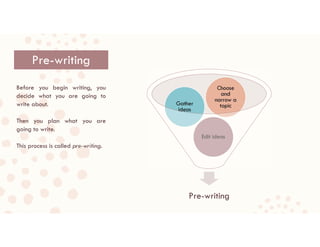
Pre-writing
Edit ideas
Gather
ideas
Choose
and
narrow a
topic
Choosing and
narrowing a topic
How to choose a topic for a paragraph?
A paragraph is a group of five to ten sentences that give information about a topic.
Before you write, you must choose a topic for your paragraph.
Choose a topic that isn’t too narrow (limited, brief).
A narrow topic will not have enough ideas to write about.
Choose a topic that isn’t too broad (general).
A broad topic will have too many ideas for just one paragraph.
Brainstorming
What is brainstorming?
Brainstorming is a way of gathering ideas
about a topic.
When you brainstorm, write down every
idea that comes to you.
Don’t worry about whether the ideas are
good or silly, useful or not.
You can decide that later.
Right now, you are gathering as many
ideas as you can.
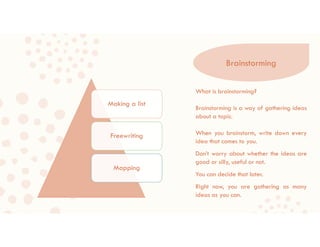
Making a list
Freewriting
Mapping
Making a list
Write single words, phrases, or
sentences that are connected to
your topic.
Look at this list a student made
when brainstorming ideas to write
about her topic, ‘What should I
study at university?’
Freewriting
When you freewrite, you write
whatever comes into your head
about your topic, without
stopping.
Freewriting helps you practice
fluency (writing quickly and
easily).
When you freewrite, you do not
need to worry about accuracy
(having correct grammar and
spelling).
Don’t check your dictionary when
you freewrite.
Don’t stop if you make a mistake.
Just keep writing!
Mapping
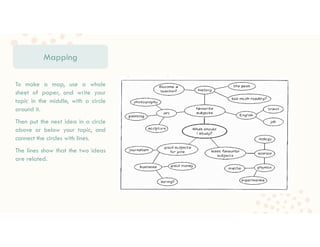
To make a map, use a whole
sheet of paper, and write your
topic in the middle, with a circle
around it.
Then put the next idea in a circle
above or below your topic, and
connect the circles with lines.
The lines show that the two ideas
are related.
Editing
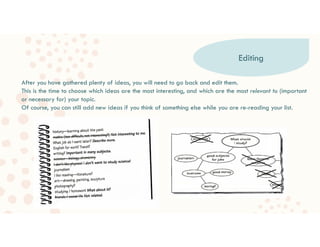
After you have gathered plenty of ideas, you will need to go back and edit them.
This is the time to choose which ideas are the most interesting, and which are the most relevant to (important
or necessary for) your topic.
Of course, you can still add new ideas if you think of something else while you are re-reading your list.
The end . . .
Thanks for your kind attention!

Pre-writing: Getting Ready to Write

  • 1.
    WRITING IN PROFESSIONAL CONTEXT Pre-writing: Getting Readyto Write Andi Patmasari, S.Pd., M.Pd. Tadulako University
  • 2.
    Pre-writing Before you beginwriting, you decide what you are going to write about. Then you plan what you are going to write. This process is called pre-writing. Pre-writing Edit ideas Gather ideas Choose and narrow a topic
  • 3.
    Choosing and narrowing atopic How to choose a topic for a paragraph? A paragraph is a group of five to ten sentences that give information about a topic. Before you write, you must choose a topic for your paragraph. Choose a topic that isn’t too narrow (limited, brief). A narrow topic will not have enough ideas to write about. Choose a topic that isn’t too broad (general). A broad topic will have too many ideas for just one paragraph.
  • 4.
    Brainstorming What is brainstorming? Brainstormingis a way of gathering ideas about a topic. When you brainstorm, write down every idea that comes to you. Don’t worry about whether the ideas are good or silly, useful or not. You can decide that later. Right now, you are gathering as many ideas as you can. Making a list Freewriting Mapping
  • 5.
    Making a list Writesingle words, phrases, or sentences that are connected to your topic. Look at this list a student made when brainstorming ideas to write about her topic, ‘What should I study at university?’
  • 6.
    Freewriting When you freewrite,you write whatever comes into your head about your topic, without stopping. Freewriting helps you practice fluency (writing quickly and easily). When you freewrite, you do not need to worry about accuracy (having correct grammar and spelling). Don’t check your dictionary when you freewrite. Don’t stop if you make a mistake. Just keep writing!
  • 7.
    Mapping To make amap, use a whole sheet of paper, and write your topic in the middle, with a circle around it. Then put the next idea in a circle above or below your topic, and connect the circles with lines. The lines show that the two ideas are related.
  • 8.
    Editing After you havegathered plenty of ideas, you will need to go back and edit them. This is the time to choose which ideas are the most interesting, and which are the most relevant to (important or necessary for) your topic. Of course, you can still add new ideas if you think of something else while you are re-reading your list.
  • 9.
    The end .. . Thanks for your kind attention!