The 5 Steps of
Essay Writing
Prewriting
Planning
Drafting
Revising
Editing
Understand the Assignment
   What exactly does the prompt request?
   Key Words/Wording in the prompt:
            Summarize the reading
            Analyze the reading
            Research a Topic
            Take a Position
            Compare and Contrast
            Explore the Causes/Effects
Confused?

What if the assignment is not clear?
      Ask for clarification while the
      instructor introduces the prompt, or
      ask later. Do not wait till the day the
      essay is due to state your lack of
      understanding!
Length and Design
   Is there a page/word requirement?
   Format Required?
   MLA, APA


                  Research
                      Is Research Required?
                            Personal Experience
                            Academic Sources -- Library Research
                            Interviews and Questionnaires
Audience

 Who are your readers?
 How well informed are they about the
 subject?
 What do you want them to learn?
Deadlines

  Note Deadlines
       Draft Due Date?
       Final Draft Due Date?
  Make a Schedule: Find a time frame and specific places where you
  concentrate best
  Find a class peer to work with to help keep you motivated.
Prewriting
Planning
Drafting
Revising
Editing
Step 1: Prewriting
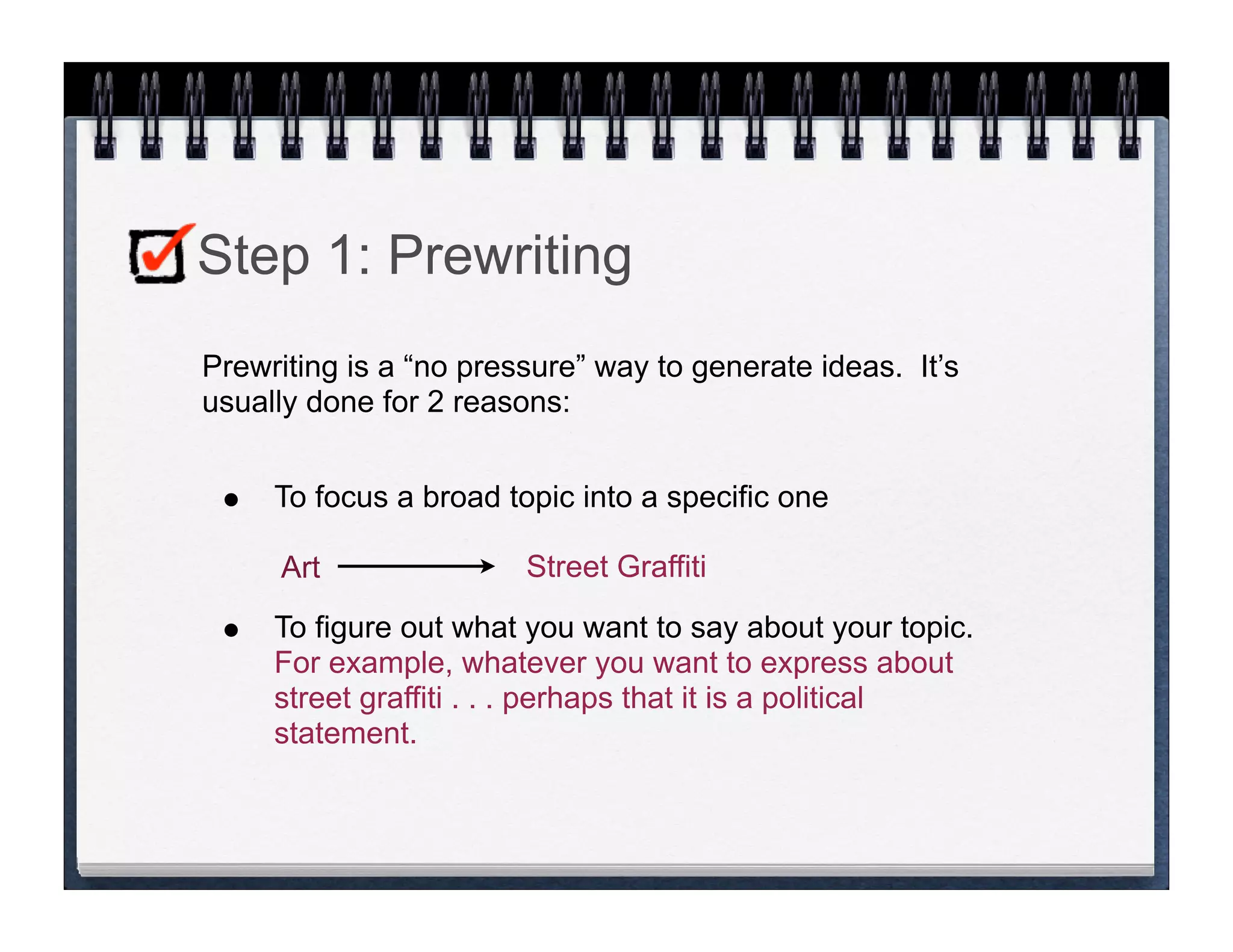
Prewriting is a “no pressure” way to generate ideas. It’s
usually done for 2 reasons:


 •   To focus a broad topic into a specific one

     Art                Street Graffiti

 •   To figure out what you want to say about your topic.
     For example, whatever you want to express about
     street graffiti . . . perhaps that it is a political
     statement.
Step 1: Prewriting
Types of Prewriting.
    Discussion
    Note-taking
    Listing/Brainstorming
    Clustering
    Freewrite
    Journalist Questions (who, what, when, where, how, why)
Step 1: Prewriting
Asking Journalist Questions

   What point do I want to make about my topic?
   What do I need to tell my audience so that they will get my point?
    What is my topic similar to/different from?
    What causes it? What are the effects?
    Why is the topic important?
    Who does this topic affect?
    How does the topic affect people’s lives, or my life?
    What particular attitudes or opinions about my topic do readers have?
   If applicable, where and when does my topic occur?
Step 1: Prewriting

Free-writing is a very useful way to narrow a general subject or
assignment.

Write for a fixed period, perhaps 5 or 10 minutes, without
stopping and without paying attention to spelling, grammar, or
punctuation. Your goal is to get your ideas down on paper so
you can react to them.
Step 1: Prewriting
A Student Writer’s Example of Freewriting:
        Write about a time when you could have spoken out in protest but chose not
        to. Would you make the same decision today?

Student freewriting:
         Write for ten minutes ... ten minutes ... at 9 o'clock in the morning — Just what I
         want to do in the morning — If you can't think of something to say, just write
         about anything. Right! Time to get this over with — An experience — should
         have talked — I can think of plenty of times I should have kept quiet! I should
         have brought coffee to class. Damn. I wonder what the people next to me are
         writing about. That reminds me. Next to me. Jeff Servin in chemistry. The time I
         saw him cheating. I was mad but I didn't do anything. I studied so hard and all
         he did was cheat. I was so mad. Nobody else seemed to care either. What's
         the difference between now and then? It's only a year and a half.... Honor
         code? Maturity? A lot of people cheated in high school. I bet I could write about
         this — Before and after, etc. My attitude then and now.
Step 1: Prewriting
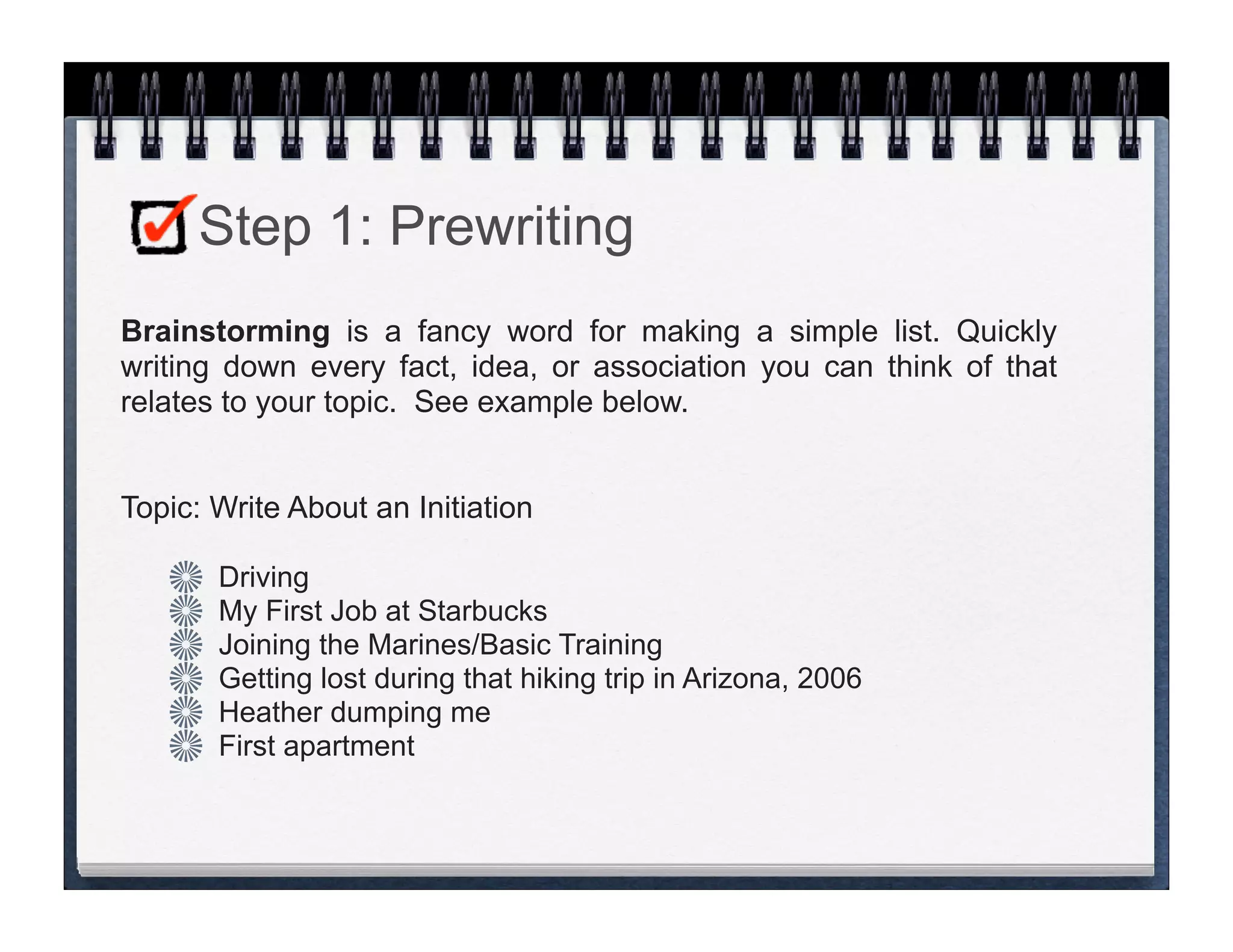
Brainstorming is a fancy word for making a simple list. Quickly
writing down every fact, idea, or association you can think of that
relates to your topic. See example below.


Topic: Write About an Initiation

       Driving
       My First Job at Starbucks
       Joining the Marines/Basic Training
       Getting lost during that hiking trip in Arizona, 2006
       Heather dumping me
       First apartment
Step 1: Prewriting
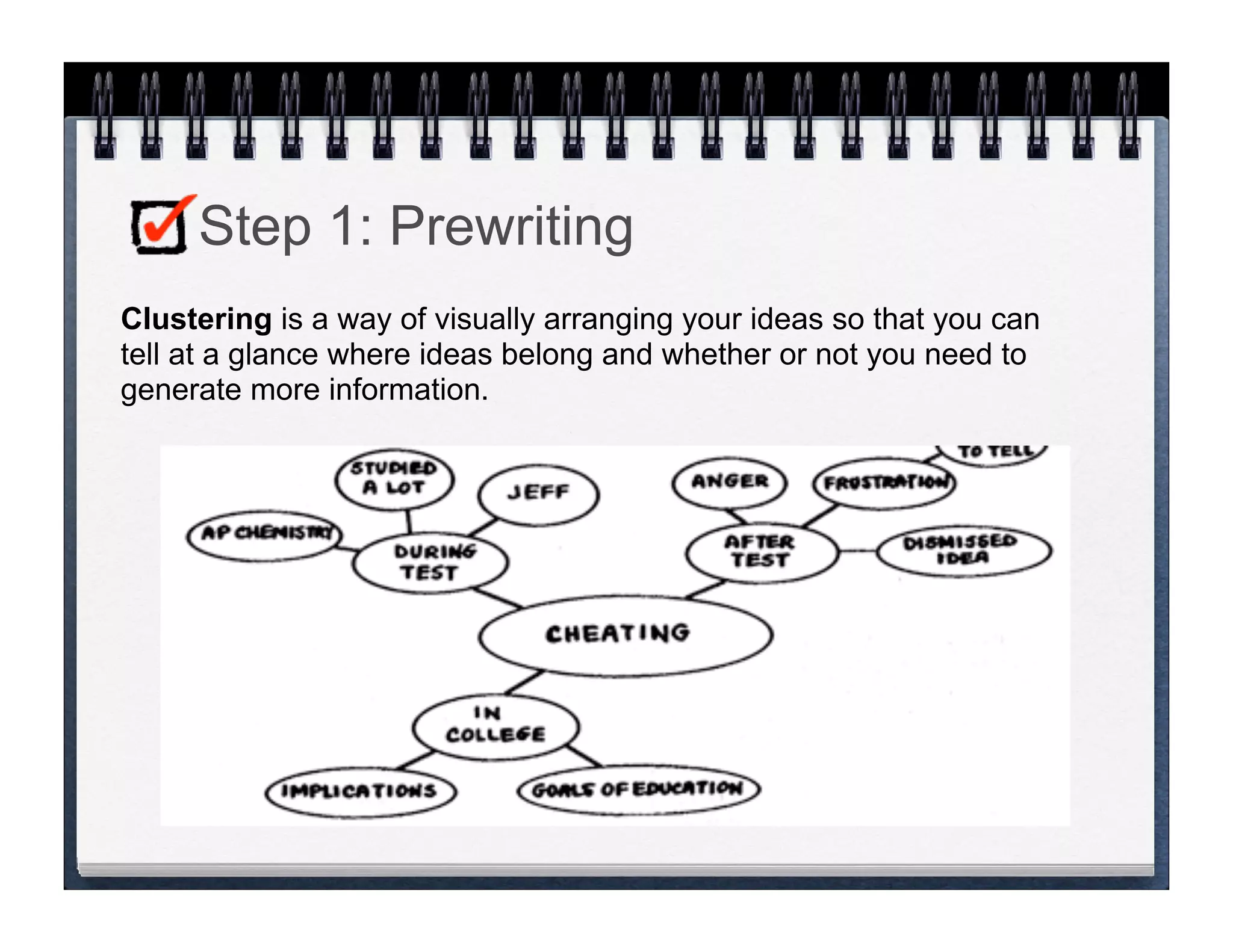
Clustering is a way of visually arranging your ideas so that you can
tell at a glance where ideas belong and whether or not you need to
generate more information.
Step 1: Prewriting
Prewriting Practice: Narrow these broad topics


top college demands
the effects of social networking sites
your most influential peer
the top environmental issue for your generation
the best method for getting out of debt
the benefits of moving out at 18

Lp essaywriting prewriting

  • 1.
    The 5 Stepsof Essay Writing
  • 2.
  • 3.
    Understand the Assignment What exactly does the prompt request? Key Words/Wording in the prompt: Summarize the reading Analyze the reading Research a Topic Take a Position Compare and Contrast Explore the Causes/Effects
  • 4.
    Confused? What if theassignment is not clear? Ask for clarification while the instructor introduces the prompt, or ask later. Do not wait till the day the essay is due to state your lack of understanding!
  • 5.
    Length and Design Is there a page/word requirement? Format Required? MLA, APA Research Is Research Required? Personal Experience Academic Sources -- Library Research Interviews and Questionnaires
  • 6.
    Audience Who areyour readers? How well informed are they about the subject? What do you want them to learn?
  • 7.
    Deadlines NoteDeadlines Draft Due Date? Final Draft Due Date? Make a Schedule: Find a time frame and specific places where you concentrate best Find a class peer to work with to help keep you motivated.
  • 8.
  • 9.
    Step 1: Prewriting Prewritingis a “no pressure” way to generate ideas. It’s usually done for 2 reasons: • To focus a broad topic into a specific one Art Street Graffiti • To figure out what you want to say about your topic. For example, whatever you want to express about street graffiti . . . perhaps that it is a political statement.
  • 10.
    Step 1: Prewriting Typesof Prewriting. Discussion Note-taking Listing/Brainstorming Clustering Freewrite Journalist Questions (who, what, when, where, how, why)
  • 11.
    Step 1: Prewriting AskingJournalist Questions What point do I want to make about my topic? What do I need to tell my audience so that they will get my point? What is my topic similar to/different from? What causes it? What are the effects? Why is the topic important? Who does this topic affect? How does the topic affect people’s lives, or my life? What particular attitudes or opinions about my topic do readers have? If applicable, where and when does my topic occur?
  • 12.
    Step 1: Prewriting Free-writingis a very useful way to narrow a general subject or assignment. Write for a fixed period, perhaps 5 or 10 minutes, without stopping and without paying attention to spelling, grammar, or punctuation. Your goal is to get your ideas down on paper so you can react to them.
  • 13.
    Step 1: Prewriting AStudent Writer’s Example of Freewriting: Write about a time when you could have spoken out in protest but chose not to. Would you make the same decision today? Student freewriting: Write for ten minutes ... ten minutes ... at 9 o'clock in the morning — Just what I want to do in the morning — If you can't think of something to say, just write about anything. Right! Time to get this over with — An experience — should have talked — I can think of plenty of times I should have kept quiet! I should have brought coffee to class. Damn. I wonder what the people next to me are writing about. That reminds me. Next to me. Jeff Servin in chemistry. The time I saw him cheating. I was mad but I didn't do anything. I studied so hard and all he did was cheat. I was so mad. Nobody else seemed to care either. What's the difference between now and then? It's only a year and a half.... Honor code? Maturity? A lot of people cheated in high school. I bet I could write about this — Before and after, etc. My attitude then and now.
  • 14.
    Step 1: Prewriting Brainstormingis a fancy word for making a simple list. Quickly writing down every fact, idea, or association you can think of that relates to your topic. See example below. Topic: Write About an Initiation Driving My First Job at Starbucks Joining the Marines/Basic Training Getting lost during that hiking trip in Arizona, 2006 Heather dumping me First apartment
  • 15.
    Step 1: Prewriting Clusteringis a way of visually arranging your ideas so that you can tell at a glance where ideas belong and whether or not you need to generate more information.
  • 16.
    Step 1: Prewriting PrewritingPractice: Narrow these broad topics top college demands the effects of social networking sites your most influential peer the top environmental issue for your generation the best method for getting out of debt the benefits of moving out at 18