Pre-Writing StrategiesBy: Elizabeth FosterEDU 290Class time: Monday and Wednesday 2:00
What is Pre-Writing?Preparatory work for a piece of writingIt is an idea formulationResearchUsed as an outline
The Goal of Pre-WritingFirst step in writing processCalms down nervesDon’t panic about the topic of the paperTo get ideas of what to write about
Getting StartedCarefully think about the topicThink about what the purpose of the paper isHow can you achieve that purposeStart thinking of topics and ideas
Types of Pre-WritingBrainstormingClusteringFree WritingLoopingAsking the six journalists’ questions(Who? What? Where? When? Why? How?)
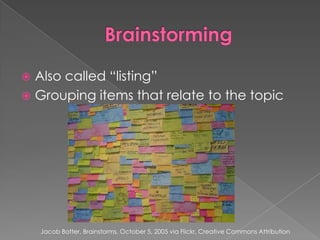
BrainstormingAlso called “listing”Grouping items that relate to the topicJacob Botter, Brainstorms, October 5, 2005 via Flickr, Creative Commons Attribution
ClusteringAllows you to relate ideas togetherAlso called “Mind mapping”Alan Cleaver, March 24 2010 via Canon EOS 400D Digital,  Creative Commons Attribution
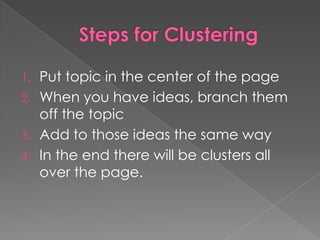
Steps for ClusteringPut topic in the center of the pageWhen you have ideas, branch them off the topicAdd to those ideas the same wayIn the end there will be clusters all over the page.
Free-writingA process of writing for a certain amount of timeFocus on a specific topicTime for 5-10 minutesForce yourself to continue writing
Free-writing continued…When finished, look over the paperPick out the most interesting ideaThen begin over again with related ideas
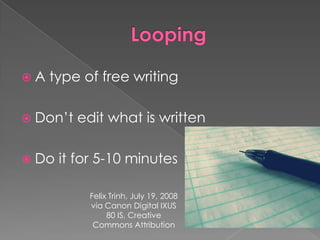
LoopingA type of free writingDon’t edit what is writtenDo it for 5-10 minutesFelix Trinh, July 19, 2008 via Canon Digital IXUS 80 IS, Creative Commons Attribution
Looping Continued…After the time is up, circle the best ideas, sentences, and phrasesHave your classmates circle ideas on your paper alsoThen write again for 5-10 minutesContinue for 4 or 5 times
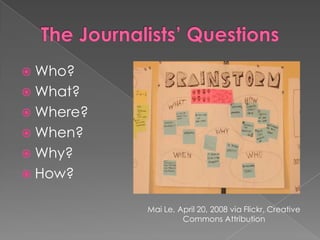
The Journalists’ QuestionsWho?What?Where?When?Why?How?Mai Le, April 20, 2008 via Flickr, Creative Commons Attribution
The Journalists’ Questions continued…Who?-Who are you talking about?What?-What is the topic? What are the issues?Where? Where does it take place?
The Journalists’ Questions Continued…When?-When did the topic take place?Why?-Why is the topic an issue?How?-How is the topic significant?
The End!For more information:"Prewriting Strategies." KU Writing Center. Web. 26 	Feb. 2011. 					<http://www.writing.ku.edu/~writing/guides/pre	writing.shtml>.Brizee, Allen. "Purdue OWL: Prewriting (Invention)." 	Welcome to the Purdue University Online Writing 	Lab (OWL). Web. 26 Feb. 2011. 	<http://owl.english.purdue.edu/owl/resource/67	3/01/>.

Pre writing strategies

  • 1.
    Pre-Writing StrategiesBy: ElizabethFosterEDU 290Class time: Monday and Wednesday 2:00
  • 2.
    What is Pre-Writing?Preparatorywork for a piece of writingIt is an idea formulationResearchUsed as an outline
  • 3.
    The Goal ofPre-WritingFirst step in writing processCalms down nervesDon’t panic about the topic of the paperTo get ideas of what to write about
  • 4.
    Getting StartedCarefully thinkabout the topicThink about what the purpose of the paper isHow can you achieve that purposeStart thinking of topics and ideas
  • 5.
    Types of Pre-WritingBrainstormingClusteringFreeWritingLoopingAsking the six journalists’ questions(Who? What? Where? When? Why? How?)
  • 6.
    BrainstormingAlso called “listing”Groupingitems that relate to the topicJacob Botter, Brainstorms, October 5, 2005 via Flickr, Creative Commons Attribution
  • 7.
    ClusteringAllows you torelate ideas togetherAlso called “Mind mapping”Alan Cleaver, March 24 2010 via Canon EOS 400D Digital, Creative Commons Attribution
  • 8.
    Steps for ClusteringPuttopic in the center of the pageWhen you have ideas, branch them off the topicAdd to those ideas the same wayIn the end there will be clusters all over the page.
  • 9.
    Free-writingA process ofwriting for a certain amount of timeFocus on a specific topicTime for 5-10 minutesForce yourself to continue writing
  • 10.
    Free-writing continued…When finished,look over the paperPick out the most interesting ideaThen begin over again with related ideas
  • 11.
    LoopingA type offree writingDon’t edit what is writtenDo it for 5-10 minutesFelix Trinh, July 19, 2008 via Canon Digital IXUS 80 IS, Creative Commons Attribution
  • 12.
    Looping Continued…After thetime is up, circle the best ideas, sentences, and phrasesHave your classmates circle ideas on your paper alsoThen write again for 5-10 minutesContinue for 4 or 5 times
  • 13.
    The Journalists’ QuestionsWho?What?Where?When?Why?How?MaiLe, April 20, 2008 via Flickr, Creative Commons Attribution
  • 14.
    The Journalists’ Questionscontinued…Who?-Who are you talking about?What?-What is the topic? What are the issues?Where? Where does it take place?
  • 15.
    The Journalists’ QuestionsContinued…When?-When did the topic take place?Why?-Why is the topic an issue?How?-How is the topic significant?
  • 16.
    The End!For moreinformation:"Prewriting Strategies." KU Writing Center. Web. 26 Feb. 2011. <http://www.writing.ku.edu/~writing/guides/pre writing.shtml>.Brizee, Allen. "Purdue OWL: Prewriting (Invention)." Welcome to the Purdue University Online Writing Lab (OWL). Web. 26 Feb. 2011. <http://owl.english.purdue.edu/owl/resource/67 3/01/>.