Contents
Introduction and history
Definitions
Concepts of preventive dentistry
Scope of preventive dentistry
Principles of preventive dentistry
Modes of intervention
Levels of prevention
Prevention of caries
Prevention of periodontal diseases
Prevention of oral cancer
Preventive orthodontics
Conclusion
INTRODUCTION
Dr. Greene Vardiman Black (1836-1915)
Black made a
prophetic
statement "The day
is surely coming
and perhaps within
the lifetime of you
young men before
me when we will be
engaged in
practicing
preventive rather
than reparative
dentistry".
HISTORY
Alfred Fones
DEFINITIONS
HEALTH - “a state of complete physical, mental
and social well-being and not merely the absence
of disease or infirmity” (World Health
Organization 1946)
PREVENTIVE DENTISTRY – It is that specialized
branch of dentistry which deals with the
prevention and interpretation of the progress of
all dental and oral diseases, prevention and
limitation of disabilities and provides
rehabilitation.
CONCEPTS
OF
PREVENTIVE
DENTISTRY
Spans from
womb to
tomb
Continuous
process
Teamwork
including
dentists and
patients
Economical
and
effective
Old concept
Control of disease
Patient education and motivation
Development of host resistance
Restoration of function
Maintenance of oral health
PRINCIPLES
SCOPE
Factors
predisposing to
disease can be
controlled
Factors
encouraging the
advancement of
disease can be
altered
Complication of
disease and
deformity can
be avoided
Factors causing
recurrence of
disease can be
eradicated.
Primordial
prevention
Primary
Prevention
Secondary
prevention
Tertiary
Prevention
LEVELS OF PREVENTION
PRIMORDIAL PREVENTION
A new concept
Prevention of the emergence or
development of risk factors in countries or
population groups in which they have not
yet appeared
Individual and mass education
PRIMARY PREVENTION
Taken prior to the onset of disease which
removes the possibility that the disease will
ever occur (K. Park)
Uses strategies and agents to prevent the
onset of disease, reverse the progress of
disease or arrest the disease process before
secondary treatment becomes necessary.
This level is sometimes thought of as dental
hygiene (Norman Harris)
Concept of positive health
Encourages
achievement
and
maintenance
of an
acceptable
level of
health
that will
enable every
individual to
lead a
socially and
economically
healthy life
Approaches for Primary Prevention
1Population
(mass)
strategy
The WHO has recommended the following approaches for the primary
prevention of chronic diseases where the risk factors are established:
2 High -risk
strategy
• “Population strategy" is directed at the whole population
irrespective of individual risk levels.
• The population approach is directed towards socio-
economic, behavioral and lifestyle changes
• The high -risk strategy aims to bring preventive care to
individuals at special risk.
• This requires detection of individuals at high risk by the
optimum use of clinical methods.
Health
promotion
Specific
protection
The process of
enabling people
to increase
control over
factors that
influence their
health and
thereby improve
their health
It is targeted at a
specific disease
or type of injury
Primary
prevention
Health promotion
Life style and behavioral
changes
Nutritional interventions
Health education
Environmental modifications
Specific protection
Immunization and
seroprophylaxis
Use of specific nutrients or
supplementations
Protection against
occupational hazards
Safety of drugs and foods
Control of environmental
hazards,
Goal:
Reduce number of new casesPhase of disease:
• Specific Causal Factors
Typical
activities:
• Remove or reduce source of
the risk
• Educate and make aware of
disease risk
• Include behavioral changes
to reduce exposure
• Improve general health
Target
population: Those who are most likely to
be exposed (high risk) and/or
could increase their resistance
PRIMARY PREVENTION
SECONDARY PREVENTION AND EARLY
INTERVENTION
It is defined as “ action which halts (stop)
the progress of a disease at its incipient
stage and prevents complications.”
Reverse the initiation of disease
An outcome of good health can still be
achieved
Approaches for Secondary Prevention
Early
diagnosis
and
treatment.
Early diagnosis (e.g. screening tests, and case finding
program)
Treating it before irreversible pathological changes take
place, and reverse communicability of infectious diseases
Goal:
• Reduce number of new cases;
• Reduce number of severe cases
Phase of disease:
Early stage of disease
Typical
activities:
• Screening for exposure
and/or disease
• Post-exposure prophylaxis
• Early treatment to reduce
impact of disease/reverse
course
Target
population:
Those who have been exposed to
the disease-causing agent or have
early symptoms of the disease
SECONDARY PREVENTION
Tertiary Prevention
All measures available to reduce or limit impairments
and disabilities, minimize suffering caused by existing
departures from good health and to promote the
patients adjustment to irremediable conditions
Disease  impairment  disability  handicap
A.Disability limitation early symptomatic disease
B.Rehabilitation  late symptomatic disease
IMPAIRMENT
- any loss or abnormality of
physiological, psychological or
anatomical structure or function.
DISABILITY
- any restriction or lack of ability to
perform an activity in the manner or
within the range considered normal
for a human being.
HANDICAPPED
- a disadvantage for a given individual
resulting from an impairment or a
disability, that limits or prevents the
fulfillment of a role that is normal for
that individual
IMPAIRMENT Vs DISABILITY Vs
HANDICAPPED
Rehabilitation
The combined and coordinated use of medical, social, educational and vocational measures for
training and retraining the individual to the highest possible level of functional ability.
VOCATIONAL
REHABILITATION
PSYCHOLOGICAL
REHABILITATION
SOCIAL
REHABILITATION
MEDICAL
REHABILITATION
Restoration
of Function
Restoration of
Personal
Dignity and
Confidence Restoration of
the Capacity
to earn a
livelihood Restoration of
Family and
Social
Relationship
Goal:
Reduce number/impact of
complications
Phase of disease:
Late stage of disease
Typical
activities:
• Treatment tailored to the
patient
• Rehabilitation to promote
recovery
Target
population:
Those who have disease and need
treatment
TERTIARY PREVENTION
1.Oral evaluation
2.Dental Prophylaxis
3.Fluoride as
preventive agent
4.Dental sealants
5.Health education
6.Health promotion
1.Dental restoration
2.Periodontal
Debridement
3.Fluoride use on
incipient caries
1.Prosthodontics
2.Implants
3.Oromaxillofacial
Surgery
Primary
prevention
Tertiary
prevention
Secondary
prevention
THE PROCESS OF DISEASE AND
INTERVENTION
INTERVENTION
RECOVERY
PROCESS
WELLNESS ILLNESS DISABLITY
DEATH
SECONDARY
PREVENTION
CLINICAL CARE
PRIMARY
PREVENTION
PREVENTIVE CARE
HEALTH PROMOTION
TERTIARY
PREVENTION
REHABILITATION
MAINTAINAENCE CARE
MODIFIED VERSION OF LEAVELLS
LEVELS OF PREVENTION
TERTIARY
PREVENTION
SECONDARY
PREVENTION
PRIMARY
PREVENTION
NO KNOWN RISK
FACTORS
HIDDEN STAGE:
ASYMPTOMATIC
DISEASE
INITIAL CARE
DISEASE
SUSCEPTIBLITY
SUBSEQUENT
CARE
PRE-DISEASE
STAGE
LATENT STAGE
SYMPTOMATIC
DISEASES
HEALTH PROMOTION:
• Lifestyle Changes
• Nutrition
• Environment
SPECIFIC PROTECTION:
• Nutrition Supplements
• Immunizations
• Occupational And Automobile
Safety Measures
• SCREENING(for population )
• CASE FINDING(for individuals)
• TREATMENT: If disease found
DISABLITY LIMITATION:
Medical or Surgical
treament to limit damage
REHABILITATION:
Identify and teach
methods to reduce
physical and social
disalbity
Prevention
strategy
Primary Secondary Tertiary
Disease Status Susceptible Asymptomatic Symptomatic
Effects Reduced disease
incidence
Reduced
prevalance/
consequence
Reduced
complications/
disability
Prevention of caries
Sealants Fluorides
Pacifier
LEVELS OF
PREVENTION
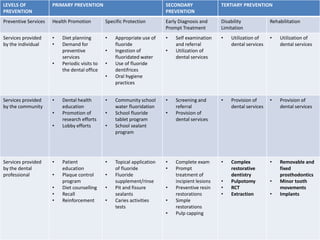
PRIMARY PREVENTION SECONDARY
PREVENTION
TERTIARY PREVENTION
Preventive Services Health Promotion Specific Protection Early Diagnosis and
Prompt Treatment
Disability
Limitation
Rehabilitation
Services provided
by the individual
• Diet planning
• Demand for
preventive
services
• Periodic visits to
the dental office
• Appropriate use of
fluoride
• Ingestion of
fluoridated water
• Use of fluoride
dentifrices
• Oral hygiene
practices
• Self examination
and referral
• Utilization of
dental services
• Utilization of
dental services
• Utilization of
dental services
Services provided
by the community
• Dental health
education
• Promotion of
research efforts
• Lobby efforts
• Community school
water fluoridation
• School fluoride
tablet program
• School sealant
program
• Screening and
referral
• Provision of
dental services
• Provision of
dental services
• Provision of
dental services
Services provided
by the dental
professional
• Patient
education
• Plaque control
program
• Diet counselling
• Recall
• Reinforcement
• Topical application
of fluoride
• Fluoride
supplement/rinse
• Pit and fissure
sealants
• Caries activities
tests
• Complete exam
• Prompt
treatment of
incipient lesions
• Preventive resin
restorations
• Simple
restorations
• Pulp capping
• Complex
restorative
dentistry
• Pulpotomy
• RCT
• Extraction
• Removable and
fixed
prosthodontics
• Minor tooth
movements
• Implants
Dentifrices and
Mouthwashes
Dental floss
Prevention of periodontal disease
LEVELS OF
PREVENTION
PRIMARY PREVENTION SECONDARY
PREVENTION
TERTIARY PREVENTION
Preventive Services Health Promotion Specific Protection Early Diagnosis and
Prompt Treatment
Disability Limitation Rehabilitation
Services provided by
the individual
• Periodic visits to
dental office
• Demand for
preventive
services
• Oral hygiene
practices
• Self examination
and referral
• Utilization of
dental services
• Utilization of
dental services
• Utilization of
dental services
Services provided by
the community
• Dental health
education
programs
• Promotion of
research
• Provision of oral
hygiene aids
• Supervised
school brushing
programs
• Periodic Screening
and referral
• Provision of dental
services
• Provision of dental
services
• Provision of dental
services
Services provided by
the dental
professional
• Patient education
• Plaque control
program
• Recall
• Reinforcement
• Plaque control
program
• Correction of
mal-aligned
teeth
• Prophylaxis
• Complete
examination
• Scaling and
curettage
• Corrective
restorative and
occlusal services
• Deep curettage
• Root planing
• Splinting
• Periodontal
surgery
• Selective
extraction
• Removable or
fixed partial
dentures
• Minor tooth
movement s
Prevention of Malocclusion
Minor orthodontics Space maintainers
Habit breaking
appliances
LEVELS OF
PREVENTION
PRIMARY PREVENTION SECONDARY
PREVENTION
TERTIARY PREVENTION
Preventive Services Health Promotion Specific Protection Early Diagnosis and
Prompt Treatment
Disability Limitation Rehabilitation
Services provided by
the individual
• Dental health
education
programmes
• Promotion of
protective grab
• Lobby efforts
• Patient education
• Use of protective
devices
• Habit control
• Use of dental
services
• Utilization of
dental services
• Utilization of
dental services
Services provided by
the community
• Mouthgaurd
programme
• Safety of school
buildings and
playgrounds
• Provision of dental
services
• Provision of dental
services
• Provision of dental
services
Services provided by
the dental
professional
• Caries control
• Space
maintainers
• Genetic
counselling
• Prenatal care
• Parental
counselling
• Minor
orthodontics
• Major
orthodontics
• Surgery
• Maxillofacial and
removable
prosthodontics
• Plastic surgery
• Speech therapy
• Counselling
Cancer screening Early diagnosis
Cancer awareness
Prevention of oral cancer
LEVELS OF
PREVENTION
PRIMARY PREVENTION SECONDARY
PREVENTION
TERTIARY PREVENTION
Preventive Services Health Promotion Specific Protection Early Diagnosis and
Prompt Treatment
Disability Limitation Rehabilitation
Services provided by
the individual
• Demand for
preventive services
• Periodic visits to the
dental office
Avoidance of
known irritants
• Self examination
and referral
• Utilization of
dental services
• Utilization of
dental services
• Utilization of
dental services
Services provided by
the community
• Dental health
education
programs
• Promotion of
research efforts
• Lobby efforts
Avoidance of
known irritants
• Periodic Screening
and referral
• Provision of dental
services
• Provision of dental
services
• Provision of dental
services
Services provided by
the dental
professional
• Patient education Removal of known
irritants
• Complete
examination
• Biopsy
• Complete excision
• Chemotherapy
• Radiotherapy
• Surgery
• Maxillofacial and
removable
prosthodontics
• Plastic surgery
• Speech therapy
ANTICIPATORY GUIDANCE
“Anticipatory Guidance is defined as proactive counseling of
parents and patients about developmental changes that will
occur in the interval between health supervision visits that
includes information about daily caretaking specific to that
upcoming interval [1]..”
INTEGRAL PARTS
COUNSELLING
INDIVIDUALIZED
DISCUSSION
• Oral hygiene Maintenance
• Dietary Habits
• Oral tissue Development
• Fluoride Needs
• Non Nutritive habits
• Anti-microbials & Meds in oral health
• Speech and Language development
• Injury prevention
Maternal oral
health and
caries status
Vertical
transmission
of S.mutans
Affects infants
oral health
Maternally
Derived
Streptococcus
Mutans
Disease
Prenatal counselling
MOTHERS WHO USED
XYLITOL PRODUCTS
MOTHERS WHO DID
NOT USE XYLITOL
Reduction in
caries activity in
infants
No significant
reduction in
caries activity in
infants
Development of Oral tissues
ERUPTION MAINTAINANCEFUNCTION
Perinatal Oral care
Before
Eruption
of primary
teeth After
Use of soft
toothbrush and
smear of
fluoridated
toothpaste
Wiping baby’s
mouth with a
soft cloth
twice daily
ERUPTION
UNNOTICED
MAY CAUSE STRESS OR
DISCOMFORT IN A CHILD
Applying pressure
over the gums
Numbing the
gums by applying
topical anestheisa
Diet , nutrition and food choices
1
The Parents /
caregivers
should be
intimated
against putting
baby to bed
with a bottle.
2
Children should
be encouraged
to use the cup
as early as
possible (by 1
year of age)
3
Parents should be
educated that the
frequency of
sugar exposures is
more detrimental
to oral health
rather than the
amount of sugar
4
Prolonged bottle
feeding with
sugar containing
drinks and
frequent
between meal
consumption of
sugar containing
snacks or drinks
(juice, formula,
soda) should be
thoroughly
discouraged
5
Acids in
carbonated
beverages can
have a
deleterious
effect on tooth
enamel causing
erosion
6
Dietary analysis
is to be done at
periodic intervals
and healthy
alternatives are
to be suggested
for replacing the
cariogenic foods
Non Nutritive Habits
Although the use of pacifiers and digit sucking are
considered normal, habits of sufficient intensity,
duration and frequency can contribute to deleterious
changes in occlusion and facial development. So it
becomes important to discuss the need to wean
from the habits as early as possible (by 3years of
age) [2]. For school aged children and adolescents
patient counseling regarding any existing habits (nail
biting, bruxism, clenching) is appropriate.
Sucking Habits
The Parents /
caregivers
should be
intimated
against putting
baby to bed
with a bottle.
1
Sucking is a
natural reflex
which is
present inutero
and is generally
given up by 4 –
5 years of age
2
BUT if it
persists
beyond this
age it may
result in
malocclusions.
3
To break the
habit, child
must be
educated
about the
harmful effects
of thumb
sucking
Speech and language
Speech and language are integral components of
child’s early development. Deficiencies and
abnormal delays in speech and language
production should be recognized early and
appropriate referral made to address these
concerns
Injury prevention
Facial trauma that results in fractured, displaced or lost tooth
can have significant negative, functional, esthetic and
psychological effects on children. Greatest incidence of
trauma to the primary dentition occurs at 2 – 3 years of age
and most common injuries to the permanent dentition occur
secondary to falls, traffic accidents and sports
Fluoride needs
Since fluoride contributes to the prevention, inhibition and
reversal of caries, the family’s source of drinking water
(bottled versus tap water, filtered or non-filtered, water
treated by reverse osmosis) is to be assessed for the content
of fluoride. Supplements of fluoride or topical fluoride
applications may be advocated depending upon the needs of
the patient.
Use of Medication and oral health
R
E
F
E
R
N
C
E
S
Primary preventive dentistry (7th ed) -
Norman O. Harris
Parks textbook of preventive and social
medicine
Essentials of preventive and community
dentistry - Soben Peter
Textbook of preventive and community
dentistry (2nd ed )- SS Hiremeth

Preventive dentistry

  • 2.
    Contents Introduction and history Definitions Conceptsof preventive dentistry Scope of preventive dentistry Principles of preventive dentistry Modes of intervention Levels of prevention Prevention of caries Prevention of periodontal diseases Prevention of oral cancer Preventive orthodontics Conclusion
  • 3.
    INTRODUCTION Dr. Greene VardimanBlack (1836-1915) Black made a prophetic statement "The day is surely coming and perhaps within the lifetime of you young men before me when we will be engaged in practicing preventive rather than reparative dentistry".
  • 4.
  • 5.
    DEFINITIONS HEALTH - “astate of complete physical, mental and social well-being and not merely the absence of disease or infirmity” (World Health Organization 1946) PREVENTIVE DENTISTRY – It is that specialized branch of dentistry which deals with the prevention and interpretation of the progress of all dental and oral diseases, prevention and limitation of disabilities and provides rehabilitation.
  • 6.
  • 7.
    Control of disease Patienteducation and motivation Development of host resistance Restoration of function Maintenance of oral health PRINCIPLES
  • 8.
    SCOPE Factors predisposing to disease canbe controlled Factors encouraging the advancement of disease can be altered Complication of disease and deformity can be avoided Factors causing recurrence of disease can be eradicated.
  • 9.
  • 10.
    PRIMORDIAL PREVENTION A newconcept Prevention of the emergence or development of risk factors in countries or population groups in which they have not yet appeared Individual and mass education
  • 11.
    PRIMARY PREVENTION Taken priorto the onset of disease which removes the possibility that the disease will ever occur (K. Park) Uses strategies and agents to prevent the onset of disease, reverse the progress of disease or arrest the disease process before secondary treatment becomes necessary. This level is sometimes thought of as dental hygiene (Norman Harris)
  • 12.
    Concept of positivehealth Encourages achievement and maintenance of an acceptable level of health that will enable every individual to lead a socially and economically healthy life
  • 13.
    Approaches for PrimaryPrevention 1Population (mass) strategy The WHO has recommended the following approaches for the primary prevention of chronic diseases where the risk factors are established: 2 High -risk strategy • “Population strategy" is directed at the whole population irrespective of individual risk levels. • The population approach is directed towards socio- economic, behavioral and lifestyle changes • The high -risk strategy aims to bring preventive care to individuals at special risk. • This requires detection of individuals at high risk by the optimum use of clinical methods.
  • 14.
    Health promotion Specific protection The process of enablingpeople to increase control over factors that influence their health and thereby improve their health It is targeted at a specific disease or type of injury
  • 15.
    Primary prevention Health promotion Life styleand behavioral changes Nutritional interventions Health education Environmental modifications Specific protection Immunization and seroprophylaxis Use of specific nutrients or supplementations Protection against occupational hazards Safety of drugs and foods Control of environmental hazards,
  • 16.
    Goal: Reduce number ofnew casesPhase of disease: • Specific Causal Factors Typical activities: • Remove or reduce source of the risk • Educate and make aware of disease risk • Include behavioral changes to reduce exposure • Improve general health Target population: Those who are most likely to be exposed (high risk) and/or could increase their resistance PRIMARY PREVENTION
  • 17.
    SECONDARY PREVENTION ANDEARLY INTERVENTION It is defined as “ action which halts (stop) the progress of a disease at its incipient stage and prevents complications.” Reverse the initiation of disease An outcome of good health can still be achieved
  • 18.
    Approaches for SecondaryPrevention Early diagnosis and treatment. Early diagnosis (e.g. screening tests, and case finding program) Treating it before irreversible pathological changes take place, and reverse communicability of infectious diseases
  • 19.
    Goal: • Reduce numberof new cases; • Reduce number of severe cases Phase of disease: Early stage of disease Typical activities: • Screening for exposure and/or disease • Post-exposure prophylaxis • Early treatment to reduce impact of disease/reverse course Target population: Those who have been exposed to the disease-causing agent or have early symptoms of the disease SECONDARY PREVENTION
  • 20.
    Tertiary Prevention All measuresavailable to reduce or limit impairments and disabilities, minimize suffering caused by existing departures from good health and to promote the patients adjustment to irremediable conditions Disease  impairment  disability  handicap A.Disability limitation early symptomatic disease B.Rehabilitation  late symptomatic disease
  • 21.
    IMPAIRMENT - any lossor abnormality of physiological, psychological or anatomical structure or function. DISABILITY - any restriction or lack of ability to perform an activity in the manner or within the range considered normal for a human being. HANDICAPPED - a disadvantage for a given individual resulting from an impairment or a disability, that limits or prevents the fulfillment of a role that is normal for that individual IMPAIRMENT Vs DISABILITY Vs HANDICAPPED
  • 22.
    Rehabilitation The combined andcoordinated use of medical, social, educational and vocational measures for training and retraining the individual to the highest possible level of functional ability. VOCATIONAL REHABILITATION PSYCHOLOGICAL REHABILITATION SOCIAL REHABILITATION MEDICAL REHABILITATION Restoration of Function Restoration of Personal Dignity and Confidence Restoration of the Capacity to earn a livelihood Restoration of Family and Social Relationship
  • 23.
    Goal: Reduce number/impact of complications Phaseof disease: Late stage of disease Typical activities: • Treatment tailored to the patient • Rehabilitation to promote recovery Target population: Those who have disease and need treatment TERTIARY PREVENTION
  • 24.
    1.Oral evaluation 2.Dental Prophylaxis 3.Fluorideas preventive agent 4.Dental sealants 5.Health education 6.Health promotion 1.Dental restoration 2.Periodontal Debridement 3.Fluoride use on incipient caries 1.Prosthodontics 2.Implants 3.Oromaxillofacial Surgery Primary prevention Tertiary prevention Secondary prevention
  • 25.
    THE PROCESS OFDISEASE AND INTERVENTION INTERVENTION RECOVERY PROCESS WELLNESS ILLNESS DISABLITY DEATH SECONDARY PREVENTION CLINICAL CARE PRIMARY PREVENTION PREVENTIVE CARE HEALTH PROMOTION TERTIARY PREVENTION REHABILITATION MAINTAINAENCE CARE
  • 26.
    MODIFIED VERSION OFLEAVELLS LEVELS OF PREVENTION TERTIARY PREVENTION SECONDARY PREVENTION PRIMARY PREVENTION NO KNOWN RISK FACTORS HIDDEN STAGE: ASYMPTOMATIC DISEASE INITIAL CARE DISEASE SUSCEPTIBLITY SUBSEQUENT CARE PRE-DISEASE STAGE LATENT STAGE SYMPTOMATIC DISEASES HEALTH PROMOTION: • Lifestyle Changes • Nutrition • Environment SPECIFIC PROTECTION: • Nutrition Supplements • Immunizations • Occupational And Automobile Safety Measures • SCREENING(for population ) • CASE FINDING(for individuals) • TREATMENT: If disease found DISABLITY LIMITATION: Medical or Surgical treament to limit damage REHABILITATION: Identify and teach methods to reduce physical and social disalbity
  • 27.
    Prevention strategy Primary Secondary Tertiary DiseaseStatus Susceptible Asymptomatic Symptomatic Effects Reduced disease incidence Reduced prevalance/ consequence Reduced complications/ disability
  • 28.
  • 29.
    LEVELS OF PREVENTION PRIMARY PREVENTIONSECONDARY PREVENTION TERTIARY PREVENTION Preventive Services Health Promotion Specific Protection Early Diagnosis and Prompt Treatment Disability Limitation Rehabilitation Services provided by the individual • Diet planning • Demand for preventive services • Periodic visits to the dental office • Appropriate use of fluoride • Ingestion of fluoridated water • Use of fluoride dentifrices • Oral hygiene practices • Self examination and referral • Utilization of dental services • Utilization of dental services • Utilization of dental services Services provided by the community • Dental health education • Promotion of research efforts • Lobby efforts • Community school water fluoridation • School fluoride tablet program • School sealant program • Screening and referral • Provision of dental services • Provision of dental services • Provision of dental services Services provided by the dental professional • Patient education • Plaque control program • Diet counselling • Recall • Reinforcement • Topical application of fluoride • Fluoride supplement/rinse • Pit and fissure sealants • Caries activities tests • Complete exam • Prompt treatment of incipient lesions • Preventive resin restorations • Simple restorations • Pulp capping • Complex restorative dentistry • Pulpotomy • RCT • Extraction • Removable and fixed prosthodontics • Minor tooth movements • Implants
  • 30.
  • 31.
    LEVELS OF PREVENTION PRIMARY PREVENTIONSECONDARY PREVENTION TERTIARY PREVENTION Preventive Services Health Promotion Specific Protection Early Diagnosis and Prompt Treatment Disability Limitation Rehabilitation Services provided by the individual • Periodic visits to dental office • Demand for preventive services • Oral hygiene practices • Self examination and referral • Utilization of dental services • Utilization of dental services • Utilization of dental services Services provided by the community • Dental health education programs • Promotion of research • Provision of oral hygiene aids • Supervised school brushing programs • Periodic Screening and referral • Provision of dental services • Provision of dental services • Provision of dental services Services provided by the dental professional • Patient education • Plaque control program • Recall • Reinforcement • Plaque control program • Correction of mal-aligned teeth • Prophylaxis • Complete examination • Scaling and curettage • Corrective restorative and occlusal services • Deep curettage • Root planing • Splinting • Periodontal surgery • Selective extraction • Removable or fixed partial dentures • Minor tooth movement s
  • 32.
    Prevention of Malocclusion Minororthodontics Space maintainers Habit breaking appliances
  • 33.
    LEVELS OF PREVENTION PRIMARY PREVENTIONSECONDARY PREVENTION TERTIARY PREVENTION Preventive Services Health Promotion Specific Protection Early Diagnosis and Prompt Treatment Disability Limitation Rehabilitation Services provided by the individual • Dental health education programmes • Promotion of protective grab • Lobby efforts • Patient education • Use of protective devices • Habit control • Use of dental services • Utilization of dental services • Utilization of dental services Services provided by the community • Mouthgaurd programme • Safety of school buildings and playgrounds • Provision of dental services • Provision of dental services • Provision of dental services Services provided by the dental professional • Caries control • Space maintainers • Genetic counselling • Prenatal care • Parental counselling • Minor orthodontics • Major orthodontics • Surgery • Maxillofacial and removable prosthodontics • Plastic surgery • Speech therapy • Counselling
  • 34.
    Cancer screening Earlydiagnosis Cancer awareness Prevention of oral cancer
  • 35.
    LEVELS OF PREVENTION PRIMARY PREVENTIONSECONDARY PREVENTION TERTIARY PREVENTION Preventive Services Health Promotion Specific Protection Early Diagnosis and Prompt Treatment Disability Limitation Rehabilitation Services provided by the individual • Demand for preventive services • Periodic visits to the dental office Avoidance of known irritants • Self examination and referral • Utilization of dental services • Utilization of dental services • Utilization of dental services Services provided by the community • Dental health education programs • Promotion of research efforts • Lobby efforts Avoidance of known irritants • Periodic Screening and referral • Provision of dental services • Provision of dental services • Provision of dental services Services provided by the dental professional • Patient education Removal of known irritants • Complete examination • Biopsy • Complete excision • Chemotherapy • Radiotherapy • Surgery • Maxillofacial and removable prosthodontics • Plastic surgery • Speech therapy
  • 36.
    ANTICIPATORY GUIDANCE “Anticipatory Guidanceis defined as proactive counseling of parents and patients about developmental changes that will occur in the interval between health supervision visits that includes information about daily caretaking specific to that upcoming interval [1]..”
  • 37.
    INTEGRAL PARTS COUNSELLING INDIVIDUALIZED DISCUSSION • Oralhygiene Maintenance • Dietary Habits • Oral tissue Development • Fluoride Needs • Non Nutritive habits • Anti-microbials & Meds in oral health • Speech and Language development • Injury prevention
  • 38.
    Maternal oral health and cariesstatus Vertical transmission of S.mutans Affects infants oral health Maternally Derived Streptococcus Mutans Disease Prenatal counselling MOTHERS WHO USED XYLITOL PRODUCTS MOTHERS WHO DID NOT USE XYLITOL Reduction in caries activity in infants No significant reduction in caries activity in infants
  • 39.
    Development of Oraltissues ERUPTION MAINTAINANCEFUNCTION
  • 40.
    Perinatal Oral care Before Eruption ofprimary teeth After Use of soft toothbrush and smear of fluoridated toothpaste Wiping baby’s mouth with a soft cloth twice daily
  • 41.
    ERUPTION UNNOTICED MAY CAUSE STRESSOR DISCOMFORT IN A CHILD Applying pressure over the gums Numbing the gums by applying topical anestheisa
  • 42.
    Diet , nutritionand food choices 1 The Parents / caregivers should be intimated against putting baby to bed with a bottle. 2 Children should be encouraged to use the cup as early as possible (by 1 year of age) 3 Parents should be educated that the frequency of sugar exposures is more detrimental to oral health rather than the amount of sugar 4 Prolonged bottle feeding with sugar containing drinks and frequent between meal consumption of sugar containing snacks or drinks (juice, formula, soda) should be thoroughly discouraged 5 Acids in carbonated beverages can have a deleterious effect on tooth enamel causing erosion 6 Dietary analysis is to be done at periodic intervals and healthy alternatives are to be suggested for replacing the cariogenic foods
  • 43.
    Non Nutritive Habits Althoughthe use of pacifiers and digit sucking are considered normal, habits of sufficient intensity, duration and frequency can contribute to deleterious changes in occlusion and facial development. So it becomes important to discuss the need to wean from the habits as early as possible (by 3years of age) [2]. For school aged children and adolescents patient counseling regarding any existing habits (nail biting, bruxism, clenching) is appropriate.
  • 44.
    Sucking Habits The Parents/ caregivers should be intimated against putting baby to bed with a bottle. 1 Sucking is a natural reflex which is present inutero and is generally given up by 4 – 5 years of age 2 BUT if it persists beyond this age it may result in malocclusions. 3 To break the habit, child must be educated about the harmful effects of thumb sucking
  • 45.
    Speech and language Speechand language are integral components of child’s early development. Deficiencies and abnormal delays in speech and language production should be recognized early and appropriate referral made to address these concerns
  • 46.
    Injury prevention Facial traumathat results in fractured, displaced or lost tooth can have significant negative, functional, esthetic and psychological effects on children. Greatest incidence of trauma to the primary dentition occurs at 2 – 3 years of age and most common injuries to the permanent dentition occur secondary to falls, traffic accidents and sports
  • 47.
    Fluoride needs Since fluoridecontributes to the prevention, inhibition and reversal of caries, the family’s source of drinking water (bottled versus tap water, filtered or non-filtered, water treated by reverse osmosis) is to be assessed for the content of fluoride. Supplements of fluoride or topical fluoride applications may be advocated depending upon the needs of the patient.
  • 48.
    Use of Medicationand oral health
  • 49.
    R E F E R N C E S Primary preventive dentistry(7th ed) - Norman O. Harris Parks textbook of preventive and social medicine Essentials of preventive and community dentistry - Soben Peter Textbook of preventive and community dentistry (2nd ed )- SS Hiremeth