ADVANCES INADVANCES IN
PREVENTIVEPREVENTIVE
DENTISTRYDENTISTRY
Check out ppt download link in description
Or
Download link : https://userupload.net/ucq2c1km5pb7
CONTENTSCONTENTS
 INTRODUCTIONINTRODUCTION
 MINIMAL INTERVENTIONMINIMAL INTERVENTION
DENTISTRYDENTISTRY
 CARIES VACCINECARIES VACCINE
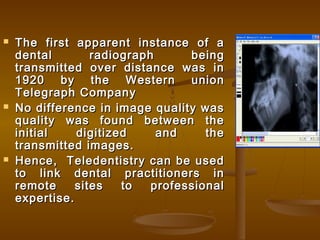
 TELEDENTISTRYTELEDENTISTRY
 EVIDENCE BASED DENTISTRYEVIDENCE BASED DENTISTRY
 FLUORIDE UPDATEFLUORIDE UPDATE
 COMPUTERSCOMPUTERS
 PROBIOTICSPROBIOTICS
 CHEM0-MECHANICAL REMOVAL OFCHEM0-MECHANICAL REMOVAL OF
CARIESCARIES
 ARREST OF CARIES TECHNIQUEARREST OF CARIES TECHNIQUE
 GENETICSGENETICS
 CONCLUSIONCONCLUSION
 Prevention is derived from the wordPrevention is derived from the word
“PRAEVENTO” it means a forestalling = to“PRAEVENTO” it means a forestalling = to
act before hand; Hinderact before hand; Hinder
 PREVENTION= TO KEEP FROMPREVENTION= TO KEEP FROM
HAPPENING; MAKE IMPOSSIBLE BYHAPPENING; MAKE IMPOSSIBLE BY
PRIOR ACTION; HINDER.PRIOR ACTION; HINDER.
CLICK HERE TO DOWNLOAD
THIS PPT
https://userupload.net/ucq2c1km5pb7
 Prevention is defined as actions and interventionsPrevention is defined as actions and interventions
designed to identify risks and reduce susceptibilitydesigned to identify risks and reduce susceptibility
or exposure to health threats prior to disease oror exposure to health threats prior to disease or
injury onset, detect and treat diseases in earlyinjury onset, detect and treat diseases in early
stages to arrest progress or recurrence andstages to arrest progress or recurrence and
alleviate the effects of Disease or injury.alleviate the effects of Disease or injury.
 It is the action of stopping something fromIt is the action of stopping something from
happening or making impossible an anticipatedhappening or making impossible an anticipated
event or intended to act.event or intended to act.
OBJECTIVES OF THEOBJECTIVES OF THE
PREVENTIONPREVENTION
 To avert initiation of disease process.To avert initiation of disease process.
 To intercept their progress.To intercept their progress.
 To control their spread.To control their spread.
 To limit their complications and afterTo limit their complications and after
effects.effects.
 To provide rehabilitationTo provide rehabilitation
 WHY PREVENTION IS BETTER THANWHY PREVENTION IS BETTER THAN
CURE?CURE?
 BECAUSEBECAUSE
 ETHICAL: It prevents mental anguish,ETHICAL: It prevents mental anguish,
physical pain and loss of productivityphysical pain and loss of productivity
to the communityto the community
 ECONOMICALECONOMICAL
 CAN BE DONE EVEN FOR LARGERCAN BE DONE EVEN FOR LARGER
POPULATION.POPULATION.
 NO AFTER EFFECTNO AFTER EFFECT
MINIMUMMINIMUM
INTERVENTIONINTERVENTION
DENTISTRYDENTISTRY
 To intervene – to come between, so as toTo intervene – to come between, so as to
prevent or alter the result or course ofprevent or alter the result or course of
events.events.
 The term “minimum intervention” isThe term “minimum intervention” is
relatively new in dentistry and beenrelatively new in dentistry and been
introduced to suggest to the professionintroduced to suggest to the profession
that is time for change in the principlesthat is time for change in the principles
of operative dentistry. The conceptof operative dentistry. The concept
evolved as a consequence of ourevolved as a consequence of our
increased understanding of cariesincreased understanding of caries
process and the development ofprocess and the development of
adhesive restorative materials.adhesive restorative materials.
 It is now recognized that demineralized but non-It is now recognized that demineralized but non-
cavitated enamel and dentin can be healed andcavitated enamel and dentin can be healed and
that the surgical approach to the treatment of athat the surgical approach to the treatment of a
carious lesion along with extension forcarious lesion along with extension for
prevention as proposed by G.V.Black is noprevention as proposed by G.V.Black is no
longer tenable. This adopts a philosophy thatlonger tenable. This adopts a philosophy that
integrates prevention, remineralization andintegrates prevention, remineralization and
minimal intervention for the placement andminimal intervention for the placement and
replacement of the restoration.replacement of the restoration.
EVOLUTION OF THEEVOLUTION OF THE
CONCEPTCONCEPT
 Dental caries has long been recognizedDental caries has long been recognized
as an infectious disease requiring aas an infectious disease requiring a
susceptible host, a cariogenic microflorasusceptible host, a cariogenic microflora
and diet high in refined carbohydrate,and diet high in refined carbohydrate,
causing demineralization of hard tissues ofcausing demineralization of hard tissues of
tooth leading to cavity formation, thetooth leading to cavity formation, the
ultimate symposium of the disease.ultimate symposium of the disease.
 The primary problem encountered in thisThe primary problem encountered in this
disease is control of microflora and secondarydisease is control of microflora and secondary
problem is elimination of cavity and restorationproblem is elimination of cavity and restoration
of crown back to its original forms.of crown back to its original forms.
 Till now there was a lack of understanding of theTill now there was a lack of understanding of the
carious process, in particular potential forcarious process, in particular potential for
remineralization and physical properties ofremineralization and physical properties of
available materials were poor. Hence theavailable materials were poor. Hence the
secondary problem commanded most attention.secondary problem commanded most attention.
CLICK HERE TO DOWNLOAD
THIS PPT
https://userupload.net/ucq2c1km5pb7
 A number of problems arises from Black’s “A number of problems arises from Black’s “
Extension for prevention” approach.Extension for prevention” approach.
 Idiosyncratic caries diagnosisIdiosyncratic caries diagnosis
 Risk factors disregardedRisk factors disregarded
 Need for restoration emphasizedNeed for restoration emphasized
 Aggressive restorative treatment decisionsAggressive restorative treatment decisions
 Cavity preparations dictated by outline formsCavity preparations dictated by outline forms
 Caries not managed as a diseaseCaries not managed as a disease
 Inadequate preventive backupInadequate preventive backup
 Restorations readily failedRestorations readily failed
 Restorations repeatedRestorations repeated
 Cavities increase in sizeCavities increase in size
 Teeth become weakerTeeth become weaker
 Endodontics – prognosis deterioratesEndodontics – prognosis deteriorates
 REPLACEMENT DENTISTRYREPLACEMENT DENTISTRY
 The philosophy of minimum interventionThe philosophy of minimum intervention
dentistry has now arisen as an attempt todentistry has now arisen as an attempt to
combine all the present knowledge ofcombine all the present knowledge of
prevention, remineralization, ionprevention, remineralization, ion
exchange, healing and adhesion with theexchange, healing and adhesion with the
object of reducing carious damage in theobject of reducing carious damage in the
simplest and least invasive manner assimplest and least invasive manner as
possible.possible.
Factors influencing minimallyFactors influencing minimally
invasive dentistryinvasive dentistry
 The demineralization – remineralizationThe demineralization – remineralization
cyclecycle
 Adhesion in restorative dentistryAdhesion in restorative dentistry
 Bio-mimetic restorative materialsBio-mimetic restorative materials
Minimum interventionMinimum intervention
techniquestechniques
 Tunnel preparationTunnel preparation
 Internal restorationInternal restoration
 Preventive resin restorationPreventive resin restoration
 Preventive glass ionomer restorationPreventive glass ionomer restoration
 Pit and fissure sealantsPit and fissure sealants
 LasersLasers
 Air abrasionAir abrasion
 Ozone applicationOzone application
 Atraumatic restorative treatmentAtraumatic restorative treatment
TUNNEL PREPARATIONTUNNEL PREPARATION
 Done in situations like early proximalDone in situations like early proximal
lesions in posterior teeth, below thelesions in posterior teeth, below the
contact area, which causes accumulationcontact area, which causes accumulation
of plaque.of plaque.
 Marginal ridge and contact area is soundMarginal ridge and contact area is sound
 Lesion should be 2.5mm below the crestLesion should be 2.5mm below the crest
of the marginal ridge.of the marginal ridge.
 Access gained through occlusal surface.Access gained through occlusal surface.
Preparation is limited to achieve visibility.Preparation is limited to achieve visibility.
 GIC is recommended as it flows readilyGIC is recommended as it flows readily
and has ability to remineralise bothand has ability to remineralise both
enamel and dentine.enamel and dentine.
Types of tunnelTypes of tunnel
 Internal tunnelInternal tunnel
 Partial tunnelPartial tunnel
 Blind tunnelBlind tunnel
 Class –I tunnelClass –I tunnel
AdvantagesAdvantages
 ConservativeConservative
 Marginal ridge retainedMarginal ridge retained
 Damage to adjacent approximal surfaceDamage to adjacent approximal surface
non-existentnon-existent
 Normal contact area maintainedNormal contact area maintained
 No risk of approximal restorationNo risk of approximal restoration
overhangsoverhangs
CLICK HERE TO DOWNLOAD
THIS PPT
https://userupload.net/ucq2c1km5pb7
INTERNAL RESTORATIONSINTERNAL RESTORATIONS
 These are similar to tunnel preparations.These are similar to tunnel preparations.
Difference is both marginal ridge andDifference is both marginal ridge and
proximal enamel surface are maintained inproximal enamel surface are maintained in
it. Studies suggest that risk of failures areit. Studies suggest that risk of failures are
higher than in tunnel restorations.higher than in tunnel restorations.
PREVENTIVE RESINPREVENTIVE RESIN
RESTORATION(PRR)RESTORATION(PRR)
 It is a conservative treatment that involvesIt is a conservative treatment that involves
limited excavation to remove caries tissue,limited excavation to remove caries tissue,
restoration of excavated area withrestoration of excavated area with
composite resin and application of acomposite resin and application of a
sealant over the surface of restoration andsealant over the surface of restoration and
remaining sound, continuous pits andremaining sound, continuous pits and
fissures.fissures.
IndicationsIndications
 Site – occlusal surface of premolars,Site – occlusal surface of premolars,
molars and primary molarsmolars and primary molars
 No radiographic evidence of proximalNo radiographic evidence of proximal
cariescaries
 Occlusal lesions that can be identifiedOcclusal lesions that can be identified
clinically but not radiographically.clinically but not radiographically.
ArmamentariumArmamentarium
 Excavation should be performed withExcavation should be performed with
small round, pear shaped or round endedsmall round, pear shaped or round ended
bur.bur.
 Width of bur should not exceed 1mmWidth of bur should not exceed 1mm
 If the width of the preparation exceedsIf the width of the preparation exceeds
more than one third of the distancemore than one third of the distance
between buccal and lingual cusp tips,between buccal and lingual cusp tips,
conventional restoration should beconventional restoration should be
planned.planned.
TechniqueTechnique
 AnesthesiaAnesthesia
 IsolationIsolation
 Caries removalCaries removal
 Pulpal protection if necessaryPulpal protection if necessary
 Clean the occlusal surfaceClean the occlusal surface
 Conditioning the entire occlusal surfaceConditioning the entire occlusal surface
 Placement of bonding agentPlacement of bonding agent
 Placing the resin restorationPlacing the resin restoration
 Apply sealantApply sealant
 Equilibrate occlusionEquilibrate occlusion
AdvantagesAdvantages
 Less invasiveLess invasive
 No preconceived cavity designNo preconceived cavity design
 Good success rate over 10 yearsGood success rate over 10 years
 Protective sealing of adjacent pits andProtective sealing of adjacent pits and
fissures.fissures.
LASERSLASERS
 Over the past several years, there hasOver the past several years, there has
been a strong emergence of lasers inbeen a strong emergence of lasers in
the field of dentistry. Lasers are not newthe field of dentistry. Lasers are not new
to the field; in-vitro studies date back toto the field; in-vitro studies date back to
the 1960’s. In 1980’s they saw their firstthe 1960’s. In 1980’s they saw their first
use in clinical practice.use in clinical practice.
 Laser is an acronym for “Light amplification byLaser is an acronym for “Light amplification by
stimulated emission of radiation.”stimulated emission of radiation.”
 Basically, a laser beam is generated when anBasically, a laser beam is generated when an
external power source stimulates a chamber ofexternal power source stimulates a chamber of
laser medium – solid, liquid or gas.laser medium – solid, liquid or gas.
 The resulting spontaneous emission of photonsThe resulting spontaneous emission of photons
resonates between the mirrored ends of theresonates between the mirrored ends of the
laser chamber.laser chamber.
 These bouncing photons further excite otherThese bouncing photons further excite other
atoms in the laser medium. Momentum buildsatoms in the laser medium. Momentum builds
until a highly concentrateduntil a highly concentrated
 Pioneers such as Fischer and Frame in U.K,Pioneers such as Fischer and Frame in U.K,
Picaro and Pick in U.S, Melker in FrancePicaro and Pick in U.S, Melker in France
(initiated hard tissue applications with CO(initiated hard tissue applications with CO22
lasers) laid the foundation for future endeavorslasers) laid the foundation for future endeavors
in this field. When used efficaciously andin this field. When used efficaciously and
ethically lasers are an exceptional modality ofethically lasers are an exceptional modality of
treatment for many clinical conditions thattreatment for many clinical conditions that
dentists or dental specialists treat on a dailydentists or dental specialists treat on a daily
basis. A new era has begun in the use of lasersbasis. A new era has begun in the use of lasers
in dentistry, especially in regard to hard tissuesin dentistry, especially in regard to hard tissues
of the teeth.of the teeth.
 THE RUBY LASER:THE RUBY LASER:
 Dental laser research began in 1963 at theDental laser research began in 1963 at the
University of California at Los Angeles SchoolUniversity of California at Los Angeles School
of Dentistry with the investigations ofof Dentistry with the investigations of
Ralph.H.Stern and Reidar.F.Sognnaes.Ralph.H.Stern and Reidar.F.Sognnaes.
 Development of cratering and glasslike fusionDevelopment of cratering and glasslike fusion
of enamel, and the penetration and charring ofof enamel, and the penetration and charring of
dentin followed a single milli-second pulse ofdentin followed a single milli-second pulse of
the ruby laser at 500-2000J/cmthe ruby laser at 500-2000J/cm22
IncreasedIncreased
resistance to acid penetration into enamelresistance to acid penetration into enamel
suggesting a possible role for the laser insuggesting a possible role for the laser in
caries preventioncaries prevention
 First report of laser exposure to a vital humanFirst report of laser exposure to a vital human
tooth appeared in 1965 when Leon Goldman, atooth appeared in 1965 when Leon Goldman, a
dermatologist applied 2 pulses of a ruby laserdermatologist applied 2 pulses of a ruby laser
to the tooth of his brother, Bernard, who was ato the tooth of his brother, Bernard, who was a
dentist.dentist.
 According to their report the first dental laserAccording to their report the first dental laser
patient experienced no pain with onlypatient experienced no pain with only
superficial damage to the crown.superficial damage to the crown.
COCO22 LASERLASER
 In the United States, Sterne and LobeneIn the United States, Sterne and Lobene
shifted their attention towards COshifted their attention towards CO22 laserlaser
from the 1960’s to early 1980’s.Becausefrom the 1960’s to early 1980’s.Because
of its wavelength of 10.6Mm,it was wellof its wavelength of 10.6Mm,it was well
absorbed by the enamel and was thoughtabsorbed by the enamel and was thought
to be suitable in sealing of pits andto be suitable in sealing of pits and
fissures or the prevention of dental cariesfissures or the prevention of dental caries
 NEODYMIUM LASERNEODYMIUM LASER
 In a series of experiments YamamotoIn a series of experiments Yamamoto
determined that the Nd: YAG laser was andetermined that the Nd: YAG laser was an
effective tool for inhibiting the formation ofeffective tool for inhibiting the formation of
incipient caries both in vivo and invitroincipient caries both in vivo and invitro
 COMBINATION OF ABLATIONCOMBINATION OF ABLATION
AND CARIES PREVENTION.AND CARIES PREVENTION.
 It would be desirable to develop a laserIt would be desirable to develop a laser
that would remove carious tissue initiallythat would remove carious tissue initially
and treat subsequently the walls of theand treat subsequently the walls of the
area where carious tissue is removed toarea where carious tissue is removed to
make them resistant to subsequentmake them resistant to subsequent
carious challenge.carious challenge.
 Fried et al have described a CO2 laserFried et al have described a CO2 laser
that removes carious tissue efficientlythat removes carious tissue efficiently
and can inhibit caries progressionand can inhibit caries progression
 CREATING VALUE FOR LASERCREATING VALUE FOR LASER
DENTISTRY.DENTISTRY.
 The publics’ positive view on lasers and theThe publics’ positive view on lasers and the
dental professions use of lasers create valuedental professions use of lasers create value
for laser dentistry that drives modern laserfor laser dentistry that drives modern laser
practice management.practice management.
   Reduced anxiety / fear of drillReduced anxiety / fear of drill
       Reduced noise from drillReduced noise from drill
     Needle-free or no anesthesia dentistry.Needle-free or no anesthesia dentistry.
       Desensitization of teeth.Desensitization of teeth.
       Less chair-time.Less chair-time.
  
Faster and better treatmentFaster and better treatment
   Reduced need for sutureReduced need for suture
    New approaches for dental infectionsNew approaches for dental infections
   Requiring less antibiotics Requiring less antibiotics 
Regenerative techniques enabling fewerRegenerative techniques enabling fewer
extractionsextractions
     Faster healingFaster healing
Less pain Less pain 
Less bleeding and less discomfort.Less bleeding and less discomfort.
AIR ABRASIONAIR ABRASION
 Kinetic energy is used for caries removal.Kinetic energy is used for caries removal.
Narrow powerful stream of movingNarrow powerful stream of moving
aluminium oxide particles are directedaluminium oxide particles are directed
against the surface to be cut. When theyagainst the surface to be cut. When they
hit the tooth, they abrade the surface. Canhit the tooth, they abrade the surface. Can
be used for both diagnosis and treatmentbe used for both diagnosis and treatment
of early occlusal lesions.of early occlusal lesions.
AdvantagesAdvantages
 Decreased noiseDecreased noise
 Reduced vibrationReduced vibration
 Reduced sensitivityReduced sensitivity
 More rounded internal contours – lessMore rounded internal contours – less
fracture.fracture.
OZONE APPLICATIONOZONE APPLICATION
 This is one of methods of minimal toothThis is one of methods of minimal tooth
preparation thereby the maximum toothpreparation thereby the maximum tooth
structure is saved. In this method anstructure is saved. In this method an
oxidant is used which is toxic to cariogenicoxidant is used which is toxic to cariogenic
micro flora, thereby producing colonymicro flora, thereby producing colony
forming units.forming units.
ConceptConcept
 Reduction of colony forming unitsReduction of colony forming units
 Reduction of further demineralisationReduction of further demineralisation
through by – productsthrough by – products
 Reduction of nutrients, necessary forReduction of nutrients, necessary for
bacterial recolonisationbacterial recolonisation
 Promotion of rapid remineralisation andPromotion of rapid remineralisation and
caries arrest.caries arrest.
AdvantagesAdvantages
 Minimal invasive, good patient complianceMinimal invasive, good patient compliance
 Supports rapid remineralisation and cariesSupports rapid remineralisation and caries
arrest.arrest.
DisadvantagesDisadvantages
 More research needed.More research needed.
Clinical procedureClinical procedure
 Cleaning of tooth surfaceCleaning of tooth surface
 Measurement, using laser fluorescentMeasurement, using laser fluorescent
caries diagnosticcaries diagnostic
 Clinical diagnosis (CSI) and treatmentClinical diagnosis (CSI) and treatment
planplan
 Ozone exposureOzone exposure
 Ozone removalOzone removal
 Rinsing with mineral fluidRinsing with mineral fluid
 Recall after 3 months.Recall after 3 months.
ATRAUMATIC RESTORATIVE TREATMENTATRAUMATIC RESTORATIVE TREATMENT
{ART}{ART}
Rationale and techniqueRationale and technique
 IntroductionIntroduction
 Development of ARTDevelopment of ART
 Rationale of ARTRationale of ART
 Principles of ARTPrinciples of ART
 Armamentarium and Technique of ARTArmamentarium and Technique of ART
 Advantages and LimitationsAdvantages and Limitations
 ART—A myth or reality?ART—A myth or reality?
 ConclusionConclusion
Despite long term efforts toDespite long term efforts to use appropriate dentaluse appropriate dental
Equipment for treating dental caries in less developedEquipment for treating dental caries in less developed
countries, the predominant treatment remainscountries, the predominant treatment remains
extraction.extraction.
The need to develop a new approach forThe need to develop a new approach for
oraloral
care in economically was necessary andcare in economically was necessary and
also stressedalso stressed
upon by WHOupon by WHO..
Unfortunately, in most cases the use of importedUnfortunately, in most cases the use of imported
technology astechnology as
a new approach to has proven to be tooa new approach to has proven to be too
complicated forcomplicated for
sustained use.sustained use.
Attempts to further simplify the equip­ment hasAttempts to further simplify the equip­ment has
resulted inresulted in
the introduction of air­driven drills and suctionthe introduction of air­driven drills and suction
equip­ment,equip­ment,
and simplified operating beds such as those madeand simplified operating beds such as those made
Mobile oral equipment is rarely used to its full capacity inMobile oral equipment is rarely used to its full capacity in
these countries for a number of reasons: vehicles are re­quiredthese countries for a number of reasons: vehicles are re­quired
to transport the equipment to the outreach situations,to transport the equipment to the outreach situations,
technical skills are required to maintain the equip­ment, and ittechnical skills are required to maintain the equip­ment, and it
uses electricity.uses electricity.
All these additional requirements either cannot be met or areAll these additional requirements either cannot be met or are
met unreliably, and pre­sent a huge problem of excessive costmet unreliably, and pre­sent a huge problem of excessive cost
for communities that cannot afford it.for communities that cannot afford it.
Obviously, a new approach was needed to make oral care moreObviously, a new approach was needed to make oral care more
available for the majority of people in economically lessavailable for the majority of people in economically less
developed countries.developed countries.
The search for a new approach was accelerated by results ofThe search for a new approach was accelerated by results of
oral health research done in the economically developed world.oral health research done in the economically developed world.
This research included the study of:This research included the study of:
(1) The longevity of amalgam restorations in general(1) The longevity of amalgam restorations in general
Practice.Practice.
(2) Adhesive restorative materials (composites and glass(2) Adhesive restorative materials (composites and glass
ionomers), which opened up the possibility of developingionomers), which opened up the possibility of developing
restorative treatment techniques requiring minimal or norestorative treatment techniques requiring minimal or no
cavity preparationcavity preparation
(3) The fate of caries­inducing microorganisms under fillings(3) The fate of caries­inducing microorganisms under fillings
and sealants that showed reduced viability and numbers overand sealants that showed reduced viability and numbers over
time concurrent with arrested carious lesionstime concurrent with arrested carious lesions
(4) The need for complete caries removal, where some evidence(4) The need for complete caries removal, where some evidence
suggested that perhaps caries need not always be removedsuggested that perhaps caries need not always be removed
completely from the deeper parts of the cavity.completely from the deeper parts of the cavity.
These studies and associated caries investigations haveThese studies and associated caries investigations have
provided a better understanding of the dynamics involved inprovided a better understanding of the dynamics involved in
the caries process.the caries process.
As a result, “ Shift has occurred from the traditional approachAs a result, “ Shift has occurred from the traditional approach
of maximal inter­vention and invasiveness in oral care basedof maximal inter­vention and invasiveness in oral care based
on Black's principles and the use of amalgam, to the modernon Black's principles and the use of amalgam, to the modern
approach of minimal intervention and invasion, maximalapproach of minimal intervention and invasion, maximal
caries prevention based on retaining sound tooth tissues, andcaries prevention based on retaining sound tooth tissues, and
the use of modem adhesive materials”the use of modem adhesive materials”
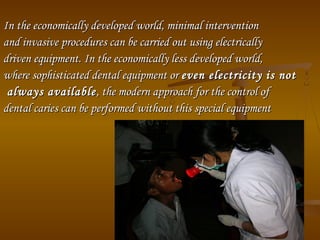
In the economically developed world, minimal interventionIn the economically developed world, minimal intervention
and invasive procedures can be carried out using electricallyand invasive procedures can be carried out using electrically
driven equipment. In the economically less developed world,driven equipment. In the economically less developed world,
where sophisticated dental equipment orwhere sophisticated dental equipment or even electricity is noteven electricity is not
always availablealways available, the modern approach for the control of, the modern approach for the control of
dental caries can be performed without this special equipmentdental caries can be performed without this special equipment
The New Approach for ControllingThe New Approach for Controlling Dental CariesDental Caries
ATRAUMATIC RESTORATIVE TREATMENTATRAUMATIC RESTORATIVE TREATMENT
(ART).(ART).
This approach was pioneered and conceptualized inThis approach was pioneered and conceptualized in
Tanzania in the mid1980s as part of a community­Tanzania in the mid1980s as part of a community­
based primary oral health program by the Universitybased primary oral health program by the University
of Dar es Salaam.of Dar es Salaam.
RATIONALE OF ARTRATIONALE OF ART
ART consists of an elementary technique of caries removalART consists of an elementary technique of caries removal
using hand instruments only, combined with the use of ausing hand instruments only, combined with the use of a
modem restorative material with adhesive characteristics.modem restorative material with adhesive characteristics.
Currently, glass ionomers that leach fluoride and minimize theCurrently, glass ionomers that leach fluoride and minimize the
onset of secondary caries are used.onset of secondary caries are used.
In developed countries, the ART Technique has found a placeIn developed countries, the ART Technique has found a place
in the modern surgery.in the modern surgery.
A patient with multiple carious lesions is treated with theA patient with multiple carious lesions is treated with the
ART Technique and the carious process stabilized before aART Technique and the carious process stabilized before a
more definitive restoration is placed.more definitive restoration is placed.
Dentists have found that this technique is useful for nervousDentists have found that this technique is useful for nervous
patients who are scared of the drill, and restorative procedurespatients who are scared of the drill, and restorative procedures
are accomplished using hand instrumentation only.are accomplished using hand instrumentation only.
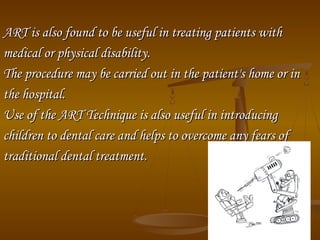
ART is also found to be useful in treating patients withART is also found to be useful in treating patients with
medical or physical disability.medical or physical disability.
The procedure may be carried out in the patient's home or inThe procedure may be carried out in the patient's home or in
the hospital.the hospital.
Use of the ART Technique is also useful in introducingUse of the ART Technique is also useful in introducing
children to dental care and helps to overcome any fears ofchildren to dental care and helps to overcome any fears of
traditional dental treatment.traditional dental treatment.
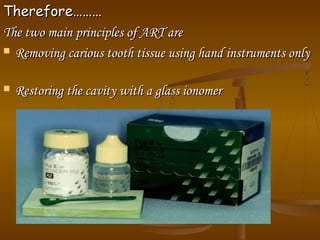
Therefore………Therefore………
The two main principles of ART areThe two main principles of ART are
 Removing carious tooth tissue using hand instruments onlyRemoving carious tooth tissue using hand instruments only
 Restoring the cavity with a glass ionomerRestoring the cavity with a glass ionomer
The often cited disadvantages of glass ionomers, namelyThe often cited disadvantages of glass ionomers, namely lowlow
wear resistance and strength, are minimizedwear resistance and strength, are minimized
because thebecause the
cavity preparations of the ART technique usuallycavity preparations of the ART technique usually
result inresult in
relatively small restorationsrelatively small restorations ..
Further­more, new glass ionomers with improved wearFurther­more, new glass ionomers with improved wear
resistance and strength are being developed specifically for theresistance and strength are being developed specifically for the
ART technique.ART technique.
What Instruments and MaterialsWhat Instruments and Materials
Are Used ?Are Used ?
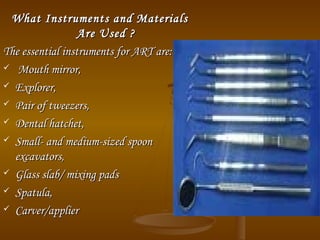
The essential instruments for ART are:The essential instruments for ART are:
 Mouth mirror,Mouth mirror,
 Explorer,Explorer,
 Pair of tweezers,Pair of tweezers,
 Dental hatchet,Dental hatchet,
 Small­ and medium­sized spoonSmall­ and medium­sized spoon
excavators,excavators,
 Glass slab/ mixing padsGlass slab/ mixing pads
 Spatula,Spatula,
 Carver/applierCarver/applier
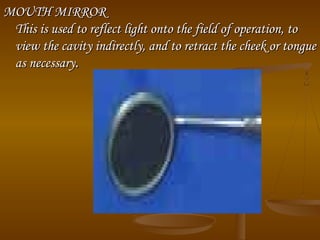
MOUTH MIRRORMOUTH MIRROR
This is used to reflect light onto the field of operation, toThis is used to reflect light onto the field of operation, to
view the cavity indirectly, and to retract the cheek or tongueview the cavity indirectly, and to retract the cheek or tongue
as necessaryas necessary..
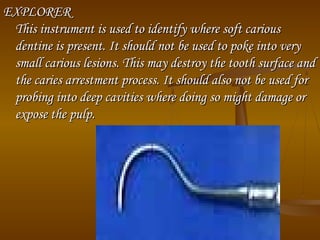
EXPLOREREXPLORER
This instrument is used to identify where soft cariousThis instrument is used to identify where soft carious
dentine is present. It should not be used to poke into verydentine is present. It should not be used to poke into very
small carious lesions. This may destroy the tooth surface andsmall carious lesions. This may destroy the tooth surface and
the caries arrestment process. It should also not be used forthe caries arrestment process. It should also not be used for
probing into deep cavities where doing so might damage orprobing into deep cavities where doing so might damage or
expose the pulp.expose the pulp.
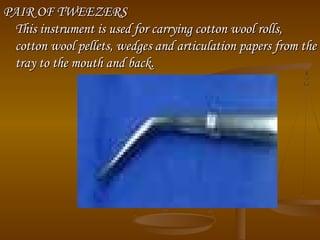
PAIR OF TWEEZERSPAIR OF TWEEZERS
This instrument is used for carrying cotton wool rolls,This instrument is used for carrying cotton wool rolls,
cotton wool pellets, wedges and articulation papers from thecotton wool pellets, wedges and articulation papers from the
tray to the mouth and back.tray to the mouth and back.
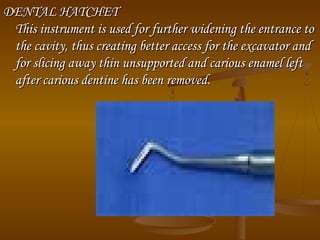
DENTAL HATCHETDENTAL HATCHET
This instrument is used for further widening the entrance toThis instrument is used for further widening the entrance to
the cavity, thus creating better access for the excavator andthe cavity, thus creating better access for the excavator and
for slicing away thin unsupported and carious enamel leftfor slicing away thin unsupported and carious enamel left
after carious dentine has been removed.after carious dentine has been removed.
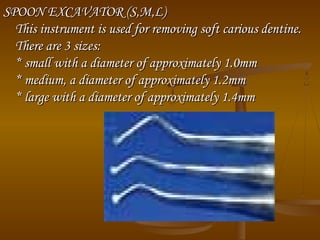
SPOON EXCAVATOR (S,M,L)SPOON EXCAVATOR (S,M,L)
This instrument is used for removing soft carious dentine.This instrument is used for removing soft carious dentine.
There are 3 sizes:There are 3 sizes:
* small with a diameter of approximately 1.0mm* small with a diameter of approximately 1.0mm
* medium, a diameter of approximately 1.2mm* medium, a diameter of approximately 1.2mm
* large with a diameter of approximately 1.4mm* large with a diameter of approximately 1.4mm
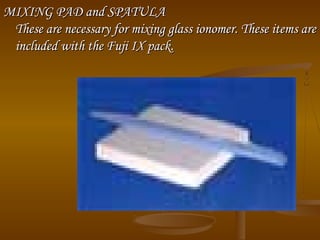
MIXING PAD and SPATULAMIXING PAD and SPATULA
These are necessary for mixing glass ionomer. These items areThese are necessary for mixing glass ionomer. These items are
included with the Fuji IX pack.included with the Fuji IX pack.
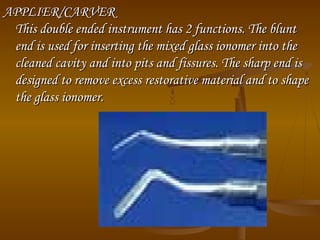
APPLIER/CARVERAPPLIER/CARVER
This double ended instrument has 2 functions. The bluntThis double ended instrument has 2 functions. The blunt
end is used for inserting the mixed glass ionomer into theend is used for inserting the mixed glass ionomer into the
cleaned cavity and into pits and fissures. The sharp end iscleaned cavity and into pits and fissures. The sharp end is
designed to remove excess restorative material and to shapedesigned to remove excess restorative material and to shape
the glass ionomer.the glass ionomer.
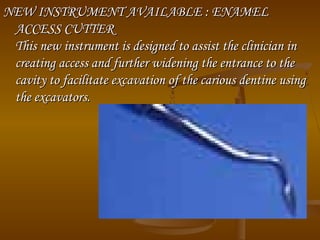
NEW INSTRUMENT AVAILABLE : ENAMELNEW INSTRUMENT AVAILABLE : ENAMEL
ACCESS CUTTERACCESS CUTTER
This new instrument is designed to assist the clinician inThis new instrument is designed to assist the clinician in
creating access and further widening the entrance to thecreating access and further widening the entrance to the
cavity to facilitate excavation of the carious dentine usingcavity to facilitate excavation of the carious dentine using
the excavators.the excavators.
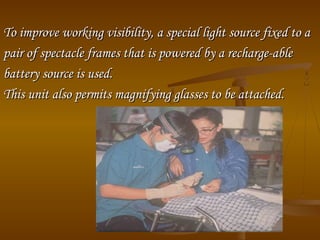
To improve working visibility, a special light source fixed to aTo improve working visibility, a special light source fixed to a
pair of spectacle frames that is powered by a recharge­ablepair of spectacle frames that is powered by a recharge­able
battery source is used.battery source is used.
This unit also permits magnifying glasses to be attached.This unit also permits magnifying glasses to be attached.
The essential materials are:The essential materials are:
 Gloves,Gloves,
 Cotton wool rolls and pellets.Cotton wool rolls and pellets.
 Glass ionomer restorative material (powder/liquid),Glass ionomer restorative material (powder/liquid),
 Dentin conditioner,Dentin conditioner,
 Petroleum jelly (Vaseline),Petroleum jelly (Vaseline),
 Wedges and plastic stripsWedges and plastic strips
 Clean water.Clean water.
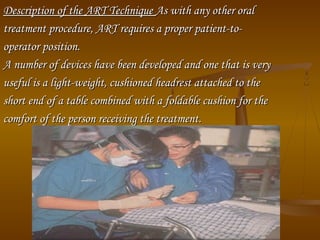
Description of the ART TechniqueDescription of the ART Technique As with any other oralAs with any other oral
treatment procedure, ART requires a proper patient­to­treatment procedure, ART requires a proper patient­to­
operator position.operator position.
A number of devices have been developed and one that is veryA number of devices have been developed and one that is very
useful is a light­weight, cushioned headrest attached to theuseful is a light­weight, cushioned headrest attached to the
short end of a table combined with a foldable cushion for theshort end of a table combined with a foldable cushion for the
comfort of the person receiving the treatment.comfort of the person receiving the treatment.
Since its inception, the ART technique has undergone revisionsSince its inception, the ART technique has undergone revisions
aimed at improving the basic technique.aimed at improving the basic technique.
Unlike many other restorative procedures, usually there is noUnlike many other restorative procedures, usually there is no
need to give local anesthesia when using the ART techniqueneed to give local anesthesia when using the ART technique
because temperature­induced pain from using a drill isbecause temperature­induced pain from using a drill is
Avoided.Avoided.
Because the technique mainly involves the removal ofBecause the technique mainly involves the removal of
decal­cified tooth tissue, pain can be minimized, and oftendecal­cified tooth tissue, pain can be minimized, and often
does not occur at all.does not occur at all.
Thus, fear of dental procedures is reducedThus, fear of dental procedures is reduced..
THE STEPS OF ARTTHE STEPS OF ART
1.1. Isolate the tooth with cotton wool rolls.Isolate the tooth with cotton wool rolls. OnlyOnly
the tooth orthe tooth or
teeth to be treated need to be isolated.teeth to be treated need to be isolated.
Rationale:Rationale: It is easier to work in a dry environment than in aIt is easier to work in a dry environment than in a
wet one.wet one.
2.2. Clean the tooth surfaceClean the tooth surface toto be treated with a wetbe treated with a wet
cottoncotton
wool pellet.wool pellet. Have a small cup of water available.Have a small cup of water available.
Rationale: TheRationale: The wet cotton wool pellet removes the debris andwet cotton wool pellet removes the debris and
Plaque from the surface thus improving visibility.Plaque from the surface thus improving visibility.
The extent of the lesion and any unsupported enamel can beThe extent of the lesion and any unsupported enamel can be
3.Widen the entrance of the lesion:3.Widen the entrance of the lesion:
It is necessary if the entrance of the lesion is small.It is necessary if the entrance of the lesion is small.
Rationale: The Hatchet replaces the bur. ByRationale: The Hatchet replaces the bur. By
rotating therotating the
instrument tip ,unsupported enamel will breakinstrument tip ,unsupported enamel will break
off.off.
4.Remove the caries:4.Remove the caries:
Depending on the size of the cavity,the size of the excavator isDepending on the size of the cavity,the size of the excavator is
chosen.Using circular scraping movements of the excavatorchosen.Using circular scraping movements of the excavator
the soft caries is removed.the soft caries is removed.
Rationale: When all the soft caries is removed, theRationale: When all the soft caries is removed, the
thinthin
decalcified unsupported enamel is relatively easydecalcified unsupported enamel is relatively easy
to break off.to break off.
5.Provide pulpal protection if necessary:5.Provide pulpal protection if necessary:
It is indicated for deep cavities that are relatively close toIt is indicated for deep cavities that are relatively close to
pulp. This can achieved by using Calcium Hydroxide pastepulp. This can achieved by using Calcium Hydroxide paste
to the deeper parts of the floor of the cavity.to the deeper parts of the floor of the cavity.
The cavity floor does not need to be covered completelyThe cavity floor does not need to be covered completely
because it will reduce the area available for adhesion of thebecause it will reduce the area available for adhesion of the
filling material.filling material.
Rationale:Rationale: Calcium hydroxide stimulates repair ofCalcium hydroxide stimulates repair of
dentin anddentin and
glass ionomers are biocompatible.glass ionomers are biocompatible.
6.Clean the occlusal surface:6.Clean the occlusal surface: All pits and fissures should beAll pits and fissures should be
clear of plaque and debris as much as possible.clear of plaque and debris as much as possible.
Use a probe and a wet pellet for cleaning.Use a probe and a wet pellet for cleaning.
Rationale:Rationale: The remaining pits and fissures will beThe remaining pits and fissures will be
sealed withsealed with
the same material used for filling the cavity.the same material used for filling the cavity.
7. Condition the cavity and occlusal surface:7. Condition the cavity and occlusal surface:
Use a drop of dentin conditioner on a cotton wool pellet andUse a drop of dentin conditioner on a cotton wool pellet and
rub both the cavity and the occlusal surfaces for 10 to 15rub both the cavity and the occlusal surfaces for 10 to 15
seconds.seconds.
The conditioned surfaces should then be washed several timesThe conditioned surfaces should then be washed several times
with wet cotton wool pellets.with wet cotton wool pellets.
The surfaces are then dried with dry pellets.The surfaces are then dried with dry pellets.
Rationale:Rationale: Conditioning increases the bondConditioning increases the bond
strength of glassstrength of glass
ionomers.ionomers.
8. Mix glass ionomer according8. Mix glass ionomer according toto manufacturers' instructions.manufacturers' instructions.
9. Insert mixed glass ionomer into the cavity and overfill9. Insert mixed glass ionomer into the cavity and overfill
slightly.slightly. The mixed material is inserted using the flat end ofThe mixed material is inserted using the flat end of
the applier, and plugged into corners of the cavity with thethe applier, and plugged into corners of the cavity with the
smooth side of an excavator or with a ball burnisher.smooth side of an excavator or with a ball burnisher.
Avoid the inclusion of air bubbles.Avoid the inclusion of air bubbles.
The material also is placed over pits and fissures in smallThe material also is placed over pits and fissures in small
amounts.amounts.
10. Press coated gloved finger on top of the entire occlusal10. Press coated gloved finger on top of the entire occlusal
surface and apply slight pressure.surface and apply slight pressure.
Petroleum jelly (Vaseline) is used to coat the gloved finger toPetroleum jelly (Vaseline) is used to coat the gloved finger to
prevent the glass ionomer from sticking to the glove.prevent the glass ionomer from sticking to the glove.
Place the finger on top of the mixture, apply slight pressure forPlace the finger on top of the mixture, apply slight pressure for
a few seconds, and remove the finger.a few seconds, and remove the finger.
Rationale:Rationale: The finger pressure should push theThe finger pressure should push the
glass ionomerglass ionomer
into the deeper parts of the pits and fissures. Anyinto the deeper parts of the pits and fissures. Any
excessexcess
Material will overflow and can be removed easily.Material will overflow and can be removed easily.
11. Check the bite.11. Check the bite.
Place articulating paper over the filling /Place articulating paper over the filling /
sealant and ask the patient to close.sealant and ask the patient to close.
The petroleum jelly (Vaseline) left on the surface will preventThe petroleum jelly (Vaseline) left on the surface will prevent
saliva contact with the filling/ sealant while the bite issaliva contact with the filling/ sealant while the bite is
checked.checked.
12. Remove excess material with the carver.12. Remove excess material with the carver.
13. Recheck the bite and adjust the height of the restoration13. Recheck the bite and adjust the height of the restoration
until comfortable.until comfortable.
14. Cover filling/sealant with petroleum jelly (Vaseline) once14. Cover filling/sealant with petroleum jelly (Vaseline) once
againagain oror apply varnish.apply varnish.
15. Instruct the patient not15. Instruct the patient not toto eat for at least one hour.eat for at least one hour.
For restoring proximal cavities, a plastic strip and wedgesFor restoring proximal cavities, a plastic strip and wedges
are used to produce a correct contour to the filling.are used to produce a correct contour to the filling.
What are the advantages and limitations ART ?What are the advantages and limitations ART ?
 
The ADVANTAGES include:The ADVANTAGES include:
 The use of easily available and relatively inexpensive handThe use of easily available and relatively inexpensive hand
instruments rather than expensive electrically driven dentalinstruments rather than expensive electrically driven dental
Equipment.Equipment.
 A biologically friendly approach involving the removal ofA biologically friendly approach involving the removal of
only decalcified tooth tissues, which results in relativelyonly decalcified tooth tissues, which results in relatively
small cavities and conserves sound tooth tissue.small cavities and conserves sound tooth tissue.
 the limitation of pain, thereby minimizing the need for localthe limitation of pain, thereby minimizing the need for local
anesthesia.anesthesia.
 A straightforward and simple infection control practiceA straightforward and simple infection control practice
without the need to use sequentially autoclaved hand pieces.without the need to use sequentially autoclaved hand pieces.
 The chemical adhesion of glass ionomers that reduces theThe chemical adhesion of glass ionomers that reduces the
need to cut sound tooth tissue for retention of the restorativeneed to cut sound tooth tissue for retention of the restorative
Material.Material.
 The leaching of fluoride from glass ionomers, which preventsThe leaching of fluoride from glass ionomers, which prevents
secondary caries development and probably remineralizessecondary caries development and probably remineralizes
carious dentin.carious dentin.
 · The combination of a preventive and curative treatment in· The combination of a preventive and curative treatment in
one procedure.one procedure.
 The ease of repairing defects in the restoration;The ease of repairing defects in the restoration;
One of the greatest advantages of ART cited is that itOne of the greatest advantages of ART cited is that it makesmakes
it possible to reach people who otherwise neverit possible to reach people who otherwise never
would havewould have
received any oral care.received any oral care.
The technique allows oral care workers to leave the clinic andThe technique allows oral care workers to leave the clinic and
to visit people in their own living environments, e.g., in seniorto visit people in their own living environments, e.g., in senior
citizen homes, institutions for the handicapped, villages incitizen homes, institutions for the handicapped, villages in
rural and suburban areas in economically less developedrural and suburban areas in economically less developed
countries, and in their own homes.countries, and in their own homes.
From a health point of view, these possibilities must beFrom a health point of view, these possibilities must be
considered a huge advantage.considered a huge advantage.
Limitations of ART…Limitations of ART…
 long­term survival rates for glass ionomer ART restorationslong­term survival rates for glass ionomer ART restorations
and sealants are not yet available.and sealants are not yet available.
 The technique's acceptance by oral health care personnel isThe technique's acceptance by oral health care personnel is
not yet assured.not yet assured.
 At the moment its use is limited to small­ and medium­At the moment its use is limited to small­ and medium­
sized, one­surface lesions because of the low wear resistancesized, one­surface lesions because of the low wear resistance
and strength of existing glass ionomer materialsand strength of existing glass ionomer materials..
 The possibility exists for hand fatigue from the use of handThe possibility exists for hand fatigue from the use of hand
instruments over long periods.instruments over long periods.
 Hand mixing might produce a relatively unstandardizedHand mixing might produce a relatively unstandardized
mix of glass ionomer, varying among operators and differentmix of glass ionomer, varying among operators and different
geographical climatic situations.geographical climatic situations.
 ·· The misapprehension that ART can be performed easily­The misapprehension that ART can be performed easily­
this is not the case and each step must be carried out tothis is not the case and each step must be carried out to
Perfection.Perfection.
 · The apparent lack of sophistication of the technique,· The apparent lack of sophistication of the technique,
which might make it difficult for ART to be easily accepted bywhich might make it difficult for ART to be easily accepted by
the dental profession.the dental profession.
 · A misconception by the public that the new glass ionomer· A misconception by the public that the new glass ionomer
"white fillings" are only temporary dressings."white fillings" are only temporary dressings.
Some of these disadvantages of glass ionomers, such as lowSome of these disadvantages of glass ionomers, such as low
wear resistance and reduced strength, are being consideredwear resistance and reduced strength, are being considered
andand reinforced materials being under research forreinforced materials being under research for
useuse..
When improved materials become available, larger one­surfaceWhen improved materials become available, larger one­surface
and small­ to medium­sized multi­surface lesions might alsoand small­ to medium­sized multi­surface lesions might also
bebe
managed with the ART technique.managed with the ART technique.
Also, the variation in mixtures of hand­mixed glass ionomerAlso, the variation in mixtures of hand­mixed glass ionomer
can be reduced bycan be reduced by making the materials more usermaking the materials more user
friendly, afriendly, a
particularly important factor in the economicallyparticularly important factor in the economically
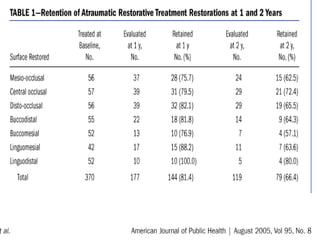
Till date studies have been done to assess the life of ARTTill date studies have been done to assess the life of ART
restorations to a maximum of 3 years only.restorations to a maximum of 3 years only.
A study done by NATY LOPEZ and SARAA study done by NATY LOPEZ and SARA
SIMPSERAFLIN on the retentivity of ART restorationsSIMPSERAFLIN on the retentivity of ART restorations
among the underserved population in Mexico yielded theamong the underserved population in Mexico yielded the
following results….following results….
Is ART a Myth or Reality?Is ART a Myth or Reality?
The removal of caries by hand instruments alone is by noThe removal of caries by hand instruments alone is by no
means a new approach since over the years dentists have usedmeans a new approach since over the years dentists have used
hand instruments when they considered it necessary or whenhand instruments when they considered it necessary or when
they could not use other dental equipment.they could not use other dental equipment.
The ART technique, however, differs in concept from previousThe ART technique, however, differs in concept from previous
treatment.treatment.
Instead of filling excavated cavities with a temporary fillingInstead of filling excavated cavities with a temporary filling
material that later needs to be replaced with permanentmaterial that later needs to be replaced with permanent
restoration, a chemically bonding material is used.restoration, a chemically bonding material is used.
““Furthermore, the minimal cavity preparationFurthermore, the minimal cavity preparation
resulting fromresulting from
the use of hand instruments is in line with modemthe use of hand instruments is in line with modem
concepts forconcepts for
a biologic cavity preparationa biologic cavity preparation .”.”
CONCLUSIONCONCLUSION
The greater part of the world's population has no access toThe greater part of the world's population has no access to
restorative dental care.restorative dental care.
One of the main obstacles is the traditionalOne of the main obstacles is the traditional
manner of treatingmanner of treating
caries, which relies on electrically drivencaries, which relies on electrically driven
equipment.equipment.
The basic concepts of the ART technique are the removal ofThe basic concepts of the ART technique are the removal of
decalcified dental tissues using only readily available handdecalcified dental tissues using only readily available hand
instruments, following the modern concepts of cavityinstruments, following the modern concepts of cavity
preparation, and the use of a high technology adhesivepreparation, and the use of a high technology adhesive
restorative material.restorative material. This technique has the potentialThis technique has the potential
to maketo make
References:References:
1.1. Jo E Frencken,Taco pilot et al;ART-Jo E Frencken,Taco pilot et al;ART-
rationale and development:Journal Ofrationale and development:Journal Of
Public health Dentistry(JPHD) Vol 56 no.3Public health Dentistry(JPHD) Vol 56 no.3
19961996
2.2. Jo Frencken,Prathip Phantumavit; ManualJo Frencken,Prathip Phantumavit; Manual
of ART-WHO series 1997of ART-WHO series 1997
3. Naty lopez and saraSimpseraflin;3. Naty lopez and saraSimpseraflin;
Atraumatic restorative treatment forAtraumatic restorative treatment for
prevention and treatment of caries in anprevention and treatment of caries in an
underserved community.underserved community.
American Journal of Public health AUGAmerican Journal of Public health AUG
2005vol 90 page 8-132005vol 90 page 8-13
4.www.googlesearch/mit/oralheathpubli.html4.www.googlesearch/mit/oralheathpubli.html
5.www.gcfuji-asia.org5.www.gcfuji-asia.org
INDEXINDEX
 INTRODUCTIONINTRODUCTION
 HISTORY OF CARIES VACCINATIONHISTORY OF CARIES VACCINATION
 ACQUISITION OF MUTANS STREPTOCOCCIACQUISITION OF MUTANS STREPTOCOCCI
 ONTOGENY OF IMMUNITY IN SALIVAONTOGENY OF IMMUNITY IN SALIVA
 MOLECULAR PATHOGENESISMOLECULAR PATHOGENESIS
 EFFECTIVE MOLECULAR TARGETSEFFECTIVE MOLECULAR TARGETS
 SUBUNIT VACCINESSUBUNIT VACCINES
 CONJUGATE VACCINESCONJUGATE VACCINES
 ADJUVANTS AND DELIVERY SYSTEMS FORADJUVANTS AND DELIVERY SYSTEMS FOR
DENTAL CARIES VACCINESDENTAL CARIES VACCINES
INTRODUCTIONINTRODUCTION
Dental Caries, an InfectiousDental Caries, an Infectious
DiseaseDisease
 DDental caries remains one of most widespread diseases ofental caries remains one of most widespread diseases of
mankind.mankind.
 Advances in prophylactic measures to deal with thisAdvances in prophylactic measures to deal with this
disease have significantly reduced overall caries rate in US.disease have significantly reduced overall caries rate in US.
 However, Surgeon General’s 2000 report on Oral Health inHowever, Surgeon General’s 2000 report on Oral Health in
America stated that majority of 5 to 9 year old US childrenAmerica stated that majority of 5 to 9 year old US children
have at least one lesion on crowns of their teeth.have at least one lesion on crowns of their teeth.
 This % increases to 84.7% in adults who are at least 18This % increases to 84.7% in adults who are at least 18
years of age.years of age.
 Nearly 50% of elder population have root-surface caries.Nearly 50% of elder population have root-surface caries.
 Being poor is clearly risk factor for increased decay.Being poor is clearly risk factor for increased decay.
 This high caries rate continues among less economicallyThis high caries rate continues among less economically
advantaged.advantaged.
 Thus, more effective public health measures are neededThus, more effective public health measures are needed
to address this worldwide problem.to address this worldwide problem.
 Vaccines are particularly well suited for public healthVaccines are particularly well suited for public health
applications, especially in environments that do not lendapplications, especially in environments that do not lend
themselves to regular health carethemselves to regular health care
HISTORYHISTORY
 Great strides are made in understanding dental cariesGreat strides are made in understanding dental caries
etiology.etiology.
 Infection as key component was uncovered more than 110Infection as key component was uncovered more than 110
years ago by Miller who made link among microorganisms,years ago by Miller who made link among microorganisms,
dietary carbohydrates, & dental disease.dietary carbohydrates, & dental disease.
 Early in last century Clarke isolated Streptococcus mutans,Early in last century Clarke isolated Streptococcus mutans,
upon which modern dental research has cast its brightestupon which modern dental research has cast its brightest
light.light.
 In latter half of 20th century, research efforts at NIH & inIn latter half of 20th century, research efforts at NIH & in
Scandinavia confirmed cariogenic properties of thisScandinavia confirmed cariogenic properties of this
organism, demonstrated its transmissibility, &organism, demonstrated its transmissibility, &
described its worldwide distribution.described its worldwide distribution.
 Later, others identified many of its virulenceLater, others identified many of its virulence
characteristics & unraveled its biochemistrycharacteristics & unraveled its biochemistry..
 Ultimately, complete genome sequence of S. mutans wasUltimately, complete genome sequence of S. mutans was
reported in 2002.reported in 2002.
 Although molecular biological & cultural techniques haveAlthough molecular biological & cultural techniques have
also incriminated other bacteria in process, S. mutansalso incriminated other bacteria in process, S. mutans
continues to be Public Enemy #1, especially for earlycontinues to be Public Enemy #1, especially for early
childhood dental disease.childhood dental disease.
 Concept of vaccination against caries has existed almostConcept of vaccination against caries has existed almost
from time that this disease was recognized to result fromfrom time that this disease was recognized to result from
colonization of teeth by acidogenic bacteria, even thoughcolonization of teeth by acidogenic bacteria, even though
etiological agents were originally thought to beetiological agents were originally thought to be
lactobacilli.lactobacilli.
 Given general appreciation for infectious component ofGiven general appreciation for infectious component of
dental caries, injected vaccines containing lactobacillidental caries, injected vaccines containing lactobacilli
were administered with limited success in the 1940s.were administered with limited success in the 1940s.
 However, at that time molecular pathogenesis of S.However, at that time molecular pathogenesis of S.
mutans was unknown, nor was there an understanding ofmutans was unknown, nor was there an understanding of
immune mechanisms that operate in oral cavity.immune mechanisms that operate in oral cavity.
 Most virulence characteristics were unclear, withMost virulence characteristics were unclear, with
exception of ability of cariogenic bacteria to produceexception of ability of cariogenic bacteria to produce
enamel-dissolving acid.enamel-dissolving acid.
 Modern era of vaccine therapy began in late 1960sModern era of vaccine therapy began in late 1960s
with William Bowen’s use of S. Mutans towith William Bowen’s use of S. Mutans to
intravenously immunize irus monkeys.intravenously immunize irus monkeys.
 Today we have answered many of these questions,Today we have answered many of these questions,
permitting us to more knowledgeably explorepermitting us to more knowledgeably explore
potential for vaccine therapy for dental cariespotential for vaccine therapy for dental caries
associated with S. mutans.associated with S. mutans.
Acquisition of MutansAcquisition of Mutans
StreptococciStreptococci
 Landmark experiments in 1960s (reviewed in Gibbons & vanLandmark experiments in 1960s (reviewed in Gibbons & van
Houte, 1975; Loesche, 1986) established that mutansHoute, 1975; Loesche, 1986) established that mutans
streptococci are primary etiologic agents of this disease &streptococci are primary etiologic agents of this disease &
that infection is transmissible.that infection is transmissible.
 Strong association exists b/n level of colonization with mutansStrong association exists b/n level of colonization with mutans
streptococci & caries, although other organisms, such asstreptococci & caries, although other organisms, such as
lactobacilli, have also been implicated in this disease.lactobacilli, have also been implicated in this disease.
 Under normal circumstances of diet & challenge, childrenUnder normal circumstances of diet & challenge, children
become permanently colonized with mutans streptococcibecome permanently colonized with mutans streptococci
between middle of 2between middle of 2ndnd
year & end of 3year & end of 3rdrd
year of life, duringyear of life, during
a so-calleda so-called “window of infectivity”“window of infectivity”
 Many studies have shown that primary source of infectionMany studies have shown that primary source of infection
is maternal, although there is recent evidence to suggestis maternal, although there is recent evidence to suggest
that non-familial transfer can occur when environmentalthat non-familial transfer can occur when environmental
conditions favor colonizationconditions favor colonization
 Infection is related to maternal dose (Kohler etInfection is related to maternal dose (Kohler et
al., 1984; Caufield et al., 1993), in that higheral., 1984; Caufield et al., 1993), in that higher
level of maternal mutans streptococcallevel of maternal mutans streptococcal
infection, higher % of children who becomeinfection, higher % of children who become
infected.infected.
 If environment strongly favors mutansIf environment strongly favors mutans
colonization —for Ex, if high maternal infectioncolonization —for Ex, if high maternal infection
levels are combined with high dietary sucroselevels are combined with high dietary sucrose
levels—this so-called “window of infection”levels—this so-called “window of infection”
shifts to an earlier age.shifts to an earlier age.
 Many have also suggested that mutansMany have also suggested that mutans
streptococci can be found in oral cavity duringstreptococci can be found in oral cavity during
11STST
year of life, especially in caries proneyear of life, especially in caries prone
populationspopulations
 However, despite influence of maternal dose,However, despite influence of maternal dose,
children who do not become infected by # 3children who do not become infected by # 3
years of age appear to remain uninfected, oryears of age appear to remain uninfected, or
minimally colonized for several years , possiblyminimally colonized for several years , possibly
until new opportunities for colonization occuruntil new opportunities for colonization occur
upon eruption secondary dentition.upon eruption secondary dentition.
 This suggests that longer-term benefit couldThis suggests that longer-term benefit could
ensue if mutans streptococcal colonization couldensue if mutans streptococcal colonization could
be impeded in early childhood by measuresbe impeded in early childhood by measures
such as immunization. such as immunization. 
Ontogeny of Immunity in SalivaOntogeny of Immunity in Saliva
 Immunological interception of initial attempts ofImmunological interception of initial attempts of
mutans streptococci to colonize tooth surfacemutans streptococci to colonize tooth surface
would seem to be preferred vaccine strategywould seem to be preferred vaccine strategy
since these organisms are exceedingly difficult tosince these organisms are exceedingly difficult to
displace once they become part of dental biofilm.displace once they become part of dental biofilm.
 Given natural history of mutans streptococcalGiven natural history of mutans streptococcal
infection, this strategy would require year oldinfection, this strategy would require year old
children to be sufficiently mature immunologicallychildren to be sufficiently mature immunologically
to form protective levels of antibody in their oralto form protective levels of antibody in their oral
cavity at this time.cavity at this time.
 Secretory IgA (SIgA)Secretory IgA (SIgA) is principal immuneis principal immune
component of major & minor gland salivarycomponent of major & minor gland salivary
secretions & thus would be considered to besecretions & thus would be considered to be
primary mediator of immunity.primary mediator of immunity.
 Although SIgA antibody in saliva & other secretionsAlthough SIgA antibody in saliva & other secretions
is essentially absent at birth, mature SIgA—is essentially absent at birth, mature SIgA— isis
principal salivary immunoglobulin secreted by 1principal salivary immunoglobulin secreted by 1
month of age.month of age.
 Induced by Environmental antigenic challenge,Induced by Environmental antigenic challenge,
mucosal IgA antibody to pioneer oral microbiotamucosal IgA antibody to pioneer oral microbiota
appears in secretions within weeks of initialappears in secretions within weeks of initial
microbial exposure.microbial exposure.
 By 6 to 9 months of age most children exhibit anBy 6 to 9 months of age most children exhibit an
adult like distribution of salivary IgA subclasses,adult like distribution of salivary IgA subclasses,
which include antibody to several antigens ofwhich include antibody to several antigens of
predominant pioneer oral flora.predominant pioneer oral flora.
Can children respond to natural exposure toCan children respond to natural exposure to
mutans streptococcimutans streptococci ??
 The answer is yesThe answer is yes
 Salivary antibody to mutans streptococcalSalivary antibody to mutans streptococcal
antigens is usually 1antigens is usually 1STST
observed inobserved in 22ndnd
& 3& 3rdrd
years of life.years of life.
 Salivary responses are often directed to thoseSalivary responses are often directed to those
streptococcal components that are important instreptococcal components that are important in
colonization & accumulation, such ascolonization & accumulation, such as antigenantigen
 Most children apparently respondMost children apparently respond
immunologically to transient infection or ongoingimmunologically to transient infection or ongoing
colonization with mutans streptococci in earlycolonization with mutans streptococci in early
childhood.childhood.
 Although distribution & specificity of children’sAlthough distribution & specificity of children’s
responses are not identical, antibody to a fewresponses are not identical, antibody to a few
major antigens predominates.major antigens predominates.
 These data suggest possibility that suchThese data suggest possibility that such
responses could be protective if induced prior toresponses could be protective if induced prior to
critical colonization events.critical colonization events.
MOLECULAR PATHOGENESISMOLECULAR PATHOGENESIS
 Thirty years ago British & American scientistsThirty years ago British & American scientists
demonstrated that experimental protectiondemonstrated that experimental protection
could be achieved by immunization with mutanscould be achieved by immunization with mutans
streptococci (reviewed by Michalek andstreptococci (reviewed by Michalek and
Childers7).Childers7).
 Attention then focused on immunologicallyAttention then focused on immunologically
intercepting properties of these organisms thatintercepting properties of these organisms that
led to disease.led to disease.
 Molecular pathogenesis of mutans streptococciMolecular pathogenesis of mutans streptococci
involves several phases, each of which offersinvolves several phases, each of which offers
targets for immunological intervention.targets for immunological intervention.
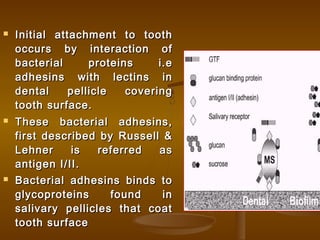
 Initial attachment to toothInitial attachment to tooth
occurs by interaction ofoccurs by interaction of
bacterial proteins i.ebacterial proteins i.e
adhesins with lectins inadhesins with lectins in
dental pellicle coveringdental pellicle covering
tooth surface.tooth surface.
 These bacterial adhesins,These bacterial adhesins,
first described by Russell &first described by Russell &
Lehner is referred asLehner is referred as
antigen I/II.antigen I/II.
 Bacterial adhesins binds toBacterial adhesins binds to
glycoproteins found inglycoproteins found in
salivary pellicles that coatsalivary pellicles that coat
tooth surfacetooth surface
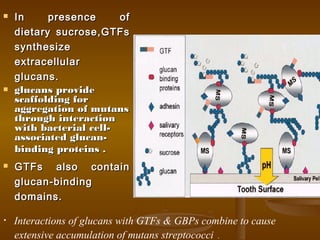
 In presence ofIn presence of
dietary sucrose,GTFsdietary sucrose,GTFs
synthesizesynthesize
extracellularextracellular
glucans.glucans.
 glucans provideglucans provide
scaffolding forscaffolding for
aggregation of mutansaggregation of mutans
through interactionthrough interaction
with bacterial cell-with bacterial cell-
associated glucan-associated glucan-
binding proteins .binding proteins .
 GTFs also containGTFs also contain
glucan-bindingglucan-binding
domains.domains.
• Interactions of glucans with GTFs & GBPs combine to cause
extensive accumulation of mutans streptococci .
 Theoretically, next phase of pathogenesisTheoretically, next phase of pathogenesis
results from metabolic activities of theseresults from metabolic activities of these
masses of accumulated mutans streptococci.masses of accumulated mutans streptococci.
 Mutans streptococci are most prolificMutans streptococci are most prolific
producers of lactic acid in theseproducers of lactic acid in these
accumulations although other “low pHaccumulations although other “low pH
bacteria” may also contribute.bacteria” may also contribute.
 Dental caries ultimately ensues becauseDental caries ultimately ensues because
resulting increase in lactic acidresulting increase in lactic acid
concentration cannot be sufficiently bufferedconcentration cannot be sufficiently buffered
to prevent enamel dissolution.to prevent enamel dissolution.
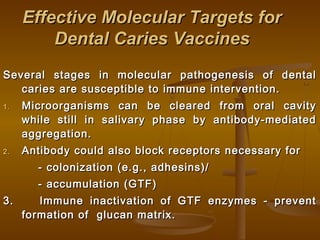
Effective Molecular Targets forEffective Molecular Targets for
Dental Caries VaccinesDental Caries Vaccines
Several stages in molecular pathogenesis of dentalSeveral stages in molecular pathogenesis of dental
caries are susceptible to immune intervention.caries are susceptible to immune intervention.
1.1. Microorganisms can be cleared from oral cavityMicroorganisms can be cleared from oral cavity
while still in salivary phase by antibody-mediatedwhile still in salivary phase by antibody-mediated
aggregation.aggregation.
2.2. Antibody could also block receptors necessary forAntibody could also block receptors necessary for
- colonization (e.g., adhesins)/- colonization (e.g., adhesins)/
- accumulation (GTF)- accumulation (GTF)
3. Immune inactivation of GTF enzymes - prevent3. Immune inactivation of GTF enzymes - prevent
formation of glucan matrix.formation of glucan matrix.
 Most of recent experimental effortMost of recent experimental effort hashas
been directed towardbeen directed toward
1.1. ADHESINS,ADHESINS,
2.2. GTFSGTFS
asas vaccine targets.vaccine targets.
ROUTES TO PROTECTIVE RESPONSESROUTES TO PROTECTIVE RESPONSES
 Mucosal applications of caries vaccines areMucosal applications of caries vaccines are
generallygenerally preferred for induction of secretory IgApreferred for induction of secretory IgA
antibody in salivary compartment, since this Igantibody in salivary compartment, since this Ig
constitutesconstitutes major immune component of major &major immune component of major &
minor salivary glandminor salivary gland secretions.secretions.
 Many investigators have shown that exposure ofMany investigators have shown that exposure of
antigenantigen to mucosally associated lymphoid tissueto mucosally associated lymphoid tissue
in gut, nasal, bronchial,in gut, nasal, bronchial, or rectal site can give riseor rectal site can give rise
to immune responses not only in region ofto immune responses not only in region of
induction, but also in remote locations.induction, but also in remote locations.
 ThisThis has given rise to the notion of "commonhas given rise to the notion of "common
mucosal immune system"mucosal immune system"
 Consequently, several mucosal routes haveConsequently, several mucosal routes have
been used to induce protective immunebeen used to induce protective immune
responses to dental cariesresponses to dental caries vaccine antigens.vaccine antigens.
(A) ORAL(A) ORAL
 Many of earlier studies relied on oralMany of earlier studies relied on oral
induction of immunityinduction of immunity in gut-associatedin gut-associated
lymphoid tissues (GALT) to elicit protectivelymphoid tissues (GALT) to elicit protective
salivary IgA antibody responses.salivary IgA antibody responses.
 In these studies, antigen wasIn these studies, antigen was applied byapplied by
oral feeding, gastric intubation, or inoral feeding, gastric intubation, or in
vaccine-containingvaccine-containing capsules or liposomes.capsules or liposomes.
 Although oral route was not idealAlthough oral route was not ideal {{
for reasonsfor reasons
including detrimental effects of stomach acidityincluding detrimental effects of stomach acidity onon
antigen, or inductive sites were relatively distant,}antigen, or inductive sites were relatively distant,}
experiments with this route established that itexperiments with this route established that it
was sufficient to change course of mutanswas sufficient to change course of mutans
streptococcal infection & disease in animalstreptococcal infection & disease in animal
models (Michalek et al., 1976;models (Michalek et al., 1976; Smith et al., 1979)Smith et al., 1979)
and humans (Smith and Taubman, 1987).and humans (Smith and Taubman, 1987).
B) INTRANASALB) INTRANASAL
 More recently, attempts have been made toMore recently, attempts have been made to
induce protectiveinduce protective immunity in mucosal inductiveimmunity in mucosal inductive
sites that are in closer anatomicalsites that are in closer anatomical relationship torelationship to
oral cavity.oral cavity.
 Intranasal installation ofIntranasal installation of antigen, which targetsantigen, which targets
nasal-associated lymphoid tissuenasal-associated lymphoid tissue (NALT)(NALT)
(Brandtzaeg and Haneberg, 1997), has been(Brandtzaeg and Haneberg, 1997), has been
used to induceused to induce immunity to many bacterialimmunity to many bacterial
antigens, including those associatedantigens, including those associated with mutanswith mutans
streptococcal colonization & accumulation.streptococcal colonization & accumulation.
 ProtectiveProtective immunity after infection withimmunity after infection with
cariogeniccariogenic
(C) TONSILLAR(C) TONSILLAR
 Ability of tonsillar application of antigen toAbility of tonsillar application of antigen to
induce immuneinduce immune responses in oral cavity is ofresponses in oral cavity is of
great interest.great interest.
 TonsillarTonsillar tissue contains required elements oftissue contains required elements of
immune induction ofimmune induction of secretory IgA responsessecretory IgA responses
(van Kempen et al., 2000).(van Kempen et al., 2000).
 Nonetheless, palatineNonetheless, palatine tonsils, & especiallytonsils, & especially
nasopharyngeal tonsils, have beennasopharyngeal tonsils, have been suggested tosuggested to
contribute precursor cells to mucosal effectorcontribute precursor cells to mucosal effector
sites , such as salivary glands.sites , such as salivary glands.
(D) MINOR SALIVARY GLAND(D) MINOR SALIVARY GLAND
 The minor salivary glands populate lips,The minor salivary glands populate lips,
cheeks, & softcheeks, & soft palate.palate.
 These glands have been suggested asThese glands have been suggested as
potential routespotential routes for mucosal induction offor mucosal induction of
salivary immune responses Experiments insalivary immune responses Experiments in
which S. sobrinus GTF was topicallywhich S. sobrinus GTF was topically
administered onto lower lips of youngadministered onto lower lips of young
adults have suggestedadults have suggested that this route havethat this route have
potential for caries vaccinepotential for caries vaccine delivery.delivery.
 In these experiments, those who received labialIn these experiments, those who received labial
applicationapplication of GTF had significantly lowerof GTF had significantly lower
proportions of indigenous mutansproportions of indigenous mutans
streptococci/total streptococcal flora in theirstreptococci/total streptococcal flora in their
whole salivawhole saliva during 6-week period followingduring 6-week period following
dental prophylaxis, compareddental prophylaxis, compared with placebowith placebo
group.group.
(E) RECTAL(E) RECTAL
 More remote mucosal sites have also beenMore remote mucosal sites have also been
investigated for theirinvestigated for their inductive potential.inductive potential.
 For example, rectal immunization with non-oralFor example, rectal immunization with non-oral
bacterial antigens such as Helicobacter pylori orbacterial antigens such as Helicobacter pylori or
Streptococcus pneumoniae ,presented in contextStreptococcus pneumoniae ,presented in context
of toxin-based adjuvant, can resultof toxin-based adjuvant, can result in appearancein appearance
of secretory IgA antibody in distant salivaryof secretory IgA antibody in distant salivary sites.sites.
 Colo-rectal region as an inductive location forColo-rectal region as an inductive location for
mucosalmucosal immune responses in humans isimmune responses in humans is
suggested from fact that thissuggested from fact that this site has highestsite has highest
concentration of lymphoid follicles inconcentration of lymphoid follicles in lowerlower
intestinal tract.intestinal tract.
 One could, therefore, foresee use of vaccineOne could, therefore, foresee use of vaccine
suppositoriessuppositories as one alternative for children inas one alternative for children in
whom respiratory ailmentswhom respiratory ailments preclude intranasalpreclude intranasal
application of vaccine.application of vaccine.
CONCLUSIONCONCLUSION
 During the past 2 decades, numerousDuring the past 2 decades, numerous
advancements have been made towardadvancements have been made toward
development of a safe caries vaccinedevelopment of a safe caries vaccine for use infor use in
humans.humans.
 However, it is still difficult to predict when or if aHowever, it is still difficult to predict when or if a
vaccine will be available for actual use sincevaccine will be available for actual use since
appropriate clinical studies have yet to be performed.appropriate clinical studies have yet to be performed.
REFERENCESREFERENCES
D.J. Smith: Dental Caries Vaccines: Prospects andD.J. Smith: Dental Caries Vaccines: Prospects and
Concerns: Crit Rev Oral Biol Med13(4):335-349 (2002)Concerns: Crit Rev Oral Biol Med13(4):335-349 (2002)
Daniel J. Smith, Ph.D: Caries Vaccines for theDaniel J. Smith, Ph.D: Caries Vaccines for the
Twenty-First Century:Twenty-First Century: Transfer of Advances inTransfer of Advances in
Science into Dental Education: Journal of DentalScience into Dental Education: Journal of Dental
Education Volume 67, Number 10 : pg no 1130-39Education Volume 67, Number 10 : pg no 1130-39
Suzanne M. Michalek and Noel K. Childers DevelopmentSuzanne M. Michalek and Noel K. Childers Development
and Outlook for a Caries Vaccine: Oral Biology andand Outlook for a Caries Vaccine: Oral Biology and
Medicine:Volume 1, Issue 1Medicine:Volume 1, Issue 1
MichaelW. Russella Noel K. Childersb SuzanneMichaelW. Russella Noel K. Childersb Suzanne
M. Michalekc Daniel J. Smith Martin A.M. Michalekc Daniel J. Smith Martin A.
Taubmand;Taubmand; A Caries Vaccine? The State of theA Caries Vaccine? The State of the
Science of Immunization against Dental Caries:Science of Immunization against Dental Caries:
Caries Res 2004;38:230–235Caries Res 2004;38:230–235
Dr. Noel K. Childers: Immunobiology of Dental Caries:Dr. Noel K. Childers: Immunobiology of Dental Caries:
nkc@uab.edunkc@uab.edu
The Scientific and Moral Imperative for a DentalThe Scientific and Moral Imperative for a Dental
Caries Vaccine : iadr.confex.com/iadr/2004Caries Vaccine : iadr.confex.com/iadr/2004
Hawaii/ techprogram/sessionHawaii/ techprogram/session
Caries Immunology:Caries Immunology:Chapter 13Chapter 13
TELEDENTISTRYTELEDENTISTRY
INTRODUCTIONINTRODUCTION
 The explosive growth of theThe explosive growth of the
Internet and its use bring with itInternet and its use bring with it
the potential for electronic mediathe potential for electronic media
to fundamentally alter the wayto fundamentally alter the way
dentistry and medicines aredentistry and medicines are
practiced.practiced.
 The profession has come a longThe profession has come a long
way from extractions andway from extractions and
dentures.dentures.
 Now digital technology is takingNow digital technology is taking
dentistry to another level-dentistry to another level-
creating practice possibilitiescreating practice possibilities
that were hardly imaginable eventhat were hardly imaginable even
10 years ago10 years ago
 Teledentistry is a relatively new field thatTeledentistry is a relatively new field that
combines telecommunication technology andcombines telecommunication technology and
dental care.dental care.
 It provides new opportunities for educationIt provides new opportunities for education
and delivery of care that offer much potentialand delivery of care that offer much potential
and challenges.and challenges.
 The practice of teledentistry broadly definesThe practice of teledentistry broadly defines
the use of electronic communication andthe use of electronic communication and
information technologies to provide or supportinformation technologies to provide or support
clinical care at a distance is becomingclinical care at a distance is becoming
increasingly common due to the recentincreasingly common due to the recent
innovations in data communication as well asinnovations in data communication as well as
increased demand for accessible and costincreased demand for accessible and cost
effective health care.effective health care.
DefinitionsDefinitions
 Teledentistry's roots lie in telemedicine.Teledentistry's roots lie in telemedicine.
 One of the best definitions of telemedicine is thatOne of the best definitions of telemedicine is that
expressed by the Association of Americanexpressed by the Association of American
Medical Colleges or AMMC.Medical Colleges or AMMC.
 "Telemedicine is the use of telecommunication"Telemedicine is the use of telecommunication
technology to send data, graphics, audio andtechnology to send data, graphics, audio and
video images between participants who arevideo images between participants who are
physically separated (i.e. at a distance from onephysically separated (i.e. at a distance from one
another) for the purpose of clinical care.another) for the purpose of clinical care.
 The state of California considers Telemedicine toThe state of California considers Telemedicine to
be "The practice of health care delivery, diagnosis,be "The practice of health care delivery, diagnosis,
consultation, treatment and education, usingconsultation, treatment and education, using
interactive audio. video or data communications.interactive audio. video or data communications.
 The Federal Government in its 1997 TelemedicineThe Federal Government in its 1997 Telemedicine
report to Congress defined it asreport to Congress defined it as ““the use ofthe use of
electronic communication and informationelectronic communication and information
technologies to provide or support clinical care at atechnologies to provide or support clinical care at a
distance.distance.
 The term Teledentistry was used in 1997 whenThe term Teledentistry was used in 1997 when
Cook defined it as "... The practice of using videoCook defined it as "... The practice of using video
conferencing technologies to diagnose and provideconferencing technologies to diagnose and provide
advice about treatment over a distance.advice about treatment over a distance.
History of TeledentistryHistory of Teledentistry
 The United States military formally launched aThe United States military formally launched a
coordinated telemedicine program in 1994.coordinated telemedicine program in 1994.
 One of the military telemedicine efforts was toOne of the military telemedicine efforts was to
start a teledentistry project.start a teledentistry project.
 The Total Dental Access (TDA) is a tri-serviceThe Total Dental Access (TDA) is a tri-service
teledentistry project, which started in 1994.teledentistry project, which started in 1994.
 One of the goals of this project is to increaseOne of the goals of this project is to increase
patient access to quality dental care.patient access to quality dental care.
 The other goal is to establish a cost effectiveThe other goal is to establish a cost effective
telemedicine system.telemedicine system.
 The Total Dental Access project focuses on threeThe Total Dental Access project focuses on three
areas of dentistry.areas of dentistry.
Patient-care:Patient-care:
 In some of the remote clinics, a patient must travelIn some of the remote clinics, a patient must travel
hundreds ofhundreds of files to receive specialty care.files to receive specialty care.
 With the implementation of teledentistry, there is aWith the implementation of teledentistry, there is a
potential of savings in cost and travel timepotential of savings in cost and travel time
required by the patient.required by the patient.
 Referral to specialists, consultations andReferral to specialists, consultations and
laboratory communications are some of thelaboratory communications are some of the
clinical areas where teledentistry could improveclinical areas where teledentistry could improve
the patient care.the patient care.
Continuing dental education:Continuing dental education:
 Through the use of video teleconferencingThrough the use of video teleconferencing
equipment, the lectures could be broadcasted toequipment, the lectures could be broadcasted to
any clinic where continuing dental education isany clinic where continuing dental education is
difficult to obtain.difficult to obtain.
Dentist-laboratory communicationsDentist-laboratory communications ::
 Occasionally, cases. submitted to the dentalOccasionally, cases. submitted to the dental
laboratories have subtle complications orlaboratories have subtle complications or
esthetic nuances that require direct contactesthetic nuances that require direct contact
between the dentist and the laboratorybetween the dentist and the laboratory
technician.technician.
 In these instances, the ability to send colourIn these instances, the ability to send colour
images of the patientimages of the patient’’s teeth and then to talks teeth and then to talk
about the images can help to prevent makingabout the images can help to prevent making
improperly constructed appliances, therebyimproperly constructed appliances, thereby
saving time and money.saving time and money.
Step 1:Step 1: ImageImage File Transfer via ModemFile Transfer via Modem
 The US Army conducted the first study ofThe US Army conducted the first study of
teledentistry at Fortteledentistry at Fort Gordon, Georgia in JulyGordon, Georgia in July
1994.1994.
 In this study a dental image managementIn this study a dental image management
system was used in conjunction with an intra-system was used in conjunction with an intra-
oral camera to capture color images of aoral camera to capture color images of a
patient's mouth.patient's mouth.
 These images were then transmitted to FortThese images were then transmitted to Fort
Gordon, a distance of 120 miles.Gordon, a distance of 120 miles.
 They concluded that 14 of the 15 patientsThey concluded that 14 of the 15 patients
saved the return trip to Fort Gordon.saved the return trip to Fort Gordon.
Step 2: File lmage Transfer via SatelliteStep 2: File lmage Transfer via Satellite
 The second study was performed in Haiti in 1995. InThe second study was performed in Haiti in 1995. In
this study a video teleconferencing system was usedthis study a video teleconferencing system was used
allowing the deployed dentists to talk face to faceallowing the deployed dentists to talk face to face
with specialists at Walter Reed Army Medical Centrewith specialists at Walter Reed Army Medical Centre
in Washington.in Washington.
Step 3: ISDN-Based Teledentistry SystemStep 3: ISDN-Based Teledentistry System
 For this project the Army posts were networkedFor this project the Army posts were networked
using desktop video teleconferencing equipment andusing desktop video teleconferencing equipment and
ISDN linesISDN lines
 This equipment allows live video consulting as wellThis equipment allows live video consulting as well
as capability to send still images.as capability to send still images.
Step 4: Web-Based Teledentistry SystemsStep 4: Web-Based Teledentistry Systems
 Since most of the dental clinics in Europe have aSince most of the dental clinics in Europe have a
local area network (LAN) and access to Internetlocal area network (LAN) and access to Internet
through the medical hospitals, this system is beingthrough the medical hospitals, this system is being
used in over 50 tri-service dental clinics in Europe.used in over 50 tri-service dental clinics in Europe.
 Advantages of a web-based teledentistryAdvantages of a web-based teledentistry
consultation system include low cost, expandableconsultation system include low cost, expandable
to a wide range of locations, more completeto a wide range of locations, more complete
information for data analysis.information for data analysis.
TELERADIOLOGYTELERADIOLOGY
 Teleradiology is the most common application ofTeleradiology is the most common application of
telemedicinetelemedicine
Domain of TeleradiologyDomain of Teleradiology
 In 1994, the American College of Radiology (ACR)In 1994, the American College of Radiology (ACR)
defined teleradiology as the electronic transmissiondefined teleradiology as the electronic transmission
of radiologic images from one location to anotherof radiologic images from one location to another
for the purposes of interpretation, consultation, orfor the purposes of interpretation, consultation, or
both.both.
 Teleradiology systems allow direct digital orTeleradiology systems allow direct digital or
digitized film images to be transmitted to distantdigitized film images to be transmitted to distant
locations, where they can be viewed andlocations, where they can be viewed and
downloaded to hard copy for reading anddownloaded to hard copy for reading and
interpretation.interpretation.
 The first apparent instance of aThe first apparent instance of a
dental radiograph beingdental radiograph being
transmitted over distance was intransmitted over distance was in
1920 by the Western union1920 by the Western union
Telegraph CompanyTelegraph Company
 No difference in image quality wasNo difference in image quality was
quality was found between thequality was found between the
initial digitized and theinitial digitized and the
transmitted images.transmitted images.
 Hence, Teledentistry can be usedHence, Teledentistry can be used
to link dental practitioners into link dental practitioners in
remote sites to professionalremote sites to professional
expertise.expertise.
TELESTOMATOLOGYTELESTOMATOLOGY
 An E-mail based oral medicine consultationAn E-mail based oral medicine consultation
was undertaken as a pilot study by Younaiwas undertaken as a pilot study by Younai
and Messadi in 2000 to assess whether textand Messadi in 2000 to assess whether text
based electronic patient data transmissionbased electronic patient data transmission
(e-mail) is a reliable source of information for(e-mail) is a reliable source of information for
the diagnostic decision making process.the diagnostic decision making process.
 Two post graduate residents transfer all theTwo post graduate residents transfer all the
relevant information to a standard patientrelevant information to a standard patient
datadata
 Each form was then coded and given toEach form was then coded and given to
Oral Medicine faculty judges who wereOral Medicine faculty judges who were
blinded to identify the patientsblinded to identify the patients
 They concluded that face to face patientThey concluded that face to face patient
examination is more accurate inexamination is more accurate in
establishing a correct diagnosis for oralestablishing a correct diagnosis for oral
mucosal pathologies that transmittedmucosal pathologies that transmitted
descriptive patient data alone.descriptive patient data alone.
TELE ORAL SURGERYTELE ORAL SURGERY
 Coultard et al in 1999 did a study in greatCoultard et al in 1999 did a study in great
Manchester to know the requirementManchester to know the requirement ofof
telemedicine in oral surgery referrals.telemedicine in oral surgery referrals.
 400 general dental practitioners were400 general dental practitioners were
randomly selected for the study.randomly selected for the study.
 It was concluded that a significant numberIt was concluded that a significant number
of dentist suggested that there was a needof dentist suggested that there was a need
to change the system of oral surgeryto change the system of oral surgery
specialist care.specialist care.
 The principal concern being the amount ofThe principal concern being the amount of
time wasted for consultation and thetime wasted for consultation and the
treatment and perceived difficulty intreatment and perceived difficulty in
travelling to the specialist unit.travelling to the specialist unit.
 Coultard et al suggested that telemedicineCoultard et al suggested that telemedicine
in oral surgery could conceivable bein oral surgery could conceivable be
another way to improve access toanother way to improve access to
specialist oral surgery care.specialist oral surgery care.
TELEPATHOLOGYTELEPATHOLOGY
 Very few teleconsultations is being used inVery few teleconsultations is being used in
the field of pathology.the field of pathology.
 1998 Dr Vincent Menoli, section chief of1998 Dr Vincent Menoli, section chief of
Anatomic pathology at Dartmouth-HitchcockAnatomic pathology at Dartmouth-Hitchcock
medical centre started experimenting withmedical centre started experimenting with
telepathology system.telepathology system.
 It worked reasonably well but did not allowIt worked reasonably well but did not allow
him to scan the glass slides in real to selecthim to scan the glass slides in real to select
exactly the right fields, focal depth andexactly the right fields, focal depth and
magnification.magnification.
 He planned a Digital Meeting SystemHe planned a Digital Meeting System
based Telepathology system, with 2 ruralbased Telepathology system, with 2 rural
sites and the hub at the medical centre.sites and the hub at the medical centre.
 The equipment delivered very reasonableThe equipment delivered very reasonable
image fidelity and allowed for fullimage fidelity and allowed for full
interaction between the rural pathologistinteraction between the rural pathologist
and medical centre suband medical centre sub specialists.specialists.
TELEORTHODONTICSTELEORTHODONTICS
 Orthodontic practice via teledentistry project isOrthodontic practice via teledentistry project is
a universally accepted part of moderna universally accepted part of modern
healthcare.healthcare.
 Due to the shortage of orthodontists in theDue to the shortage of orthodontists in the
United Kingdom, aUnited Kingdom, a project was designed atproject was designed at
the University of Bristol Dental School inthe University of Bristol Dental School in
Southwest England and was known as theSouthwest England and was known as the
"Teledent Southwest""Teledent Southwest"
 Each of the dentists was provided with aEach of the dentists was provided with a
Pentium PC and associatedPentium PC and associated
videoconferencing software and hardware.videoconferencing software and hardware.
TELE-ENDODONTICSTELE-ENDODONTICS
 The literature on restorativeThe literature on restorative
dental referrals is relativelydental referrals is relatively
sparsesparse
 Nuttal et al in 2002 conductedNuttal et al in 2002 conducted
a study in the rural and urbana study in the rural and urban
areas of Scotland forareas of Scotland for
secondary restorative dentalsecondary restorative dental
care.care.
 Most dentists (85%) whoMost dentists (85%) who
practiced in urban areas saidpracticed in urban areas said
they felt that they had anthey felt that they had an
access to a secondary referralaccess to a secondary referral
serviceservice
TELEDENTISTRY IN DENTALTELEDENTISTRY IN DENTAL
EDUCATIONEDUCATION
 Most dentists and dental educatorsMost dentists and dental educators
are unaware that teledentistry can beare unaware that teledentistry can be
used not only for increased access toused not only for increased access to
dental care but also for advanceddental care but also for advanced
dental education and delivery of caredental education and delivery of care
that offer much potential andthat offer much potential and
challenges.challenges.
 Teledentistry in dental education canTeledentistry in dental education can
be divided into 2 types.be divided into 2 types.
1. Web based self-instruction1. Web based self-instruction
2. Interactive video conferencing2. Interactive video conferencing..
Web based self-instruction:Web based self-instruction:
 The Web based self-instruction educationalThe Web based self-instruction educational
system contains information that has beensystem contains information that has been
developed and stored before the userdeveloped and stored before the user
accesses the program.accesses the program.
 The advantage is that user can control paceThe advantage is that user can control pace
of learning and can review material as manyof learning and can review material as many
times as he wishes.times as he wishes.
 The researchers found that the lack of face-The researchers found that the lack of face-
to-face communication with peers andto-face communication with peers and
instructors was one of the main reasons forinstructors was one of the main reasons for
dissatisfactiondissatisfaction
Interactive videoconferencing:Interactive videoconferencing:
 Interactive video conferencing includes both aInteractive video conferencing includes both a
1.1. Live interactive video conference (with at least oneLive interactive video conference (with at least one
camera set up where the patients information iscamera set up where the patients information is
transmitted: however cameras at both locations are ideal)transmitted: however cameras at both locations are ideal)
andand
2.2. Supportive information (such as patient medical history,Supportive information (such as patient medical history,
radiographs) that can be sent before or at the same timeradiographs) that can be sent before or at the same time
(for eg via fax) as the videoconference (with or without(for eg via fax) as the videoconference (with or without
the patient present).the patient present).
 The advantage of this educational style is that the userThe advantage of this educational style is that the user
(typically the patients health care provider) can receive(typically the patients health care provider) can receive
immediate feedback.immediate feedback.
Positive feedback:Positive feedback:
 According to the 1999 United States Army studyAccording to the 1999 United States Army study
teledentistry can be a very useful tool for teachingteledentistry can be a very useful tool for teaching
post graduate students and even providingpost graduate students and even providing
continuing education for dentists.continuing education for dentists.
 Although a complete evaluation of interactiveAlthough a complete evaluation of interactive
videoconferencing has not been performed, studiesvideoconferencing has not been performed, studies
have shown positive reactions from both thehave shown positive reactions from both the
educator and the student.educator and the student.
 They received a positive feedback from theThey received a positive feedback from the
participating general dentistsparticipating general dentists patients and patient'spatients and patient's
parentsparents..
 The general dentists participating in the pilot studyThe general dentists participating in the pilot study
stated that teledentistry taught them when to refer astated that teledentistry taught them when to refer a
patient and how to treat more complicated casespatient and how to treat more complicated cases
which changed their practice stylewhich changed their practice style
 The results of the studyThe results of the study showed that teledentistryshowed that teledentistry
significantly elevated healthcare knowledge: andsignificantly elevated healthcare knowledge: and
computer skillscomputer skills
 The interactive video conferencing is more effectiveThe interactive video conferencing is more effective
than web based self-instruction because of the abilitythan web based self-instruction because of the ability
to generate immediate feedback. which enhancesto generate immediate feedback. which enhances
student's enthusiasm for learningstudent's enthusiasm for learning
TELEDENTISTRY IN RURALTELEDENTISTRY IN RURAL
AREASAREAS
 The forerunners of testing the role of teledentistry in theThe forerunners of testing the role of teledentistry in the
rural population are the state of California, Australia, Japanrural population are the state of California, Australia, Japan
and Taiwan.and Taiwan.
 The children's Hospital Los Angeles Teledentistry projectThe children's Hospital Los Angeles Teledentistry project
being run in association with the University of Southernbeing run in association with the University of Southern
CaliforniaCalifornia’’s mobile dental clinic seeks to increase ands mobile dental clinic seeks to increase and
enhance the quality of oral healthcare that is provided toenhance the quality of oral healthcare that is provided to
children living in remote rural areaschildren living in remote rural areas..
 It has proved to be a vital resource in addressing the oralIt has proved to be a vital resource in addressing the oral
health needs of children from areas lacking in dentalhealth needs of children from areas lacking in dental
practitionerspractitioners..
CONCLUSIONCONCLUSION
 It is clear that no field is untouched by informationIt is clear that no field is untouched by information
technology. Dentistry is no exception to it.technology. Dentistry is no exception to it. ..
 History is suggestive of use of telemedicine for the firstHistory is suggestive of use of telemedicine for the first
time in 1950's and 1994 was the year of first teledentistrytime in 1950's and 1994 was the year of first teledentistry
based health programme of U.S. Army.based health programme of U.S. Army.
 Their Total Dental Access (TDA) is considered as pioneerTheir Total Dental Access (TDA) is considered as pioneer
project in the history teledentistry today.project in the history teledentistry today.
 Undoubtedly teledentistry is a ray of hope where not onlyUndoubtedly teledentistry is a ray of hope where not only
dental care access is increased but also the level ofdental care access is increased but also the level of
health education.health education.
REFERENCESREFERENCES
Mitra A. Rocca, MS, V. Lawrence Kudryk, DMD, JohnMitra A. Rocca, MS, V. Lawrence Kudryk, DMD, John
C. Pajak, Tommy Morris: The Evolution of aC. Pajak, Tommy Morris: The Evolution of a
Teledentistry System Within the Department ofTeledentistry System Within the Department of
Defense: Telemedicine and Advanced TechnologyDefense: Telemedicine and Advanced Technology
Research CenterResearch Center
Jeffrey c. Bauer, ph.D.; William t. Brown: The digitalJeffrey c. Bauer, ph.D.; William t. Brown: The digital
transformation of oral health care: Teledentistrytransformation of oral health care: Teledentistry
and electronic commerce:and electronic commerce: JADA, Vol. 132, FebruaryJADA, Vol. 132, February
2001:pg 204-092001:pg 204-09
Jung-wei chen; martin h. Hobdell; kim dunn; kathy a.Jung-wei chen; martin h. Hobdell; kim dunn; kathy a.
Johnson; jiajie zhang Teledentistry and its use inJohnson; jiajie zhang Teledentistry and its use in
dental education:dental education: JADA, Vol. 134, March 2003:JADA, Vol. 134, March 2003: 342 - 46342 - 46
Daniel T. Golder; Kathleen a. Brennan,, J.D:Daniel T. Golder; Kathleen a. Brennan,, J.D:
Practicing Dentistry in the Age of TelemedicinePracticing Dentistry in the Age of Telemedicine
JADA, Vol. 131, June 2000:734-744JADA, Vol. 131, June 2000:734-744
Teledentistry: Legal and regultory issues exploredTeledentistry: Legal and regultory issues explored
JADA, Vol. 128, December 1997: 1716-18JADA, Vol. 128, December 1997: 1716-18
Daniel R. Plotkin: Teledentistry Program ReducingDaniel R. Plotkin: Teledentistry Program Reducing
Oral Health Disparities in California: AmericanOral Health Disparities in California: American
Telemedicine AssociationTelemedicine Association
EVIDENCE BASEDEVIDENCE BASED
DENTISTRYDENTISTRY
INTRODUCTIONINTRODUCTION
 Volumes of literature and lecturesVolumes of literature and lectures
directed at the modern dentaldirected at the modern dental
practitioners.practitioners.
 In resolving a clinical decision,In resolving a clinical decision,
evidence rather than empiricismevidence rather than empiricism
should dictate treatment.should dictate treatment.
 Evidence based dentistry is based onEvidence based dentistry is based on
the concepts developed at Mac Masterthe concepts developed at Mac Master
university, presents guidelines touniversity, presents guidelines to
determine the validity of study resultsdetermine the validity of study results
and whether they can be applied toand whether they can be applied to
clinical practice.clinical practice.
 The foundation for evidence basedThe foundation for evidence based
practice was laid by David Sackett.practice was laid by David Sackett.
 Sackett defined EBD as “integratingSackett defined EBD as “integrating
individual clinical expertise with theindividual clinical expertise with the
best available external clinicalbest available external clinical
evidence from systematic research”.evidence from systematic research”.
 EBD supplies guidelines to help theEBD supplies guidelines to help the
clinician make an intelligent decision.clinician make an intelligent decision.
 In & of itself EBD doesn't itself giveIn & of itself EBD doesn't itself give
definitive answers.definitive answers.
 In a perfect world, full of prospectiveIn a perfect world, full of prospective
studies one would have to pull up a wellstudies one would have to pull up a well
performed meta-analysis or systematicperformed meta-analysis or systematic
review of the evidence on the clinicalreview of the evidence on the clinical
question to solve the problem at hand.question to solve the problem at hand.
 Unfortunately, these studies are too fewUnfortunately, these studies are too few
and clinicians must apply the bestand clinicians must apply the best
available evidence to make a decision.available evidence to make a decision.
 Armed with tools of EBD, the cliniciansArmed with tools of EBD, the clinicians
can readily evaluate the mass of data andcan readily evaluate the mass of data and
choose in an educated manner, what tochoose in an educated manner, what to
use and what to discard.use and what to discard.
 What is EBM?What is EBM? catchphrase ofcatchphrase of
1990s1990s
 Defined as “ the ability to track down,Defined as “ the ability to track down,
critically appraise (for its validity andcritically appraise (for its validity and
usefulness), and incorporate ausefulness), and incorporate a
rapidly growing body of evidence intorapidly growing body of evidence into
clinical practice (Sackett &clinical practice (Sackett &
Rosenberg 1995).Rosenberg 1995).
 However questioned whether it isHowever questioned whether it is
being implemented in the ‘frontline’being implemented in the ‘frontline’
 Defined as a “process thatDefined as a “process that
restructures th way in which werestructures th way in which we
think about clinical problems”think about clinical problems”
 Characterized by “making decisionsCharacterized by “making decisions
based on evidence” (Richards &based on evidence” (Richards &
Lawrence, 1995).Lawrence, 1995).
 The American Dental Association (ADA)The American Dental Association (ADA)
has defined Evidence-based dentistryhas defined Evidence-based dentistry
asas
““an approach to oral health care that requiresan approach to oral health care that requires
the judicious integration of:the judicious integration of:
 systematic assessments of clinically relevantsystematic assessments of clinically relevant
scientific evidence, relating to the patients oral andscientific evidence, relating to the patients oral and
medical condition and history,medical condition and history,   together with thetogether with the
 dentists clinical expertise anddentists clinical expertise and

Comparison of evidence basedComparison of evidence based
dentistry Vs. traditional dentistrydentistry Vs. traditional dentistry
 SIMILARITIESSIMILARITIES
 High values of clinical skills andHigh values of clinical skills and
experienceexperience
 Fundamental importance of integratingFundamental importance of integrating
evidence with patient values.evidence with patient values.
DIFFERENCESDIFFERENCES
 EBDEBD
 Uses bestUses best
evidence availableevidence available
 SystematicSystematic
appraisal ofappraisal of
quality of evidencequality of evidence
 More objective,More objective,
more transparentmore transparent
and less biasedand less biased
processprocess
 Grater acceptanceGrater acceptance
of levels ofof levels of
uncertaintyuncertainty
 TRADITIONALTRADITIONAL
DENTISTRYDENTISTRY
 Unclear basis ofUnclear basis of
evidenceevidence
 Unclear or absentUnclear or absent
appraisal of quality ofappraisal of quality of
evidenceevidence
 More subjective, moreMore subjective, more
opaque and more biasedopaque and more biased
processprocess
 Greater tendency toGreater tendency to
black and whitblack and whit
 The Evidence-based approach isThe Evidence-based approach is
essentially a structured (stepwise) processessentially a structured (stepwise) process
for dealing with clinical problems.for dealing with clinical problems.
 This stepwise approach encourages theThis stepwise approach encourages the
use of the latest information rather that ause of the latest information rather that a
reliance on techniques, materials andreliance on techniques, materials and
treatments learned years earlier.treatments learned years earlier.
 There are five elements to the approach:There are five elements to the approach:
 QuestionQuestion - Developing a clear question based - Developing a clear question based
on the patients clinical problem.on the patients clinical problem.
 FindFind - Finding the latest evidence through- Finding the latest evidence through
efficient searching for information.efficient searching for information.
 AppraiseAppraise - Critically appraising the evidence to- Critically appraising the evidence to
assess its value.assess its value.
 ActAct   - Acting on the evidence you find, if- Acting on the evidence you find, if
appropriate and relevant to the clinicalappropriate and relevant to the clinical
situation to provide treatment for the patients.situation to provide treatment for the patients.
 EvaluationEvaluation - Each aspect of your perfomance- Each aspect of your perfomance
in this process can, and should be evaluated andin this process can, and should be evaluated and
this is increasingly relevant with the developmentthis is increasingly relevant with the development
Asking questionsAsking questions
 In practice it is a rare day when you areIn practice it is a rare day when you are
not faced with a need to know some newnot faced with a need to know some new
information about the prognosis, treatmentinformation about the prognosis, treatment
or management of a condition.or management of a condition.
 Turning these clinical problems into aTurning these clinical problems into a
well-built ( answerable) clinical question iswell-built ( answerable) clinical question is
a key skill of evidence-based practice.a key skill of evidence-based practice.
 There are essentially two types of question:There are essentially two types of question:
 1. Background questions:1. Background questions: These ask forThese ask for
general knowledge about a disorder andgeneral knowledge about a disorder and
have two main components.have two main components.
 A question root (who, what, how, when orA question root (who, what, how, when or
why)why)
 A disorder or specific aspect of a disorderA disorder or specific aspect of a disorder
(e.g. What causes dental caries? or What(e.g. What causes dental caries? or What
are the complications of root canalare the complications of root canal
treatment?)treatment?)
 2. Foreground questions:2. Foreground questions: These ask for specificThese ask for specific
knowledge about how to manage patients with aknowledge about how to manage patients with a
disorder and a good or well-constructed foregrounddisorder and a good or well-constructed foreground
question usually has four main elements:question usually has four main elements:
PP - The type of patient or the problem of interest- The type of patient or the problem of interest
II - The main intervention or exposure E; this is- The main intervention or exposure E; this is
commonly a treatment but it could be a diagnosticcommonly a treatment but it could be a diagnostic
test, some prognostic factor etc.test, some prognostic factor etc.
CC - The comparison intervention/s when relevant- The comparison intervention/s when relevant
OO - The clinical outcome of interest. - The clinical outcome of interest.
e.g.  In patients with tooth discolouration would homee.g.  In patients with tooth discolouration would home
bleaching compared to placebo lead to whiter teeth?bleaching compared to placebo lead to whiter teeth?
How to find evidence?How to find evidence?
 We are constantly bombarded withWe are constantly bombarded with
information from a wide range of sources.information from a wide range of sources.
Traditional sources of information (books,Traditional sources of information (books,
journals and colleagues) as with otherjournals and colleagues) as with other
sources have their limitationssources have their limitations
 With the rise of the internet, an increasingWith the rise of the internet, an increasing
number of electronic databases arenumber of electronic databases are
available which can provide access to theavailable which can provide access to the
best current evidence. The most widelybest current evidence. The most widely
available free database is Medline whichavailable free database is Medline which
can be accessed via thecan be accessed via the PubMedPubMed interface.interface.
 Increasingly databases are providingIncreasingly databases are providing
explict evidence;explict evidence;
A good example is the Evidence-basedA good example is the Evidence-based
Medicne reviews product fromMedicne reviews product from Ovid,Ovid, whichwhich
combines a number of electronic databasescombines a number of electronic databases
(Cochrane Database of Systematic(Cochrane Database of Systematic
Reviews, Best Evidence, Evidence-basedReviews, Best Evidence, Evidence-based
Mental Health and Evidence-basedMental Health and Evidence-based
Nursing, Cancerlit, Healthstar, Aidsline,Nursing, Cancerlit, Healthstar, Aidsline,
Bioethicsline and Medline).Bioethicsline and Medline).
 Structured approach to searchingStructured approach to searching
 In order to be really effective in searchingIn order to be really effective in searching
for evidence, specific training or access tofor evidence, specific training or access to
an information specialist is required.an information specialist is required.
 First define the question - then search for each ofFirst define the question - then search for each of
the following in turnthe following in turn
 Evidence-based GuidelinesEvidence-based Guidelines
 Cochrane ReviewsCochrane Reviews
 Evidence summaries (e.g from SpecialistEvidence summaries (e.g from Specialist
Library for Oral Health)Library for Oral Health)
 Medline - for appropriate studies to answerMedline - for appropriate studies to answer
your questionyour question
Appraising the evidenceAppraising the evidence
 Almost all scientific studies are flawed and itAlmost all scientific studies are flawed and it
would come as a surprise to some clinicianswould come as a surprise to some clinicians
that some (perhaps most) published papersthat some (perhaps most) published papers
should be thrown in the bin rather than usedshould be thrown in the bin rather than used
to inform clinical practice.to inform clinical practice.
 The important thing is not to stopThe important thing is not to stop
questioning. Curiosity has its own reason forquestioning. Curiosity has its own reason for
existing.  existing.  
 Critical appraisal is a way of rapidlyCritical appraisal is a way of rapidly
assessing published papers in order to sortassessing published papers in order to sort
out the  relevant or valid papers from theout the  relevant or valid papers from the
poor quality or irrelevant ones.poor quality or irrelevant ones.
 ValidityValidity -- is the degree to which theis the degree to which the
results of the study are likely to be true,results of the study are likely to be true,
believable and free from bias.believable and free from bias.
 Bias Bias  - is any factor (other than the- is any factor (other than the
experimental factor) that could change theexperimental factor) that could change the
study results in a non-random way.study results in a non-random way.
 Critical appraisal is best carried out in aCritical appraisal is best carried out in a
structured/standardised way usingstructured/standardised way using
explicit criteria. Appraisal can help theexplicit criteria. Appraisal can help the
clinician to assess:clinician to assess:
 ValidityValidity
 Clinical importanceClinical importance
 Clinical relevanceClinical relevance
Acting on the evidenceActing on the evidence
 Being aware of the available evidence is oneBeing aware of the available evidence is one
thing, but acting on it is another.thing, but acting on it is another.
 There are a number of well documented delaysThere are a number of well documented delays
between clinical practice and the availablebetween clinical practice and the available
research evidence.research evidence.
 The most often cited examples have been inThe most often cited examples have been in
medicine but one can look at the variations in themedicine but one can look at the variations in the
use of topical fluorides and fissure sealantsuse of topical fluorides and fissure sealants
despite good evidence of their effectiveness.despite good evidence of their effectiveness.
 These delays and variations in provision andThese delays and variations in provision and
uptake of treatmetns have contributed to theuptake of treatmetns have contributed to the
developement of the evidence-based approach.developement of the evidence-based approach.
 The practitioner needs to decide whether theThe practitioner needs to decide whether the
specific patient is similar enough to those inspecific patient is similar enough to those in
the research to use the findings .the research to use the findings .
 There may also be barriers regarding theThere may also be barriers regarding the
materials or equipmentmaterials or equipment
required, and there may also be costrequired, and there may also be cost
implications.implications.
 There are also personal barriers such as theThere are also personal barriers such as the
extent to which the results conflict withextent to which the results conflict with
professional experience and cherishedprofessional experience and cherished
beliefs.beliefs.
 The decision to act on evidence should beThe decision to act on evidence should be
based on the evidence, the relevance to yourbased on the evidence, the relevance to your
patient, the willingness of the patient topatient, the willingness of the patient to
recieve the treatment, and the practitionersrecieve the treatment, and the practitioners
ability to provide the treatment.ability to provide the treatment.
 It is therefore a carefully considered decisionIt is therefore a carefully considered decision
and not aand not a ''cookbookcookbook'' approach, as hasapproach, as has
been claimed by some opponents ofbeen claimed by some opponents of
evidence-based practiceevidence-based practice
Getting research findingsGetting research findings
into practiceinto practice
Applying
evidence
Based policy
In practice
Creating
Evidence
Based policies
Synthesizing
The evidenceGenerate
evidence
Making clinical
decision
The
evidence
Patient’s
preference
Patient’s
Unique
circumstance
Oxford Centre for Evidence-based MedicineOxford Centre for Evidence-based Medicine
Levels of Evidence (May 2001)Levels of Evidence (May 2001)
LEVELLEVEL TYPE OF EVIDENCETYPE OF EVIDENCE
1a1a Systematic review (withSystematic review (with
homogeneity) of RCThomogeneity) of RCT
1b1b Individual RCT (with narrowIndividual RCT (with narrow
confidence interval)confidence interval)
2a2a Systematic review (withSystematic review (with
homogeneity) of Cohort studieshomogeneity) of Cohort studies
2b2b Individual cohort studies (includingIndividual cohort studies (including
low quality RCT; e.g.,<80% follow-low quality RCT; e.g.,<80% follow-
up).up).
Oxford Centre for Evidence-based MedicineOxford Centre for Evidence-based Medicine
Levels of Evidence (May 2001)Levels of Evidence (May 2001)
LEVELLEVEL TYPE OF EVIDENCETYPE OF EVIDENCE
3a3a Systematic review (withSystematic review (with
homogeneity) of case-control studieshomogeneity) of case-control studies
3b3b Individual case-control studyIndividual case-control study
44 Case-series (and poor quality cohortCase-series (and poor quality cohort
& case-control studies)& case-control studies)
55 Expert opinion with-out explicitExpert opinion with-out explicit
critical appraisal, or based oncritical appraisal, or based on
physiology, bench research or firstphysiology, bench research or first
Grades of RecommendationGrades of Recommendation
 AA consistent level 1 studiesconsistent level 1 studies
 BB consistent level 2 or 3 studiesconsistent level 2 or 3 studies oror
extrapolations from level 1 studiesextrapolations from level 1 studies
 CC level 4 studieslevel 4 studies oror extrapolations fromextrapolations from
level 2 or 3 studieslevel 2 or 3 studies
 DD level 5 evidencelevel 5 evidence oror troublinglytroublingly
inconsistent or inconclusive studies of anyinconsistent or inconclusive studies of any
levellevel
Frequently-Asked Questions onFrequently-Asked Questions on
Levels of EvidenceLevels of Evidence
 What criteria are used for these levels and graWhat criteria are used for these levels and gra
??
 What do we mean by "outcomesWhat do we mean by "outcomes
research"?research"?
 What do we mean by "first principles"?What do we mean by "first principles"?
 How do we link grades and levels?How do we link grades and levels?
 Where would we place N-of-1 trials in thisWhere would we place N-of-1 trials in this
hierarchy?hierarchy?
 Where would we place cross-over studies?Where would we place cross-over studies?
Barriers and bridges to evidence basedBarriers and bridges to evidence based
clinical practiceclinical practice
 ProblemProblem
 The size andThe size and
complexity of thecomplexity of the
researchresearch
 Difficulties inDifficulties in
developing evidencedeveloping evidence
based clinical policybased clinical policy
 SolutionSolution
 Use services thatUse services that
abstract andabstract and
synthesizesynthesize
informationinformation
 Produce guidelinesProduce guidelines
for how to developfor how to develop
evidence basedevidence based
clinical guidelinesclinical guidelines
Problems in implementing and possible solutions
Difficulties in applying evidence inDifficulties in applying evidence in
practice because of the following factorspractice because of the following factors
 Poor access toPoor access to
best evidence andbest evidence and
guidelinesguidelines
 OrganizationalOrganizational
barriersbarriers
 Use informationUse information
systems that integratesystems that integrate
evidence andevidence and
guidelines with patientguidelines with patient
carecare
 Develop facilities andDevelop facilities and
incentives toincentives to
encourage effectiveencourage effective
care and bettercare and better
disease managementdisease management
systemssystems
 Ineffectual continuingIneffectual continuing
educationeducation
programmesprogrammes
 Low patientLow patient
adherence toadherence to
treatmentstreatments
 ImproveImprove
effectiveness ofeffectiveness of
educational andeducational and
quality improvementquality improvement
programmes forprogrammes for
practitionerspractitioners
 Develop moreDevelop more
effective strategieseffective strategies
to encourageto encourage
patients to followpatients to follow
healthcare advicehealthcare advice
Decision analysis and theDecision analysis and the
implementation of research findingsimplementation of research findings
 Decision analysis reconciles evidence basedDecision analysis reconciles evidence based
medicine with patients' preferencesmedicine with patients' preferences
 Decision analysis uses Bayesian probabilitiesDecision analysis uses Bayesian probabilities
together with values assigned to differenttogether with values assigned to different
outcomes to determine the best course of actionoutcomes to determine the best course of action
 Although it is currently unrealistic to do a separateAlthough it is currently unrealistic to do a separate
decision analysis for each patient, computerdecision analysis for each patient, computer
programs may soon overcome this problemprograms may soon overcome this problem
 In the meantime, decision analysis can be usedIn the meantime, decision analysis can be used
to provide guidelines for managing groups ofto provide guidelines for managing groups of
patients with similar clinical featurespatients with similar clinical features
 Calculating specimen decision analyses can beCalculating specimen decision analyses can be
helpful for patients with different valueshelpful for patients with different values
When to act on the evidence?When to act on the evidence?
 There is increasing interest in providingThere is increasing interest in providing
evidence based health care that is, care inevidence based health care that is, care in
which healthcare professionals, providerwhich healthcare professionals, provider
managers, those who commission healthmanagers, those who commission health
care, the public, and policymakerscare, the public, and policymakers
consistently consider research evidenceconsistently consider research evidence
when making decisions.when making decisions.
 Policymakers must also ensure that there isPolicymakers must also ensure that there is
an adequate infrastructure for monitoringan adequate infrastructure for monitoring
changes in practice and for producing,changes in practice and for producing,
gathering, summarizing, and disseminatinggathering, summarizing, and disseminating
evidenceevidence
 Clinicians determine the day to day careClinicians determine the day to day care
patients receive in healthcare systems,patients receive in healthcare systems,
and user groups (for example, patients,and user groups (for example, patients,
their families, and their representatives)their families, and their representatives)
are also beginning to play an importantare also beginning to play an important
role in influencing healthcare decisions.role in influencing healthcare decisions.
The factors described below should be consideredThe factors described below should be considered
when deciding whether to act on or promote thewhen deciding whether to act on or promote the
implementation of research findingsimplementation of research findings
 There is increasing interest in making clinical andThere is increasing interest in making clinical and
policy decisions based on research findingspolicy decisions based on research findings
 Not all research findings should or can beNot all research findings should or can be
implemented; prioritization is necessaryimplemented; prioritization is necessary
 Systematic reviews that show consistent resultsSystematic reviews that show consistent results
are likely to provide more reliable researchare likely to provide more reliable research
evidence than non-systematic reviews or singleevidence than non-systematic reviews or single
studiesstudies
 Researchers should design studies that take intoResearchers should design studies that take into
account how and by whom the results will be usedaccount how and by whom the results will be used
and the need to convince decision makers to useand the need to convince decision makers to use
the intervention studiedthe intervention studied
Evaluating the methods andEvaluating the methods and
results of systematic reviewsresults of systematic reviews
 Criteria that increase the reliability of aCriteria that increase the reliability of a
systematic reviewsystematic review
 Use of explicit criteria for inclusion and exclusion;Use of explicit criteria for inclusion and exclusion;
these should specify the population, thethese should specify the population, the
intervention, the outcome, and the methodologicalintervention, the outcome, and the methodological
criteria for the studies included in the reviewcriteria for the studies included in the review
 Use of comprehensive search methods to locateUse of comprehensive search methods to locate
relevant studies, including searching a wide rangerelevant studies, including searching a wide range
of computerized databases using a mixture ofof computerized databases using a mixture of
appropriate key words and free textappropriate key words and free text
 Assessment of the validity of the primaryAssessment of the validity of the primary
studies; this should be reproducible andstudies; this should be reproducible and
attempt to avoid biasattempt to avoid bias
 Exploration of variation between the findingsExploration of variation between the findings
of the studiesof the studies
 Appropriate synthesis and, when suitable,Appropriate synthesis and, when suitable,
pooling of primary studiespooling of primary studies
 A rigorous systematic reviewA rigorous systematic review
may sometimes leave themay sometimes leave the
decision maker who isdecision maker who is
reading it uncertain.reading it uncertain.
 Classification of the strengthClassification of the strength
of research evidence shouldof research evidence should
consider each of the followingconsider each of the following
four points.four points.
 Firstly, the methodology ofFirstly, the methodology of
the primary studies may bethe primary studies may be
weak..weak..
 Secondly, unexplained variability betweenSecondly, unexplained variability between
study results may lead to doubt about thestudy results may lead to doubt about the
results of studies that show larger treatmentresults of studies that show larger treatment
effects or those that show no benefit.effects or those that show no benefit.
 Thirdly, small sample sizes may lead toThirdly, small sample sizes may lead to
wide confidence intervals even after resultswide confidence intervals even after results
have been pooled across studies.have been pooled across studies.
 Thus, the research evidence may be consistentThus, the research evidence may be consistent
with a large or a negligible treatment effect.with a large or a negligible treatment effect.
 Fourthly, because of the side effects associatedFourthly, because of the side effects associated
with a treatment, or their cost, the balancewith a treatment, or their cost, the balance
between treating and not treating with anbetween treating and not treating with an
effective intervention may be precariouseffective intervention may be precarious
Putting evidence of benefit intoPutting evidence of benefit into
perspectiveperspective
 Evidence of effectiveness alone does notEvidence of effectiveness alone does not
imply that an intervention should be adopted;imply that an intervention should be adopted;
adoption of an intervention depends onadoption of an intervention depends on
whether the benefit is sufficiently largewhether the benefit is sufficiently large
relative to the risks and costs.relative to the risks and costs.
 For example, the small positive effect ofFor example, the small positive effect of
interferon beta in the treatment of multipleinterferon beta in the treatment of multiple
sclerosis relative to its cost makessclerosis relative to its cost makes
implementation of its use questionableimplementation of its use questionable
 One approach to the decision about whetherOne approach to the decision about whether
an intervention should be implemented is toan intervention should be implemented is to
determine a threshold above which treatmentdetermine a threshold above which treatment
would routinely be offered and below which itwould routinely be offered and below which it
would notwould not
 Because the cost of treatment and the benefitBecause the cost of treatment and the benefit
to the length and quality of life vary, eachto the length and quality of life vary, each
intervention needs a separate threshold; thisintervention needs a separate threshold; this
threshold will also vary according to thethreshold will also vary according to the
values of the patient, or population, beingvalues of the patient, or population, being
offered the interventionoffered the intervention
 When reliable data are available, aWhen reliable data are available, a
threshold might be expressed in terms ofthreshold might be expressed in terms of
a cost effectiveness ratio that defines thea cost effectiveness ratio that defines the
cost of achieving a unit of benefit belowcost of achieving a unit of benefit below
which an intervention is seen as worthwhich an intervention is seen as worth
implementing routinely (for example,implementing routinely (for example,
quality adjusted life years that take socialquality adjusted life years that take social
values about the equity of health andvalues about the equity of health and
resource allocation into account).resource allocation into account).
Applying research to practiceApplying research to practice
 Factors to consider when applyingFactors to consider when applying
evidence to individual patientsevidence to individual patients
 Is the relative risk reduction that isIs the relative risk reduction that is
attributed to the intervention likely to beattributed to the intervention likely to be
different in this case because of thedifferent in this case because of the
patient's physiological or clinicalpatient's physiological or clinical
characteristics?characteristics?
 What is the patient's absolute risk of anWhat is the patient's absolute risk of an
adverse event without the intervention?adverse event without the intervention?
 Is there significant co-morbidity or aIs there significant co-morbidity or a
contraindication that might reduce thecontraindication that might reduce the
benefit?benefit?
 Are there social or cultural factors that mightAre there social or cultural factors that might
affect the suitability of treatment or itsaffect the suitability of treatment or its
acceptability?acceptability?
 What do the patient and the patient's familyWhat do the patient and the patient's family
want?want?
CONCLUSIONCONCLUSION
 The principles of EBD provide structure andThe principles of EBD provide structure and
guidance to facilitate the highest level ofguidance to facilitate the highest level of
patient care.patient care.
 There are numerous components to EBDThere are numerous components to EBD
including the production of best availableincluding the production of best available
evidence, the critical appraisal andevidence, the critical appraisal and
interpretation of the evidence, theinterpretation of the evidence, the
communication and discussion of thecommunication and discussion of the
evidence to the individuals seeking careevidence to the individuals seeking care
and the integration of the evidence withand the integration of the evidence with
clinical skills and patient values.clinical skills and patient values.
 However an understanding of the principlesHowever an understanding of the principles
should help to underpin the latter aspects.should help to underpin the latter aspects.
 EBD is not an easier approach to patientEBD is not an easier approach to patient
management, but should provide bothmanagement, but should provide both
clinicians and patients with greaterclinicians and patients with greater
confidence and trust in their mutualconfidence and trust in their mutual
relationship.relationship.
REFERENCESREFERENCES
 David L Sackett, William M C Rosenberg, JDavid L Sackett, William M C Rosenberg, J
A Muir Gray, R Brian Haynes, and W ScottA Muir Gray, R Brian Haynes, and W Scott
Richardson. Evidence based medicine:Richardson. Evidence based medicine:
what it is and what it isn't. BMJ 1996; 312:what it is and what it isn't. BMJ 1996; 312:
71-7271-72
 BMJBMJ 1998;317:465-4681998;317:465-468
 Mulrow CD. Rationale for systematic reviews.Mulrow CD. Rationale for systematic reviews. BMJBMJ
1994; 309: 597-5991994; 309: 597-599
 Altman D. The scandal of poor medicalAltman D. The scandal of poor medical
research. (Editorial) BMJ 1994; 308: 283-284.research. (Editorial) BMJ 1994; 308: 283-284.
 Oxman AD. Checklists for review articles.Oxman AD. Checklists for review articles.
BMJBMJ 1994; 309: 648-6511994; 309: 648-651
 Critical Thinking- 1Critical Thinking- 1stst
editionBrunette-1996editionBrunette-1996
 Oxford text book of Public Health-4Oxford text book of Public Health-4thth
editionedition
 Text book of Essential Public Health,2003-Text book of Essential Public Health,2003-
DalyDaly
 J. of Dental Clinics of North America,2002J. of Dental Clinics of North America,2002
FLUORIDE UPTAKEFLUORIDE UPTAKE
 Since the development of topical fluoride agentsSince the development of topical fluoride agents
in 1940’s research efforts have been centeredin 1940’s research efforts have been centered
on enamel – fluoride interaction to enhanceon enamel – fluoride interaction to enhance
permanently bound fluorapatite formation inpermanently bound fluorapatite formation in
enamel and to precipitate betterenamel and to precipitate better
remineralization…..remineralization…..
 In this context, the research directed towardsIn this context, the research directed towards
this end and having a direct relevance with thethis end and having a direct relevance with the
objectives to be achieved would be brieflyobjectives to be achieved would be briefly
reviewed.reviewed.
Intra oral fluoride releasingIntra oral fluoride releasing
devicedevice
 Frequent exposure of teeth to low levels ofFrequent exposure of teeth to low levels of
topical fluorides has been found to be mosttopical fluorides has been found to be most
effective means of reducing caries (Heifetz et aleffective means of reducing caries (Heifetz et al
1983, and Horotwitz, 1980) and hence sustained1983, and Horotwitz, 1980) and hence sustained
release of fluoride from an intra oral devicerelease of fluoride from an intra oral device
could be an effective approach. Such an intracould be an effective approach. Such an intra
oral delivery system has now been developedoral delivery system has now been developed
(Cowsar et al 1976; Mirth et al 1980) to release(Cowsar et al 1976; Mirth et al 1980) to release
fluoride at a predetermined rate when placed influoride at a predetermined rate when placed in
oral acqueous environment.oral acqueous environment.
 It consists of a central depot of sodium fluorideIt consists of a central depot of sodium fluoride
intimately mixed with a plastic copolymer nadintimately mixed with a plastic copolymer nad
surrounded by a rate controlling membrane.surrounded by a rate controlling membrane.
Fluoride diffuses out at a rate that is controlledFluoride diffuses out at a rate that is controlled
by the thickness of the membrane and exposedby the thickness of the membrane and exposed
areas of the devices. Short term studies inareas of the devices. Short term studies in
humans revealed that individuals wearing thishumans revealed that individuals wearing this
fluoride releasing device had significantlyfluoride releasing device had significantly
elevated levels of fluoride in plaque and saliva (elevated levels of fluoride in plaque and saliva (
Adderly et al 1981; Mirth , 1982)Adderly et al 1981; Mirth , 1982)
 All the available evidence is consistentAll the available evidence is consistent
with the premise that slow fluoridewith the premise that slow fluoride
releasing devices can play a major role inreleasing devices can play a major role in
caries prevention. Patients likely to becaries prevention. Patients likely to be
most beneficiaries of these devices aremost beneficiaries of these devices are
those who belong to high caries risk groupthose who belong to high caries risk group
who have salivary gland malfunctions andwho have salivary gland malfunctions and
the handicapped – who are unable tothe handicapped – who are unable to
carry out normal oral hygiene procedures.carry out normal oral hygiene procedures.
Use of fluoride polyvalent metalUse of fluoride polyvalent metal
ion complexing agentsion complexing agents
 Mc Cann et al (1969) hypothesized that it mayMc Cann et al (1969) hypothesized that it may
be possible to retain fluoride in enamel l to abe possible to retain fluoride in enamel l to a
greater concentration if Aluminum salt in solutiongreater concentration if Aluminum salt in solution
is applied before fluoride or in conjunction with itis applied before fluoride or in conjunction with it
which was later confirmed. It was found that thewhich was later confirmed. It was found that the
fluoride was capable of forming strong fluoridefluoride was capable of forming strong fluoride
complexes with any polyvalent metal while itscomplexes with any polyvalent metal while its
retention in enamel was subjected to the metalretention in enamel was subjected to the metal
being able to simultaneously bind to the apatitebeing able to simultaneously bind to the apatite
crystals.crystals.
 The metals which could perform both theThe metals which could perform both the
functions simultaneously were Aluminiumfunctions simultaneously were Aluminium
and Titanium. Treatment of enamel for 1and Titanium. Treatment of enamel for 1
minute with 0.5M aluminium nitrate, then 3minute with 0.5M aluminium nitrate, then 3
minutes with APF solution and washedminutes with APF solution and washed
extensively retained 1800 ppm of fluorideextensively retained 1800 ppm of fluoride
in the outer 25 micrometer enamel layerin the outer 25 micrometer enamel layer
as compared to 800 ppm fluoride with APFas compared to 800 ppm fluoride with APF
applications only.applications only.
 Other divalent metals such as berylliumOther divalent metals such as beryllium
and tin were ineffective as they could notand tin were ineffective as they could not
perform both functions at the same timeperform both functions at the same time
inspite of being good fluoride complexes.inspite of being good fluoride complexes.
 Titanium in the form of TitaniumTitanium in the form of Titanium
tetrafluoride proved to be a promisingtetrafluoride proved to be a promising
cation.cation.
Role of surface active agents onRole of surface active agents on
fluoride – enamel interactionsfluoride – enamel interactions
 Another area of current interest in the fieldAnother area of current interest in the field
of fluoride is prolonging the time of fluorideof fluoride is prolonging the time of fluoride
– enamel interactions in the process of– enamel interactions in the process of
topical applications leading to a high ratetopical applications leading to a high rate
of penetration of fluoride in to the body ofof penetration of fluoride in to the body of
enamel resulting in formation of aenamel resulting in formation of a
relatively more permanently bound form ofrelatively more permanently bound form of
fluoride.fluoride.
 For this purpose a bettary of surface activeFor this purpose a bettary of surface active
agents (SAA) which can affect the wettability i.e.agents (SAA) which can affect the wettability i.e.
lowering the surface tension of F solutionlowering the surface tension of F solution
leading to its increased spread and penetrationleading to its increased spread and penetration
in the tooth surface have been tested.in the tooth surface have been tested.
 On the basis of the results of these preliminaryOn the basis of the results of these preliminary
investigations, promising Surface active agents –investigations, promising Surface active agents –
Lodyne S-110 and Cetylpyridinium chloride wereLodyne S-110 and Cetylpyridinium chloride were
studied in detail.studied in detail.
 The mechanism proposed for greaterThe mechanism proposed for greater
Fluorapatite formation by these twoFluorapatite formation by these two
surface active agents were to facilitatesurface active agents were to facilitate
wetting of the enamel surface, leading to awetting of the enamel surface, leading to a
quicker formation of a very thin barrier ofquicker formation of a very thin barrier of
Calcium Fluoride on the surface of theCalcium Fluoride on the surface of the
enamel thus reducing the furtherenamel thus reducing the further
dissolution of the enamel leading to moredissolution of the enamel leading to more
formation of firmly bound fluoride in theformation of firmly bound fluoride in the
apatite form.apatite form.
Self gelling liquid fluorideSelf gelling liquid fluoride
 The topical fluoride solutions because of SolThe topical fluoride solutions because of Sol
state offer the advantage of ready access tostate offer the advantage of ready access to
some of the partly inaccessible surfaces of asome of the partly inaccessible surfaces of a
tooth as well as to pore structure of the enameltooth as well as to pore structure of the enamel
through capillary action. However fluoride inthrough capillary action. However fluoride in
solution form cannot stay over the tooth surfacesolution form cannot stay over the tooth surface
for a long period compared to the gels whichfor a long period compared to the gels which
after application have the capability of prolongedafter application have the capability of prolonged
retention especially in between the teethretention especially in between the teeth
because of their gel state.because of their gel state.
 Since these two properties have a bearing onSince these two properties have a bearing on
the interactions of F with enamel for thethe interactions of F with enamel for the
formation of permanently bound F in apetiteformation of permanently bound F in apetite
form, various investigators recently haveform, various investigators recently have
focused their attention to prepare fluoridefocused their attention to prepare fluoride
formulations which when applied as a solutionformulations which when applied as a solution
initially can gel on the tooth surface combininginitially can gel on the tooth surface combining
the best characteristics of both.the best characteristics of both.
 The basis for the system is a reaction betweenThe basis for the system is a reaction between
Tetraethoxysilane (TES) and water leading toTetraethoxysilane (TES) and water leading to
the formation of a cross linked polymer andthe formation of a cross linked polymer and
ethanol. Since TES is insoluble in water, it isethanol. Since TES is insoluble in water, it is
necessary to finely suspend the compound innecessary to finely suspend the compound in
water to facilitate polymerization.water to facilitate polymerization.
 This system seems to have potential forThis system seems to have potential for
eventual in – vivo application.eventual in – vivo application.
Additive protective effects ofAdditive protective effects of
combination of fluoride andcombination of fluoride and
chlorhexidine on acid production inchlorhexidine on acid production in
dental plaquedental plaque Fluoride by means of its action on enolaseFluoride by means of its action on enolase
(plaque enzyme) can inhibit glycolysis and(plaque enzyme) can inhibit glycolysis and
therefore acid production in dental plaque. It cantherefore acid production in dental plaque. It can
also indirectly inhibit sugar transport in bacteria byalso indirectly inhibit sugar transport in bacteria by
reducing the availability of Phosphoenolpyruvatereducing the availability of Phosphoenolpyruvate
(PEP) in the PEP – PTS sugar transport system(PEP) in the PEP – PTS sugar transport system
( Hamilton 1977). Chlorhexidine has the( Hamilton 1977). Chlorhexidine has the
advantage of its long term retention in the mouthadvantage of its long term retention in the mouth
with a subsequent slow release into the salivawith a subsequent slow release into the saliva
(Rolla et al 1971) at a bacteriostatic(Rolla et al 1971) at a bacteriostatic
 Fluoride and Chlorhexidine have theFluoride and Chlorhexidine have the
potential to inhibit carbohydratepotential to inhibit carbohydrate
metabolism at several different sitesmetabolism at several different sites
including the PTS and PMF driven uptakeincluding the PTS and PMF driven uptake
of sugars and would therefore, beof sugars and would therefore, be
expected to have additive inhibitory effectexpected to have additive inhibitory effect
when used together. (Louma et al ).when used together. (Louma et al ).
REFERENCESREFERENCES
 J.J.Murray. Fluories and dental caries.J.J.Murray. Fluories and dental caries.
 Amrit Tiwari. Fluorides and dental caries - AAmrit Tiwari. Fluorides and dental caries - A
compendium.compendium.
 Adderly DA: evaluation of an intra oral device forAdderly DA: evaluation of an intra oral device for
the controlled release of fluoride in primates. J .the controlled release of fluoride in primates. J .
Dent Res. 60:1064:1981.Dent Res. 60:1064:1981.
 Gron.P.Caslavska (1981): Fluoride deposition inGron.P.Caslavska (1981): Fluoride deposition in
enamel from application of sodium, potassium orenamel from application of sodium, potassium or
ammonium fluoride. Caries research. 15:459-ammonium fluoride. Caries research. 15:459-
467:1981467:1981
COMPUTERSCOMPUTERS
 Computers have become a part ofComputers have become a part of
everyday life. Their use as aneveryday life. Their use as an
administrative aid is increasing as theadministrative aid is increasing as the
machines become more compact andmachines become more compact and
easy to operate, and many dentaleasy to operate, and many dental
administrators are now employingadministrators are now employing
computers for a variety of purposes.computers for a variety of purposes.
 All computers consist of three basic parts.All computers consist of three basic parts.
The input unit, the central processing unit,The input unit, the central processing unit,
and an output unit. The input unit is thatand an output unit. The input unit is that
part of the machine which accepts thepart of the machine which accepts the
data, the central processing unit is thedata, the central processing unit is the
region where the appropriate operationsregion where the appropriate operations
are performed and the output is the unitare performed and the output is the unit
where the results of the processes arewhere the results of the processes are
presented to the user.presented to the user.
Programming languagesProgramming languages
 Computers work by possessing manyComputers work by possessing many
thousands of small electric circuits. Thethousands of small electric circuits. The
usual form of arithmetic suitable for theseusual form of arithmetic suitable for these
circuits is binary arithmetic. This is basedcircuits is binary arithmetic. This is based
on a unit of two, which can be representedon a unit of two, which can be represented
in circuits by the fact of whether they arein circuits by the fact of whether they are
carrying an electrical current or not. Thus,carrying an electrical current or not. Thus,
basically all information fed into abasically all information fed into a
computer has to be numerical informationcomputer has to be numerical information
in a binary form.in a binary form.
The application of computers toThe application of computers to
dental epidemiological datadental epidemiological data
 The problem of analysis of dentalThe problem of analysis of dental
epidemiological data is the amount of data whichepidemiological data is the amount of data which
has to be collected to make any studyhas to be collected to make any study
worthwhile. Having assembled these data theworthwhile. Having assembled these data the
observer often wishes to look at them in severalobserver often wishes to look at them in several
ways and compare them with the results ofways and compare them with the results of
previous studies. After examination of some ofprevious studies. After examination of some of
the results additional interesting ways in whichthe results additional interesting ways in which
the data may be analyzed may becomethe data may be analyzed may become
apparent.apparent.
 If such a study is to be undertaken by hand,If such a study is to be undertaken by hand,
several months of hard work are required toseveral months of hard work are required to
obtain the interim results and often any furtherobtain the interim results and often any further
analysis is abandoned simply because of theanalysis is abandoned simply because of the
time factor. Until recently, epidemiological datatime factor. Until recently, epidemiological data
from all parts of the world were extremelyfrom all parts of the world were extremely
scarce, not because there was nay difficulty inscarce, not because there was nay difficulty in
its collection but because of the tedious natureits collection but because of the tedious nature
of its analysis. In the last few year, almost everyof its analysis. In the last few year, almost every
published report of dental epidemiological workpublished report of dental epidemiological work
indicates that computer facilities have been usedindicates that computer facilities have been used
for the analyses.for the analyses.
 New methods of analysis have beenNew methods of analysis have been
introduced. One example is the mappingintroduced. One example is the mapping
of dental epidemiological data. If anof dental epidemiological data. If an
individual’s place of residence, in the formindividual’s place of residence, in the form
of a map reference is added to the dentalof a map reference is added to the dental
information, then the computer can beinformation, then the computer can be
used to map the prevalence of dentalused to map the prevalence of dental
disease.disease.
 However, many of these maps are notHowever, many of these maps are not
easy to interpret, so it is necessary to useeasy to interpret, so it is necessary to use
statistical methods to calculate thestatistical methods to calculate the
position of contour lines joining areas ofposition of contour lines joining areas of
equal disease prevalence.equal disease prevalence.
Analysis of dental dataAnalysis of dental data
 The dental data collected will be analyzedThe dental data collected will be analyzed
in two steps. First, the abstraction of thein two steps. First, the abstraction of the
data according to the variousdata according to the various
epidemiological indices and secondly theepidemiological indices and secondly the
analysis of the results of groups ofanalysis of the results of groups of
individuals using these indices.individuals using these indices.
Other applicationsOther applications
 Patient education and patientPatient education and patient
administrationadministration
 Medical records – recall system.Medical records – recall system.
 DiagnosisDiagnosis
 InvestigationsInvestigations
 Aids in certain treatment proceduresAids in certain treatment procedures
(RVG).(RVG).
ReferencesReferences
 Geoffrey.L.Slack. Textbook of dentalGeoffrey.L.Slack. Textbook of dental
public health. 2public health. 2ndnd
editionedition
 www.google.comwww.google.com
PROBIOTICSPROBIOTICS
 Probiotics are bacterial cultures or livingProbiotics are bacterial cultures or living
microorganisms which, upon ingestion inmicroorganisms which, upon ingestion in
certain numbers, eSxert health benefitscertain numbers, eSxert health benefits
beyond inherent general and support abeyond inherent general and support a
good and healthy intestinal bacterial flora.good and healthy intestinal bacterial flora.
 Hence, they are viable bacteria thatHence, they are viable bacteria that
beneficially affect the host by improving itsbeneficially affect the host by improving its
intestinal microbial balance.intestinal microbial balance.
 These bacteria have to belong to theThese bacteria have to belong to the
natural flora in order to be able to resistnatural flora in order to be able to resist
acid and bile, to survive during intestinalacid and bile, to survive during intestinal
transit, to adhere to the intestinal mucosa,transit, to adhere to the intestinal mucosa,
and to produce antimicrobial substancesand to produce antimicrobial substances
in order to retain the characteristics thatin order to retain the characteristics that
contribute to their beneficial health effects.contribute to their beneficial health effects.
 A number of bacterial strains have beenA number of bacterial strains have been
isolated and studied with a view to clinicalisolated and studied with a view to clinical
use. The most commonly used anduse. The most commonly used and
studied probiotics are lactobacilli andstudied probiotics are lactobacilli and
bifido-bacteria.bifido-bacteria.
Mechanisms of probiotic actionMechanisms of probiotic action
 Probiotics improve colonization resistanceProbiotics improve colonization resistance
to gut pathogens by reinforcing theto gut pathogens by reinforcing the
mucosal barrier and restoring gut micro-mucosal barrier and restoring gut micro-
ecology after diarrhoea.ecology after diarrhoea.
Probiotics in dentistryProbiotics in dentistry
 Involvement in binding of oral micro-organismsInvolvement in binding of oral micro-organisms
to proteins (biofilm formation)to proteins (biofilm formation)
 Action on plaque formation and on its complexAction on plaque formation and on its complex
ecosystem by competing and intervening withecosystem by competing and intervening with
bacteria to bacteria attachments.bacteria to bacteria attachments.
 Involvement in metabolism of substratesInvolvement in metabolism of substrates
(competing with oral micro – organisms of(competing with oral micro – organisms of
substrates available)substrates available)
 Production of chemicals that inhibit oral bacteria.Production of chemicals that inhibit oral bacteria.
antimicrobial substances)antimicrobial substances)
Direct interactions in dental plaqueDirect interactions in dental plaque
Indirect probiotic actions in the oralIndirect probiotic actions in the oral
cavitycavity
 Modulating systemic immune functionModulating systemic immune function
 Effect on local immunityEffect on local immunity
 Effect on non-immunologic defenceEffect on non-immunologic defence
mechanismmechanism
 Regulation of mucosal permeabilityRegulation of mucosal permeability
 Selection pressure on developing oralSelection pressure on developing oral
microflora towards colonization by lessmicroflora towards colonization by less
pathogenic species.pathogenic species.
 The concept – where the beneficial micro –The concept – where the beneficial micro –
organisms can inhabitant a bio-film and actuallyorganisms can inhabitant a bio-film and actually
protect oral tissue from disease. It is possibleprotect oral tissue from disease. It is possible
that one of these bio-film’s mechanisms is tothat one of these bio-film’s mechanisms is to
keep the pathogens out in order to occupy akeep the pathogens out in order to occupy a
space that might otherwise be occupied by aspace that might otherwise be occupied by a
pathogen.pathogen.
 An in – vitro study suggests that L.RhamnosusAn in – vitro study suggests that L.Rhamnosus
GG can inhibit the colonization of streptococciGG can inhibit the colonization of streptococci
caries pathogens, thus reducing the incidence ofcaries pathogens, thus reducing the incidence of
caries in childrencaries in children
Delivery of the probioticsDelivery of the probiotics
 As a culture concentrate added to aAs a culture concentrate added to a
beverage or food (such as fruit juice)beverage or food (such as fruit juice)
 Inoculated into prebiotic fibersInoculated into prebiotic fibers
 Inoculated into a milk base food ( milk,Inoculated into a milk base food ( milk,
yogurt, cheese)yogurt, cheese)
 As concentrated and dried cells packagedAs concentrated and dried cells packaged
as dietary supplements ( non – dairyas dietary supplements ( non – dairy
products such as powder, capsule, gelatinproducts such as powder, capsule, gelatin
tablets)tablets)
FutureFuture
 Probiotics should adhere to dental tissueProbiotics should adhere to dental tissue
for them to establish a cariostatic effectfor them to establish a cariostatic effect
and thus should be a part of the bio-film toand thus should be a part of the bio-film to
fight with cariogenic bacteria. For thisfight with cariogenic bacteria. For this
action, installation of probiotics in oralaction, installation of probiotics in oral
environment seems important.environment seems important.
 However the contact time betweenHowever the contact time between
probiotics and plaque would be short, thatprobiotics and plaque would be short, that
the activity will be weak. This activitythe activity will be weak. This activity
increases if probiotics could be installed inincreases if probiotics could be installed in
the oral environment for longer duration.the oral environment for longer duration.
At this point, ideal vehicles of probioticAt this point, ideal vehicles of probiotic
installation should be determined.installation should be determined.
ConclusionConclusion
 Bacteriotherapy in the form of probioticsBacteriotherapy in the form of probiotics
seems to be a new alternative for oralseems to be a new alternative for oral
health giving a new research field for ahealth giving a new research field for a
dental science to proceed.dental science to proceed.
ReferencesReferences
 Caglar.E, Kargul.B, Tanboga.I.Caglar.E, Kargul.B, Tanboga.I.
Bacteriotherapy and probiotics role on oralBacteriotherapy and probiotics role on oral
health. Oral diseases 2005,11:131-137.health. Oral diseases 2005,11:131-137.
 Meruman JH. Probiotics:do they have aMeruman JH. Probiotics:do they have a
role inoral medicine and dentistry?role inoral medicine and dentistry?
European journal of Oral SciencesEuropean journal of Oral Sciences
2005;113:188-196.2005;113:188-196.
 www. Google.comwww. Google.com
Chemo – Mechanical CariesChemo – Mechanical Caries
RemovalRemoval
 Chemo- mechanical caries removal is aChemo- mechanical caries removal is a
method for minimally invasive, gentlemethod for minimally invasive, gentle
dentine caries removal based ondentine caries removal based on
biological principles.biological principles.
 The system uses a gel and specialThe system uses a gel and special
instruments that preserve healthy tissue.instruments that preserve healthy tissue.
 Patient comfort is significantly enhanced.Patient comfort is significantly enhanced.
 Carisolv gel is applied to the cariesCarisolv gel is applied to the caries
affected area of the dentine. It softens theaffected area of the dentine. It softens the
diseased portion of the tooth, whilediseased portion of the tooth, while
healthy tissue is preserved.healthy tissue is preserved.
 The softened carious dentine is removedThe softened carious dentine is removed
with special Carisolv instruments. Thewith special Carisolv instruments. The
treatment is quite and effective.treatment is quite and effective.
 Many patients and dentists call it a silentMany patients and dentists call it a silent
revolution.revolution.
ConceptConcept
 Chemo – mechanical caries removal is theChemo – mechanical caries removal is the
most documented alternative to traditionalmost documented alternative to traditional
drilling for dentine caries removal. Todrilling for dentine caries removal. To
summarise, the procedure involvessummarise, the procedure involves
application of a chemical solution to theapplication of a chemical solution to the
carious dentine, followed by gentlecarious dentine, followed by gentle
removal with hand instruments. CMCR isremoval with hand instruments. CMCR is
currently the only approach that includes acurrently the only approach that includes a
selective caries softener.selective caries softener.
 The caries lesion contains an outer zoneThe caries lesion contains an outer zone
of necrotic material. The inner zone isof necrotic material. The inner zone is
demineralized to varying degrees, but hasdemineralized to varying degrees, but has
the potential to remineralize if acidthe potential to remineralize if acid
challenging is removed.challenging is removed.
 The strategy for chemo-mechanical cariesThe strategy for chemo-mechanical caries
removal is to remove outer zone ofremoval is to remove outer zone of
necrotic material which is disrupted andnecrotic material which is disrupted and
which does not undergo remineralisation.which does not undergo remineralisation.
 Only demineralised dentine containingOnly demineralised dentine containing
denatured collagen is affected. The threedenatured collagen is affected. The three
amino acids react with the sodiumamino acids react with the sodium
hypochlorite to form chloramines. Thishypochlorite to form chloramines. This
modifies the chlorine reactivity, i.e.modifies the chlorine reactivity, i.e.
neutralizes its aggressive behavior onneutralizes its aggressive behavior on
healthy tissue.healthy tissue.
 The gel is applied at room temperature,The gel is applied at room temperature,
which reduces the risk of pain sometimeswhich reduces the risk of pain sometimes
associated with the cool liquids that areassociated with the cool liquids that are
used with other caries removalused with other caries removal
procedures.procedures.
 The gel consistency simplifies the controlThe gel consistency simplifies the control
of the application and reduces the risk ofof the application and reduces the risk of
spillage.spillage.
GENETICSGENETICS
 Future prevention might includeFuture prevention might include: GENETICS: GENETICS
 No field relevant to health promotion andNo field relevant to health promotion and
disease prevention is growing rapidly thandisease prevention is growing rapidly than
human genetics. The human genome project,human genetics. The human genome project,
an attempt to identify all the 80,000 or soan attempt to identify all the 80,000 or so
genes in the human genome is moving rapidly.genes in the human genome is moving rapidly.
In June 2000, scientists announced theIn June 2000, scientists announced the
completion of the working draft of the humancompletion of the working draft of the human
genome sequencegenome sequence
 This is an essential first step in identifyingThis is an essential first step in identifying
individual genes and in determining what theyindividual genes and in determining what they
do and how they can be screened anddo and how they can be screened and
possibly modified for the purpose of treating orpossibly modified for the purpose of treating or
preventing disease .preventing disease .
Screening for geneticScreening for genetic
abnormalitiesabnormalities
 In the near future the most important aspect inIn the near future the most important aspect in
genetic research is likely to perform screeninggenetic research is likely to perform screening
for genetic abnormalities or tendencies. It isfor genetic abnormalities or tendencies. It is
already possible to screen for several hundredalready possible to screen for several hundred
gene abnormalities. Within years or decades,gene abnormalities. Within years or decades,
the use of screening CHIPS should make itthe use of screening CHIPS should make it
possible to evaluate a person’s completepossible to evaluate a person’s complete
genome for abnormalities that are linked withgenome for abnormalities that are linked with
serious health problems.serious health problems.
 The greatest impact that genomeThe greatest impact that genome
research will have on public health will beresearch will have on public health will be
its impact on diseases that have multipleits impact on diseases that have multiple
gene causation are found in largegene causation are found in large
number of individuals and can benumber of individuals and can be
prevented or arrested at their earlyprevented or arrested at their early
stages via screening and preventivestages via screening and preventive
intervention.intervention.
 The screening potential exists for itsThe screening potential exists for its
prevention possibilities, but it is alsoprevention possibilities, but it is also
worrisome in terms of feasibility, ethicalworrisome in terms of feasibility, ethical
implications and acceptability. Howeverimplications and acceptability. However
the general public is more likely to acceptthe general public is more likely to accept
this for the screening of the followingthis for the screening of the following
purposepurpose
 Genes whose effects can be attenuated byGenes whose effects can be attenuated by
modifying the nutrition.E.g. Diabetes mellitusmodifying the nutrition.E.g. Diabetes mellitus
 Genes hose effects can be attenuated byGenes hose effects can be attenuated by
modifying the environment or life style.modifying the environment or life style.
 E.g. Allergies, increased sensitivity toE.g. Allergies, increased sensitivity to
U.V. rays, etc.U.V. rays, etc.
 Genes whose presence is considered as aGenes whose presence is considered as a
marker for a life-threatening but potentiallymarker for a life-threatening but potentially
curable disease. E.g. Breast cancercurable disease. E.g. Breast cancer
 Genes whose presence affects whetherGenes whose presence affects whether
treatment with specific drug is likely to betreatment with specific drug is likely to be
effective. E.g:Insulin, Succinyl choline apnea,effective. E.g:Insulin, Succinyl choline apnea,
etc etc 
REFERENCESREFERENCES
 James F Jekel, David l Katz and Joann GJames F Jekel, David l Katz and Joann G
Elmore, Preventive Medicine and PublicElmore, Preventive Medicine and Public
Health, Text book of Biostatistics,Health, Text book of Biostatistics,
Epidemiology & Preventive Medicine, 2ndEpidemiology & Preventive Medicine, 2nd
edi 2001:223-6,231-6, 248,261-6&274edi 2001:223-6,231-6, 248,261-6&274
ARREST OF CARIESARREST OF CARIES
TECHNIQUE (ACT)TECHNIQUE (ACT)
 It presents an alternative set ofIt presents an alternative set of
appropriate oral health care techologiesappropriate oral health care techologies
for disadvantaged communities. Thesefor disadvantaged communities. These
techniques aim to arrest caries but doestechniques aim to arrest caries but does
not aim to restore the damaged toothnot aim to restore the damaged tooth
structure.structure.
 Arrest of caries techniques include theseArrest of caries techniques include these
using silver fluoride and stannous fluoride;using silver fluoride and stannous fluoride;
silver diamine fluoride, low viscosity glasssilver diamine fluoride, low viscosity glass
ionomer cement and supervised toothionomer cement and supervised tooth
brushing programmes using fluorides.brushing programmes using fluorides.
Silver fluorideSilver fluoride
 The silver component of silver fluorideThe silver component of silver fluoride
may act in two specific ways ( Gotjamanosmay act in two specific ways ( Gotjamanos
1996; Thibadeau et al 1978):1996; Thibadeau et al 1978):
 Inactivation and destruction of plaqueInactivation and destruction of plaque
bacteria including Streptococcus mutansbacteria including Streptococcus mutans
 Mechanical sealing of carious and soundMechanical sealing of carious and sound
dentinal tubules.dentinal tubules.
 Indications – dental caries in primaryIndications – dental caries in primary
dentition which does not involve thedentition which does not involve the
dental pulp.dental pulp.
 Contraindications – pain and abscess.Contraindications – pain and abscess.
 The technique may also be used toThe technique may also be used to
arrest caries in adult teeth in remotearrest caries in adult teeth in remote
areas until restorative care can beareas until restorative care can be
sought.sought.
REFERENCESREFERENCES
 David Walker, Robert Yee. Nepal DentalDavid Walker, Robert Yee. Nepal Dental
Association Journal 2000;3(1):1-5.Association Journal 2000;3(1):1-5.
CONCLUSIONCONCLUSION
 Prevention should be part of every Medical/DentalPrevention should be part of every Medical/Dental
practice, unfortunately it was not given its share ofpractice, unfortunately it was not given its share of
importance until the out break of epidemics. It’simportance until the out break of epidemics. It’s
importance also overlooked by the policy makers.importance also overlooked by the policy makers.
 It is not easy for preventive program to compete forIt is not easy for preventive program to compete for
funds in a tight fiscal climate because of frequencyfunds in a tight fiscal climate because of frequency
of long delays before the benefits of suchof long delays before the benefits of such
investments are noted. One of the purposes of theinvestments are noted. One of the purposes of the
specialty training in public/Dental public Health is tospecialty training in public/Dental public Health is to
prepare investigations, which can demonstrate theprepare investigations, which can demonstrate the
cost effectiveness and cost benefits of prevention.cost effectiveness and cost benefits of prevention.
CLICK HERE TO DOWNLOAD
THIS PPT
https://userupload.net/ucq2c1km5pb7

Recent advances in preventive dentistry

  • 1.
    ADVANCES INADVANCES IN PREVENTIVEPREVENTIVE DENTISTRYDENTISTRY Checkout ppt download link in description Or Download link : https://userupload.net/ucq2c1km5pb7
  • 2.
    CONTENTSCONTENTS  INTRODUCTIONINTRODUCTION  MINIMALINTERVENTIONMINIMAL INTERVENTION DENTISTRYDENTISTRY  CARIES VACCINECARIES VACCINE  TELEDENTISTRYTELEDENTISTRY  EVIDENCE BASED DENTISTRYEVIDENCE BASED DENTISTRY  FLUORIDE UPDATEFLUORIDE UPDATE
  • 3.
     COMPUTERSCOMPUTERS  PROBIOTICSPROBIOTICS CHEM0-MECHANICAL REMOVAL OFCHEM0-MECHANICAL REMOVAL OF CARIESCARIES  ARREST OF CARIES TECHNIQUEARREST OF CARIES TECHNIQUE  GENETICSGENETICS  CONCLUSIONCONCLUSION
  • 4.
     Prevention isderived from the wordPrevention is derived from the word “PRAEVENTO” it means a forestalling = to“PRAEVENTO” it means a forestalling = to act before hand; Hinderact before hand; Hinder  PREVENTION= TO KEEP FROMPREVENTION= TO KEEP FROM HAPPENING; MAKE IMPOSSIBLE BYHAPPENING; MAKE IMPOSSIBLE BY PRIOR ACTION; HINDER.PRIOR ACTION; HINDER.
  • 5.
    CLICK HERE TODOWNLOAD THIS PPT https://userupload.net/ucq2c1km5pb7
  • 6.
     Prevention isdefined as actions and interventionsPrevention is defined as actions and interventions designed to identify risks and reduce susceptibilitydesigned to identify risks and reduce susceptibility or exposure to health threats prior to disease oror exposure to health threats prior to disease or injury onset, detect and treat diseases in earlyinjury onset, detect and treat diseases in early stages to arrest progress or recurrence andstages to arrest progress or recurrence and alleviate the effects of Disease or injury.alleviate the effects of Disease or injury.  It is the action of stopping something fromIt is the action of stopping something from happening or making impossible an anticipatedhappening or making impossible an anticipated event or intended to act.event or intended to act.
  • 7.
    OBJECTIVES OF THEOBJECTIVESOF THE PREVENTIONPREVENTION  To avert initiation of disease process.To avert initiation of disease process.  To intercept their progress.To intercept their progress.  To control their spread.To control their spread.  To limit their complications and afterTo limit their complications and after effects.effects.  To provide rehabilitationTo provide rehabilitation
  • 8.
     WHY PREVENTIONIS BETTER THANWHY PREVENTION IS BETTER THAN CURE?CURE?  BECAUSEBECAUSE  ETHICAL: It prevents mental anguish,ETHICAL: It prevents mental anguish, physical pain and loss of productivityphysical pain and loss of productivity to the communityto the community  ECONOMICALECONOMICAL  CAN BE DONE EVEN FOR LARGERCAN BE DONE EVEN FOR LARGER POPULATION.POPULATION.  NO AFTER EFFECTNO AFTER EFFECT
  • 9.
  • 10.
     To intervene– to come between, so as toTo intervene – to come between, so as to prevent or alter the result or course ofprevent or alter the result or course of events.events.
  • 11.
     The term“minimum intervention” isThe term “minimum intervention” is relatively new in dentistry and beenrelatively new in dentistry and been introduced to suggest to the professionintroduced to suggest to the profession that is time for change in the principlesthat is time for change in the principles of operative dentistry. The conceptof operative dentistry. The concept evolved as a consequence of ourevolved as a consequence of our increased understanding of cariesincreased understanding of caries process and the development ofprocess and the development of adhesive restorative materials.adhesive restorative materials.
  • 12.
     It isnow recognized that demineralized but non-It is now recognized that demineralized but non- cavitated enamel and dentin can be healed andcavitated enamel and dentin can be healed and that the surgical approach to the treatment of athat the surgical approach to the treatment of a carious lesion along with extension forcarious lesion along with extension for prevention as proposed by G.V.Black is noprevention as proposed by G.V.Black is no longer tenable. This adopts a philosophy thatlonger tenable. This adopts a philosophy that integrates prevention, remineralization andintegrates prevention, remineralization and minimal intervention for the placement andminimal intervention for the placement and replacement of the restoration.replacement of the restoration.
  • 13.
    EVOLUTION OF THEEVOLUTIONOF THE CONCEPTCONCEPT  Dental caries has long been recognizedDental caries has long been recognized as an infectious disease requiring aas an infectious disease requiring a susceptible host, a cariogenic microflorasusceptible host, a cariogenic microflora and diet high in refined carbohydrate,and diet high in refined carbohydrate, causing demineralization of hard tissues ofcausing demineralization of hard tissues of tooth leading to cavity formation, thetooth leading to cavity formation, the ultimate symposium of the disease.ultimate symposium of the disease.
  • 14.
     The primaryproblem encountered in thisThe primary problem encountered in this disease is control of microflora and secondarydisease is control of microflora and secondary problem is elimination of cavity and restorationproblem is elimination of cavity and restoration of crown back to its original forms.of crown back to its original forms.  Till now there was a lack of understanding of theTill now there was a lack of understanding of the carious process, in particular potential forcarious process, in particular potential for remineralization and physical properties ofremineralization and physical properties of available materials were poor. Hence theavailable materials were poor. Hence the secondary problem commanded most attention.secondary problem commanded most attention.
  • 15.
    CLICK HERE TODOWNLOAD THIS PPT https://userupload.net/ucq2c1km5pb7
  • 16.
     A numberof problems arises from Black’s “A number of problems arises from Black’s “ Extension for prevention” approach.Extension for prevention” approach.  Idiosyncratic caries diagnosisIdiosyncratic caries diagnosis  Risk factors disregardedRisk factors disregarded  Need for restoration emphasizedNeed for restoration emphasized  Aggressive restorative treatment decisionsAggressive restorative treatment decisions  Cavity preparations dictated by outline formsCavity preparations dictated by outline forms  Caries not managed as a diseaseCaries not managed as a disease
  • 17.
     Inadequate preventivebackupInadequate preventive backup  Restorations readily failedRestorations readily failed  Restorations repeatedRestorations repeated  Cavities increase in sizeCavities increase in size  Teeth become weakerTeeth become weaker  Endodontics – prognosis deterioratesEndodontics – prognosis deteriorates  REPLACEMENT DENTISTRYREPLACEMENT DENTISTRY
  • 18.
     The philosophyof minimum interventionThe philosophy of minimum intervention dentistry has now arisen as an attempt todentistry has now arisen as an attempt to combine all the present knowledge ofcombine all the present knowledge of prevention, remineralization, ionprevention, remineralization, ion exchange, healing and adhesion with theexchange, healing and adhesion with the object of reducing carious damage in theobject of reducing carious damage in the simplest and least invasive manner assimplest and least invasive manner as possible.possible.
  • 19.
    Factors influencing minimallyFactorsinfluencing minimally invasive dentistryinvasive dentistry  The demineralization – remineralizationThe demineralization – remineralization cyclecycle  Adhesion in restorative dentistryAdhesion in restorative dentistry  Bio-mimetic restorative materialsBio-mimetic restorative materials
  • 20.
    Minimum interventionMinimum intervention techniquestechniques Tunnel preparationTunnel preparation  Internal restorationInternal restoration  Preventive resin restorationPreventive resin restoration  Preventive glass ionomer restorationPreventive glass ionomer restoration  Pit and fissure sealantsPit and fissure sealants  LasersLasers  Air abrasionAir abrasion  Ozone applicationOzone application  Atraumatic restorative treatmentAtraumatic restorative treatment
  • 21.
    TUNNEL PREPARATIONTUNNEL PREPARATION Done in situations like early proximalDone in situations like early proximal lesions in posterior teeth, below thelesions in posterior teeth, below the contact area, which causes accumulationcontact area, which causes accumulation of plaque.of plaque.  Marginal ridge and contact area is soundMarginal ridge and contact area is sound  Lesion should be 2.5mm below the crestLesion should be 2.5mm below the crest of the marginal ridge.of the marginal ridge.
  • 22.
     Access gainedthrough occlusal surface.Access gained through occlusal surface. Preparation is limited to achieve visibility.Preparation is limited to achieve visibility.  GIC is recommended as it flows readilyGIC is recommended as it flows readily and has ability to remineralise bothand has ability to remineralise both enamel and dentine.enamel and dentine.
  • 23.
    Types of tunnelTypesof tunnel  Internal tunnelInternal tunnel  Partial tunnelPartial tunnel  Blind tunnelBlind tunnel  Class –I tunnelClass –I tunnel
  • 24.
    AdvantagesAdvantages  ConservativeConservative  Marginalridge retainedMarginal ridge retained  Damage to adjacent approximal surfaceDamage to adjacent approximal surface non-existentnon-existent  Normal contact area maintainedNormal contact area maintained  No risk of approximal restorationNo risk of approximal restoration overhangsoverhangs
  • 25.
    CLICK HERE TODOWNLOAD THIS PPT https://userupload.net/ucq2c1km5pb7
  • 26.
    INTERNAL RESTORATIONSINTERNAL RESTORATIONS These are similar to tunnel preparations.These are similar to tunnel preparations. Difference is both marginal ridge andDifference is both marginal ridge and proximal enamel surface are maintained inproximal enamel surface are maintained in it. Studies suggest that risk of failures areit. Studies suggest that risk of failures are higher than in tunnel restorations.higher than in tunnel restorations.
  • 27.
    PREVENTIVE RESINPREVENTIVE RESIN RESTORATION(PRR)RESTORATION(PRR) It is a conservative treatment that involvesIt is a conservative treatment that involves limited excavation to remove caries tissue,limited excavation to remove caries tissue, restoration of excavated area withrestoration of excavated area with composite resin and application of acomposite resin and application of a sealant over the surface of restoration andsealant over the surface of restoration and remaining sound, continuous pits andremaining sound, continuous pits and fissures.fissures.
  • 28.
    IndicationsIndications  Site –occlusal surface of premolars,Site – occlusal surface of premolars, molars and primary molarsmolars and primary molars  No radiographic evidence of proximalNo radiographic evidence of proximal cariescaries  Occlusal lesions that can be identifiedOcclusal lesions that can be identified clinically but not radiographically.clinically but not radiographically.
  • 29.
    ArmamentariumArmamentarium  Excavation shouldbe performed withExcavation should be performed with small round, pear shaped or round endedsmall round, pear shaped or round ended bur.bur.  Width of bur should not exceed 1mmWidth of bur should not exceed 1mm  If the width of the preparation exceedsIf the width of the preparation exceeds more than one third of the distancemore than one third of the distance between buccal and lingual cusp tips,between buccal and lingual cusp tips, conventional restoration should beconventional restoration should be planned.planned.
  • 30.
    TechniqueTechnique  AnesthesiaAnesthesia  IsolationIsolation Caries removalCaries removal  Pulpal protection if necessaryPulpal protection if necessary  Clean the occlusal surfaceClean the occlusal surface  Conditioning the entire occlusal surfaceConditioning the entire occlusal surface  Placement of bonding agentPlacement of bonding agent  Placing the resin restorationPlacing the resin restoration  Apply sealantApply sealant  Equilibrate occlusionEquilibrate occlusion
  • 31.
    AdvantagesAdvantages  Less invasiveLessinvasive  No preconceived cavity designNo preconceived cavity design  Good success rate over 10 yearsGood success rate over 10 years  Protective sealing of adjacent pits andProtective sealing of adjacent pits and fissures.fissures.
  • 32.
  • 33.
     Over thepast several years, there hasOver the past several years, there has been a strong emergence of lasers inbeen a strong emergence of lasers in the field of dentistry. Lasers are not newthe field of dentistry. Lasers are not new to the field; in-vitro studies date back toto the field; in-vitro studies date back to the 1960’s. In 1980’s they saw their firstthe 1960’s. In 1980’s they saw their first use in clinical practice.use in clinical practice.
  • 34.
     Laser isan acronym for “Light amplification byLaser is an acronym for “Light amplification by stimulated emission of radiation.”stimulated emission of radiation.”  Basically, a laser beam is generated when anBasically, a laser beam is generated when an external power source stimulates a chamber ofexternal power source stimulates a chamber of laser medium – solid, liquid or gas.laser medium – solid, liquid or gas.  The resulting spontaneous emission of photonsThe resulting spontaneous emission of photons resonates between the mirrored ends of theresonates between the mirrored ends of the laser chamber.laser chamber.  These bouncing photons further excite otherThese bouncing photons further excite other atoms in the laser medium. Momentum buildsatoms in the laser medium. Momentum builds until a highly concentrateduntil a highly concentrated
  • 35.
     Pioneers suchas Fischer and Frame in U.K,Pioneers such as Fischer and Frame in U.K, Picaro and Pick in U.S, Melker in FrancePicaro and Pick in U.S, Melker in France (initiated hard tissue applications with CO(initiated hard tissue applications with CO22 lasers) laid the foundation for future endeavorslasers) laid the foundation for future endeavors in this field. When used efficaciously andin this field. When used efficaciously and ethically lasers are an exceptional modality ofethically lasers are an exceptional modality of treatment for many clinical conditions thattreatment for many clinical conditions that dentists or dental specialists treat on a dailydentists or dental specialists treat on a daily basis. A new era has begun in the use of lasersbasis. A new era has begun in the use of lasers in dentistry, especially in regard to hard tissuesin dentistry, especially in regard to hard tissues of the teeth.of the teeth.
  • 36.
     THE RUBYLASER:THE RUBY LASER:  Dental laser research began in 1963 at theDental laser research began in 1963 at the University of California at Los Angeles SchoolUniversity of California at Los Angeles School of Dentistry with the investigations ofof Dentistry with the investigations of Ralph.H.Stern and Reidar.F.Sognnaes.Ralph.H.Stern and Reidar.F.Sognnaes.  Development of cratering and glasslike fusionDevelopment of cratering and glasslike fusion of enamel, and the penetration and charring ofof enamel, and the penetration and charring of dentin followed a single milli-second pulse ofdentin followed a single milli-second pulse of the ruby laser at 500-2000J/cmthe ruby laser at 500-2000J/cm22 IncreasedIncreased resistance to acid penetration into enamelresistance to acid penetration into enamel suggesting a possible role for the laser insuggesting a possible role for the laser in caries preventioncaries prevention
  • 37.
     First reportof laser exposure to a vital humanFirst report of laser exposure to a vital human tooth appeared in 1965 when Leon Goldman, atooth appeared in 1965 when Leon Goldman, a dermatologist applied 2 pulses of a ruby laserdermatologist applied 2 pulses of a ruby laser to the tooth of his brother, Bernard, who was ato the tooth of his brother, Bernard, who was a dentist.dentist.  According to their report the first dental laserAccording to their report the first dental laser patient experienced no pain with onlypatient experienced no pain with only superficial damage to the crown.superficial damage to the crown.
  • 38.
    COCO22 LASERLASER  Inthe United States, Sterne and LobeneIn the United States, Sterne and Lobene shifted their attention towards COshifted their attention towards CO22 laserlaser from the 1960’s to early 1980’s.Becausefrom the 1960’s to early 1980’s.Because of its wavelength of 10.6Mm,it was wellof its wavelength of 10.6Mm,it was well absorbed by the enamel and was thoughtabsorbed by the enamel and was thought to be suitable in sealing of pits andto be suitable in sealing of pits and fissures or the prevention of dental cariesfissures or the prevention of dental caries
  • 39.
     NEODYMIUM LASERNEODYMIUMLASER  In a series of experiments YamamotoIn a series of experiments Yamamoto determined that the Nd: YAG laser was andetermined that the Nd: YAG laser was an effective tool for inhibiting the formation ofeffective tool for inhibiting the formation of incipient caries both in vivo and invitroincipient caries both in vivo and invitro
  • 40.
     COMBINATION OFABLATIONCOMBINATION OF ABLATION AND CARIES PREVENTION.AND CARIES PREVENTION.  It would be desirable to develop a laserIt would be desirable to develop a laser that would remove carious tissue initiallythat would remove carious tissue initially and treat subsequently the walls of theand treat subsequently the walls of the area where carious tissue is removed toarea where carious tissue is removed to make them resistant to subsequentmake them resistant to subsequent carious challenge.carious challenge.  Fried et al have described a CO2 laserFried et al have described a CO2 laser that removes carious tissue efficientlythat removes carious tissue efficiently and can inhibit caries progressionand can inhibit caries progression
  • 41.
     CREATING VALUEFOR LASERCREATING VALUE FOR LASER DENTISTRY.DENTISTRY.  The publics’ positive view on lasers and theThe publics’ positive view on lasers and the dental professions use of lasers create valuedental professions use of lasers create value for laser dentistry that drives modern laserfor laser dentistry that drives modern laser practice management.practice management.    Reduced anxiety / fear of drillReduced anxiety / fear of drill        Reduced noise from drillReduced noise from drill      Needle-free or no anesthesia dentistry.Needle-free or no anesthesia dentistry.        Desensitization of teeth.Desensitization of teeth.        Less chair-time.Less chair-time.   
  • 42.
    Faster and bettertreatmentFaster and better treatment    Reduced need for sutureReduced need for suture     New approaches for dental infectionsNew approaches for dental infections    Requiring less antibiotics Requiring less antibiotics  Regenerative techniques enabling fewerRegenerative techniques enabling fewer extractionsextractions      Faster healingFaster healing Less pain Less pain  Less bleeding and less discomfort.Less bleeding and less discomfort.
  • 43.
    AIR ABRASIONAIR ABRASION Kinetic energy is used for caries removal.Kinetic energy is used for caries removal. Narrow powerful stream of movingNarrow powerful stream of moving aluminium oxide particles are directedaluminium oxide particles are directed against the surface to be cut. When theyagainst the surface to be cut. When they hit the tooth, they abrade the surface. Canhit the tooth, they abrade the surface. Can be used for both diagnosis and treatmentbe used for both diagnosis and treatment of early occlusal lesions.of early occlusal lesions.
  • 44.
    AdvantagesAdvantages  Decreased noiseDecreasednoise  Reduced vibrationReduced vibration  Reduced sensitivityReduced sensitivity  More rounded internal contours – lessMore rounded internal contours – less fracture.fracture.
  • 45.
    OZONE APPLICATIONOZONE APPLICATION This is one of methods of minimal toothThis is one of methods of minimal tooth preparation thereby the maximum toothpreparation thereby the maximum tooth structure is saved. In this method anstructure is saved. In this method an oxidant is used which is toxic to cariogenicoxidant is used which is toxic to cariogenic micro flora, thereby producing colonymicro flora, thereby producing colony forming units.forming units.
  • 46.
    ConceptConcept  Reduction ofcolony forming unitsReduction of colony forming units  Reduction of further demineralisationReduction of further demineralisation through by – productsthrough by – products  Reduction of nutrients, necessary forReduction of nutrients, necessary for bacterial recolonisationbacterial recolonisation  Promotion of rapid remineralisation andPromotion of rapid remineralisation and caries arrest.caries arrest.
  • 47.
    AdvantagesAdvantages  Minimal invasive,good patient complianceMinimal invasive, good patient compliance  Supports rapid remineralisation and cariesSupports rapid remineralisation and caries arrest.arrest.
  • 48.
  • 49.
    Clinical procedureClinical procedure Cleaning of tooth surfaceCleaning of tooth surface  Measurement, using laser fluorescentMeasurement, using laser fluorescent caries diagnosticcaries diagnostic  Clinical diagnosis (CSI) and treatmentClinical diagnosis (CSI) and treatment planplan  Ozone exposureOzone exposure  Ozone removalOzone removal  Rinsing with mineral fluidRinsing with mineral fluid  Recall after 3 months.Recall after 3 months.
  • 50.
    ATRAUMATIC RESTORATIVE TREATMENTATRAUMATICRESTORATIVE TREATMENT {ART}{ART} Rationale and techniqueRationale and technique
  • 51.
     IntroductionIntroduction  Developmentof ARTDevelopment of ART  Rationale of ARTRationale of ART  Principles of ARTPrinciples of ART  Armamentarium and Technique of ARTArmamentarium and Technique of ART  Advantages and LimitationsAdvantages and Limitations  ART—A myth or reality?ART—A myth or reality?  ConclusionConclusion
  • 52.
    Despite long termefforts toDespite long term efforts to use appropriate dentaluse appropriate dental Equipment for treating dental caries in less developedEquipment for treating dental caries in less developed countries, the predominant treatment remainscountries, the predominant treatment remains extraction.extraction. The need to develop a new approach forThe need to develop a new approach for oraloral care in economically was necessary andcare in economically was necessary and also stressedalso stressed upon by WHOupon by WHO..
  • 53.
    Unfortunately, in mostcases the use of importedUnfortunately, in most cases the use of imported technology astechnology as a new approach to has proven to be tooa new approach to has proven to be too complicated forcomplicated for sustained use.sustained use. Attempts to further simplify the equip­ment hasAttempts to further simplify the equip­ment has resulted inresulted in the introduction of air­driven drills and suctionthe introduction of air­driven drills and suction equip­ment,equip­ment, and simplified operating beds such as those madeand simplified operating beds such as those made
  • 54.
    Mobile oral equipmentis rarely used to its full capacity inMobile oral equipment is rarely used to its full capacity in these countries for a number of reasons: vehicles are re­quiredthese countries for a number of reasons: vehicles are re­quired to transport the equipment to the outreach situations,to transport the equipment to the outreach situations, technical skills are required to maintain the equip­ment, and ittechnical skills are required to maintain the equip­ment, and it uses electricity.uses electricity. All these additional requirements either cannot be met or areAll these additional requirements either cannot be met or are met unreliably, and pre­sent a huge problem of excessive costmet unreliably, and pre­sent a huge problem of excessive cost for communities that cannot afford it.for communities that cannot afford it.
  • 55.
    Obviously, a newapproach was needed to make oral care moreObviously, a new approach was needed to make oral care more available for the majority of people in economically lessavailable for the majority of people in economically less developed countries.developed countries. The search for a new approach was accelerated by results ofThe search for a new approach was accelerated by results of oral health research done in the economically developed world.oral health research done in the economically developed world.
  • 56.
    This research includedthe study of:This research included the study of: (1) The longevity of amalgam restorations in general(1) The longevity of amalgam restorations in general Practice.Practice. (2) Adhesive restorative materials (composites and glass(2) Adhesive restorative materials (composites and glass ionomers), which opened up the possibility of developingionomers), which opened up the possibility of developing restorative treatment techniques requiring minimal or norestorative treatment techniques requiring minimal or no cavity preparationcavity preparation
  • 57.
    (3) The fateof caries­inducing microorganisms under fillings(3) The fate of caries­inducing microorganisms under fillings and sealants that showed reduced viability and numbers overand sealants that showed reduced viability and numbers over time concurrent with arrested carious lesionstime concurrent with arrested carious lesions (4) The need for complete caries removal, where some evidence(4) The need for complete caries removal, where some evidence suggested that perhaps caries need not always be removedsuggested that perhaps caries need not always be removed completely from the deeper parts of the cavity.completely from the deeper parts of the cavity.
  • 58.
    These studies andassociated caries investigations haveThese studies and associated caries investigations have provided a better understanding of the dynamics involved inprovided a better understanding of the dynamics involved in the caries process.the caries process. As a result, “ Shift has occurred from the traditional approachAs a result, “ Shift has occurred from the traditional approach of maximal inter­vention and invasiveness in oral care basedof maximal inter­vention and invasiveness in oral care based on Black's principles and the use of amalgam, to the modernon Black's principles and the use of amalgam, to the modern approach of minimal intervention and invasion, maximalapproach of minimal intervention and invasion, maximal caries prevention based on retaining sound tooth tissues, andcaries prevention based on retaining sound tooth tissues, and the use of modem adhesive materials”the use of modem adhesive materials”
  • 59.
    In the economicallydeveloped world, minimal interventionIn the economically developed world, minimal intervention and invasive procedures can be carried out using electricallyand invasive procedures can be carried out using electrically driven equipment. In the economically less developed world,driven equipment. In the economically less developed world, where sophisticated dental equipment orwhere sophisticated dental equipment or even electricity is noteven electricity is not always availablealways available, the modern approach for the control of, the modern approach for the control of dental caries can be performed without this special equipmentdental caries can be performed without this special equipment
  • 60.
    The New Approachfor ControllingThe New Approach for Controlling Dental CariesDental Caries ATRAUMATIC RESTORATIVE TREATMENTATRAUMATIC RESTORATIVE TREATMENT (ART).(ART). This approach was pioneered and conceptualized inThis approach was pioneered and conceptualized in Tanzania in the mid1980s as part of a community­Tanzania in the mid1980s as part of a community­ based primary oral health program by the Universitybased primary oral health program by the University of Dar es Salaam.of Dar es Salaam.
  • 61.
    RATIONALE OF ARTRATIONALEOF ART ART consists of an elementary technique of caries removalART consists of an elementary technique of caries removal using hand instruments only, combined with the use of ausing hand instruments only, combined with the use of a modem restorative material with adhesive characteristics.modem restorative material with adhesive characteristics. Currently, glass ionomers that leach fluoride and minimize theCurrently, glass ionomers that leach fluoride and minimize the onset of secondary caries are used.onset of secondary caries are used.
  • 62.
    In developed countries,the ART Technique has found a placeIn developed countries, the ART Technique has found a place in the modern surgery.in the modern surgery. A patient with multiple carious lesions is treated with theA patient with multiple carious lesions is treated with the ART Technique and the carious process stabilized before aART Technique and the carious process stabilized before a more definitive restoration is placed.more definitive restoration is placed. Dentists have found that this technique is useful for nervousDentists have found that this technique is useful for nervous patients who are scared of the drill, and restorative procedurespatients who are scared of the drill, and restorative procedures are accomplished using hand instrumentation only.are accomplished using hand instrumentation only.
  • 63.
    ART is alsofound to be useful in treating patients withART is also found to be useful in treating patients with medical or physical disability.medical or physical disability. The procedure may be carried out in the patient's home or inThe procedure may be carried out in the patient's home or in the hospital.the hospital. Use of the ART Technique is also useful in introducingUse of the ART Technique is also useful in introducing children to dental care and helps to overcome any fears ofchildren to dental care and helps to overcome any fears of traditional dental treatment.traditional dental treatment.
  • 64.
    Therefore………Therefore……… The two mainprinciples of ART areThe two main principles of ART are  Removing carious tooth tissue using hand instruments onlyRemoving carious tooth tissue using hand instruments only  Restoring the cavity with a glass ionomerRestoring the cavity with a glass ionomer
  • 65.
    The often citeddisadvantages of glass ionomers, namelyThe often cited disadvantages of glass ionomers, namely lowlow wear resistance and strength, are minimizedwear resistance and strength, are minimized because thebecause the cavity preparations of the ART technique usuallycavity preparations of the ART technique usually result inresult in relatively small restorationsrelatively small restorations .. Further­more, new glass ionomers with improved wearFurther­more, new glass ionomers with improved wear resistance and strength are being developed specifically for theresistance and strength are being developed specifically for the ART technique.ART technique.
  • 66.
    What Instruments andMaterialsWhat Instruments and Materials Are Used ?Are Used ? The essential instruments for ART are:The essential instruments for ART are:  Mouth mirror,Mouth mirror,  Explorer,Explorer,  Pair of tweezers,Pair of tweezers,  Dental hatchet,Dental hatchet,  Small­ and medium­sized spoonSmall­ and medium­sized spoon excavators,excavators,  Glass slab/ mixing padsGlass slab/ mixing pads  Spatula,Spatula,  Carver/applierCarver/applier
  • 67.
    MOUTH MIRRORMOUTH MIRROR Thisis used to reflect light onto the field of operation, toThis is used to reflect light onto the field of operation, to view the cavity indirectly, and to retract the cheek or tongueview the cavity indirectly, and to retract the cheek or tongue as necessaryas necessary..
  • 68.
    EXPLOREREXPLORER This instrument isused to identify where soft cariousThis instrument is used to identify where soft carious dentine is present. It should not be used to poke into verydentine is present. It should not be used to poke into very small carious lesions. This may destroy the tooth surface andsmall carious lesions. This may destroy the tooth surface and the caries arrestment process. It should also not be used forthe caries arrestment process. It should also not be used for probing into deep cavities where doing so might damage orprobing into deep cavities where doing so might damage or expose the pulp.expose the pulp.
  • 69.
    PAIR OF TWEEZERSPAIROF TWEEZERS This instrument is used for carrying cotton wool rolls,This instrument is used for carrying cotton wool rolls, cotton wool pellets, wedges and articulation papers from thecotton wool pellets, wedges and articulation papers from the tray to the mouth and back.tray to the mouth and back.
  • 70.
    DENTAL HATCHETDENTAL HATCHET Thisinstrument is used for further widening the entrance toThis instrument is used for further widening the entrance to the cavity, thus creating better access for the excavator andthe cavity, thus creating better access for the excavator and for slicing away thin unsupported and carious enamel leftfor slicing away thin unsupported and carious enamel left after carious dentine has been removed.after carious dentine has been removed.
  • 71.
    SPOON EXCAVATOR (S,M,L)SPOONEXCAVATOR (S,M,L) This instrument is used for removing soft carious dentine.This instrument is used for removing soft carious dentine. There are 3 sizes:There are 3 sizes: * small with a diameter of approximately 1.0mm* small with a diameter of approximately 1.0mm * medium, a diameter of approximately 1.2mm* medium, a diameter of approximately 1.2mm * large with a diameter of approximately 1.4mm* large with a diameter of approximately 1.4mm
  • 72.
    MIXING PAD andSPATULAMIXING PAD and SPATULA These are necessary for mixing glass ionomer. These items areThese are necessary for mixing glass ionomer. These items are included with the Fuji IX pack.included with the Fuji IX pack.
  • 73.
    APPLIER/CARVERAPPLIER/CARVER This double endedinstrument has 2 functions. The bluntThis double ended instrument has 2 functions. The blunt end is used for inserting the mixed glass ionomer into theend is used for inserting the mixed glass ionomer into the cleaned cavity and into pits and fissures. The sharp end iscleaned cavity and into pits and fissures. The sharp end is designed to remove excess restorative material and to shapedesigned to remove excess restorative material and to shape the glass ionomer.the glass ionomer.
  • 74.
    NEW INSTRUMENT AVAILABLE: ENAMELNEW INSTRUMENT AVAILABLE : ENAMEL ACCESS CUTTERACCESS CUTTER This new instrument is designed to assist the clinician inThis new instrument is designed to assist the clinician in creating access and further widening the entrance to thecreating access and further widening the entrance to the cavity to facilitate excavation of the carious dentine usingcavity to facilitate excavation of the carious dentine using the excavators.the excavators.
  • 75.
    To improve workingvisibility, a special light source fixed to aTo improve working visibility, a special light source fixed to a pair of spectacle frames that is powered by a recharge­ablepair of spectacle frames that is powered by a recharge­able battery source is used.battery source is used. This unit also permits magnifying glasses to be attached.This unit also permits magnifying glasses to be attached.
  • 76.
    The essential materialsare:The essential materials are:  Gloves,Gloves,  Cotton wool rolls and pellets.Cotton wool rolls and pellets.  Glass ionomer restorative material (powder/liquid),Glass ionomer restorative material (powder/liquid),  Dentin conditioner,Dentin conditioner,  Petroleum jelly (Vaseline),Petroleum jelly (Vaseline),  Wedges and plastic stripsWedges and plastic strips  Clean water.Clean water.
  • 77.
    Description of theART TechniqueDescription of the ART Technique As with any other oralAs with any other oral treatment procedure, ART requires a proper patient­to­treatment procedure, ART requires a proper patient­to­ operator position.operator position. A number of devices have been developed and one that is veryA number of devices have been developed and one that is very useful is a light­weight, cushioned headrest attached to theuseful is a light­weight, cushioned headrest attached to the short end of a table combined with a foldable cushion for theshort end of a table combined with a foldable cushion for the comfort of the person receiving the treatment.comfort of the person receiving the treatment.
  • 78.
    Since its inception,the ART technique has undergone revisionsSince its inception, the ART technique has undergone revisions aimed at improving the basic technique.aimed at improving the basic technique. Unlike many other restorative procedures, usually there is noUnlike many other restorative procedures, usually there is no need to give local anesthesia when using the ART techniqueneed to give local anesthesia when using the ART technique because temperature­induced pain from using a drill isbecause temperature­induced pain from using a drill is Avoided.Avoided.
  • 79.
    Because the techniquemainly involves the removal ofBecause the technique mainly involves the removal of decal­cified tooth tissue, pain can be minimized, and oftendecal­cified tooth tissue, pain can be minimized, and often does not occur at all.does not occur at all. Thus, fear of dental procedures is reducedThus, fear of dental procedures is reduced..
  • 80.
    THE STEPS OFARTTHE STEPS OF ART 1.1. Isolate the tooth with cotton wool rolls.Isolate the tooth with cotton wool rolls. OnlyOnly the tooth orthe tooth or teeth to be treated need to be isolated.teeth to be treated need to be isolated. Rationale:Rationale: It is easier to work in a dry environment than in aIt is easier to work in a dry environment than in a wet one.wet one. 2.2. Clean the tooth surfaceClean the tooth surface toto be treated with a wetbe treated with a wet cottoncotton wool pellet.wool pellet. Have a small cup of water available.Have a small cup of water available. Rationale: TheRationale: The wet cotton wool pellet removes the debris andwet cotton wool pellet removes the debris and Plaque from the surface thus improving visibility.Plaque from the surface thus improving visibility. The extent of the lesion and any unsupported enamel can beThe extent of the lesion and any unsupported enamel can be
  • 81.
    3.Widen the entranceof the lesion:3.Widen the entrance of the lesion: It is necessary if the entrance of the lesion is small.It is necessary if the entrance of the lesion is small. Rationale: The Hatchet replaces the bur. ByRationale: The Hatchet replaces the bur. By rotating therotating the instrument tip ,unsupported enamel will breakinstrument tip ,unsupported enamel will break off.off.
  • 82.
    4.Remove the caries:4.Removethe caries: Depending on the size of the cavity,the size of the excavator isDepending on the size of the cavity,the size of the excavator is chosen.Using circular scraping movements of the excavatorchosen.Using circular scraping movements of the excavator the soft caries is removed.the soft caries is removed. Rationale: When all the soft caries is removed, theRationale: When all the soft caries is removed, the thinthin decalcified unsupported enamel is relatively easydecalcified unsupported enamel is relatively easy to break off.to break off.
  • 83.
    5.Provide pulpal protectionif necessary:5.Provide pulpal protection if necessary: It is indicated for deep cavities that are relatively close toIt is indicated for deep cavities that are relatively close to pulp. This can achieved by using Calcium Hydroxide pastepulp. This can achieved by using Calcium Hydroxide paste to the deeper parts of the floor of the cavity.to the deeper parts of the floor of the cavity. The cavity floor does not need to be covered completelyThe cavity floor does not need to be covered completely because it will reduce the area available for adhesion of thebecause it will reduce the area available for adhesion of the filling material.filling material. Rationale:Rationale: Calcium hydroxide stimulates repair ofCalcium hydroxide stimulates repair of dentin anddentin and glass ionomers are biocompatible.glass ionomers are biocompatible.
  • 84.
    6.Clean the occlusalsurface:6.Clean the occlusal surface: All pits and fissures should beAll pits and fissures should be clear of plaque and debris as much as possible.clear of plaque and debris as much as possible. Use a probe and a wet pellet for cleaning.Use a probe and a wet pellet for cleaning. Rationale:Rationale: The remaining pits and fissures will beThe remaining pits and fissures will be sealed withsealed with the same material used for filling the cavity.the same material used for filling the cavity.
  • 85.
    7. Condition thecavity and occlusal surface:7. Condition the cavity and occlusal surface: Use a drop of dentin conditioner on a cotton wool pellet andUse a drop of dentin conditioner on a cotton wool pellet and rub both the cavity and the occlusal surfaces for 10 to 15rub both the cavity and the occlusal surfaces for 10 to 15 seconds.seconds. The conditioned surfaces should then be washed several timesThe conditioned surfaces should then be washed several times with wet cotton wool pellets.with wet cotton wool pellets. The surfaces are then dried with dry pellets.The surfaces are then dried with dry pellets. Rationale:Rationale: Conditioning increases the bondConditioning increases the bond strength of glassstrength of glass ionomers.ionomers.
  • 86.
    8. Mix glassionomer according8. Mix glass ionomer according toto manufacturers' instructions.manufacturers' instructions. 9. Insert mixed glass ionomer into the cavity and overfill9. Insert mixed glass ionomer into the cavity and overfill slightly.slightly. The mixed material is inserted using the flat end ofThe mixed material is inserted using the flat end of the applier, and plugged into corners of the cavity with thethe applier, and plugged into corners of the cavity with the smooth side of an excavator or with a ball burnisher.smooth side of an excavator or with a ball burnisher. Avoid the inclusion of air bubbles.Avoid the inclusion of air bubbles. The material also is placed over pits and fissures in smallThe material also is placed over pits and fissures in small amounts.amounts.
  • 87.
    10. Press coatedgloved finger on top of the entire occlusal10. Press coated gloved finger on top of the entire occlusal surface and apply slight pressure.surface and apply slight pressure. Petroleum jelly (Vaseline) is used to coat the gloved finger toPetroleum jelly (Vaseline) is used to coat the gloved finger to prevent the glass ionomer from sticking to the glove.prevent the glass ionomer from sticking to the glove. Place the finger on top of the mixture, apply slight pressure forPlace the finger on top of the mixture, apply slight pressure for a few seconds, and remove the finger.a few seconds, and remove the finger. Rationale:Rationale: The finger pressure should push theThe finger pressure should push the glass ionomerglass ionomer into the deeper parts of the pits and fissures. Anyinto the deeper parts of the pits and fissures. Any excessexcess Material will overflow and can be removed easily.Material will overflow and can be removed easily.
  • 88.
    11. Check thebite.11. Check the bite. Place articulating paper over the filling /Place articulating paper over the filling / sealant and ask the patient to close.sealant and ask the patient to close. The petroleum jelly (Vaseline) left on the surface will preventThe petroleum jelly (Vaseline) left on the surface will prevent saliva contact with the filling/ sealant while the bite issaliva contact with the filling/ sealant while the bite is checked.checked.
  • 89.
    12. Remove excessmaterial with the carver.12. Remove excess material with the carver. 13. Recheck the bite and adjust the height of the restoration13. Recheck the bite and adjust the height of the restoration until comfortable.until comfortable. 14. Cover filling/sealant with petroleum jelly (Vaseline) once14. Cover filling/sealant with petroleum jelly (Vaseline) once againagain oror apply varnish.apply varnish. 15. Instruct the patient not15. Instruct the patient not toto eat for at least one hour.eat for at least one hour. For restoring proximal cavities, a plastic strip and wedgesFor restoring proximal cavities, a plastic strip and wedges are used to produce a correct contour to the filling.are used to produce a correct contour to the filling.
  • 90.
    What are theadvantages and limitations ART ?What are the advantages and limitations ART ?  
  • 91.
    The ADVANTAGES include:TheADVANTAGES include:  The use of easily available and relatively inexpensive handThe use of easily available and relatively inexpensive hand instruments rather than expensive electrically driven dentalinstruments rather than expensive electrically driven dental Equipment.Equipment.  A biologically friendly approach involving the removal ofA biologically friendly approach involving the removal of only decalcified tooth tissues, which results in relativelyonly decalcified tooth tissues, which results in relatively small cavities and conserves sound tooth tissue.small cavities and conserves sound tooth tissue.
  • 92.
     the limitationof pain, thereby minimizing the need for localthe limitation of pain, thereby minimizing the need for local anesthesia.anesthesia.  A straightforward and simple infection control practiceA straightforward and simple infection control practice without the need to use sequentially autoclaved hand pieces.without the need to use sequentially autoclaved hand pieces.  The chemical adhesion of glass ionomers that reduces theThe chemical adhesion of glass ionomers that reduces the need to cut sound tooth tissue for retention of the restorativeneed to cut sound tooth tissue for retention of the restorative Material.Material.
  • 93.
     The leachingof fluoride from glass ionomers, which preventsThe leaching of fluoride from glass ionomers, which prevents secondary caries development and probably remineralizessecondary caries development and probably remineralizes carious dentin.carious dentin.  · The combination of a preventive and curative treatment in· The combination of a preventive and curative treatment in one procedure.one procedure.  The ease of repairing defects in the restoration;The ease of repairing defects in the restoration;
  • 94.
    One of thegreatest advantages of ART cited is that itOne of the greatest advantages of ART cited is that it makesmakes it possible to reach people who otherwise neverit possible to reach people who otherwise never would havewould have received any oral care.received any oral care. The technique allows oral care workers to leave the clinic andThe technique allows oral care workers to leave the clinic and to visit people in their own living environments, e.g., in seniorto visit people in their own living environments, e.g., in senior citizen homes, institutions for the handicapped, villages incitizen homes, institutions for the handicapped, villages in rural and suburban areas in economically less developedrural and suburban areas in economically less developed countries, and in their own homes.countries, and in their own homes. From a health point of view, these possibilities must beFrom a health point of view, these possibilities must be considered a huge advantage.considered a huge advantage.
  • 95.
    Limitations of ART…Limitationsof ART…  long­term survival rates for glass ionomer ART restorationslong­term survival rates for glass ionomer ART restorations and sealants are not yet available.and sealants are not yet available.  The technique's acceptance by oral health care personnel isThe technique's acceptance by oral health care personnel is not yet assured.not yet assured.  At the moment its use is limited to small­ and medium­At the moment its use is limited to small­ and medium­ sized, one­surface lesions because of the low wear resistancesized, one­surface lesions because of the low wear resistance and strength of existing glass ionomer materialsand strength of existing glass ionomer materials..
  • 96.
     The possibilityexists for hand fatigue from the use of handThe possibility exists for hand fatigue from the use of hand instruments over long periods.instruments over long periods.  Hand mixing might produce a relatively unstandardizedHand mixing might produce a relatively unstandardized mix of glass ionomer, varying among operators and differentmix of glass ionomer, varying among operators and different geographical climatic situations.geographical climatic situations.
  • 97.
     ·· Themisapprehension that ART can be performed easily­The misapprehension that ART can be performed easily­ this is not the case and each step must be carried out tothis is not the case and each step must be carried out to Perfection.Perfection.  · The apparent lack of sophistication of the technique,· The apparent lack of sophistication of the technique, which might make it difficult for ART to be easily accepted bywhich might make it difficult for ART to be easily accepted by the dental profession.the dental profession.  · A misconception by the public that the new glass ionomer· A misconception by the public that the new glass ionomer "white fillings" are only temporary dressings."white fillings" are only temporary dressings.
  • 98.
    Some of thesedisadvantages of glass ionomers, such as lowSome of these disadvantages of glass ionomers, such as low wear resistance and reduced strength, are being consideredwear resistance and reduced strength, are being considered andand reinforced materials being under research forreinforced materials being under research for useuse.. When improved materials become available, larger one­surfaceWhen improved materials become available, larger one­surface and small­ to medium­sized multi­surface lesions might alsoand small­ to medium­sized multi­surface lesions might also bebe managed with the ART technique.managed with the ART technique. Also, the variation in mixtures of hand­mixed glass ionomerAlso, the variation in mixtures of hand­mixed glass ionomer can be reduced bycan be reduced by making the materials more usermaking the materials more user friendly, afriendly, a particularly important factor in the economicallyparticularly important factor in the economically
  • 99.
    Till date studieshave been done to assess the life of ARTTill date studies have been done to assess the life of ART restorations to a maximum of 3 years only.restorations to a maximum of 3 years only. A study done by NATY LOPEZ and SARAA study done by NATY LOPEZ and SARA SIMPSERAFLIN on the retentivity of ART restorationsSIMPSERAFLIN on the retentivity of ART restorations among the underserved population in Mexico yielded theamong the underserved population in Mexico yielded the following results….following results….
  • 101.
    Is ART aMyth or Reality?Is ART a Myth or Reality? The removal of caries by hand instruments alone is by noThe removal of caries by hand instruments alone is by no means a new approach since over the years dentists have usedmeans a new approach since over the years dentists have used hand instruments when they considered it necessary or whenhand instruments when they considered it necessary or when they could not use other dental equipment.they could not use other dental equipment. The ART technique, however, differs in concept from previousThe ART technique, however, differs in concept from previous treatment.treatment.
  • 102.
    Instead of fillingexcavated cavities with a temporary fillingInstead of filling excavated cavities with a temporary filling material that later needs to be replaced with permanentmaterial that later needs to be replaced with permanent restoration, a chemically bonding material is used.restoration, a chemically bonding material is used. ““Furthermore, the minimal cavity preparationFurthermore, the minimal cavity preparation resulting fromresulting from the use of hand instruments is in line with modemthe use of hand instruments is in line with modem concepts forconcepts for a biologic cavity preparationa biologic cavity preparation .”.”
  • 103.
    CONCLUSIONCONCLUSION The greater partof the world's population has no access toThe greater part of the world's population has no access to restorative dental care.restorative dental care. One of the main obstacles is the traditionalOne of the main obstacles is the traditional manner of treatingmanner of treating caries, which relies on electrically drivencaries, which relies on electrically driven equipment.equipment. The basic concepts of the ART technique are the removal ofThe basic concepts of the ART technique are the removal of decalcified dental tissues using only readily available handdecalcified dental tissues using only readily available hand instruments, following the modern concepts of cavityinstruments, following the modern concepts of cavity preparation, and the use of a high technology adhesivepreparation, and the use of a high technology adhesive restorative material.restorative material. This technique has the potentialThis technique has the potential to maketo make
  • 104.
    References:References: 1.1. Jo EFrencken,Taco pilot et al;ART-Jo E Frencken,Taco pilot et al;ART- rationale and development:Journal Ofrationale and development:Journal Of Public health Dentistry(JPHD) Vol 56 no.3Public health Dentistry(JPHD) Vol 56 no.3 19961996 2.2. Jo Frencken,Prathip Phantumavit; ManualJo Frencken,Prathip Phantumavit; Manual of ART-WHO series 1997of ART-WHO series 1997 3. Naty lopez and saraSimpseraflin;3. Naty lopez and saraSimpseraflin; Atraumatic restorative treatment forAtraumatic restorative treatment for prevention and treatment of caries in anprevention and treatment of caries in an underserved community.underserved community. American Journal of Public health AUGAmerican Journal of Public health AUG 2005vol 90 page 8-132005vol 90 page 8-13
  • 105.
  • 107.
    INDEXINDEX  INTRODUCTIONINTRODUCTION  HISTORYOF CARIES VACCINATIONHISTORY OF CARIES VACCINATION  ACQUISITION OF MUTANS STREPTOCOCCIACQUISITION OF MUTANS STREPTOCOCCI  ONTOGENY OF IMMUNITY IN SALIVAONTOGENY OF IMMUNITY IN SALIVA  MOLECULAR PATHOGENESISMOLECULAR PATHOGENESIS  EFFECTIVE MOLECULAR TARGETSEFFECTIVE MOLECULAR TARGETS  SUBUNIT VACCINESSUBUNIT VACCINES  CONJUGATE VACCINESCONJUGATE VACCINES  ADJUVANTS AND DELIVERY SYSTEMS FORADJUVANTS AND DELIVERY SYSTEMS FOR DENTAL CARIES VACCINESDENTAL CARIES VACCINES
  • 108.
  • 109.
    Dental Caries, anInfectiousDental Caries, an Infectious DiseaseDisease  DDental caries remains one of most widespread diseases ofental caries remains one of most widespread diseases of mankind.mankind.  Advances in prophylactic measures to deal with thisAdvances in prophylactic measures to deal with this disease have significantly reduced overall caries rate in US.disease have significantly reduced overall caries rate in US.  However, Surgeon General’s 2000 report on Oral Health inHowever, Surgeon General’s 2000 report on Oral Health in America stated that majority of 5 to 9 year old US childrenAmerica stated that majority of 5 to 9 year old US children have at least one lesion on crowns of their teeth.have at least one lesion on crowns of their teeth.  This % increases to 84.7% in adults who are at least 18This % increases to 84.7% in adults who are at least 18 years of age.years of age.
  • 110.
     Nearly 50%of elder population have root-surface caries.Nearly 50% of elder population have root-surface caries.  Being poor is clearly risk factor for increased decay.Being poor is clearly risk factor for increased decay.  This high caries rate continues among less economicallyThis high caries rate continues among less economically advantaged.advantaged.  Thus, more effective public health measures are neededThus, more effective public health measures are needed to address this worldwide problem.to address this worldwide problem.  Vaccines are particularly well suited for public healthVaccines are particularly well suited for public health applications, especially in environments that do not lendapplications, especially in environments that do not lend themselves to regular health carethemselves to regular health care
  • 111.
    HISTORYHISTORY  Great stridesare made in understanding dental cariesGreat strides are made in understanding dental caries etiology.etiology.  Infection as key component was uncovered more than 110Infection as key component was uncovered more than 110 years ago by Miller who made link among microorganisms,years ago by Miller who made link among microorganisms, dietary carbohydrates, & dental disease.dietary carbohydrates, & dental disease.  Early in last century Clarke isolated Streptococcus mutans,Early in last century Clarke isolated Streptococcus mutans, upon which modern dental research has cast its brightestupon which modern dental research has cast its brightest light.light.  In latter half of 20th century, research efforts at NIH & inIn latter half of 20th century, research efforts at NIH & in Scandinavia confirmed cariogenic properties of thisScandinavia confirmed cariogenic properties of this organism, demonstrated its transmissibility, &organism, demonstrated its transmissibility, &
  • 112.
    described its worldwidedistribution.described its worldwide distribution.  Later, others identified many of its virulenceLater, others identified many of its virulence characteristics & unraveled its biochemistrycharacteristics & unraveled its biochemistry..  Ultimately, complete genome sequence of S. mutans wasUltimately, complete genome sequence of S. mutans was reported in 2002.reported in 2002.  Although molecular biological & cultural techniques haveAlthough molecular biological & cultural techniques have also incriminated other bacteria in process, S. mutansalso incriminated other bacteria in process, S. mutans continues to be Public Enemy #1, especially for earlycontinues to be Public Enemy #1, especially for early childhood dental disease.childhood dental disease.
  • 113.
     Concept ofvaccination against caries has existed almostConcept of vaccination against caries has existed almost from time that this disease was recognized to result fromfrom time that this disease was recognized to result from colonization of teeth by acidogenic bacteria, even thoughcolonization of teeth by acidogenic bacteria, even though etiological agents were originally thought to beetiological agents were originally thought to be lactobacilli.lactobacilli.  Given general appreciation for infectious component ofGiven general appreciation for infectious component of dental caries, injected vaccines containing lactobacillidental caries, injected vaccines containing lactobacilli were administered with limited success in the 1940s.were administered with limited success in the 1940s.  However, at that time molecular pathogenesis of S.However, at that time molecular pathogenesis of S. mutans was unknown, nor was there an understanding ofmutans was unknown, nor was there an understanding of immune mechanisms that operate in oral cavity.immune mechanisms that operate in oral cavity.
  • 114.
     Most virulencecharacteristics were unclear, withMost virulence characteristics were unclear, with exception of ability of cariogenic bacteria to produceexception of ability of cariogenic bacteria to produce enamel-dissolving acid.enamel-dissolving acid.  Modern era of vaccine therapy began in late 1960sModern era of vaccine therapy began in late 1960s with William Bowen’s use of S. Mutans towith William Bowen’s use of S. Mutans to intravenously immunize irus monkeys.intravenously immunize irus monkeys.  Today we have answered many of these questions,Today we have answered many of these questions, permitting us to more knowledgeably explorepermitting us to more knowledgeably explore potential for vaccine therapy for dental cariespotential for vaccine therapy for dental caries associated with S. mutans.associated with S. mutans.
  • 115.
    Acquisition of MutansAcquisitionof Mutans StreptococciStreptococci  Landmark experiments in 1960s (reviewed in Gibbons & vanLandmark experiments in 1960s (reviewed in Gibbons & van Houte, 1975; Loesche, 1986) established that mutansHoute, 1975; Loesche, 1986) established that mutans streptococci are primary etiologic agents of this disease &streptococci are primary etiologic agents of this disease & that infection is transmissible.that infection is transmissible.  Strong association exists b/n level of colonization with mutansStrong association exists b/n level of colonization with mutans streptococci & caries, although other organisms, such asstreptococci & caries, although other organisms, such as lactobacilli, have also been implicated in this disease.lactobacilli, have also been implicated in this disease.
  • 116.
     Under normalcircumstances of diet & challenge, childrenUnder normal circumstances of diet & challenge, children become permanently colonized with mutans streptococcibecome permanently colonized with mutans streptococci between middle of 2between middle of 2ndnd year & end of 3year & end of 3rdrd year of life, duringyear of life, during a so-calleda so-called “window of infectivity”“window of infectivity”  Many studies have shown that primary source of infectionMany studies have shown that primary source of infection is maternal, although there is recent evidence to suggestis maternal, although there is recent evidence to suggest that non-familial transfer can occur when environmentalthat non-familial transfer can occur when environmental conditions favor colonizationconditions favor colonization
  • 117.
     Infection isrelated to maternal dose (Kohler etInfection is related to maternal dose (Kohler et al., 1984; Caufield et al., 1993), in that higheral., 1984; Caufield et al., 1993), in that higher level of maternal mutans streptococcallevel of maternal mutans streptococcal infection, higher % of children who becomeinfection, higher % of children who become infected.infected.  If environment strongly favors mutansIf environment strongly favors mutans colonization —for Ex, if high maternal infectioncolonization —for Ex, if high maternal infection levels are combined with high dietary sucroselevels are combined with high dietary sucrose levels—this so-called “window of infection”levels—this so-called “window of infection” shifts to an earlier age.shifts to an earlier age.
  • 118.
     Many havealso suggested that mutansMany have also suggested that mutans streptococci can be found in oral cavity duringstreptococci can be found in oral cavity during 11STST year of life, especially in caries proneyear of life, especially in caries prone populationspopulations  However, despite influence of maternal dose,However, despite influence of maternal dose, children who do not become infected by # 3children who do not become infected by # 3 years of age appear to remain uninfected, oryears of age appear to remain uninfected, or minimally colonized for several years , possiblyminimally colonized for several years , possibly until new opportunities for colonization occuruntil new opportunities for colonization occur upon eruption secondary dentition.upon eruption secondary dentition.
  • 119.
     This suggeststhat longer-term benefit couldThis suggests that longer-term benefit could ensue if mutans streptococcal colonization couldensue if mutans streptococcal colonization could be impeded in early childhood by measuresbe impeded in early childhood by measures such as immunization. such as immunization. 
  • 120.
    Ontogeny of Immunityin SalivaOntogeny of Immunity in Saliva  Immunological interception of initial attempts ofImmunological interception of initial attempts of mutans streptococci to colonize tooth surfacemutans streptococci to colonize tooth surface would seem to be preferred vaccine strategywould seem to be preferred vaccine strategy since these organisms are exceedingly difficult tosince these organisms are exceedingly difficult to displace once they become part of dental biofilm.displace once they become part of dental biofilm.  Given natural history of mutans streptococcalGiven natural history of mutans streptococcal infection, this strategy would require year oldinfection, this strategy would require year old children to be sufficiently mature immunologicallychildren to be sufficiently mature immunologically to form protective levels of antibody in their oralto form protective levels of antibody in their oral cavity at this time.cavity at this time.
  • 121.
     Secretory IgA(SIgA)Secretory IgA (SIgA) is principal immuneis principal immune component of major & minor gland salivarycomponent of major & minor gland salivary secretions & thus would be considered to besecretions & thus would be considered to be primary mediator of immunity.primary mediator of immunity.  Although SIgA antibody in saliva & other secretionsAlthough SIgA antibody in saliva & other secretions is essentially absent at birth, mature SIgA—is essentially absent at birth, mature SIgA— isis principal salivary immunoglobulin secreted by 1principal salivary immunoglobulin secreted by 1 month of age.month of age.  Induced by Environmental antigenic challenge,Induced by Environmental antigenic challenge, mucosal IgA antibody to pioneer oral microbiotamucosal IgA antibody to pioneer oral microbiota appears in secretions within weeks of initialappears in secretions within weeks of initial microbial exposure.microbial exposure.
  • 122.
     By 6to 9 months of age most children exhibit anBy 6 to 9 months of age most children exhibit an adult like distribution of salivary IgA subclasses,adult like distribution of salivary IgA subclasses, which include antibody to several antigens ofwhich include antibody to several antigens of predominant pioneer oral flora.predominant pioneer oral flora. Can children respond to natural exposure toCan children respond to natural exposure to mutans streptococcimutans streptococci ??  The answer is yesThe answer is yes  Salivary antibody to mutans streptococcalSalivary antibody to mutans streptococcal antigens is usually 1antigens is usually 1STST observed inobserved in 22ndnd & 3& 3rdrd years of life.years of life.  Salivary responses are often directed to thoseSalivary responses are often directed to those streptococcal components that are important instreptococcal components that are important in colonization & accumulation, such ascolonization & accumulation, such as antigenantigen
  • 123.
     Most childrenapparently respondMost children apparently respond immunologically to transient infection or ongoingimmunologically to transient infection or ongoing colonization with mutans streptococci in earlycolonization with mutans streptococci in early childhood.childhood.  Although distribution & specificity of children’sAlthough distribution & specificity of children’s responses are not identical, antibody to a fewresponses are not identical, antibody to a few major antigens predominates.major antigens predominates.  These data suggest possibility that suchThese data suggest possibility that such responses could be protective if induced prior toresponses could be protective if induced prior to critical colonization events.critical colonization events.
  • 124.
    MOLECULAR PATHOGENESISMOLECULAR PATHOGENESIS Thirty years ago British & American scientistsThirty years ago British & American scientists demonstrated that experimental protectiondemonstrated that experimental protection could be achieved by immunization with mutanscould be achieved by immunization with mutans streptococci (reviewed by Michalek andstreptococci (reviewed by Michalek and Childers7).Childers7).  Attention then focused on immunologicallyAttention then focused on immunologically intercepting properties of these organisms thatintercepting properties of these organisms that led to disease.led to disease.  Molecular pathogenesis of mutans streptococciMolecular pathogenesis of mutans streptococci involves several phases, each of which offersinvolves several phases, each of which offers targets for immunological intervention.targets for immunological intervention.
  • 125.
     Initial attachmentto toothInitial attachment to tooth occurs by interaction ofoccurs by interaction of bacterial proteins i.ebacterial proteins i.e adhesins with lectins inadhesins with lectins in dental pellicle coveringdental pellicle covering tooth surface.tooth surface.  These bacterial adhesins,These bacterial adhesins, first described by Russell &first described by Russell & Lehner is referred asLehner is referred as antigen I/II.antigen I/II.  Bacterial adhesins binds toBacterial adhesins binds to glycoproteins found inglycoproteins found in salivary pellicles that coatsalivary pellicles that coat tooth surfacetooth surface
  • 126.
     In presenceofIn presence of dietary sucrose,GTFsdietary sucrose,GTFs synthesizesynthesize extracellularextracellular glucans.glucans.  glucans provideglucans provide scaffolding forscaffolding for aggregation of mutansaggregation of mutans through interactionthrough interaction with bacterial cell-with bacterial cell- associated glucan-associated glucan- binding proteins .binding proteins .  GTFs also containGTFs also contain glucan-bindingglucan-binding domains.domains. • Interactions of glucans with GTFs & GBPs combine to cause extensive accumulation of mutans streptococci .
  • 127.
     Theoretically, nextphase of pathogenesisTheoretically, next phase of pathogenesis results from metabolic activities of theseresults from metabolic activities of these masses of accumulated mutans streptococci.masses of accumulated mutans streptococci.  Mutans streptococci are most prolificMutans streptococci are most prolific producers of lactic acid in theseproducers of lactic acid in these accumulations although other “low pHaccumulations although other “low pH bacteria” may also contribute.bacteria” may also contribute.  Dental caries ultimately ensues becauseDental caries ultimately ensues because resulting increase in lactic acidresulting increase in lactic acid concentration cannot be sufficiently bufferedconcentration cannot be sufficiently buffered to prevent enamel dissolution.to prevent enamel dissolution.
  • 128.
    Effective Molecular TargetsforEffective Molecular Targets for Dental Caries VaccinesDental Caries Vaccines Several stages in molecular pathogenesis of dentalSeveral stages in molecular pathogenesis of dental caries are susceptible to immune intervention.caries are susceptible to immune intervention. 1.1. Microorganisms can be cleared from oral cavityMicroorganisms can be cleared from oral cavity while still in salivary phase by antibody-mediatedwhile still in salivary phase by antibody-mediated aggregation.aggregation. 2.2. Antibody could also block receptors necessary forAntibody could also block receptors necessary for - colonization (e.g., adhesins)/- colonization (e.g., adhesins)/ - accumulation (GTF)- accumulation (GTF) 3. Immune inactivation of GTF enzymes - prevent3. Immune inactivation of GTF enzymes - prevent formation of glucan matrix.formation of glucan matrix.
  • 129.
     Most ofrecent experimental effortMost of recent experimental effort hashas been directed towardbeen directed toward 1.1. ADHESINS,ADHESINS, 2.2. GTFSGTFS asas vaccine targets.vaccine targets.
  • 130.
    ROUTES TO PROTECTIVERESPONSESROUTES TO PROTECTIVE RESPONSES  Mucosal applications of caries vaccines areMucosal applications of caries vaccines are generallygenerally preferred for induction of secretory IgApreferred for induction of secretory IgA antibody in salivary compartment, since this Igantibody in salivary compartment, since this Ig constitutesconstitutes major immune component of major &major immune component of major & minor salivary glandminor salivary gland secretions.secretions.  Many investigators have shown that exposure ofMany investigators have shown that exposure of antigenantigen to mucosally associated lymphoid tissueto mucosally associated lymphoid tissue in gut, nasal, bronchial,in gut, nasal, bronchial, or rectal site can give riseor rectal site can give rise to immune responses not only in region ofto immune responses not only in region of induction, but also in remote locations.induction, but also in remote locations.
  • 131.
     ThisThis hasgiven rise to the notion of "commonhas given rise to the notion of "common mucosal immune system"mucosal immune system"  Consequently, several mucosal routes haveConsequently, several mucosal routes have been used to induce protective immunebeen used to induce protective immune responses to dental cariesresponses to dental caries vaccine antigens.vaccine antigens.
  • 132.
    (A) ORAL(A) ORAL Many of earlier studies relied on oralMany of earlier studies relied on oral induction of immunityinduction of immunity in gut-associatedin gut-associated lymphoid tissues (GALT) to elicit protectivelymphoid tissues (GALT) to elicit protective salivary IgA antibody responses.salivary IgA antibody responses.  In these studies, antigen wasIn these studies, antigen was applied byapplied by oral feeding, gastric intubation, or inoral feeding, gastric intubation, or in vaccine-containingvaccine-containing capsules or liposomes.capsules or liposomes.
  • 133.
     Although oralroute was not idealAlthough oral route was not ideal {{ for reasonsfor reasons including detrimental effects of stomach acidityincluding detrimental effects of stomach acidity onon antigen, or inductive sites were relatively distant,}antigen, or inductive sites were relatively distant,} experiments with this route established that itexperiments with this route established that it was sufficient to change course of mutanswas sufficient to change course of mutans streptococcal infection & disease in animalstreptococcal infection & disease in animal models (Michalek et al., 1976;models (Michalek et al., 1976; Smith et al., 1979)Smith et al., 1979) and humans (Smith and Taubman, 1987).and humans (Smith and Taubman, 1987).
  • 134.
    B) INTRANASALB) INTRANASAL More recently, attempts have been made toMore recently, attempts have been made to induce protectiveinduce protective immunity in mucosal inductiveimmunity in mucosal inductive sites that are in closer anatomicalsites that are in closer anatomical relationship torelationship to oral cavity.oral cavity.  Intranasal installation ofIntranasal installation of antigen, which targetsantigen, which targets nasal-associated lymphoid tissuenasal-associated lymphoid tissue (NALT)(NALT) (Brandtzaeg and Haneberg, 1997), has been(Brandtzaeg and Haneberg, 1997), has been used to induceused to induce immunity to many bacterialimmunity to many bacterial antigens, including those associatedantigens, including those associated with mutanswith mutans streptococcal colonization & accumulation.streptococcal colonization & accumulation.  ProtectiveProtective immunity after infection withimmunity after infection with cariogeniccariogenic
  • 135.
    (C) TONSILLAR(C) TONSILLAR Ability of tonsillar application of antigen toAbility of tonsillar application of antigen to induce immuneinduce immune responses in oral cavity is ofresponses in oral cavity is of great interest.great interest.  TonsillarTonsillar tissue contains required elements oftissue contains required elements of immune induction ofimmune induction of secretory IgA responsessecretory IgA responses (van Kempen et al., 2000).(van Kempen et al., 2000).  Nonetheless, palatineNonetheless, palatine tonsils, & especiallytonsils, & especially nasopharyngeal tonsils, have beennasopharyngeal tonsils, have been suggested tosuggested to contribute precursor cells to mucosal effectorcontribute precursor cells to mucosal effector sites , such as salivary glands.sites , such as salivary glands.
  • 136.
    (D) MINOR SALIVARYGLAND(D) MINOR SALIVARY GLAND  The minor salivary glands populate lips,The minor salivary glands populate lips, cheeks, & softcheeks, & soft palate.palate.  These glands have been suggested asThese glands have been suggested as potential routespotential routes for mucosal induction offor mucosal induction of salivary immune responses Experiments insalivary immune responses Experiments in which S. sobrinus GTF was topicallywhich S. sobrinus GTF was topically administered onto lower lips of youngadministered onto lower lips of young adults have suggestedadults have suggested that this route havethat this route have potential for caries vaccinepotential for caries vaccine delivery.delivery.
  • 137.
     In theseexperiments, those who received labialIn these experiments, those who received labial applicationapplication of GTF had significantly lowerof GTF had significantly lower proportions of indigenous mutansproportions of indigenous mutans streptococci/total streptococcal flora in theirstreptococci/total streptococcal flora in their whole salivawhole saliva during 6-week period followingduring 6-week period following dental prophylaxis, compareddental prophylaxis, compared with placebowith placebo group.group.
  • 138.
    (E) RECTAL(E) RECTAL More remote mucosal sites have also beenMore remote mucosal sites have also been investigated for theirinvestigated for their inductive potential.inductive potential.  For example, rectal immunization with non-oralFor example, rectal immunization with non-oral bacterial antigens such as Helicobacter pylori orbacterial antigens such as Helicobacter pylori or Streptococcus pneumoniae ,presented in contextStreptococcus pneumoniae ,presented in context of toxin-based adjuvant, can resultof toxin-based adjuvant, can result in appearancein appearance of secretory IgA antibody in distant salivaryof secretory IgA antibody in distant salivary sites.sites.  Colo-rectal region as an inductive location forColo-rectal region as an inductive location for mucosalmucosal immune responses in humans isimmune responses in humans is suggested from fact that thissuggested from fact that this site has highestsite has highest concentration of lymphoid follicles inconcentration of lymphoid follicles in lowerlower intestinal tract.intestinal tract.
  • 139.
     One could,therefore, foresee use of vaccineOne could, therefore, foresee use of vaccine suppositoriessuppositories as one alternative for children inas one alternative for children in whom respiratory ailmentswhom respiratory ailments preclude intranasalpreclude intranasal application of vaccine.application of vaccine.
  • 140.
    CONCLUSIONCONCLUSION  During thepast 2 decades, numerousDuring the past 2 decades, numerous advancements have been made towardadvancements have been made toward development of a safe caries vaccinedevelopment of a safe caries vaccine for use infor use in humans.humans.  However, it is still difficult to predict when or if aHowever, it is still difficult to predict when or if a vaccine will be available for actual use sincevaccine will be available for actual use since appropriate clinical studies have yet to be performed.appropriate clinical studies have yet to be performed.
  • 141.
    REFERENCESREFERENCES D.J. Smith: DentalCaries Vaccines: Prospects andD.J. Smith: Dental Caries Vaccines: Prospects and Concerns: Crit Rev Oral Biol Med13(4):335-349 (2002)Concerns: Crit Rev Oral Biol Med13(4):335-349 (2002) Daniel J. Smith, Ph.D: Caries Vaccines for theDaniel J. Smith, Ph.D: Caries Vaccines for the Twenty-First Century:Twenty-First Century: Transfer of Advances inTransfer of Advances in Science into Dental Education: Journal of DentalScience into Dental Education: Journal of Dental Education Volume 67, Number 10 : pg no 1130-39Education Volume 67, Number 10 : pg no 1130-39 Suzanne M. Michalek and Noel K. Childers DevelopmentSuzanne M. Michalek and Noel K. Childers Development and Outlook for a Caries Vaccine: Oral Biology andand Outlook for a Caries Vaccine: Oral Biology and Medicine:Volume 1, Issue 1Medicine:Volume 1, Issue 1
  • 142.
    MichaelW. Russella NoelK. Childersb SuzanneMichaelW. Russella Noel K. Childersb Suzanne M. Michalekc Daniel J. Smith Martin A.M. Michalekc Daniel J. Smith Martin A. Taubmand;Taubmand; A Caries Vaccine? The State of theA Caries Vaccine? The State of the Science of Immunization against Dental Caries:Science of Immunization against Dental Caries: Caries Res 2004;38:230–235Caries Res 2004;38:230–235 Dr. Noel K. Childers: Immunobiology of Dental Caries:Dr. Noel K. Childers: Immunobiology of Dental Caries: nkc@uab.edunkc@uab.edu The Scientific and Moral Imperative for a DentalThe Scientific and Moral Imperative for a Dental Caries Vaccine : iadr.confex.com/iadr/2004Caries Vaccine : iadr.confex.com/iadr/2004 Hawaii/ techprogram/sessionHawaii/ techprogram/session Caries Immunology:Caries Immunology:Chapter 13Chapter 13
  • 143.
  • 144.
    INTRODUCTIONINTRODUCTION  The explosivegrowth of theThe explosive growth of the Internet and its use bring with itInternet and its use bring with it the potential for electronic mediathe potential for electronic media to fundamentally alter the wayto fundamentally alter the way dentistry and medicines aredentistry and medicines are practiced.practiced.  The profession has come a longThe profession has come a long way from extractions andway from extractions and dentures.dentures.  Now digital technology is takingNow digital technology is taking dentistry to another level-dentistry to another level- creating practice possibilitiescreating practice possibilities that were hardly imaginable eventhat were hardly imaginable even 10 years ago10 years ago
  • 145.
     Teledentistry isa relatively new field thatTeledentistry is a relatively new field that combines telecommunication technology andcombines telecommunication technology and dental care.dental care.  It provides new opportunities for educationIt provides new opportunities for education and delivery of care that offer much potentialand delivery of care that offer much potential and challenges.and challenges.  The practice of teledentistry broadly definesThe practice of teledentistry broadly defines the use of electronic communication andthe use of electronic communication and information technologies to provide or supportinformation technologies to provide or support clinical care at a distance is becomingclinical care at a distance is becoming increasingly common due to the recentincreasingly common due to the recent innovations in data communication as well asinnovations in data communication as well as increased demand for accessible and costincreased demand for accessible and cost effective health care.effective health care.
  • 146.
    DefinitionsDefinitions  Teledentistry's rootslie in telemedicine.Teledentistry's roots lie in telemedicine.  One of the best definitions of telemedicine is thatOne of the best definitions of telemedicine is that expressed by the Association of Americanexpressed by the Association of American Medical Colleges or AMMC.Medical Colleges or AMMC.  "Telemedicine is the use of telecommunication"Telemedicine is the use of telecommunication technology to send data, graphics, audio andtechnology to send data, graphics, audio and video images between participants who arevideo images between participants who are physically separated (i.e. at a distance from onephysically separated (i.e. at a distance from one another) for the purpose of clinical care.another) for the purpose of clinical care.
  • 147.
     The stateof California considers Telemedicine toThe state of California considers Telemedicine to be "The practice of health care delivery, diagnosis,be "The practice of health care delivery, diagnosis, consultation, treatment and education, usingconsultation, treatment and education, using interactive audio. video or data communications.interactive audio. video or data communications.  The Federal Government in its 1997 TelemedicineThe Federal Government in its 1997 Telemedicine report to Congress defined it asreport to Congress defined it as ““the use ofthe use of electronic communication and informationelectronic communication and information technologies to provide or support clinical care at atechnologies to provide or support clinical care at a distance.distance.  The term Teledentistry was used in 1997 whenThe term Teledentistry was used in 1997 when Cook defined it as "... The practice of using videoCook defined it as "... The practice of using video conferencing technologies to diagnose and provideconferencing technologies to diagnose and provide advice about treatment over a distance.advice about treatment over a distance.
  • 148.
    History of TeledentistryHistoryof Teledentistry  The United States military formally launched aThe United States military formally launched a coordinated telemedicine program in 1994.coordinated telemedicine program in 1994.  One of the military telemedicine efforts was toOne of the military telemedicine efforts was to start a teledentistry project.start a teledentistry project.  The Total Dental Access (TDA) is a tri-serviceThe Total Dental Access (TDA) is a tri-service teledentistry project, which started in 1994.teledentistry project, which started in 1994.  One of the goals of this project is to increaseOne of the goals of this project is to increase patient access to quality dental care.patient access to quality dental care.  The other goal is to establish a cost effectiveThe other goal is to establish a cost effective telemedicine system.telemedicine system.  The Total Dental Access project focuses on threeThe Total Dental Access project focuses on three areas of dentistry.areas of dentistry.
  • 149.
    Patient-care:Patient-care:  In someof the remote clinics, a patient must travelIn some of the remote clinics, a patient must travel hundreds ofhundreds of files to receive specialty care.files to receive specialty care.  With the implementation of teledentistry, there is aWith the implementation of teledentistry, there is a potential of savings in cost and travel timepotential of savings in cost and travel time required by the patient.required by the patient.  Referral to specialists, consultations andReferral to specialists, consultations and laboratory communications are some of thelaboratory communications are some of the clinical areas where teledentistry could improveclinical areas where teledentistry could improve the patient care.the patient care.
  • 150.
    Continuing dental education:Continuingdental education:  Through the use of video teleconferencingThrough the use of video teleconferencing equipment, the lectures could be broadcasted toequipment, the lectures could be broadcasted to any clinic where continuing dental education isany clinic where continuing dental education is difficult to obtain.difficult to obtain.
  • 151.
    Dentist-laboratory communicationsDentist-laboratory communications::  Occasionally, cases. submitted to the dentalOccasionally, cases. submitted to the dental laboratories have subtle complications orlaboratories have subtle complications or esthetic nuances that require direct contactesthetic nuances that require direct contact between the dentist and the laboratorybetween the dentist and the laboratory technician.technician.  In these instances, the ability to send colourIn these instances, the ability to send colour images of the patientimages of the patient’’s teeth and then to talks teeth and then to talk about the images can help to prevent makingabout the images can help to prevent making improperly constructed appliances, therebyimproperly constructed appliances, thereby saving time and money.saving time and money.
  • 152.
    Step 1:Step 1:ImageImage File Transfer via ModemFile Transfer via Modem  The US Army conducted the first study ofThe US Army conducted the first study of teledentistry at Fortteledentistry at Fort Gordon, Georgia in JulyGordon, Georgia in July 1994.1994.  In this study a dental image managementIn this study a dental image management system was used in conjunction with an intra-system was used in conjunction with an intra- oral camera to capture color images of aoral camera to capture color images of a patient's mouth.patient's mouth.  These images were then transmitted to FortThese images were then transmitted to Fort Gordon, a distance of 120 miles.Gordon, a distance of 120 miles.  They concluded that 14 of the 15 patientsThey concluded that 14 of the 15 patients saved the return trip to Fort Gordon.saved the return trip to Fort Gordon.
  • 153.
    Step 2: Filelmage Transfer via SatelliteStep 2: File lmage Transfer via Satellite  The second study was performed in Haiti in 1995. InThe second study was performed in Haiti in 1995. In this study a video teleconferencing system was usedthis study a video teleconferencing system was used allowing the deployed dentists to talk face to faceallowing the deployed dentists to talk face to face with specialists at Walter Reed Army Medical Centrewith specialists at Walter Reed Army Medical Centre in Washington.in Washington. Step 3: ISDN-Based Teledentistry SystemStep 3: ISDN-Based Teledentistry System  For this project the Army posts were networkedFor this project the Army posts were networked using desktop video teleconferencing equipment andusing desktop video teleconferencing equipment and ISDN linesISDN lines  This equipment allows live video consulting as wellThis equipment allows live video consulting as well as capability to send still images.as capability to send still images.
  • 154.
    Step 4: Web-BasedTeledentistry SystemsStep 4: Web-Based Teledentistry Systems  Since most of the dental clinics in Europe have aSince most of the dental clinics in Europe have a local area network (LAN) and access to Internetlocal area network (LAN) and access to Internet through the medical hospitals, this system is beingthrough the medical hospitals, this system is being used in over 50 tri-service dental clinics in Europe.used in over 50 tri-service dental clinics in Europe.  Advantages of a web-based teledentistryAdvantages of a web-based teledentistry consultation system include low cost, expandableconsultation system include low cost, expandable to a wide range of locations, more completeto a wide range of locations, more complete information for data analysis.information for data analysis.
  • 155.
    TELERADIOLOGYTELERADIOLOGY  Teleradiology isthe most common application ofTeleradiology is the most common application of telemedicinetelemedicine Domain of TeleradiologyDomain of Teleradiology  In 1994, the American College of Radiology (ACR)In 1994, the American College of Radiology (ACR) defined teleradiology as the electronic transmissiondefined teleradiology as the electronic transmission of radiologic images from one location to anotherof radiologic images from one location to another for the purposes of interpretation, consultation, orfor the purposes of interpretation, consultation, or both.both.  Teleradiology systems allow direct digital orTeleradiology systems allow direct digital or digitized film images to be transmitted to distantdigitized film images to be transmitted to distant locations, where they can be viewed andlocations, where they can be viewed and downloaded to hard copy for reading anddownloaded to hard copy for reading and interpretation.interpretation.
  • 156.
     The firstapparent instance of aThe first apparent instance of a dental radiograph beingdental radiograph being transmitted over distance was intransmitted over distance was in 1920 by the Western union1920 by the Western union Telegraph CompanyTelegraph Company  No difference in image quality wasNo difference in image quality was quality was found between thequality was found between the initial digitized and theinitial digitized and the transmitted images.transmitted images.  Hence, Teledentistry can be usedHence, Teledentistry can be used to link dental practitioners into link dental practitioners in remote sites to professionalremote sites to professional expertise.expertise.
  • 157.
    TELESTOMATOLOGYTELESTOMATOLOGY  An E-mailbased oral medicine consultationAn E-mail based oral medicine consultation was undertaken as a pilot study by Younaiwas undertaken as a pilot study by Younai and Messadi in 2000 to assess whether textand Messadi in 2000 to assess whether text based electronic patient data transmissionbased electronic patient data transmission (e-mail) is a reliable source of information for(e-mail) is a reliable source of information for the diagnostic decision making process.the diagnostic decision making process.  Two post graduate residents transfer all theTwo post graduate residents transfer all the relevant information to a standard patientrelevant information to a standard patient datadata
  • 158.
     Each formwas then coded and given toEach form was then coded and given to Oral Medicine faculty judges who wereOral Medicine faculty judges who were blinded to identify the patientsblinded to identify the patients  They concluded that face to face patientThey concluded that face to face patient examination is more accurate inexamination is more accurate in establishing a correct diagnosis for oralestablishing a correct diagnosis for oral mucosal pathologies that transmittedmucosal pathologies that transmitted descriptive patient data alone.descriptive patient data alone.
  • 159.
    TELE ORAL SURGERYTELEORAL SURGERY  Coultard et al in 1999 did a study in greatCoultard et al in 1999 did a study in great Manchester to know the requirementManchester to know the requirement ofof telemedicine in oral surgery referrals.telemedicine in oral surgery referrals.  400 general dental practitioners were400 general dental practitioners were randomly selected for the study.randomly selected for the study.  It was concluded that a significant numberIt was concluded that a significant number of dentist suggested that there was a needof dentist suggested that there was a need to change the system of oral surgeryto change the system of oral surgery specialist care.specialist care.
  • 160.
     The principalconcern being the amount ofThe principal concern being the amount of time wasted for consultation and thetime wasted for consultation and the treatment and perceived difficulty intreatment and perceived difficulty in travelling to the specialist unit.travelling to the specialist unit.  Coultard et al suggested that telemedicineCoultard et al suggested that telemedicine in oral surgery could conceivable bein oral surgery could conceivable be another way to improve access toanother way to improve access to specialist oral surgery care.specialist oral surgery care.
  • 161.
    TELEPATHOLOGYTELEPATHOLOGY  Very fewteleconsultations is being used inVery few teleconsultations is being used in the field of pathology.the field of pathology.  1998 Dr Vincent Menoli, section chief of1998 Dr Vincent Menoli, section chief of Anatomic pathology at Dartmouth-HitchcockAnatomic pathology at Dartmouth-Hitchcock medical centre started experimenting withmedical centre started experimenting with telepathology system.telepathology system.  It worked reasonably well but did not allowIt worked reasonably well but did not allow him to scan the glass slides in real to selecthim to scan the glass slides in real to select exactly the right fields, focal depth andexactly the right fields, focal depth and magnification.magnification.
  • 162.
     He planneda Digital Meeting SystemHe planned a Digital Meeting System based Telepathology system, with 2 ruralbased Telepathology system, with 2 rural sites and the hub at the medical centre.sites and the hub at the medical centre.  The equipment delivered very reasonableThe equipment delivered very reasonable image fidelity and allowed for fullimage fidelity and allowed for full interaction between the rural pathologistinteraction between the rural pathologist and medical centre suband medical centre sub specialists.specialists.
  • 163.
    TELEORTHODONTICSTELEORTHODONTICS  Orthodontic practicevia teledentistry project isOrthodontic practice via teledentistry project is a universally accepted part of moderna universally accepted part of modern healthcare.healthcare.  Due to the shortage of orthodontists in theDue to the shortage of orthodontists in the United Kingdom, aUnited Kingdom, a project was designed atproject was designed at the University of Bristol Dental School inthe University of Bristol Dental School in Southwest England and was known as theSouthwest England and was known as the "Teledent Southwest""Teledent Southwest"  Each of the dentists was provided with aEach of the dentists was provided with a Pentium PC and associatedPentium PC and associated videoconferencing software and hardware.videoconferencing software and hardware.
  • 164.
    TELE-ENDODONTICSTELE-ENDODONTICS  The literatureon restorativeThe literature on restorative dental referrals is relativelydental referrals is relatively sparsesparse  Nuttal et al in 2002 conductedNuttal et al in 2002 conducted a study in the rural and urbana study in the rural and urban areas of Scotland forareas of Scotland for secondary restorative dentalsecondary restorative dental care.care.  Most dentists (85%) whoMost dentists (85%) who practiced in urban areas saidpracticed in urban areas said they felt that they had anthey felt that they had an access to a secondary referralaccess to a secondary referral serviceservice
  • 165.
    TELEDENTISTRY IN DENTALTELEDENTISTRYIN DENTAL EDUCATIONEDUCATION  Most dentists and dental educatorsMost dentists and dental educators are unaware that teledentistry can beare unaware that teledentistry can be used not only for increased access toused not only for increased access to dental care but also for advanceddental care but also for advanced dental education and delivery of caredental education and delivery of care that offer much potential andthat offer much potential and challenges.challenges.  Teledentistry in dental education canTeledentistry in dental education can be divided into 2 types.be divided into 2 types. 1. Web based self-instruction1. Web based self-instruction 2. Interactive video conferencing2. Interactive video conferencing..
  • 166.
    Web based self-instruction:Webbased self-instruction:  The Web based self-instruction educationalThe Web based self-instruction educational system contains information that has beensystem contains information that has been developed and stored before the userdeveloped and stored before the user accesses the program.accesses the program.  The advantage is that user can control paceThe advantage is that user can control pace of learning and can review material as manyof learning and can review material as many times as he wishes.times as he wishes.  The researchers found that the lack of face-The researchers found that the lack of face- to-face communication with peers andto-face communication with peers and instructors was one of the main reasons forinstructors was one of the main reasons for dissatisfactiondissatisfaction
  • 167.
    Interactive videoconferencing:Interactive videoconferencing: Interactive video conferencing includes both aInteractive video conferencing includes both a 1.1. Live interactive video conference (with at least oneLive interactive video conference (with at least one camera set up where the patients information iscamera set up where the patients information is transmitted: however cameras at both locations are ideal)transmitted: however cameras at both locations are ideal) andand 2.2. Supportive information (such as patient medical history,Supportive information (such as patient medical history, radiographs) that can be sent before or at the same timeradiographs) that can be sent before or at the same time (for eg via fax) as the videoconference (with or without(for eg via fax) as the videoconference (with or without the patient present).the patient present).  The advantage of this educational style is that the userThe advantage of this educational style is that the user (typically the patients health care provider) can receive(typically the patients health care provider) can receive immediate feedback.immediate feedback.
  • 168.
    Positive feedback:Positive feedback: According to the 1999 United States Army studyAccording to the 1999 United States Army study teledentistry can be a very useful tool for teachingteledentistry can be a very useful tool for teaching post graduate students and even providingpost graduate students and even providing continuing education for dentists.continuing education for dentists.  Although a complete evaluation of interactiveAlthough a complete evaluation of interactive videoconferencing has not been performed, studiesvideoconferencing has not been performed, studies have shown positive reactions from both thehave shown positive reactions from both the educator and the student.educator and the student.  They received a positive feedback from theThey received a positive feedback from the participating general dentistsparticipating general dentists patients and patient'spatients and patient's parentsparents..
  • 169.
     The generaldentists participating in the pilot studyThe general dentists participating in the pilot study stated that teledentistry taught them when to refer astated that teledentistry taught them when to refer a patient and how to treat more complicated casespatient and how to treat more complicated cases which changed their practice stylewhich changed their practice style  The results of the studyThe results of the study showed that teledentistryshowed that teledentistry significantly elevated healthcare knowledge: andsignificantly elevated healthcare knowledge: and computer skillscomputer skills  The interactive video conferencing is more effectiveThe interactive video conferencing is more effective than web based self-instruction because of the abilitythan web based self-instruction because of the ability to generate immediate feedback. which enhancesto generate immediate feedback. which enhances student's enthusiasm for learningstudent's enthusiasm for learning
  • 170.
    TELEDENTISTRY IN RURALTELEDENTISTRYIN RURAL AREASAREAS  The forerunners of testing the role of teledentistry in theThe forerunners of testing the role of teledentistry in the rural population are the state of California, Australia, Japanrural population are the state of California, Australia, Japan and Taiwan.and Taiwan.  The children's Hospital Los Angeles Teledentistry projectThe children's Hospital Los Angeles Teledentistry project being run in association with the University of Southernbeing run in association with the University of Southern CaliforniaCalifornia’’s mobile dental clinic seeks to increase ands mobile dental clinic seeks to increase and enhance the quality of oral healthcare that is provided toenhance the quality of oral healthcare that is provided to children living in remote rural areaschildren living in remote rural areas..  It has proved to be a vital resource in addressing the oralIt has proved to be a vital resource in addressing the oral health needs of children from areas lacking in dentalhealth needs of children from areas lacking in dental practitionerspractitioners..
  • 171.
    CONCLUSIONCONCLUSION  It isclear that no field is untouched by informationIt is clear that no field is untouched by information technology. Dentistry is no exception to it.technology. Dentistry is no exception to it. ..  History is suggestive of use of telemedicine for the firstHistory is suggestive of use of telemedicine for the first time in 1950's and 1994 was the year of first teledentistrytime in 1950's and 1994 was the year of first teledentistry based health programme of U.S. Army.based health programme of U.S. Army.  Their Total Dental Access (TDA) is considered as pioneerTheir Total Dental Access (TDA) is considered as pioneer project in the history teledentistry today.project in the history teledentistry today.  Undoubtedly teledentistry is a ray of hope where not onlyUndoubtedly teledentistry is a ray of hope where not only dental care access is increased but also the level ofdental care access is increased but also the level of health education.health education.
  • 172.
    REFERENCESREFERENCES Mitra A. Rocca,MS, V. Lawrence Kudryk, DMD, JohnMitra A. Rocca, MS, V. Lawrence Kudryk, DMD, John C. Pajak, Tommy Morris: The Evolution of aC. Pajak, Tommy Morris: The Evolution of a Teledentistry System Within the Department ofTeledentistry System Within the Department of Defense: Telemedicine and Advanced TechnologyDefense: Telemedicine and Advanced Technology Research CenterResearch Center Jeffrey c. Bauer, ph.D.; William t. Brown: The digitalJeffrey c. Bauer, ph.D.; William t. Brown: The digital transformation of oral health care: Teledentistrytransformation of oral health care: Teledentistry and electronic commerce:and electronic commerce: JADA, Vol. 132, FebruaryJADA, Vol. 132, February 2001:pg 204-092001:pg 204-09 Jung-wei chen; martin h. Hobdell; kim dunn; kathy a.Jung-wei chen; martin h. Hobdell; kim dunn; kathy a. Johnson; jiajie zhang Teledentistry and its use inJohnson; jiajie zhang Teledentistry and its use in dental education:dental education: JADA, Vol. 134, March 2003:JADA, Vol. 134, March 2003: 342 - 46342 - 46
  • 173.
    Daniel T. Golder;Kathleen a. Brennan,, J.D:Daniel T. Golder; Kathleen a. Brennan,, J.D: Practicing Dentistry in the Age of TelemedicinePracticing Dentistry in the Age of Telemedicine JADA, Vol. 131, June 2000:734-744JADA, Vol. 131, June 2000:734-744 Teledentistry: Legal and regultory issues exploredTeledentistry: Legal and regultory issues explored JADA, Vol. 128, December 1997: 1716-18JADA, Vol. 128, December 1997: 1716-18 Daniel R. Plotkin: Teledentistry Program ReducingDaniel R. Plotkin: Teledentistry Program Reducing Oral Health Disparities in California: AmericanOral Health Disparities in California: American Telemedicine AssociationTelemedicine Association
  • 174.
  • 175.
    INTRODUCTIONINTRODUCTION  Volumes ofliterature and lecturesVolumes of literature and lectures directed at the modern dentaldirected at the modern dental practitioners.practitioners.  In resolving a clinical decision,In resolving a clinical decision, evidence rather than empiricismevidence rather than empiricism should dictate treatment.should dictate treatment.  Evidence based dentistry is based onEvidence based dentistry is based on the concepts developed at Mac Masterthe concepts developed at Mac Master university, presents guidelines touniversity, presents guidelines to determine the validity of study resultsdetermine the validity of study results and whether they can be applied toand whether they can be applied to clinical practice.clinical practice.
  • 176.
     The foundationfor evidence basedThe foundation for evidence based practice was laid by David Sackett.practice was laid by David Sackett.  Sackett defined EBD as “integratingSackett defined EBD as “integrating individual clinical expertise with theindividual clinical expertise with the best available external clinicalbest available external clinical evidence from systematic research”.evidence from systematic research”.  EBD supplies guidelines to help theEBD supplies guidelines to help the clinician make an intelligent decision.clinician make an intelligent decision.  In & of itself EBD doesn't itself giveIn & of itself EBD doesn't itself give definitive answers.definitive answers.
  • 177.
     In aperfect world, full of prospectiveIn a perfect world, full of prospective studies one would have to pull up a wellstudies one would have to pull up a well performed meta-analysis or systematicperformed meta-analysis or systematic review of the evidence on the clinicalreview of the evidence on the clinical question to solve the problem at hand.question to solve the problem at hand.  Unfortunately, these studies are too fewUnfortunately, these studies are too few and clinicians must apply the bestand clinicians must apply the best available evidence to make a decision.available evidence to make a decision.  Armed with tools of EBD, the cliniciansArmed with tools of EBD, the clinicians can readily evaluate the mass of data andcan readily evaluate the mass of data and choose in an educated manner, what tochoose in an educated manner, what to use and what to discard.use and what to discard.
  • 178.
     What isEBM?What is EBM? catchphrase ofcatchphrase of 1990s1990s  Defined as “ the ability to track down,Defined as “ the ability to track down, critically appraise (for its validity andcritically appraise (for its validity and usefulness), and incorporate ausefulness), and incorporate a rapidly growing body of evidence intorapidly growing body of evidence into clinical practice (Sackett &clinical practice (Sackett & Rosenberg 1995).Rosenberg 1995).  However questioned whether it isHowever questioned whether it is being implemented in the ‘frontline’being implemented in the ‘frontline’
  • 179.
     Defined asa “process thatDefined as a “process that restructures th way in which werestructures th way in which we think about clinical problems”think about clinical problems”  Characterized by “making decisionsCharacterized by “making decisions based on evidence” (Richards &based on evidence” (Richards & Lawrence, 1995).Lawrence, 1995).
  • 180.
     The AmericanDental Association (ADA)The American Dental Association (ADA) has defined Evidence-based dentistryhas defined Evidence-based dentistry asas ““an approach to oral health care that requiresan approach to oral health care that requires the judicious integration of:the judicious integration of:  systematic assessments of clinically relevantsystematic assessments of clinically relevant scientific evidence, relating to the patients oral andscientific evidence, relating to the patients oral and medical condition and history,medical condition and history,   together with thetogether with the  dentists clinical expertise anddentists clinical expertise and 
  • 181.
    Comparison of evidencebasedComparison of evidence based dentistry Vs. traditional dentistrydentistry Vs. traditional dentistry  SIMILARITIESSIMILARITIES  High values of clinical skills andHigh values of clinical skills and experienceexperience  Fundamental importance of integratingFundamental importance of integrating evidence with patient values.evidence with patient values.
  • 182.
    DIFFERENCESDIFFERENCES  EBDEBD  UsesbestUses best evidence availableevidence available  SystematicSystematic appraisal ofappraisal of quality of evidencequality of evidence  More objective,More objective, more transparentmore transparent and less biasedand less biased processprocess  Grater acceptanceGrater acceptance of levels ofof levels of uncertaintyuncertainty  TRADITIONALTRADITIONAL DENTISTRYDENTISTRY  Unclear basis ofUnclear basis of evidenceevidence  Unclear or absentUnclear or absent appraisal of quality ofappraisal of quality of evidenceevidence  More subjective, moreMore subjective, more opaque and more biasedopaque and more biased processprocess  Greater tendency toGreater tendency to black and whitblack and whit
  • 183.
     The Evidence-basedapproach isThe Evidence-based approach is essentially a structured (stepwise) processessentially a structured (stepwise) process for dealing with clinical problems.for dealing with clinical problems.  This stepwise approach encourages theThis stepwise approach encourages the use of the latest information rather that ause of the latest information rather that a reliance on techniques, materials andreliance on techniques, materials and treatments learned years earlier.treatments learned years earlier.  There are five elements to the approach:There are five elements to the approach:
  • 184.
     QuestionQuestion - Developing aclear question based - Developing a clear question based on the patients clinical problem.on the patients clinical problem.  FindFind - Finding the latest evidence through- Finding the latest evidence through efficient searching for information.efficient searching for information.  AppraiseAppraise - Critically appraising the evidence to- Critically appraising the evidence to assess its value.assess its value.  ActAct   - Acting on the evidence you find, if- Acting on the evidence you find, if appropriate and relevant to the clinicalappropriate and relevant to the clinical situation to provide treatment for the patients.situation to provide treatment for the patients.  EvaluationEvaluation - Each aspect of your perfomance- Each aspect of your perfomance in this process can, and should be evaluated andin this process can, and should be evaluated and this is increasingly relevant with the developmentthis is increasingly relevant with the development
  • 185.
    Asking questionsAsking questions In practice it is a rare day when you areIn practice it is a rare day when you are not faced with a need to know some newnot faced with a need to know some new information about the prognosis, treatmentinformation about the prognosis, treatment or management of a condition.or management of a condition.  Turning these clinical problems into aTurning these clinical problems into a well-built ( answerable) clinical question iswell-built ( answerable) clinical question is a key skill of evidence-based practice.a key skill of evidence-based practice.
  • 186.
     There areessentially two types of question:There are essentially two types of question:  1. Background questions:1. Background questions: These ask forThese ask for general knowledge about a disorder andgeneral knowledge about a disorder and have two main components.have two main components.  A question root (who, what, how, when orA question root (who, what, how, when or why)why)  A disorder or specific aspect of a disorderA disorder or specific aspect of a disorder (e.g. What causes dental caries? or What(e.g. What causes dental caries? or What are the complications of root canalare the complications of root canal treatment?)treatment?)
  • 187.
     2. Foregroundquestions:2. Foreground questions: These ask for specificThese ask for specific knowledge about how to manage patients with aknowledge about how to manage patients with a disorder and a good or well-constructed foregrounddisorder and a good or well-constructed foreground question usually has four main elements:question usually has four main elements: PP - The type of patient or the problem of interest- The type of patient or the problem of interest II - The main intervention or exposure E; this is- The main intervention or exposure E; this is commonly a treatment but it could be a diagnosticcommonly a treatment but it could be a diagnostic test, some prognostic factor etc.test, some prognostic factor etc. CC - The comparison intervention/s when relevant- The comparison intervention/s when relevant OO - The clinical outcome of interest. - The clinical outcome of interest. e.g.  In patients with tooth discolouration would homee.g.  In patients with tooth discolouration would home bleaching compared to placebo lead to whiter teeth?bleaching compared to placebo lead to whiter teeth?
  • 188.
    How to findevidence?How to find evidence?  We are constantly bombarded withWe are constantly bombarded with information from a wide range of sources.information from a wide range of sources. Traditional sources of information (books,Traditional sources of information (books, journals and colleagues) as with otherjournals and colleagues) as with other sources have their limitationssources have their limitations  With the rise of the internet, an increasingWith the rise of the internet, an increasing number of electronic databases arenumber of electronic databases are available which can provide access to theavailable which can provide access to the best current evidence. The most widelybest current evidence. The most widely available free database is Medline whichavailable free database is Medline which can be accessed via thecan be accessed via the PubMedPubMed interface.interface.
  • 189.
     Increasingly databasesare providingIncreasingly databases are providing explict evidence;explict evidence; A good example is the Evidence-basedA good example is the Evidence-based Medicne reviews product fromMedicne reviews product from Ovid,Ovid, whichwhich combines a number of electronic databasescombines a number of electronic databases (Cochrane Database of Systematic(Cochrane Database of Systematic Reviews, Best Evidence, Evidence-basedReviews, Best Evidence, Evidence-based Mental Health and Evidence-basedMental Health and Evidence-based Nursing, Cancerlit, Healthstar, Aidsline,Nursing, Cancerlit, Healthstar, Aidsline, Bioethicsline and Medline).Bioethicsline and Medline).
  • 190.
     Structured approachto searchingStructured approach to searching  In order to be really effective in searchingIn order to be really effective in searching for evidence, specific training or access tofor evidence, specific training or access to an information specialist is required.an information specialist is required.  First define the question - then search for each ofFirst define the question - then search for each of the following in turnthe following in turn  Evidence-based GuidelinesEvidence-based Guidelines  Cochrane ReviewsCochrane Reviews  Evidence summaries (e.g from SpecialistEvidence summaries (e.g from Specialist Library for Oral Health)Library for Oral Health)  Medline - for appropriate studies to answerMedline - for appropriate studies to answer your questionyour question
  • 191.
    Appraising the evidenceAppraisingthe evidence  Almost all scientific studies are flawed and itAlmost all scientific studies are flawed and it would come as a surprise to some clinicianswould come as a surprise to some clinicians that some (perhaps most) published papersthat some (perhaps most) published papers should be thrown in the bin rather than usedshould be thrown in the bin rather than used to inform clinical practice.to inform clinical practice.  The important thing is not to stopThe important thing is not to stop questioning. Curiosity has its own reason forquestioning. Curiosity has its own reason for existing.  existing.  
  • 192.
     Critical appraisalis a way of rapidlyCritical appraisal is a way of rapidly assessing published papers in order to sortassessing published papers in order to sort out the  relevant or valid papers from theout the  relevant or valid papers from the poor quality or irrelevant ones.poor quality or irrelevant ones.  ValidityValidity -- is the degree to which theis the degree to which the results of the study are likely to be true,results of the study are likely to be true, believable and free from bias.believable and free from bias.  Bias Bias  - is any factor (other than the- is any factor (other than the experimental factor) that could change theexperimental factor) that could change the study results in a non-random way.study results in a non-random way.
  • 193.
     Critical appraisalis best carried out in aCritical appraisal is best carried out in a structured/standardised way usingstructured/standardised way using explicit criteria. Appraisal can help theexplicit criteria. Appraisal can help the clinician to assess:clinician to assess:  ValidityValidity  Clinical importanceClinical importance  Clinical relevanceClinical relevance
  • 194.
    Acting on theevidenceActing on the evidence  Being aware of the available evidence is oneBeing aware of the available evidence is one thing, but acting on it is another.thing, but acting on it is another.  There are a number of well documented delaysThere are a number of well documented delays between clinical practice and the availablebetween clinical practice and the available research evidence.research evidence.  The most often cited examples have been inThe most often cited examples have been in medicine but one can look at the variations in themedicine but one can look at the variations in the use of topical fluorides and fissure sealantsuse of topical fluorides and fissure sealants despite good evidence of their effectiveness.despite good evidence of their effectiveness.  These delays and variations in provision andThese delays and variations in provision and uptake of treatmetns have contributed to theuptake of treatmetns have contributed to the developement of the evidence-based approach.developement of the evidence-based approach.
  • 195.
     The practitionerneeds to decide whether theThe practitioner needs to decide whether the specific patient is similar enough to those inspecific patient is similar enough to those in the research to use the findings .the research to use the findings .  There may also be barriers regarding theThere may also be barriers regarding the materials or equipmentmaterials or equipment required, and there may also be costrequired, and there may also be cost implications.implications.  There are also personal barriers such as theThere are also personal barriers such as the extent to which the results conflict withextent to which the results conflict with professional experience and cherishedprofessional experience and cherished beliefs.beliefs.
  • 196.
     The decisionto act on evidence should beThe decision to act on evidence should be based on the evidence, the relevance to yourbased on the evidence, the relevance to your patient, the willingness of the patient topatient, the willingness of the patient to recieve the treatment, and the practitionersrecieve the treatment, and the practitioners ability to provide the treatment.ability to provide the treatment.  It is therefore a carefully considered decisionIt is therefore a carefully considered decision and not aand not a ''cookbookcookbook'' approach, as hasapproach, as has been claimed by some opponents ofbeen claimed by some opponents of evidence-based practiceevidence-based practice
  • 197.
    Getting research findingsGettingresearch findings into practiceinto practice Applying evidence Based policy In practice Creating Evidence Based policies Synthesizing The evidenceGenerate evidence Making clinical decision The evidence Patient’s preference Patient’s Unique circumstance
  • 198.
    Oxford Centre forEvidence-based MedicineOxford Centre for Evidence-based Medicine Levels of Evidence (May 2001)Levels of Evidence (May 2001) LEVELLEVEL TYPE OF EVIDENCETYPE OF EVIDENCE 1a1a Systematic review (withSystematic review (with homogeneity) of RCThomogeneity) of RCT 1b1b Individual RCT (with narrowIndividual RCT (with narrow confidence interval)confidence interval) 2a2a Systematic review (withSystematic review (with homogeneity) of Cohort studieshomogeneity) of Cohort studies 2b2b Individual cohort studies (includingIndividual cohort studies (including low quality RCT; e.g.,<80% follow-low quality RCT; e.g.,<80% follow- up).up).
  • 199.
    Oxford Centre forEvidence-based MedicineOxford Centre for Evidence-based Medicine Levels of Evidence (May 2001)Levels of Evidence (May 2001) LEVELLEVEL TYPE OF EVIDENCETYPE OF EVIDENCE 3a3a Systematic review (withSystematic review (with homogeneity) of case-control studieshomogeneity) of case-control studies 3b3b Individual case-control studyIndividual case-control study 44 Case-series (and poor quality cohortCase-series (and poor quality cohort & case-control studies)& case-control studies) 55 Expert opinion with-out explicitExpert opinion with-out explicit critical appraisal, or based oncritical appraisal, or based on physiology, bench research or firstphysiology, bench research or first
  • 200.
    Grades of RecommendationGradesof Recommendation  AA consistent level 1 studiesconsistent level 1 studies  BB consistent level 2 or 3 studiesconsistent level 2 or 3 studies oror extrapolations from level 1 studiesextrapolations from level 1 studies  CC level 4 studieslevel 4 studies oror extrapolations fromextrapolations from level 2 or 3 studieslevel 2 or 3 studies  DD level 5 evidencelevel 5 evidence oror troublinglytroublingly inconsistent or inconclusive studies of anyinconsistent or inconclusive studies of any levellevel
  • 201.
    Frequently-Asked Questions onFrequently-AskedQuestions on Levels of EvidenceLevels of Evidence  What criteria are used for these levels and graWhat criteria are used for these levels and gra ??  What do we mean by "outcomesWhat do we mean by "outcomes research"?research"?  What do we mean by "first principles"?What do we mean by "first principles"?  How do we link grades and levels?How do we link grades and levels?  Where would we place N-of-1 trials in thisWhere would we place N-of-1 trials in this hierarchy?hierarchy?  Where would we place cross-over studies?Where would we place cross-over studies?
  • 202.
    Barriers and bridgesto evidence basedBarriers and bridges to evidence based clinical practiceclinical practice  ProblemProblem  The size andThe size and complexity of thecomplexity of the researchresearch  Difficulties inDifficulties in developing evidencedeveloping evidence based clinical policybased clinical policy  SolutionSolution  Use services thatUse services that abstract andabstract and synthesizesynthesize informationinformation  Produce guidelinesProduce guidelines for how to developfor how to develop evidence basedevidence based clinical guidelinesclinical guidelines Problems in implementing and possible solutions
  • 203.
    Difficulties in applyingevidence inDifficulties in applying evidence in practice because of the following factorspractice because of the following factors  Poor access toPoor access to best evidence andbest evidence and guidelinesguidelines  OrganizationalOrganizational barriersbarriers  Use informationUse information systems that integratesystems that integrate evidence andevidence and guidelines with patientguidelines with patient carecare  Develop facilities andDevelop facilities and incentives toincentives to encourage effectiveencourage effective care and bettercare and better disease managementdisease management systemssystems
  • 204.
     Ineffectual continuingIneffectualcontinuing educationeducation programmesprogrammes  Low patientLow patient adherence toadherence to treatmentstreatments  ImproveImprove effectiveness ofeffectiveness of educational andeducational and quality improvementquality improvement programmes forprogrammes for practitionerspractitioners  Develop moreDevelop more effective strategieseffective strategies to encourageto encourage patients to followpatients to follow healthcare advicehealthcare advice
  • 205.
    Decision analysis andtheDecision analysis and the implementation of research findingsimplementation of research findings  Decision analysis reconciles evidence basedDecision analysis reconciles evidence based medicine with patients' preferencesmedicine with patients' preferences  Decision analysis uses Bayesian probabilitiesDecision analysis uses Bayesian probabilities together with values assigned to differenttogether with values assigned to different outcomes to determine the best course of actionoutcomes to determine the best course of action  Although it is currently unrealistic to do a separateAlthough it is currently unrealistic to do a separate decision analysis for each patient, computerdecision analysis for each patient, computer programs may soon overcome this problemprograms may soon overcome this problem
  • 206.
     In themeantime, decision analysis can be usedIn the meantime, decision analysis can be used to provide guidelines for managing groups ofto provide guidelines for managing groups of patients with similar clinical featurespatients with similar clinical features  Calculating specimen decision analyses can beCalculating specimen decision analyses can be helpful for patients with different valueshelpful for patients with different values
  • 207.
    When to acton the evidence?When to act on the evidence?  There is increasing interest in providingThere is increasing interest in providing evidence based health care that is, care inevidence based health care that is, care in which healthcare professionals, providerwhich healthcare professionals, provider managers, those who commission healthmanagers, those who commission health care, the public, and policymakerscare, the public, and policymakers consistently consider research evidenceconsistently consider research evidence when making decisions.when making decisions.  Policymakers must also ensure that there isPolicymakers must also ensure that there is an adequate infrastructure for monitoringan adequate infrastructure for monitoring changes in practice and for producing,changes in practice and for producing, gathering, summarizing, and disseminatinggathering, summarizing, and disseminating evidenceevidence
  • 208.
     Clinicians determinethe day to day careClinicians determine the day to day care patients receive in healthcare systems,patients receive in healthcare systems, and user groups (for example, patients,and user groups (for example, patients, their families, and their representatives)their families, and their representatives) are also beginning to play an importantare also beginning to play an important role in influencing healthcare decisions.role in influencing healthcare decisions.
  • 209.
    The factors describedbelow should be consideredThe factors described below should be considered when deciding whether to act on or promote thewhen deciding whether to act on or promote the implementation of research findingsimplementation of research findings  There is increasing interest in making clinical andThere is increasing interest in making clinical and policy decisions based on research findingspolicy decisions based on research findings  Not all research findings should or can beNot all research findings should or can be implemented; prioritization is necessaryimplemented; prioritization is necessary
  • 210.
     Systematic reviewsthat show consistent resultsSystematic reviews that show consistent results are likely to provide more reliable researchare likely to provide more reliable research evidence than non-systematic reviews or singleevidence than non-systematic reviews or single studiesstudies  Researchers should design studies that take intoResearchers should design studies that take into account how and by whom the results will be usedaccount how and by whom the results will be used and the need to convince decision makers to useand the need to convince decision makers to use the intervention studiedthe intervention studied
  • 211.
    Evaluating the methodsandEvaluating the methods and results of systematic reviewsresults of systematic reviews  Criteria that increase the reliability of aCriteria that increase the reliability of a systematic reviewsystematic review  Use of explicit criteria for inclusion and exclusion;Use of explicit criteria for inclusion and exclusion; these should specify the population, thethese should specify the population, the intervention, the outcome, and the methodologicalintervention, the outcome, and the methodological criteria for the studies included in the reviewcriteria for the studies included in the review  Use of comprehensive search methods to locateUse of comprehensive search methods to locate relevant studies, including searching a wide rangerelevant studies, including searching a wide range of computerized databases using a mixture ofof computerized databases using a mixture of appropriate key words and free textappropriate key words and free text
  • 212.
     Assessment ofthe validity of the primaryAssessment of the validity of the primary studies; this should be reproducible andstudies; this should be reproducible and attempt to avoid biasattempt to avoid bias  Exploration of variation between the findingsExploration of variation between the findings of the studiesof the studies  Appropriate synthesis and, when suitable,Appropriate synthesis and, when suitable, pooling of primary studiespooling of primary studies
  • 213.
     A rigoroussystematic reviewA rigorous systematic review may sometimes leave themay sometimes leave the decision maker who isdecision maker who is reading it uncertain.reading it uncertain.  Classification of the strengthClassification of the strength of research evidence shouldof research evidence should consider each of the followingconsider each of the following four points.four points.  Firstly, the methodology ofFirstly, the methodology of the primary studies may bethe primary studies may be weak..weak..
  • 214.
     Secondly, unexplainedvariability betweenSecondly, unexplained variability between study results may lead to doubt about thestudy results may lead to doubt about the results of studies that show larger treatmentresults of studies that show larger treatment effects or those that show no benefit.effects or those that show no benefit.  Thirdly, small sample sizes may lead toThirdly, small sample sizes may lead to wide confidence intervals even after resultswide confidence intervals even after results have been pooled across studies.have been pooled across studies.
  • 215.
     Thus, theresearch evidence may be consistentThus, the research evidence may be consistent with a large or a negligible treatment effect.with a large or a negligible treatment effect.  Fourthly, because of the side effects associatedFourthly, because of the side effects associated with a treatment, or their cost, the balancewith a treatment, or their cost, the balance between treating and not treating with anbetween treating and not treating with an effective intervention may be precariouseffective intervention may be precarious
  • 216.
    Putting evidence ofbenefit intoPutting evidence of benefit into perspectiveperspective  Evidence of effectiveness alone does notEvidence of effectiveness alone does not imply that an intervention should be adopted;imply that an intervention should be adopted; adoption of an intervention depends onadoption of an intervention depends on whether the benefit is sufficiently largewhether the benefit is sufficiently large relative to the risks and costs.relative to the risks and costs.  For example, the small positive effect ofFor example, the small positive effect of interferon beta in the treatment of multipleinterferon beta in the treatment of multiple sclerosis relative to its cost makessclerosis relative to its cost makes implementation of its use questionableimplementation of its use questionable
  • 217.
     One approachto the decision about whetherOne approach to the decision about whether an intervention should be implemented is toan intervention should be implemented is to determine a threshold above which treatmentdetermine a threshold above which treatment would routinely be offered and below which itwould routinely be offered and below which it would notwould not  Because the cost of treatment and the benefitBecause the cost of treatment and the benefit to the length and quality of life vary, eachto the length and quality of life vary, each intervention needs a separate threshold; thisintervention needs a separate threshold; this threshold will also vary according to thethreshold will also vary according to the values of the patient, or population, beingvalues of the patient, or population, being offered the interventionoffered the intervention
  • 218.
     When reliabledata are available, aWhen reliable data are available, a threshold might be expressed in terms ofthreshold might be expressed in terms of a cost effectiveness ratio that defines thea cost effectiveness ratio that defines the cost of achieving a unit of benefit belowcost of achieving a unit of benefit below which an intervention is seen as worthwhich an intervention is seen as worth implementing routinely (for example,implementing routinely (for example, quality adjusted life years that take socialquality adjusted life years that take social values about the equity of health andvalues about the equity of health and resource allocation into account).resource allocation into account).
  • 219.
    Applying research topracticeApplying research to practice  Factors to consider when applyingFactors to consider when applying evidence to individual patientsevidence to individual patients  Is the relative risk reduction that isIs the relative risk reduction that is attributed to the intervention likely to beattributed to the intervention likely to be different in this case because of thedifferent in this case because of the patient's physiological or clinicalpatient's physiological or clinical characteristics?characteristics?  What is the patient's absolute risk of anWhat is the patient's absolute risk of an adverse event without the intervention?adverse event without the intervention?
  • 220.
     Is theresignificant co-morbidity or aIs there significant co-morbidity or a contraindication that might reduce thecontraindication that might reduce the benefit?benefit?  Are there social or cultural factors that mightAre there social or cultural factors that might affect the suitability of treatment or itsaffect the suitability of treatment or its acceptability?acceptability?  What do the patient and the patient's familyWhat do the patient and the patient's family want?want?
  • 221.
    CONCLUSIONCONCLUSION  The principlesof EBD provide structure andThe principles of EBD provide structure and guidance to facilitate the highest level ofguidance to facilitate the highest level of patient care.patient care.  There are numerous components to EBDThere are numerous components to EBD including the production of best availableincluding the production of best available evidence, the critical appraisal andevidence, the critical appraisal and interpretation of the evidence, theinterpretation of the evidence, the communication and discussion of thecommunication and discussion of the evidence to the individuals seeking careevidence to the individuals seeking care and the integration of the evidence withand the integration of the evidence with clinical skills and patient values.clinical skills and patient values.
  • 222.
     However anunderstanding of the principlesHowever an understanding of the principles should help to underpin the latter aspects.should help to underpin the latter aspects.  EBD is not an easier approach to patientEBD is not an easier approach to patient management, but should provide bothmanagement, but should provide both clinicians and patients with greaterclinicians and patients with greater confidence and trust in their mutualconfidence and trust in their mutual relationship.relationship.
  • 223.
  • 224.
     David LSackett, William M C Rosenberg, JDavid L Sackett, William M C Rosenberg, J A Muir Gray, R Brian Haynes, and W ScottA Muir Gray, R Brian Haynes, and W Scott Richardson. Evidence based medicine:Richardson. Evidence based medicine: what it is and what it isn't. BMJ 1996; 312:what it is and what it isn't. BMJ 1996; 312: 71-7271-72  BMJBMJ 1998;317:465-4681998;317:465-468  Mulrow CD. Rationale for systematic reviews.Mulrow CD. Rationale for systematic reviews. BMJBMJ 1994; 309: 597-5991994; 309: 597-599  Altman D. The scandal of poor medicalAltman D. The scandal of poor medical research. (Editorial) BMJ 1994; 308: 283-284.research. (Editorial) BMJ 1994; 308: 283-284.
  • 225.
     Oxman AD.Checklists for review articles.Oxman AD. Checklists for review articles. BMJBMJ 1994; 309: 648-6511994; 309: 648-651  Critical Thinking- 1Critical Thinking- 1stst editionBrunette-1996editionBrunette-1996  Oxford text book of Public Health-4Oxford text book of Public Health-4thth editionedition  Text book of Essential Public Health,2003-Text book of Essential Public Health,2003- DalyDaly  J. of Dental Clinics of North America,2002J. of Dental Clinics of North America,2002
  • 226.
  • 227.
     Since thedevelopment of topical fluoride agentsSince the development of topical fluoride agents in 1940’s research efforts have been centeredin 1940’s research efforts have been centered on enamel – fluoride interaction to enhanceon enamel – fluoride interaction to enhance permanently bound fluorapatite formation inpermanently bound fluorapatite formation in enamel and to precipitate betterenamel and to precipitate better remineralization…..remineralization…..  In this context, the research directed towardsIn this context, the research directed towards this end and having a direct relevance with thethis end and having a direct relevance with the objectives to be achieved would be brieflyobjectives to be achieved would be briefly reviewed.reviewed.
  • 228.
    Intra oral fluoridereleasingIntra oral fluoride releasing devicedevice  Frequent exposure of teeth to low levels ofFrequent exposure of teeth to low levels of topical fluorides has been found to be mosttopical fluorides has been found to be most effective means of reducing caries (Heifetz et aleffective means of reducing caries (Heifetz et al 1983, and Horotwitz, 1980) and hence sustained1983, and Horotwitz, 1980) and hence sustained release of fluoride from an intra oral devicerelease of fluoride from an intra oral device could be an effective approach. Such an intracould be an effective approach. Such an intra oral delivery system has now been developedoral delivery system has now been developed (Cowsar et al 1976; Mirth et al 1980) to release(Cowsar et al 1976; Mirth et al 1980) to release fluoride at a predetermined rate when placed influoride at a predetermined rate when placed in oral acqueous environment.oral acqueous environment.
  • 229.
     It consistsof a central depot of sodium fluorideIt consists of a central depot of sodium fluoride intimately mixed with a plastic copolymer nadintimately mixed with a plastic copolymer nad surrounded by a rate controlling membrane.surrounded by a rate controlling membrane. Fluoride diffuses out at a rate that is controlledFluoride diffuses out at a rate that is controlled by the thickness of the membrane and exposedby the thickness of the membrane and exposed areas of the devices. Short term studies inareas of the devices. Short term studies in humans revealed that individuals wearing thishumans revealed that individuals wearing this fluoride releasing device had significantlyfluoride releasing device had significantly elevated levels of fluoride in plaque and saliva (elevated levels of fluoride in plaque and saliva ( Adderly et al 1981; Mirth , 1982)Adderly et al 1981; Mirth , 1982)
  • 230.
     All theavailable evidence is consistentAll the available evidence is consistent with the premise that slow fluoridewith the premise that slow fluoride releasing devices can play a major role inreleasing devices can play a major role in caries prevention. Patients likely to becaries prevention. Patients likely to be most beneficiaries of these devices aremost beneficiaries of these devices are those who belong to high caries risk groupthose who belong to high caries risk group who have salivary gland malfunctions andwho have salivary gland malfunctions and the handicapped – who are unable tothe handicapped – who are unable to carry out normal oral hygiene procedures.carry out normal oral hygiene procedures.
  • 231.
    Use of fluoridepolyvalent metalUse of fluoride polyvalent metal ion complexing agentsion complexing agents  Mc Cann et al (1969) hypothesized that it mayMc Cann et al (1969) hypothesized that it may be possible to retain fluoride in enamel l to abe possible to retain fluoride in enamel l to a greater concentration if Aluminum salt in solutiongreater concentration if Aluminum salt in solution is applied before fluoride or in conjunction with itis applied before fluoride or in conjunction with it which was later confirmed. It was found that thewhich was later confirmed. It was found that the fluoride was capable of forming strong fluoridefluoride was capable of forming strong fluoride complexes with any polyvalent metal while itscomplexes with any polyvalent metal while its retention in enamel was subjected to the metalretention in enamel was subjected to the metal being able to simultaneously bind to the apatitebeing able to simultaneously bind to the apatite crystals.crystals.
  • 232.
     The metalswhich could perform both theThe metals which could perform both the functions simultaneously were Aluminiumfunctions simultaneously were Aluminium and Titanium. Treatment of enamel for 1and Titanium. Treatment of enamel for 1 minute with 0.5M aluminium nitrate, then 3minute with 0.5M aluminium nitrate, then 3 minutes with APF solution and washedminutes with APF solution and washed extensively retained 1800 ppm of fluorideextensively retained 1800 ppm of fluoride in the outer 25 micrometer enamel layerin the outer 25 micrometer enamel layer as compared to 800 ppm fluoride with APFas compared to 800 ppm fluoride with APF applications only.applications only.
  • 233.
     Other divalentmetals such as berylliumOther divalent metals such as beryllium and tin were ineffective as they could notand tin were ineffective as they could not perform both functions at the same timeperform both functions at the same time inspite of being good fluoride complexes.inspite of being good fluoride complexes.  Titanium in the form of TitaniumTitanium in the form of Titanium tetrafluoride proved to be a promisingtetrafluoride proved to be a promising cation.cation.
  • 234.
    Role of surfaceactive agents onRole of surface active agents on fluoride – enamel interactionsfluoride – enamel interactions  Another area of current interest in the fieldAnother area of current interest in the field of fluoride is prolonging the time of fluorideof fluoride is prolonging the time of fluoride – enamel interactions in the process of– enamel interactions in the process of topical applications leading to a high ratetopical applications leading to a high rate of penetration of fluoride in to the body ofof penetration of fluoride in to the body of enamel resulting in formation of aenamel resulting in formation of a relatively more permanently bound form ofrelatively more permanently bound form of fluoride.fluoride.
  • 235.
     For thispurpose a bettary of surface activeFor this purpose a bettary of surface active agents (SAA) which can affect the wettability i.e.agents (SAA) which can affect the wettability i.e. lowering the surface tension of F solutionlowering the surface tension of F solution leading to its increased spread and penetrationleading to its increased spread and penetration in the tooth surface have been tested.in the tooth surface have been tested.  On the basis of the results of these preliminaryOn the basis of the results of these preliminary investigations, promising Surface active agents –investigations, promising Surface active agents – Lodyne S-110 and Cetylpyridinium chloride wereLodyne S-110 and Cetylpyridinium chloride were studied in detail.studied in detail.
  • 236.
     The mechanismproposed for greaterThe mechanism proposed for greater Fluorapatite formation by these twoFluorapatite formation by these two surface active agents were to facilitatesurface active agents were to facilitate wetting of the enamel surface, leading to awetting of the enamel surface, leading to a quicker formation of a very thin barrier ofquicker formation of a very thin barrier of Calcium Fluoride on the surface of theCalcium Fluoride on the surface of the enamel thus reducing the furtherenamel thus reducing the further dissolution of the enamel leading to moredissolution of the enamel leading to more formation of firmly bound fluoride in theformation of firmly bound fluoride in the apatite form.apatite form.
  • 237.
    Self gelling liquidfluorideSelf gelling liquid fluoride  The topical fluoride solutions because of SolThe topical fluoride solutions because of Sol state offer the advantage of ready access tostate offer the advantage of ready access to some of the partly inaccessible surfaces of asome of the partly inaccessible surfaces of a tooth as well as to pore structure of the enameltooth as well as to pore structure of the enamel through capillary action. However fluoride inthrough capillary action. However fluoride in solution form cannot stay over the tooth surfacesolution form cannot stay over the tooth surface for a long period compared to the gels whichfor a long period compared to the gels which after application have the capability of prolongedafter application have the capability of prolonged retention especially in between the teethretention especially in between the teeth because of their gel state.because of their gel state.
  • 238.
     Since thesetwo properties have a bearing onSince these two properties have a bearing on the interactions of F with enamel for thethe interactions of F with enamel for the formation of permanently bound F in apetiteformation of permanently bound F in apetite form, various investigators recently haveform, various investigators recently have focused their attention to prepare fluoridefocused their attention to prepare fluoride formulations which when applied as a solutionformulations which when applied as a solution initially can gel on the tooth surface combininginitially can gel on the tooth surface combining the best characteristics of both.the best characteristics of both.  The basis for the system is a reaction betweenThe basis for the system is a reaction between Tetraethoxysilane (TES) and water leading toTetraethoxysilane (TES) and water leading to the formation of a cross linked polymer andthe formation of a cross linked polymer and ethanol. Since TES is insoluble in water, it isethanol. Since TES is insoluble in water, it is necessary to finely suspend the compound innecessary to finely suspend the compound in water to facilitate polymerization.water to facilitate polymerization.  This system seems to have potential forThis system seems to have potential for eventual in – vivo application.eventual in – vivo application.
  • 239.
    Additive protective effectsofAdditive protective effects of combination of fluoride andcombination of fluoride and chlorhexidine on acid production inchlorhexidine on acid production in dental plaquedental plaque Fluoride by means of its action on enolaseFluoride by means of its action on enolase (plaque enzyme) can inhibit glycolysis and(plaque enzyme) can inhibit glycolysis and therefore acid production in dental plaque. It cantherefore acid production in dental plaque. It can also indirectly inhibit sugar transport in bacteria byalso indirectly inhibit sugar transport in bacteria by reducing the availability of Phosphoenolpyruvatereducing the availability of Phosphoenolpyruvate (PEP) in the PEP – PTS sugar transport system(PEP) in the PEP – PTS sugar transport system ( Hamilton 1977). Chlorhexidine has the( Hamilton 1977). Chlorhexidine has the advantage of its long term retention in the mouthadvantage of its long term retention in the mouth with a subsequent slow release into the salivawith a subsequent slow release into the saliva (Rolla et al 1971) at a bacteriostatic(Rolla et al 1971) at a bacteriostatic
  • 240.
     Fluoride andChlorhexidine have theFluoride and Chlorhexidine have the potential to inhibit carbohydratepotential to inhibit carbohydrate metabolism at several different sitesmetabolism at several different sites including the PTS and PMF driven uptakeincluding the PTS and PMF driven uptake of sugars and would therefore, beof sugars and would therefore, be expected to have additive inhibitory effectexpected to have additive inhibitory effect when used together. (Louma et al ).when used together. (Louma et al ).
  • 241.
    REFERENCESREFERENCES  J.J.Murray. Fluoriesand dental caries.J.J.Murray. Fluories and dental caries.  Amrit Tiwari. Fluorides and dental caries - AAmrit Tiwari. Fluorides and dental caries - A compendium.compendium.  Adderly DA: evaluation of an intra oral device forAdderly DA: evaluation of an intra oral device for the controlled release of fluoride in primates. J .the controlled release of fluoride in primates. J . Dent Res. 60:1064:1981.Dent Res. 60:1064:1981.  Gron.P.Caslavska (1981): Fluoride deposition inGron.P.Caslavska (1981): Fluoride deposition in enamel from application of sodium, potassium orenamel from application of sodium, potassium or ammonium fluoride. Caries research. 15:459-ammonium fluoride. Caries research. 15:459- 467:1981467:1981
  • 242.
  • 243.
     Computers havebecome a part ofComputers have become a part of everyday life. Their use as aneveryday life. Their use as an administrative aid is increasing as theadministrative aid is increasing as the machines become more compact andmachines become more compact and easy to operate, and many dentaleasy to operate, and many dental administrators are now employingadministrators are now employing computers for a variety of purposes.computers for a variety of purposes.
  • 244.
     All computersconsist of three basic parts.All computers consist of three basic parts. The input unit, the central processing unit,The input unit, the central processing unit, and an output unit. The input unit is thatand an output unit. The input unit is that part of the machine which accepts thepart of the machine which accepts the data, the central processing unit is thedata, the central processing unit is the region where the appropriate operationsregion where the appropriate operations are performed and the output is the unitare performed and the output is the unit where the results of the processes arewhere the results of the processes are presented to the user.presented to the user.
  • 245.
    Programming languagesProgramming languages Computers work by possessing manyComputers work by possessing many thousands of small electric circuits. Thethousands of small electric circuits. The usual form of arithmetic suitable for theseusual form of arithmetic suitable for these circuits is binary arithmetic. This is basedcircuits is binary arithmetic. This is based on a unit of two, which can be representedon a unit of two, which can be represented in circuits by the fact of whether they arein circuits by the fact of whether they are carrying an electrical current or not. Thus,carrying an electrical current or not. Thus, basically all information fed into abasically all information fed into a computer has to be numerical informationcomputer has to be numerical information in a binary form.in a binary form.
  • 246.
    The application ofcomputers toThe application of computers to dental epidemiological datadental epidemiological data  The problem of analysis of dentalThe problem of analysis of dental epidemiological data is the amount of data whichepidemiological data is the amount of data which has to be collected to make any studyhas to be collected to make any study worthwhile. Having assembled these data theworthwhile. Having assembled these data the observer often wishes to look at them in severalobserver often wishes to look at them in several ways and compare them with the results ofways and compare them with the results of previous studies. After examination of some ofprevious studies. After examination of some of the results additional interesting ways in whichthe results additional interesting ways in which the data may be analyzed may becomethe data may be analyzed may become apparent.apparent.
  • 247.
     If sucha study is to be undertaken by hand,If such a study is to be undertaken by hand, several months of hard work are required toseveral months of hard work are required to obtain the interim results and often any furtherobtain the interim results and often any further analysis is abandoned simply because of theanalysis is abandoned simply because of the time factor. Until recently, epidemiological datatime factor. Until recently, epidemiological data from all parts of the world were extremelyfrom all parts of the world were extremely scarce, not because there was nay difficulty inscarce, not because there was nay difficulty in its collection but because of the tedious natureits collection but because of the tedious nature of its analysis. In the last few year, almost everyof its analysis. In the last few year, almost every published report of dental epidemiological workpublished report of dental epidemiological work indicates that computer facilities have been usedindicates that computer facilities have been used for the analyses.for the analyses.
  • 248.
     New methodsof analysis have beenNew methods of analysis have been introduced. One example is the mappingintroduced. One example is the mapping of dental epidemiological data. If anof dental epidemiological data. If an individual’s place of residence, in the formindividual’s place of residence, in the form of a map reference is added to the dentalof a map reference is added to the dental information, then the computer can beinformation, then the computer can be used to map the prevalence of dentalused to map the prevalence of dental disease.disease.
  • 249.
     However, manyof these maps are notHowever, many of these maps are not easy to interpret, so it is necessary to useeasy to interpret, so it is necessary to use statistical methods to calculate thestatistical methods to calculate the position of contour lines joining areas ofposition of contour lines joining areas of equal disease prevalence.equal disease prevalence.
  • 250.
    Analysis of dentaldataAnalysis of dental data  The dental data collected will be analyzedThe dental data collected will be analyzed in two steps. First, the abstraction of thein two steps. First, the abstraction of the data according to the variousdata according to the various epidemiological indices and secondly theepidemiological indices and secondly the analysis of the results of groups ofanalysis of the results of groups of individuals using these indices.individuals using these indices.
  • 251.
    Other applicationsOther applications Patient education and patientPatient education and patient administrationadministration  Medical records – recall system.Medical records – recall system.  DiagnosisDiagnosis  InvestigationsInvestigations  Aids in certain treatment proceduresAids in certain treatment procedures (RVG).(RVG).
  • 252.
    ReferencesReferences  Geoffrey.L.Slack. Textbookof dentalGeoffrey.L.Slack. Textbook of dental public health. 2public health. 2ndnd editionedition  www.google.comwww.google.com
  • 253.
  • 254.
     Probiotics arebacterial cultures or livingProbiotics are bacterial cultures or living microorganisms which, upon ingestion inmicroorganisms which, upon ingestion in certain numbers, eSxert health benefitscertain numbers, eSxert health benefits beyond inherent general and support abeyond inherent general and support a good and healthy intestinal bacterial flora.good and healthy intestinal bacterial flora.  Hence, they are viable bacteria thatHence, they are viable bacteria that beneficially affect the host by improving itsbeneficially affect the host by improving its intestinal microbial balance.intestinal microbial balance.
  • 255.
     These bacteriahave to belong to theThese bacteria have to belong to the natural flora in order to be able to resistnatural flora in order to be able to resist acid and bile, to survive during intestinalacid and bile, to survive during intestinal transit, to adhere to the intestinal mucosa,transit, to adhere to the intestinal mucosa, and to produce antimicrobial substancesand to produce antimicrobial substances in order to retain the characteristics thatin order to retain the characteristics that contribute to their beneficial health effects.contribute to their beneficial health effects.
  • 256.
     A numberof bacterial strains have beenA number of bacterial strains have been isolated and studied with a view to clinicalisolated and studied with a view to clinical use. The most commonly used anduse. The most commonly used and studied probiotics are lactobacilli andstudied probiotics are lactobacilli and bifido-bacteria.bifido-bacteria.
  • 257.
    Mechanisms of probioticactionMechanisms of probiotic action  Probiotics improve colonization resistanceProbiotics improve colonization resistance to gut pathogens by reinforcing theto gut pathogens by reinforcing the mucosal barrier and restoring gut micro-mucosal barrier and restoring gut micro- ecology after diarrhoea.ecology after diarrhoea.
  • 258.
  • 259.
     Involvement inbinding of oral micro-organismsInvolvement in binding of oral micro-organisms to proteins (biofilm formation)to proteins (biofilm formation)  Action on plaque formation and on its complexAction on plaque formation and on its complex ecosystem by competing and intervening withecosystem by competing and intervening with bacteria to bacteria attachments.bacteria to bacteria attachments.  Involvement in metabolism of substratesInvolvement in metabolism of substrates (competing with oral micro – organisms of(competing with oral micro – organisms of substrates available)substrates available)  Production of chemicals that inhibit oral bacteria.Production of chemicals that inhibit oral bacteria. antimicrobial substances)antimicrobial substances) Direct interactions in dental plaqueDirect interactions in dental plaque
  • 260.
    Indirect probiotic actionsin the oralIndirect probiotic actions in the oral cavitycavity  Modulating systemic immune functionModulating systemic immune function  Effect on local immunityEffect on local immunity  Effect on non-immunologic defenceEffect on non-immunologic defence mechanismmechanism  Regulation of mucosal permeabilityRegulation of mucosal permeability  Selection pressure on developing oralSelection pressure on developing oral microflora towards colonization by lessmicroflora towards colonization by less pathogenic species.pathogenic species.
  • 261.
     The concept– where the beneficial micro –The concept – where the beneficial micro – organisms can inhabitant a bio-film and actuallyorganisms can inhabitant a bio-film and actually protect oral tissue from disease. It is possibleprotect oral tissue from disease. It is possible that one of these bio-film’s mechanisms is tothat one of these bio-film’s mechanisms is to keep the pathogens out in order to occupy akeep the pathogens out in order to occupy a space that might otherwise be occupied by aspace that might otherwise be occupied by a pathogen.pathogen.  An in – vitro study suggests that L.RhamnosusAn in – vitro study suggests that L.Rhamnosus GG can inhibit the colonization of streptococciGG can inhibit the colonization of streptococci caries pathogens, thus reducing the incidence ofcaries pathogens, thus reducing the incidence of caries in childrencaries in children
  • 262.
    Delivery of theprobioticsDelivery of the probiotics  As a culture concentrate added to aAs a culture concentrate added to a beverage or food (such as fruit juice)beverage or food (such as fruit juice)  Inoculated into prebiotic fibersInoculated into prebiotic fibers  Inoculated into a milk base food ( milk,Inoculated into a milk base food ( milk, yogurt, cheese)yogurt, cheese)  As concentrated and dried cells packagedAs concentrated and dried cells packaged as dietary supplements ( non – dairyas dietary supplements ( non – dairy products such as powder, capsule, gelatinproducts such as powder, capsule, gelatin tablets)tablets)
  • 263.
    FutureFuture  Probiotics shouldadhere to dental tissueProbiotics should adhere to dental tissue for them to establish a cariostatic effectfor them to establish a cariostatic effect and thus should be a part of the bio-film toand thus should be a part of the bio-film to fight with cariogenic bacteria. For thisfight with cariogenic bacteria. For this action, installation of probiotics in oralaction, installation of probiotics in oral environment seems important.environment seems important.
  • 264.
     However thecontact time betweenHowever the contact time between probiotics and plaque would be short, thatprobiotics and plaque would be short, that the activity will be weak. This activitythe activity will be weak. This activity increases if probiotics could be installed inincreases if probiotics could be installed in the oral environment for longer duration.the oral environment for longer duration. At this point, ideal vehicles of probioticAt this point, ideal vehicles of probiotic installation should be determined.installation should be determined.
  • 265.
    ConclusionConclusion  Bacteriotherapy inthe form of probioticsBacteriotherapy in the form of probiotics seems to be a new alternative for oralseems to be a new alternative for oral health giving a new research field for ahealth giving a new research field for a dental science to proceed.dental science to proceed.
  • 266.
    ReferencesReferences  Caglar.E, Kargul.B,Tanboga.I.Caglar.E, Kargul.B, Tanboga.I. Bacteriotherapy and probiotics role on oralBacteriotherapy and probiotics role on oral health. Oral diseases 2005,11:131-137.health. Oral diseases 2005,11:131-137.  Meruman JH. Probiotics:do they have aMeruman JH. Probiotics:do they have a role inoral medicine and dentistry?role inoral medicine and dentistry? European journal of Oral SciencesEuropean journal of Oral Sciences 2005;113:188-196.2005;113:188-196.  www. Google.comwww. Google.com
  • 267.
    Chemo – MechanicalCariesChemo – Mechanical Caries RemovalRemoval  Chemo- mechanical caries removal is aChemo- mechanical caries removal is a method for minimally invasive, gentlemethod for minimally invasive, gentle dentine caries removal based ondentine caries removal based on biological principles.biological principles.  The system uses a gel and specialThe system uses a gel and special instruments that preserve healthy tissue.instruments that preserve healthy tissue.  Patient comfort is significantly enhanced.Patient comfort is significantly enhanced.
  • 268.
     Carisolv gelis applied to the cariesCarisolv gel is applied to the caries affected area of the dentine. It softens theaffected area of the dentine. It softens the diseased portion of the tooth, whilediseased portion of the tooth, while healthy tissue is preserved.healthy tissue is preserved.  The softened carious dentine is removedThe softened carious dentine is removed with special Carisolv instruments. Thewith special Carisolv instruments. The treatment is quite and effective.treatment is quite and effective.  Many patients and dentists call it a silentMany patients and dentists call it a silent revolution.revolution.
  • 269.
    ConceptConcept  Chemo –mechanical caries removal is theChemo – mechanical caries removal is the most documented alternative to traditionalmost documented alternative to traditional drilling for dentine caries removal. Todrilling for dentine caries removal. To summarise, the procedure involvessummarise, the procedure involves application of a chemical solution to theapplication of a chemical solution to the carious dentine, followed by gentlecarious dentine, followed by gentle removal with hand instruments. CMCR isremoval with hand instruments. CMCR is currently the only approach that includes acurrently the only approach that includes a selective caries softener.selective caries softener.
  • 270.
     The carieslesion contains an outer zoneThe caries lesion contains an outer zone of necrotic material. The inner zone isof necrotic material. The inner zone is demineralized to varying degrees, but hasdemineralized to varying degrees, but has the potential to remineralize if acidthe potential to remineralize if acid challenging is removed.challenging is removed.  The strategy for chemo-mechanical cariesThe strategy for chemo-mechanical caries removal is to remove outer zone ofremoval is to remove outer zone of necrotic material which is disrupted andnecrotic material which is disrupted and which does not undergo remineralisation.which does not undergo remineralisation.
  • 271.
     Only demineraliseddentine containingOnly demineralised dentine containing denatured collagen is affected. The threedenatured collagen is affected. The three amino acids react with the sodiumamino acids react with the sodium hypochlorite to form chloramines. Thishypochlorite to form chloramines. This modifies the chlorine reactivity, i.e.modifies the chlorine reactivity, i.e. neutralizes its aggressive behavior onneutralizes its aggressive behavior on healthy tissue.healthy tissue.
  • 272.
     The gelis applied at room temperature,The gel is applied at room temperature, which reduces the risk of pain sometimeswhich reduces the risk of pain sometimes associated with the cool liquids that areassociated with the cool liquids that are used with other caries removalused with other caries removal procedures.procedures.  The gel consistency simplifies the controlThe gel consistency simplifies the control of the application and reduces the risk ofof the application and reduces the risk of spillage.spillage.
  • 273.
  • 274.
     Future preventionmight includeFuture prevention might include: GENETICS: GENETICS  No field relevant to health promotion andNo field relevant to health promotion and disease prevention is growing rapidly thandisease prevention is growing rapidly than human genetics. The human genome project,human genetics. The human genome project, an attempt to identify all the 80,000 or soan attempt to identify all the 80,000 or so genes in the human genome is moving rapidly.genes in the human genome is moving rapidly. In June 2000, scientists announced theIn June 2000, scientists announced the completion of the working draft of the humancompletion of the working draft of the human genome sequencegenome sequence  This is an essential first step in identifyingThis is an essential first step in identifying individual genes and in determining what theyindividual genes and in determining what they do and how they can be screened anddo and how they can be screened and possibly modified for the purpose of treating orpossibly modified for the purpose of treating or preventing disease .preventing disease .
  • 275.
    Screening for geneticScreeningfor genetic abnormalitiesabnormalities  In the near future the most important aspect inIn the near future the most important aspect in genetic research is likely to perform screeninggenetic research is likely to perform screening for genetic abnormalities or tendencies. It isfor genetic abnormalities or tendencies. It is already possible to screen for several hundredalready possible to screen for several hundred gene abnormalities. Within years or decades,gene abnormalities. Within years or decades, the use of screening CHIPS should make itthe use of screening CHIPS should make it possible to evaluate a person’s completepossible to evaluate a person’s complete genome for abnormalities that are linked withgenome for abnormalities that are linked with serious health problems.serious health problems.
  • 276.
     The greatestimpact that genomeThe greatest impact that genome research will have on public health will beresearch will have on public health will be its impact on diseases that have multipleits impact on diseases that have multiple gene causation are found in largegene causation are found in large number of individuals and can benumber of individuals and can be prevented or arrested at their earlyprevented or arrested at their early stages via screening and preventivestages via screening and preventive intervention.intervention.
  • 277.
     The screeningpotential exists for itsThe screening potential exists for its prevention possibilities, but it is alsoprevention possibilities, but it is also worrisome in terms of feasibility, ethicalworrisome in terms of feasibility, ethical implications and acceptability. Howeverimplications and acceptability. However the general public is more likely to acceptthe general public is more likely to accept this for the screening of the followingthis for the screening of the following purposepurpose
  • 278.
     Genes whoseeffects can be attenuated byGenes whose effects can be attenuated by modifying the nutrition.E.g. Diabetes mellitusmodifying the nutrition.E.g. Diabetes mellitus  Genes hose effects can be attenuated byGenes hose effects can be attenuated by modifying the environment or life style.modifying the environment or life style.  E.g. Allergies, increased sensitivity toE.g. Allergies, increased sensitivity to U.V. rays, etc.U.V. rays, etc.  Genes whose presence is considered as aGenes whose presence is considered as a marker for a life-threatening but potentiallymarker for a life-threatening but potentially curable disease. E.g. Breast cancercurable disease. E.g. Breast cancer  Genes whose presence affects whetherGenes whose presence affects whether treatment with specific drug is likely to betreatment with specific drug is likely to be effective. E.g:Insulin, Succinyl choline apnea,effective. E.g:Insulin, Succinyl choline apnea, etc etc 
  • 279.
    REFERENCESREFERENCES  James FJekel, David l Katz and Joann GJames F Jekel, David l Katz and Joann G Elmore, Preventive Medicine and PublicElmore, Preventive Medicine and Public Health, Text book of Biostatistics,Health, Text book of Biostatistics, Epidemiology & Preventive Medicine, 2ndEpidemiology & Preventive Medicine, 2nd edi 2001:223-6,231-6, 248,261-6&274edi 2001:223-6,231-6, 248,261-6&274
  • 280.
    ARREST OF CARIESARRESTOF CARIES TECHNIQUE (ACT)TECHNIQUE (ACT)
  • 281.
     It presentsan alternative set ofIt presents an alternative set of appropriate oral health care techologiesappropriate oral health care techologies for disadvantaged communities. Thesefor disadvantaged communities. These techniques aim to arrest caries but doestechniques aim to arrest caries but does not aim to restore the damaged toothnot aim to restore the damaged tooth structure.structure.
  • 282.
     Arrest ofcaries techniques include theseArrest of caries techniques include these using silver fluoride and stannous fluoride;using silver fluoride and stannous fluoride; silver diamine fluoride, low viscosity glasssilver diamine fluoride, low viscosity glass ionomer cement and supervised toothionomer cement and supervised tooth brushing programmes using fluorides.brushing programmes using fluorides.
  • 283.
    Silver fluorideSilver fluoride The silver component of silver fluorideThe silver component of silver fluoride may act in two specific ways ( Gotjamanosmay act in two specific ways ( Gotjamanos 1996; Thibadeau et al 1978):1996; Thibadeau et al 1978):  Inactivation and destruction of plaqueInactivation and destruction of plaque bacteria including Streptococcus mutansbacteria including Streptococcus mutans  Mechanical sealing of carious and soundMechanical sealing of carious and sound dentinal tubules.dentinal tubules.
  • 284.
     Indications –dental caries in primaryIndications – dental caries in primary dentition which does not involve thedentition which does not involve the dental pulp.dental pulp.  Contraindications – pain and abscess.Contraindications – pain and abscess.  The technique may also be used toThe technique may also be used to arrest caries in adult teeth in remotearrest caries in adult teeth in remote areas until restorative care can beareas until restorative care can be sought.sought.
  • 285.
    REFERENCESREFERENCES  David Walker,Robert Yee. Nepal DentalDavid Walker, Robert Yee. Nepal Dental Association Journal 2000;3(1):1-5.Association Journal 2000;3(1):1-5.
  • 286.
    CONCLUSIONCONCLUSION  Prevention shouldbe part of every Medical/DentalPrevention should be part of every Medical/Dental practice, unfortunately it was not given its share ofpractice, unfortunately it was not given its share of importance until the out break of epidemics. It’simportance until the out break of epidemics. It’s importance also overlooked by the policy makers.importance also overlooked by the policy makers.  It is not easy for preventive program to compete forIt is not easy for preventive program to compete for funds in a tight fiscal climate because of frequencyfunds in a tight fiscal climate because of frequency of long delays before the benefits of suchof long delays before the benefits of such investments are noted. One of the purposes of theinvestments are noted. One of the purposes of the specialty training in public/Dental public Health is tospecialty training in public/Dental public Health is to prepare investigations, which can demonstrate theprepare investigations, which can demonstrate the cost effectiveness and cost benefits of prevention.cost effectiveness and cost benefits of prevention.
  • 287.
    CLICK HERE TODOWNLOAD THIS PPT https://userupload.net/ucq2c1km5pb7

Editor's Notes

  • #112 Is dental caries conquered? Walk into a day care center three-quarters of five-year-old children experience significant dental decay. Elders are also showing up with disease on their root surfaces. In the United States, about $70 billion are spent annually in dental services, a significant portion of which pays for dental caries treatment or conditions resulting from tooth decay. Clearly, we have a long way to go before we can declare victory over this disease. Great strides are made in understanding dental caries etiology.
  • #116 Acquisition of MutansStreptococciThe modern era of vaccine therapy began in the late 1960s with William Bowen’s use of S. mutans to intravenously immunize irus monkeys. At that time, it was known that most people carried S. mutans in their dental plaque. It became clear from animal studies, however, that once these organisms colonized dental plaque, they were extremely difficult to dislodge. dental caries vaccine approaches attempted to modify initial infection with S. mutans. Translating this approach to humans required that we know when children first become infected with S. mutans and from whom their infection came.