Gases
Lecture 2
1
Volumes of Gases in Chemical Reactions
 We are often concerned with knowing the identity and/or quantity of a gas involved in a chemical reaction.
 Thus, it is useful to be able to calculate the volumes of gases consumed or produced in reactions.
 Such calculations are based on the mole concept and balanced chemical equations.
 The coefficients in a balanced chemical equation tell us the relative amounts (in moles) of reactants and products in
a reaction.
 The ideal-gas equation relates the number of moles of a gas to 𝑷, 𝑽, 𝒂𝒏𝒅 𝑻.
2
Gas Mixtures and Partial Pressures
 How do we deal with mixtures of two or more different gases?
 While studying the properties of air, John Dalton made an important observation:
 The total pressure of a mixture of gases equals the sum of the pressures that each would exert if it
were present alone.
 The pressure exerted by a particular component of a mixture of gases is called the partial
pressure of that component.
 Dalton’s observation is known as Dalton’s law of partial pressures.
4
Partial Pressure and Mole Fractions
 For an ideal gas, we can write
 𝒚𝟏 =
𝒎𝒐𝒍𝒆𝒔 𝒐𝒇 𝒄𝒐𝒎𝒑𝒐𝒏𝒆𝒏𝒕 𝟏
𝒕𝒐𝒕𝒂𝒍 𝒎𝒐𝒍𝒆𝒔
=
𝒏𝟏
𝒏𝒕
𝑷𝟏
𝑷𝒕
= 𝒚𝟏 , 𝑷𝟏 = 𝒚𝟏𝑷𝒕
7
 The Kinetic –Molecular Theory of Gases
 To understand :
 Why does a gas expand when heated at constant pressure?
 Why does its pressure increase when the gas is compressed at constant
temperature?
 Consider the kinetic-molecular theory of gases
 The kinetic-molecular theory (the theory of moving molecules) is summarized by
the following statements:
1. Gases consist of large numbers of molecules that are in continuous, random motion.
2. The combined volume of all the molecules of the gas is negligible
relative to the total volume in which the gas is contained.
3. Attractive and repulsive forces between gas molecules
are negligible (the molecules behave as if they were perfectly
elastic solid spheres which rebound after collision without any
loss of energy or change of velocity)
3. Energy can be transferred between molecules during collisions
but, as long as temperature remains constant, the average
kinetic energy of the molecules does not change with time
9
5. The pressure of a gas is caused by collisions of the molecules with the walls
of the container .
6. The average kinetic energy of the molecules is 𝜶 to the absolute temperature ,
the molecules of all gases have the same average kinetic energy at the same
temperature.
a. The absolute temperature of a gas is a measure of the average K.E of its molecules
b. If two gases at the same temperature , their molecules
have the same K.E
c. If the absolute temperature of a gas is doubled
, the average K.E of its molecules doubles.
10
 According to Newton's second law of motion, the rate of change of momentum (i.e.,
change of momentum per second) is the applied force. So, we have,
 The gas pressure, by definition, is the force per unit area. Thus,
 This equation is known as kinetic equation of gases. This equation gives
the pressure exerted by an ideal gas.
 For 1 mole of a gas, 𝑷𝑽 =
𝟏
𝟑
𝒎𝑵𝒖𝟐
, where N = Avogadro's number.
13
 Derivation the ideal Equation 𝑷𝑽 = 𝑹𝑻 using the kinetic
theory of gases
 The average kinetic energy of the molecules is 𝜶 to the absolute
temperature (statement # 6)
 For 1 g mole of a gas, the value of constant, (
𝟐
𝟑
𝒌), is equal to R, i.e., gas
constant. Therefore,
14
Consistency of Various Gas Laws
 Boyle's law:

 At constant temperature, kinetic energy (E) of the gas is constant.
 𝑷𝑽 = 𝒄𝒐𝒏𝒔𝒕𝒂𝒏𝒕 ,
𝟐
𝟑
∗ 𝑬 = 𝒄𝒐𝒏𝒔𝒕𝒂𝒏𝒕 This is Boyle's law.
15
 Charles' law :
 According to it, 'at constant pressure, the volume of a given mass of
a gas is directly proportional to its absolute temperature, ' i.e.,
 𝑽 𝜶 𝑻 𝒂𝒕 𝒄𝒐𝒏𝒔𝒕𝒂𝒏𝒕 𝑷
 At constant pressure , so
𝟐
𝟑
∗
𝟏
𝑷
= 𝒄𝒐𝒏𝒔𝒕𝒂𝒏𝒕
 Since, 𝑬 𝜶 𝑻 , 𝐰𝐡𝐞𝐫𝐞 𝑻 𝐢𝐬 𝐭𝐡𝐞 𝐚𝐛𝐬𝐨𝐥𝐮𝐭𝐞 𝐭𝐞𝐦𝐩𝐞𝐫𝐚𝐭𝐮𝐫𝐞
 𝑽𝜶 𝑻 This is Charles' law.
16
 When the gases are also at the same temperature, their mean kinetic energy
will also be the same, i.e.,
 Dividing equation (1) by (2), we get, 𝒏𝟏 = 𝒏𝟐 , This is Avogadro's
hypothesis.
 From kinetic equation of gases, how to calculate the root mean
square velocity, u, of gas molecules under different conditions?
A. When only temperature is given
 For 1 mole of a gas we have, from kinetic equation
 Knowing the value of 𝑻, we can calculate 𝒖.
18
B. When both pressure and temperature are given
 From kinetic equation, we have for 1 mole of a gas,
 The value of V can be obtained from the above equation
 where,
 𝑷𝟎, 𝑽𝟎 𝒂𝒏𝒅 𝑻𝟎 arev correspond to STP conditions
19
C. When both pressure and density are given
 For 1 mole of a gas, the kinetic equation is written as,
 Knowing the values of 𝑷 and d, we can calculate 𝒖.
 Average velocity (𝒗):
 It is defined as, 'the average of the velocities of all molecules at any time
 If 𝒖𝟏, 𝒖𝟐, 𝒖𝟑, … . 𝒖𝒏 are the velocities of individual molecules in a gas and 𝒏
is the total number of molecules contained in a gas, then the average
velocity is given by,
 𝒗 =
𝒖𝟏+𝒖𝟐+𝒖𝟑+⋯𝒖𝒏
𝒏
 𝒗 =
𝟖𝑹𝑻
𝝅𝑴
20
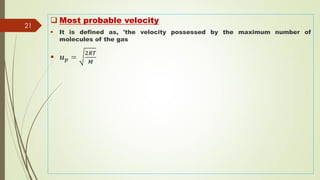
 Most probable velocity
 It is defined as, 'the velocity possessed by the maximum number of
molecules of the gas
 𝒖𝒑 =
𝟐𝑹𝑻
𝑴
21

Lecture 2 summary.pdf

  • 1.
  • 2.
    Volumes of Gasesin Chemical Reactions  We are often concerned with knowing the identity and/or quantity of a gas involved in a chemical reaction.  Thus, it is useful to be able to calculate the volumes of gases consumed or produced in reactions.  Such calculations are based on the mole concept and balanced chemical equations.  The coefficients in a balanced chemical equation tell us the relative amounts (in moles) of reactants and products in a reaction.  The ideal-gas equation relates the number of moles of a gas to 𝑷, 𝑽, 𝒂𝒏𝒅 𝑻. 2
  • 3.
    Gas Mixtures andPartial Pressures  How do we deal with mixtures of two or more different gases?  While studying the properties of air, John Dalton made an important observation:  The total pressure of a mixture of gases equals the sum of the pressures that each would exert if it were present alone.  The pressure exerted by a particular component of a mixture of gases is called the partial pressure of that component.  Dalton’s observation is known as Dalton’s law of partial pressures. 4
  • 4.
    Partial Pressure andMole Fractions  For an ideal gas, we can write  𝒚𝟏 = 𝒎𝒐𝒍𝒆𝒔 𝒐𝒇 𝒄𝒐𝒎𝒑𝒐𝒏𝒆𝒏𝒕 𝟏 𝒕𝒐𝒕𝒂𝒍 𝒎𝒐𝒍𝒆𝒔 = 𝒏𝟏 𝒏𝒕 𝑷𝟏 𝑷𝒕 = 𝒚𝟏 , 𝑷𝟏 = 𝒚𝟏𝑷𝒕 7
  • 5.
     The Kinetic–Molecular Theory of Gases  To understand :  Why does a gas expand when heated at constant pressure?  Why does its pressure increase when the gas is compressed at constant temperature?  Consider the kinetic-molecular theory of gases  The kinetic-molecular theory (the theory of moving molecules) is summarized by the following statements: 1. Gases consist of large numbers of molecules that are in continuous, random motion. 2. The combined volume of all the molecules of the gas is negligible relative to the total volume in which the gas is contained. 3. Attractive and repulsive forces between gas molecules are negligible (the molecules behave as if they were perfectly elastic solid spheres which rebound after collision without any loss of energy or change of velocity) 3. Energy can be transferred between molecules during collisions but, as long as temperature remains constant, the average kinetic energy of the molecules does not change with time 9
  • 6.
    5. The pressureof a gas is caused by collisions of the molecules with the walls of the container . 6. The average kinetic energy of the molecules is 𝜶 to the absolute temperature , the molecules of all gases have the same average kinetic energy at the same temperature. a. The absolute temperature of a gas is a measure of the average K.E of its molecules b. If two gases at the same temperature , their molecules have the same K.E c. If the absolute temperature of a gas is doubled , the average K.E of its molecules doubles. 10
  • 7.
     According toNewton's second law of motion, the rate of change of momentum (i.e., change of momentum per second) is the applied force. So, we have,  The gas pressure, by definition, is the force per unit area. Thus,  This equation is known as kinetic equation of gases. This equation gives the pressure exerted by an ideal gas.  For 1 mole of a gas, 𝑷𝑽 = 𝟏 𝟑 𝒎𝑵𝒖𝟐 , where N = Avogadro's number. 13
  • 8.
     Derivation theideal Equation 𝑷𝑽 = 𝑹𝑻 using the kinetic theory of gases  The average kinetic energy of the molecules is 𝜶 to the absolute temperature (statement # 6)  For 1 g mole of a gas, the value of constant, ( 𝟐 𝟑 𝒌), is equal to R, i.e., gas constant. Therefore, 14
  • 9.
    Consistency of VariousGas Laws  Boyle's law:   At constant temperature, kinetic energy (E) of the gas is constant.  𝑷𝑽 = 𝒄𝒐𝒏𝒔𝒕𝒂𝒏𝒕 , 𝟐 𝟑 ∗ 𝑬 = 𝒄𝒐𝒏𝒔𝒕𝒂𝒏𝒕 This is Boyle's law. 15
  • 10.
     Charles' law:  According to it, 'at constant pressure, the volume of a given mass of a gas is directly proportional to its absolute temperature, ' i.e.,  𝑽 𝜶 𝑻 𝒂𝒕 𝒄𝒐𝒏𝒔𝒕𝒂𝒏𝒕 𝑷  At constant pressure , so 𝟐 𝟑 ∗ 𝟏 𝑷 = 𝒄𝒐𝒏𝒔𝒕𝒂𝒏𝒕  Since, 𝑬 𝜶 𝑻 , 𝐰𝐡𝐞𝐫𝐞 𝑻 𝐢𝐬 𝐭𝐡𝐞 𝐚𝐛𝐬𝐨𝐥𝐮𝐭𝐞 𝐭𝐞𝐦𝐩𝐞𝐫𝐚𝐭𝐮𝐫𝐞  𝑽𝜶 𝑻 This is Charles' law. 16
  • 11.
     When thegases are also at the same temperature, their mean kinetic energy will also be the same, i.e.,  Dividing equation (1) by (2), we get, 𝒏𝟏 = 𝒏𝟐 , This is Avogadro's hypothesis.  From kinetic equation of gases, how to calculate the root mean square velocity, u, of gas molecules under different conditions? A. When only temperature is given  For 1 mole of a gas we have, from kinetic equation  Knowing the value of 𝑻, we can calculate 𝒖. 18
  • 12.
    B. When bothpressure and temperature are given  From kinetic equation, we have for 1 mole of a gas,  The value of V can be obtained from the above equation  where,  𝑷𝟎, 𝑽𝟎 𝒂𝒏𝒅 𝑻𝟎 arev correspond to STP conditions 19
  • 13.
    C. When bothpressure and density are given  For 1 mole of a gas, the kinetic equation is written as,  Knowing the values of 𝑷 and d, we can calculate 𝒖.  Average velocity (𝒗):  It is defined as, 'the average of the velocities of all molecules at any time  If 𝒖𝟏, 𝒖𝟐, 𝒖𝟑, … . 𝒖𝒏 are the velocities of individual molecules in a gas and 𝒏 is the total number of molecules contained in a gas, then the average velocity is given by,  𝒗 = 𝒖𝟏+𝒖𝟐+𝒖𝟑+⋯𝒖𝒏 𝒏  𝒗 = 𝟖𝑹𝑻 𝝅𝑴 20
  • 14.
     Most probablevelocity  It is defined as, 'the velocity possessed by the maximum number of molecules of the gas  𝒖𝒑 = 𝟐𝑹𝑻 𝑴 21