The Behavior of Gases
Science 10
Science 10
Properties of Gases (Review)

No definite shape
No definite shape

No definite volume
No definite volume

Compressible
Compressible
Examples of Gases (Review)

Air
Air

Helium
Helium

Ozone
Ozone

Carbon dioxide
Carbon dioxide

Water vapor
Water vapor
Kinetic Molecular Theory
moving molecules well supported ideas
Examples of KMT:
Examples of KMT:
1.
1. Ice melts when you remove it from the
Ice melts when you remove it from the
freezer.
freezer.
2.
2. A balloon bursts on a warm day.
A balloon bursts on a warm day.
3.
3. Dry ice disappears without being noticed.
Dry ice disappears without being noticed.
4.
4. Mist
Mist appears on the surface of your
appears on the surface of your
eyeglasses after you come out of a
cold room.
cold room.
5.
5. You
You feel a cool sensation after you get
feel a cool sensation after you get
out of a pool.
out of a pool.
Basic Kinetic Theory of Gases
1.
1. Composed of particles like
Composed of particles like
atoms (ex: He) or molecules like
(O
(O2
2 and CO
and CO2
2)
)
There are no attractive/repulsive
forces.
forces.
Lots of empty space.
Basic Kinetic Theory of Gases
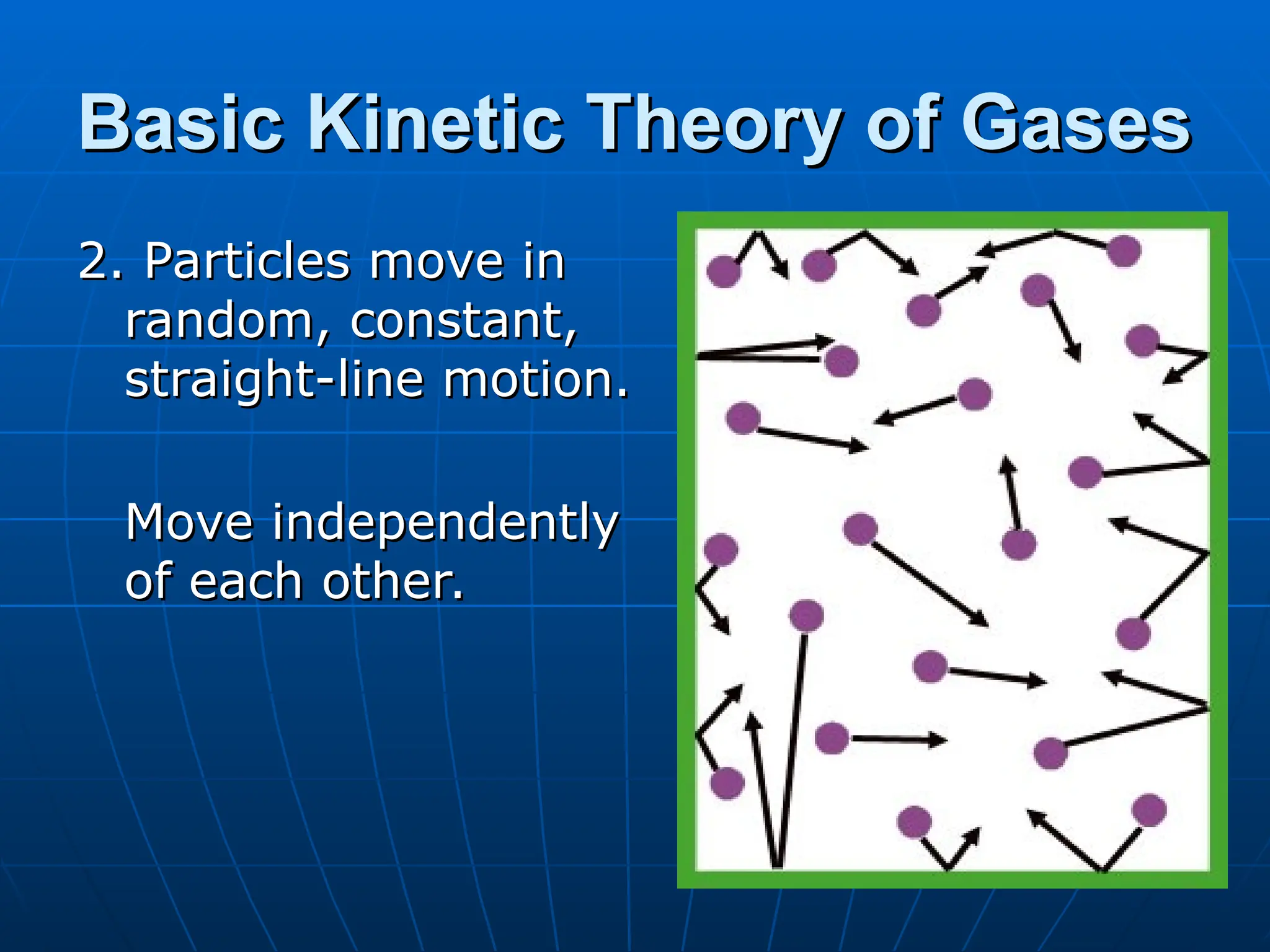
2. Particles move in
random, constant,
random, constant,
straight-line motion.
Move independently
Move independently
of each other.
of each other.
Basic Kinetic Theory of Gases
3. All collisions are elastic meaning
that KE is transferred without loss of
energy.
energy.
No change in kinetic energy.
Gases tend to diffuse towards areas
of
of lower concentration
lower concentration.
.
Gas Pressure
Gas Pressure

Pressure
Pressure- force exerted on container
- force exerted on container
walls by particles in a gas

Units used-
Units used- kPa, atm, Torr, mmHg
kPa, atm, Torr, mmHg

STP (Standard Temperature and
Pressure)
Pressure)

Temperature: 273.15 K or 0°C

Pressure: 1 atm = 760 mmHg
= 760 torr
= 760 torr
= 101.325 kPa
= 101.325 kPa
Factors Affecting Pressure
Amount of
Amount of
Gas (number
Gas (number
of moles)
of moles)
Increasing amount
Increasing amount
will increase P (and
vice versa)
vice versa)
Ex: bicycle tires,
Ex: bicycle tires,
car tires
car tires
Temperature
Temperature Increasing temp.
Increasing temp.
will increase P (and
vice versa)
vice versa)
Ex: Tires deflate
Ex: Tires deflate
in winter
in winter
Volume
Volume Decreasing volume
Decreasing volume
will increase P,
will increase P,
increasing volume
increasing volume
decreases P
decreases P
Ex: press down
Ex: press down
on a balloon and
on a balloon and
it pops
it pops

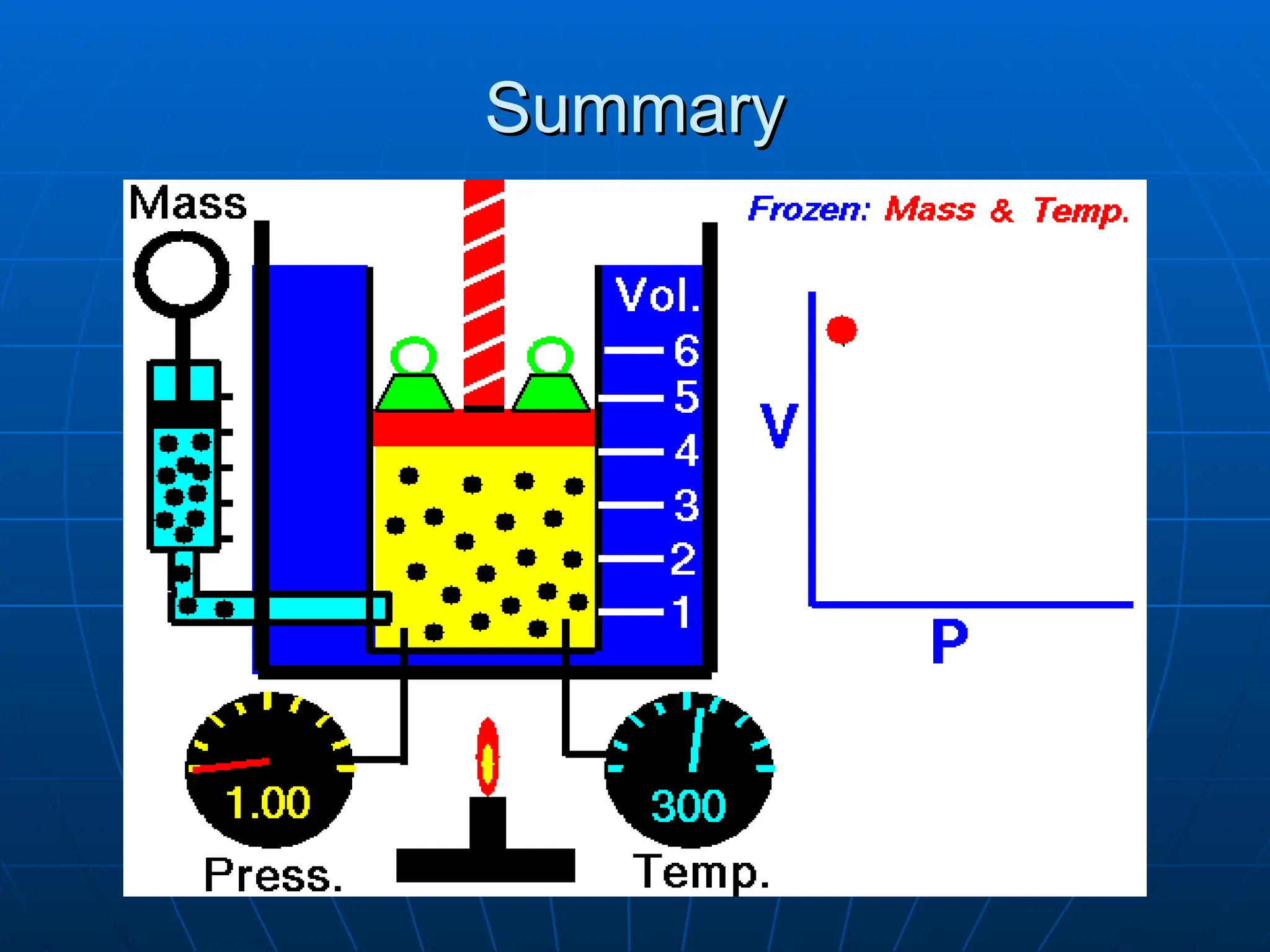
Pressure
Pressure and
and volume
volume have an inverse
have an inverse
relationship, if
relationship, if temperature remains
temperature remains
constant
constant.
.

If
If volume
volume is increased,
is increased, pressure
pressure is
is
decreased by the same factor.
Mathematically, the product of PV is constant or
PV = k (where k is some constant).
Boyle’ Law
P1 V1 = P2 V2 = P3 V3…
Summary
Summary

Volume
Volume and
and temperature
temperature have a
have a
direct relationship, if
direct relationship, if pressure is held
pressure is held
constant
constant.
.

If
If temperature (K)
temperature (K) is increased,
is increased,
volume
volume is increased by the same
is increased by the same
factor.
factor.
Mathematically, the relationship of volume divided
by Kelvin temperature is constant or V/T = k.
Charles’ Law
V1 /T1 = V2 /T2 = V3 /T3 …
Summary
Summary

Pressure
Pressure and
and temperature
temperature have a
have a
direct relationship, if
direct relationship, if volume remains
volume remains
constant.
constant.

If
If temperature (K)
temperature (K) is increased,
is increased,
pressure
pressure will be increased by the
will be increased by the
same factor.
same factor.
Mathematically, the relationship of volume divided
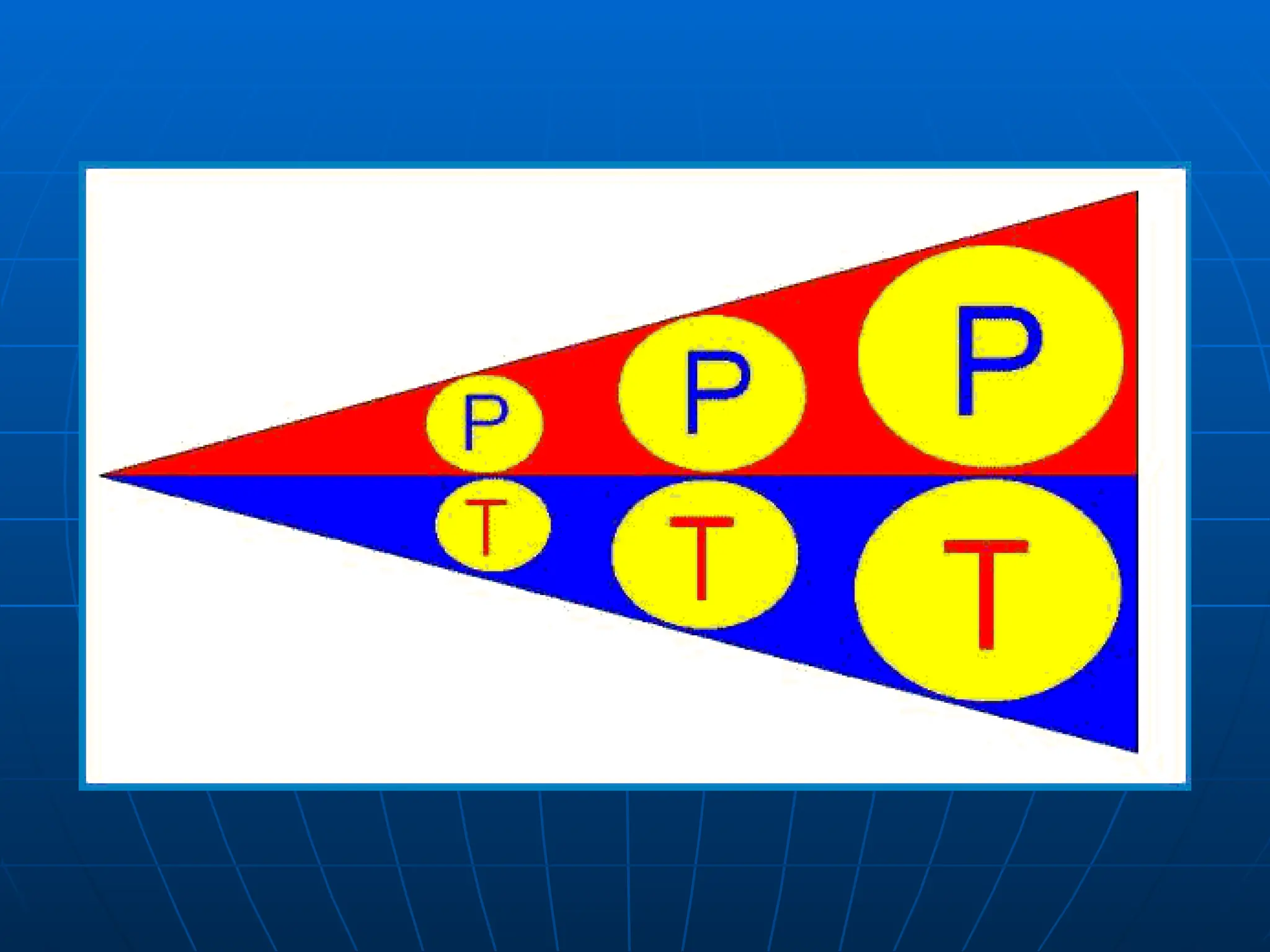
by Kelvin temperature is constant or P/T = k.
P
r
e
s
s
u
r
e
Gay-Lussac’s Law
P1 /T1 = P2 /T2 = P3 /T3 …
Combined Gas Law Equation
P
P1
1 V
V1
1 =
= P
P2
2 V
V2
2
T
T1
1 T
T2
2
Combined Gas Law Equation

Steps:
Steps:

Determine which variable (if any) is kept
constant.
constant.

Cancel those terms and remove them from
the equation (Ex: If the question says that
temperature remains constant the new
equation becomes P
equation becomes P1
1V
V1
1 = P
= P2
2V
V2
2).
).

Plug in values that are given.

Solve for the unknown.

Be sure to always use temperature in
Kelvins.
Kelvins.
Ideal Gases vs. Real Gases

“
“Ideal gases”
Ideal gases” behave as predicted
behave as predicted
by
by Kinetic Molecular Theory.
Kinetic Molecular Theory.
 Examples:
Examples: H
H2
2 and
and He
He

Gases are most ideal at
Gases are most ideal at high
high
temperature
temperature and
and low pressure
low pressure (also
(also
have low mass and low polarity).

“
“Real gases”
Real gases” deviate from ideal
deviate from ideal
behavior.
behavior.

Why?
Why?

At low temps, gas particles
become
become attracted to each other
attracted to each other
(KMT says they are not).

Under high pressure, gases
Under high pressure, gases occupy
occupy
a specific volume
a specific volume (KMT says they
(KMT says they
don’t).
don’t).
Avogadro’s Law
Avogadro’s Law

Avogadro’s number: 6.02 x 10
Avogadro’s number: 6.02 x 10²³
23

Simply refers to the quantity of particles
found in a
found in a mole
mole.
.

At STP, 6.02 x 10
At STP, 6.02 x 10²³
23
particles of a gas
particles of a gas
occupies
occupies 22.4 L
22.4 L.
.

At STP, 3.01 x 10
At STP, 3.01 x 10²³
23
particles of a gas
particles of a gas
occupies
occupies 11.2 L
11.2 L.
.

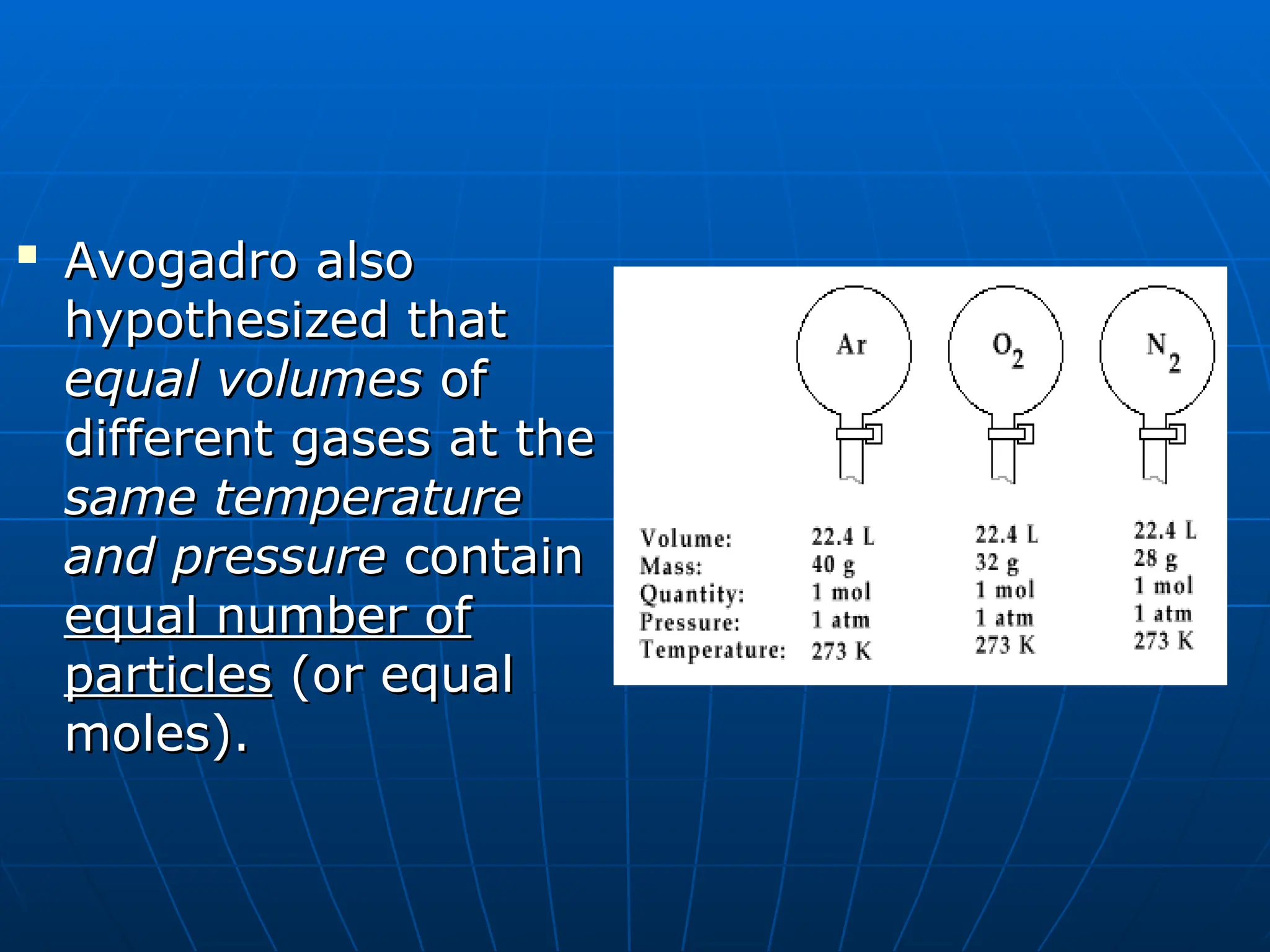
Avogadro also
Avogadro also
hypothesized that
hypothesized that
equal volumes
equal volumes of
of
different gases at the
same temperature
same temperature
and pressure
and pressure contain
contain
equal number of
equal number of
particles
particles (or equal
(or equal
moles).
moles).
Vapor Pressure
Vapor Pressure

In a sealed container,
In a sealed container, vapor pressure
vapor pressure
can be measured above a liquid.

Evaporation occurs when
Evaporation occurs when some
some
particles from the surface of a liquid
escape
escape causing pressure to build up
causing pressure to build up
above the liquid (not to be confused
with boiling).
with boiling).
Factors that Increase the Rate of
Evaporation
Evaporation

Heating a liquid (not to
boiling point)
boiling point)

Increasing surface area

Create air currents
Create air currents
(blow across the surface)
Liquid-Vapor Equilibrium

Some of the gas particles condense
and then we find
and then we find both evaporating
both evaporating
and condensing occurs at the same
rate.
rate.

Rate of Evaporation = Rate of Condensation
Related to Boiling
Related to Boiling

Boiling occurs when the
Boiling occurs when the vapor
vapor
pressure
pressure becomes equal to the
becomes equal to the
external pressure
external pressure.
.

At normal atmospheric pressure, we
call this
call this normal boiling point
normal boiling point.
.
Boiling and Attractive
(Intermolecular Forces)

Boiling occurs when
Boiling occurs when heat energy
heat energy
overcomes attractive forces between
molecules.
molecules.

The stronger the
The stronger the intermolecular forces
intermolecular forces, the
, the
higher the
higher the boiling point
boiling point.
.

The weaker the
The weaker the intermolecular forces
intermolecular forces, the
, the
lower the
lower the boiling point
boiling point.
.
Table H
Table H
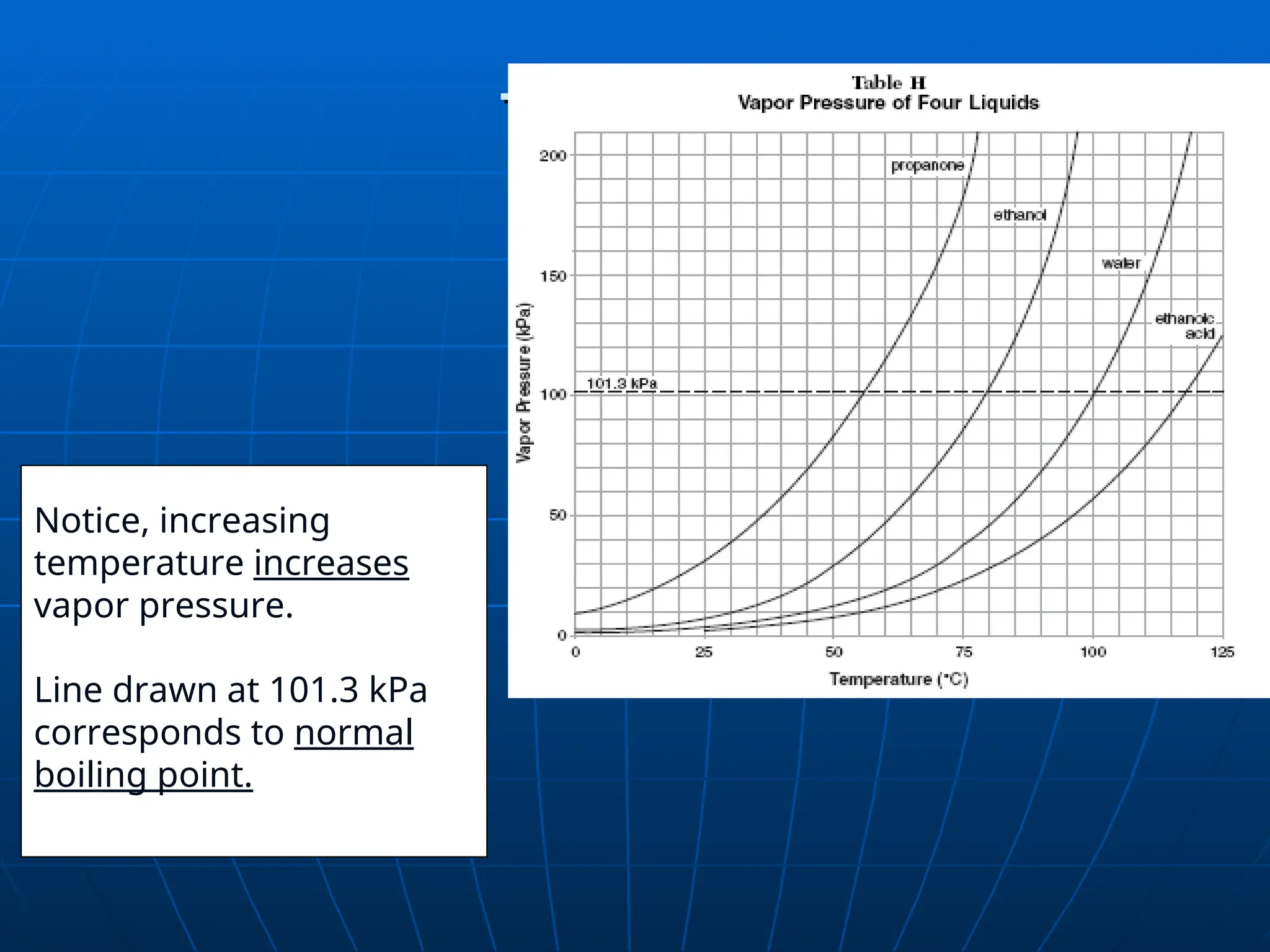
Notice, increasing
temperature increases
vapor pressure.
Line drawn at 101.3 kPa
corresponds to normal
boiling point.

behavior_of_gases_core is important to study

  • 1.
    The Behavior ofGases The Behavior of Gases Science 10 Science 10
  • 2.
    Properties of Gases(Review) Properties of Gases (Review)  No definite shape No definite shape  No definite volume No definite volume  Compressible Compressible
  • 3.
    Examples of Gases(Review) Examples of Gases (Review)  Air Air  Helium Helium  Ozone Ozone  Carbon dioxide Carbon dioxide  Water vapor Water vapor
  • 5.
    Kinetic Molecular Theory KineticMolecular Theory moving molecules well supported ideas
  • 6.
    Examples of KMT: Examplesof KMT: 1. 1. Ice melts when you remove it from the Ice melts when you remove it from the freezer. freezer. 2. 2. A balloon bursts on a warm day. A balloon bursts on a warm day. 3. 3. Dry ice disappears without being noticed. Dry ice disappears without being noticed. 4. 4. Mist Mist appears on the surface of your appears on the surface of your eyeglasses after you come out of a eyeglasses after you come out of a cold room. cold room. 5. 5. You You feel a cool sensation after you get feel a cool sensation after you get out of a pool. out of a pool.
  • 7.
    Basic Kinetic Theoryof Gases Basic Kinetic Theory of Gases 1. 1. Composed of particles like Composed of particles like atoms (ex: He) or molecules like atoms (ex: He) or molecules like (O (O2 2 and CO and CO2 2) ) There are no attractive/repulsive There are no attractive/repulsive forces. forces. Lots of empty space. Lots of empty space.
  • 8.
    Basic Kinetic Theoryof Gases Basic Kinetic Theory of Gases 2. Particles move in 2. Particles move in random, constant, random, constant, straight-line motion. straight-line motion. Move independently Move independently of each other. of each other.
  • 9.
    Basic Kinetic Theoryof Gases Basic Kinetic Theory of Gases 3. All collisions are elastic meaning 3. All collisions are elastic meaning that KE is transferred without loss of that KE is transferred without loss of energy. energy. No change in kinetic energy. No change in kinetic energy. Gases tend to diffuse towards areas Gases tend to diffuse towards areas of of lower concentration lower concentration. .
  • 10.
    Gas Pressure Gas Pressure  Pressure Pressure-force exerted on container - force exerted on container walls by particles in a gas walls by particles in a gas  Units used- Units used- kPa, atm, Torr, mmHg kPa, atm, Torr, mmHg  STP (Standard Temperature and STP (Standard Temperature and Pressure) Pressure)  Temperature: 273.15 K or 0°C Temperature: 273.15 K or 0°C  Pressure: 1 atm = 760 mmHg Pressure: 1 atm = 760 mmHg = 760 torr = 760 torr = 101.325 kPa = 101.325 kPa
  • 11.
    Factors Affecting Pressure FactorsAffecting Pressure Amount of Amount of Gas (number Gas (number of moles) of moles) Increasing amount Increasing amount will increase P (and will increase P (and vice versa) vice versa) Ex: bicycle tires, Ex: bicycle tires, car tires car tires Temperature Temperature Increasing temp. Increasing temp. will increase P (and will increase P (and vice versa) vice versa) Ex: Tires deflate Ex: Tires deflate in winter in winter Volume Volume Decreasing volume Decreasing volume will increase P, will increase P, increasing volume increasing volume decreases P decreases P Ex: press down Ex: press down on a balloon and on a balloon and it pops it pops
  • 12.
     Pressure Pressure and and volume volumehave an inverse have an inverse relationship, if relationship, if temperature remains temperature remains constant constant. .  If If volume volume is increased, is increased, pressure pressure is is decreased by the same factor. decreased by the same factor.
  • 13.
    Mathematically, the productof PV is constant or Mathematically, the product of PV is constant or PV = k (where k is some constant). PV = k (where k is some constant). Boyle’ Law P1 V1 = P2 V2 = P3 V3…
  • 14.
  • 15.
     Volume Volume and and temperature temperaturehave a have a direct relationship, if direct relationship, if pressure is held pressure is held constant constant. .  If If temperature (K) temperature (K) is increased, is increased, volume volume is increased by the same is increased by the same factor. factor.
  • 16.
    Mathematically, the relationshipof volume divided Mathematically, the relationship of volume divided by Kelvin temperature is constant or V/T = k. by Kelvin temperature is constant or V/T = k. Charles’ Law V1 /T1 = V2 /T2 = V3 /T3 …
  • 17.
  • 18.
     Pressure Pressure and and temperature temperaturehave a have a direct relationship, if direct relationship, if volume remains volume remains constant. constant.  If If temperature (K) temperature (K) is increased, is increased, pressure pressure will be increased by the will be increased by the same factor. same factor.
  • 19.
    Mathematically, the relationshipof volume divided Mathematically, the relationship of volume divided by Kelvin temperature is constant or P/T = k. by Kelvin temperature is constant or P/T = k. P r e s s u r e Gay-Lussac’s Law P1 /T1 = P2 /T2 = P3 /T3 …
  • 21.
    Combined Gas LawEquation Combined Gas Law Equation P P1 1 V V1 1 = = P P2 2 V V2 2 T T1 1 T T2 2
  • 22.
    Combined Gas LawEquation Combined Gas Law Equation  Steps: Steps:  Determine which variable (if any) is kept Determine which variable (if any) is kept constant. constant.  Cancel those terms and remove them from Cancel those terms and remove them from the equation (Ex: If the question says that the equation (Ex: If the question says that temperature remains constant the new temperature remains constant the new equation becomes P equation becomes P1 1V V1 1 = P = P2 2V V2 2). ).  Plug in values that are given. Plug in values that are given.  Solve for the unknown. Solve for the unknown.  Be sure to always use temperature in Be sure to always use temperature in Kelvins. Kelvins.
  • 23.
    Ideal Gases vs.Real Gases Ideal Gases vs. Real Gases  “ “Ideal gases” Ideal gases” behave as predicted behave as predicted by by Kinetic Molecular Theory. Kinetic Molecular Theory.  Examples: Examples: H H2 2 and and He He  Gases are most ideal at Gases are most ideal at high high temperature temperature and and low pressure low pressure (also (also have low mass and low polarity). have low mass and low polarity).
  • 24.
     “ “Real gases” Real gases”deviate from ideal deviate from ideal behavior. behavior.  Why? Why?  At low temps, gas particles At low temps, gas particles become become attracted to each other attracted to each other (KMT says they are not). (KMT says they are not).  Under high pressure, gases Under high pressure, gases occupy occupy a specific volume a specific volume (KMT says they (KMT says they don’t). don’t).
  • 25.
    Avogadro’s Law Avogadro’s Law  Avogadro’snumber: 6.02 x 10 Avogadro’s number: 6.02 x 10²³ 23  Simply refers to the quantity of particles Simply refers to the quantity of particles found in a found in a mole mole. .  At STP, 6.02 x 10 At STP, 6.02 x 10²³ 23 particles of a gas particles of a gas occupies occupies 22.4 L 22.4 L. .  At STP, 3.01 x 10 At STP, 3.01 x 10²³ 23 particles of a gas particles of a gas occupies occupies 11.2 L 11.2 L. .
  • 26.
     Avogadro also Avogadro also hypothesizedthat hypothesized that equal volumes equal volumes of of different gases at the different gases at the same temperature same temperature and pressure and pressure contain contain equal number of equal number of particles particles (or equal (or equal moles). moles).
  • 27.
    Vapor Pressure Vapor Pressure  Ina sealed container, In a sealed container, vapor pressure vapor pressure can be measured above a liquid. can be measured above a liquid.  Evaporation occurs when Evaporation occurs when some some particles from the surface of a liquid particles from the surface of a liquid escape escape causing pressure to build up causing pressure to build up above the liquid (not to be confused above the liquid (not to be confused with boiling). with boiling).
  • 29.
    Factors that Increasethe Rate of Factors that Increase the Rate of Evaporation Evaporation  Heating a liquid (not to Heating a liquid (not to boiling point) boiling point)  Increasing surface area Increasing surface area  Create air currents Create air currents (blow across the surface) (blow across the surface)
  • 30.
    Liquid-Vapor Equilibrium Liquid-Vapor Equilibrium  Someof the gas particles condense Some of the gas particles condense and then we find and then we find both evaporating both evaporating and condensing occurs at the same and condensing occurs at the same rate. rate.  Rate of Evaporation = Rate of Condensation Rate of Evaporation = Rate of Condensation
  • 31.
    Related to Boiling Relatedto Boiling  Boiling occurs when the Boiling occurs when the vapor vapor pressure pressure becomes equal to the becomes equal to the external pressure external pressure. .  At normal atmospheric pressure, we At normal atmospheric pressure, we call this call this normal boiling point normal boiling point. .
  • 32.
    Boiling and Attractive Boilingand Attractive (Intermolecular Forces) (Intermolecular Forces)  Boiling occurs when Boiling occurs when heat energy heat energy overcomes attractive forces between overcomes attractive forces between molecules. molecules.  The stronger the The stronger the intermolecular forces intermolecular forces, the , the higher the higher the boiling point boiling point. .  The weaker the The weaker the intermolecular forces intermolecular forces, the , the lower the lower the boiling point boiling point. .
  • 33.
    Table H Table H Notice,increasing temperature increases vapor pressure. Line drawn at 101.3 kPa corresponds to normal boiling point.