PRESENT PERFECT
                       LET’S THINK BEFORE
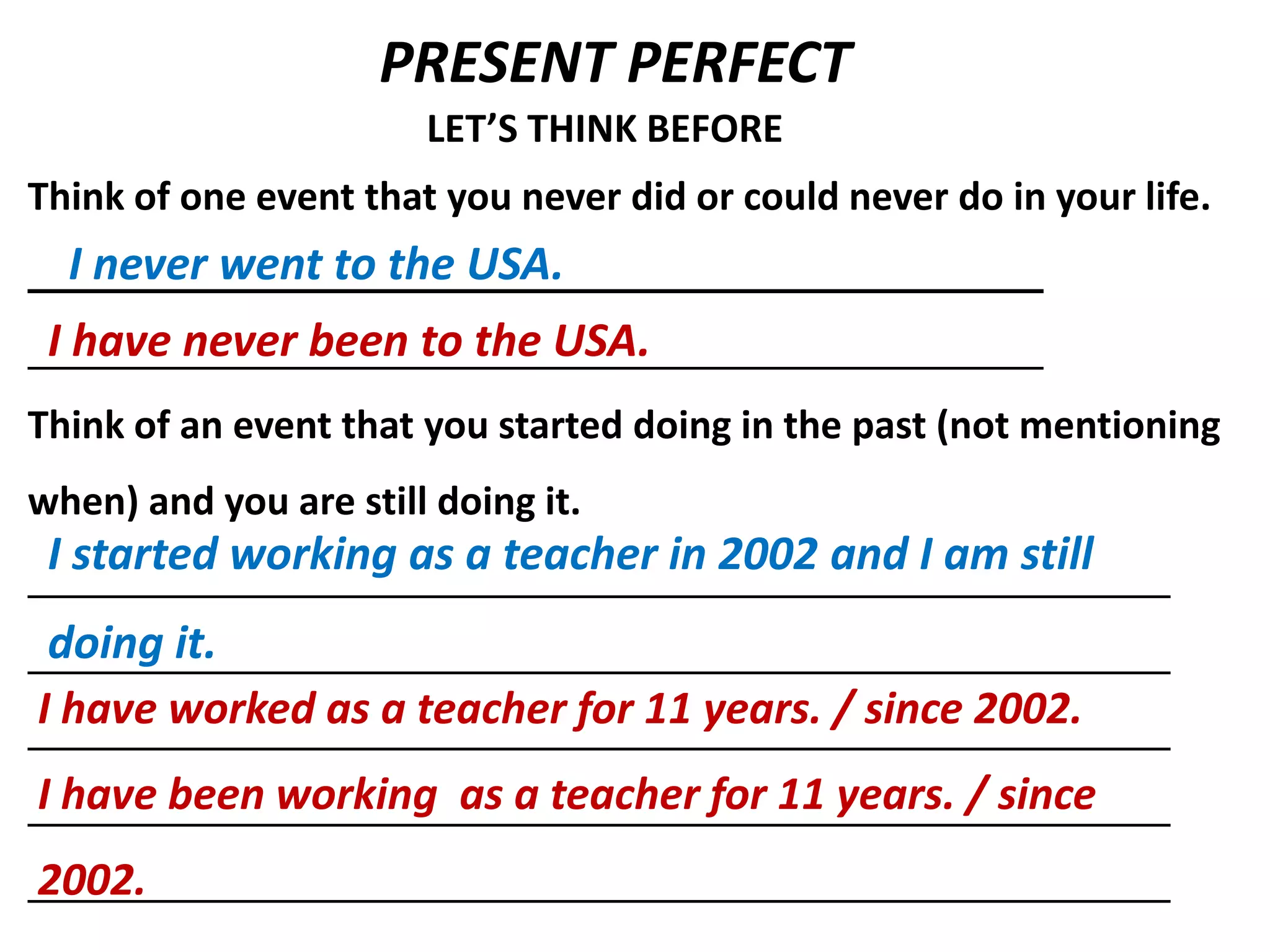
Think of one event that you never did or could never do in your life.
  I never went to the USA.
 I have never been to the USA.
Think of an event that you started doing in the past (not mentioning
when) and you are still doing it.
 I started working as a teacher in 2002 and I am still
 doing it.
I have worked as a teacher for 11 years. / since 2002.
I have been working as a teacher for 11 years. / since
2002.
PRESENT PERFECT
                   LET’S THINK BEFORE
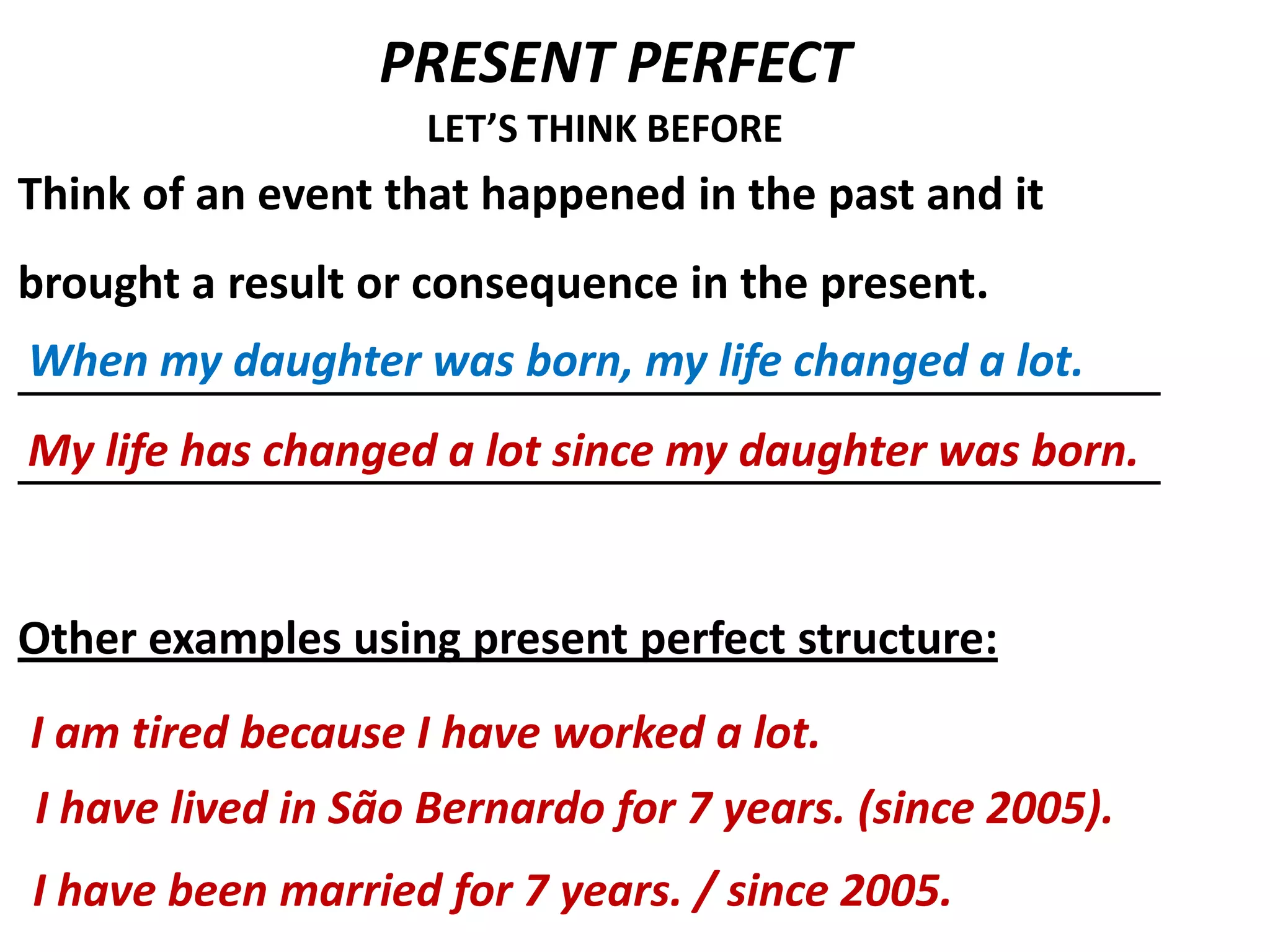
Think of an event that happened in the past and it
brought a result or consequence in the present.
When my daughter was born, my life changed a lot.
My life has changed a lot since my daughter was born.


Other examples using present perfect structure:
I am tired because I have worked a lot.
I have lived in São Bernardo for 7 years. (since 2005).
I have been married for 7 years. / since 2005.
PRESENT PERFECT
                    ASPECTS TO BE CONSIDERED:
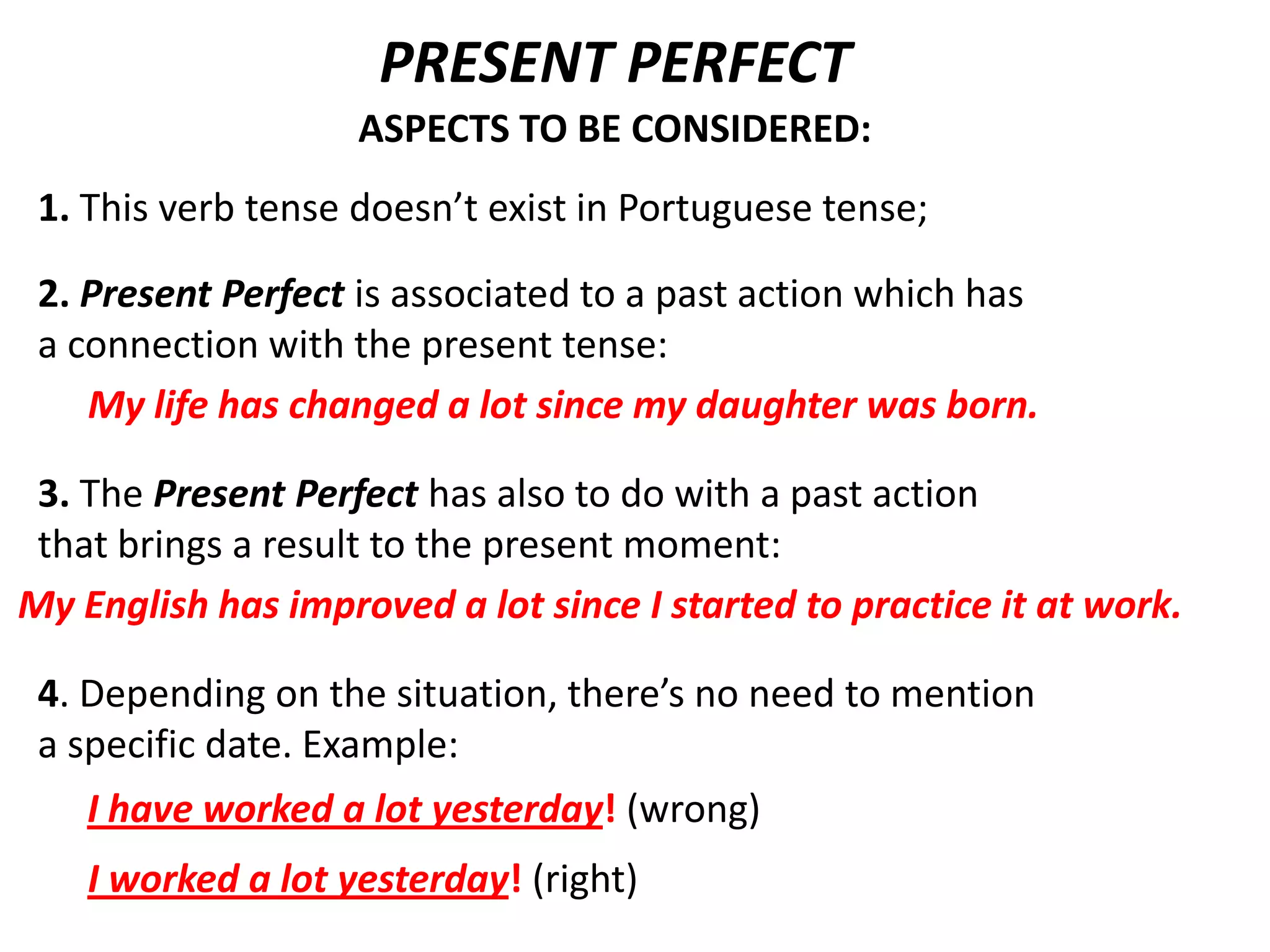
 1. This verb tense doesn’t exist in Portuguese tense;

 2. Present Perfect is associated to a past action which has
 a connection with the present tense:
    My life has changed a lot since my daughter was born.

 3. The Present Perfect has also to do with a past action
 that brings a result to the present moment:
My English has improved a lot since I started to practice it at work.

 4. Depending on the situation, there’s no need to mention
 a specific date. Example:
    I have worked a lot yesterday! (wrong)
    I worked a lot yesterday! (right)
PRESENT PERFECT
                    ASPECTS TO BE CONSIDERED:

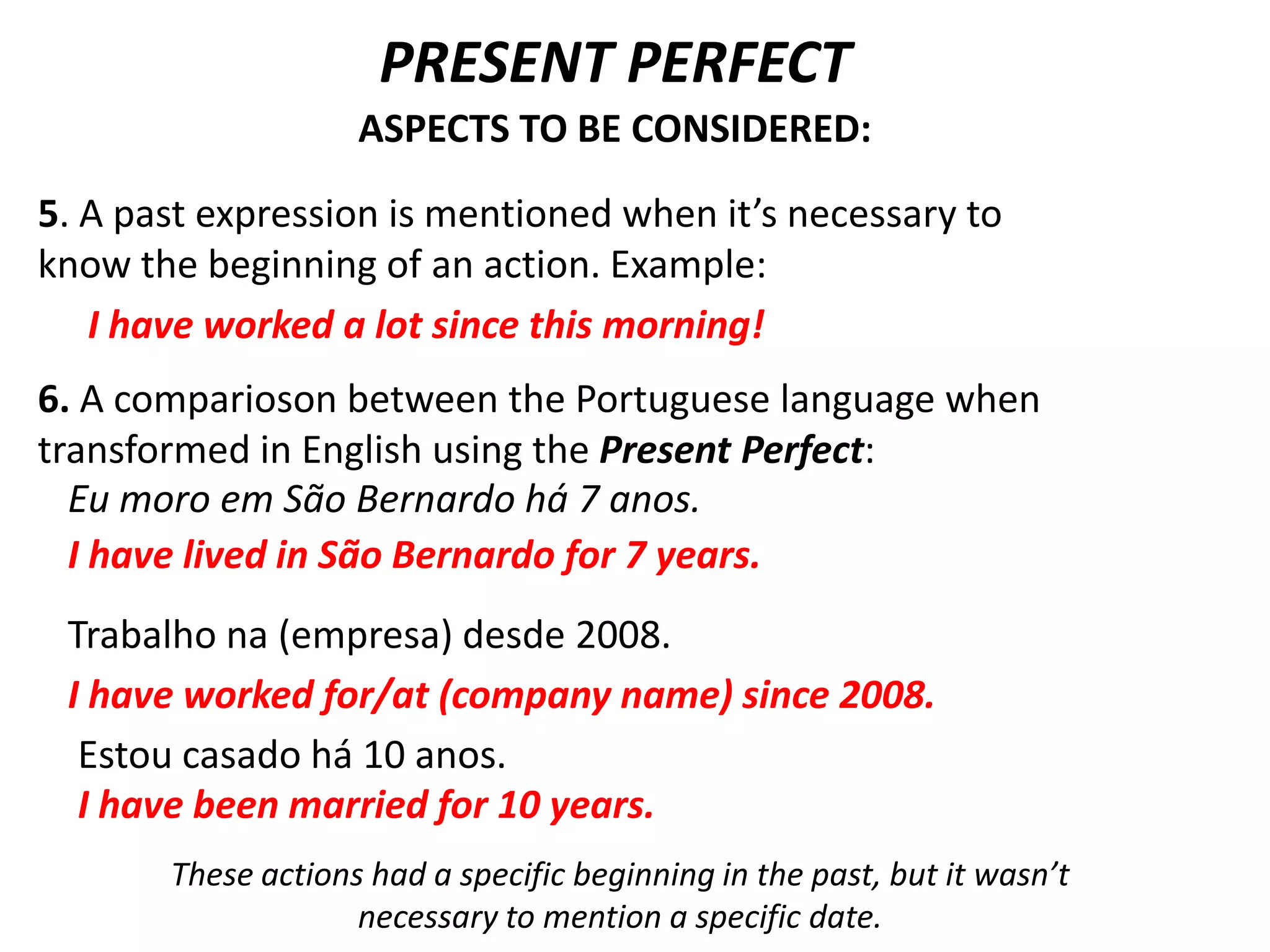
5. A past expression is mentioned when it’s necessary to
know the beginning of an action. Example:
   I have worked a lot since this morning!
6. A comparioson between the Portuguese language when
transformed in English using the Present Perfect:
  Eu moro em São Bernardo há 7 anos.
  I have lived in São Bernardo for 7 years.
 Trabalho na (empresa) desde 2008.
 I have worked for/at (company name) since 2008.
  Estou casado há 10 anos.
  I have been married for 10 years.
       These actions had a specific beginning in the past, but it wasn’t
                    necessary to mention a specific date.
PRESENT PERFECT
                  ASPECTS TO BE CONSIDERED:


                   BEEN or GONE????
7. have+been is used to say that a person went
somewhere and returned:
I have been to Caldas Novas twice.

8. have+gone is used to say that a person went
somewhere and is still there:
Sorry, but he has already gone! He won’t come back today!
PRESENT PERFECT
                         ASPECTS TO BE CONSIDERED:

PRESENT PERFECT WORDS

Already = action finished minutes or hours ago
I have already finished the exercises (I finished them yesterday)

Just = action finished seconds ago
I have just done the exercises (I finished the exercises right now)

Yet = negative / Can be used in questions
I haven’t done the exercises yet. (I didn’t finish the exercises / I’m still doing them)
Have you finished the exercises yet?

Ever = for questions (an action that never happened in your life)
Have you ever been to Disney?

Never = for affirmatives statements (which gives negative ideas)
I’ve never been to Disney.
PRESENT PERFECT
                        ASPECTS TO BE CONSIDERED:
PRESENT PERFECT WORDS

For = for period of time
I’ve talked in English on the phone for 5 times.
I’ve worked at FORD for 5 years.
I’ve been studying English for 3 years.

Since = for months, years, weeks…
I’ve been studying English since 2003.
Also for actions that started in a specific point in the past
I’ve been working since this morning.
We haven’t talked since 3 o’clock.

Lately = for recent actions
What have you been doing lately?

Recently = for recent actions
What have you been doing recently?
PRESENT PERFECT
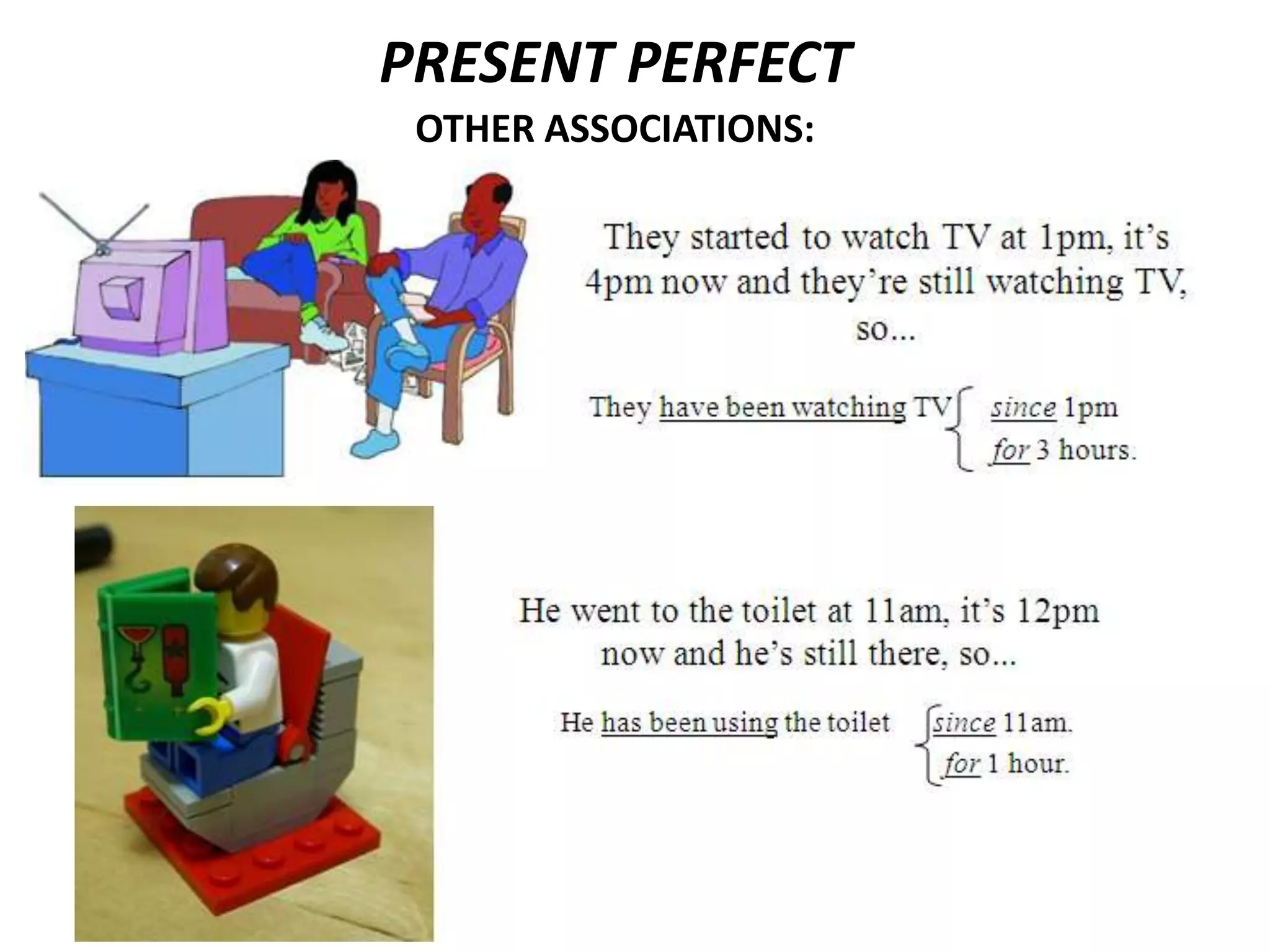
 OTHER ASSOCIATIONS:
PRESENT PERFECT
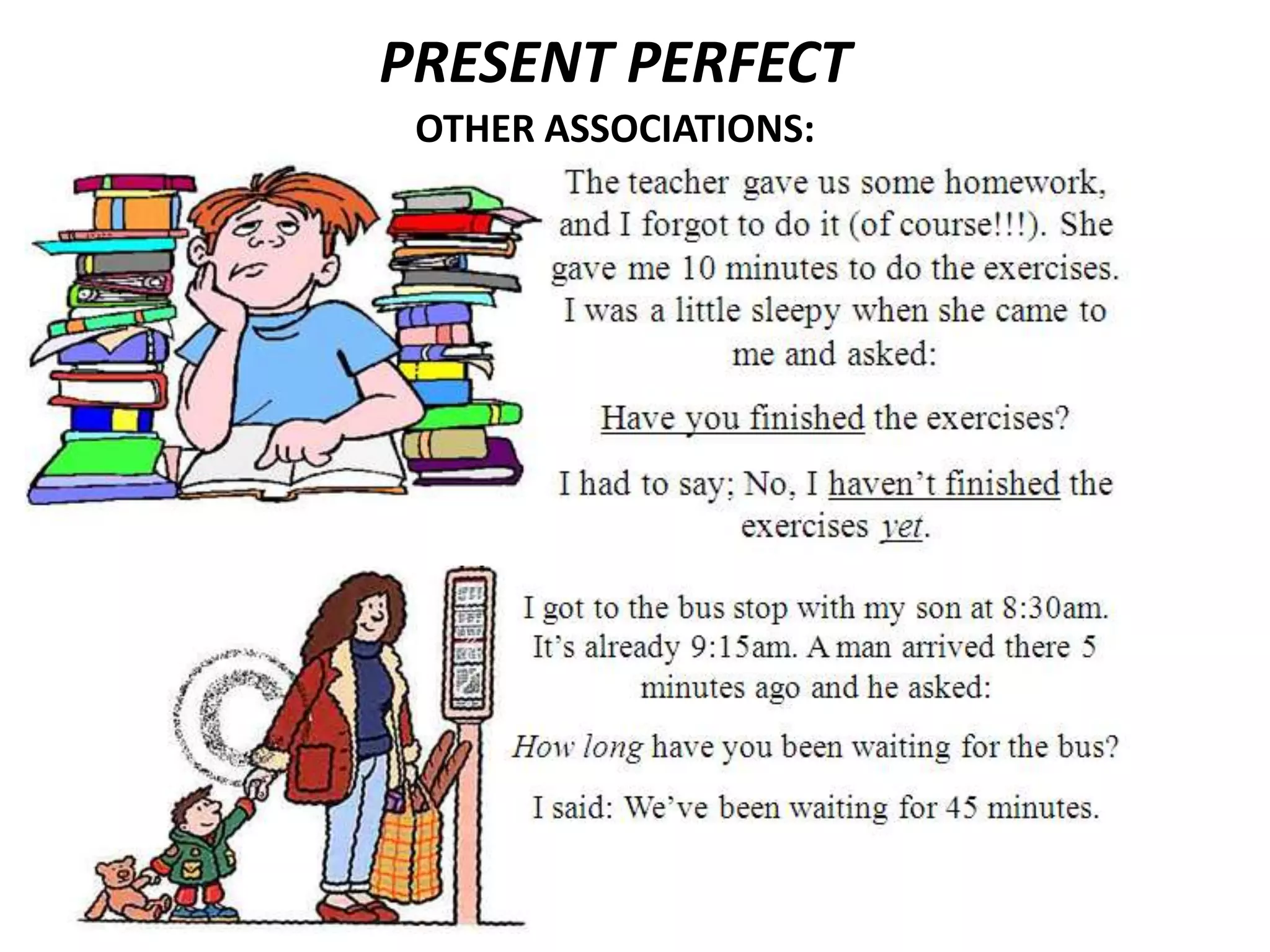
 OTHER ASSOCIATIONS:
PRESENT PERFECT
 OTHER ASSOCIATIONS:
PRESENT PERFECT
 OTHER ASSOCIATIONS:
PRESENT PERFECT
 OTHER ASSOCIATIONS:
PRESENT PERFECT
 OTHER ASSOCIATIONS:
PRESENT PERFECT
               EXERCISES – since/for
SINCE   I CRASHED MY CAR       SINCE   THE DAY I MET YOU

SINCE   1997                 SINCE     LAST YEAR

FOR     TWO NIGHTS           FOR       THREE HOURS

FOR     1 CENTURY            FOR       20 YEARS

FOR     2 DECADES            FOR       10 MINUTES

SINCE   I WAS BORN           SINCE     AUGUST

SINCE   THE CLASS STARTED    FOR       TWO WEEKS

SINCE   CORINTHIANS WON THE LIBERTADORES
PRESENT PERFECT
                      TO MAKE IT CLEARER!!!
Write:
a place you never went to: _______________
a place you visited recently:_______________

a book you never read(/red/):_________________
a book you read(/red/) recently:_______________

a film you never saw:_________________
a film you saw recently:________________

an activity you didn't finish:___________________
an activity you finished recently:_________________

a person you don't see for a long time:_________________
a person you saw recently:__________________
PRESENT PERFECT
                      TO MAKE IT CLEARER!!!
Speaking wrong English in correct Portuguese:
I never went to the USA. (Eu nunca fui pros Estados Unidos)
I already went to Santa Catarina.(Eu já fui pra Santa Catarina) ou
(Eu já estive em Santa Catarina)

I never read(/red/) "O menino do pijama listrado". (Eu nunca li...)
I already read(/red/) the whole Bible.(Eu já li a Bíblia inteira).

I never saw "Twilight". (Eu nunca vi...)
I already saw "Titanic". (Eu já vi...)

I don't see my cousin Patricia for a long time.(Eu não vejo minha
prima Patrícia há anos)
I just saw my friend Carlos.(Acabei de ver meu colega Carlos)
PRESENT PERFECT
                             TO MAKE IT CLEARER!!!
In Portuguese we don’t have Present Perfect as a tense, that’s why we use the past
structure.
All the sentences before should be said this way:
Eu nunca fui pros Estados Unidos = I have never been to the USA.
Eu já fui pra Santa Catarina = I have already been to Santa Catarina.
Eu nunca li ‘O menino do pijama listrado’ = I have never read(/red/) "O menino do
pijama listrado".
Eu já li a Bíblia inteira = I have already read(/red/) the whole Bible.
Eu ainda não assisti “Twilight“ = I haven't seen "Twilight“ yet.
Eu já assisti “Titabnic”. = I have already seen “Titanic”.
Eu não vejo minha prima Patrícia há anos = I haven't seen my cousin for a long time.
Acabei de ver meu colega Carlos = I have just seen my friend Carlos.

SEE YA!                                                      pedro.dantas_jr@yahoo.com.br

Present perfect well explained (in english)

  • 1.
    PRESENT PERFECT LET’S THINK BEFORE Think of one event that you never did or could never do in your life. I never went to the USA. I have never been to the USA. Think of an event that you started doing in the past (not mentioning when) and you are still doing it. I started working as a teacher in 2002 and I am still doing it. I have worked as a teacher for 11 years. / since 2002. I have been working as a teacher for 11 years. / since 2002.
  • 2.
    PRESENT PERFECT LET’S THINK BEFORE Think of an event that happened in the past and it brought a result or consequence in the present. When my daughter was born, my life changed a lot. My life has changed a lot since my daughter was born. Other examples using present perfect structure: I am tired because I have worked a lot. I have lived in São Bernardo for 7 years. (since 2005). I have been married for 7 years. / since 2005.
  • 3.
    PRESENT PERFECT ASPECTS TO BE CONSIDERED: 1. This verb tense doesn’t exist in Portuguese tense; 2. Present Perfect is associated to a past action which has a connection with the present tense: My life has changed a lot since my daughter was born. 3. The Present Perfect has also to do with a past action that brings a result to the present moment: My English has improved a lot since I started to practice it at work. 4. Depending on the situation, there’s no need to mention a specific date. Example: I have worked a lot yesterday! (wrong) I worked a lot yesterday! (right)
  • 4.
    PRESENT PERFECT ASPECTS TO BE CONSIDERED: 5. A past expression is mentioned when it’s necessary to know the beginning of an action. Example: I have worked a lot since this morning! 6. A comparioson between the Portuguese language when transformed in English using the Present Perfect: Eu moro em São Bernardo há 7 anos. I have lived in São Bernardo for 7 years. Trabalho na (empresa) desde 2008. I have worked for/at (company name) since 2008. Estou casado há 10 anos. I have been married for 10 years. These actions had a specific beginning in the past, but it wasn’t necessary to mention a specific date.
  • 5.
    PRESENT PERFECT ASPECTS TO BE CONSIDERED: BEEN or GONE???? 7. have+been is used to say that a person went somewhere and returned: I have been to Caldas Novas twice. 8. have+gone is used to say that a person went somewhere and is still there: Sorry, but he has already gone! He won’t come back today!
  • 6.
    PRESENT PERFECT ASPECTS TO BE CONSIDERED: PRESENT PERFECT WORDS Already = action finished minutes or hours ago I have already finished the exercises (I finished them yesterday) Just = action finished seconds ago I have just done the exercises (I finished the exercises right now) Yet = negative / Can be used in questions I haven’t done the exercises yet. (I didn’t finish the exercises / I’m still doing them) Have you finished the exercises yet? Ever = for questions (an action that never happened in your life) Have you ever been to Disney? Never = for affirmatives statements (which gives negative ideas) I’ve never been to Disney.
  • 7.
    PRESENT PERFECT ASPECTS TO BE CONSIDERED: PRESENT PERFECT WORDS For = for period of time I’ve talked in English on the phone for 5 times. I’ve worked at FORD for 5 years. I’ve been studying English for 3 years. Since = for months, years, weeks… I’ve been studying English since 2003. Also for actions that started in a specific point in the past I’ve been working since this morning. We haven’t talked since 3 o’clock. Lately = for recent actions What have you been doing lately? Recently = for recent actions What have you been doing recently?
  • 8.
    PRESENT PERFECT OTHERASSOCIATIONS:
  • 9.
    PRESENT PERFECT OTHERASSOCIATIONS:
  • 10.
    PRESENT PERFECT OTHERASSOCIATIONS:
  • 11.
    PRESENT PERFECT OTHERASSOCIATIONS:
  • 12.
    PRESENT PERFECT OTHERASSOCIATIONS:
  • 13.
    PRESENT PERFECT OTHERASSOCIATIONS:
  • 14.
    PRESENT PERFECT EXERCISES – since/for SINCE I CRASHED MY CAR SINCE THE DAY I MET YOU SINCE 1997 SINCE LAST YEAR FOR TWO NIGHTS FOR THREE HOURS FOR 1 CENTURY FOR 20 YEARS FOR 2 DECADES FOR 10 MINUTES SINCE I WAS BORN SINCE AUGUST SINCE THE CLASS STARTED FOR TWO WEEKS SINCE CORINTHIANS WON THE LIBERTADORES
  • 15.
    PRESENT PERFECT TO MAKE IT CLEARER!!! Write: a place you never went to: _______________ a place you visited recently:_______________ a book you never read(/red/):_________________ a book you read(/red/) recently:_______________ a film you never saw:_________________ a film you saw recently:________________ an activity you didn't finish:___________________ an activity you finished recently:_________________ a person you don't see for a long time:_________________ a person you saw recently:__________________
  • 16.
    PRESENT PERFECT TO MAKE IT CLEARER!!! Speaking wrong English in correct Portuguese: I never went to the USA. (Eu nunca fui pros Estados Unidos) I already went to Santa Catarina.(Eu já fui pra Santa Catarina) ou (Eu já estive em Santa Catarina) I never read(/red/) "O menino do pijama listrado". (Eu nunca li...) I already read(/red/) the whole Bible.(Eu já li a Bíblia inteira). I never saw "Twilight". (Eu nunca vi...) I already saw "Titanic". (Eu já vi...) I don't see my cousin Patricia for a long time.(Eu não vejo minha prima Patrícia há anos) I just saw my friend Carlos.(Acabei de ver meu colega Carlos)
  • 17.
    PRESENT PERFECT TO MAKE IT CLEARER!!! In Portuguese we don’t have Present Perfect as a tense, that’s why we use the past structure. All the sentences before should be said this way: Eu nunca fui pros Estados Unidos = I have never been to the USA. Eu já fui pra Santa Catarina = I have already been to Santa Catarina. Eu nunca li ‘O menino do pijama listrado’ = I have never read(/red/) "O menino do pijama listrado". Eu já li a Bíblia inteira = I have already read(/red/) the whole Bible. Eu ainda não assisti “Twilight“ = I haven't seen "Twilight“ yet. Eu já assisti “Titabnic”. = I have already seen “Titanic”. Eu não vejo minha prima Patrícia há anos = I haven't seen my cousin for a long time. Acabei de ver meu colega Carlos = I have just seen my friend Carlos. SEE YA! pedro.dantas_jr@yahoo.com.br