ELS 134:
Instructional Materials
Development and Evaluation
Instructor:
MRS. DOLLY ANN D. CARACA, LPT, MAED-ET
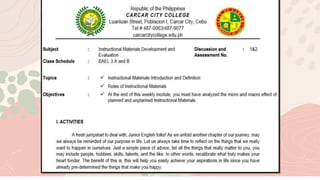
OBJECTIVES:
At the end of the session, you must have:
 defined Instructional Materials;
 analyzed the concept of backward design in IMs
preparation;
 identified the roles of IMs; and
 analyzed the micro and macro effect of planned and
unplanned IMs.
Based on the given examples, how
do you understand Instructional
Materials? What are these?
Warm up!
Let us surmise that you are now a teacher with 45 students in
a class. You would like to assess their reading comprehension skills
in an interactive way. You want to have it done in a big group
activity. What materials will you use? How can you be sure that it
will be an effective method or strategy? Address this situation using
21st Century Approach.
INSTRUCTIONAL MATERIALS
So what are instructional materials? Every teacher needs
supplies and resources in order to have a successful classroom.
Writing utensils, paper, and inspirational wall signs are all useful
objects in a classroom, but they are not instructional
materials. Instructional materials are the tools used in
educational lessons, which includes active learning and
assessment. Basically, any resource a teacher uses to help him
teach his students is an instructional material. There are many
types of instructional materials, but let's look at some of the most
common ones.
INSTRUCTIONAL MATERIALS
Instructional materials are the content or information
conveyed within a course. These include the lectures, readings,
textbooks, multimedia components, and other resources in a
course. These materials can be used in both face-to-face and
online classrooms; however, some must be modified or
redesigned to be effective for the online environment. The best
instructional materials are aligned with all other elements in the
course, including the learning objectives, assessments, and
activities.
INSTRUCTIONAL MATERIALS
Instructional materials refer to the HUMAN and non-
human materials and facilities that can be used to ease, encourage,
improved and promote teaching and learning activities. They are
whatever materials used in the process of instruction. They are a broad
range of resource which can be used to facilitate effective instruction.
They indicate a systematic way of designing, carrying out and employing
the total process of learning and communication and employing human
and non-human resources to bring out a more meaningful and effective
instruction. They are human and non-human material that a teacher uses
to pass information to the learner in his/her class.
What makes IMs important?
Instructional materials provide the core information
that students will experience, learn, and apply during a
course. They hold the power to either engage or
demotivate students. This is especially true for online
courses, which rely on a thoughtful and complete
collection of instructional materials that students will
access, explore, absorb, and reference as they proceed
in a course
What makes IMs important?
Therefore, such materials must be carefully
planned, selected, organized, refined, and used in a
course for the maximum effect. The planning and
selection of instructional materials should take into
consideration both the breadth and depth of content so
that student learning is optimized.
How to put this into practice?
Instructors and/or instructional designers should cast a
wide net and aim for a variety of materials to include in their
course. At the same time, they should be deliberate with these
choices so that the course has the appropriate combination of
instructional materials. In putting this to practice, reflect on the
principle below:
To begin with the end in mind means to start with a clear
understanding of your destination. It means to know where you’re
going so that you better understand where you are now and so that
the steps you take are always in the right direction.
-Stephen Covey
Teachers should begin their planning and know exactly what
they want the students to learn and demonstrate by the end of each
teaching-learning process. When teachers and students know
where they are going, they are more likely to achieve success
(Davies, 2011).
Backward design, also called backward
planning or backward mapping, is a process that educators use to
design learning experiences and instructional techniques to
achieve specific learning goals. Backward design begins with the
objectives of a unit or course—what students are expected to learn
and be able to do—and then proceeds “backward” to create lessons
that achieve those desired goals (Srinivasan, 2019).
ROLES OF INSTRUCTIONAL MATERIALS
Instructional Materials Development & Evaluation-PPT-1.pptx

Instructional Materials Development & Evaluation-PPT-1.pptx

  • 1.
    ELS 134: Instructional Materials Developmentand Evaluation Instructor: MRS. DOLLY ANN D. CARACA, LPT, MAED-ET
  • 2.
    OBJECTIVES: At the endof the session, you must have:  defined Instructional Materials;  analyzed the concept of backward design in IMs preparation;  identified the roles of IMs; and  analyzed the micro and macro effect of planned and unplanned IMs.
  • 7.
    Based on thegiven examples, how do you understand Instructional Materials? What are these?
  • 8.
    Warm up! Let ussurmise that you are now a teacher with 45 students in a class. You would like to assess their reading comprehension skills in an interactive way. You want to have it done in a big group activity. What materials will you use? How can you be sure that it will be an effective method or strategy? Address this situation using 21st Century Approach.
  • 9.
    INSTRUCTIONAL MATERIALS So whatare instructional materials? Every teacher needs supplies and resources in order to have a successful classroom. Writing utensils, paper, and inspirational wall signs are all useful objects in a classroom, but they are not instructional materials. Instructional materials are the tools used in educational lessons, which includes active learning and assessment. Basically, any resource a teacher uses to help him teach his students is an instructional material. There are many types of instructional materials, but let's look at some of the most common ones.
  • 10.
    INSTRUCTIONAL MATERIALS Instructional materialsare the content or information conveyed within a course. These include the lectures, readings, textbooks, multimedia components, and other resources in a course. These materials can be used in both face-to-face and online classrooms; however, some must be modified or redesigned to be effective for the online environment. The best instructional materials are aligned with all other elements in the course, including the learning objectives, assessments, and activities.
  • 11.
    INSTRUCTIONAL MATERIALS Instructional materialsrefer to the HUMAN and non- human materials and facilities that can be used to ease, encourage, improved and promote teaching and learning activities. They are whatever materials used in the process of instruction. They are a broad range of resource which can be used to facilitate effective instruction. They indicate a systematic way of designing, carrying out and employing the total process of learning and communication and employing human and non-human resources to bring out a more meaningful and effective instruction. They are human and non-human material that a teacher uses to pass information to the learner in his/her class.
  • 12.
    What makes IMsimportant? Instructional materials provide the core information that students will experience, learn, and apply during a course. They hold the power to either engage or demotivate students. This is especially true for online courses, which rely on a thoughtful and complete collection of instructional materials that students will access, explore, absorb, and reference as they proceed in a course
  • 13.
    What makes IMsimportant? Therefore, such materials must be carefully planned, selected, organized, refined, and used in a course for the maximum effect. The planning and selection of instructional materials should take into consideration both the breadth and depth of content so that student learning is optimized.
  • 14.
    How to putthis into practice? Instructors and/or instructional designers should cast a wide net and aim for a variety of materials to include in their course. At the same time, they should be deliberate with these choices so that the course has the appropriate combination of instructional materials. In putting this to practice, reflect on the principle below:
  • 15.
    To begin withthe end in mind means to start with a clear understanding of your destination. It means to know where you’re going so that you better understand where you are now and so that the steps you take are always in the right direction. -Stephen Covey
  • 16.
    Teachers should begintheir planning and know exactly what they want the students to learn and demonstrate by the end of each teaching-learning process. When teachers and students know where they are going, they are more likely to achieve success (Davies, 2011).
  • 17.
    Backward design, alsocalled backward planning or backward mapping, is a process that educators use to design learning experiences and instructional techniques to achieve specific learning goals. Backward design begins with the objectives of a unit or course—what students are expected to learn and be able to do—and then proceeds “backward” to create lessons that achieve those desired goals (Srinivasan, 2019).
  • 18.