Instructional
Instructional
materials,
materials,
media,and
media,and
technology used in
technology used in
English learning
English learning
Jennylyn Salvacion
Jennylyn Salvacion
Chliff Dennery Sevilla
IS THERE A DIFFERENCE BETWEEN
INSTRUCTIONAL METHODS AND
INSTRUCTIONALMATERIALS?
2023 | @reallygreatsite
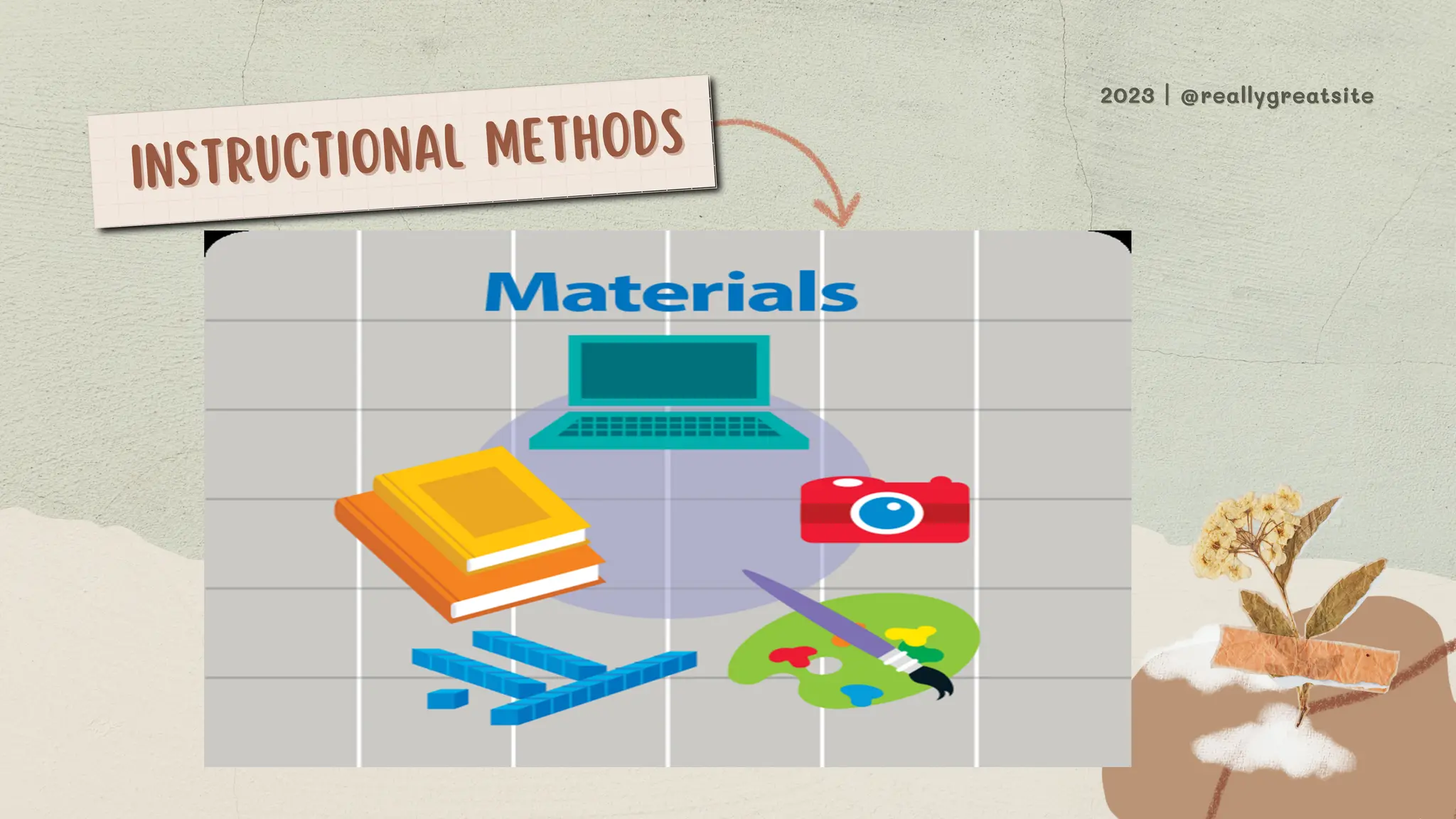
INSTRUCTIONAL METHODS
2023 | @reallygreatsite
General Principles of Effectiveness
Media should:
Media should:
Change behavior by influencing a gain in cognitive,
affective, and/or psychomotor skills
Enhance learning no one tool is better than another
Complement the instructional methods
Media should :
Media should :
Match available financial resources
Be appropriate for physical environment
Complement learners’ sensory abilities, developmental
stage, and educational level
Impart accurate, current, valid and appropriate
messages
messages
Add diversity and information to learning
Choosing Instructional
Materials
Materials
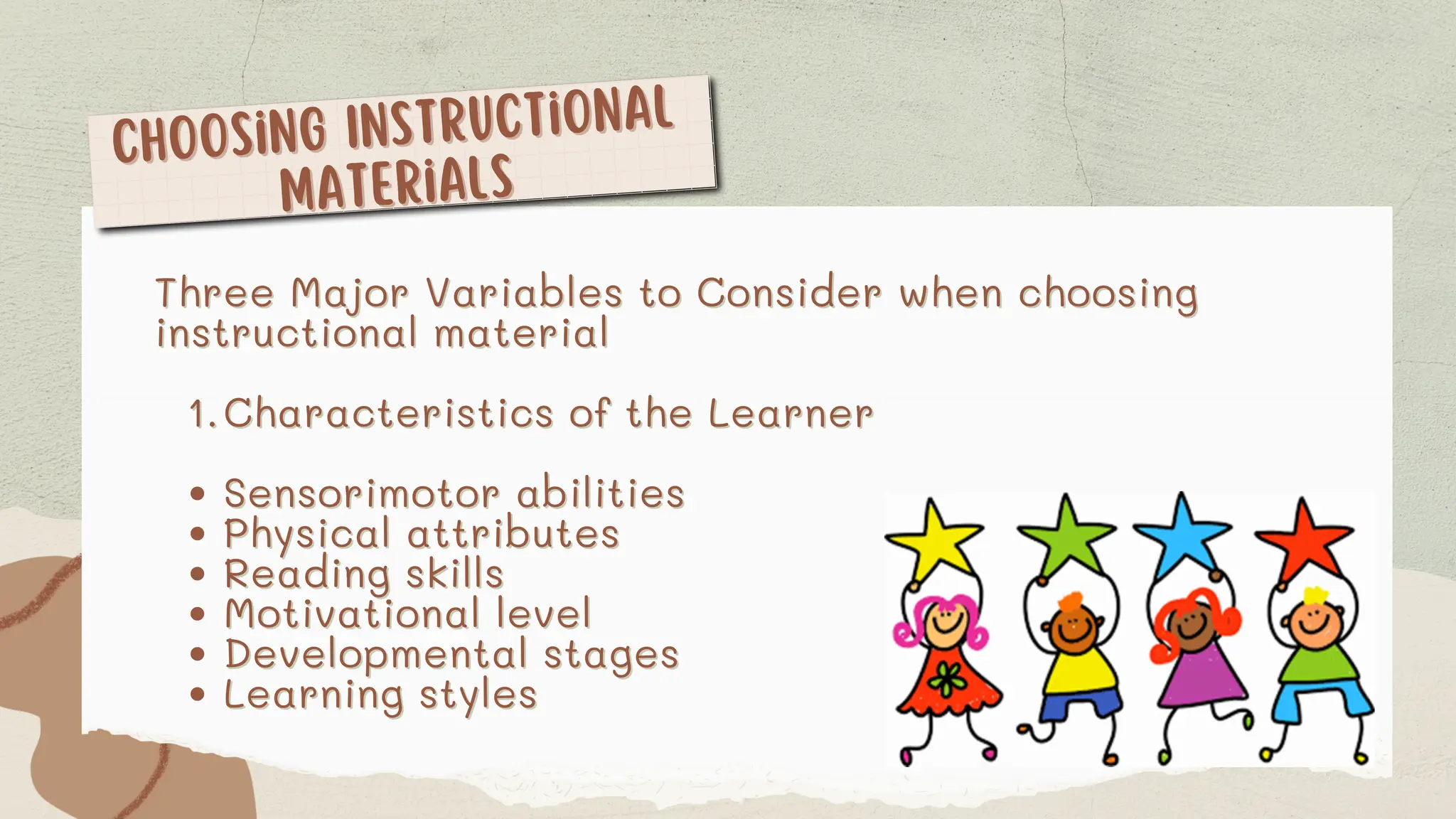
Three Major Variables to Consider when choosing
instructional material
Characteristics of the Learner
1
1.
.
Sensorimotor abilities
Physical attributes
Physical attributes
Reading skills
Reading skills
Motivational level
Motivational level
Developmental stages
Learning styles
Learning styles
CHOOSING INSTRUCTIONAL
MATERIAL
MATERIAL
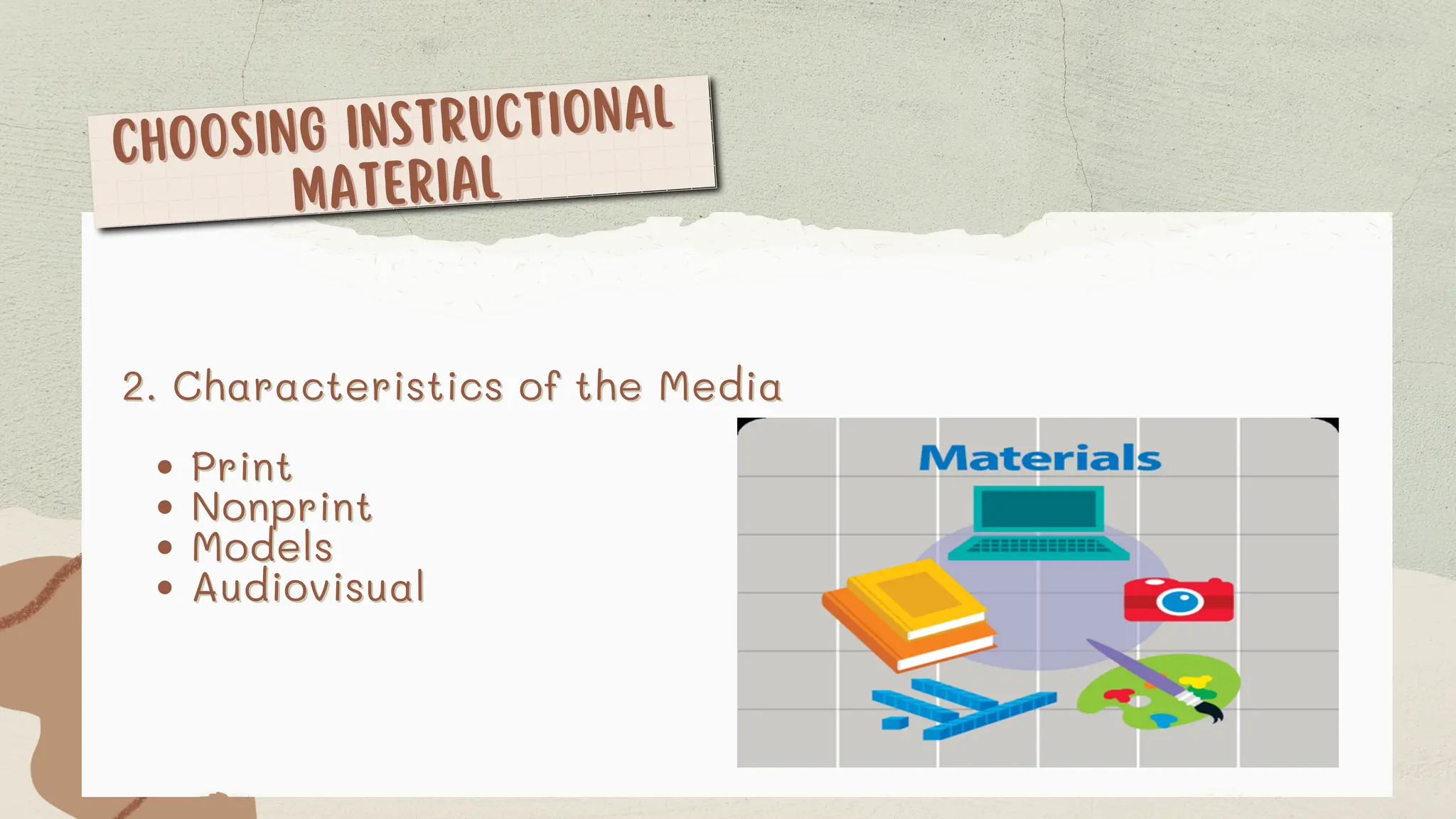
2. Characteristics of the Media
Print
Print
Nonprint
Nonprint
Models
Models
Audiovisual
Audiovisual
CHOOSING INSTRUCTIONAL
MATERIAL
MATERIAL
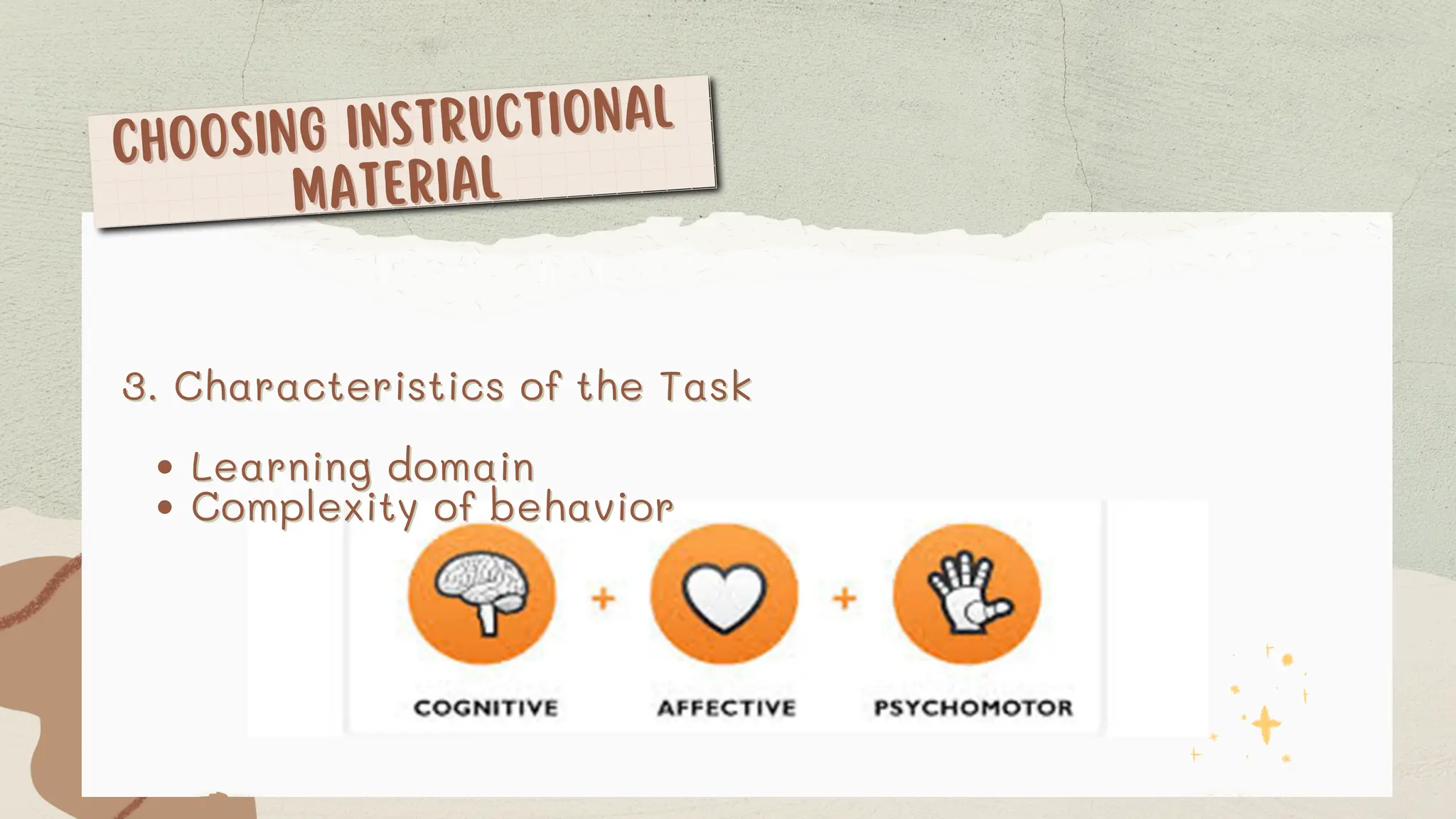
3. Characteristics of the Task
Learning domain
Learning domain
Complexity of behavior
Written (Printed) Materials
Types of Instructional Materials
Written Materials
Example of Written Material;
Commercially Prepared materials
These materials includes material that prepared
by companies that may or may not produced in
collaboration with health professionals,
which raises the questions
of how factual the information may be.
Factors to be considered when using
Commercially Prepared materials
Who produced the item? Was there any input by
healthcare professionals?
Can the item be previewed?
The price must be consistent with its educational
value.
value.
Written Materials
Written Materials
Example of Written Materials;
Instructor Composed Material
Educators may choose to write their
own instructional material for the purpose
of cost saving or the need to tailor
content to specific audience.
Guidelines for writing Effective
Instructor Composed Material
Fit your own institution’s policies, procedures and equipment.
Build in answers to those questions asked most frequently by
your patients.
Highlight points considered especially important by your
healthcare team.
Reinforce specific oral instructions and clarify difficult
concepts.
Evaluating Printed Materials
Educator must consider:
Nature of the audience
Literacy level required
Linguistic variety available
Brevity and clarity
Layout and appearance
Opportunity for repetition
Concreteness and familiarity
DEMONSTRATION MATERIALS
Demonstration materials includes many
types of non-print media, such as models
and real equipment as
well as displays, such as posters, diagrams,
illustrations,charts bulletin boards.
DEMONSTRATION MATERIALS
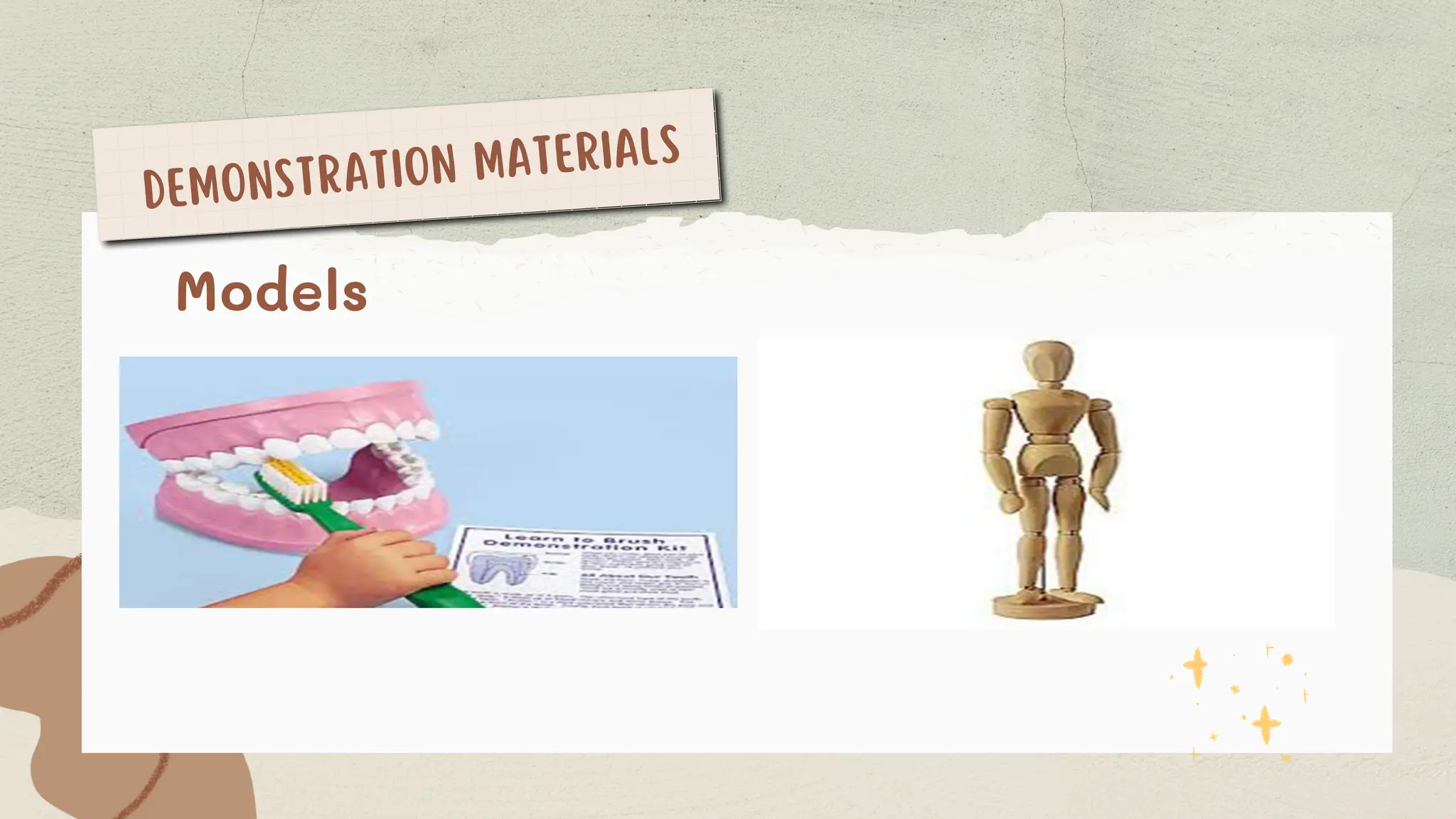
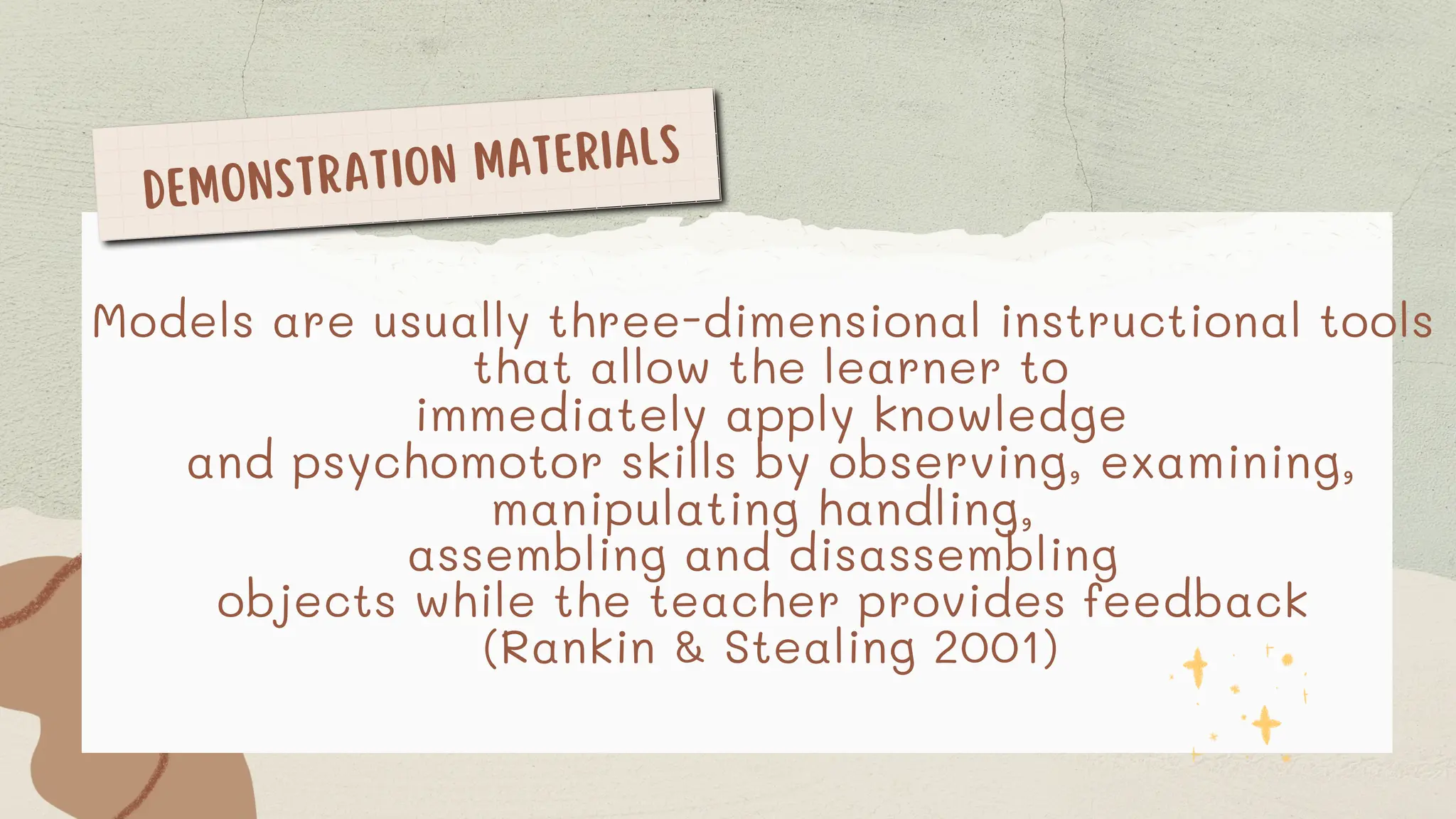
Models
DEMONSTRATION MATERIALS
Models are usually three-dimensional instructional tools
that allow the learner to
immediately apply knowledge
and psychomotor skills by observing, examining,
manipulating handling,
assembling and disassembling
objects while the teacher provides feedback
(Rankin & Stealing 2001)
DEMONSTRATION MATERIALS
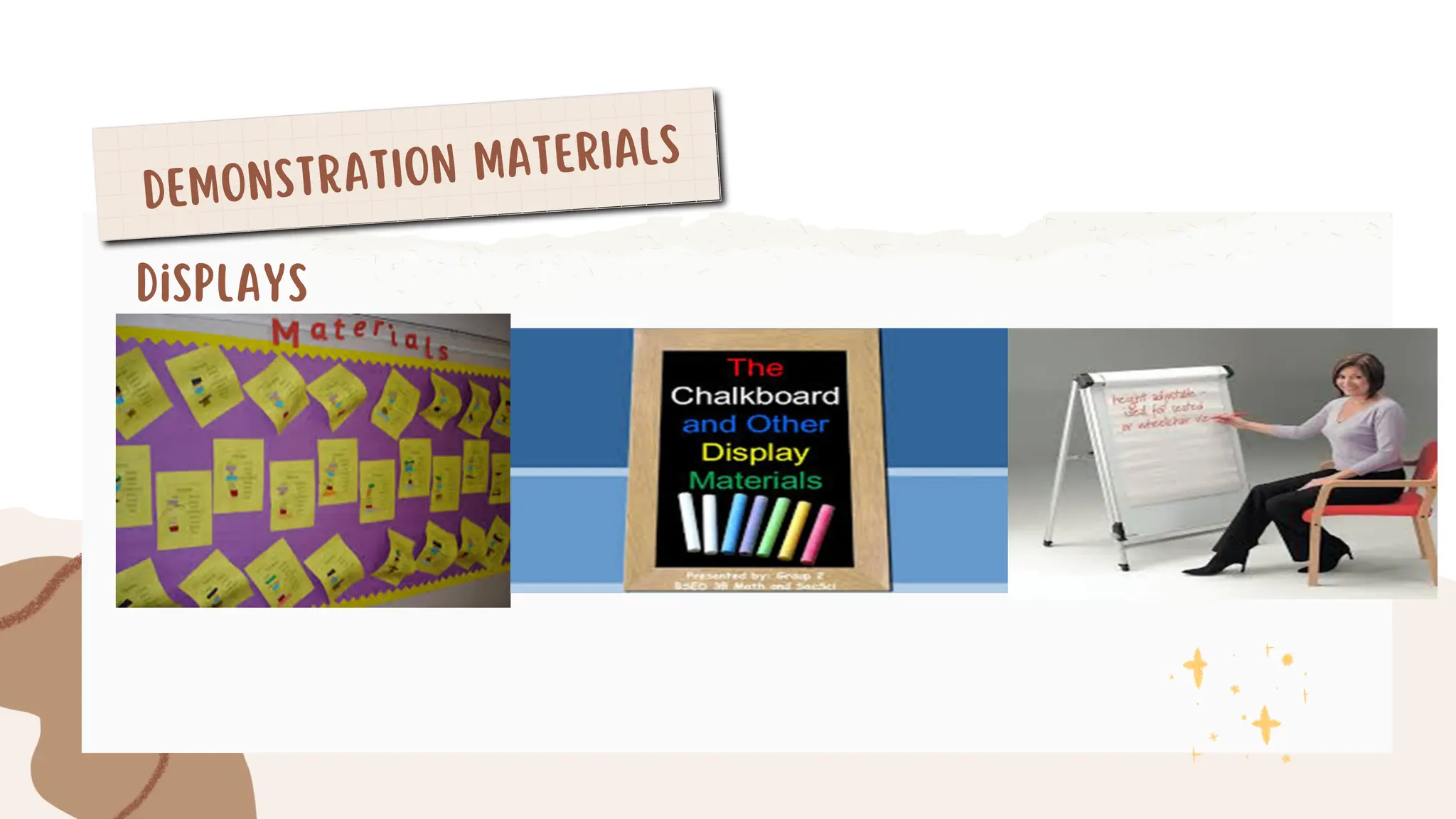
Displays
DEMONSTRATION MATERIALS
Displays such as chalkboards, boards, flipchart are two-
dimensional objects, they are useful tools for a variety of
teaching purposes to clarify, reinforce or summarize
information on important topics and themes.
DEMONSTRATION MATERIALS
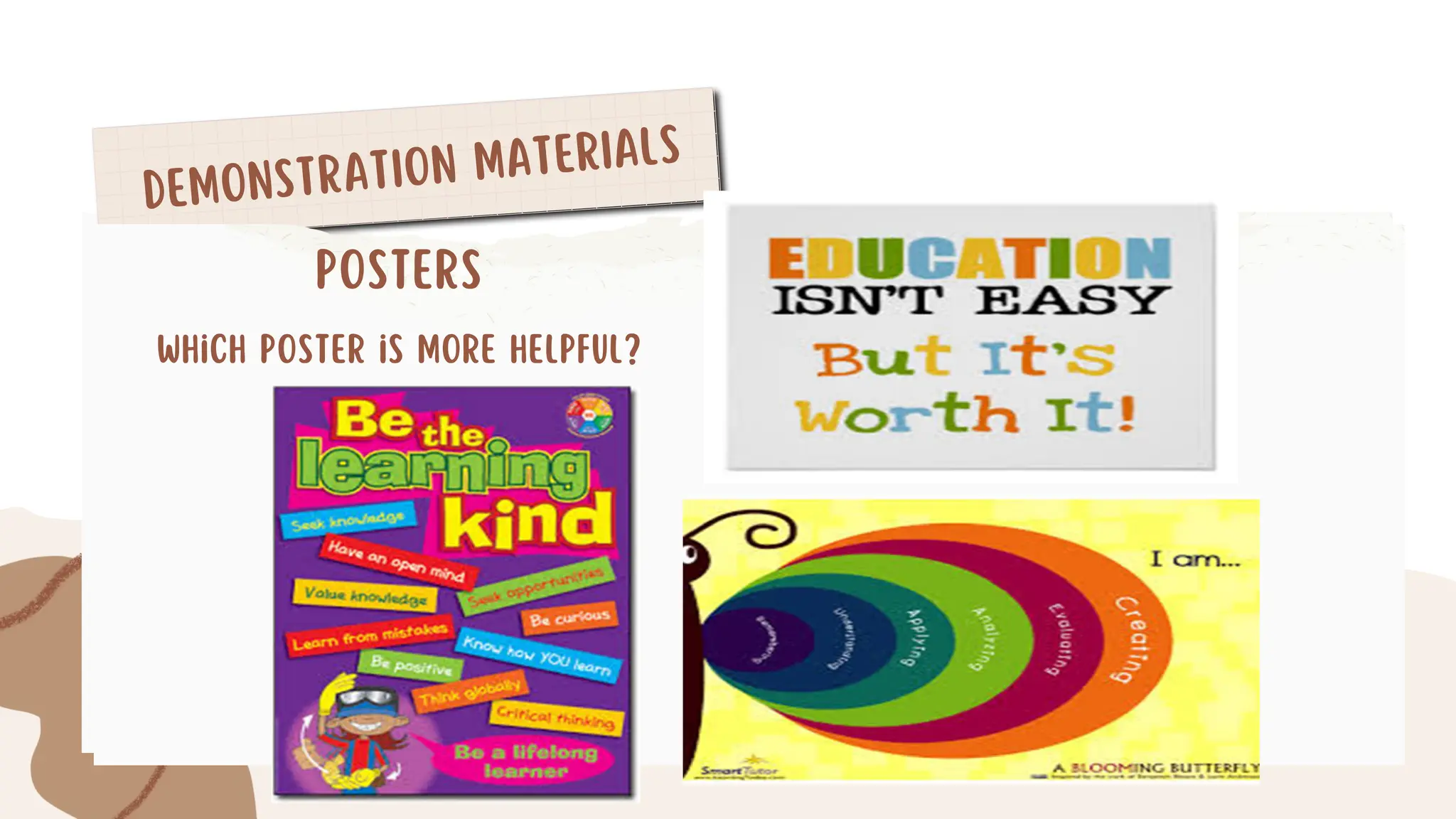
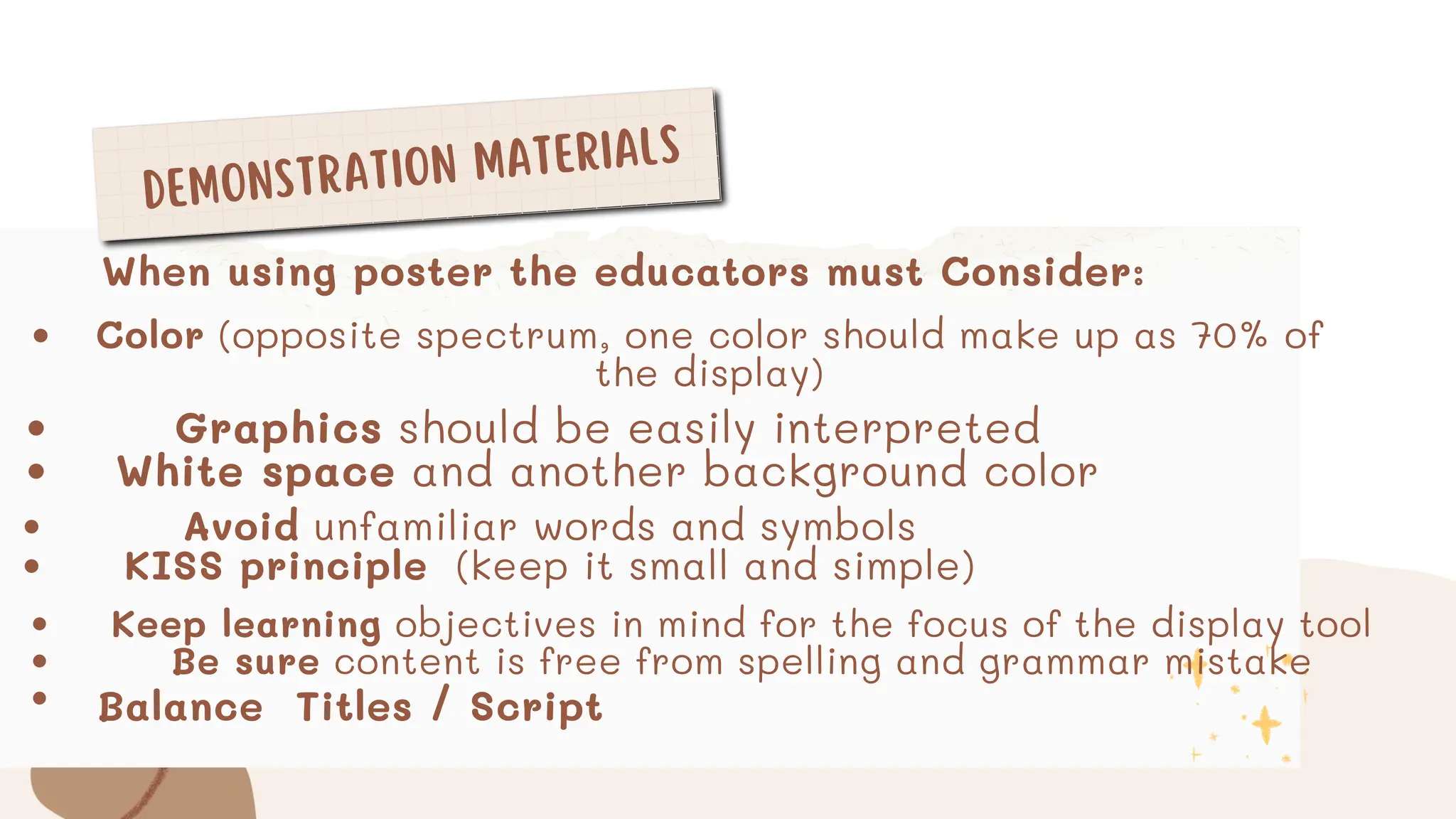
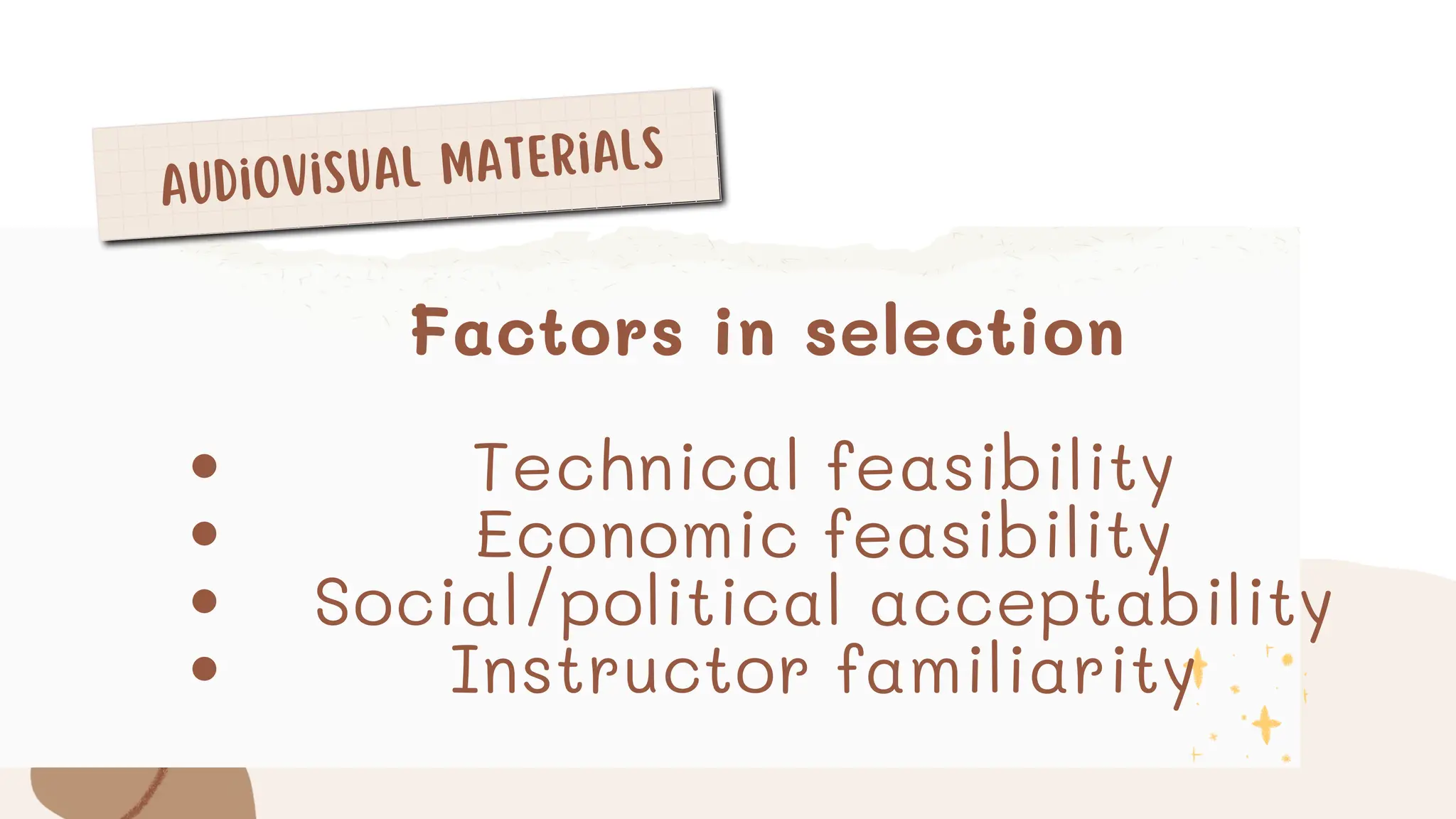
Posters
Which poster is more helpful?
DEMONSTRATION MATERIALS
Color (opposite spectrum, one color should make up as 70% of
the display)
Graphics should be easily interpreted
White space and another background color
When using poster the educators must Consider:
Avoid unfamiliar words and symbols
KISS principle (keep it small and simple)
Keep learning objectives in mind for the focus of the display tool
Be sure content is free from spelling and grammar mistake
Balance Titles / Script
Audiovisual Materials
Factors in selection
Technical feasibility
Economic feasibility
Social/political acceptability
Instructor familiarity
Audiovisual Materials
Technology software and hardware are exceptional aids because
many can influence all three domains of learning by promoting
cognitive development ,stimulating attitude change, and helps to build
psychomotor skills
Audiovisual Materials
Audiovisual materials can be categorized in to five major types`;
•Projected Learning Resources
•Audio Learning Resources
•Video Learning Resources
•Telecommunications Learning
Resources
•Computer Learning Resources
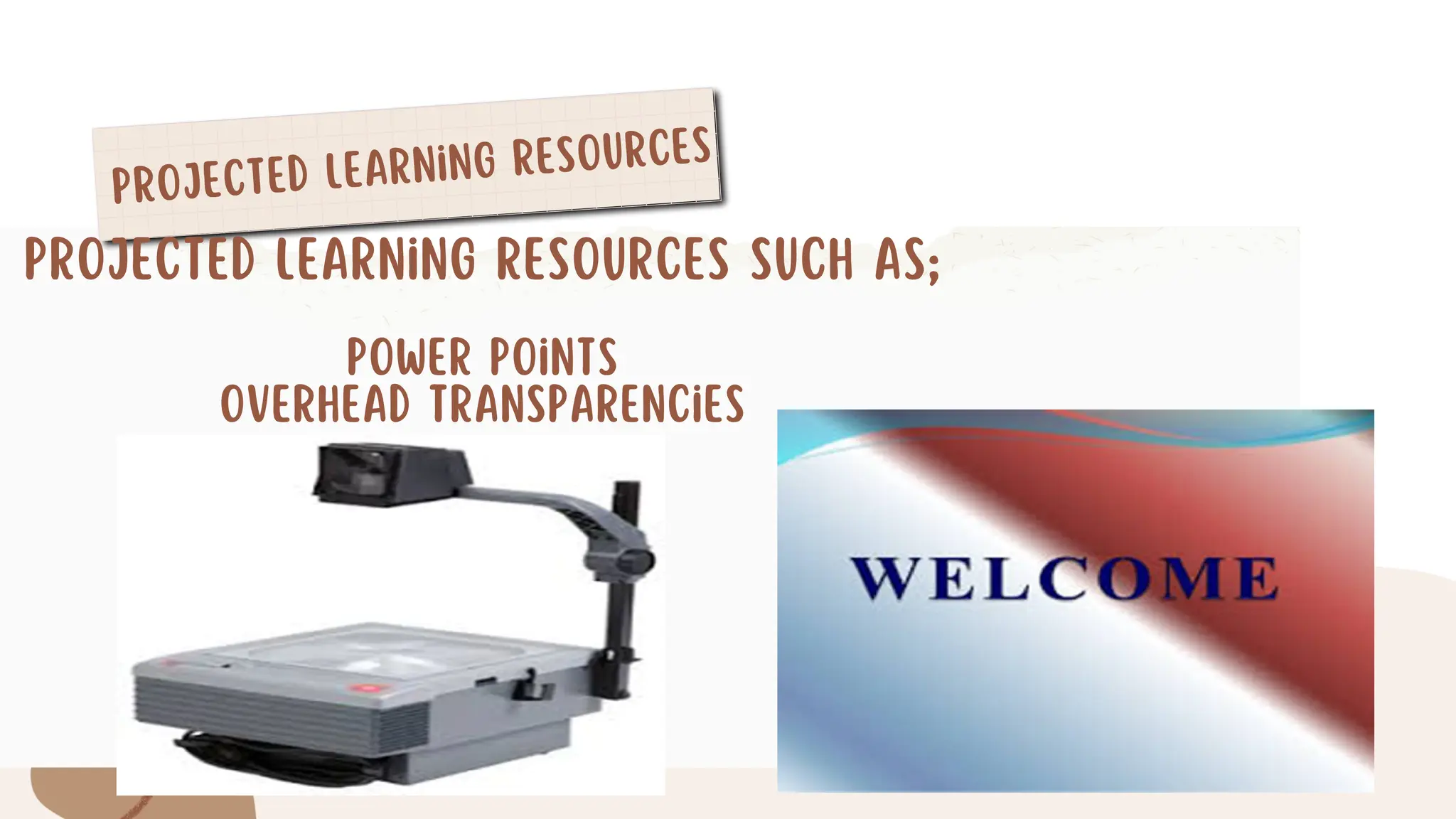
Projected Learning Resources
Projected Learning Resources such as;
Power Points
Overhead transparencies
Audio Learning Resources
Audio Learning Resources includes CDs, Digital Sound Files,
Radio
Video Learning Resources
Video Learning Resources includes ; Digital Video Files,
DVDs, Webinars
Telecommunications Learning
Resources
Telecommunications Learning Resources includes Television, and
Telephones
Computer Learning Resources
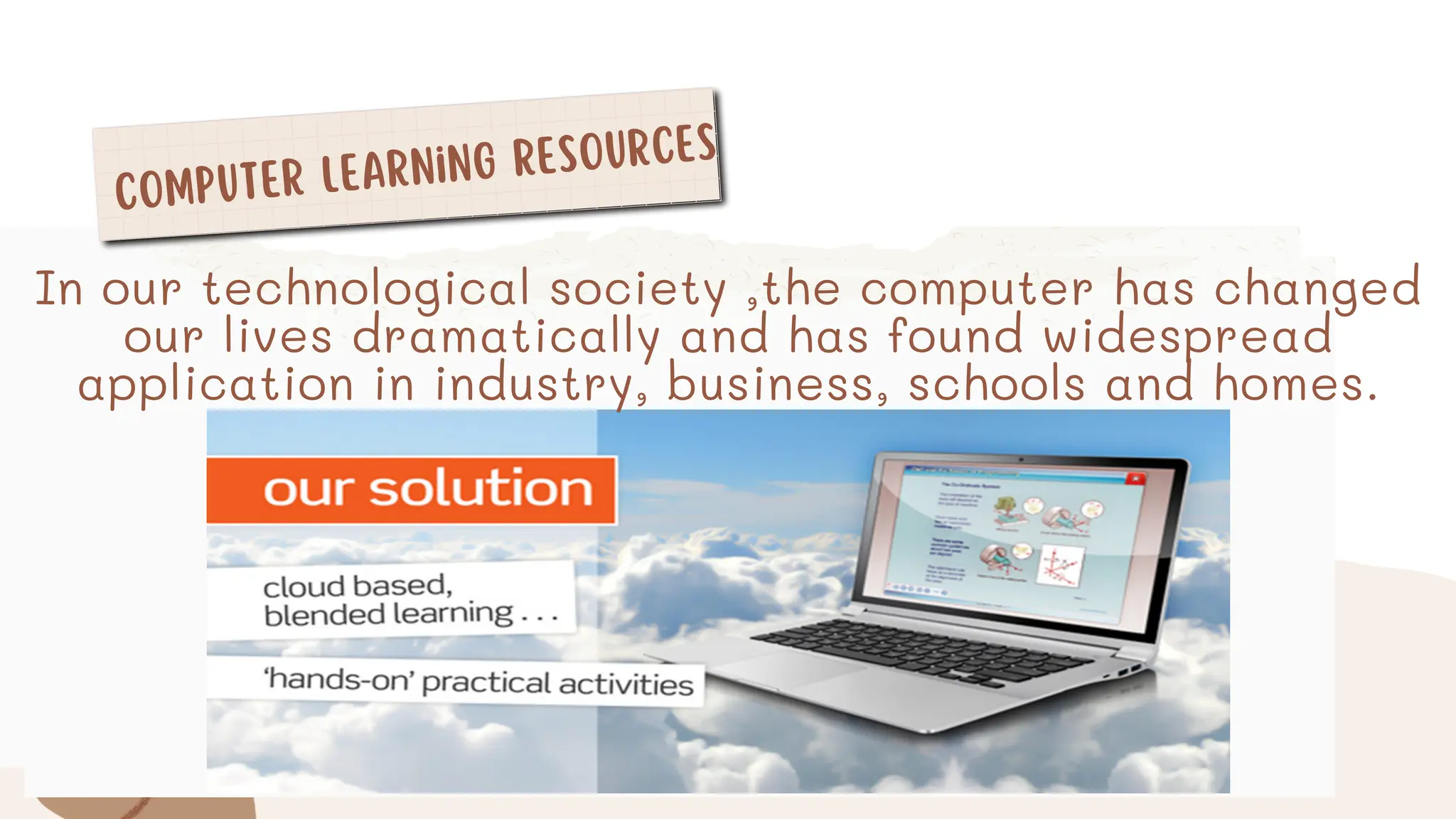
In our technological society ,the computer has changed
our lives dramatically and has found widespread
application in industry, business, schools and homes.
Evaluation Criteria for
Selecting Materials
Considerations for Selecting Materials
Learner characteristics
Task(s) to be achieved
Media available
thank you! :)
Instructional materials, media,and technology used in English learning.pdf

Instructional materials, media,and technology used in English learning.pdf

  • 1.
    Instructional Instructional materials, materials, media,and media,and technology used in technologyused in English learning English learning Jennylyn Salvacion Jennylyn Salvacion Chliff Dennery Sevilla Chliff Dennery Sevilla
  • 2.
    IS THERE ADIFFERENCE BETWEEN IS THERE A DIFFERENCE BETWEEN INSTRUCTIONAL METHODS AND INSTRUCTIONAL METHODS AND INSTRUCTIONALMATERIALS? INSTRUCTIONALMATERIALS? 2023 | @reallygreatsite 2023 | @reallygreatsite
  • 3.
  • 4.
    INSTRUCTIONAL METHODS INSTRUCTIONAL METHODS 2023| @reallygreatsite 2023 | @reallygreatsite
  • 5.
    General Principles ofEffectiveness General Principles of Effectiveness Media should: Media should: Change behavior by influencing a gain in cognitive, Change behavior by influencing a gain in cognitive, affective, and/or psychomotor skills affective, and/or psychomotor skills Enhance learning no one tool is better than another Enhance learning no one tool is better than another Complement the instructional methods Complement the instructional methods
  • 6.
    Media should : Mediashould : Match available financial resources Match available financial resources Be appropriate for physical environment Be appropriate for physical environment Complement learners’ sensory abilities, developmental Complement learners’ sensory abilities, developmental stage, and educational level stage, and educational level Impart accurate, current, valid and appropriate Impart accurate, current, valid and appropriate messages messages Add diversity and information to learning Add diversity and information to learning
  • 7.
    Choosing Instructional Choosing Instructional Materials Materials ThreeMajor Variables to Consider when choosing Three Major Variables to Consider when choosing instructional material instructional material Characteristics of the Learner Characteristics of the Learner 1 1. . Sensorimotor abilities Sensorimotor abilities Physical attributes Physical attributes Reading skills Reading skills Motivational level Motivational level Developmental stages Developmental stages Learning styles Learning styles
  • 8.
    CHOOSING INSTRUCTIONAL CHOOSING INSTRUCTIONAL MATERIAL MATERIAL 2.Characteristics of the Media 2. Characteristics of the Media Print Print Nonprint Nonprint Models Models Audiovisual Audiovisual
  • 9.
    CHOOSING INSTRUCTIONAL CHOOSING INSTRUCTIONAL MATERIAL MATERIAL 3.Characteristics of the Task 3. Characteristics of the Task Learning domain Learning domain Complexity of behavior Complexity of behavior
  • 10.
    Written (Printed) Materials Written(Printed) Materials Types of Instructional Materials
  • 11.
    Written Materials Example ofWritten Material; Commercially Prepared materials These materials includes material that prepared by companies that may or may not produced in collaboration with health professionals, which raises the questions of how factual the information may be.
  • 12.
    Factors to beconsidered when using Factors to be considered when using Commercially Prepared materials Commercially Prepared materials Who produced the item? Was there any input by Who produced the item? Was there any input by healthcare professionals? healthcare professionals? Can the item be previewed? Can the item be previewed? The price must be consistent with its educational The price must be consistent with its educational value. value. Written Materials
  • 13.
    Written Materials Example ofWritten Materials; Instructor Composed Material Educators may choose to write their own instructional material for the purpose of cost saving or the need to tailor content to specific audience.
  • 14.
    Guidelines for writingEffective Instructor Composed Material Fit your own institution’s policies, procedures and equipment. Build in answers to those questions asked most frequently by your patients. Highlight points considered especially important by your healthcare team. Reinforce specific oral instructions and clarify difficult concepts.
  • 15.
    Evaluating Printed Materials Educatormust consider: Nature of the audience Literacy level required Linguistic variety available Brevity and clarity Layout and appearance Opportunity for repetition Concreteness and familiarity
  • 16.
    DEMONSTRATION MATERIALS Demonstration materialsincludes many types of non-print media, such as models and real equipment as well as displays, such as posters, diagrams, illustrations,charts bulletin boards.
  • 17.
  • 18.
    DEMONSTRATION MATERIALS Models areusually three-dimensional instructional tools that allow the learner to immediately apply knowledge and psychomotor skills by observing, examining, manipulating handling, assembling and disassembling objects while the teacher provides feedback (Rankin & Stealing 2001)
  • 19.
  • 20.
    DEMONSTRATION MATERIALS Displays suchas chalkboards, boards, flipchart are two- dimensional objects, they are useful tools for a variety of teaching purposes to clarify, reinforce or summarize information on important topics and themes.
  • 21.
  • 22.
    DEMONSTRATION MATERIALS Color (oppositespectrum, one color should make up as 70% of the display) Graphics should be easily interpreted White space and another background color When using poster the educators must Consider: Avoid unfamiliar words and symbols KISS principle (keep it small and simple) Keep learning objectives in mind for the focus of the display tool Be sure content is free from spelling and grammar mistake Balance Titles / Script
  • 23.
    Audiovisual Materials Factors inselection Technical feasibility Economic feasibility Social/political acceptability Instructor familiarity
  • 24.
  • 25.
    Audiovisual Materials Technology softwareand hardware are exceptional aids because many can influence all three domains of learning by promoting cognitive development ,stimulating attitude change, and helps to build psychomotor skills
  • 26.
    Audiovisual Materials Audiovisual materialscan be categorized in to five major types`; •Projected Learning Resources •Audio Learning Resources •Video Learning Resources •Telecommunications Learning Resources •Computer Learning Resources
  • 27.
    Projected Learning Resources ProjectedLearning Resources such as; Power Points Overhead transparencies
  • 28.
    Audio Learning Resources AudioLearning Resources includes CDs, Digital Sound Files, Radio
  • 29.
    Video Learning Resources VideoLearning Resources includes ; Digital Video Files, DVDs, Webinars
  • 30.
    Telecommunications Learning Resources Telecommunications LearningResources includes Television, and Telephones
  • 31.
    Computer Learning Resources Inour technological society ,the computer has changed our lives dramatically and has found widespread application in industry, business, schools and homes.
  • 32.
    Evaluation Criteria for SelectingMaterials Considerations for Selecting Materials Learner characteristics Task(s) to be achieved Media available
  • 33.