Introduction to Physiology
KAMRAN
Physiology
• Physiology is the study of the normal function of cell,
tissue, organs, systems and organisms
• Physiology can be divided into the following specialties:
– Cell physiology – field of biology which focuses on studying
the function of cells, and how cells interact with each other
and with the larger organism they inhabit
– Molecular physiology- field of biology that focuses on the
scientific study of dynamic interactive processes and
biochemical communications at the subcellular level.
Includes instruction in ion channels and transporters,
molecular signaling pathways, endocrine control and
regulation, genetic information transfer, homeostasis and
molecular control systems, electrophysiology and sensory
mechanisms, protein synthesis, and applicable research
methods and technologies
– Special physiology - study of specific organ
– Systemic physiology – study of system
– Pathological physiology – study of the effect of disease on
cell, tissue, organ and system
Why cellular physiology?
The cell is the smallest unit capable of carrying out the processes
associated with life.
Classical Properties of Living
Organisms:
Reproduction
Nutrition
Respiration
Excretion
Irritability/respond
Movement
Growth
How cells fulfill these criteria of
Living Organisms:
Cell replication
Nutrition
Respiration
Excretion
Respond to environment
Movement within and externally
Grow in number and size
Organization of the Body
– Levels of organization
• Cell
• Tissue
• Organ
• System
Levels of Organization
Organization of the Body
– Simplify by classifying
– Entire human body contains about 100 trillion cells
– Body has over 200 different cell types
– Cells can be put into four groups
• Neurons
• Muscle cells
• Epithelial cells
• Connective tissue cells
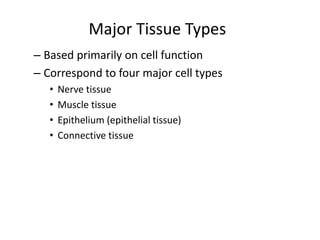
Major Tissue Types
– Based primarily on cell function
– Correspond to four major cell types
• Nerve tissue
• Muscle tissue
• Epithelium (epithelial tissue)
• Connective tissue
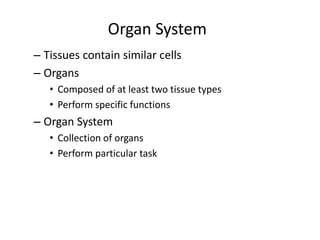
Organ System
– Tissues contain similar cells
– Organs
• Composed of at least two tissue types
• Perform specific functions
– Organ System
• Collection of organs
• Perform particular task
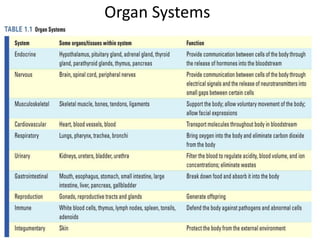
Organ Systems
Table 1.1
Copyright © 2008 Pearson Education, Inc., publishing as Benjamin
Cummings.
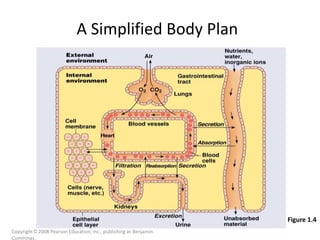
A Simplified Body Plan
Figure 1.4
Body Fluid Compartments
– 18% of the body weight is protein and related
substances, 7% is mineral, and 15% is fat. The
remaining 60% is water
– Water is distributed in ICF & ECF as follows:
– 70 kg man
- Total body water = 42 liters
– 28 liters intracellular fluid (ICF)
– 14 liters extracellular fluid (ECF)
- Three liters plasma
- 11 liters interstitial fluid (ISF)
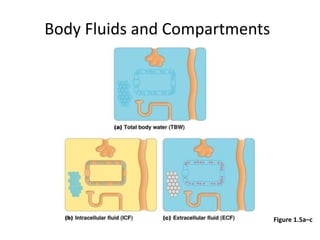
Body Fluids and Compartments
Figure 1.5a–c
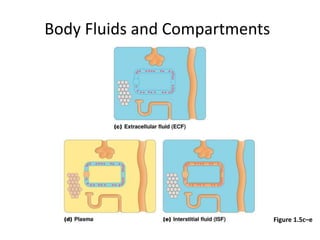
Body Fluids and Compartments
Figure 1.5c–e
THE VARIOUS BASIC SCIENTIFIC LAWS
important to physiology
• MOLE: A mole is the gram-molecular weight of a
substance, ie, the molecular weight of the
substance in grams; in physiology, mmoles
• Standard SI unit for expressing an amount of a
substance
• DALTONS: It’s the ratio of the mass of the molecule
you are measuring to the weight of 1/12th of a
carbon atom
• A dalton is a unit of measuring the molecular mass
of a substance
• Measuring large molecules requires kilodaltons
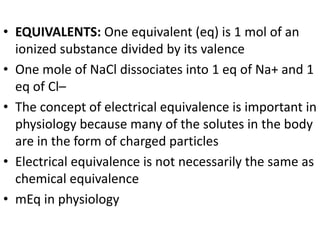
• EQUIVALENTS: One equivalent (eq) is 1 mol of an
ionized substance divided by its valence
• One mole of NaCl dissociates into 1 eq of Na+ and 1
eq of Cl–
• The concept of electrical equivalence is important in
physiology because many of the solutes in the body
are in the form of charged particles
• Electrical equivalence is not necessarily the same as
chemical equivalence
• mEq in physiology
pH AND BUFFERING
• The maintenance of a stable hydrogen ion
concentration ([H+]) in body fluids is essential to life
• Is the negative logarithm of the [H+]
• Substance donating H+ in solutions are acids
• Body pH is stabilized by the buffering capacity of
the body fluids
• isohydric principle
• Henderson Hasselbach equation:
pH = pKa + log [A–]/[HA]
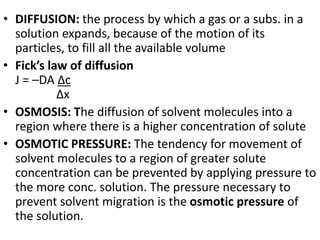
• DIFFUSION: the process by which a gas or a subs. in a
solution expands, because of the motion of its
particles, to fill all the available volume
• Fick’s law of diffusion
J = –DA Δc
Δx
• OSMOSIS: The diffusion of solvent molecules into a
region where there is a higher concentration of solute
• OSMOTIC PRESSURE: The tendency for movement of
solvent molecules to a region of greater solute
concentration can be prevented by applying pressure to
the more conc. solution. The pressure necessary to
prevent solvent migration is the osmotic pressure of
the solution.
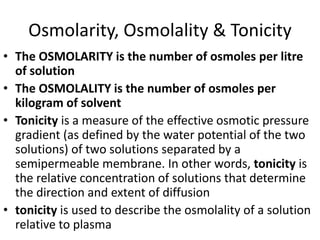
Osmolarity, Osmolality & Tonicity
• The OSMOLARITY is the number of osmoles per litre
of solution
• The OSMOLALITY is the number of osmoles per
kilogram of solvent
• Tonicity is a measure of the effective osmotic pressure
gradient (as defined by the water potential of the two
solutions) of two solutions separated by a
semipermeable membrane. In other words, tonicity is
the relative concentration of solutions that determine
the direction and extent of diffusion
• tonicity is used to describe the osmolality of a solution
relative to plasma
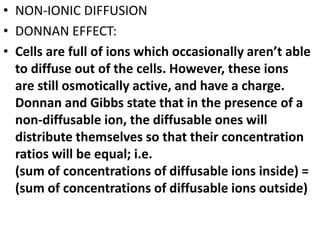
• NON-IONIC DIFFUSION
• DONNAN EFFECT:
• Cells are full of ions which occasionally aren’t able
to diffuse out of the cells. However, these ions
are still osmotically active, and have a charge.
Donnan and Gibbs state that in the presence of a
non-diffusable ion, the diffusable ones will
distribute themselves so that their concentration
ratios will be equal; i.e.
(sum of concentrations of diffusable ions inside) =
(sum of concentrations of diffusable ions outside)
• NERNEST EQUATION: What membrane
potential would exist at the true equilibrium
for a particular ion? & What is the voltage that
would balance diffusion gradients with the
force that would prevent net ion movement?
• This theoretical equilibrium potential can be
calculated (for a particular ion)
RT [Na+]out
[Na+]in
ENa =
zF
ln
___ ___
For K+ around -90mV
For Na+ around +60mV

Introduction to physiology

  • 1.
  • 2.
    Physiology • Physiology isthe study of the normal function of cell, tissue, organs, systems and organisms • Physiology can be divided into the following specialties: – Cell physiology – field of biology which focuses on studying the function of cells, and how cells interact with each other and with the larger organism they inhabit – Molecular physiology- field of biology that focuses on the scientific study of dynamic interactive processes and biochemical communications at the subcellular level. Includes instruction in ion channels and transporters, molecular signaling pathways, endocrine control and regulation, genetic information transfer, homeostasis and molecular control systems, electrophysiology and sensory mechanisms, protein synthesis, and applicable research methods and technologies – Special physiology - study of specific organ – Systemic physiology – study of system – Pathological physiology – study of the effect of disease on cell, tissue, organ and system
  • 3.
    Why cellular physiology? Thecell is the smallest unit capable of carrying out the processes associated with life. Classical Properties of Living Organisms: Reproduction Nutrition Respiration Excretion Irritability/respond Movement Growth How cells fulfill these criteria of Living Organisms: Cell replication Nutrition Respiration Excretion Respond to environment Movement within and externally Grow in number and size
  • 4.
    Organization of theBody – Levels of organization • Cell • Tissue • Organ • System
  • 5.
  • 6.
    Organization of theBody – Simplify by classifying – Entire human body contains about 100 trillion cells – Body has over 200 different cell types – Cells can be put into four groups • Neurons • Muscle cells • Epithelial cells • Connective tissue cells
  • 7.
    Major Tissue Types –Based primarily on cell function – Correspond to four major cell types • Nerve tissue • Muscle tissue • Epithelium (epithelial tissue) • Connective tissue
  • 8.
    Organ System – Tissuescontain similar cells – Organs • Composed of at least two tissue types • Perform specific functions – Organ System • Collection of organs • Perform particular task
  • 9.
  • 10.
    Copyright © 2008Pearson Education, Inc., publishing as Benjamin Cummings. A Simplified Body Plan Figure 1.4
  • 11.
    Body Fluid Compartments –18% of the body weight is protein and related substances, 7% is mineral, and 15% is fat. The remaining 60% is water – Water is distributed in ICF & ECF as follows: – 70 kg man - Total body water = 42 liters – 28 liters intracellular fluid (ICF) – 14 liters extracellular fluid (ECF) - Three liters plasma - 11 liters interstitial fluid (ISF)
  • 12.
    Body Fluids andCompartments Figure 1.5a–c
  • 13.
    Body Fluids andCompartments Figure 1.5c–e
  • 14.
    THE VARIOUS BASICSCIENTIFIC LAWS important to physiology • MOLE: A mole is the gram-molecular weight of a substance, ie, the molecular weight of the substance in grams; in physiology, mmoles • Standard SI unit for expressing an amount of a substance • DALTONS: It’s the ratio of the mass of the molecule you are measuring to the weight of 1/12th of a carbon atom • A dalton is a unit of measuring the molecular mass of a substance • Measuring large molecules requires kilodaltons
  • 15.
    • EQUIVALENTS: Oneequivalent (eq) is 1 mol of an ionized substance divided by its valence • One mole of NaCl dissociates into 1 eq of Na+ and 1 eq of Cl– • The concept of electrical equivalence is important in physiology because many of the solutes in the body are in the form of charged particles • Electrical equivalence is not necessarily the same as chemical equivalence • mEq in physiology
  • 16.
    pH AND BUFFERING •The maintenance of a stable hydrogen ion concentration ([H+]) in body fluids is essential to life • Is the negative logarithm of the [H+] • Substance donating H+ in solutions are acids • Body pH is stabilized by the buffering capacity of the body fluids • isohydric principle • Henderson Hasselbach equation: pH = pKa + log [A–]/[HA]
  • 17.
    • DIFFUSION: theprocess by which a gas or a subs. in a solution expands, because of the motion of its particles, to fill all the available volume • Fick’s law of diffusion J = –DA Δc Δx • OSMOSIS: The diffusion of solvent molecules into a region where there is a higher concentration of solute • OSMOTIC PRESSURE: The tendency for movement of solvent molecules to a region of greater solute concentration can be prevented by applying pressure to the more conc. solution. The pressure necessary to prevent solvent migration is the osmotic pressure of the solution.
  • 18.
    Osmolarity, Osmolality &Tonicity • The OSMOLARITY is the number of osmoles per litre of solution • The OSMOLALITY is the number of osmoles per kilogram of solvent • Tonicity is a measure of the effective osmotic pressure gradient (as defined by the water potential of the two solutions) of two solutions separated by a semipermeable membrane. In other words, tonicity is the relative concentration of solutions that determine the direction and extent of diffusion • tonicity is used to describe the osmolality of a solution relative to plasma
  • 19.
    • NON-IONIC DIFFUSION •DONNAN EFFECT: • Cells are full of ions which occasionally aren’t able to diffuse out of the cells. However, these ions are still osmotically active, and have a charge. Donnan and Gibbs state that in the presence of a non-diffusable ion, the diffusable ones will distribute themselves so that their concentration ratios will be equal; i.e. (sum of concentrations of diffusable ions inside) = (sum of concentrations of diffusable ions outside)
  • 20.
    • NERNEST EQUATION:What membrane potential would exist at the true equilibrium for a particular ion? & What is the voltage that would balance diffusion gradients with the force that would prevent net ion movement? • This theoretical equilibrium potential can be calculated (for a particular ion) RT [Na+]out [Na+]in ENa = zF ln ___ ___ For K+ around -90mV For Na+ around +60mV