From:- Wan Nur Aisyah bt Wan Zahari 4 server virus
In computer technology, viruses are malicious software programs, a form of malware. By definition, viruses exist on local disk drives and spread from one computer to another through sharing of "infected" files  Definition of virus…..
Viruses are spread mainly by these four ways: Using a floppy diskette from a machine that has a virus.  Downloading a file from the internet (or bulletin board) that contains a virus.  Getting an  e-mail attachment  that contains a virus.  Installing software purchased from a store or mail  warehouse. While this is the rarest of the ways, software vendors have been found to ship their software with viruses (unknown to them of course) on the installation diskettes/cd-roms.
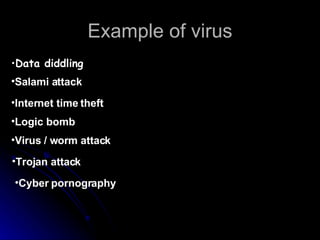
Example of virus Data diddling   Salami attack   Internet time theft   Logic bomb   Virus / worm attack   Trojan attack   Cyber pornography
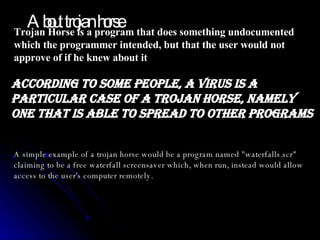
Trojan Horse is a program that does something undocumented which the programmer intended, but that the user would not approve of if he knew about it  According to some people, a virus is a particular case of a Trojan Horse, namely one that is able to spread to other programs  A simple example of a trojan horse would be a program named "waterfalls.scr" claiming to be a free waterfall screensaver which, when run, instead would allow access to the user's computer remotely. About trojan horse
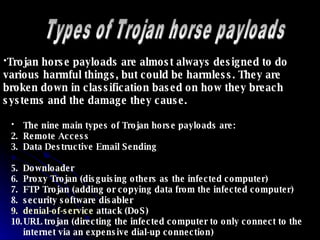
Types of Trojan horse payloads  Trojan horse payloads are almost always designed to do various harmful things, but could be harmless. They are broken down in classification based on how they breach systems and the damage they cause.  The nine main types of Trojan horse payloads are: Remote Access  Data Destructive Email Sending  Downloader  Proxy Trojan (disguising others as the infected computer)  FTP Trojan (adding or copying data from the infected computer)  security software disabler  denial-of-service  attack (DoS)  URL trojan (directing the infected computer to only connect to the internet via an expensive dial-up connection)
Definition of salami attack This attack is used for the commission of financial crimes
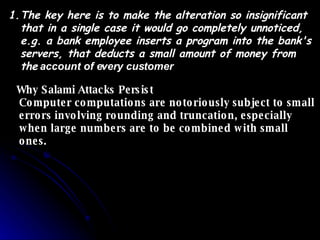
The key here is to make the alteration so insignificant that in a single case it would go completely unnoticed, e.g. a bank employee inserts a program into the bank's servers, that deducts a small amount of money from the   account of every customer   Why Salami Attacks Persist  Computer computations are notoriously subject to small errors involving rounding and truncation, especially when large numbers are to be combined with small ones.
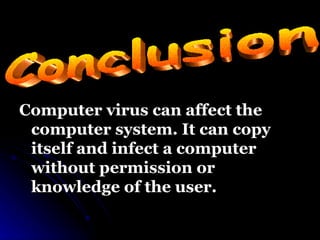
Computer virus can affect the computer system. It can copy itself and infect a computer without permission or knowledge of the user. Conclusion
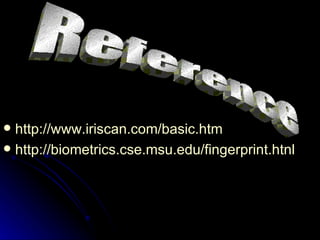
http://www.iriscan.com/basic.htm http://biometrics.cse.msu.edu/fingerprint.htnl   Reference
THE END THANK YOU…….

Presentation1

  • 1.
    From:- Wan NurAisyah bt Wan Zahari 4 server virus
  • 2.
    In computer technology,viruses are malicious software programs, a form of malware. By definition, viruses exist on local disk drives and spread from one computer to another through sharing of "infected" files Definition of virus…..
  • 3.
    Viruses are spreadmainly by these four ways: Using a floppy diskette from a machine that has a virus. Downloading a file from the internet (or bulletin board) that contains a virus. Getting an e-mail attachment that contains a virus. Installing software purchased from a store or mail warehouse. While this is the rarest of the ways, software vendors have been found to ship their software with viruses (unknown to them of course) on the installation diskettes/cd-roms.
  • 4.
    Example of virusData diddling Salami attack Internet time theft Logic bomb Virus / worm attack Trojan attack Cyber pornography
  • 5.
    Trojan Horse isa program that does something undocumented which the programmer intended, but that the user would not approve of if he knew about it According to some people, a virus is a particular case of a Trojan Horse, namely one that is able to spread to other programs A simple example of a trojan horse would be a program named "waterfalls.scr" claiming to be a free waterfall screensaver which, when run, instead would allow access to the user's computer remotely. About trojan horse
  • 6.
    Types of Trojanhorse payloads Trojan horse payloads are almost always designed to do various harmful things, but could be harmless. They are broken down in classification based on how they breach systems and the damage they cause. The nine main types of Trojan horse payloads are: Remote Access Data Destructive Email Sending Downloader Proxy Trojan (disguising others as the infected computer) FTP Trojan (adding or copying data from the infected computer) security software disabler denial-of-service attack (DoS) URL trojan (directing the infected computer to only connect to the internet via an expensive dial-up connection)
  • 7.
    Definition of salamiattack This attack is used for the commission of financial crimes
  • 8.
    The key hereis to make the alteration so insignificant that in a single case it would go completely unnoticed, e.g. a bank employee inserts a program into the bank's servers, that deducts a small amount of money from the account of every customer Why Salami Attacks Persist Computer computations are notoriously subject to small errors involving rounding and truncation, especially when large numbers are to be combined with small ones.
  • 9.
    Computer virus canaffect the computer system. It can copy itself and infect a computer without permission or knowledge of the user. Conclusion
  • 10.
  • 11.
    THE END THANKYOU…….