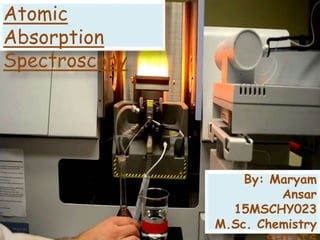
Atomic
Absorption
Spectroscopy
By: Maryam
Ansar
15MSCHY023
M.Sc. Chemistry
 Introduction
 History
 Principle
 Instrumentation
 Application
Contents
Introduction
Atomic Absorption Spectroscopy is a
technique for determining the
concentration of a particular metal
element in a sample.
AAS can be used to analyze the
concentration of over 70different
metals in a solution.
Introduced in 1955
by Alan Walsh in Australia
First commercial AA
Spectrometer was introduced in
1955.
The principles were
established in the second
half of the 19th century
by Gustav Robert
Kirchhoff and Robert
Wilhelm Bunsen
University of Heidelberg,
Germany
Working Principle of AAS
When a beam of monochromatic radiation is passed
through the atoms of an element, the rate of decrease
of intensity of radiation is proportional to the intensity
of incident radiation as well as the concentration of the
solution.”
This technique basically uses the principle that free
atoms (gas) generated in an atomizer can absorb
radiation at specific frequency.
The atoms absorb UV or visible light and make
transitions to higher electronic levels. AAS quantifies
the absorption of ground state atoms in the gaseous
state.
Instrumentation
Light source
(a)Hollow Cathode Lamp
 It contains a tungsten anode and a
hollow cylindrical cathode made of
the element to be determined.
These are sealed in a glass tube
filled with an inert gas.
Each element has its own unique
lamp which must be used for that
analysis .
Reactions in the HCL
Ionisation
Sputtering
Excitation
Emission
Electrodeless Discharge
Lamp
It contain a small quantity of the analyte as a
metal
or a salt in a quartz bulb.
The bulb is inserted into a coil that is
generating an electromagnetic radio
frequency
Nebuliser
 Suck up liquid samples at controlled rate.
 Create a fine Aerosol spray for introduction into
flame.
 Mix the Aerosol and Fuel and Oxidant
thoroughly for introduction into flame.
Atomization
Elements to be analyzed needs to be in atomic
sate.
Atomization is separation of particles into
individual molecules and breaking molecules into
atoms. This is done by exposing the analyte to
high temperatures in a flame or graphite
furnace .
Atomizer
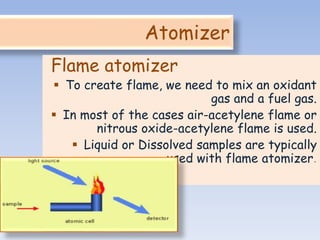
Flame atomizer
 To create flame, we need to mix an oxidant
gas and a fuel gas.
 In most of the cases air-acetylene flame or
nitrous oxide-acetylene flame is used.
 Liquid or Dissolved samples are typically
used with flame atomizer.
Graphite Tube Atomizer
In graphite tube analyzer sample, samples are deposited
in a small graphite coated tube which can then be heated
to vaporize and atomize the analyte.
The graphite tubes are heated using a high current power
supply.
Application
 Clinical analysis
 Environmental analysis
 Pharmaceuticals
 Industry
 Mining
Presentation1

Presentation1

  • 1.
  • 2.
     Introduction  History Principle  Instrumentation  Application Contents
  • 3.
    Introduction Atomic Absorption Spectroscopyis a technique for determining the concentration of a particular metal element in a sample. AAS can be used to analyze the concentration of over 70different metals in a solution.
  • 4.
    Introduced in 1955 byAlan Walsh in Australia First commercial AA Spectrometer was introduced in 1955. The principles were established in the second half of the 19th century by Gustav Robert Kirchhoff and Robert Wilhelm Bunsen University of Heidelberg, Germany
  • 5.
    Working Principle ofAAS When a beam of monochromatic radiation is passed through the atoms of an element, the rate of decrease of intensity of radiation is proportional to the intensity of incident radiation as well as the concentration of the solution.” This technique basically uses the principle that free atoms (gas) generated in an atomizer can absorb radiation at specific frequency. The atoms absorb UV or visible light and make transitions to higher electronic levels. AAS quantifies the absorption of ground state atoms in the gaseous state.
  • 6.
  • 7.
    Light source (a)Hollow CathodeLamp  It contains a tungsten anode and a hollow cylindrical cathode made of the element to be determined. These are sealed in a glass tube filled with an inert gas. Each element has its own unique lamp which must be used for that analysis .
  • 8.
    Reactions in theHCL Ionisation Sputtering Excitation Emission
  • 9.
    Electrodeless Discharge Lamp It containa small quantity of the analyte as a metal or a salt in a quartz bulb. The bulb is inserted into a coil that is generating an electromagnetic radio frequency
  • 10.
    Nebuliser  Suck upliquid samples at controlled rate.  Create a fine Aerosol spray for introduction into flame.  Mix the Aerosol and Fuel and Oxidant thoroughly for introduction into flame.
  • 11.
    Atomization Elements to beanalyzed needs to be in atomic sate. Atomization is separation of particles into individual molecules and breaking molecules into atoms. This is done by exposing the analyte to high temperatures in a flame or graphite furnace .
  • 12.
    Atomizer Flame atomizer  Tocreate flame, we need to mix an oxidant gas and a fuel gas.  In most of the cases air-acetylene flame or nitrous oxide-acetylene flame is used.  Liquid or Dissolved samples are typically used with flame atomizer.
  • 13.
    Graphite Tube Atomizer Ingraphite tube analyzer sample, samples are deposited in a small graphite coated tube which can then be heated to vaporize and atomize the analyte. The graphite tubes are heated using a high current power supply.
  • 14.
    Application  Clinical analysis Environmental analysis  Pharmaceuticals  Industry  Mining