
SEMINAR 3

Relationship/Loyalty.
---------------------------------Erik Abelsson
Lars Ohlson

Ann-Katrin Bartel
Thomas Vareilhes
AGENDA.

----------------------------

TODAY’S

1. Recap
2. Articles
Fournier 1998
Consumers and Their Brands:
Developing Relationship Theory in
Consumer Research.

Richard 1999
Whence Consumer Loyalty?

3. Comparison
(and summary)

4. Break
(hand in your questions!)

5. Discussion
Costumer based

brand equity

Brandscape
(starbucks case)

----------------------------

Brand Personality

RECAP

BRANDING.
(seminar 2)
LOYALTY

RELATIONSHIP.
ARTICLES

----------------------------

TODAY’S

Fournier 1998
Consumers and Their Brands:
Developing Relationship Theory
in Consumer Research.

Oliver 1999
Whence Consumer
Loyalty?
Fournier 1998
Consumers and Their Brands:

Developing Relationship Theory in Consumer Research.

-------------------------------------

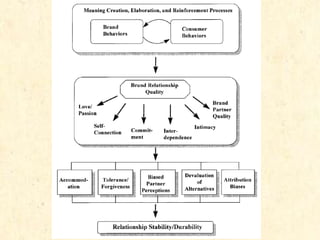
The concept of Relationship & it’s legitimation


Brand as a relationship-partner



Relationships add and structure meanings
Relationships are:



 Polymorph
 Dynamic
Fournier 1998
Consumers and Their Brands:

Developing Relationship Theory in Consumer Research.

-------------------------------------

Empirical Study: 3 women, 12-15 hours interview, $100 tailor gifts

•
•
•
•

Jean
59 years old
Married mother
Barmaid
Italian origins

Karen
• 39 years old
• Recently divorced
• Working mother

Vicki
• 23 years old
• Master student
• Living away from
home
Fournier 1998
Consumers and Their Brands:

Developing Relationship Theory in Consumer Research.

Buzz

QUESTION

-------------------------

-------------------------------------

The development of ICT and in particular the
internet has enabled new types of relationships:
« virtual relationsips ».
Having in mind the Brand Relationship theory of
Fournier (1998), how should those new types of
relationships be interepreted/included in this
model?
ARTICLES

----------------------------

TODAY’S

Oliver 1999
Whence Consumer
Loyalty?
Oliver 1999
Whence Consumer Loyalty?
------------------------------------

Loyalty ≠ satisfaction; but the concepts are
strongly linked



Satisfaction: pleasurable fulfillment
Loyalty: A deeply held commitment to rebuy a
preferred product or brand consistently in the
future.
Ultimate loyalty as an enhanced form of loyalty




Oliver 1999
Whence Consumer Loyalty?
-------------------------------------

Loyalty Phases and Obstacles to Loyalty
Cognitive
loyalty
Affective
loyalty
Conative
loyalty
Action loyalty

• Create dissatisfaction
on different levels of
vulnerability
• Switching incentives:
Price
reductions, coupons, disc
ounts, induced
unavailability

• Variety-seeking
consumers
Oliver 1999
Whence Consumer Loyalty?
-------------------------------------

The four loyalty strategies

•

Product superiority as the weakest form of loyalty

•

Determined self-isolation: The consumer s desire to rebuy a brand can be
based on determined self-isolation; comparable to the concept of love.

•

Village envelopment: The consumer is a passive acceptor of the brand
environment within a social alliance that shelters from outside influences.

•

Immersed self-identity: This form represents a form of ultimate loyalty as
the consumer found a “natural match” with the brand and its environment.
Buzz

QUESTION

-------------------------

Oliver 1999
Whence Consumer Loyalty?
-------------------------------------

Considering Oliver s theory that some firms will
struggle achieving true loyalty among consumers
and should thus focus on achieving satisfaction
only, what indicators do you think determine if a
firm/brand should create a loyalty program?
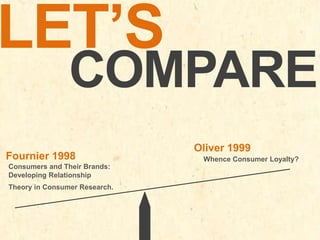
LET’S

COMPARE

Fournier 1998
Consumers and Their Brands:
Developing Relationship
Theory in Consumer Research.

Oliver 1999
Whence Consumer Loyalty?
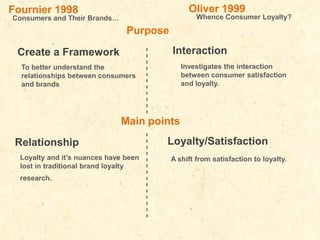
Oliver 1999

Fournier 1998

Consumers and Their Brands…

Whence Consumer Loyalty?

Create a Framework
To better understand the
relationships between consumers
and brands

-----------

Purpose
Interaction
Investigates the interaction
between consumer satisfaction
and loyalty.

Relationship
Loyalty and it’s nuances have been
lost in traditional brand loyalty

research.

--------------

Main points
Loyalty/Satisfaction
A shift from satisfaction to loyalty.
Oliver 1999

Fournier 1998

Consumers and Their Brands…

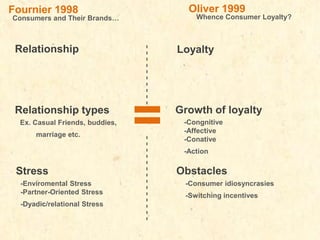
Ex. Casual Friends, buddies,
marriage etc.

Stress
-Enviromental Stress
-Partner-Oriented Stress
-Dyadic/relational Stress

-----------

Relationship types

=
--------------

Relationship

Whence Consumer Loyalty?

Loyalty

Growth of loyalty
-Congnitive
-Affective
-Conative
-Action

Obstacles
-Consumer idiosyncrasies
-Switching incentives
Innovation

Oliver 1999

----------------------------

Relationship

Szmigin 2003

----------------------------

Fournier 1998

Loyalty + Satisfaction
Oliver 1999

Fournier 1998

Consumers and Their Brands…

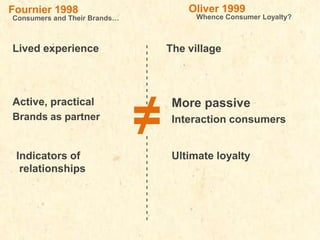
Indicators of
relationships

-----------

Active, practical
Brands as partner

≠
--------------

Lived experience

Whence Consumer Loyalty?

The village

More passive
Interaction consumers
Ultimate loyalty
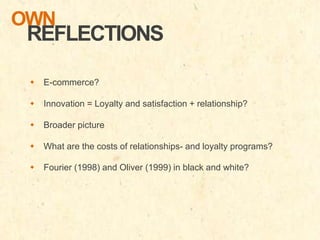
OWN

REFLECTIONS
 E-commerce?
 Innovation = Loyalty and satisfaction + relationship?

 Broader picture
 What are the costs of relationships- and loyalty programs?
 Fourier (1998) and Oliver (1999) in black and white?
EMPIRIC

FINDINGS
QUESTION
Group A2

Some consumers are multiloyal to several brands
and some enjoy seeking diffrent alternatives.
How should companies that aim to have a high
level of costumer loyalty deal with this?

(Think about the articles!)
QUESTION
Group A4

Fournier (1998) states that « Consumers do not
choose brands, they choose lives », this indicates
that brands define people and the self-identity
they pursue. Do you believe this is applicable to
all types of products and services?
In which cases is this not applicable?
QUESTION
Group A3

Have loyalty programs become a hygien factor as
Oliver (1999) was touching upon, and if this is the
case:
How should companies diffrentiate themselves
through loyalty/relations?
THANKS.
AND GOOD WORK

Loyalty/Relationship

  • 1.
  • 2.
    AGENDA. ---------------------------- TODAY’S 1. Recap 2. Articles Fournier1998 Consumers and Their Brands: Developing Relationship Theory in Consumer Research. Richard 1999 Whence Consumer Loyalty? 3. Comparison (and summary) 4. Break (hand in your questions!) 5. Discussion
  • 3.
    Costumer based brand equity Brandscape (starbuckscase) ---------------------------- Brand Personality RECAP BRANDING. (seminar 2)
  • 4.
  • 5.
    ARTICLES ---------------------------- TODAY’S Fournier 1998 Consumers andTheir Brands: Developing Relationship Theory in Consumer Research. Oliver 1999 Whence Consumer Loyalty?
  • 6.
    Fournier 1998 Consumers andTheir Brands: Developing Relationship Theory in Consumer Research. ------------------------------------- The concept of Relationship & it’s legitimation  Brand as a relationship-partner  Relationships add and structure meanings Relationships are:   Polymorph  Dynamic
  • 7.
    Fournier 1998 Consumers andTheir Brands: Developing Relationship Theory in Consumer Research. ------------------------------------- Empirical Study: 3 women, 12-15 hours interview, $100 tailor gifts • • • • Jean 59 years old Married mother Barmaid Italian origins Karen • 39 years old • Recently divorced • Working mother Vicki • 23 years old • Master student • Living away from home
  • 10.
    Fournier 1998 Consumers andTheir Brands: Developing Relationship Theory in Consumer Research. Buzz QUESTION ------------------------- ------------------------------------- The development of ICT and in particular the internet has enabled new types of relationships: « virtual relationsips ». Having in mind the Brand Relationship theory of Fournier (1998), how should those new types of relationships be interepreted/included in this model?
  • 11.
  • 12.
    Oliver 1999 Whence ConsumerLoyalty? ------------------------------------ Loyalty ≠ satisfaction; but the concepts are strongly linked  Satisfaction: pleasurable fulfillment Loyalty: A deeply held commitment to rebuy a preferred product or brand consistently in the future. Ultimate loyalty as an enhanced form of loyalty  
  • 13.
    Oliver 1999 Whence ConsumerLoyalty? ------------------------------------- Loyalty Phases and Obstacles to Loyalty Cognitive loyalty Affective loyalty Conative loyalty Action loyalty • Create dissatisfaction on different levels of vulnerability • Switching incentives: Price reductions, coupons, disc ounts, induced unavailability • Variety-seeking consumers
  • 14.
    Oliver 1999 Whence ConsumerLoyalty? ------------------------------------- The four loyalty strategies • Product superiority as the weakest form of loyalty • Determined self-isolation: The consumer s desire to rebuy a brand can be based on determined self-isolation; comparable to the concept of love. • Village envelopment: The consumer is a passive acceptor of the brand environment within a social alliance that shelters from outside influences. • Immersed self-identity: This form represents a form of ultimate loyalty as the consumer found a “natural match” with the brand and its environment.
  • 15.
    Buzz QUESTION ------------------------- Oliver 1999 Whence ConsumerLoyalty? ------------------------------------- Considering Oliver s theory that some firms will struggle achieving true loyalty among consumers and should thus focus on achieving satisfaction only, what indicators do you think determine if a firm/brand should create a loyalty program?
  • 16.
    LET’S COMPARE Fournier 1998 Consumers andTheir Brands: Developing Relationship Theory in Consumer Research. Oliver 1999 Whence Consumer Loyalty?
  • 17.
    Oliver 1999 Fournier 1998 Consumersand Their Brands… Whence Consumer Loyalty? Create a Framework To better understand the relationships between consumers and brands ----------- Purpose Interaction Investigates the interaction between consumer satisfaction and loyalty. Relationship Loyalty and it’s nuances have been lost in traditional brand loyalty research. -------------- Main points Loyalty/Satisfaction A shift from satisfaction to loyalty.
  • 18.
    Oliver 1999 Fournier 1998 Consumersand Their Brands… Ex. Casual Friends, buddies, marriage etc. Stress -Enviromental Stress -Partner-Oriented Stress -Dyadic/relational Stress ----------- Relationship types = -------------- Relationship Whence Consumer Loyalty? Loyalty Growth of loyalty -Congnitive -Affective -Conative -Action Obstacles -Consumer idiosyncrasies -Switching incentives
  • 19.
  • 20.
    Oliver 1999 Fournier 1998 Consumersand Their Brands… Indicators of relationships ----------- Active, practical Brands as partner ≠ -------------- Lived experience Whence Consumer Loyalty? The village More passive Interaction consumers Ultimate loyalty
  • 21.
    OWN REFLECTIONS  E-commerce?  Innovation= Loyalty and satisfaction + relationship?  Broader picture  What are the costs of relationships- and loyalty programs?  Fourier (1998) and Oliver (1999) in black and white?
  • 23.
  • 24.
    QUESTION Group A2 Some consumersare multiloyal to several brands and some enjoy seeking diffrent alternatives. How should companies that aim to have a high level of costumer loyalty deal with this? (Think about the articles!)
  • 25.
    QUESTION Group A4 Fournier (1998)states that « Consumers do not choose brands, they choose lives », this indicates that brands define people and the self-identity they pursue. Do you believe this is applicable to all types of products and services? In which cases is this not applicable?
  • 26.
    QUESTION Group A3 Have loyaltyprograms become a hygien factor as Oliver (1999) was touching upon, and if this is the case: How should companies diffrentiate themselves through loyalty/relations?
  • 27.

Editor's Notes

  • #18 I written interaction –but it is relationFournier believes that …