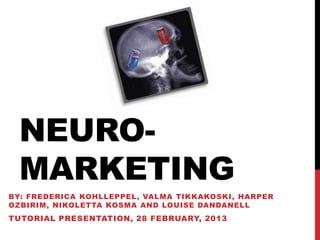
NEURO-
  MARKETING
BY: FREDERICA KOHLLEPPEL, VALMA TIKKAKOSKI, HARPER
OZBIRIM, NIKOLETTA KOSMA AND LOUISE DANDANELL
TUTORIAL PRESENTATION, 28 FEBRUARY, 2013
AGENDA

• Introduction - History – Purpose
• Techniques – Usage
• Case Study
• Critiques
• Conclusion
• Future Perspectives
WHAT IS
NEUROMARKETING?
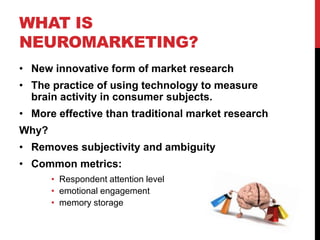
• New innovative form of market research
• The practice of using technology to measure
  brain activity in consumer subjects.
• More effective than traditional market research
Why?
• Removes subjectivity and ambiguity
• Common metrics:
       • Respondent attention level
       • emotional engagement
       • memory storage
HISTORY

Firstly introduced in June 2002 by:
   An Atlanta advertising firm: BrightHouse
   For the creation of a business division using fMRI for marketing research

On the basis of neuroscience research
One manifestation of neuroculture
The premise:
   consumer buying decisions are made in split seconds in the
   subconscious, emotional part of the brain
  Thus:
What we like, don't like, want, fear, are bored by, etc. is
indicated by our brain's reactions to brand stimuli
PURPOSE

•   To better meet "unmet" market needs, connect
    and drive "the buy".
•   To inform the development of products and
    communications - really to inform the brand's
    4Ps
•   To guide marketers to just the right product
    designs, packaging and ad messages to boost
    sales.
METHODS IN
NEUROMARKETING
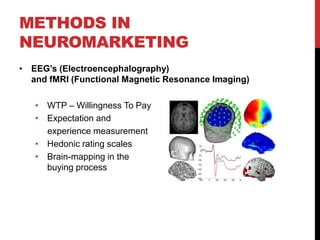
• EEG‟s (Electroencephalography)
  and fMRI (Functional Magnetic Resonance Imaging)

   • WTP – Willingness To Pay
   • Expectation and
     experience measurement
   • Hedonic rating scales
   • Brain-mapping in the
     buying process
SO WHAT ARE THESE
METHODS MONITORING ?
• Basic – it monitors our emotions!

• We feel more than we think


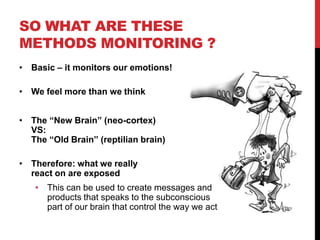
• The “New Brain” (neo-cortex)
  VS:
  The “Old Brain” (reptilian brain)

• Therefore: what we really
  react on are exposed
   • This can be used to create messages and
     products that speaks to the subconscious
     part of our brain that control the way we act
TECHNIQUES IN RELATION
TO MARKETING
• Market Research and Product Development
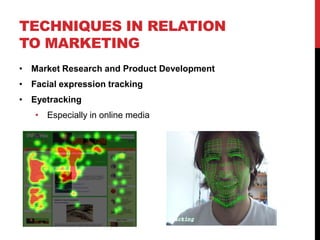
• Facial expression tracking
• Eyetracking
   • Especially in online media
WHO USES
NEUROMARKETING?
• Brain Scientists
• Neurologists
• Hollywood
• Advertising agencies
• R&D departments in P&G, Unilever, Coca Cola etc.
• Facebook
• Google
• And many more….
COCA-COLA VS. PEPSI CASE STUDY
WHAT & WHY
•   For humans, behavioral preferences for food and beverages
    are affected by a great number of sensory stimuli, hedonic
    states, expectations, semantic priming, and social context.
•   Additionally, cultural influences also affect eating and
    drinking habits
•   In this experiment, Coke and Pepsi were delivered to
    humans while using functional magnetic resonance imaging
    (fMRI).
•   Two conditions were examined: (1) anonymous delivery of
    Coke and Pepsi and (2) brand-cued delivery of Coke and
    Pepsi  AKA brain response to both drinks
•   Reasons for choosing Coke and Pepsi as stimuli
•   Hypothesis of study
THE VIDEO
http://www.youtube.com/watch?v=kmMWJ4z8ssA
PROS
 AND
CONS
NEUROMARKETING -
PROS
• Reaching unconscious mind


 • 90% of purchasing decisions (Lindstorm)

 • Sex sells?

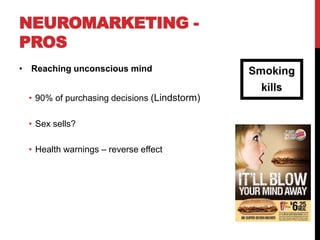
 • Health warnings – reverse effect
NEUROMARKETING -
PROS
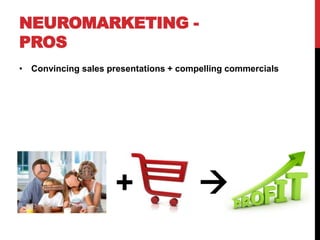
• Convincing sales presentations + compelling commercials


                     +                 
NEUROMARKETING -
PROS
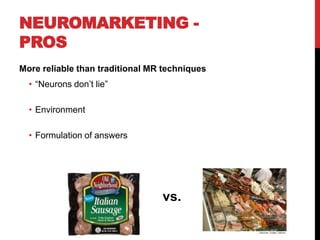
More reliable than traditional MR techniques
  • “Neurons don’t lie”

  • Environment

  • Formulation of answers


                                 vs.
NEUROMARKETING -
PROS

• Lower prices


• A better world?
NEUROMARKETING -
CONS

• Cost - $ 50K (Forbes)
  • return?


• „Brainwashing‟ Marketers – bad image
NEUROMARKETING -
CONS
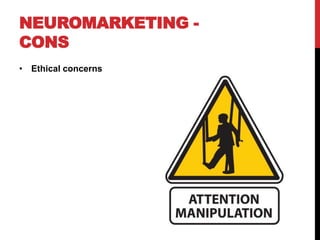
• Ethical concerns
CONCLUSION
• Is a handy tool for marketers in the research process

• No matter which industry you are in you can incorporate
  neuromarketing

• Helps to examine cultural influences on brand perceptions

• Neuromarketing can be both good and bad
FUTURE
PERSPECTIVES
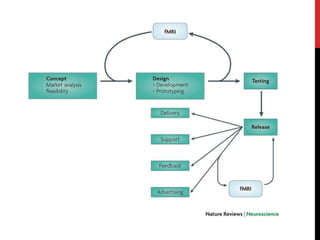
• It will become a given in future product development
  (Ariely and Berns, 2010)


• The next “big thing” in marketing research
  (Ariely and Berns, 2010)


• Could possibly achieve a better cost/benefit trade-off


• Evidence is found that new MVPA measurement will reveal
  hidden information about consumer preferences
FUTURE
PERSPECTIVES
• It will become a given in future product development
  (Ariely and Berns, 2010)


• The next “big thing” in marketing research
  (Ariely and Berns, 2010)


• Could possibly achieve a better cost/benefit trade-off


• Evidence is found that new MVPA measurement will reveal
  hidden information about consumer preferences
DISCUSSION

1. DO YOU THINK NEUROMARKETING IS
MANIPULATIVE?
DISCUSSION

2. DO WE NEED FUTURE LEGISLATION ON THIS
SUBJECT?

Presentation neuromarketing

  • 1.
    NEURO- MARKETING BY:FREDERICA KOHLLEPPEL, VALMA TIKKAKOSKI, HARPER OZBIRIM, NIKOLETTA KOSMA AND LOUISE DANDANELL TUTORIAL PRESENTATION, 28 FEBRUARY, 2013
  • 2.
    AGENDA • Introduction -History – Purpose • Techniques – Usage • Case Study • Critiques • Conclusion • Future Perspectives
  • 3.
    WHAT IS NEUROMARKETING? • Newinnovative form of market research • The practice of using technology to measure brain activity in consumer subjects. • More effective than traditional market research Why? • Removes subjectivity and ambiguity • Common metrics: • Respondent attention level • emotional engagement • memory storage
  • 4.
    HISTORY Firstly introduced inJune 2002 by:  An Atlanta advertising firm: BrightHouse  For the creation of a business division using fMRI for marketing research On the basis of neuroscience research One manifestation of neuroculture The premise:  consumer buying decisions are made in split seconds in the subconscious, emotional part of the brain Thus: What we like, don't like, want, fear, are bored by, etc. is indicated by our brain's reactions to brand stimuli
  • 5.
    PURPOSE • To better meet "unmet" market needs, connect and drive "the buy". • To inform the development of products and communications - really to inform the brand's 4Ps • To guide marketers to just the right product designs, packaging and ad messages to boost sales.
  • 6.
    METHODS IN NEUROMARKETING • EEG‟s(Electroencephalography) and fMRI (Functional Magnetic Resonance Imaging) • WTP – Willingness To Pay • Expectation and experience measurement • Hedonic rating scales • Brain-mapping in the buying process
  • 7.
    SO WHAT ARETHESE METHODS MONITORING ? • Basic – it monitors our emotions! • We feel more than we think • The “New Brain” (neo-cortex) VS: The “Old Brain” (reptilian brain) • Therefore: what we really react on are exposed • This can be used to create messages and products that speaks to the subconscious part of our brain that control the way we act
  • 8.
    TECHNIQUES IN RELATION TOMARKETING • Market Research and Product Development • Facial expression tracking • Eyetracking • Especially in online media
  • 9.
    WHO USES NEUROMARKETING? • BrainScientists • Neurologists • Hollywood • Advertising agencies • R&D departments in P&G, Unilever, Coca Cola etc. • Facebook • Google • And many more….
  • 10.
  • 11.
    WHAT & WHY • For humans, behavioral preferences for food and beverages are affected by a great number of sensory stimuli, hedonic states, expectations, semantic priming, and social context. • Additionally, cultural influences also affect eating and drinking habits • In this experiment, Coke and Pepsi were delivered to humans while using functional magnetic resonance imaging (fMRI). • Two conditions were examined: (1) anonymous delivery of Coke and Pepsi and (2) brand-cued delivery of Coke and Pepsi  AKA brain response to both drinks • Reasons for choosing Coke and Pepsi as stimuli • Hypothesis of study
  • 12.
  • 13.
  • 14.
    NEUROMARKETING - PROS • Reachingunconscious mind • 90% of purchasing decisions (Lindstorm) • Sex sells? • Health warnings – reverse effect
  • 15.
    NEUROMARKETING - PROS • Convincingsales presentations + compelling commercials + 
  • 16.
    NEUROMARKETING - PROS More reliablethan traditional MR techniques • “Neurons don’t lie” • Environment • Formulation of answers vs.
  • 17.
    NEUROMARKETING - PROS • Lowerprices • A better world?
  • 18.
    NEUROMARKETING - CONS • Cost- $ 50K (Forbes) • return? • „Brainwashing‟ Marketers – bad image
  • 19.
  • 20.
    CONCLUSION • Is ahandy tool for marketers in the research process • No matter which industry you are in you can incorporate neuromarketing • Helps to examine cultural influences on brand perceptions • Neuromarketing can be both good and bad
  • 22.
    FUTURE PERSPECTIVES • It willbecome a given in future product development (Ariely and Berns, 2010) • The next “big thing” in marketing research (Ariely and Berns, 2010) • Could possibly achieve a better cost/benefit trade-off • Evidence is found that new MVPA measurement will reveal hidden information about consumer preferences
  • 24.
    FUTURE PERSPECTIVES • It willbecome a given in future product development (Ariely and Berns, 2010) • The next “big thing” in marketing research (Ariely and Berns, 2010) • Could possibly achieve a better cost/benefit trade-off • Evidence is found that new MVPA measurement will reveal hidden information about consumer preferences
  • 25.
    DISCUSSION 1. DO YOUTHINK NEUROMARKETING IS MANIPULATIVE?
  • 26.
    DISCUSSION 2. DO WENEED FUTURE LEGISLATION ON THIS SUBJECT?

Editor's Notes

  • #15 First start with company sideWhen we walk down an aisle in a grocery store, our purchasing decisions are made in less than 4 seconds
  • #16 By getting inside the brains of human beings, marketers may be able to close more deals, deliver more convincing sales presentations and create compelling commercials and advertisements. After all, poor advertisement costs them money and time. Advocates claim neuromarketing will make ads more effective by helping consumers either buy or become more loyal to a brand.Understanding customer "buy buttons” will make businesses more profitable as they begin to limit inventories to products that customers actually want.
  • #17 how we feel about different products and ads. And it does this far more accurate than other methods, because neurons don’t lie. About 10 billion neurons lie in our brain, creating the chemical basis for all our behavior.Most advertisers believe people buy because of features, attributes or price, but the brain tells a different story. We develop preferences based on intuitive feelings for brands, not as a reaction to advertising. The brain hears advertisements from marketers, but it also listens to friends and other sources. All of these sources, not just the marketing messages, help form our opinion of the brand and contributes to our preference for or against it.
  • #18 Understanding customer "buy buttons” will make businesses more profitable as they begin to limit inventories to products that customers actually want. Neuromarketing can benefit us in many ways. Increased corporate profits will spur competition resulting in lower prices; and limiting production of goods to more of what consumers actually buy will lower waste throughout the world providing a healthier environment.
  • #19 Neuromarketing studies are expensive. The Forbes article says that an average EEG or fMRI marketing study costs in the neighborhood of $50,000. Immediately this number can trigger a ‘more expensive = better’ response, especially if you have a large budget to support such studies. What rarely gets discussed is what kind of value you obtain in return for the huge amount of money that is spent.brainwashing”. "That’s completely unfounded”, refutes neuromarketing pioneer Adam Koval of Thought Sciences. "It has nothing to do with controlling consumer thought”. Neuromarketing only identifies audience interest and enables advertisers to be more specific in providing products that consumers want.The key question in neuromarketing is what information can you get with EEG / fMRI / eye tracking / biometrics that you cannot obtain using other methods. If I can spend $1000 to do a traditional market study that gets me 85% of what a $50,000 fMRI study does then the return on my neuromarketing investment is not great.
  • #20 Anti-marketing advocacy groups have spoken out against the practice of neuromarketing and have even lobbied Congress to limit it or stop it completely. These groups are greatly concerned that any information regarding how the unconscious mind works will lead to consumer manipulation and brain washing.There is always the potential for misuse with any technology. This potential outcome, however, shouldn’t outweigh the overall benefits to be gained. Consumer groups are worried about marketing unhealthy products to vulnerable groups. However, the opposite is also true. With a better understanding of how consumers make decisions, products can be marketed that advocate for a healthier lifestyle, promote physical fitness, and are more ethically and socially acceptable.