CUSTOMER LOYALTY PROGRAMS
Latika Parmar
Shahrukh Taghvaei
Sanika Shah
Disha Chaudhry
What is Customer Loyalty?
 Loyalty is a feature of people rather
than something inherent in brands
 Attitude of the consumer
 Commitment to a specific brand
Oliver, 1997
“Deeply held commitment to re-buy or
patronize a preferred product/service
consistently in the future, thereby
causing repetitive same-brand or
same brand-set purchasing despite
situational influences and marketing
efforts having the potential to cause
switching behavior.”
Customer Loyalty Program
 A customer loyalty program is a
structured and long-term marketing
effort which provides incentives to
repeat customers who demonstrate
loyal buying behavior.
2 aims of Consumer Loyalty
Programs:
I. To increase sales revenues
II. To increase range of products bought
from supplier
III. To build a closer bond between the
brand and current and/or future
customers
3 popular concepts:
 Model 1 : Loyalty as primarily an attitude that
leads to a relationship with the brand
MONOGAMY
 Model 2: Loyalty mainly expressed in terms of
patterns of past purchases (revealed behavior)
POLYGAMY
 Model 3: Buying moderated by the individual’s
characteristics, circumstances and/or purchases
situation
PROMISCUITY
Model 1: Attitudinally-loyal customers
 Strong attitudinal commitment towards a
brand establishes true loyalty
 Strength of these attitudes is the KEY
predictor of a brand’s purchase and
repeat patronage
 Revenue becomes more predictable
and considerable with time
 Attitudes drive behavior
 Relationships attached with emotion last
longer
Limitations
Model 1 does not apply to:
 Impulsive buys
 Low risk commodities
 Frequently purchased brands
 Customers who seek variety
Model 2: Revealed Behavior
 Pattern of past purchases
 With regard to underlying consumer
motivations or commitment to the
brand
 “An ongoing propensity to buy the
brand, usually as one of several”
Limitations
I. Trial and error
II. Repeated satisfaction of a particular
brand
III. Results in “weak commitment”
IV. Revealed behavior may merely
reflect happenstance
Model 3: Individual’s
characteristics and environment
 Also known as “Contingency Approach”
 Relationship between attitude and
behavior moderated by:
- current circumstances
- individualistic characteristics
- purchase situation faced
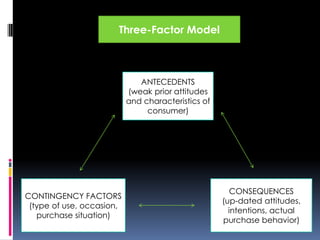
ANTECEDENTS
(weak prior attitudes
and characteristics of
consumer)
CONTINGENCY FACTORS
(type of use, occasion,
purchase situation)
CONSEQUENCES
(up-dated attitudes,
intentions, actual
purchase behavior)
Three-Factor Model
Depending on the model one adopts,
the implications of practice can be
significantly different
Model 1: Attitudinally-loyal customers
 Aim: To enhance positive beliefs and
strengthen the emotional commitment
of customers to their brand
 Image-based or persuasive advertising
 Personal Service (recovery) Programs
Model 2: Revealed Behavior
 Split-loyalty portfolios of habitually-
bought brands
 Publicity
 Advertising + Other forms of Marketing
Communications
 Matching competitor initiatives
 Avoiding supply shortages
 Result: No dramatic changes in
consumer attitudes and behavior
Model 3: Individual’s
characteristics and environment
 Easy accessibility, avoiding stock-outs,
offering appropriate assortment mix
extending opening hours – simply to
be more acceptable to the consumer
 Price promotions, deals, offers
 Service provider gains loyalty by
responding directly to the contingent
factors
Implications of these concepts
 Introduction to the three models of
loyalty – Loyalty Continuum
I. Customer Brand Commitment (CBC)
II. Customer Brand Acceptance (CBA)
III. Customer Brand Buying (CBB)
Customer Brand Commitment
 Product category: High-end products,
luxury goods
 Target audience: value psychological
and social value more than
functionality
 Acquired drive of choice/commitment
 Attitudes, values and social norms
influence the buyer’s decision
 Relationship between customer and
brand is personal
Limitations:
1. Not all high-end products necessarily
have single brand loyalty customers. Eg.
Frequent air travelers
2. Just because the brand is designed to
be unique, does not mean it is distinct in
the eyes of all its potential customers
3. Even if a customer is loyal to a brand, it
may not be the only preference of the
buyer in that particular product
category. Eg. Harley Davidson vs.
Japanese Competitors
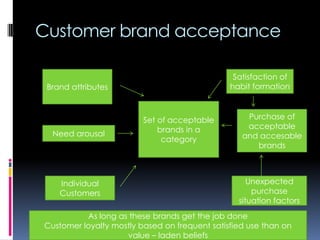
Customer brand acceptance
Set of acceptable
brands in a
category
Brand attributes
Need arousal
Individual
Customers
Satisfaction of
habit formation
Purchase of
acceptable
and accesable
brands
Unexpected
purchase
situation factors
As long as these brands get the job done
Customer loyalty mostly based on frequent satisfied use than on
value – laden beliefs
Consumer Brand Buying
 Immediate availability
 Price, promotions
 Weak attitudes. Eg: Online travel
agencies
 Contingencies are the co-determinants
of choice
 Loyalty proportional to habit rather than
serious commitment
 Model 3 – Model 1 (CBB to CBC)
 Model 2 - CBA
Loyalty Programs from the
Individual’s perspective
 Increase of single brand loyalty
 Decrease price sensitivity
 Induce greater consumer resistence
 Encourage word of mouth
 Less chances of buyers choosing a
substitute products
 Aim: Create bigger group of single
branded loyal customers
 Very hard to convince an individual to
reduce their repertoire of brands
 Greater access to brands, offers more
variety, consolidate their purchases
with fewer business providers
 Cross-selling, an attempt to increase
share-of-wallet instead of share of
market
Loyalty Programs – Market’s
perspective
1) Increase of CBA category through
- Exposure at pt. of purchase
- Gaining wider distribution
- Suggesting more usage occasions
2) Create a niche brand
3) Big brand to “super loyal brand”
4) Exploit the desire of customers for
change-of-pace (Penetration>Repeat
purchase) Eg. Premium beers
 Aim: To help grow the size of a brand
when used in combination with other
marketing programs
Loyalty Programs – Profibility
 Better insight into customer behavior
 Greater efficiency in targeted
marketing
 Demographics and lifestyles
 Too much information
 No control group method
 Importance of opportunity costs
 Thank you 

Customer loyalty programs

  • 1.
    CUSTOMER LOYALTY PROGRAMS LatikaParmar Shahrukh Taghvaei Sanika Shah Disha Chaudhry
  • 2.
    What is CustomerLoyalty?  Loyalty is a feature of people rather than something inherent in brands  Attitude of the consumer  Commitment to a specific brand
  • 3.
    Oliver, 1997 “Deeply heldcommitment to re-buy or patronize a preferred product/service consistently in the future, thereby causing repetitive same-brand or same brand-set purchasing despite situational influences and marketing efforts having the potential to cause switching behavior.”
  • 4.
    Customer Loyalty Program A customer loyalty program is a structured and long-term marketing effort which provides incentives to repeat customers who demonstrate loyal buying behavior.
  • 5.
    2 aims ofConsumer Loyalty Programs: I. To increase sales revenues II. To increase range of products bought from supplier III. To build a closer bond between the brand and current and/or future customers
  • 6.
    3 popular concepts: Model 1 : Loyalty as primarily an attitude that leads to a relationship with the brand MONOGAMY  Model 2: Loyalty mainly expressed in terms of patterns of past purchases (revealed behavior) POLYGAMY  Model 3: Buying moderated by the individual’s characteristics, circumstances and/or purchases situation PROMISCUITY
  • 7.
    Model 1: Attitudinally-loyalcustomers  Strong attitudinal commitment towards a brand establishes true loyalty  Strength of these attitudes is the KEY predictor of a brand’s purchase and repeat patronage  Revenue becomes more predictable and considerable with time  Attitudes drive behavior  Relationships attached with emotion last longer
  • 8.
    Limitations Model 1 doesnot apply to:  Impulsive buys  Low risk commodities  Frequently purchased brands  Customers who seek variety
  • 9.
    Model 2: RevealedBehavior  Pattern of past purchases  With regard to underlying consumer motivations or commitment to the brand  “An ongoing propensity to buy the brand, usually as one of several”
  • 10.
    Limitations I. Trial anderror II. Repeated satisfaction of a particular brand III. Results in “weak commitment” IV. Revealed behavior may merely reflect happenstance
  • 11.
    Model 3: Individual’s characteristicsand environment  Also known as “Contingency Approach”  Relationship between attitude and behavior moderated by: - current circumstances - individualistic characteristics - purchase situation faced
  • 12.
    ANTECEDENTS (weak prior attitudes andcharacteristics of consumer) CONTINGENCY FACTORS (type of use, occasion, purchase situation) CONSEQUENCES (up-dated attitudes, intentions, actual purchase behavior) Three-Factor Model
  • 13.
    Depending on themodel one adopts, the implications of practice can be significantly different
  • 14.
    Model 1: Attitudinally-loyalcustomers  Aim: To enhance positive beliefs and strengthen the emotional commitment of customers to their brand  Image-based or persuasive advertising  Personal Service (recovery) Programs
  • 15.
    Model 2: RevealedBehavior  Split-loyalty portfolios of habitually- bought brands  Publicity  Advertising + Other forms of Marketing Communications  Matching competitor initiatives  Avoiding supply shortages  Result: No dramatic changes in consumer attitudes and behavior
  • 16.
    Model 3: Individual’s characteristicsand environment  Easy accessibility, avoiding stock-outs, offering appropriate assortment mix extending opening hours – simply to be more acceptable to the consumer  Price promotions, deals, offers  Service provider gains loyalty by responding directly to the contingent factors
  • 17.
    Implications of theseconcepts  Introduction to the three models of loyalty – Loyalty Continuum I. Customer Brand Commitment (CBC) II. Customer Brand Acceptance (CBA) III. Customer Brand Buying (CBB)
  • 18.
    Customer Brand Commitment Product category: High-end products, luxury goods  Target audience: value psychological and social value more than functionality  Acquired drive of choice/commitment  Attitudes, values and social norms influence the buyer’s decision  Relationship between customer and brand is personal
  • 19.
    Limitations: 1. Not allhigh-end products necessarily have single brand loyalty customers. Eg. Frequent air travelers 2. Just because the brand is designed to be unique, does not mean it is distinct in the eyes of all its potential customers 3. Even if a customer is loyal to a brand, it may not be the only preference of the buyer in that particular product category. Eg. Harley Davidson vs. Japanese Competitors
  • 20.
    Customer brand acceptance Setof acceptable brands in a category Brand attributes Need arousal Individual Customers Satisfaction of habit formation Purchase of acceptable and accesable brands Unexpected purchase situation factors As long as these brands get the job done Customer loyalty mostly based on frequent satisfied use than on value – laden beliefs
  • 21.
    Consumer Brand Buying Immediate availability  Price, promotions  Weak attitudes. Eg: Online travel agencies  Contingencies are the co-determinants of choice  Loyalty proportional to habit rather than serious commitment  Model 3 – Model 1 (CBB to CBC)  Model 2 - CBA
  • 22.
    Loyalty Programs fromthe Individual’s perspective  Increase of single brand loyalty  Decrease price sensitivity  Induce greater consumer resistence  Encourage word of mouth  Less chances of buyers choosing a substitute products  Aim: Create bigger group of single branded loyal customers
  • 23.
     Very hardto convince an individual to reduce their repertoire of brands  Greater access to brands, offers more variety, consolidate their purchases with fewer business providers  Cross-selling, an attempt to increase share-of-wallet instead of share of market
  • 24.
    Loyalty Programs –Market’s perspective 1) Increase of CBA category through - Exposure at pt. of purchase - Gaining wider distribution - Suggesting more usage occasions 2) Create a niche brand 3) Big brand to “super loyal brand” 4) Exploit the desire of customers for change-of-pace (Penetration>Repeat purchase) Eg. Premium beers
  • 25.
     Aim: Tohelp grow the size of a brand when used in combination with other marketing programs
  • 26.
    Loyalty Programs –Profibility  Better insight into customer behavior  Greater efficiency in targeted marketing  Demographics and lifestyles  Too much information  No control group method  Importance of opportunity costs
  • 27.