Industrial Engineering Letters www.iiste.org 
ISSN 2224-6096 (Paper) ISSN 2225-0581 (online) 
Vol.4, No.8, 2014 
Creating an Empirical Model of the Effect of Relationship 
Marketing Strategy on Customer Loyalty 
Case Study: Insurance Firms in Iran 
Dr.Mohammad Reza Shojaei1 Parisa Mehri2 Narges Khanhossein Poor2 
1.professor assistant, shahid beheshti university, Iran, Tehran 
2.Master of business, Ershad university, Iran, Tehran 
Abstract 
To understand the mechanism of how loyalty programs can work effectively, this paper creating an empirical 
model of the effect of relationship marketing strategy on customer loyalty. The findings indicated that the 
relationship marketing positively related to the customer loyalty both toward the programs themselves and the 
stores. So, our population statistical is customer of insurance firm in Iran and the amount of sample according to 
Cochran formula is 140 person. For testing the data, we use from SPSS 19 with correlation and regression, 
according to finding all of the hypothesis are accepted. 
1.Introduction 
Loyalty has become important over the past few years because of increased competition within respective 
industries. Companies infer “loyalty” to have a similar meaning and have developed strategic marketing and 
advertising efforts around creating a connection between the company and its customers. Within the hospitality 
industry, the number of accommodation choices from which customers can choose cannot be any more apparent. 
In realizing the ongoing competitiveness that is to occur within the industry, many hotel corporations have 
shifted their focus to relationship marketing, particularly through the concept of loyalty. With the increased 
bargaining power consumers are obtaining, hotel corporations are realizing the key to their success will be to 
foster strategic relationship marketing efforts, particularly through the usage of loyalty measures. Customer 
retention is very important because of business competitive environment. Thus, a marketing expert to give heed 
to RM and its tactics. Nowadays, salesman strives not only to provide high-quality goods and services but also to 
retain loyal customer due to long-time profitable (Day, 2000). Gruen (1997) notes that relationship marketing is 
a strategy that promises “the systematic development of ongoing, collaborative business relationships as a key 
source of sustainable competitive advantage. An organization must prizes to customer propensity for a valuable 
goods and services in order that attracting its loyalty and satisfaction. Therefore, RM can be considered as main 
point in planning marketing. Previous researchers play up to RM as one manner for developing and cultivating 
long-term beneficial relationship mutually (Barnes, 1997; Dwer et al. 1987; Ganesan, 1994; Garbarino and 
Johnson, 1999; Morgan and Hunt, 1994). For a company, it is important to establish a heartfelt relation with 
customer, worker, supplier, distributor, intermediate, and retailer. Thus, relationship capital of any company is 
having a complex of knowledge, experience, and place confidence on their customer, worker, supplier, and 
distributor. The value of this relationship is more worthwhile than physical assets and, thus, it will identify 
company value in the days of next (Kotler, 2001).The RM leads a vast change on marketing opinion from a 
competition to a mutual co-working because it to give heed to co-working among supplier, worker, distributor, 
intermediate, and retailer for presenting the best value to target customer. This study contributes two aspects of 
marketing strategy literature as it will be a guideline for a manager to accent to RQ in orderthat beget sustainable 
and indissoluble trade. Firstly, it will provide theoretical and empirical insight by orienting to create a loyal 
customer. Secondly, despite the fact that RM may lead to promotion of long-term relation as it is acknowledged 
widely (Richheld, 1993; Fontenot and Hymon, 2004; Shelbay et al., 2006; Gummesson, 1994; Tseng, 2007), 
many firms don't know its role and result. Therefore, an organization always will doubt that whether relationship 
marketing tactics will cause loyalty or not? If yes, which method(s) can simplify and fortify loyalty? Therefore, 
one of the major objectives of this research was to investigate increase the information about the role and result 
of RM tactics on customer loyalty through RQ mediation. Literature was documented the importance of the 
marketing, research and development (R&D), sales, and manufacturing interface (Leenders and Wierenga, 2008). 
1-2 Customer Loyalty 
Loyalty is an ancient word that explains having a deep commitment for a country, clan, yokefellow, and friend. 
Loyalty had penetrated to marketing science literature via “Brand Loyalty”. However, in marketing literature, 
customer loyalty has been defined in this way: a customer deep commitment to purchase or to patronize for a 
product or a service frequently in future, thereby causing repetitive same-brand or same brand-set purchasing, 
despite situational influences and marketing efforts having the potential to cause switching behavior (Oliver, 
1999). From Kotler’s (2003) point of view, a company need do discriminatory behavior between their customers 
56
Industrial Engineering Letters www.iiste.org 
ISSN 2224-6096 (Paper) ISSN 2225-0581 (online) 
Vol.4, No.8, 2014 
(regular and non-regular) to create loyalty. These customers have earn most advantage from company suggests. 
Nonetheless, every company should goal setting to create loyal customer, but loyalty have never be so strength 
that customers do not accept those competitor suggestion that have more value (Kotler, 2003). 
1-1-2 Impact of Satisfaction on Customer Loyalty 
Satisfaction is a pursuit hoteliers must continually strive to meet with the guests of its property or company. 
Taylor, Celuch, & Goodwin (2004) show that satisfaction has a direct influence on customer loyalty. Mittal & 
Lassar (1998) discussed how satisfaction has been proven to directly affect loyalty. They further analyzed this 
impact by discussing the importance of looking at satisfaction and service quality together as they related to 
customer loyalty and likeliness to return. They stated “satisfaction” alone only tells whether the customer is 
satisfied or not. However, when measured with “quality”, there is greater ability to determine what aspects of 
service are below par and need improvement as they relate to guest satisfaction. Karatepe (2005) took the same 
measurement approach as Taylor, Celuch, & Goodwin (2004), and other researchers just mentioned. Skogland & 
Siguaw (2004) measured the degree to which satisfaction influenced loyalty. These two particular researchers 
felt the degree to which the customer was involved in the purchase decision had a strong effect on the propensity 
to switch service providers. They measured this impact by using the confirmation-disconfirmation and 
comparison-level theories. The satisfaction antecedents used included service quality, product quality, price, and 
location 
2-1-2 Impact of Perceived Quality on Customer Loyalty 
Zeithaml (1988) defined perceived quality to be “The consumer’s judgment about an entity’s overall excellence 
or superiority.” Antony, Antony, & Ghosh (2004) believed service quality to be so intangible that objective 
measurement is impossible. To improve service quality, increase relationship marketing and the overall loyalty 
of guest patronization, it will be important to narrow the gap between appearances and perceptions. In order to 
alleviate this deficiency, it is vital to consider both functional and technical quality as they both impact overall 
service quality. Several major developments over the past few decades will assist with performing this 
measurement. One particular development is (service quality) SERQUAL, a measurement tool covering the 
areas of tangibility, reliability, responsiveness, assurance, and empathy (Kang, Okamoto, Donovan, 2004). 
Through the usage of SERQUAL, it is believed that assessment of service quality and also customer-contact can 
increase expected value provided to the guest. Gold (2005) stated in “What Inspires Loyalty today?” that 
“…pleasant surprises… [with the] proactivity of service above and beyond… [will] stick in the mind of guests 
and drive loyalty” (p. 2). McCain, Jang, & Hu (2005) discussed how service quality plays an important role in 
the assessment of customer loyalty. Antony, Antony, & Ghosh (2004 ) also stated service quality as being linked 
to customer satisfaction and customer loyalty. The researchers measured this impact by looking at tangible and 
intangible elements of service through technical and functional quality. 
3-1-2 Impact of Perceived Value on Customer Loyalty 
In the realm of perceived value, an excerpt written by Brady & Cronin (2001, p. 243) stated, “Customers’ value 
perceptions seem to drive their future behaviors such as repurchase intent and word-of-mouth referrals.” They 
also proposed that consumers’ affective responses were directly related to perceived value in highly experiential 
service settings. Zethaml (1988) defined perceived value as “the consumer’s overall assessment of the utility of 
product based on perceptions of what is received and what is given. Oliver (1999) asserted that “value” is a 
unique construct stemming from both satisfaction and quality, also outcome variables such as loyalty. From a 
measurement standpoint, Bojanic (1996) asserted that a firm’s value can change if the firm changes what it is 
doing. When it came to pricing, Danziger, Israeli, & Bekerman (2006, p. 2) stated, “Many firms establish prices 
based on internal costs.” They further stated that this, what can be considered a “cost incurred vs. price offered 
measurement,” does not assist hotels with being able to attract customers. A final pricing strategy should 
combine a supply side focus with the value customers place on its offerings. This is based on the evaluation of 
strategic assets (corporate affiliation, brand name, firm size). By conducting this evaluation, Danziger, Israeli, & 
Bekerman (2006) believed that firms may signal strategic assets to target audiences to justify a reason for paying 
a premium price, to generate above average returns, and to form the basis of sustained competitive advantage 
4-1-2 Impact of Membership Programs on Customer Loyalty 
From a non-theoretical perspective, hotels have given considerable focus to the impact customer loyalty 
programs have on guest retention within the company. Virtually every hotel corporation has developed and 
implemented a loyalty membership program to foster this connection with its guests. Various services, amenities, 
and other offerings are provided to meet the demands and preferences guests have in regards to their membership. 
Although loyalty programs provide benefit to hotel corporations through their offerings, a concern was raised as 
regard “true” loyal customers. Baloglu (2002) endeavored to separate “friends” from “well wishers.” The 
57
Industrial Engineering Letters www.iiste.org 
ISSN 2224-6096 (Paper) ISSN 2225-0581 (online) 
Vol.4, No.8, 2014 
researcher focused on determining whether frequent guests were truly loyal by assessing both guests’ attitudes 
and their actions. He classified the “dimensions of customer loyalty” as being low, latent, spurious, and true 
loyalty. In terms of effectiveness, Lal & Bell (2003) alluded to the fact that few studies shed light on the return 
obtained from loyalty programs. Dowling & Uncles (1997, p. 71) concluded that “given the popularity of loyalty 
programs, they are surprisingly ineffective.” In the assessment of this study, it is very important to measure 
guests’ perspective on the usage and their dependence on membership programs. 
58 
2-2 Relationship marketing 
- Trust : trust is a phenomenon that strengthens organizational relation. Asuncion believes in that 
researches about marketing could be divided into four categories ( upward trust, mutual trust, lack of 
trust and downward trust based on their orientation toward trust subject.(goran,2001) 
- -Commitment: commitment is a helpful tool for measurement probability of customers’ future 
purchases. Commitment is also known as sum of normal internalized stresses for doing activities so that 
to realize organizational goal and interests. 
- Communication: communication comprises process of sending information from a person to another 
and comprehending it by receiving person that is to transfer and sharing in thought; ideas and realities 
so that the receiving person can find and comprehend it. is the delivering of a message or information, 
through various methods, from one individual or group to another (Bosch, Tait & Venter 2006: 543; 
Lages, Lages, Lages 2005; Joiner 1994: 124). Word of mouth (Kotler, Armstrong & Tait 2010: 431) 
and marketing communication (Elliott 2009: 274–277) are also regarded as methods of communication 
to and from clients. Communication is a tool in relationship marketing to present the information i.e. 
one that can be trusted on it and introducing updated information about the problems concerning to 
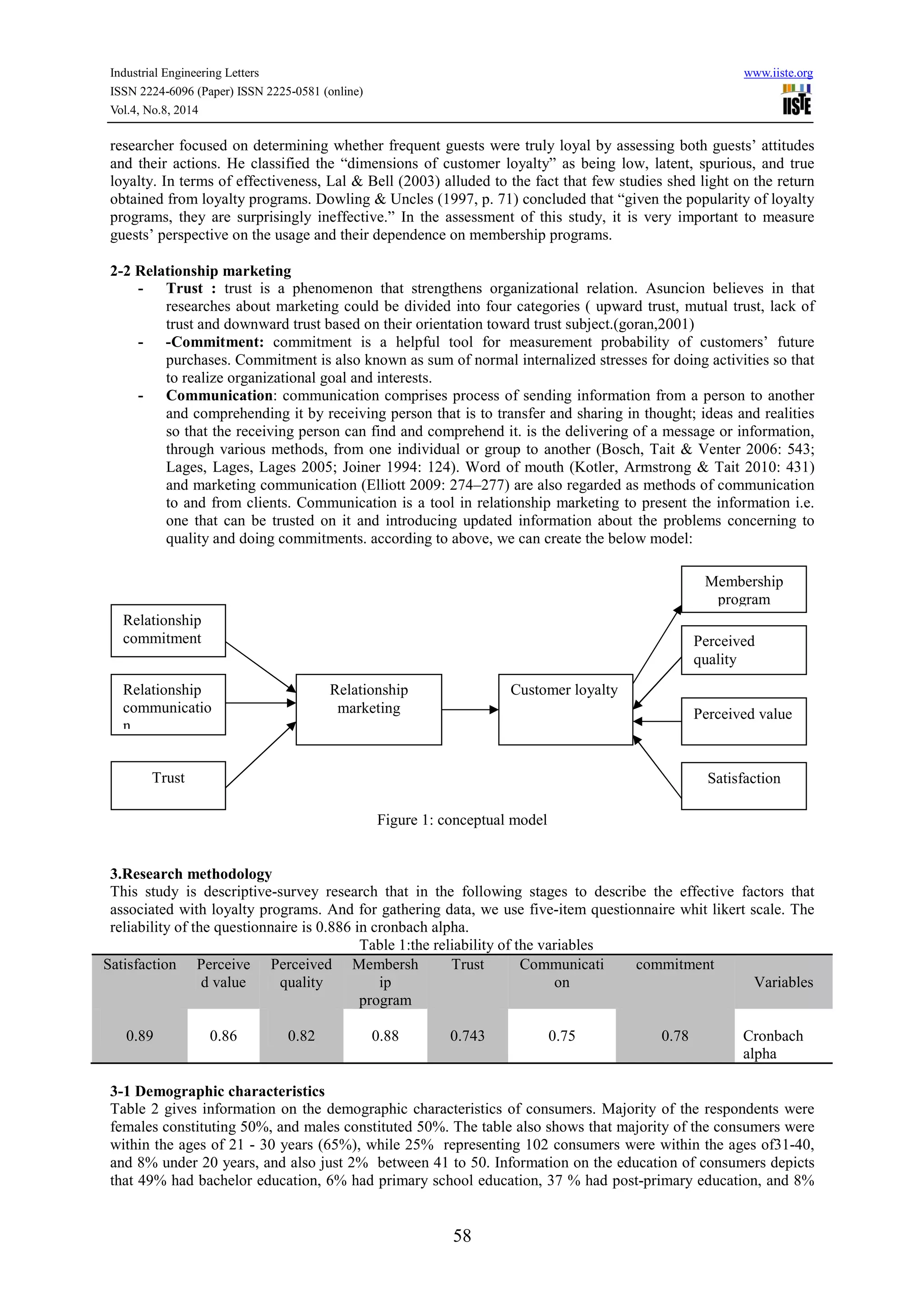
quality and doing commitments. according to above, we can create the below model: 
Relationship 
marketing 
Customer loyalty 
Figure 1: conceptual model 
Membership 
program 
Perceived 
quality 
Perceived value 
Satisfaction 
Relationship 
commitment 
Relationship 
communicatio 
n 
Trust 
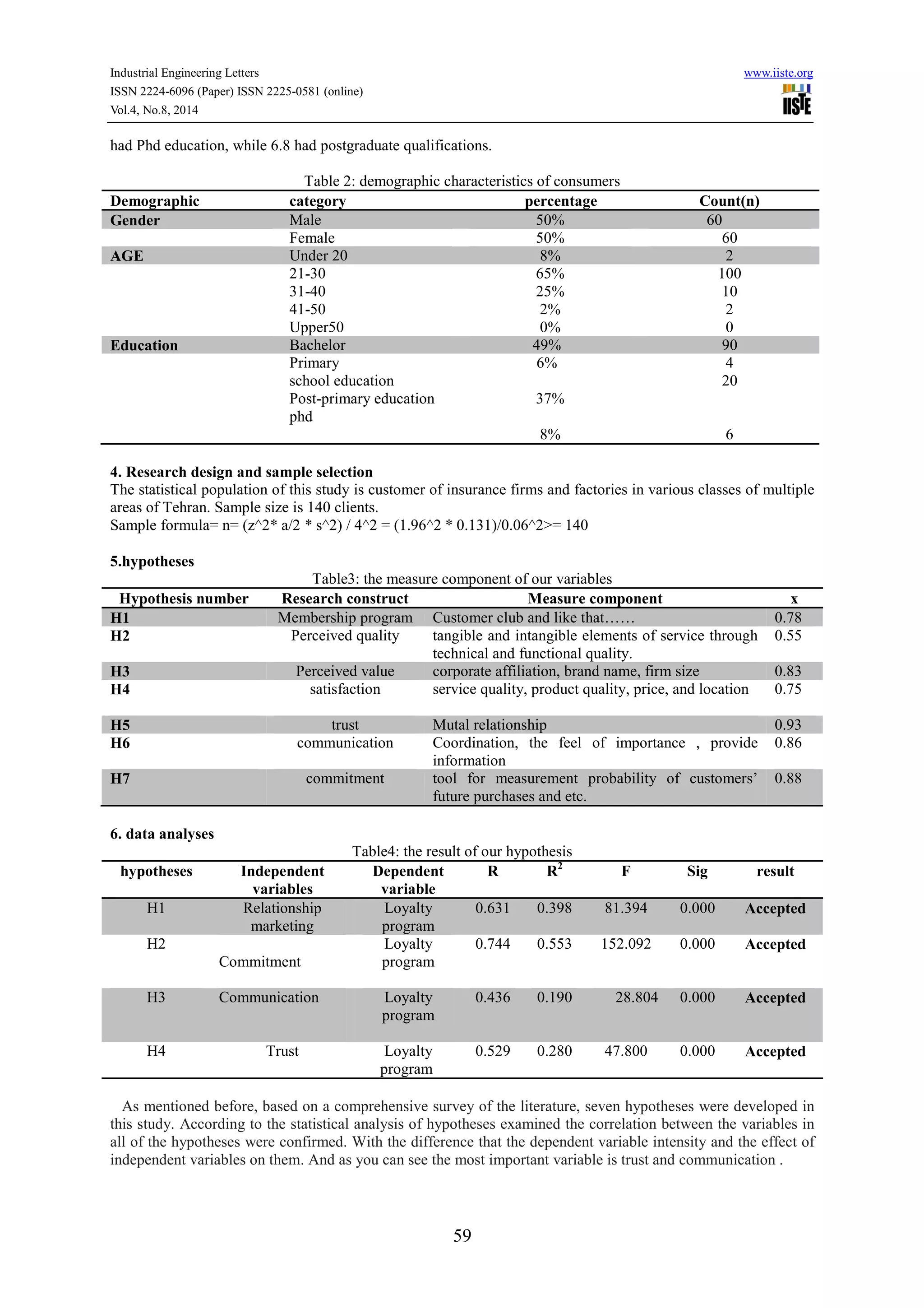
3.Research methodology 
This study is descriptive-survey research that in the following stages to describe the effective factors that 
associated with loyalty programs. And for gathering data, we use five-item questionnaire whit likert scale. The 
reliability of the questionnaire is 0.886 in cronbach alpha. 
Table 1:the reliability of the variables 
Satisfaction Perceive 
d value 
Perceived 
quality 
Membersh 
ip 
program 
Trust Communicati 
on 
commitment 
Variables 
0.89 
0.86 
0.82 
0.88 
0.743 
0.75 
0.78 
Cronbach 
alpha 
3-1 Demographic characteristics 
Table 2 gives information on the demographic characteristics of consumers. Majority of the respondents were 
females constituting 50%, and males constituted 50%. The table also shows that majority of the consumers were 
within the ages of 21 - 30 years (65%), while 25% representing 102 consumers were within the ages of31-40, 
and 8% under 20 years, and also just 2% between 41 to 50. Information on the education of consumers depicts 
that 49% had bachelor education, 6% had primary school education, 37 % had post-primary education, and 8%
Industrial Engineering Letters www.iiste.org 
ISSN 2224-6096 (Paper) ISSN 2225-0581 (online) 
Vol.4, No.8, 2014 
had Phd education, while 6.8 had postgraduate qualifications. 
Table 2: demographic characteristics of consumers 
Demographic category percentage Count(n) 
Gender Male 50% 60 
Female 50% 60 
AGE Under 20 8% 2 
59 
21-30 
31-40 
41-50 
Upper50 
65% 
25% 
2% 
0% 
100 
10 
2 
0 
Education Bachelor 49% 90 
Primary 
school education 
Post-primary education 
phd 
6% 
37% 
8% 
4 
20 
6 
4. Research design and sample selection 
The statistical population of this study is customer of insurance firms and factories in various classes of multiple 
areas of Tehran. Sample size is 140 clients. 
Sample formula= n= (z^2* a/2 * s^2) / 4^2 = (1.96^2 * 0.131)/0.06^2>= 140 
5.hypotheses 
Table3: the measure component of our variables 
Hypothesis number Research construct Measure component x 
H1 Membership program Customer club and like that…… 0.78 
H2 Perceived quality tangible and intangible elements of service through 
technical and functional quality. 
0.55 
H3 Perceived value corporate affiliation, brand name, firm size 0.83 
H4 satisfaction service quality, product quality, price, and location 
0.75 
H5 trust Mutal relationship 0.93 
H6 communication Coordination, the feel of importance , provide 
information 
0.86 
H7 commitment tool for measurement probability of customers’ 
future purchases and etc. 
0.88 
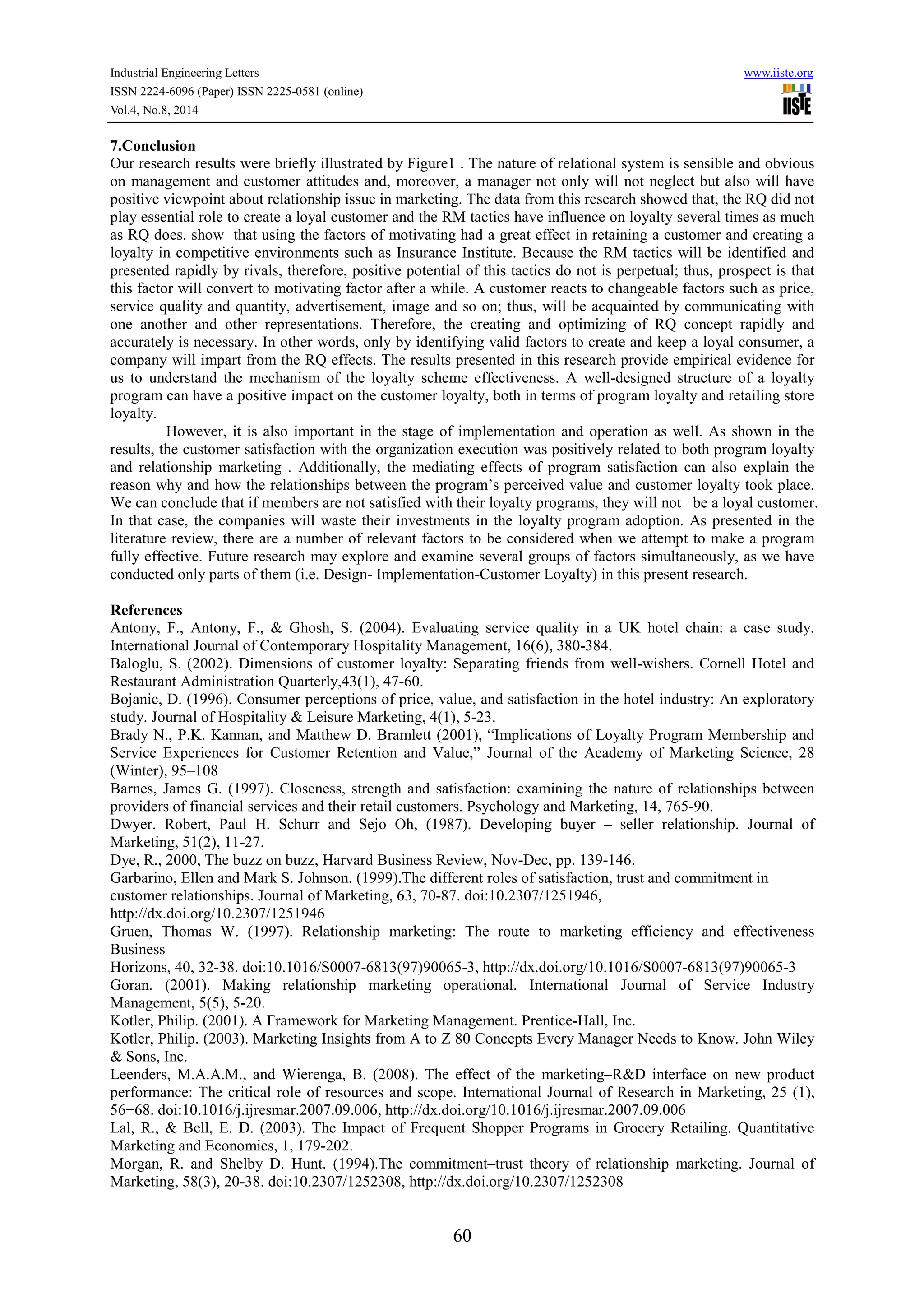
6. data analyses 
Table4: the result of our hypothesis 
R F Sig result 2 Dependent R 
variable 
Independent 
variables 
hypotheses 
Loyalty 0.631 0.398 81.394 0.000 Accepted 
program 
Relationship 
marketing 
H1 
Loyalty 0.744 0.553 152.092 0.000 Accepted 
program 
Commitment 
H2 
Loyalty 0.436 0.190 28.804 0.000 Accepted 
program 
Communication 
H3 
Loyalty 0.529 0.280 47.800 0.000 Accepted 
program 
H4 Trust 
As mentioned before, based on a comprehensive survey of the literature, seven hypotheses were developed in 
this study. According to the statistical analysis of hypotheses examined the correlation between the variables in 
all of the hypotheses were confirmed. With the difference that the dependent variable intensity and the effect of 
independent variables on them. And as you can see the most important variable is trust and communication .
Industrial Engineering Letters www.iiste.org 
ISSN 2224-6096 (Paper) ISSN 2225-0581 (online) 
Vol.4, No.8, 2014 
7.Conclusion 
Our research results were briefly illustrated by Figure1 . The nature of relational system is sensible and obvious 
on management and customer attitudes and, moreover, a manager not only will not neglect but also will have 
positive viewpoint about relationship issue in marketing. The data from this research showed that, the RQ did not 
play essential role to create a loyal customer and the RM tactics have influence on loyalty several times as much 
as RQ does. show that using the factors of motivating had a great effect in retaining a customer and creating a 
loyalty in competitive environments such as Insurance Institute. Because the RM tactics will be identified and 
presented rapidly by rivals, therefore, positive potential of this tactics do not is perpetual; thus, prospect is that 
this factor will convert to motivating factor after a while. A customer reacts to changeable factors such as price, 
service quality and quantity, advertisement, image and so on; thus, will be acquainted by communicating with 
one another and other representations. Therefore, the creating and optimizing of RQ concept rapidly and 
accurately is necessary. In other words, only by identifying valid factors to create and keep a loyal consumer, a 
company will impart from the RQ effects. The results presented in this research provide empirical evidence for 
us to understand the mechanism of the loyalty scheme effectiveness. A well-designed structure of a loyalty 
program can have a positive impact on the customer loyalty, both in terms of program loyalty and retailing store 
loyalty. 
However, it is also important in the stage of implementation and operation as well. As shown in the 
results, the customer satisfaction with the organization execution was positively related to both program loyalty 
and relationship marketing . Additionally, the mediating effects of program satisfaction can also explain the 
reason why and how the relationships between the program’s perceived value and customer loyalty took place. 
We can conclude that if members are not satisfied with their loyalty programs, they will not be a loyal customer. 
In that case, the companies will waste their investments in the loyalty program adoption. As presented in the 
literature review, there are a number of relevant factors to be considered when we attempt to make a program 
fully effective. Future research may explore and examine several groups of factors simultaneously, as we have 
conducted only parts of them (i.e. Design- Implementation-Customer Loyalty) in this present research. 
References 
Antony, F., Antony, F., & Ghosh, S. (2004). Evaluating service quality in a UK hotel chain: a case study. 
International Journal of Contemporary Hospitality Management, 16(6), 380-384. 
Baloglu, S. (2002). Dimensions of customer loyalty: Separating friends from well-wishers. Cornell Hotel and 
Restaurant Administration Quarterly,43(1), 47-60. 
Bojanic, D. (1996). Consumer perceptions of price, value, and satisfaction in the hotel industry: An exploratory 
study. Journal of Hospitality & Leisure Marketing, 4(1), 5-23. 
Brady N., P.K. Kannan, and Matthew D. Bramlett (2001), “Implications of Loyalty Program Membership and 
Service Experiences for Customer Retention and Value,” Journal of the Academy of Marketing Science, 28 
(Winter), 95–108 
Barnes, James G. (1997). Closeness, strength and satisfaction: examining the nature of relationships between 
providers of financial services and their retail customers. Psychology and Marketing, 14, 765-90. 
Dwyer. Robert, Paul H. Schurr and Sejo Oh, (1987). Developing buyer – seller relationship. Journal of 
Marketing, 51(2), 11-27. 
Dye, R., 2000, The buzz on buzz, Harvard Business Review, Nov-Dec, pp. 139-146. 
Garbarino, Ellen and Mark S. Johnson. (1999).The different roles of satisfaction, trust and commitment in 
customer relationships. Journal of Marketing, 63, 70-87. doi:10.2307/1251946, 
http://dx.doi.org/10.2307/1251946 
Gruen, Thomas W. (1997). Relationship marketing: The route to marketing efficiency and effectiveness 
Business 
Horizons, 40, 32-38. doi:10.1016/S0007-6813(97)90065-3, http://dx.doi.org/10.1016/S0007-6813(97)90065-3 
Goran. (2001). Making relationship marketing operational. International Journal of Service Industry 
Management, 5(5), 5-20. 
Kotler, Philip. (2001). A Framework for Marketing Management. Prentice-Hall, Inc. 
Kotler, Philip. (2003). Marketing Insights from A to Z 80 Concepts Every Manager Needs to Know. John Wiley 
& Sons, Inc. 
Leenders, M.A.A.M., and Wierenga, B. (2008). The effect of the marketing–R&D interface on new product 
performance: The critical role of resources and scope. International Journal of Research in Marketing, 25 (1), 
56−68. doi:10.1016/j.ijresmar.2007.09.006, http://dx.doi.org/10.1016/j.ijresmar.2007.09.006 
Lal, R., & Bell, E. D. (2003). The Impact of Frequent Shopper Programs in Grocery Retailing. Quantitative 
Marketing and Economics, 1, 179-202. 
Morgan, R. and Shelby D. Hunt. (1994).The commitment–trust theory of relationship marketing. Journal of 
Marketing, 58(3), 20-38. doi:10.2307/1252308, http://dx.doi.org/10.2307/1252308 
60
Industrial Engineering Letters www.iiste.org 
ISSN 2224-6096 (Paper) ISSN 2225-0581 (online) 
Vol.4, No.8, 2014 
Mittal, B. & Lassar, W. (1998). Why do customers switch? The dynamics of satisfaction versus loyalty. The 
Journal of Services Marketing, 12(3), 177. 
Oliver, R.L. (1999). Value as excellence in the consumption experience. Consumer value: A framework for 
analysis and research, Routledge, New York, NY 
Oliver, Richard L. (1999), “Whence Consumer Loyalty?” Journal of Marketing, 63 (Special Issue), 33–44. 
Rosen, E., 2001, The anatomy of Buzz: creating word-of-mouth marketing, London, Harper Collins Publishers. 
Reichheld FF. (1993). Loyalty based management. Harvard Business Review, 71(2), 64-73. 
Skogland, I. & Siguaw, J. (2004). Are your satisfied customers loyal? Cornell Hotel and Restaurant 
Administration Quarterly, 45(3), 221-235. 
Smith Travel Research. (2005). U.S. lodging industry overview. Hendersonville, TN: Author. 
Taylor, S., Celuch, K., and Goodwin, S. (2004). The importance of brand equity to customer loyalty. Journal of 
Product & Brand Management, 13(4), 
217-227. 
Zeithaml, V. (1988). Consumer perceptions of price, quality, and value: a means-end model and synthesis of 
evidence. Journal of Marketing, 52(July), 2-22 
61
The IISTE is a pioneer in the Open-Access hosting service and academic event 
management. The aim of the firm is Accelerating Global Knowledge Sharing. 
More information about the firm can be found on the homepage: 
http://www.iiste.org 
CALL FOR JOURNAL PAPERS 
There are more than 30 peer-reviewed academic journals hosted under the hosting 
platform. 
Prospective authors of journals can find the submission instruction on the 
following page: http://www.iiste.org/journals/ All the journals articles are available 
online to the readers all over the world without financial, legal, or technical barriers 
other than those inseparable from gaining access to the internet itself. Paper version 
of the journals is also available upon request of readers and authors. 
MORE RESOURCES 
Book publication information: http://www.iiste.org/book/ 
IISTE Knowledge Sharing Partners 
EBSCO, Index Copernicus, Ulrich's Periodicals Directory, JournalTOCS, PKP Open 
Archives Harvester, Bielefeld Academic Search Engine, Elektronische 
Zeitschriftenbibliothek EZB, Open J-Gate, OCLC WorldCat, Universe Digtial 
Library , NewJour, Google Scholar

Creating an empirical model of the effect of relationship marketing strategy on customer loyalty

  • 1.
    Industrial Engineering Letterswww.iiste.org ISSN 2224-6096 (Paper) ISSN 2225-0581 (online) Vol.4, No.8, 2014 Creating an Empirical Model of the Effect of Relationship Marketing Strategy on Customer Loyalty Case Study: Insurance Firms in Iran Dr.Mohammad Reza Shojaei1 Parisa Mehri2 Narges Khanhossein Poor2 1.professor assistant, shahid beheshti university, Iran, Tehran 2.Master of business, Ershad university, Iran, Tehran Abstract To understand the mechanism of how loyalty programs can work effectively, this paper creating an empirical model of the effect of relationship marketing strategy on customer loyalty. The findings indicated that the relationship marketing positively related to the customer loyalty both toward the programs themselves and the stores. So, our population statistical is customer of insurance firm in Iran and the amount of sample according to Cochran formula is 140 person. For testing the data, we use from SPSS 19 with correlation and regression, according to finding all of the hypothesis are accepted. 1.Introduction Loyalty has become important over the past few years because of increased competition within respective industries. Companies infer “loyalty” to have a similar meaning and have developed strategic marketing and advertising efforts around creating a connection between the company and its customers. Within the hospitality industry, the number of accommodation choices from which customers can choose cannot be any more apparent. In realizing the ongoing competitiveness that is to occur within the industry, many hotel corporations have shifted their focus to relationship marketing, particularly through the concept of loyalty. With the increased bargaining power consumers are obtaining, hotel corporations are realizing the key to their success will be to foster strategic relationship marketing efforts, particularly through the usage of loyalty measures. Customer retention is very important because of business competitive environment. Thus, a marketing expert to give heed to RM and its tactics. Nowadays, salesman strives not only to provide high-quality goods and services but also to retain loyal customer due to long-time profitable (Day, 2000). Gruen (1997) notes that relationship marketing is a strategy that promises “the systematic development of ongoing, collaborative business relationships as a key source of sustainable competitive advantage. An organization must prizes to customer propensity for a valuable goods and services in order that attracting its loyalty and satisfaction. Therefore, RM can be considered as main point in planning marketing. Previous researchers play up to RM as one manner for developing and cultivating long-term beneficial relationship mutually (Barnes, 1997; Dwer et al. 1987; Ganesan, 1994; Garbarino and Johnson, 1999; Morgan and Hunt, 1994). For a company, it is important to establish a heartfelt relation with customer, worker, supplier, distributor, intermediate, and retailer. Thus, relationship capital of any company is having a complex of knowledge, experience, and place confidence on their customer, worker, supplier, and distributor. The value of this relationship is more worthwhile than physical assets and, thus, it will identify company value in the days of next (Kotler, 2001).The RM leads a vast change on marketing opinion from a competition to a mutual co-working because it to give heed to co-working among supplier, worker, distributor, intermediate, and retailer for presenting the best value to target customer. This study contributes two aspects of marketing strategy literature as it will be a guideline for a manager to accent to RQ in orderthat beget sustainable and indissoluble trade. Firstly, it will provide theoretical and empirical insight by orienting to create a loyal customer. Secondly, despite the fact that RM may lead to promotion of long-term relation as it is acknowledged widely (Richheld, 1993; Fontenot and Hymon, 2004; Shelbay et al., 2006; Gummesson, 1994; Tseng, 2007), many firms don't know its role and result. Therefore, an organization always will doubt that whether relationship marketing tactics will cause loyalty or not? If yes, which method(s) can simplify and fortify loyalty? Therefore, one of the major objectives of this research was to investigate increase the information about the role and result of RM tactics on customer loyalty through RQ mediation. Literature was documented the importance of the marketing, research and development (R&D), sales, and manufacturing interface (Leenders and Wierenga, 2008). 1-2 Customer Loyalty Loyalty is an ancient word that explains having a deep commitment for a country, clan, yokefellow, and friend. Loyalty had penetrated to marketing science literature via “Brand Loyalty”. However, in marketing literature, customer loyalty has been defined in this way: a customer deep commitment to purchase or to patronize for a product or a service frequently in future, thereby causing repetitive same-brand or same brand-set purchasing, despite situational influences and marketing efforts having the potential to cause switching behavior (Oliver, 1999). From Kotler’s (2003) point of view, a company need do discriminatory behavior between their customers 56
  • 2.
    Industrial Engineering Letterswww.iiste.org ISSN 2224-6096 (Paper) ISSN 2225-0581 (online) Vol.4, No.8, 2014 (regular and non-regular) to create loyalty. These customers have earn most advantage from company suggests. Nonetheless, every company should goal setting to create loyal customer, but loyalty have never be so strength that customers do not accept those competitor suggestion that have more value (Kotler, 2003). 1-1-2 Impact of Satisfaction on Customer Loyalty Satisfaction is a pursuit hoteliers must continually strive to meet with the guests of its property or company. Taylor, Celuch, & Goodwin (2004) show that satisfaction has a direct influence on customer loyalty. Mittal & Lassar (1998) discussed how satisfaction has been proven to directly affect loyalty. They further analyzed this impact by discussing the importance of looking at satisfaction and service quality together as they related to customer loyalty and likeliness to return. They stated “satisfaction” alone only tells whether the customer is satisfied or not. However, when measured with “quality”, there is greater ability to determine what aspects of service are below par and need improvement as they relate to guest satisfaction. Karatepe (2005) took the same measurement approach as Taylor, Celuch, & Goodwin (2004), and other researchers just mentioned. Skogland & Siguaw (2004) measured the degree to which satisfaction influenced loyalty. These two particular researchers felt the degree to which the customer was involved in the purchase decision had a strong effect on the propensity to switch service providers. They measured this impact by using the confirmation-disconfirmation and comparison-level theories. The satisfaction antecedents used included service quality, product quality, price, and location 2-1-2 Impact of Perceived Quality on Customer Loyalty Zeithaml (1988) defined perceived quality to be “The consumer’s judgment about an entity’s overall excellence or superiority.” Antony, Antony, & Ghosh (2004) believed service quality to be so intangible that objective measurement is impossible. To improve service quality, increase relationship marketing and the overall loyalty of guest patronization, it will be important to narrow the gap between appearances and perceptions. In order to alleviate this deficiency, it is vital to consider both functional and technical quality as they both impact overall service quality. Several major developments over the past few decades will assist with performing this measurement. One particular development is (service quality) SERQUAL, a measurement tool covering the areas of tangibility, reliability, responsiveness, assurance, and empathy (Kang, Okamoto, Donovan, 2004). Through the usage of SERQUAL, it is believed that assessment of service quality and also customer-contact can increase expected value provided to the guest. Gold (2005) stated in “What Inspires Loyalty today?” that “…pleasant surprises… [with the] proactivity of service above and beyond… [will] stick in the mind of guests and drive loyalty” (p. 2). McCain, Jang, & Hu (2005) discussed how service quality plays an important role in the assessment of customer loyalty. Antony, Antony, & Ghosh (2004 ) also stated service quality as being linked to customer satisfaction and customer loyalty. The researchers measured this impact by looking at tangible and intangible elements of service through technical and functional quality. 3-1-2 Impact of Perceived Value on Customer Loyalty In the realm of perceived value, an excerpt written by Brady & Cronin (2001, p. 243) stated, “Customers’ value perceptions seem to drive their future behaviors such as repurchase intent and word-of-mouth referrals.” They also proposed that consumers’ affective responses were directly related to perceived value in highly experiential service settings. Zethaml (1988) defined perceived value as “the consumer’s overall assessment of the utility of product based on perceptions of what is received and what is given. Oliver (1999) asserted that “value” is a unique construct stemming from both satisfaction and quality, also outcome variables such as loyalty. From a measurement standpoint, Bojanic (1996) asserted that a firm’s value can change if the firm changes what it is doing. When it came to pricing, Danziger, Israeli, & Bekerman (2006, p. 2) stated, “Many firms establish prices based on internal costs.” They further stated that this, what can be considered a “cost incurred vs. price offered measurement,” does not assist hotels with being able to attract customers. A final pricing strategy should combine a supply side focus with the value customers place on its offerings. This is based on the evaluation of strategic assets (corporate affiliation, brand name, firm size). By conducting this evaluation, Danziger, Israeli, & Bekerman (2006) believed that firms may signal strategic assets to target audiences to justify a reason for paying a premium price, to generate above average returns, and to form the basis of sustained competitive advantage 4-1-2 Impact of Membership Programs on Customer Loyalty From a non-theoretical perspective, hotels have given considerable focus to the impact customer loyalty programs have on guest retention within the company. Virtually every hotel corporation has developed and implemented a loyalty membership program to foster this connection with its guests. Various services, amenities, and other offerings are provided to meet the demands and preferences guests have in regards to their membership. Although loyalty programs provide benefit to hotel corporations through their offerings, a concern was raised as regard “true” loyal customers. Baloglu (2002) endeavored to separate “friends” from “well wishers.” The 57
  • 3.
    Industrial Engineering Letterswww.iiste.org ISSN 2224-6096 (Paper) ISSN 2225-0581 (online) Vol.4, No.8, 2014 researcher focused on determining whether frequent guests were truly loyal by assessing both guests’ attitudes and their actions. He classified the “dimensions of customer loyalty” as being low, latent, spurious, and true loyalty. In terms of effectiveness, Lal & Bell (2003) alluded to the fact that few studies shed light on the return obtained from loyalty programs. Dowling & Uncles (1997, p. 71) concluded that “given the popularity of loyalty programs, they are surprisingly ineffective.” In the assessment of this study, it is very important to measure guests’ perspective on the usage and their dependence on membership programs. 58 2-2 Relationship marketing - Trust : trust is a phenomenon that strengthens organizational relation. Asuncion believes in that researches about marketing could be divided into four categories ( upward trust, mutual trust, lack of trust and downward trust based on their orientation toward trust subject.(goran,2001) - -Commitment: commitment is a helpful tool for measurement probability of customers’ future purchases. Commitment is also known as sum of normal internalized stresses for doing activities so that to realize organizational goal and interests. - Communication: communication comprises process of sending information from a person to another and comprehending it by receiving person that is to transfer and sharing in thought; ideas and realities so that the receiving person can find and comprehend it. is the delivering of a message or information, through various methods, from one individual or group to another (Bosch, Tait & Venter 2006: 543; Lages, Lages, Lages 2005; Joiner 1994: 124). Word of mouth (Kotler, Armstrong & Tait 2010: 431) and marketing communication (Elliott 2009: 274–277) are also regarded as methods of communication to and from clients. Communication is a tool in relationship marketing to present the information i.e. one that can be trusted on it and introducing updated information about the problems concerning to quality and doing commitments. according to above, we can create the below model: Relationship marketing Customer loyalty Figure 1: conceptual model Membership program Perceived quality Perceived value Satisfaction Relationship commitment Relationship communicatio n Trust 3.Research methodology This study is descriptive-survey research that in the following stages to describe the effective factors that associated with loyalty programs. And for gathering data, we use five-item questionnaire whit likert scale. The reliability of the questionnaire is 0.886 in cronbach alpha. Table 1:the reliability of the variables Satisfaction Perceive d value Perceived quality Membersh ip program Trust Communicati on commitment Variables 0.89 0.86 0.82 0.88 0.743 0.75 0.78 Cronbach alpha 3-1 Demographic characteristics Table 2 gives information on the demographic characteristics of consumers. Majority of the respondents were females constituting 50%, and males constituted 50%. The table also shows that majority of the consumers were within the ages of 21 - 30 years (65%), while 25% representing 102 consumers were within the ages of31-40, and 8% under 20 years, and also just 2% between 41 to 50. Information on the education of consumers depicts that 49% had bachelor education, 6% had primary school education, 37 % had post-primary education, and 8%
  • 4.
    Industrial Engineering Letterswww.iiste.org ISSN 2224-6096 (Paper) ISSN 2225-0581 (online) Vol.4, No.8, 2014 had Phd education, while 6.8 had postgraduate qualifications. Table 2: demographic characteristics of consumers Demographic category percentage Count(n) Gender Male 50% 60 Female 50% 60 AGE Under 20 8% 2 59 21-30 31-40 41-50 Upper50 65% 25% 2% 0% 100 10 2 0 Education Bachelor 49% 90 Primary school education Post-primary education phd 6% 37% 8% 4 20 6 4. Research design and sample selection The statistical population of this study is customer of insurance firms and factories in various classes of multiple areas of Tehran. Sample size is 140 clients. Sample formula= n= (z^2* a/2 * s^2) / 4^2 = (1.96^2 * 0.131)/0.06^2>= 140 5.hypotheses Table3: the measure component of our variables Hypothesis number Research construct Measure component x H1 Membership program Customer club and like that…… 0.78 H2 Perceived quality tangible and intangible elements of service through technical and functional quality. 0.55 H3 Perceived value corporate affiliation, brand name, firm size 0.83 H4 satisfaction service quality, product quality, price, and location 0.75 H5 trust Mutal relationship 0.93 H6 communication Coordination, the feel of importance , provide information 0.86 H7 commitment tool for measurement probability of customers’ future purchases and etc. 0.88 6. data analyses Table4: the result of our hypothesis R F Sig result 2 Dependent R variable Independent variables hypotheses Loyalty 0.631 0.398 81.394 0.000 Accepted program Relationship marketing H1 Loyalty 0.744 0.553 152.092 0.000 Accepted program Commitment H2 Loyalty 0.436 0.190 28.804 0.000 Accepted program Communication H3 Loyalty 0.529 0.280 47.800 0.000 Accepted program H4 Trust As mentioned before, based on a comprehensive survey of the literature, seven hypotheses were developed in this study. According to the statistical analysis of hypotheses examined the correlation between the variables in all of the hypotheses were confirmed. With the difference that the dependent variable intensity and the effect of independent variables on them. And as you can see the most important variable is trust and communication .
  • 5.
    Industrial Engineering Letterswww.iiste.org ISSN 2224-6096 (Paper) ISSN 2225-0581 (online) Vol.4, No.8, 2014 7.Conclusion Our research results were briefly illustrated by Figure1 . The nature of relational system is sensible and obvious on management and customer attitudes and, moreover, a manager not only will not neglect but also will have positive viewpoint about relationship issue in marketing. The data from this research showed that, the RQ did not play essential role to create a loyal customer and the RM tactics have influence on loyalty several times as much as RQ does. show that using the factors of motivating had a great effect in retaining a customer and creating a loyalty in competitive environments such as Insurance Institute. Because the RM tactics will be identified and presented rapidly by rivals, therefore, positive potential of this tactics do not is perpetual; thus, prospect is that this factor will convert to motivating factor after a while. A customer reacts to changeable factors such as price, service quality and quantity, advertisement, image and so on; thus, will be acquainted by communicating with one another and other representations. Therefore, the creating and optimizing of RQ concept rapidly and accurately is necessary. In other words, only by identifying valid factors to create and keep a loyal consumer, a company will impart from the RQ effects. The results presented in this research provide empirical evidence for us to understand the mechanism of the loyalty scheme effectiveness. A well-designed structure of a loyalty program can have a positive impact on the customer loyalty, both in terms of program loyalty and retailing store loyalty. However, it is also important in the stage of implementation and operation as well. As shown in the results, the customer satisfaction with the organization execution was positively related to both program loyalty and relationship marketing . Additionally, the mediating effects of program satisfaction can also explain the reason why and how the relationships between the program’s perceived value and customer loyalty took place. We can conclude that if members are not satisfied with their loyalty programs, they will not be a loyal customer. In that case, the companies will waste their investments in the loyalty program adoption. As presented in the literature review, there are a number of relevant factors to be considered when we attempt to make a program fully effective. Future research may explore and examine several groups of factors simultaneously, as we have conducted only parts of them (i.e. Design- Implementation-Customer Loyalty) in this present research. References Antony, F., Antony, F., & Ghosh, S. (2004). Evaluating service quality in a UK hotel chain: a case study. International Journal of Contemporary Hospitality Management, 16(6), 380-384. Baloglu, S. (2002). Dimensions of customer loyalty: Separating friends from well-wishers. Cornell Hotel and Restaurant Administration Quarterly,43(1), 47-60. Bojanic, D. (1996). Consumer perceptions of price, value, and satisfaction in the hotel industry: An exploratory study. Journal of Hospitality & Leisure Marketing, 4(1), 5-23. Brady N., P.K. Kannan, and Matthew D. Bramlett (2001), “Implications of Loyalty Program Membership and Service Experiences for Customer Retention and Value,” Journal of the Academy of Marketing Science, 28 (Winter), 95–108 Barnes, James G. (1997). Closeness, strength and satisfaction: examining the nature of relationships between providers of financial services and their retail customers. Psychology and Marketing, 14, 765-90. Dwyer. Robert, Paul H. Schurr and Sejo Oh, (1987). Developing buyer – seller relationship. Journal of Marketing, 51(2), 11-27. Dye, R., 2000, The buzz on buzz, Harvard Business Review, Nov-Dec, pp. 139-146. Garbarino, Ellen and Mark S. Johnson. (1999).The different roles of satisfaction, trust and commitment in customer relationships. Journal of Marketing, 63, 70-87. doi:10.2307/1251946, http://dx.doi.org/10.2307/1251946 Gruen, Thomas W. (1997). Relationship marketing: The route to marketing efficiency and effectiveness Business Horizons, 40, 32-38. doi:10.1016/S0007-6813(97)90065-3, http://dx.doi.org/10.1016/S0007-6813(97)90065-3 Goran. (2001). Making relationship marketing operational. International Journal of Service Industry Management, 5(5), 5-20. Kotler, Philip. (2001). A Framework for Marketing Management. Prentice-Hall, Inc. Kotler, Philip. (2003). Marketing Insights from A to Z 80 Concepts Every Manager Needs to Know. John Wiley & Sons, Inc. Leenders, M.A.A.M., and Wierenga, B. (2008). The effect of the marketing–R&D interface on new product performance: The critical role of resources and scope. International Journal of Research in Marketing, 25 (1), 56−68. doi:10.1016/j.ijresmar.2007.09.006, http://dx.doi.org/10.1016/j.ijresmar.2007.09.006 Lal, R., & Bell, E. D. (2003). The Impact of Frequent Shopper Programs in Grocery Retailing. Quantitative Marketing and Economics, 1, 179-202. Morgan, R. and Shelby D. Hunt. (1994).The commitment–trust theory of relationship marketing. Journal of Marketing, 58(3), 20-38. doi:10.2307/1252308, http://dx.doi.org/10.2307/1252308 60
  • 6.
    Industrial Engineering Letterswww.iiste.org ISSN 2224-6096 (Paper) ISSN 2225-0581 (online) Vol.4, No.8, 2014 Mittal, B. & Lassar, W. (1998). Why do customers switch? The dynamics of satisfaction versus loyalty. The Journal of Services Marketing, 12(3), 177. Oliver, R.L. (1999). Value as excellence in the consumption experience. Consumer value: A framework for analysis and research, Routledge, New York, NY Oliver, Richard L. (1999), “Whence Consumer Loyalty?” Journal of Marketing, 63 (Special Issue), 33–44. Rosen, E., 2001, The anatomy of Buzz: creating word-of-mouth marketing, London, Harper Collins Publishers. Reichheld FF. (1993). Loyalty based management. Harvard Business Review, 71(2), 64-73. Skogland, I. & Siguaw, J. (2004). Are your satisfied customers loyal? Cornell Hotel and Restaurant Administration Quarterly, 45(3), 221-235. Smith Travel Research. (2005). U.S. lodging industry overview. Hendersonville, TN: Author. Taylor, S., Celuch, K., and Goodwin, S. (2004). The importance of brand equity to customer loyalty. Journal of Product & Brand Management, 13(4), 217-227. Zeithaml, V. (1988). Consumer perceptions of price, quality, and value: a means-end model and synthesis of evidence. Journal of Marketing, 52(July), 2-22 61
  • 7.
    The IISTE isa pioneer in the Open-Access hosting service and academic event management. The aim of the firm is Accelerating Global Knowledge Sharing. More information about the firm can be found on the homepage: http://www.iiste.org CALL FOR JOURNAL PAPERS There are more than 30 peer-reviewed academic journals hosted under the hosting platform. Prospective authors of journals can find the submission instruction on the following page: http://www.iiste.org/journals/ All the journals articles are available online to the readers all over the world without financial, legal, or technical barriers other than those inseparable from gaining access to the internet itself. Paper version of the journals is also available upon request of readers and authors. MORE RESOURCES Book publication information: http://www.iiste.org/book/ IISTE Knowledge Sharing Partners EBSCO, Index Copernicus, Ulrich's Periodicals Directory, JournalTOCS, PKP Open Archives Harvester, Bielefeld Academic Search Engine, Elektronische Zeitschriftenbibliothek EZB, Open J-Gate, OCLC WorldCat, Universe Digtial Library , NewJour, Google Scholar