INVESTIGATOR’S
RESPONSIBILITIES
Bhavya RajanM.tech PruthvirajPharmD TejaswiniBPharm
Presented by
ClinoSol research Pvt.Ltd
Education and research center
1. Investigator’s Qualifications and Agreements
2. Adequate Resources
3. Medical Care of Trial Subjects
4. Communication with IRB/IEC
5. Compliance with Protocol
6. Investigational Product(s)
7. Randomization Procedures and Unblinding
8. Informed Consent of Trial Subjects
9. Records and Reports
10.Progress Reports
11.Safety Reporting
12.Premature Termination or Suspension of a Trial
13.Final Report(s) by Investigator
CONTENT
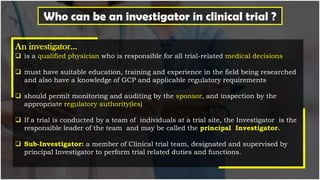
Who can be an investigator in clinical trial ?
An investigator…
❑ is a qualified physician who is responsible for all trial-related medical decisions
❑ must have suitable education, training and experience in the field being researched
and also have a knowledge of GCP and applicable regulatory requirements
❑ should permit monitoring and auditing by the sponsor, and inspection by the
appropriate regulatory authority(ies)
❑ If a trial is conducted by a team of individuals at a trial site, the Investigator is the
responsible leader of the team and may be called the principal Investigator.
❑ Sub-Investigator: a member of Clinical trial team, designated and supervised by
principal Investigator to perform trial related duties and functions.
INVESTIGATOR’S
QUALIFICATIONS
AND
AGREEMENTS
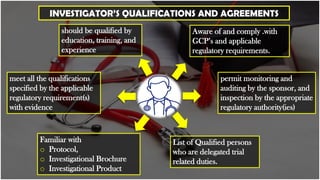
INVESTIGATOR’S QUALIFICATIONS AND AGREEMENTS
should be qualified by
education, training, and
experience
meet all the qualifications
specified by the applicable
regulatory requirement(s)
with evidence
Familiar with
o Protocol,
o Investigational Brochure
o Investigational Product
Aware of and comply .with
GCP’s and applicable
regulatory requirements.
permit monitoring and
auditing by the sponsor, and
inspection by the appropriate
regulatory authority(ies)
List of Qualified persons
who are delegated trial
related duties.
ADEQUATE RESOURCES
Adequate Resources
Recruit number of suitable
subjects within the agreed
recruitment period
Having sufficient time to
conduct and complete
within the agreed trial
period
Arrange adequate number
of qualified staff and
facilities for the duration of
the trial to conduct the trial
properly and safely
Ensure that all persons
assisting with the trial are
adequately informed about
the protocol, investigational
products and their trial
related duties and function
MEDICAL CARE OF
TRIAL SUBJECTS
MEDICAL CARE OF TRIAL SUBJECTS
Ensure that adequate medical care is provided to a
subject for any adverse events, including clinically
significant laboratory values
Inform a subject when medical care is needed for
intercurrent illness(es)
Inform the subject’s primary physician about the
subject’s participation
Although a subject is not obliged to give his/her
reason(s) for withdrawing prematurely from a trial, the
investigator should make a reasonable effort to
ascertain the reason(s), while fully respecting the
subject's rights.
COMMUNICATION WITH
IRB/IEC
COMMUNICATION WITH IRB/IEC
Before initiating a trial investigator should have: written and dated
approval/favorable opinion from the IRB/IEC for the
Trial protocol
written informed
consent form
consent form
updates
subject recruitment procedures
& other written information to
be provided to subjects
Investigator should provide current and updated { if made } copy of investigator
brochure to IRB/IEC
During the trial the Investigator should provide to the IRB/IEC all documents
subject to review.
COMPLIANCE
WITH
PROTOCOL
COMPLIANCE WITH PROTOCOL
Conduct the trial in compliance with the protocol agreed by sponsor and Regulatory
authorities and sign the protocol, or an alternative contract, to confirm agreement.
Should not implement any deviation from protocol without agreement by the sponsor
and prior review.
EXCEPT…. In emergency where necessary to eliminate immediate hazard to trial
subjects or if change involves only logistical or administrative aspect of the trial
( eg. Change of monitor or change of telephone Numbers)
Person designated by the Investigator, should document and explain any deviation
from the approved protocol.
As soon as possible, the implemented deviation or change, the reasons for it, and, if
appropriate, the proposed Protocol amendment(s) should be submitted to sponsor,
IRB/IEC and regulatory authorities
INVESTIGATIONAL PRODUCT(S)
MAINTAIN RECORDS
Should maintain records of the
product's
✓ delivery to the trial site
✓ inventory at the site
✓ use by each subject
✓ the return to the sponsor
or
✓ alternative disposition of
unused product(s).
STORAGE
Should be stored as specified by
the sponsor and in accordance
with applicable regulatory
requirement(s).
The investigator, or a person designated
by the investigator, should explain the
correct use of the investigational
product(s) to each subject and should
check, at intervals appropriate for the
trial, that each subject is following the
instructions properly.
ENSURE
The investigator should ensure
that the investigational product(s)
are used only in accordance with
the approved protocol.
EXPLAIN / CHECKING
RANDOMIZATION PROCEDURES
AND UNBLINDING
RANDOMIZATION PROCEDURES AND UNBLINDING
❑ The investigator should follow the trial's randomization
procedures, if any, and should ensure that the code is broken
only in accordance with the protocol.
❑ If the trial is blinded, the investigator should promptly
document and explain to the sponsor any premature unblinding
(e.g., accidental unblinding, unblinding due to a serious adverse
event) of the investigational product(s)
INFORMED CONSENT OF TRIAL
SUBJECTS
INFORMED CONSENT OF TRIAL SUBJECTS
While obtaining and documenting Informed consent,
Investigator must -
✓Comply with Regulatory Requirements
✓Adhere to GCP
✓Ethical principles from Declaration of Helsinki
Prior to trial, investigator should have IRB/IEC’s
written approval of-
✓Written Informed consent form/ revised ICF
✓For any other written information shared with
subjects
✓ Communication of revised ICF should
be documented
✓ No one should unduly force subject
for participation
✓ Ample time for enquiring about trial &
all questions should be
answered
-
Language
•Non- technical
•that appears to waive legal rights of subject or
release organizations/ people involved in CT
from liability of negligence should NOT be
used
Legally Acceptable
Representative(LAR)
•Incase, subject is unable to give informed
consent, investigator informs all the aspects
of trial to LAR
•Eg. Minors, Patient with dementia etc
Impartial Witness
•Incase, Subject/LAR unable to read
•Signs ICF after Subject/LAR has given oral
consent and if possible personally signed and
dated
•By signing ICF, Impartial witness attests that
all information was accurately explained &
understood by Subject/LAR
✓ Prior to participation, Subject/LAR should
receive a copy of ICF; any other written
Information
✓ and during participation copy of updated
ICF ; any amendments in written
information provided
✓ Subjects who are enrolled after consent
of LAR, should be informed about trial to
extent of their understanding
ICF continued..
ICF continued..
ICF continued..
- Non-therapeutic trial should be conducted only in subjects who can personally give consent, except in
these situations.
- Also, subjects should be closely monitored and withdrawn if they appear unduly distressed.
When objectives of trial cannot be met with such subjects
Foreseeable risks in subject are low
Negative impact on subjects well being is minimized or low
Trial is not prohibited by law
Approval of IRB/IEC is expressly sought for inclusion of such subjects
Emergency
situation, and
Subject’s
consent not
possible
LAR present Take consent
LAR absent
Measures prescribed in Protocol
Documented approval of IRB/IEC to
protect the rights, safety & well being of
patients
Ensure Compliance with regulatory
requirements
Inform Subject/ LAR as soon as possible
ICF continued..
RECORDS
AND
REPORTS
RECORDS AND REPORTS
The source documents and trial
records should be maintained
with adequacy and accuracy by
the investigator
Data reported to the sponsor
in the CRF, that are derived
from source documents,
should be consistent with the
source documents
Any change or correction to a
CRF should be dated, Initialed
and explained and should not
obscure the original entry(i.e.
Audit trail should be
maintained)
The Investigator should maintain
the trail documents as specified in
the Essential documents for the
conduct of a clinical trail.
Measures should be taken to
prevent accidental or premature
destruction of these documents
The financial aspects of the
trail should be documented in
agreement with the sponser
and Investigator.
PROGRESS
REPORTS
PROGRESS REPORTS
Status Report
Submit written summaries of
the trial status to the
IRB/IEC annually, or more
frequently, if requested by
the IRB/IEC.
Risk Report
Should promptly provide written reports to
the sponsor, the IRB/IEC and, where
applicable, the institution on any changes
significantly affecting the conduct of the trial,
and/or increasing the risk to subjects.
SAFETY
REPORTING
SAFETY REPORTING
All serious adverse events (SAEs)
should be reported immediately to
the sponsor
EXCEPT
for those SAEs that the protocol or
other document (e.g., Investigator's
Brochure)identifies as not needing
immediate reporting.
The immediate and follow-up
reports should identify subjects
by unique code numbers
assigned to the trial subjects.
Should follow regulatory requirements
should report unexpected SAE’s to
regulatory authorities
Identified abnormalities & SAE’s in the
protocol which are critical to safety
evaluations should be reported within the
time periods specified by the sponsor in
the protocol.
For reported deaths, the Investigator should supply the sponsor and the
IRB/IEC with any additional requested information (e.g., autopsy
reports and terminal medical reports).
PREMATURE
TERMINATION
OR
SUSPENSION OF
A TRIAL
PREMATURE TERMINATION OR
SUSPENSION OF A TRIAL
If the investigator terminates
or suspends a trial without
prior agreement of the
sponsor
If the sponsor terminates or
suspends a trial
If the IRB/IEC terminates
or suspends its
approval/favourable opinion
of a trial
The investigator should inform the
institution where applicable, and the
investigator should promptly inform
the sponsor and the IRB/IEC, and
should provide the sponsor and the
IRB/IEC a detailed written
explanation of the termination or
suspension.
The investigator should promptly
inform the institution where
applicable and the investigator
should promptly
inform the IRB/IEC and provide
the IRB/IEC a detailed written
explanation of the
termination or suspension.
The investigator should inform
the institution where applicable
and the investigator should
promptly notify the sponsor and
provide the sponsor with
a detailed written explanation of
the termination or suspension.
FINAL
REPORT(S)
BY
INVESTIGATOR
FINAL REPORT(S) BY INVESTIGATOR
should inform the
institution
should provide the
IRB/IEC with a
summary of the
trial’s outcome
should provide the
regulatory
authority(ies) with
any reports required.
COMPLETION OF
TRIAL
REFERENCE
REFERENCE
❑ https://database.ich.org/sites/default/fil
es/E6_R2_Addendum.pdf
Investigators Responsibilities

Investigators Responsibilities

  • 1.
    INVESTIGATOR’S RESPONSIBILITIES Bhavya RajanM.tech PruthvirajPharmDTejaswiniBPharm Presented by ClinoSol research Pvt.Ltd Education and research center
  • 2.
    1. Investigator’s Qualificationsand Agreements 2. Adequate Resources 3. Medical Care of Trial Subjects 4. Communication with IRB/IEC 5. Compliance with Protocol 6. Investigational Product(s) 7. Randomization Procedures and Unblinding 8. Informed Consent of Trial Subjects 9. Records and Reports 10.Progress Reports 11.Safety Reporting 12.Premature Termination or Suspension of a Trial 13.Final Report(s) by Investigator CONTENT
  • 3.
    Who can bean investigator in clinical trial ? An investigator… ❑ is a qualified physician who is responsible for all trial-related medical decisions ❑ must have suitable education, training and experience in the field being researched and also have a knowledge of GCP and applicable regulatory requirements ❑ should permit monitoring and auditing by the sponsor, and inspection by the appropriate regulatory authority(ies) ❑ If a trial is conducted by a team of individuals at a trial site, the Investigator is the responsible leader of the team and may be called the principal Investigator. ❑ Sub-Investigator: a member of Clinical trial team, designated and supervised by principal Investigator to perform trial related duties and functions.
  • 4.
  • 5.
    INVESTIGATOR’S QUALIFICATIONS ANDAGREEMENTS should be qualified by education, training, and experience meet all the qualifications specified by the applicable regulatory requirement(s) with evidence Familiar with o Protocol, o Investigational Brochure o Investigational Product Aware of and comply .with GCP’s and applicable regulatory requirements. permit monitoring and auditing by the sponsor, and inspection by the appropriate regulatory authority(ies) List of Qualified persons who are delegated trial related duties.
  • 6.
  • 7.
    Adequate Resources Recruit numberof suitable subjects within the agreed recruitment period Having sufficient time to conduct and complete within the agreed trial period Arrange adequate number of qualified staff and facilities for the duration of the trial to conduct the trial properly and safely Ensure that all persons assisting with the trial are adequately informed about the protocol, investigational products and their trial related duties and function
  • 8.
  • 9.
    MEDICAL CARE OFTRIAL SUBJECTS Ensure that adequate medical care is provided to a subject for any adverse events, including clinically significant laboratory values Inform a subject when medical care is needed for intercurrent illness(es) Inform the subject’s primary physician about the subject’s participation Although a subject is not obliged to give his/her reason(s) for withdrawing prematurely from a trial, the investigator should make a reasonable effort to ascertain the reason(s), while fully respecting the subject's rights.
  • 10.
  • 11.
    COMMUNICATION WITH IRB/IEC Beforeinitiating a trial investigator should have: written and dated approval/favorable opinion from the IRB/IEC for the Trial protocol written informed consent form consent form updates subject recruitment procedures & other written information to be provided to subjects Investigator should provide current and updated { if made } copy of investigator brochure to IRB/IEC During the trial the Investigator should provide to the IRB/IEC all documents subject to review.
  • 12.
  • 13.
    COMPLIANCE WITH PROTOCOL Conductthe trial in compliance with the protocol agreed by sponsor and Regulatory authorities and sign the protocol, or an alternative contract, to confirm agreement. Should not implement any deviation from protocol without agreement by the sponsor and prior review. EXCEPT…. In emergency where necessary to eliminate immediate hazard to trial subjects or if change involves only logistical or administrative aspect of the trial ( eg. Change of monitor or change of telephone Numbers) Person designated by the Investigator, should document and explain any deviation from the approved protocol. As soon as possible, the implemented deviation or change, the reasons for it, and, if appropriate, the proposed Protocol amendment(s) should be submitted to sponsor, IRB/IEC and regulatory authorities
  • 14.
  • 15.
    INVESTIGATIONAL PRODUCT(S) MAINTAIN RECORDS Shouldmaintain records of the product's ✓ delivery to the trial site ✓ inventory at the site ✓ use by each subject ✓ the return to the sponsor or ✓ alternative disposition of unused product(s). STORAGE Should be stored as specified by the sponsor and in accordance with applicable regulatory requirement(s). The investigator, or a person designated by the investigator, should explain the correct use of the investigational product(s) to each subject and should check, at intervals appropriate for the trial, that each subject is following the instructions properly. ENSURE The investigator should ensure that the investigational product(s) are used only in accordance with the approved protocol. EXPLAIN / CHECKING
  • 16.
  • 17.
    RANDOMIZATION PROCEDURES ANDUNBLINDING ❑ The investigator should follow the trial's randomization procedures, if any, and should ensure that the code is broken only in accordance with the protocol. ❑ If the trial is blinded, the investigator should promptly document and explain to the sponsor any premature unblinding (e.g., accidental unblinding, unblinding due to a serious adverse event) of the investigational product(s)
  • 18.
    INFORMED CONSENT OFTRIAL SUBJECTS
  • 19.
    INFORMED CONSENT OFTRIAL SUBJECTS While obtaining and documenting Informed consent, Investigator must - ✓Comply with Regulatory Requirements ✓Adhere to GCP ✓Ethical principles from Declaration of Helsinki Prior to trial, investigator should have IRB/IEC’s written approval of- ✓Written Informed consent form/ revised ICF ✓For any other written information shared with subjects ✓ Communication of revised ICF should be documented ✓ No one should unduly force subject for participation ✓ Ample time for enquiring about trial & all questions should be answered
  • 20.
    - Language •Non- technical •that appearsto waive legal rights of subject or release organizations/ people involved in CT from liability of negligence should NOT be used Legally Acceptable Representative(LAR) •Incase, subject is unable to give informed consent, investigator informs all the aspects of trial to LAR •Eg. Minors, Patient with dementia etc Impartial Witness •Incase, Subject/LAR unable to read •Signs ICF after Subject/LAR has given oral consent and if possible personally signed and dated •By signing ICF, Impartial witness attests that all information was accurately explained & understood by Subject/LAR ✓ Prior to participation, Subject/LAR should receive a copy of ICF; any other written Information ✓ and during participation copy of updated ICF ; any amendments in written information provided ✓ Subjects who are enrolled after consent of LAR, should be informed about trial to extent of their understanding ICF continued..
  • 21.
  • 22.
  • 23.
    - Non-therapeutic trialshould be conducted only in subjects who can personally give consent, except in these situations. - Also, subjects should be closely monitored and withdrawn if they appear unduly distressed. When objectives of trial cannot be met with such subjects Foreseeable risks in subject are low Negative impact on subjects well being is minimized or low Trial is not prohibited by law Approval of IRB/IEC is expressly sought for inclusion of such subjects
  • 24.
    Emergency situation, and Subject’s consent not possible LARpresent Take consent LAR absent Measures prescribed in Protocol Documented approval of IRB/IEC to protect the rights, safety & well being of patients Ensure Compliance with regulatory requirements Inform Subject/ LAR as soon as possible ICF continued..
  • 25.
  • 26.
    RECORDS AND REPORTS Thesource documents and trial records should be maintained with adequacy and accuracy by the investigator Data reported to the sponsor in the CRF, that are derived from source documents, should be consistent with the source documents Any change or correction to a CRF should be dated, Initialed and explained and should not obscure the original entry(i.e. Audit trail should be maintained) The Investigator should maintain the trail documents as specified in the Essential documents for the conduct of a clinical trail. Measures should be taken to prevent accidental or premature destruction of these documents The financial aspects of the trail should be documented in agreement with the sponser and Investigator.
  • 27.
  • 28.
    PROGRESS REPORTS Status Report Submitwritten summaries of the trial status to the IRB/IEC annually, or more frequently, if requested by the IRB/IEC. Risk Report Should promptly provide written reports to the sponsor, the IRB/IEC and, where applicable, the institution on any changes significantly affecting the conduct of the trial, and/or increasing the risk to subjects.
  • 29.
  • 30.
    SAFETY REPORTING All seriousadverse events (SAEs) should be reported immediately to the sponsor EXCEPT for those SAEs that the protocol or other document (e.g., Investigator's Brochure)identifies as not needing immediate reporting. The immediate and follow-up reports should identify subjects by unique code numbers assigned to the trial subjects. Should follow regulatory requirements should report unexpected SAE’s to regulatory authorities Identified abnormalities & SAE’s in the protocol which are critical to safety evaluations should be reported within the time periods specified by the sponsor in the protocol. For reported deaths, the Investigator should supply the sponsor and the IRB/IEC with any additional requested information (e.g., autopsy reports and terminal medical reports).
  • 31.
  • 32.
    PREMATURE TERMINATION OR SUSPENSIONOF A TRIAL If the investigator terminates or suspends a trial without prior agreement of the sponsor If the sponsor terminates or suspends a trial If the IRB/IEC terminates or suspends its approval/favourable opinion of a trial The investigator should inform the institution where applicable, and the investigator should promptly inform the sponsor and the IRB/IEC, and should provide the sponsor and the IRB/IEC a detailed written explanation of the termination or suspension. The investigator should promptly inform the institution where applicable and the investigator should promptly inform the IRB/IEC and provide the IRB/IEC a detailed written explanation of the termination or suspension. The investigator should inform the institution where applicable and the investigator should promptly notify the sponsor and provide the sponsor with a detailed written explanation of the termination or suspension.
  • 33.
  • 34.
    FINAL REPORT(S) BYINVESTIGATOR should inform the institution should provide the IRB/IEC with a summary of the trial’s outcome should provide the regulatory authority(ies) with any reports required. COMPLETION OF TRIAL
  • 35.
  • 36.