DivyanshuBhoyar
Divyanshu Bhoyar
CSE Sem1 Roll no 17
DivyanshuBhoyar
2
It is, however, possible to improve your presentation skills with a bit of work..
These slides focus on the same.
Presenting information clearly and effectively is a key skill in
getting your message across. Today, presentation skills are
required in almost every field, and most of us are required to
give presentations on occasions. While some people take this in
their stride, others find it much more challenging
DivyanshuBhoyar
3
03. Wedding
02. Proposal
.
01. ConferenceVarious types of
presentations
include
03. Vote of thanks
03. Farewell
03. Seeking investment
DivyanshuBhoyar
4
They do not, however, all
require the same approach.
It follows, therefore, that there
is no single set of rules that
apply to all presentations.
There are, however, some
things that every presentation
opportunity has in common.
These are explained in the
coming slides.
DivyanshuBhoyar
5
This does NOT necessarily mean that you have written out
your speech verbatim and rehearsed it until you know it off by
heart—although that might work for some people. It does,
however, mean that you have to be confident that you are
saying the right thing, in the right way, to the right people..
You will present better if
you have prepared
effectively.
01.
Co,,on points
DivyanshuBhoyar
6
Every presentation will be better if you have clearly
considered the message that you want or need to convey,
and how best to convey it to your audience. These two pieces
of information drive your style, structure, content, and use of
visual aids.
You need to be clear
about your audience
and your message.
02.
Common points
DivyanshuBhoyar
7
In other words, don’t outstay your welcome. Almost every
speech or presentation is better if it is shorter. Nobody minds
going for coffee early or finishing before they expected to do
so. Everybody minds being held up.
You must never overrun
your allocated time.
03.
Common points
DivyanshuBhoyar
8
As a rule, your audience is there (more or less) voluntarily.
They have chosen to listen to you, and they want to enjoy
your presentation. The occasion is yours to lose.
Generally speaking,
your audience starts on
your side.
04.
Common points
www.websitename.com 9
Skip
Skip through some slides to
a section that they may find
more interesting;
Suggest
Suggest that everyone
looks a bit sleepy, and
maybe it would be better to
start questions early, or
have a discussion.
Ask
Ask the audience at the start of the
presentation what they are expecting
and what they want you to cover. That
way, you can tailor the presentation to
fit their expectations
Few other Important Points
DivyanshuBhoyar
1
0
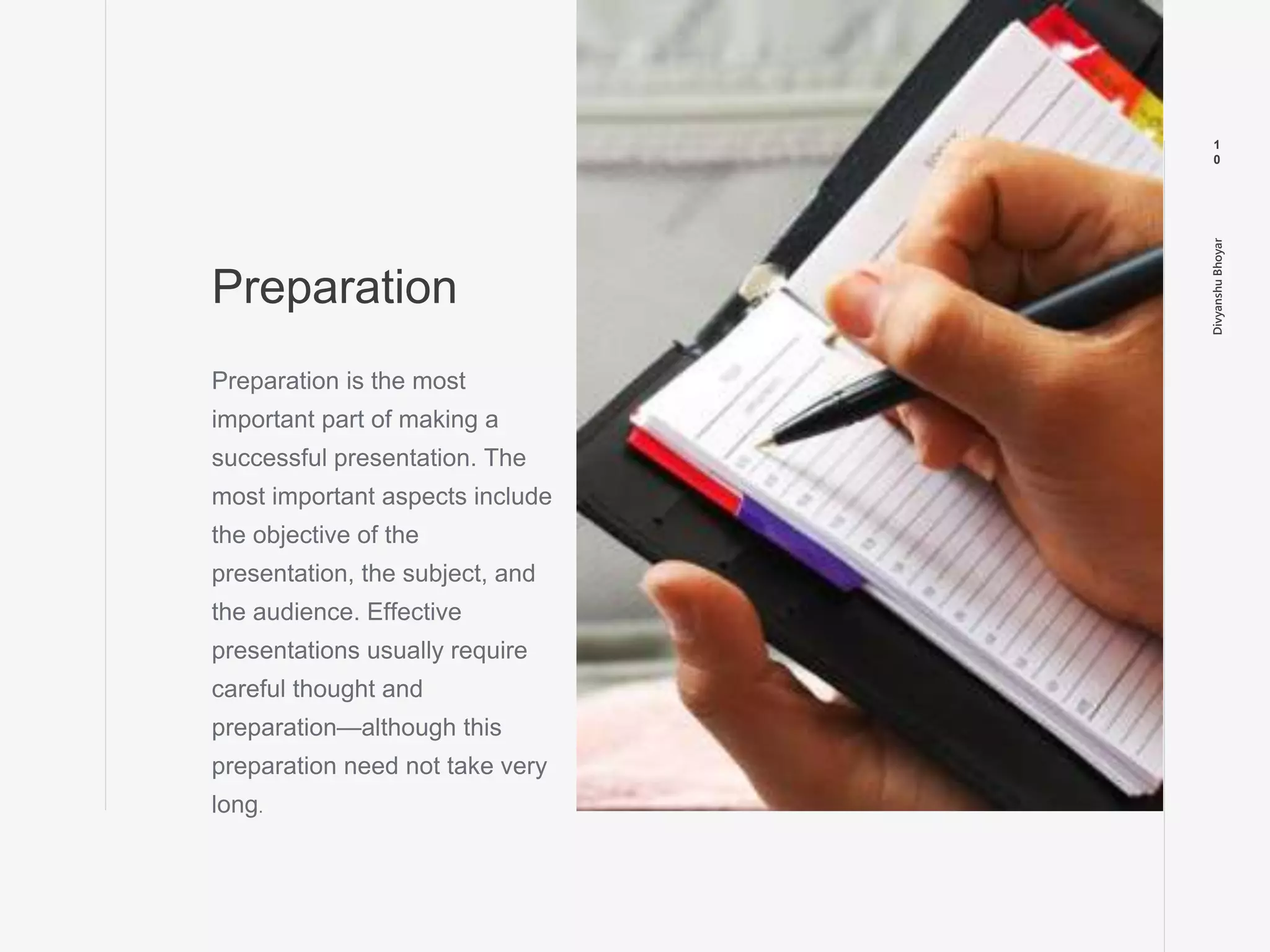
Preparation is the most
important part of making a
successful presentation. The
most important aspects include
the objective of the
presentation, the subject, and
the audience. Effective
presentations usually require
careful thought and
preparation—although this
preparation need not take very
long.
Preparation
02. Writing
By the time you come to write your
presentation, you should know
exactly what you want to say and
the order in which you want to say it.
You may want to use one of the
standard presentation structures,
such as ‘What, Why, How?’. You will
also find it helpful to consider how to
tell your story most effectively, and
to use stories in your presentation to
illustrate points.
01. Organize
Irrespective of whether the occasion
is formal or informal, you should
always aim to give a clear, well-
structured delivery. To do so, you
need to organise your presentation
material. You can either do this in
your head, or use a technique like
mind-mapping to help you identify
links and good flow.
03. Decide
You also need to decide on your
presentation method. Presentations
range from the formal to the
informal. Your choice of
presentation method will depend on
many factors, including the
audience, the venue, the facilities,
and your own preferences.
04. Visuals
Visual aids can add another
dimension to your presentation,
helping to hold your audience’s
attention, and also act as a
reminder of what you wanted to
say. However, they need
handling with care. Only use
visual aids if they are necessary
to maintain interest and assist
comprehension. If visual aids
are not used well, they can ruin
a presentation.
DivyanshuBhoyar
1
2
You also need to
remember that many
people find numbers
difficult to understand.
A particular case
of visual aids is
the use of data in
a presentation
There are times when using
data in a presentation can
really help you to tell the
story better BUT not always
DivyanshuBhoyar
1
3
In the midst of
movement and
chaos, keep stillness
inside of you. –
Deepak Chopra
On the day of
presentation
The coming slides cover the important
aspects of preparation on the final day
1
4
You should make a prior visit to see the
room, and ensure that you can operate all the
necessary equipment. There is more about
how to cope, including managing sound
systems, audio-visual equipment and
lecterns
Emotions
Many people also feel very nervous before and
during a presentation. This is entirely normal,
and can even be helpful if you can channel it in
the right way. There are some tried and tested
strategies and techniques to manage your
nerves so that you can concentrate on delivering
an effective and engaging presentation
Managing the
presentation event
1
5
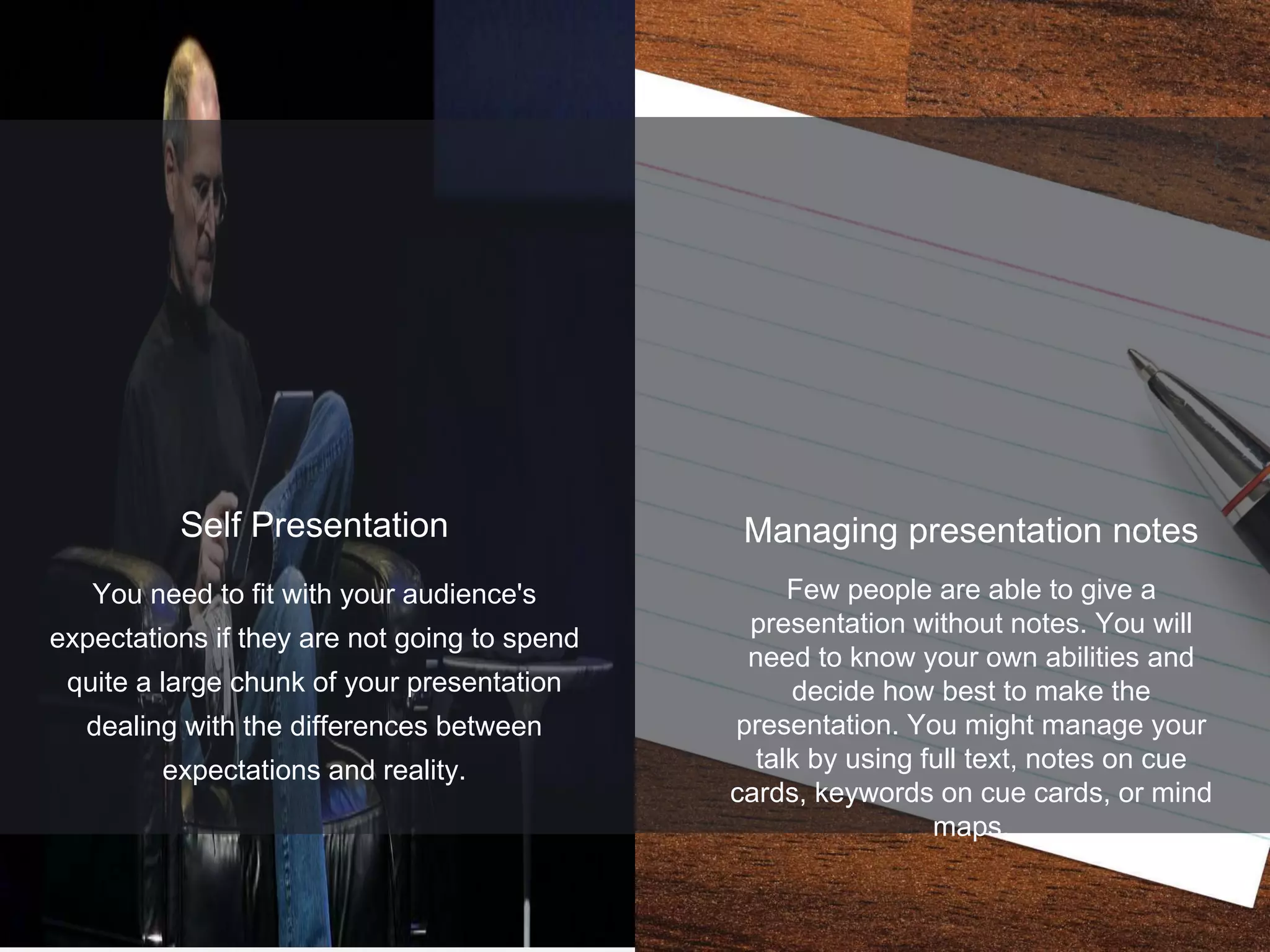
You need to fit with your audience's
expectations if they are not going to spend
quite a large chunk of your presentation
dealing with the differences between
expectations and reality.
Self Presentation Managing presentation notes
Few people are able to give a
presentation without notes. You will
need to know your own abilities and
decide how best to make the
presentation. You might manage your
talk by using full text, notes on cue
cards, keywords on cue cards, or mind
maps.
DivyanshuBhoyar
1
6
After the presentation, you may be
faced with a question-and-answer
session. For many people, this is the
worst part of the event.
Decide in advance how and when you wish
to handle questions. Some speakers prefer
questions to be raised as they arise during
the presentation whilst others prefer to deal
with questions at the end. At the start of
your presentation, you should make clear
your preferences to the audience.
.
17
Thank You.

presentation skills

  • 1.
  • 2.
    DivyanshuBhoyar 2 It is, however,possible to improve your presentation skills with a bit of work.. These slides focus on the same. Presenting information clearly and effectively is a key skill in getting your message across. Today, presentation skills are required in almost every field, and most of us are required to give presentations on occasions. While some people take this in their stride, others find it much more challenging
  • 3.
    DivyanshuBhoyar 3 03. Wedding 02. Proposal . 01.ConferenceVarious types of presentations include 03. Vote of thanks 03. Farewell 03. Seeking investment
  • 4.
    DivyanshuBhoyar 4 They do not,however, all require the same approach. It follows, therefore, that there is no single set of rules that apply to all presentations. There are, however, some things that every presentation opportunity has in common. These are explained in the coming slides.
  • 5.
    DivyanshuBhoyar 5 This does NOTnecessarily mean that you have written out your speech verbatim and rehearsed it until you know it off by heart—although that might work for some people. It does, however, mean that you have to be confident that you are saying the right thing, in the right way, to the right people.. You will present better if you have prepared effectively. 01. Co,,on points
  • 6.
    DivyanshuBhoyar 6 Every presentation willbe better if you have clearly considered the message that you want or need to convey, and how best to convey it to your audience. These two pieces of information drive your style, structure, content, and use of visual aids. You need to be clear about your audience and your message. 02. Common points
  • 7.
    DivyanshuBhoyar 7 In other words,don’t outstay your welcome. Almost every speech or presentation is better if it is shorter. Nobody minds going for coffee early or finishing before they expected to do so. Everybody minds being held up. You must never overrun your allocated time. 03. Common points
  • 8.
    DivyanshuBhoyar 8 As a rule,your audience is there (more or less) voluntarily. They have chosen to listen to you, and they want to enjoy your presentation. The occasion is yours to lose. Generally speaking, your audience starts on your side. 04. Common points
  • 9.
    www.websitename.com 9 Skip Skip throughsome slides to a section that they may find more interesting; Suggest Suggest that everyone looks a bit sleepy, and maybe it would be better to start questions early, or have a discussion. Ask Ask the audience at the start of the presentation what they are expecting and what they want you to cover. That way, you can tailor the presentation to fit their expectations Few other Important Points
  • 10.
    DivyanshuBhoyar 1 0 Preparation is themost important part of making a successful presentation. The most important aspects include the objective of the presentation, the subject, and the audience. Effective presentations usually require careful thought and preparation—although this preparation need not take very long. Preparation
  • 11.
    02. Writing By thetime you come to write your presentation, you should know exactly what you want to say and the order in which you want to say it. You may want to use one of the standard presentation structures, such as ‘What, Why, How?’. You will also find it helpful to consider how to tell your story most effectively, and to use stories in your presentation to illustrate points. 01. Organize Irrespective of whether the occasion is formal or informal, you should always aim to give a clear, well- structured delivery. To do so, you need to organise your presentation material. You can either do this in your head, or use a technique like mind-mapping to help you identify links and good flow. 03. Decide You also need to decide on your presentation method. Presentations range from the formal to the informal. Your choice of presentation method will depend on many factors, including the audience, the venue, the facilities, and your own preferences. 04. Visuals Visual aids can add another dimension to your presentation, helping to hold your audience’s attention, and also act as a reminder of what you wanted to say. However, they need handling with care. Only use visual aids if they are necessary to maintain interest and assist comprehension. If visual aids are not used well, they can ruin a presentation.
  • 12.
    DivyanshuBhoyar 1 2 You also needto remember that many people find numbers difficult to understand. A particular case of visual aids is the use of data in a presentation There are times when using data in a presentation can really help you to tell the story better BUT not always
  • 13.
    DivyanshuBhoyar 1 3 In the midstof movement and chaos, keep stillness inside of you. – Deepak Chopra On the day of presentation The coming slides cover the important aspects of preparation on the final day
  • 14.
    1 4 You should makea prior visit to see the room, and ensure that you can operate all the necessary equipment. There is more about how to cope, including managing sound systems, audio-visual equipment and lecterns Emotions Many people also feel very nervous before and during a presentation. This is entirely normal, and can even be helpful if you can channel it in the right way. There are some tried and tested strategies and techniques to manage your nerves so that you can concentrate on delivering an effective and engaging presentation Managing the presentation event
  • 15.
    1 5 You need tofit with your audience's expectations if they are not going to spend quite a large chunk of your presentation dealing with the differences between expectations and reality. Self Presentation Managing presentation notes Few people are able to give a presentation without notes. You will need to know your own abilities and decide how best to make the presentation. You might manage your talk by using full text, notes on cue cards, keywords on cue cards, or mind maps.
  • 16.
    DivyanshuBhoyar 1 6 After the presentation,you may be faced with a question-and-answer session. For many people, this is the worst part of the event. Decide in advance how and when you wish to handle questions. Some speakers prefer questions to be raised as they arise during the presentation whilst others prefer to deal with questions at the end. At the start of your presentation, you should make clear your preferences to the audience. .
  • 17.